
ACIDBASE CHEMISTRY CONCENTRATION UNITS I Mass concentrations Water
ACID-BASE CHEMISTRY
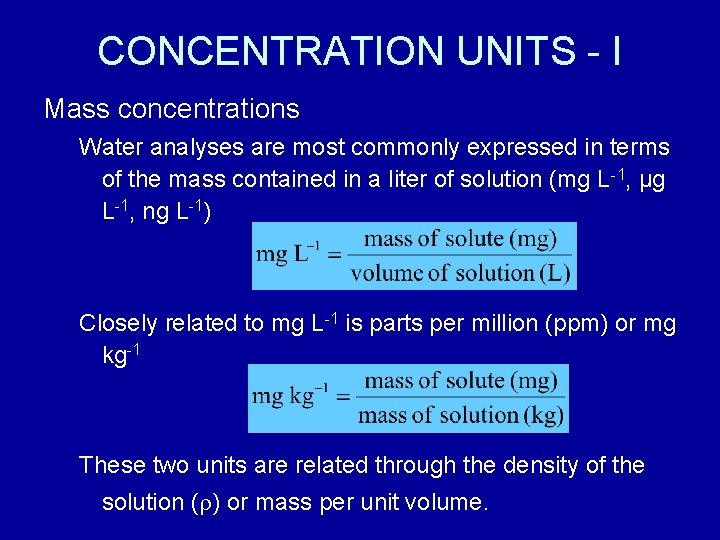
CONCENTRATION UNITS - I Mass concentrations Water analyses are most commonly expressed in terms of the mass contained in a liter of solution (mg L-1, µg L-1, ng L-1) Closely related to mg L-1 is parts per million (ppm) or mg kg-1 These two units are related through the density of the solution ( ) or mass per unit volume.
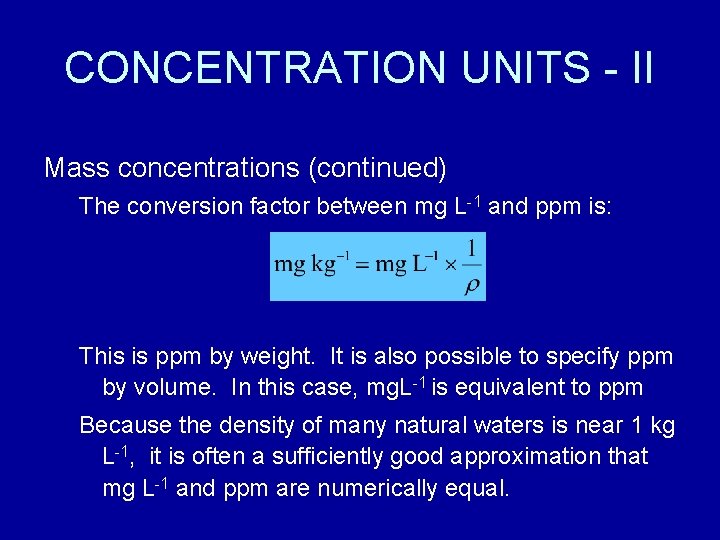
CONCENTRATION UNITS - II Mass concentrations (continued) The conversion factor between mg L-1 and ppm is: This is ppm by weight. It is also possible to specify ppm by volume. In this case, mg. L-1 is equivalent to ppm Because the density of many natural waters is near 1 kg L-1, it is often a sufficiently good approximation that mg L-1 and ppm are numerically equal.
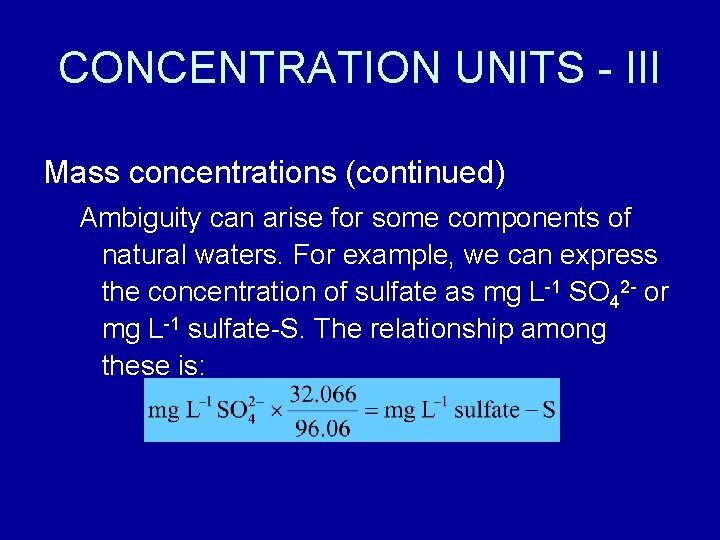
CONCENTRATION UNITS - III Mass concentrations (continued) Ambiguity can arise for some components of natural waters. For example, we can express the concentration of sulfate as mg L-1 SO 42 - or mg L-1 sulfate-S. The relationship among these is:
CONCENTRATION UNITS - IV Molar concentrations In almost all geochemical calculations, it is necessary to use molar concentrations rather than mass concentrations. Molarity (M) = moles of solute/liter of solution Molality (m) = moles of solute/1000 g of solvent If the density of the solution is significantly different from 1 kg L-1, then molality and molarity will be quite different; however, in most natural waters, these quantities are nearly equal and the difference between them can be neglected.

CONCENTRATION UNITS - V Molar concentrations (continued) Conversion from mol L-1 (M) to mg L-1 is accomplished using the formula: where FW is the formula weight of the substance in g mol-1. The reverse conversion is accomplished using:
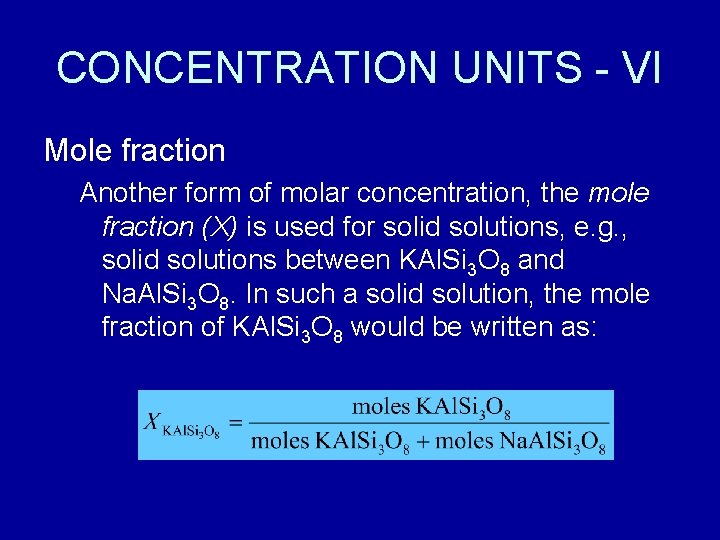
CONCENTRATION UNITS - VI Mole fraction Another form of molar concentration, the mole fraction (X) is used for solid solutions, e. g. , solid solutions between KAl. Si 3 O 8 and Na. Al. Si 3 O 8. In such a solid solution, the mole fraction of KAl. Si 3 O 8 would be written as:
CONCENTRATION UNITS - VII Equivalents and Normality Equivalents (eq) are similar to moles, but take into account the valence of an ion. For example, 0. 002 mol L-1 of Ca 2+ = 0. 004 eq L-1 Ca 2+; 0. 001 mol L-1 of Na+ = 0. 001 eq L-1 Na+; and 0. 003 mol L-1 La 3+ = 0. 009 eq L-1 La 3+. Normality (N) is another name for eq L-1. Alkalinity is an important solution parameter that is expressed as eq L-1 or meq L-1. Hardness is another parameter expressed as eq L-1.
- Slides: 8