
Acid Rain Environmental Education Middle School Program MAINE

- Slides: 17
Acid Rain Environmental Education Middle School Program MAINE DEPARTMENT OF ENVIRONMENTAL PROTECTION Protecting Maine’s Air, Land Water
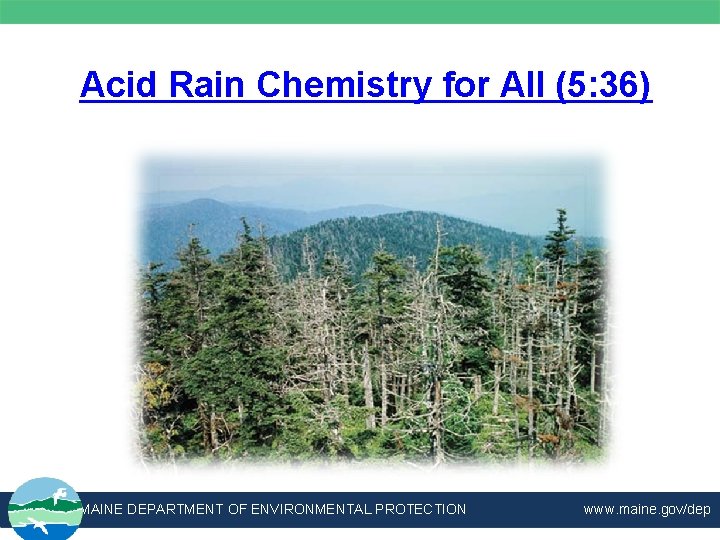
Acid Rain Chemistry for All (5: 36) MAINE DEPARTMENT OF ENVIRONMENTAL PROTECTION www. maine. gov/dep
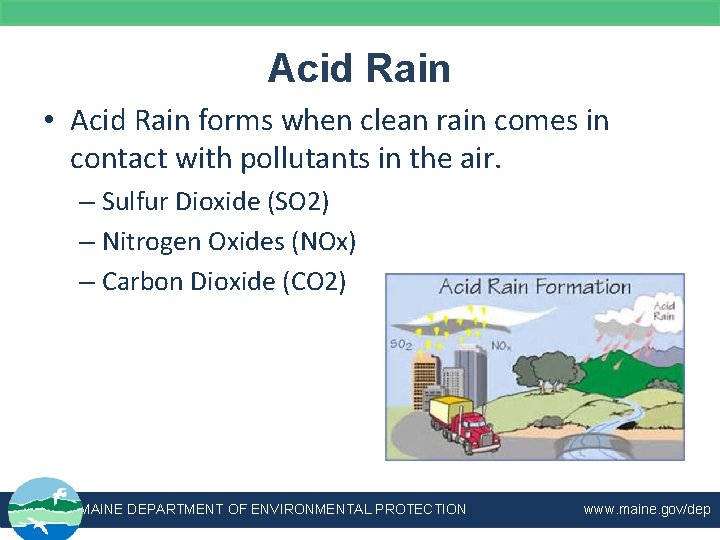
Acid Rain • Acid Rain forms when clean rain comes in contact with pollutants in the air. – Sulfur Dioxide (SO 2) – Nitrogen Oxides (NOx) – Carbon Dioxide (CO 2) MAINE DEPARTMENT OF ENVIRONMENTAL PROTECTION www. maine. gov/dep
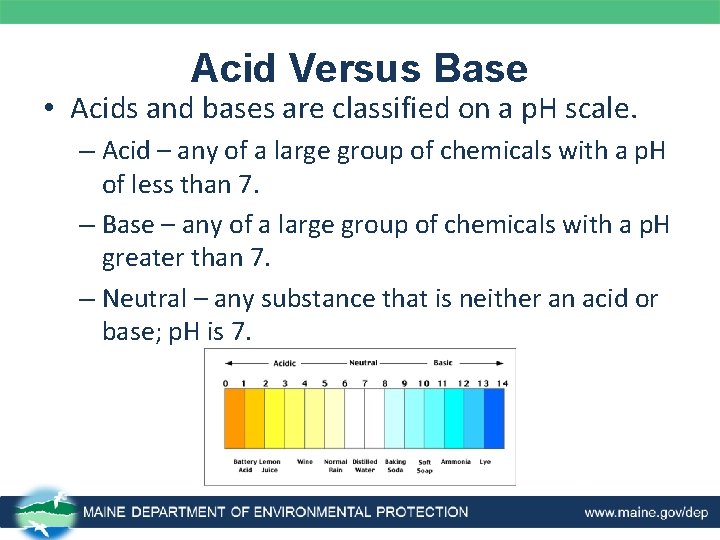
Acid Versus Base • Acids and bases are classified on a p. H scale. – Acid – any of a large group of chemicals with a p. H of less than 7. – Base – any of a large group of chemicals with a p. H greater than 7. – Neutral – any substance that is neither an acid or base; p. H is 7.
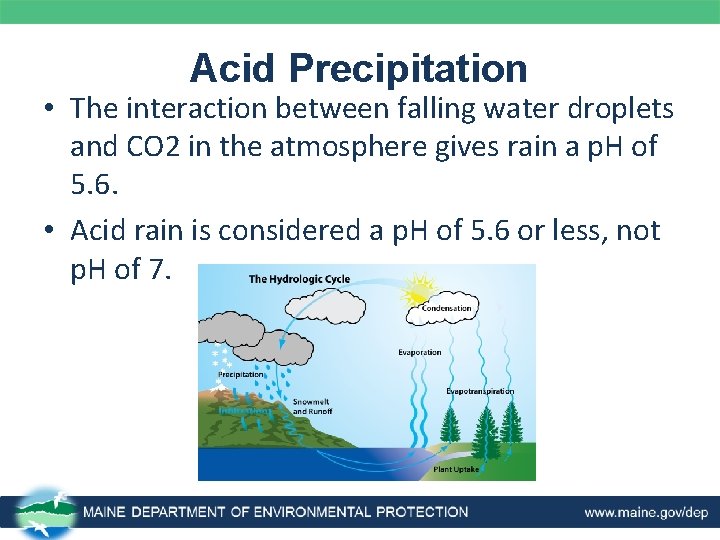
Acid Precipitation • The interaction between falling water droplets and CO 2 in the atmosphere gives rain a p. H of 5. 6. • Acid rain is considered a p. H of 5. 6 or less, not p. H of 7.
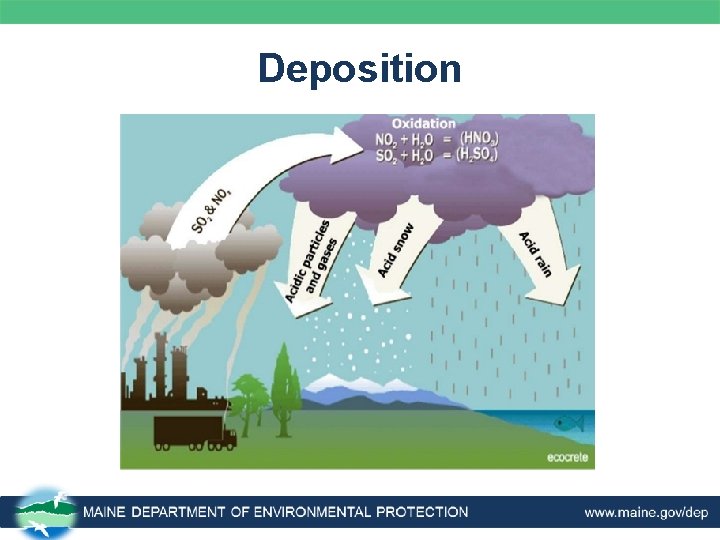
Dry Deposition • About half of the acidity in the atmosphere is deposited onto buildings, cars, homes, and trees as particles and gases. – Dry deposition may be washed from trees and other surfaces by rainstorms. – This runoff water contains acid from the rain and dry deposits, making a more acidic combination that of the acid rain alone. – The combination of acid rain plus dry deposition is called acid deposition.
Deposition
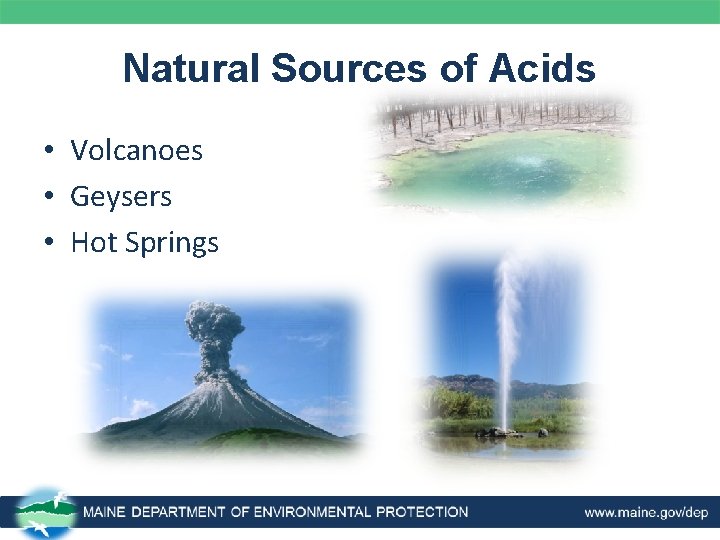
Natural Sources of Acids • Volcanoes • Geysers • Hot Springs
Effects on Ecosystems • Acid rain can damage organisms in an ecosystem. • This may cause a ripple effect harming the ecosystem. • This damage can take years or decades to reverse.
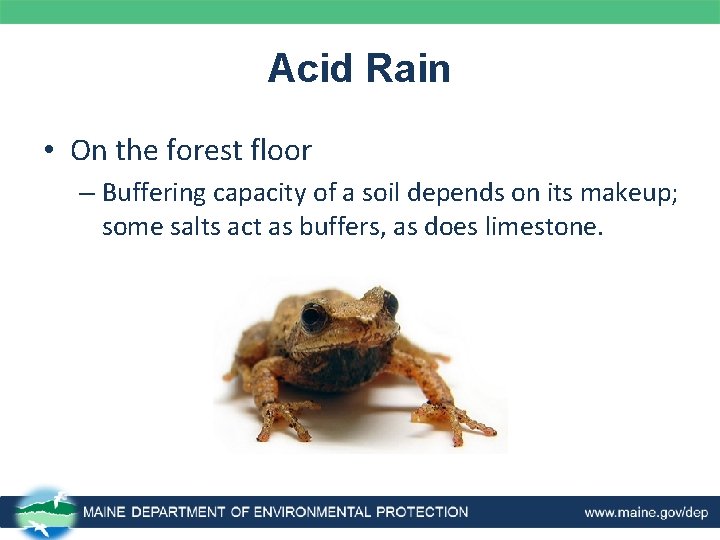
Acid Rain • On the forest floor – Buffering capacity of a soil depends on its makeup; some salts act as buffers, as does limestone.
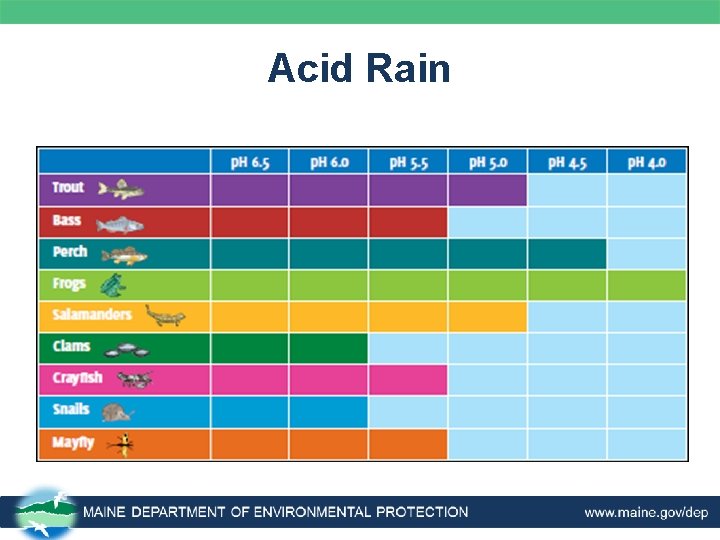
Acid Rain • In ponds, lakes, and streams – Acid rain clearly effects aquatic environment. – Most lakes and streams have a p. H between 6 -8. – If the soils around the lakes and streams can’t buffer the p. H the acid in the rains will affect the water. – Northeast U. S. has a lower buffering capacity, and p. H values can be very low. ~p. H of 5. – As p. H values drop many plants and animals will not thrive.
Acid Rain
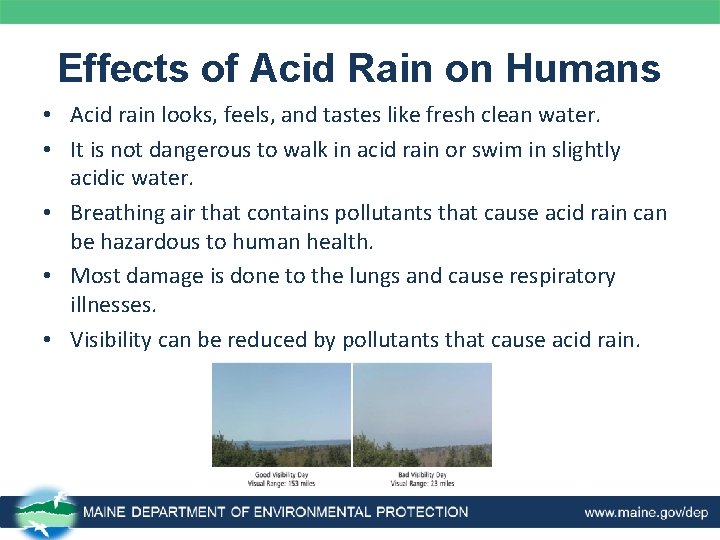
Effects of Acid Rain on Humans • Acid rain looks, feels, and tastes like fresh clean water. • It is not dangerous to walk in acid rain or swim in slightly acidic water. • Breathing air that contains pollutants that cause acid rain can be hazardous to human health. • Most damage is done to the lungs and cause respiratory illnesses. • Visibility can be reduced by pollutants that cause acid rain.
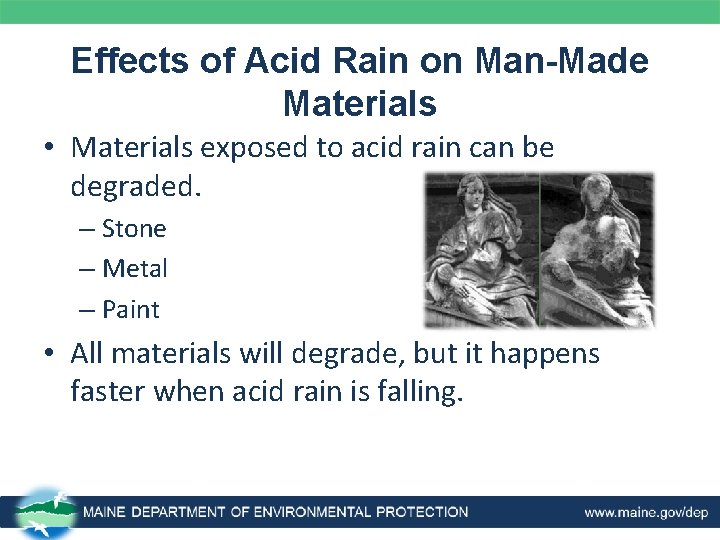
Effects of Acid Rain on Man-Made Materials • Materials exposed to acid rain can be degraded. – Stone – Metal – Paint • All materials will degrade, but it happens faster when acid rain is falling.
What is Being Done? • The Environmental Protection Agency has worked for over 20 years to reduce the effects of acid rain. • The Acid Rain Program began as part of the 1990 Clean Air Act Amendments. • Persons from the EPA, States, Universities, and other agencies set up air quality and deposition monitoring. • NADP is one system to measure wet deposition and collect atmospheric data. • Continuous Emissions Monitoring Systems are used by power plants to track the amount of pollutants they release to the atmosphere.
…And What Can You Do? • • Conserve electricity Use the ENERGY STAR program Use public/shared transportation Reduce your carbon footprint
Add contact information www. maine. gov/dep