
Acid Base Titration Ch 17 4 17 4
Acid - Base Titration Ch 17 4. 17. 4
• Volumetric analysis – a technique for determining the amount of a certain substance by doing a titration • Titration- delivery (from a buret) of a measured volume of a solution with known concentration (titrant) into a substance being analyzed (analyte)
• Equivalence point – the point in the titration where enough titrant has been added to react EXACTLY with the analyte. It is often marked by an indicator • Indicator – a substance added at the beginning of the titration that changes color very near the equivalence point • Endpoint – the point where the indicator actually changes color •
Four types of titrations • Strong acid – strong base • Weak base – strong acid • Weak diprotic acid – strong base
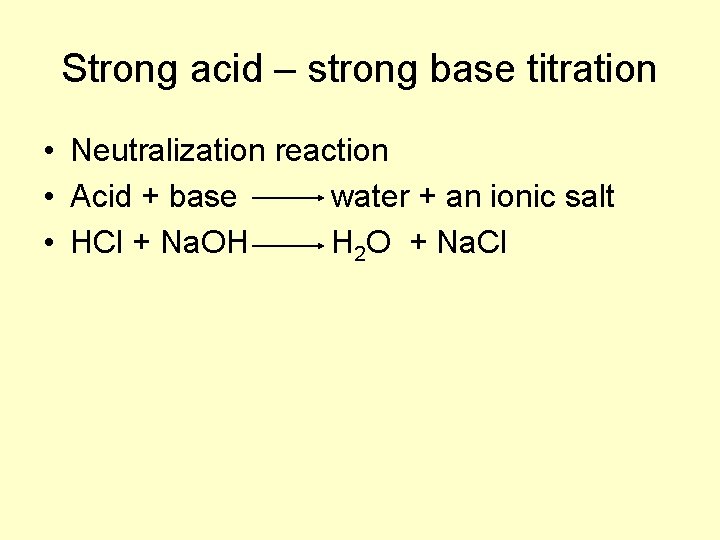
Strong acid – strong base titration • Neutralization reaction • Acid + base water + an ionic salt • HCl + Na. OH H 2 O + Na. Cl

Equivalence pt. happens during titration. It is when moles H+ = moles OH- Equivalence pt. During strong acid/strong base titration is always p. H 7 7 7 Volume Base added Volume Acid added Titration curve of strong acid with strong base Titration curve of strong base with strong acid Type 1: strong acid-strong base titration
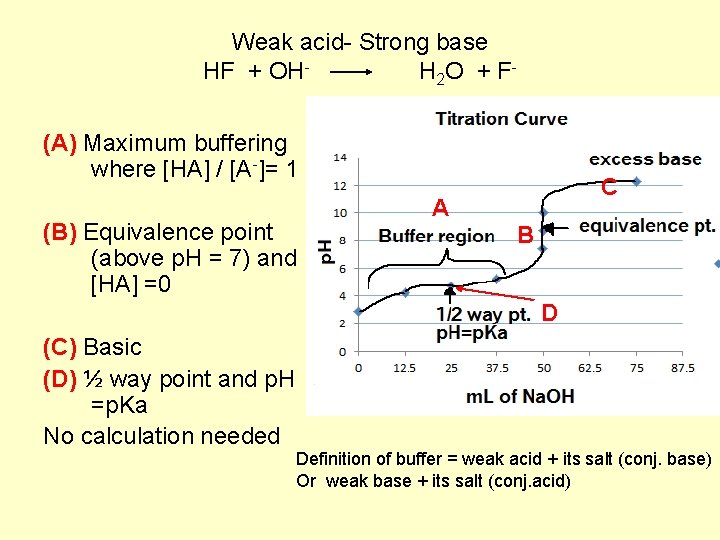
Weak acid- Strong base HF + OHH 2 O + F (A) Maximum buffering where [HA] / [A-]= 1 (B) Equivalence point (above p. H = 7) and [HA] =0 C A B D (C) Basic (D) ½ way point and p. H =p. Ka No calculation needed Definition of buffer = weak acid + its salt (conj. base) Or weak base + its salt (conj. acid)
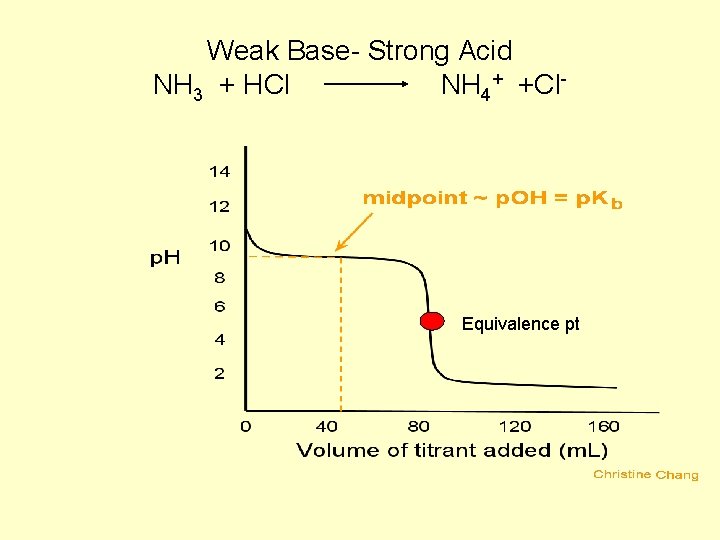
Weak Base- Strong Acid NH 3 + HCl NH 4+ +Cl- Equivalence pt

Weak diprotic acid- strong base • When a weak diprotic acid(H 2 CO 3) is titrated, there are two equivalence points. The curve is not as distinct because of various proton donors and proton acceptors in solution. • Simply knowing the general shape of the titration curve and being able to identify the 2 equiv. pts. Is sufficient for the AP exam.
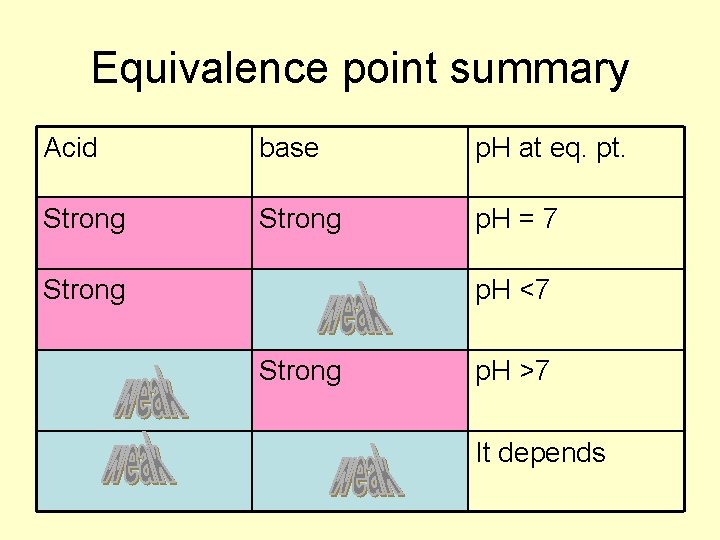
Equivalence point summary Acid base p. H at eq. pt. Strong p. H = 7 Strong p. H <7 Strong p. H >7 It depends
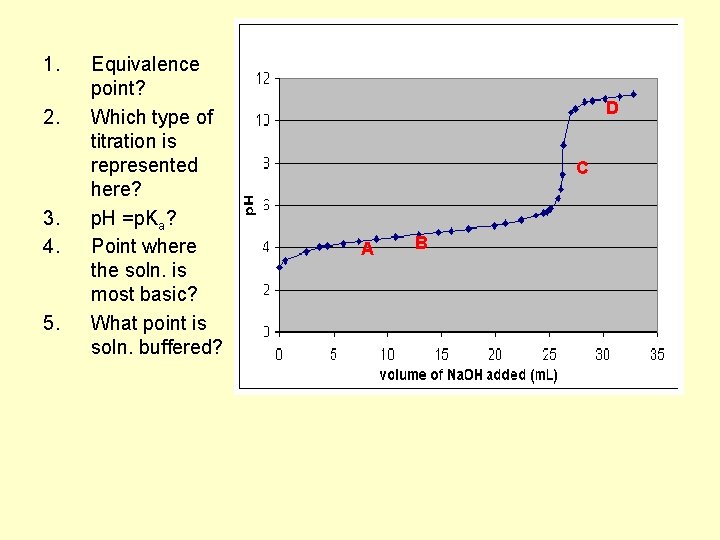
1. 2. 3. 4. 5. Equivalence point? Which type of titration is represented here? p. H =p. Ka? Point where the soln. is most basic? What point is soln. buffered? D C A B
- Slides: 11