
ACID BASE BALANCE Professor Nye Purpose Maintain a
ACID BASE BALANCE Professor Nye
Purpose Maintain a steady balance between acids and bases to achieve homeostasis Health problems lead to imbalance � Diabetes mellitus � Chronic obstructive pulmonary disease (COPD) � Kidney disease
p. H (Normal 7. 35 – 7. 45) Measure of H+ ion concentration Blood is slightly alkaline at p. H 7. 35 to 7. 45 � Less than 7. 35 = acidosis � Greater than 7. 45 = alkalosis
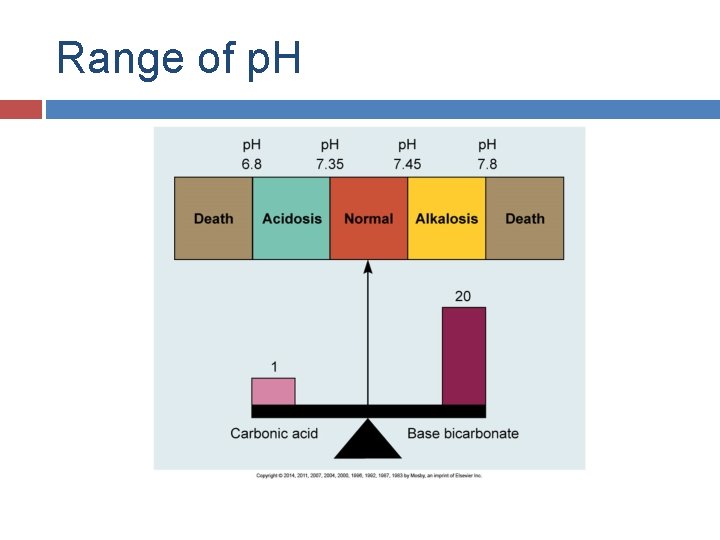
Range of p. H
Acid-Base Regulation Metabolic processes produce acids that must be neutralized and excreted Regulatory mechanisms � Buffers � Respiratory System � Renal System
Buffer System Act chemically to change strong acids to weak acids or bind acids Carbonic acid-bicarbonate, phosphate, protein, and hemoglobin buffers Shifting of hydrogen ion in and out of the cell
Respiratory System Regulation Respiratory center in the medulla controls breathing Increased respirations lead to increased CO 2 elimination and decrease CO 2 in the blood Decreased respirations lead to CO 2 retention
Renal System Regulation Conserves bicarbonate and excretes acid Three mechanisms for acid elimination � Secrete free hydrogen � Combine H+ with ammonia � Excrete weak acids
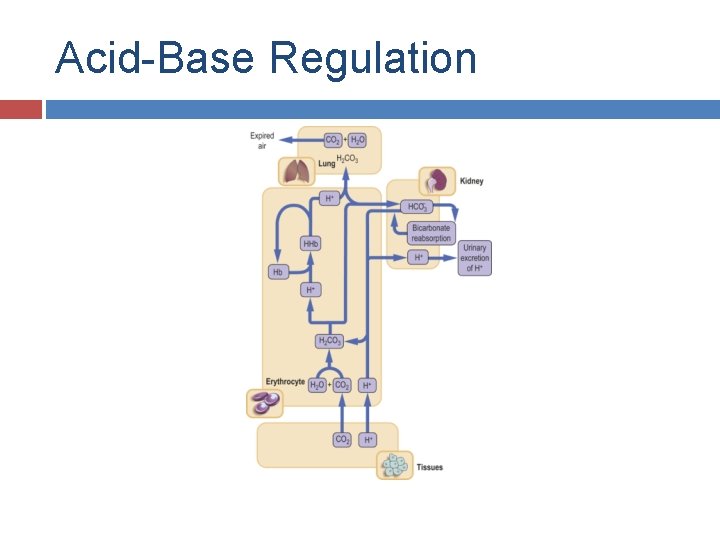
Acid-Base Regulation
Alterations in Acid – Base Balance Imbalances occur when compensatory mechanisms fail Classification of imbalances � Respiratory (CO 2) or metabolic (HCO 3) � Acidosis or alkalosis � Acute or chronic
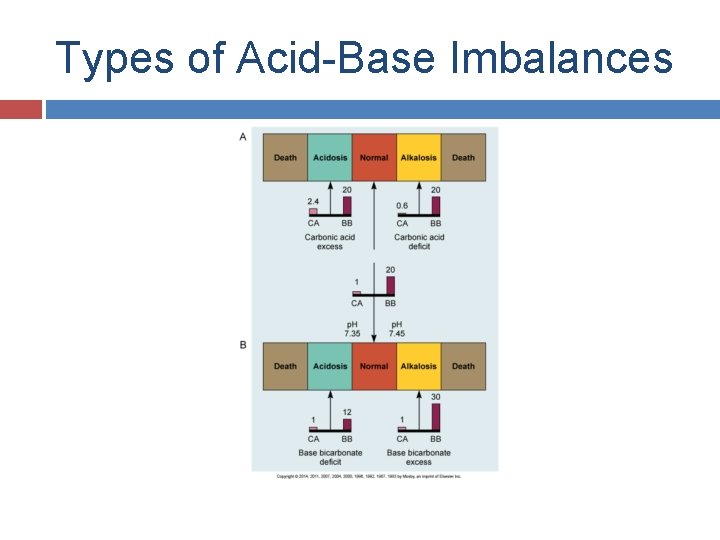
Types of Acid-Base Imbalances
Clinical Manifestations of Acid. Base Imbalances Based on p. H, not source of imbalance Acidosis � Central nervous system (CNS) depression � Kussmaul respirations Alkalosis � CNS irritability � Hypocalcemia
Blood Gas Values Arterial blood gas (ABG) values provide information about � Acid-base status � Underlying cause of imbalance � Body’s ability to regulate p. H � Overall oxygen status
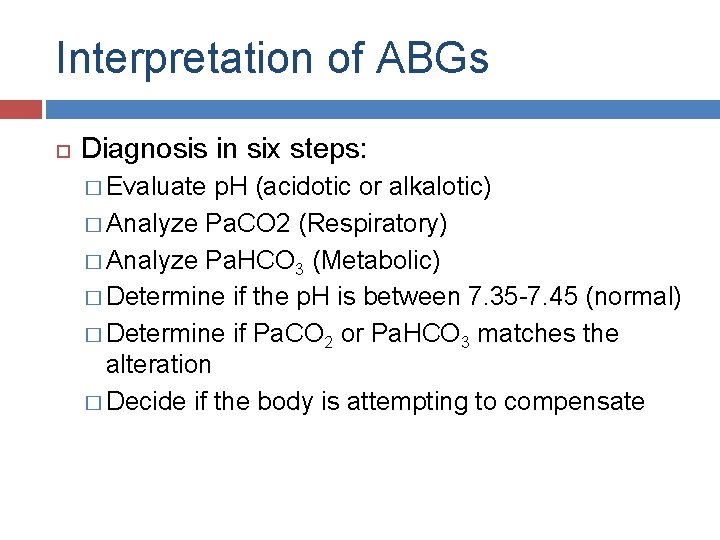
Interpretation of ABGs Diagnosis in six steps: � Evaluate p. H (acidotic or alkalotic) � Analyze Pa. CO 2 (Respiratory) � Analyze Pa. HCO 3 (Metabolic) � Determine if the p. H is between 7. 35 -7. 45 (normal) � Determine if Pa. CO 2 or Pa. HCO 3 matches the alteration � Decide if the body is attempting to compensate

Normal ABG values
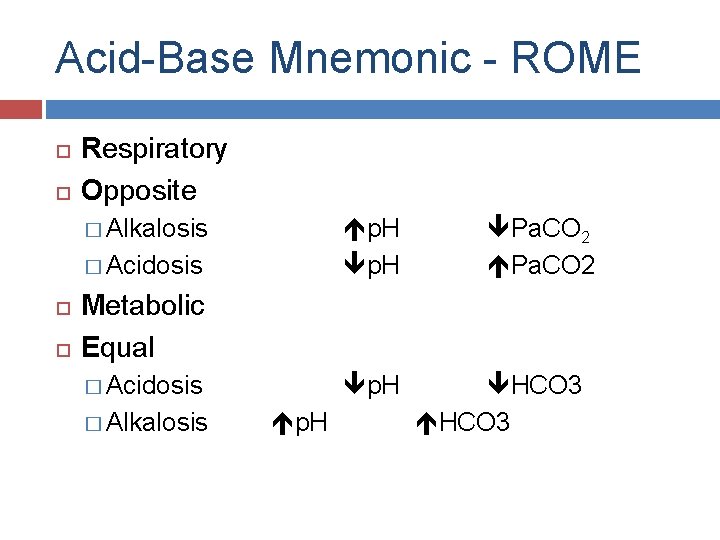
Acid-Base Mnemonic - ROME Respiratory Opposite � Alkalosis p. H � Acidosis Pa. CO 2 Metabolic Equal � Acidosis � Alkalosis p. H HCO 3
Case study Jeri is a 22 -year-old female who has been on a 3 -day party binge for the new year celebration Her friends bring her to the ED after unable to awaken her Assessment reveals shallow respiration with a rate of 8/min, diminished breath sounds, and decreased level of consciousness The physician orders an ABG
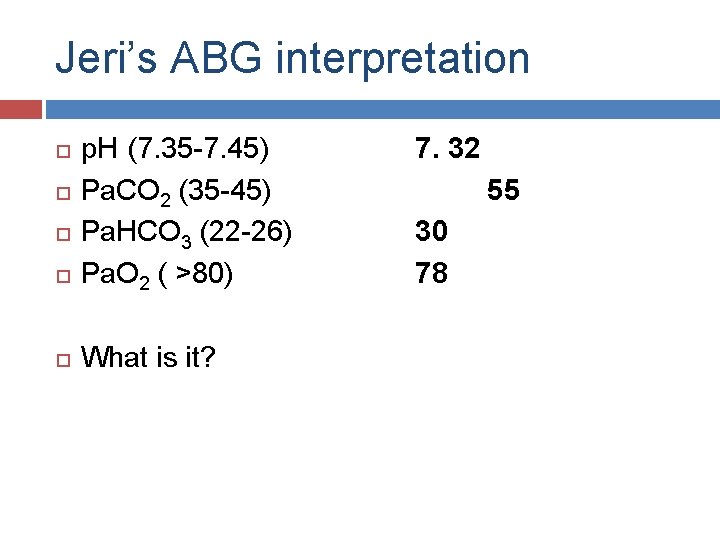
Jeri’s ABG interpretation p. H (7. 35 -7. 45) Pa. CO 2 (35 -45) Pa. HCO 3 (22 -26) Pa. O 2 ( >80) What is it? 7. 32 55 30 78
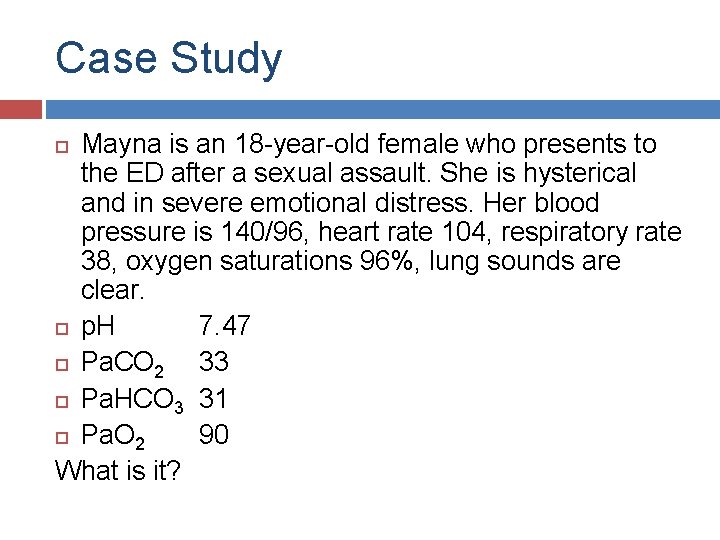
Case Study Mayna is an 18 -year-old female who presents to the ED after a sexual assault. She is hysterical and in severe emotional distress. Her blood pressure is 140/96, heart rate 104, respiratory rate 38, oxygen saturations 96%, lung sounds are clear. p. H 7. 47 Pa. CO 2 33 Pa. HCO 3 31 Pa. O 2 90 What is it?
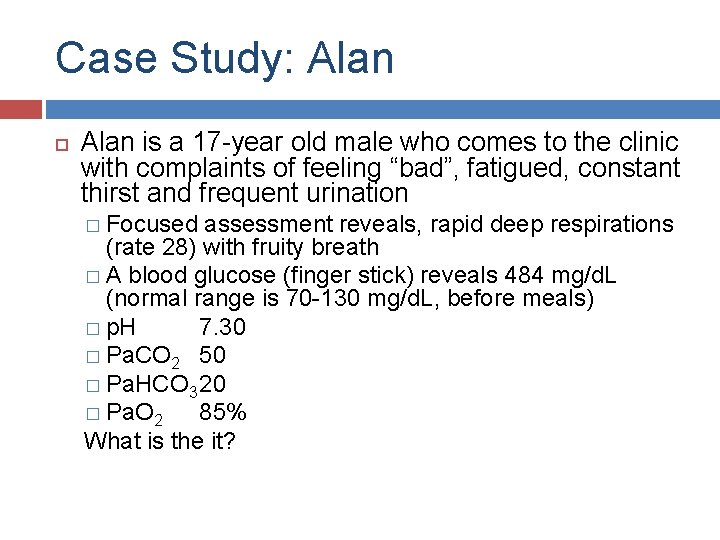
Case Study: Alan is a 17 -year old male who comes to the clinic with complaints of feeling “bad”, fatigued, constant thirst and frequent urination � Focused assessment reveals, rapid deep respirations (rate 28) with fruity breath � A blood glucose (finger stick) reveals 484 mg/d. L (normal range is 70 -130 mg/d. L, before meals) � p. H 7. 30 � Pa. CO 2 50 � Pa. HCO 3 20 � Pa. O 2 85% What is the it?
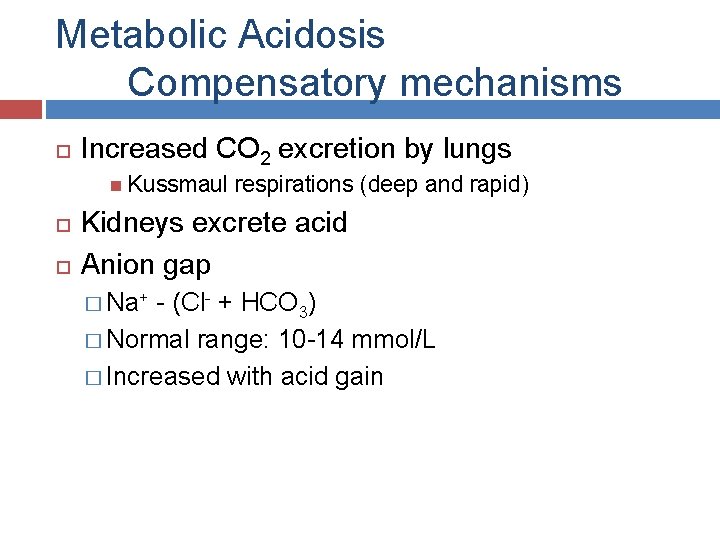
Metabolic Acidosis Compensatory mechanisms Increased CO 2 excretion by lungs Kussmaul respirations (deep and rapid) Kidneys excrete acid Anion gap � Na+ - (Cl- + HCO 3) � Normal range: 10 -14 mmol/L � Increased with acid gain
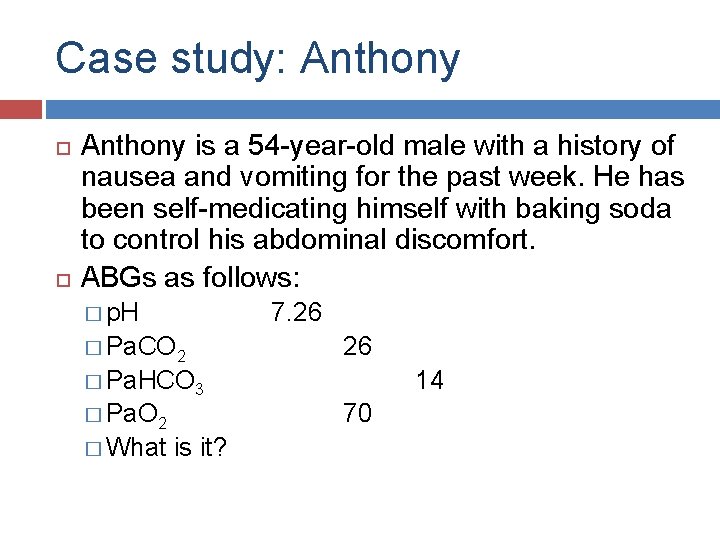
Case study: Anthony is a 54 -year-old male with a history of nausea and vomiting for the past week. He has been self-medicating himself with baking soda to control his abdominal discomfort. ABGs as follows: � p. H 7. 26 � Pa. CO 2 26 � Pa. O 2 70 � Pa. HCO 3 � What is it? 14

You. Tube Resources for ABGs https: //www. youtube. com/watch? v=WUfc. Ppnr. Xw https: //www. youtube. com/watch? v=_Opvy. EIl. Fj 8 https: //www. youtube. com/watch? v=r. V 2 PDQJT KDU
References Lewis, S. L. , Heitkemper, M. M. , Dirksen, S. R. , & Bucher, L. (2014). Medicalsurgical nursing: Assessment & management of client problems (9 th ed. ). St. Louis, MO: Mosby
- Slides: 24