
Acid and Bases 5 3 and 5 4
Acid and Bases 5. 3 and 5. 4 -Types of Oxides. Many acids and bases are formed by dissolving oxides in water
At the end of this, you should able to: l Classify oxides as acidic or basic based on metallic/non-metallic character l Give examples of each l Discuss neutralization reactions
What is an oxide? l An oxide is a compound of oxygen and another element. l Most oxides can be grouped into two types: l acidic oxides (or non-metal oxide (NMO) produce an aq sol’n p. H less than 7) l basic oxides (or metal oxides (MO) produce an aq sol’n p. H greater than 7)
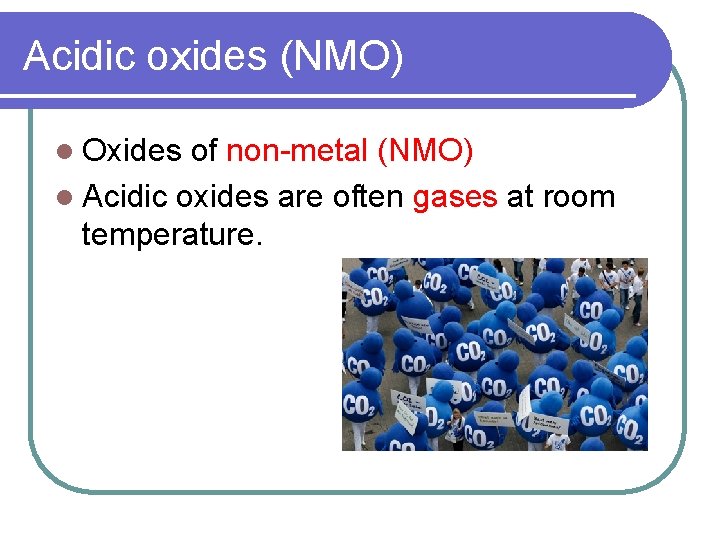
Acidic oxides (NMO) l Oxides of non-metal (NMO) l Acidic oxides are often gases at room temperature.

Acidic oxides (NMO) l React l with water to produce acids. Example: sulphur trioxide + water SO 3 + H 2 O sulphuric acid H 2 SO 4
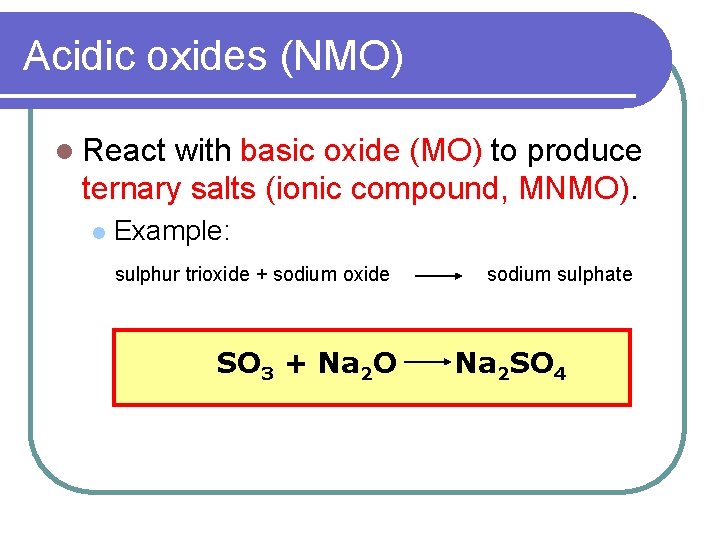
Acidic oxides (NMO) l React with basic oxide (MO) to produce ternary salts (ionic compound, MNMO). l Example: sulphur trioxide + sodium oxide SO 3 + Na 2 O sodium sulphate Na 2 SO 4
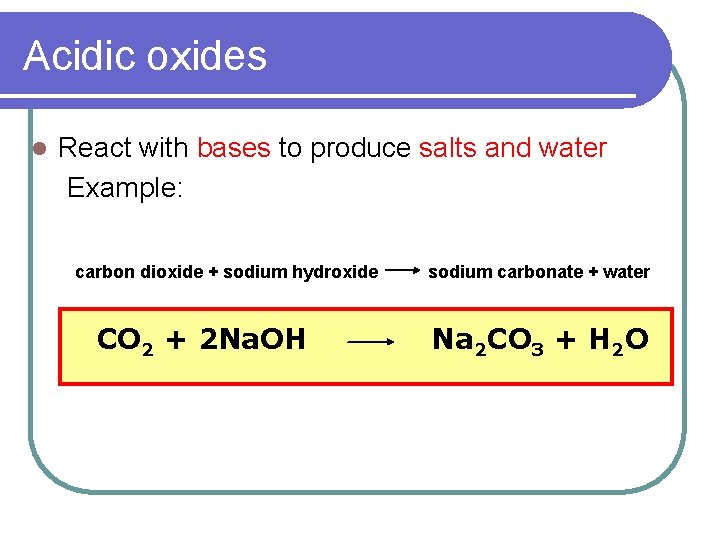
Acidic oxides l React with bases to produce salts and water Example: carbon dioxide + sodium hydroxide CO 2 + 2 Na. OH sodium carbonate + water Na 2 CO 3 + H 2 O
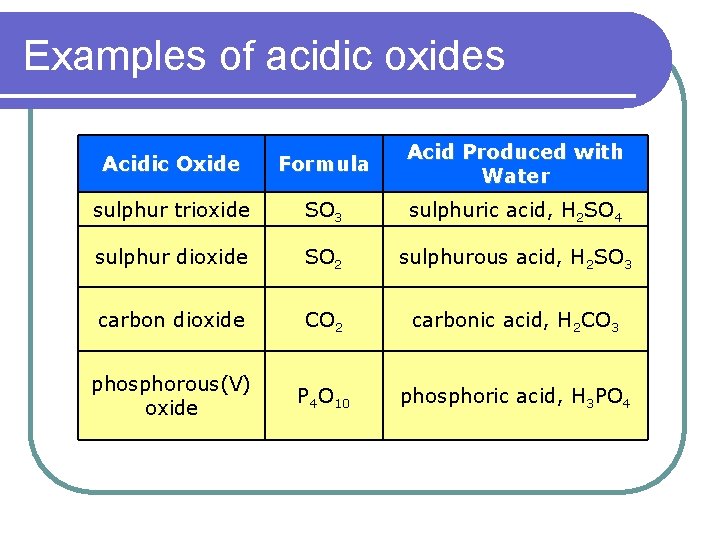
Examples of acidic oxides Acidic Oxide Formula Acid Produced with Water sulphur trioxide SO 3 sulphuric acid, H 2 SO 4 sulphur dioxide SO 2 sulphurous acid, H 2 SO 3 carbon dioxide CO 2 carbonic acid, H 2 CO 3 phosphorous(V) oxide P 4 O 10 phosphoric acid, H 3 PO 4
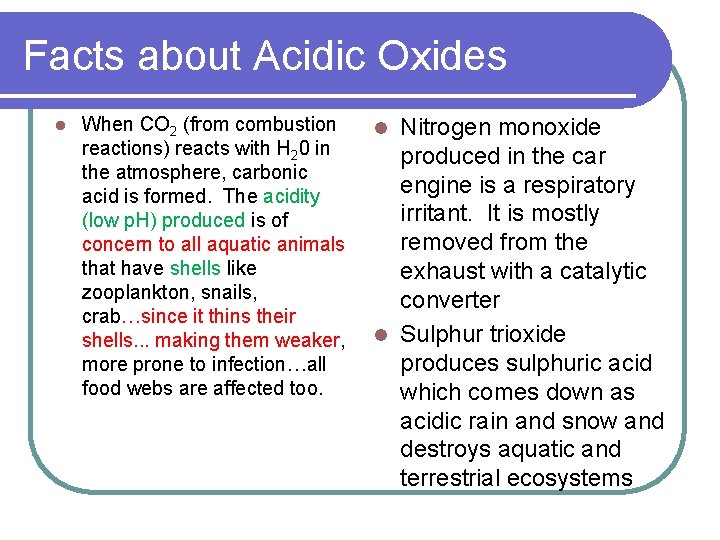
Facts about Acidic Oxides l When CO 2 (from combustion reactions) reacts with H 20 in the atmosphere, carbonic acid is formed. The acidity (low p. H) produced is of concern to all aquatic animals that have shells like zooplankton, snails, crab…since it thins their shells. . . making them weaker, more prone to infection…all food webs are affected too. Nitrogen monoxide produced in the car engine is a respiratory irritant. It is mostly removed from the exhaust with a catalytic converter l Sulphur trioxide produces sulphuric acid which comes down as acidic rain and snow and destroys aquatic and terrestrial ecosystems l
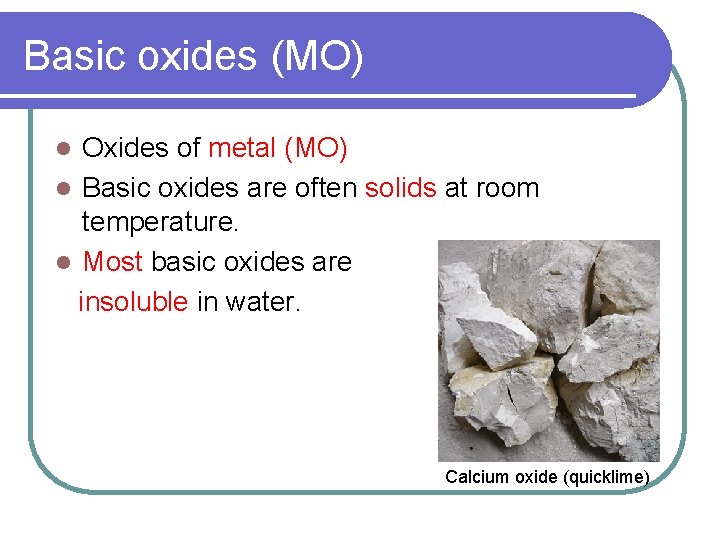
Basic oxides (MO) Oxides of metal (MO) l Basic oxides are often solids at room temperature. l Most basic oxides are insoluble in water. l Calcium oxide (quicklime)
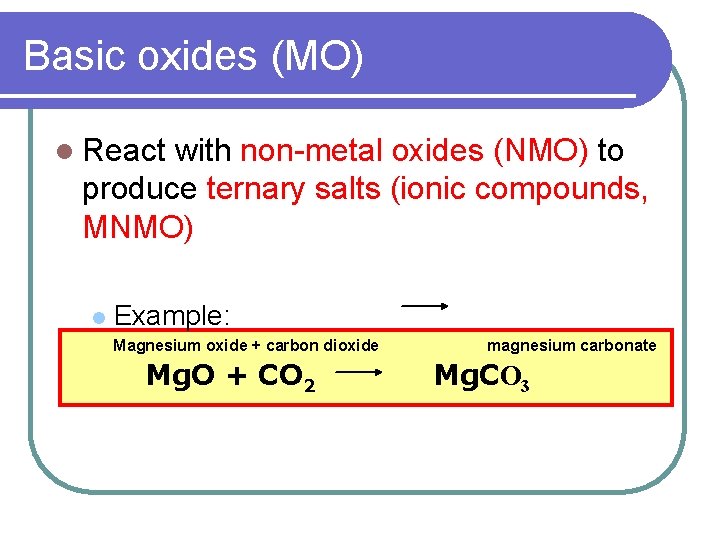
Basic oxides (MO) l React with non-metal oxides (NMO) to produce ternary salts (ionic compounds, MNMO) l Example: Magnesium oxide + carbon dioxide Mg. O + CO 2 magnesium carbonate Mg. CO 3
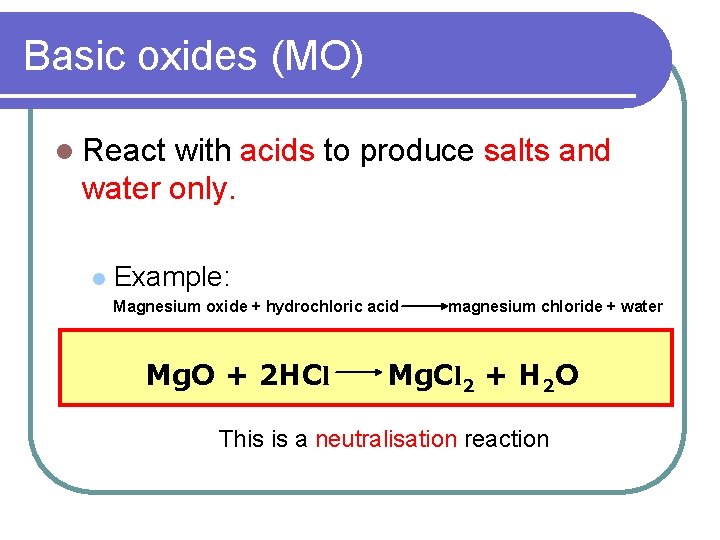
Basic oxides (MO) l React with acids to produce salts and water only. l Example: Magnesium oxide + hydrochloric acid Mg. O + 2 HCl magnesium chloride + water Mg. Cl 2 + H 2 O This is a neutralisation reaction
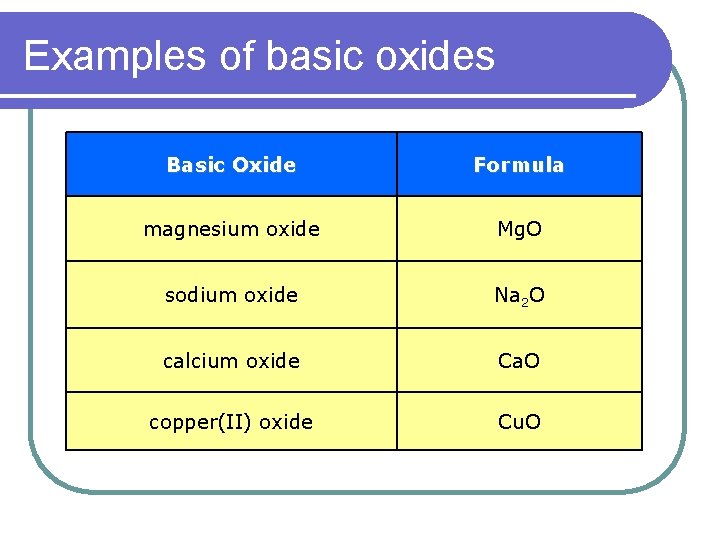
Examples of basic oxides Basic Oxide Formula magnesium oxide Mg. O sodium oxide Na 2 O calcium oxide Ca. O copper(II) oxide Cu. O
Facts about basic oxides Ca. O is called lime. Adding l Na. OH is the most Ca. O to acidic lakes by widely used chemical in dropping it from a plane the world- billions of kg results in a less acidic lake or of sodium hydroxide is neutral lake and is called made and sold all over “liming” the world l When lime is added to water, it forms a solution of calcium l Na. OH is used to make hydoxide(quicklime). . . paper, detergent, important in glass, paper and aluminum…thousands cement l of products
Neutralization Reactions…upset stomach…too much acid? Try a Tums (Ca. CO 3) l It is a ternary salt with a polyatomic ion. It will react with HCl in the stomach and produce Ca. Cl 2 and H 2 CO 3 which further breaks down to CO 2 and H 2 O l + no more acidity, Ca +2 ions absorbed… good for bones l - gas produced… l l l Try milk of magnesia (Mg(OH)2) Only slightly soluble in water so the basic characteristics not felt in the mouth and esophagus (aq. ). Mg. Cl 2 and H 2 O produced + no more acidity - difficult to swallow since slightly bitter Do not try Na. OH…very soluble in water…ouch!

Acids and Bases in Action Leavening agents= l Acid rain causes a substances that produce CO 2 decrease in reproduction gas in baking and a crash in l Citric acid (from fruit) reacts populations especially with baking soda (Na. HCO 3) aquatic ones. A lake creating CO 2 gas, sodium can be treated with lime. citrate and water l Some lakes are affected l Baking powder has dry more (N Ont. , ground is tartaric acid and baking soda. granite) and others less It is activated by moisture. (S Ont. , ground is limestone) by acid rain. l Recycling of car battery parts requires the work of acids and l Limestone= nature’s bases…great example of natural antacid chemistry at work l
Both an Acid and a Base! Sodium Hydrogen Carbonate…it rhymes Na. HCO 3 l Can react with a strong acid to strong base to form a produce a salt, water salt and water thus and carbon dioxide acting as an acid thus acting as a base (proton donor) (proton acceptor) l Na. HCO 3 + Na. OH = l Na. HCO 3 + HCl → Na 2 CO 3 + H 2 O H 2 CO 3 + Na. Cl → H 2 O + CO 2 + Na. Cl l
- Slides: 17