
Acid and Base Strength Acids Have a sour
Acid and Base Strength
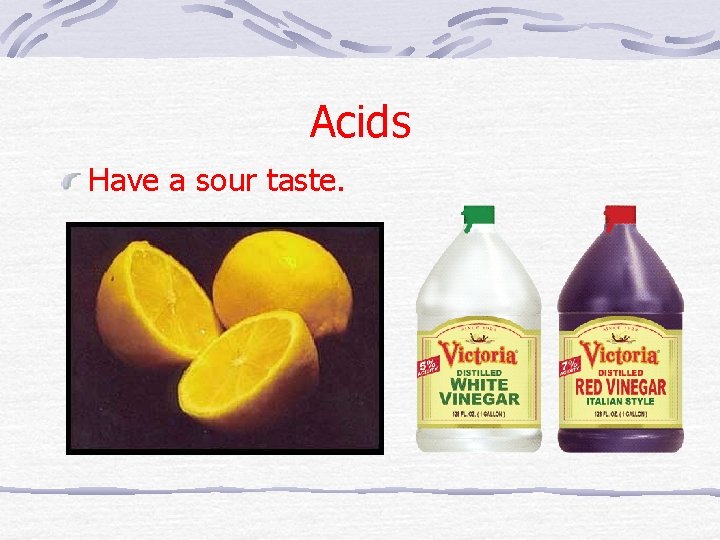
Acids Have a sour taste.
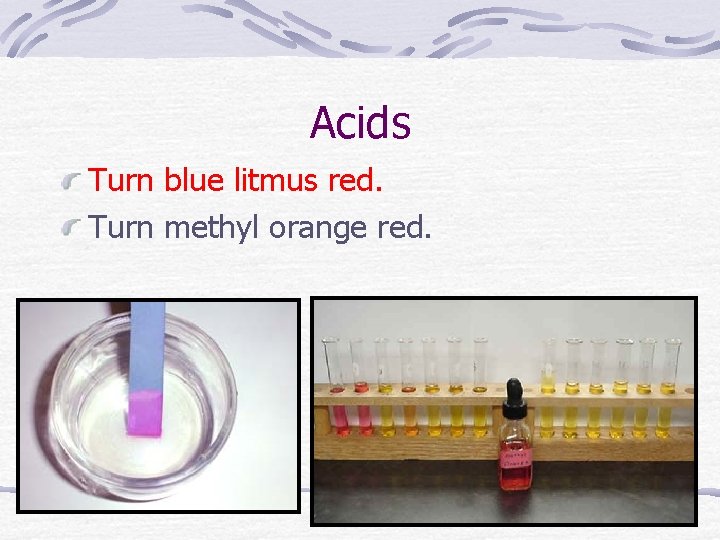
Acids Turn blue litmus red. Turn methyl orange red.
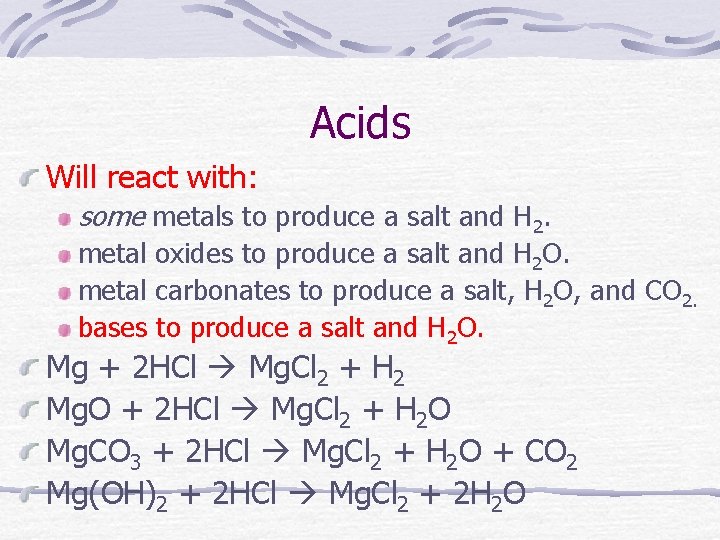
Acids Will react with: some metals to produce a salt and H 2. metal oxides to produce a salt and H 2 O. metal carbonates to produce a salt, H 2 O, and CO 2. bases to produce a salt and H 2 O. Mg + 2 HCl Mg. Cl 2 + H 2 Mg. O + 2 HCl Mg. Cl 2 + H 2 O Mg. CO 3 + 2 HCl Mg. Cl 2 + H 2 O + CO 2 Mg(OH)2 + 2 HCl Mg. Cl 2 + 2 H 2 O
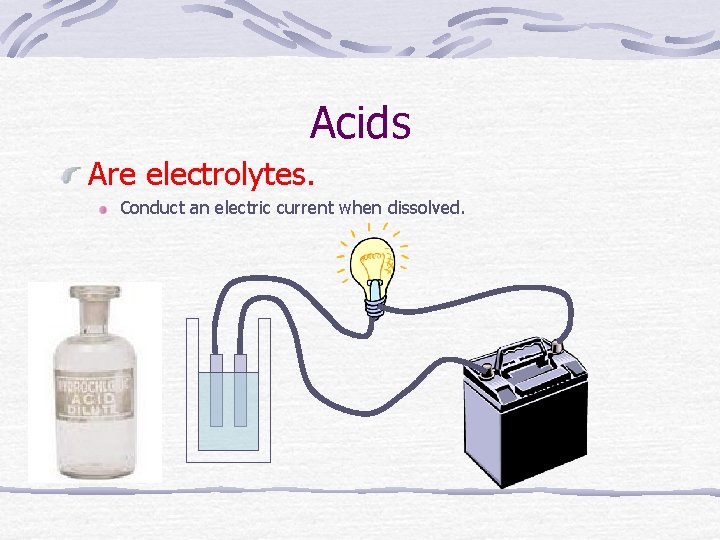
Acids Are electrolytes. Conduct an electric current when dissolved.
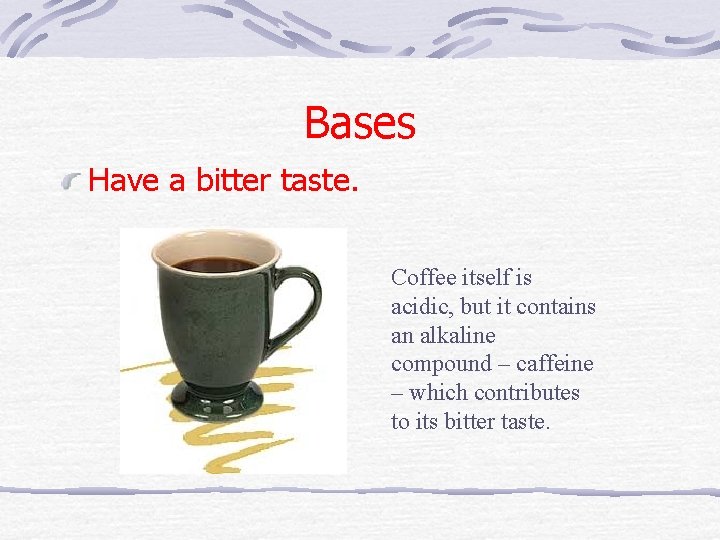
Bases Have a bitter taste. Coffee itself is acidic, but it contains an alkaline compound – caffeine – which contributes to its bitter taste.
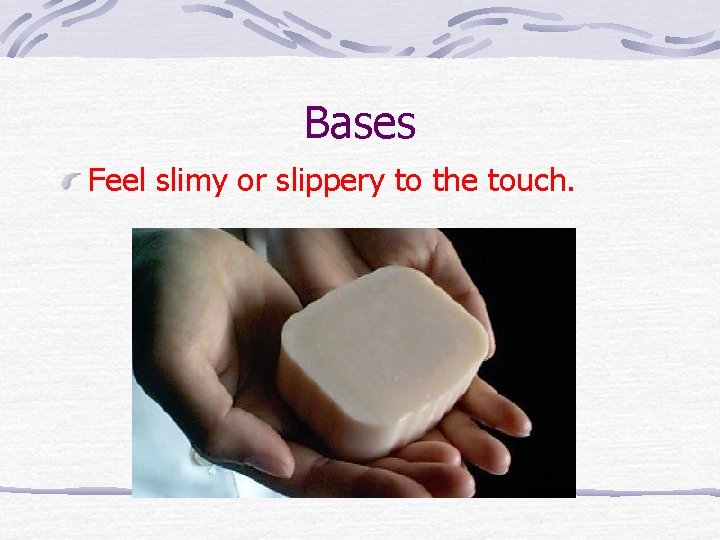
Bases Feel slimy or slippery to the touch.
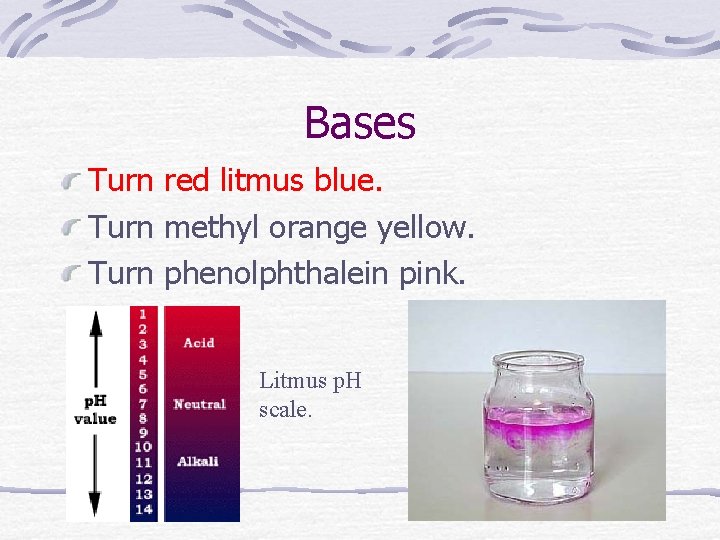
Bases Turn red litmus blue. Turn methyl orange yellow. Turn phenolphthalein pink. Litmus p. H scale.
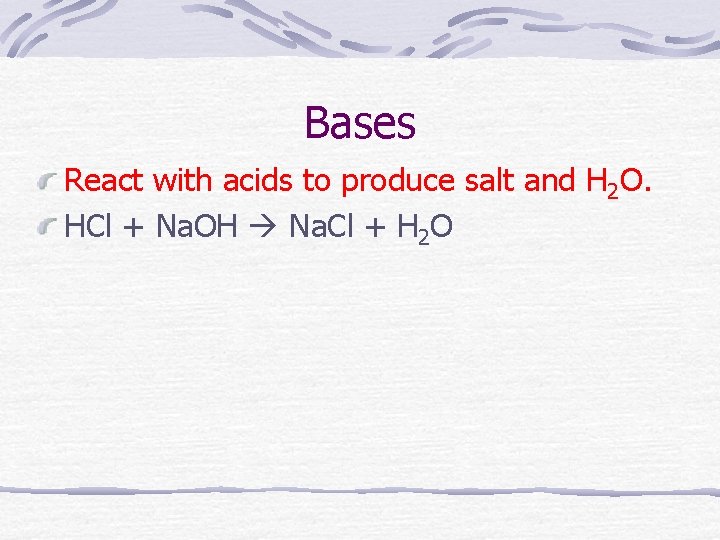
Bases React with acids to produce salt and H 2 O. HCl + Na. OH Na. Cl + H 2 O
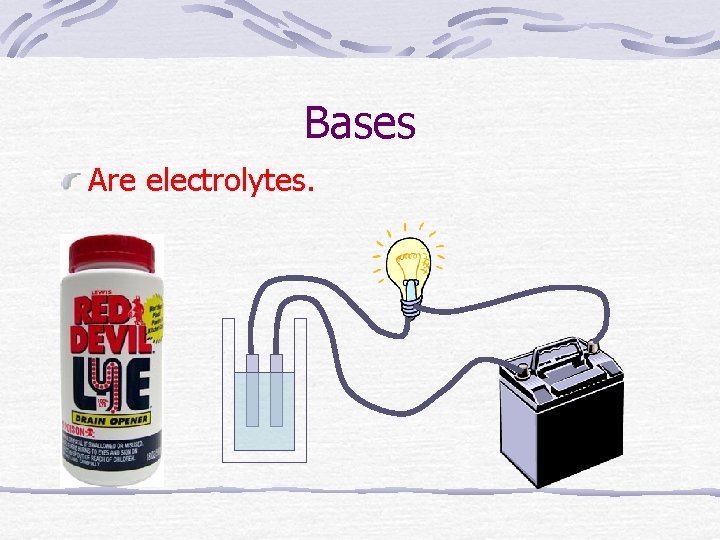
Bases Are electrolytes.
Properties of Acids ◦ Taste sour. ◦ Turn litmus red. ◦ Proton (H+) donors. ◦ Inc. [H 3 O+] in aqueous solutions. Review Properties of Bases ◦ Taste bitter. ◦ Turn litmus blue. ◦ Proton acceptors. ◦ Inc. [OH-] in aqueous solutions.
p. H Scale ◦ Traditionally 0 - 14. Can have p. H < 0 or > 14. ◦ p. H < 7 Acidic solution. ◦ p. H = 7 Neutral solution. ◦ p. H > 7 Basic solution. Review
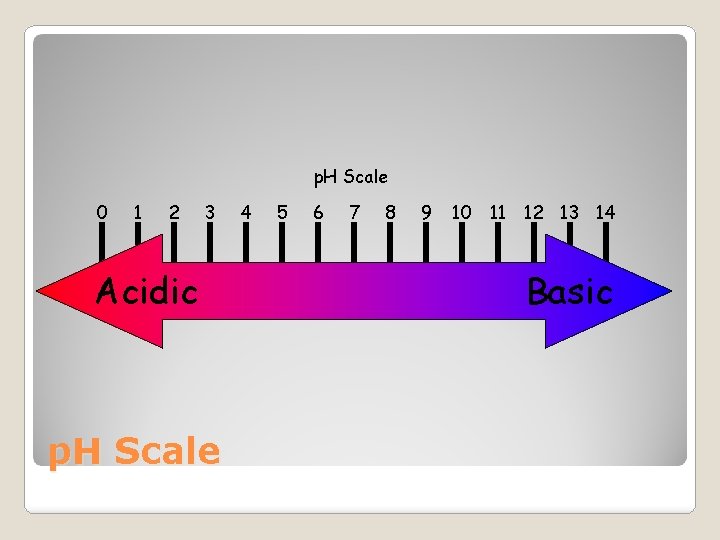
p. H Scale 0 1 2 3 Acidic p. H Scale 4 5 6 7 8 9 10 11 12 13 14 Basic
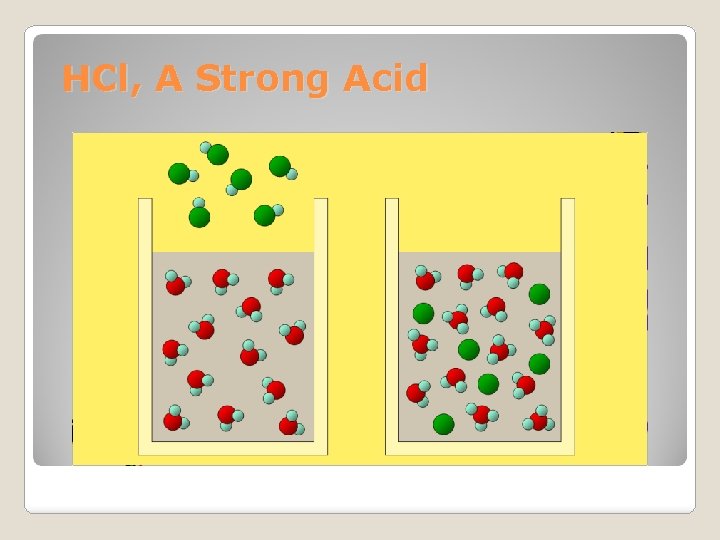
HCl, A Strong Acid
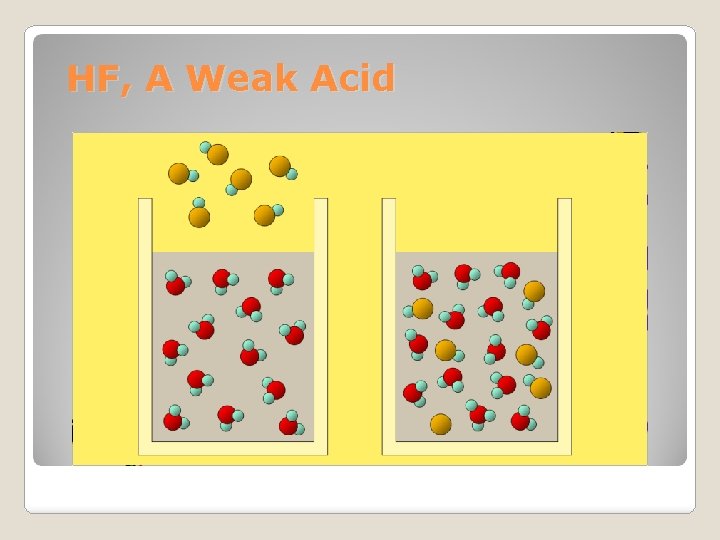
HF, A Weak Acid
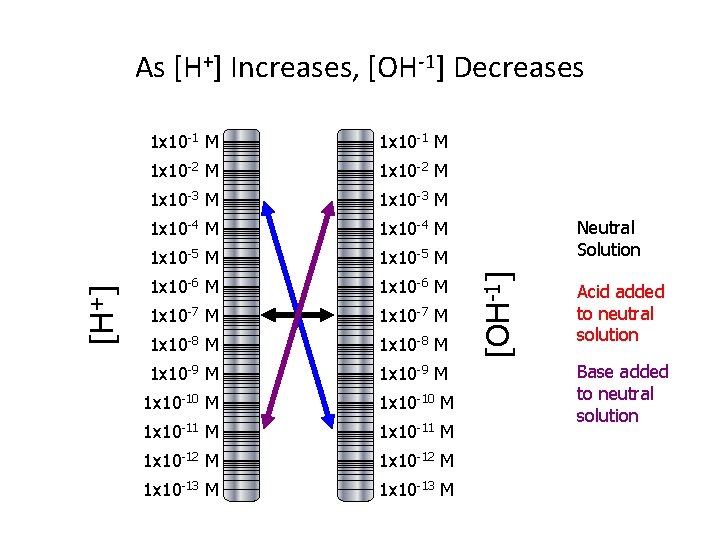
1 x 10 -1 M 1 x 10 -2 M 1 x 10 -3 M 1 x 10 -4 M 1 x 10 -5 M 1 x 10 -6 M 1 x 10 -7 M 1 x 10 -8 M 1 x 10 -9 M 1 x 10 -10 M 1 x 10 -11 M 1 x 10 -12 M 1 x 10 -13 M Neutral Solution [OH-1] [H+] As [H+] Increases, [OH-1] Decreases Acid added to neutral solution Base added to neutral solution
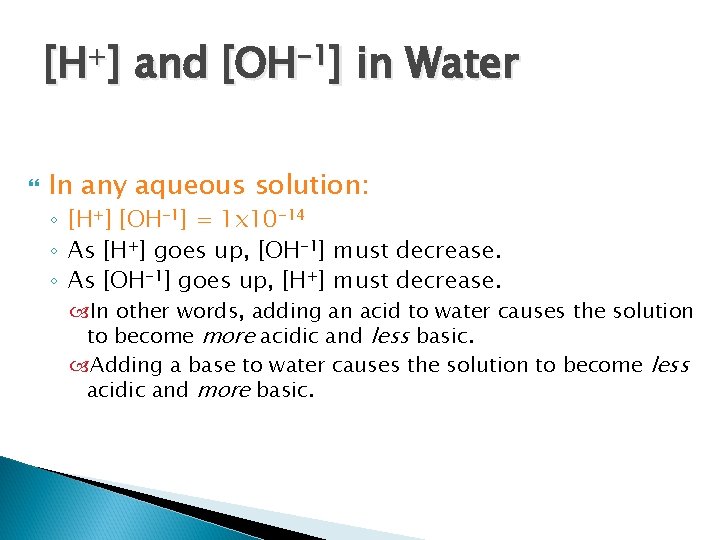
[H+] and [OH-1] in Water In any aqueous solution: ◦ [H+] [OH-1] = 1 x 10 -14 ◦ As [H+] goes up, [OH-1] must decrease. ◦ As [OH-1] goes up, [H+] must decrease. In other words, adding an acid to water causes the solution to become more acidic and less basic. Adding a base to water causes the solution to become less acidic and more basic.
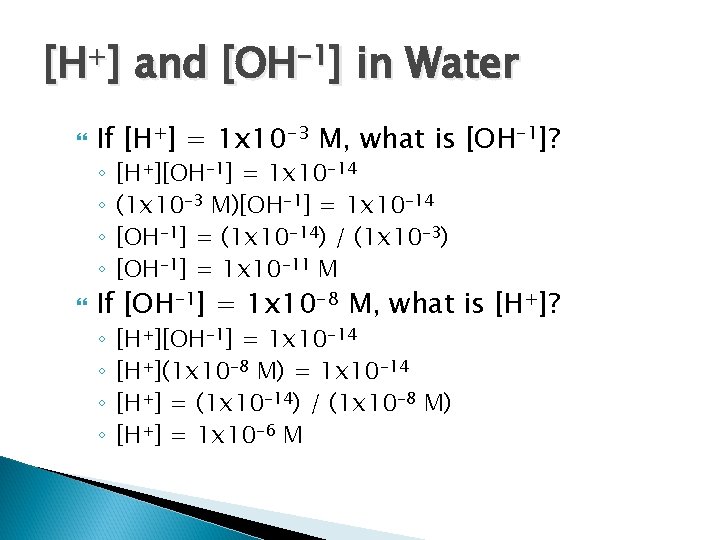
[H+] and [OH-1] in Water If [H+] = 1 x 10 -3 M, what is [OH-1]? ◦ ◦ [H+][OH-1] = 1 x 10 -14 (1 x 10 -3 M)[OH-1] = 1 x 10 -14 [OH-1] = (1 x 10 -14) / (1 x 10 -3) [OH-1] = 1 x 10 -11 M If [OH-1] = 1 x 10 -8 M, what is [H+]? ◦ ◦ [H+][OH-1] = 1 x 10 -14 [H+](1 x 10 -8 M) = 1 x 10 -14 [H+] = (1 x 10 -14) / (1 x 10 -8 M) [H+] = 1 x 10 -6 M
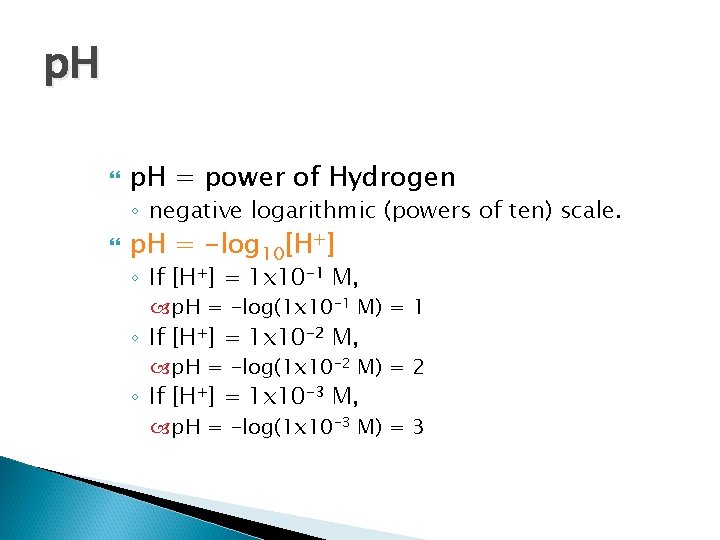
p. H = power of Hydrogen ◦ negative logarithmic (powers of ten) scale. p. H = -log 10[H+] ◦ If [H+] = 1 x 10 -1 M, p. H = -log(1 x 10 -1 M) = 1 ◦ If [H+] = 1 x 10 -2 M, p. H = -log(1 x 10 -2 M) = 2 ◦ If [H+] = 1 x 10 -3 M, p. H = -log(1 x 10 -3 M) = 3
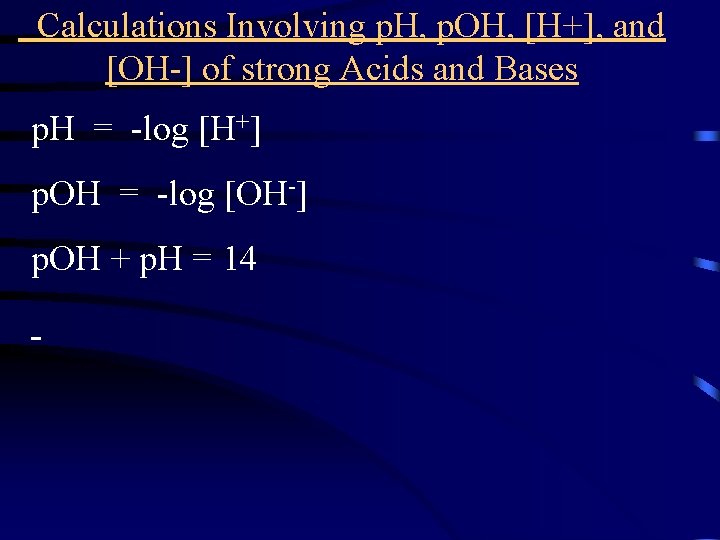
Calculations Involving p. H, p. OH, [H+], and [OH-] of strong Acids and Bases p. H = -log [H+] p. OH = -log [OH-] p. OH + p. H = 14
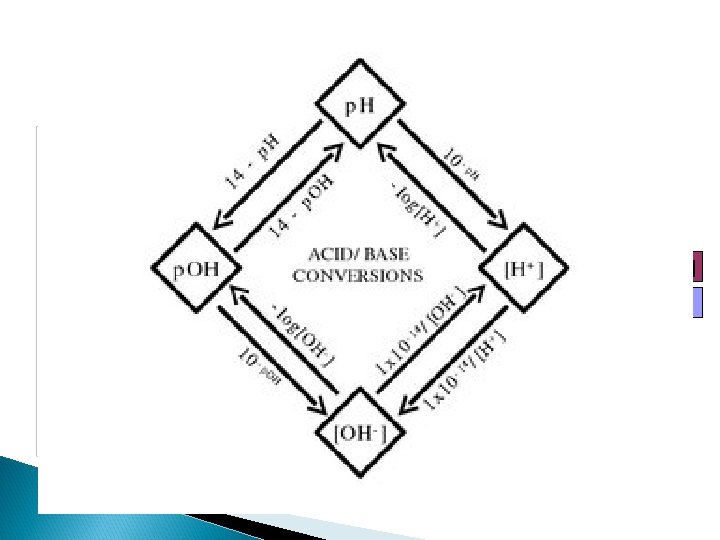
[H 3 O+1] and [OH-1] [H 3 O+1] [OH-1]
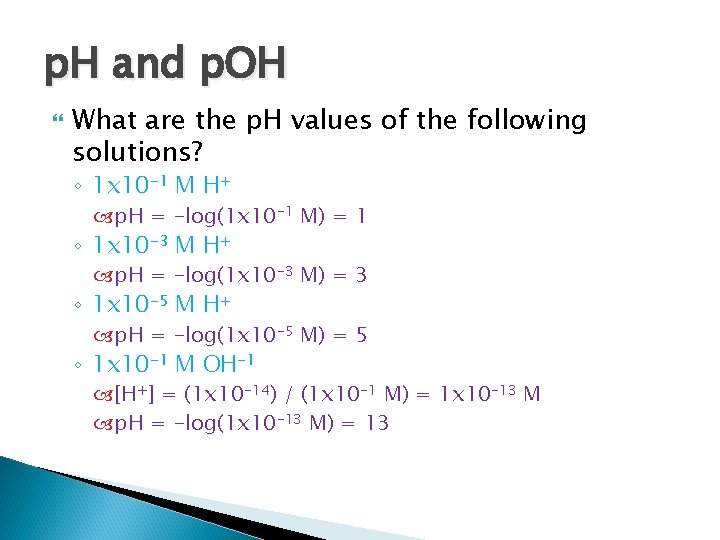
p. H and p. OH What are the p. H values of the following solutions? ◦ 1 x 10 -1 M H+ p. H = -log(1 x 10 -1 M) = 1 ◦ 1 x 10 -3 M H+ p. H = -log(1 x 10 -3 M) = 3 ◦ 1 x 10 -5 M H+ p. H = -log(1 x 10 -5 M) = 5 ◦ 1 x 10 -1 M OH-1 [H+] = (1 x 10 -14) / (1 x 10 -1 M) = 1 x 10 -13 M p. H = -log(1 x 10 -13 M) = 13
- Slides: 22