
ACHIEVING YOUR GOAL IN MATHS A journey lasting

- Slides: 26
ACHIEVING YOUR GOAL IN MATHS A journey lasting 228 days ( 132 days of school )
What does this picture say to you ?
A recipe for success • • • The best Elation Focused preparation Dedication over a period of time Commitment to be the best possible Good diet and sleep regime Training routine Having a good sports coach Being equipped to succeed
Key Ingredients • • • Attendance The input of the teacher Concentration Asking for help Supporting each other’s learning Doing homework Attending revision sessions Parent input Learning key facts and formulae Being equipped ( calculator ) Diet and sleeping patterns Time to relax
Are you in the zone ? • • • IN THE CLASSROOM Attitude to learning ( teacher knows ! ) Attendance Behaviour Engagement Motivation Focus Equipment • • • BEYOND THE CLASS Motivation to succeed ( only you truly know ) Homework Revision lessons Private revision A little and often Resources Parent interest
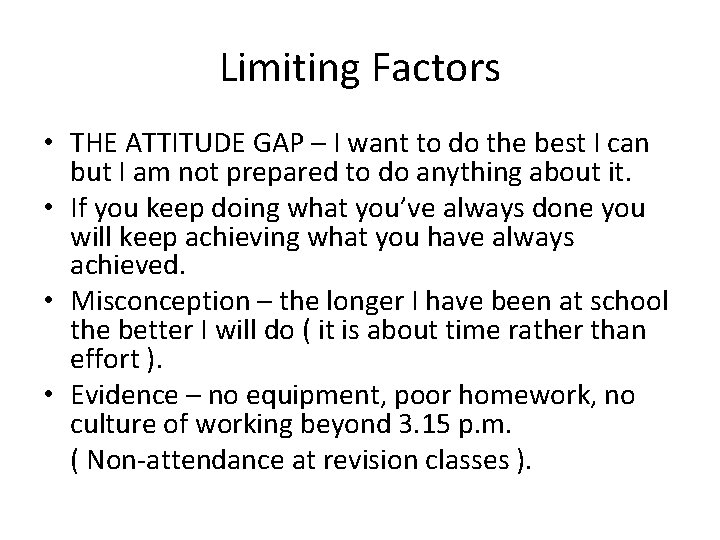
Limiting Factors • THE ATTITUDE GAP – I want to do the best I can but I am not prepared to do anything about it. • If you keep doing what you’ve always done you will keep achieving what you have always achieved. • Misconception – the longer I have been at school the better I will do ( it is about time rather than effort ). • Evidence – no equipment, poor homework, no culture of working beyond 3. 15 p. m. ( Non-attendance at revision classes ).
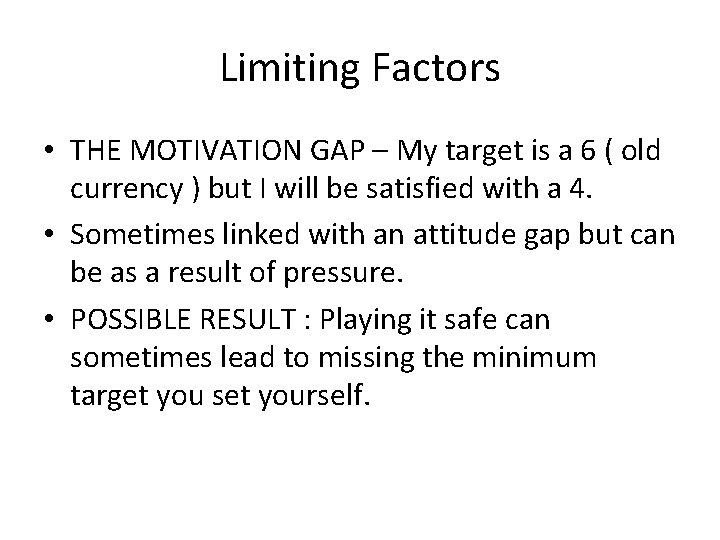
Limiting Factors • THE MOTIVATION GAP – My target is a 6 ( old currency ) but I will be satisfied with a 4. • Sometimes linked with an attitude gap but can be as a result of pressure. • POSSIBLE RESULT : Playing it safe can sometimes lead to missing the minimum target you set yourself.
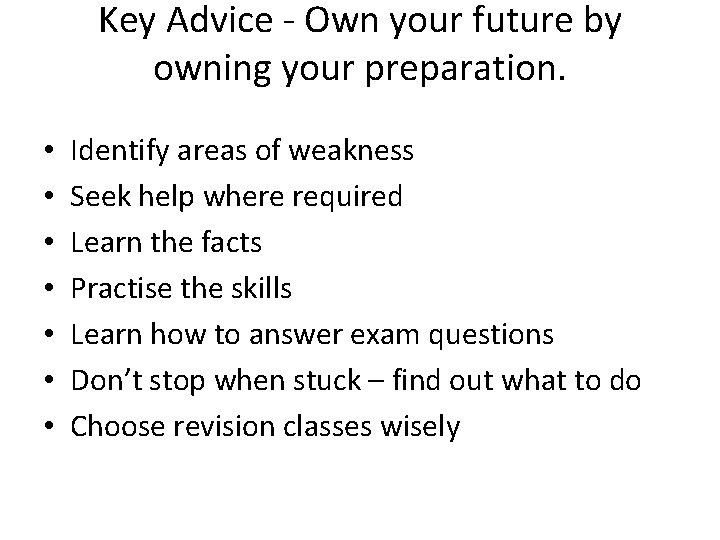
Key Advice - Own your future by owning your preparation. • • Identify areas of weakness Seek help where required Learn the facts Practise the skills Learn how to answer exam questions Don’t stop when stuck – find out what to do Choose revision classes wisely
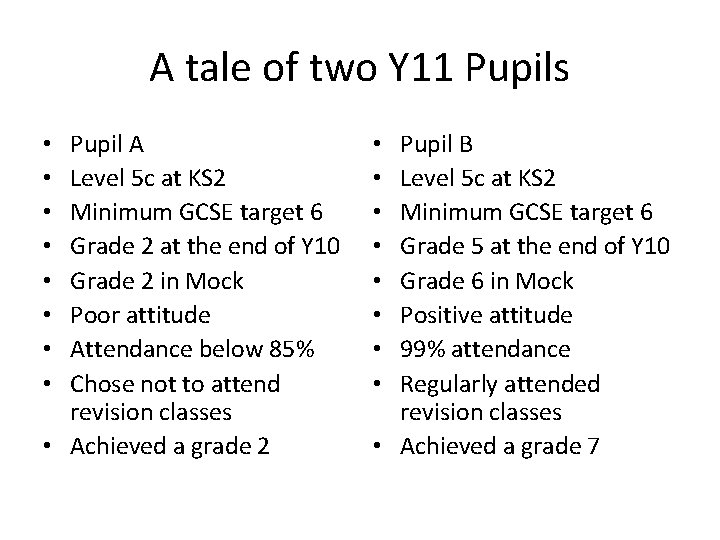
A tale of two Y 11 Pupils Pupil A Level 5 c at KS 2 Minimum GCSE target 6 Grade 2 at the end of Y 10 Grade 2 in Mock Poor attitude Attendance below 85% Chose not to attend revision classes • Achieved a grade 2 • • Pupil B Level 5 c at KS 2 Minimum GCSE target 6 Grade 5 at the end of Y 10 Grade 6 in Mock Positive attitude 99% attendance Regularly attended revision classes • Achieved a grade 7 • •
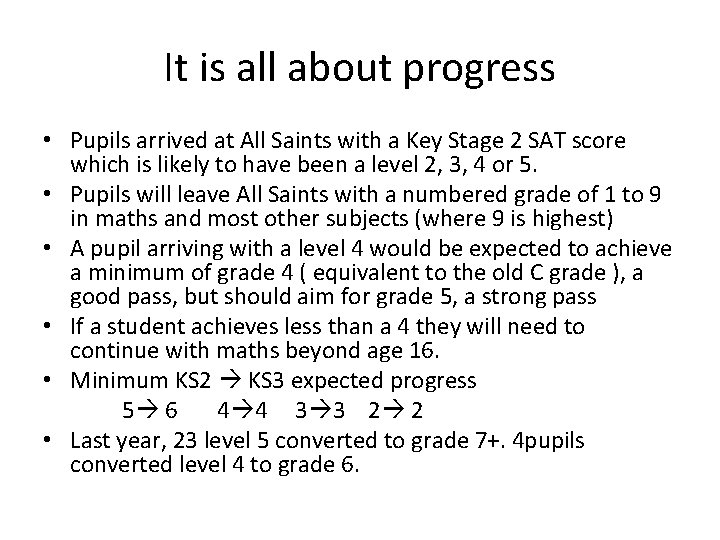
It is all about progress • Pupils arrived at All Saints with a Key Stage 2 SAT score which is likely to have been a level 2, 3, 4 or 5. • Pupils will leave All Saints with a numbered grade of 1 to 9 in maths and most other subjects (where 9 is highest) • A pupil arriving with a level 4 would be expected to achieve a minimum of grade 4 ( equivalent to the old C grade ), a good pass, but should aim for grade 5, a strong pass • If a student achieves less than a 4 they will need to continue with maths beyond age 16. • Minimum KS 2 KS 3 expected progress 5 6 4 4 3 3 2 2 • Last year, 23 level 5 converted to grade 7+. 4 pupils converted level 4 to grade 6.
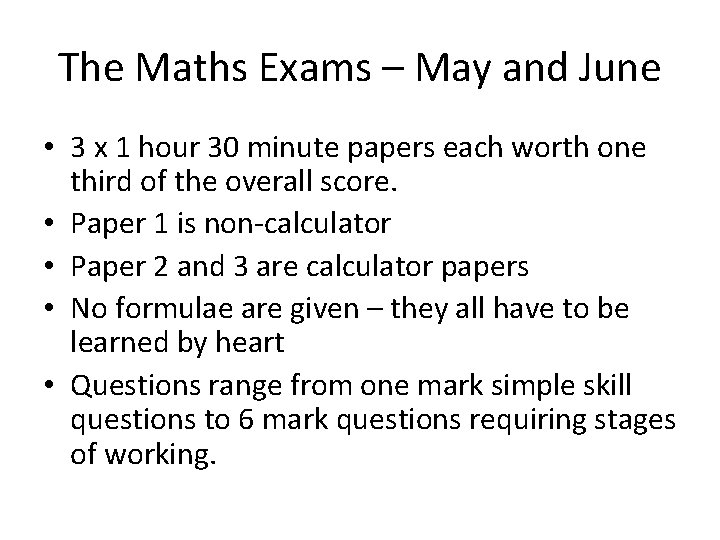
The Maths Exams – May and June • 3 x 1 hour 30 minute papers each worth one third of the overall score. • Paper 1 is non-calculator • Paper 2 and 3 are calculator papers • No formulae are given – they all have to be learned by heart • Questions range from one mark simple skill questions to 6 mark questions requiring stages of working.
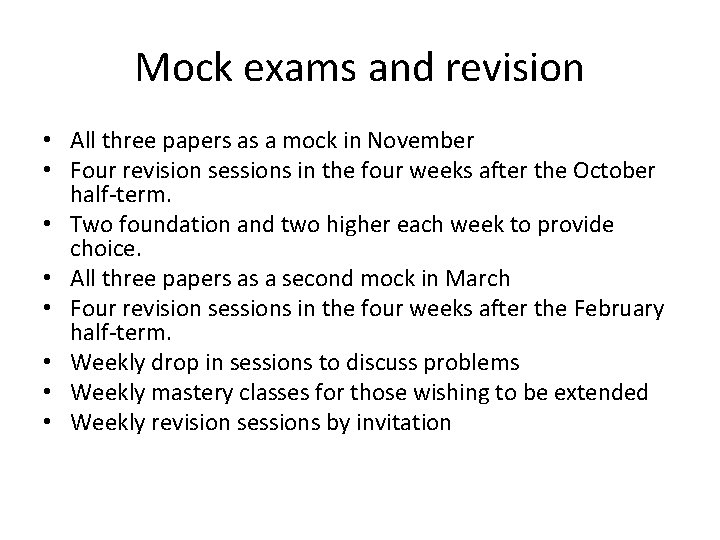
Mock exams and revision • All three papers as a mock in November • Four revision sessions in the four weeks after the October half-term. • Two foundation and two higher each week to provide choice. • All three papers as a second mock in March • Four revision sessions in the four weeks after the February half-term. • Weekly drop in sessions to discuss problems • Weekly mastery classes for those wishing to be extended • Weekly revision sessions by invitation
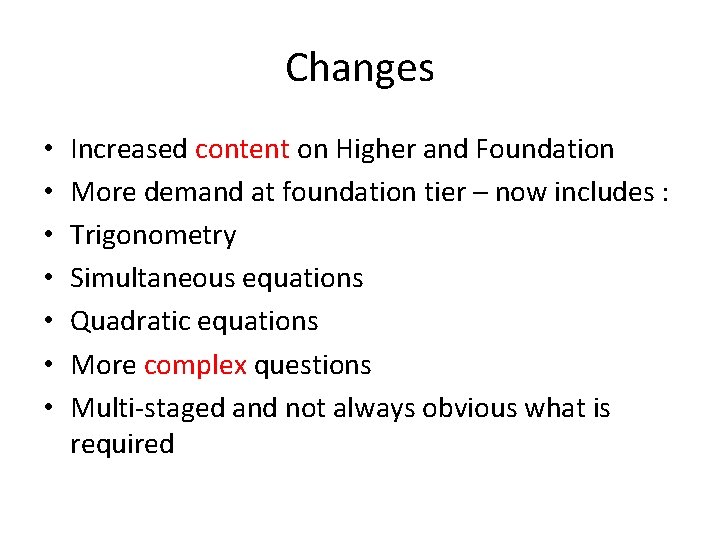
Changes • • Increased content on Higher and Foundation More demand at foundation tier – now includes : Trigonometry Simultaneous equations Quadratic equations More complex questions Multi-staged and not always obvious what is required
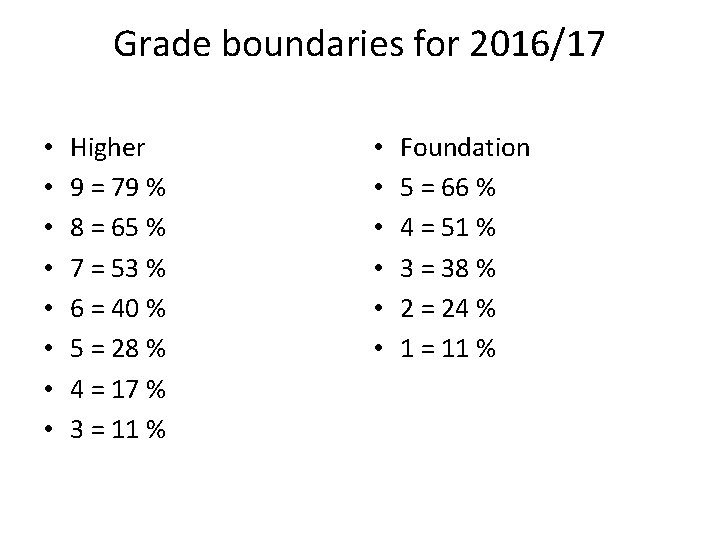
Grade boundaries for 2016/17 • • Higher 9 = 79 % 8 = 65 % 7 = 53 % 6 = 40 % 5 = 28 % 4 = 17 % 3 = 11 % • • • Foundation 5 = 66 % 4 = 51 % 3 = 38 % 2 = 24 % 1 = 11 %
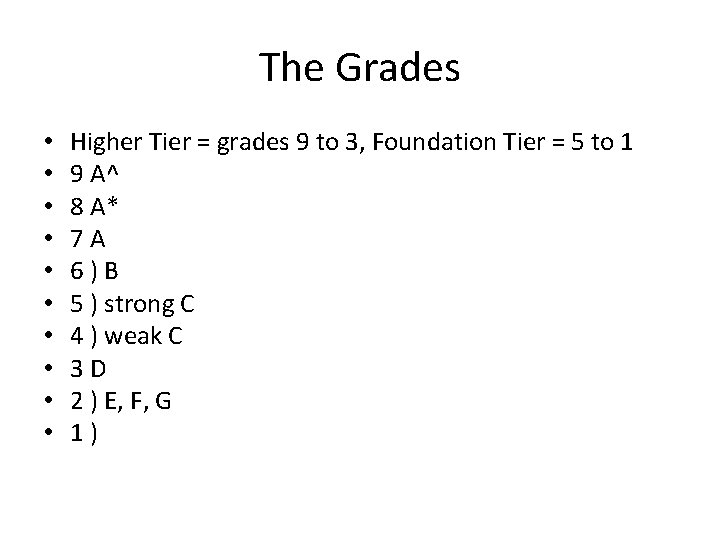
The Grades • • • Higher Tier = grades 9 to 3, Foundation Tier = 5 to 1 9 A^ 8 A* 7 A 6)B 5 ) strong C 4 ) weak C 3 D 2 ) E, F, G 1)
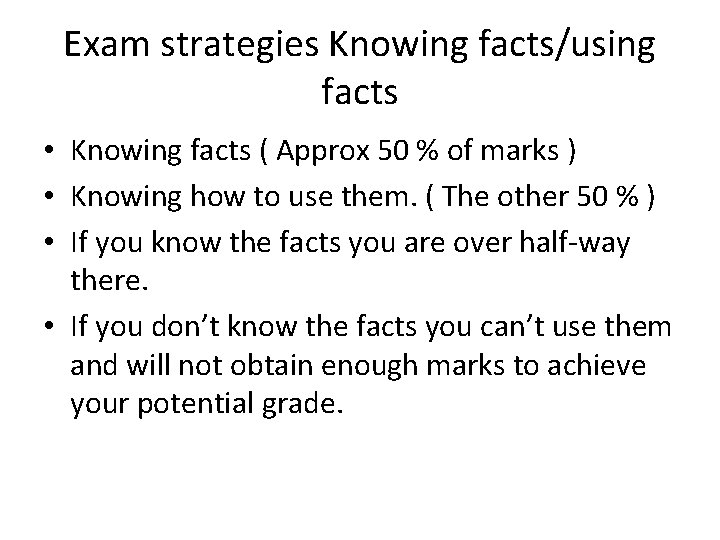
Exam strategies Knowing facts/using facts • Knowing facts ( Approx 50 % of marks ) • Knowing how to use them. ( The other 50 % ) • If you know the facts you are over half-way there. • If you don’t know the facts you can’t use them and will not obtain enough marks to achieve your potential grade.
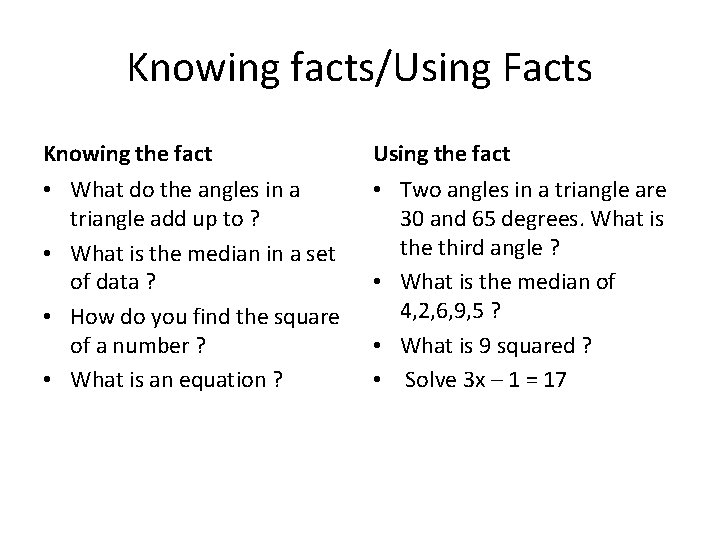
Knowing facts/Using Facts Knowing the fact Using the fact • What do the angles in a triangle add up to ? • What is the median in a set of data ? • How do you find the square of a number ? • What is an equation ? • Two angles in a triangle are 30 and 65 degrees. What is the third angle ? • What is the median of 4, 2, 6, 9, 5 ? • What is 9 squared ? • Solve 3 x – 1 = 17
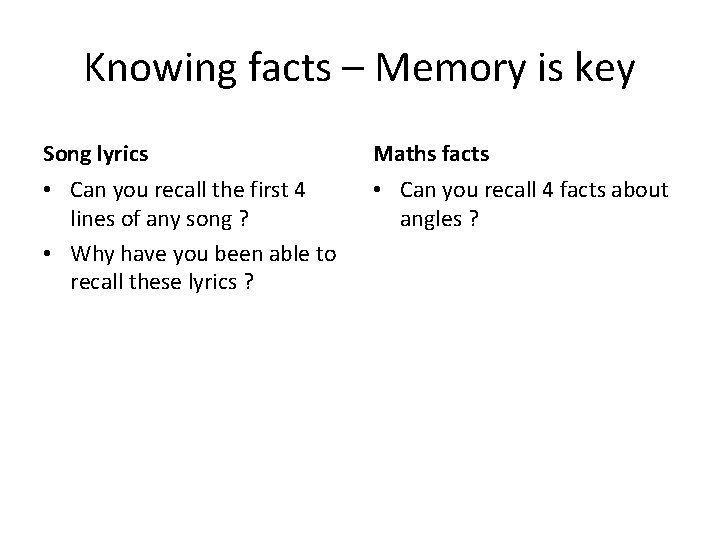
Knowing facts – Memory is key Song lyrics Maths facts • Can you recall the first 4 lines of any song ? • Why have you been able to recall these lyrics ? • Can you recall 4 facts about angles ?
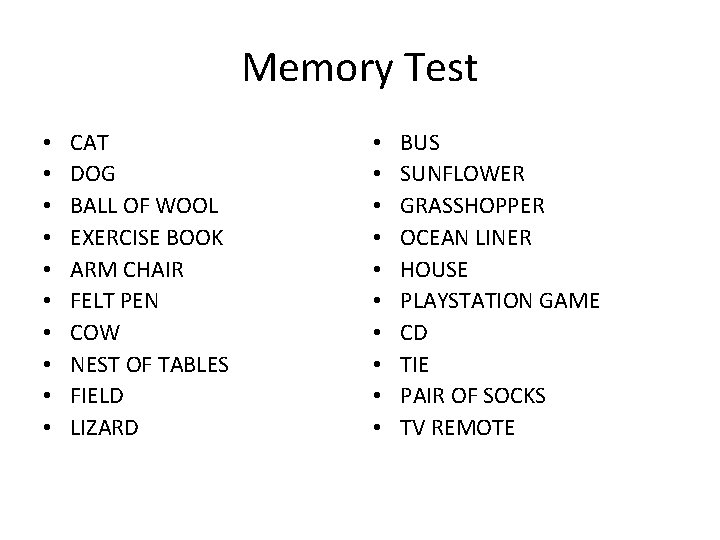
Memory Test • • • CAT DOG BALL OF WOOL EXERCISE BOOK ARM CHAIR FELT PEN COW NEST OF TABLES FIELD LIZARD • • • BUS SUNFLOWER GRASSHOPPER OCEAN LINER HOUSE PLAYSTATION GAME CD TIE PAIR OF SOCKS TV REMOTE
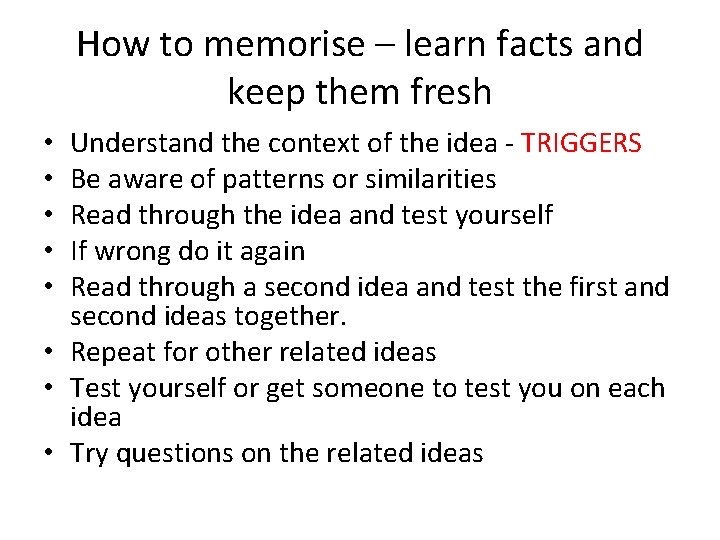
How to memorise – learn facts and keep them fresh Understand the context of the idea - TRIGGERS Be aware of patterns or similarities Read through the idea and test yourself If wrong do it again Read through a second idea and test the first and second ideas together. • Repeat for other related ideas • Test yourself or get someone to test you on each idea • Try questions on the related ideas • • •
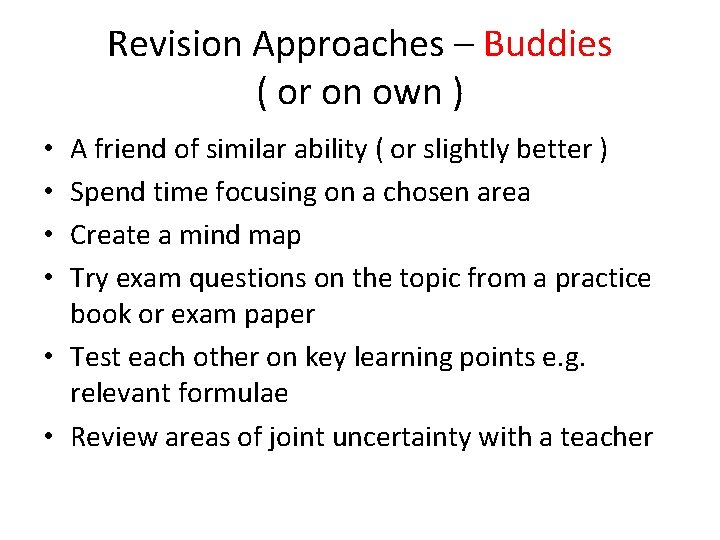
Revision Approaches – Buddies ( or on own ) A friend of similar ability ( or slightly better ) Spend time focusing on a chosen area Create a mind map Try exam questions on the topic from a practice book or exam paper • Test each other on key learning points e. g. relevant formulae • Review areas of joint uncertainty with a teacher • •
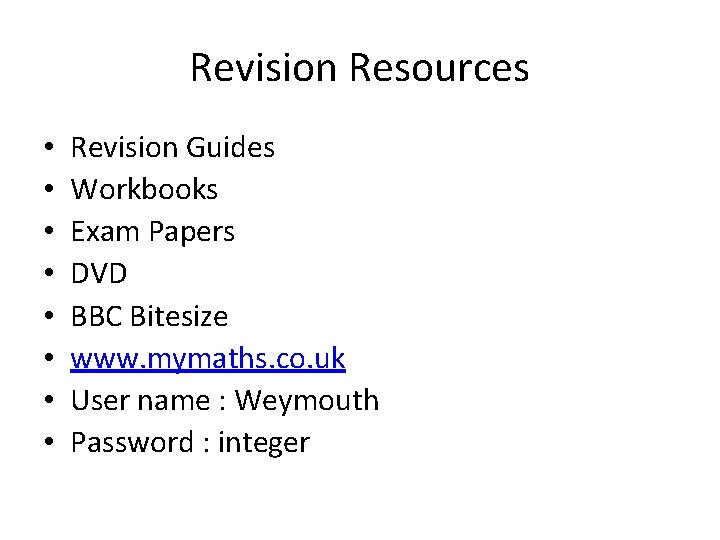
Revision Resources • • Revision Guides Workbooks Exam Papers DVD BBC Bitesize www. mymaths. co. uk User name : Weymouth Password : integer
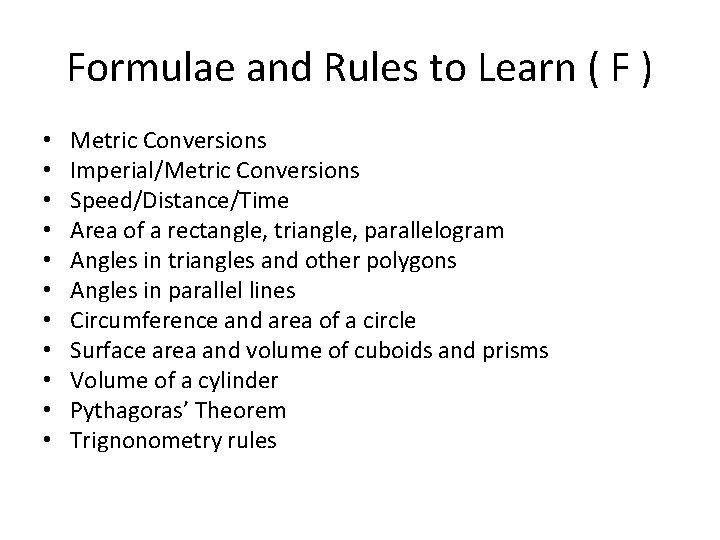
Formulae and Rules to Learn ( F ) • • • Metric Conversions Imperial/Metric Conversions Speed/Distance/Time Area of a rectangle, triangle, parallelogram Angles in triangles and other polygons Angles in parallel lines Circumference and area of a circle Surface area and volume of cuboids and prisms Volume of a cylinder Pythagoras’ Theorem Trignonometry rules
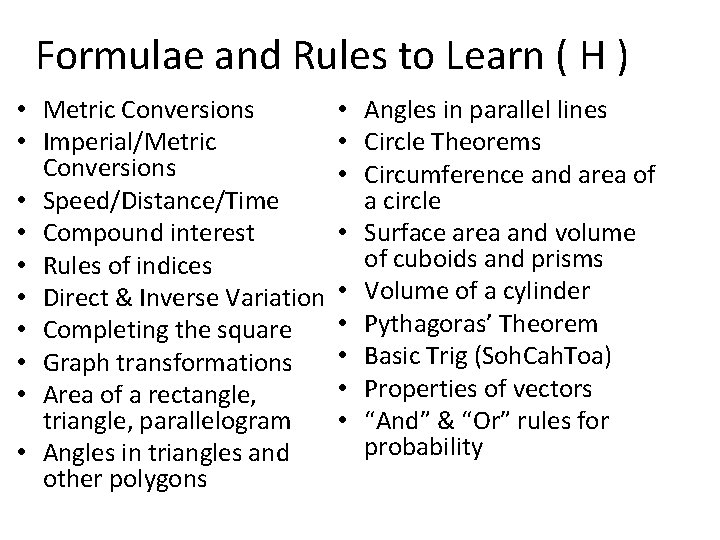
Formulae and Rules to Learn ( H ) • Metric Conversions • Imperial/Metric Conversions • Speed/Distance/Time • Compound interest • Rules of indices • Direct & Inverse Variation • Completing the square • Graph transformations • Area of a rectangle, triangle, parallelogram • Angles in triangles and other polygons • Angles in parallel lines • Circle Theorems • Circumference and area of a circle • Surface area and volume of cuboids and prisms • Volume of a cylinder • Pythagoras’ Theorem • Basic Trig (Soh. Cah. Toa) • Properties of vectors • “And” & “Or” rules for probability
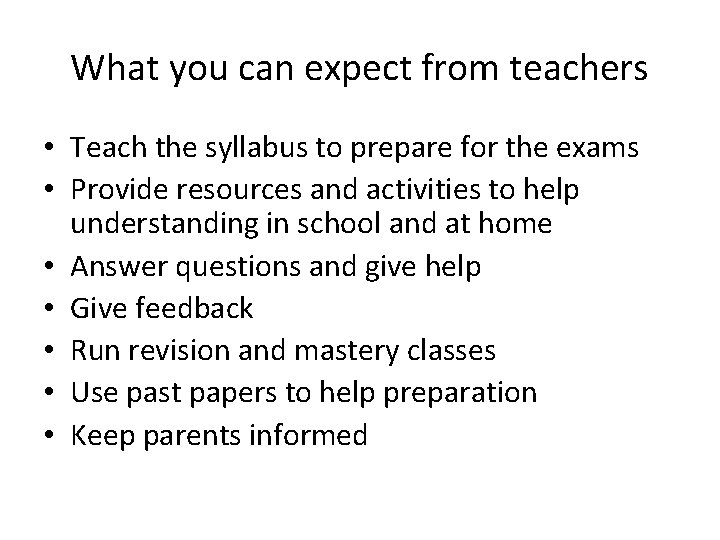
What you can expect from teachers • Teach the syllabus to prepare for the exams • Provide resources and activities to help understanding in school and at home • Answer questions and give help • Give feedback • Run revision and mastery classes • Use past papers to help preparation • Keep parents informed
Have a growth mind set • I cannot do this or • I cannot do this YET • Have the Olympians attitude • Teachers are there to support your learning. Be kind to them and use them wisely !