
Achieving Quantum Supremacy using Noisy Intermediate Scale Devices
![The “Hello, World!” Experiment[1, 2] Sampling output bitstring [1] S. Boixo, et al. ,](https://slidetodoc.com/presentation_image_h2/ca3ba612205d45d19c5eff83dd8ddb4a/image-14.jpg "The “Hello, World!” Experiment[1, 2] Sampling output bitstring [1] S. Boixo, et al. ,")
![The “Hello, World!” Experiment[1, 2] Quantum Supremacy Sampling output bitstring Classically Simul atable Beyond](https://slidetodoc.com/presentation_image_h2/ca3ba612205d45d19c5eff83dd8ddb4a/image-15.jpg "The “Hello, World!” Experiment[1, 2] Quantum Supremacy Sampling output bitstring Classically Simul atable Beyond")
![The “Hello, World!” Experiment[1, 2] Each point correspond to an output bitstring [1] S.](https://slidetodoc.com/presentation_image_h2/ca3ba612205d45d19c5eff83dd8ddb4a/image-16.jpg "The “Hello, World!” Experiment[1, 2] Each point correspond to an output bitstring [1] S.")
![The “Hello, World!” Experiment[1, 2] Quantum Computer will sample the brightest spots Each point](https://slidetodoc.com/presentation_image_h2/ca3ba612205d45d19c5eff83dd8ddb4a/image-17.jpg "The “Hello, World!” Experiment[1, 2] Quantum Computer will sample the brightest spots Each point")
![The “Hello, World!” Experiment[1, 2] Quantum Computer will sample the brightest spots Each point](https://slidetodoc.com/presentation_image_h2/ca3ba612205d45d19c5eff83dd8ddb4a/image-18.jpg "The “Hello, World!” Experiment[1, 2] Quantum Computer will sample the brightest spots Each point")
![Computational Complexity The “Hello, World!” Experiment[1, 2] Depth of the quantum circuit [1] S.](https://slidetodoc.com/presentation_image_h2/ca3ba612205d45d19c5eff83dd8ddb4a/image-19.jpg "Computational Complexity The “Hello, World!” Experiment[1, 2] Depth of the quantum circuit [1] S.")
![Quantum Supremacy Results[1] Sycamore [1] F. Arute, et al. , Nature 574, 7779 (2019)](https://slidetodoc.com/presentation_image_h2/ca3ba612205d45d19c5eff83dd8ddb4a/image-35.jpg "Quantum Supremacy Results[1] Sycamore [1] F. Arute, et al. , Nature 574, 7779 (2019)")
![Quantum Supremacy Results[1] Sycamore [1] F. Arute, et al. , Nature 574, 7779 (2019)](https://slidetodoc.com/presentation_image_h2/ca3ba612205d45d19c5eff83dd8ddb4a/image-36.jpg "Quantum Supremacy Results[1] Sycamore [1] F. Arute, et al. , Nature 574, 7779 (2019)")
![Quantum Supremacy Results[1] F. Arute, et al. , Nature 574, 7779 (2019)](https://slidetodoc.com/presentation_image_h2/ca3ba612205d45d19c5eff83dd8ddb4a/image-37.jpg "Quantum Supremacy Results[1] F. Arute, et al. , Nature 574, 7779 (2019)")
![Quantum Supremacy Results[1] Three Gorges Dam (world’s largest power station): ~22. 5 GW Denver](https://slidetodoc.com/presentation_image_h2/ca3ba612205d45d19c5eff83dd8ddb4a/image-38.jpg "Quantum Supremacy Results[1] Three Gorges Dam (world’s largest power station): ~22. 5 GW Denver")
- Slides: 40
Achieving Quantum Supremacy using Noisy. Intermediate Scale Devices Salvatore Mandra, Ph. D. Quantum Artificial Intelligence Lab (Qu. AIL) NASA Ames Research Center
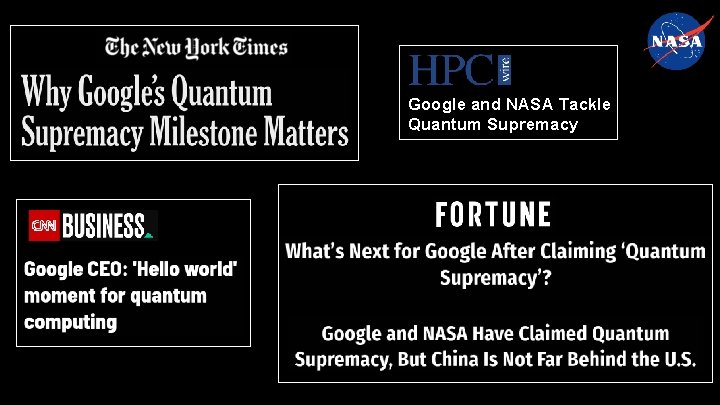
Google and NASA Tackle Quantum Supremacy
Why Quantum Computing?
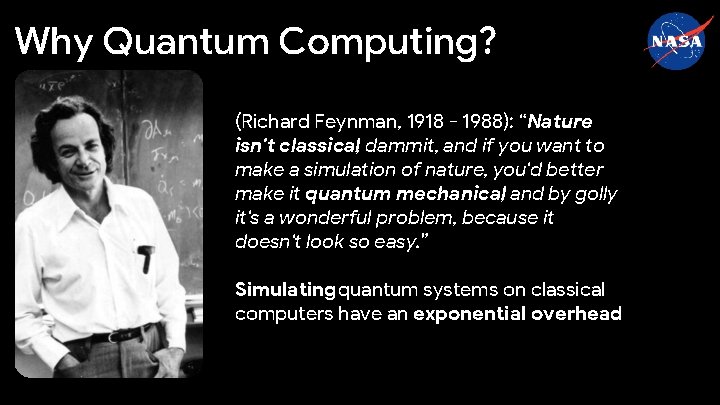
Why Quantum Computing? (Richard Feynman, 1918 - 1988): “Nature isn't classical, dammit, and if you want to make a simulation of nature, you'd better make it quantum mechanical, and by golly it's a wonderful problem, because it doesn't look so easy. ” Simulating quantum systems on classical computers have an exponential overhead
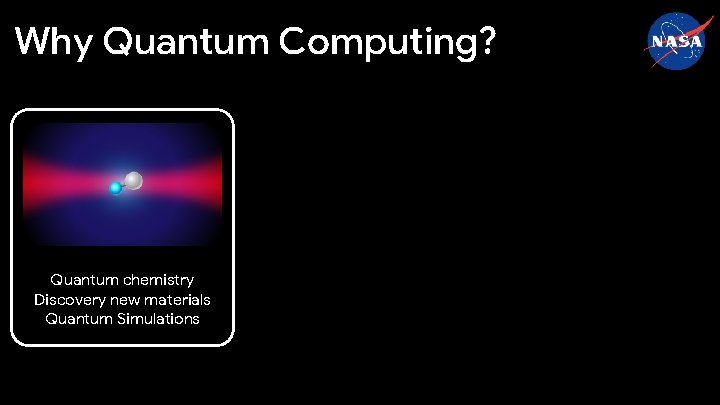
Why Quantum Computing? Quantum chemistry Discovery new materials Quantum Simulations
Why Quantum Computing? Quantum chemistry Discovery new materials Quantum Simulations Break RSA Encryption Quantum Key Distribution
Why Quantum Computing? Quantum chemistry Discovery new materials Quantum Simulations Break RSA Encryption Quantum Key Distribution Quantum Machine Learning Quantum Neurons
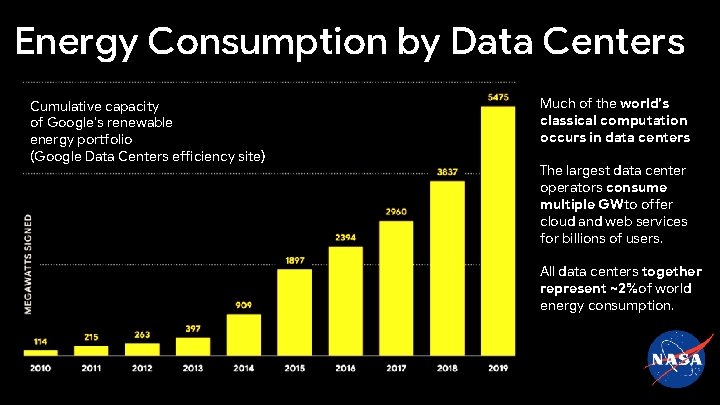
Energy Consumption by Data Centers Cumulative capacity of Google’s renewable energy portfolio (Google Data Centers efficiency site) Much of the world’s classical computation occurs in data centers. The largest data center operators consume multiple GW to offer cloud and web services for billions of users. All data centers together represent ~2% of world energy consumption.
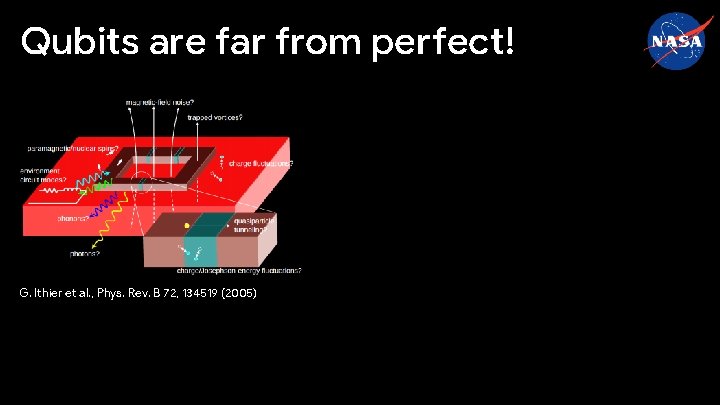
Qubits are far from perfect! G. Ithier et al. , Phys. Rev. B 72, 134519 (2005)
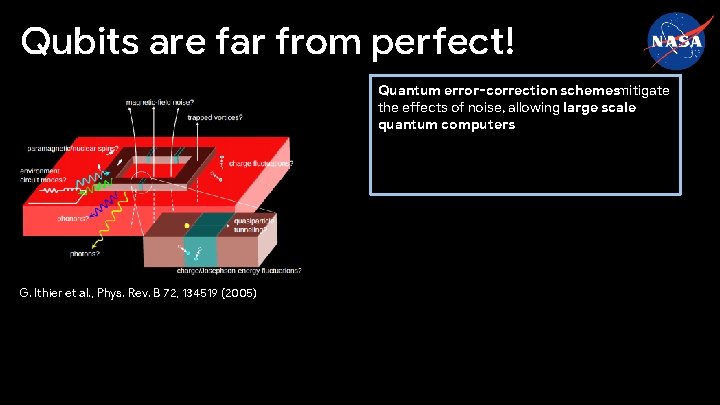
Qubits are far from perfect! Quantum error-correction schemesmitigate the effects of noise, allowing large scale quantum computers G. Ithier et al. , Phys. Rev. B 72, 134519 (2005)
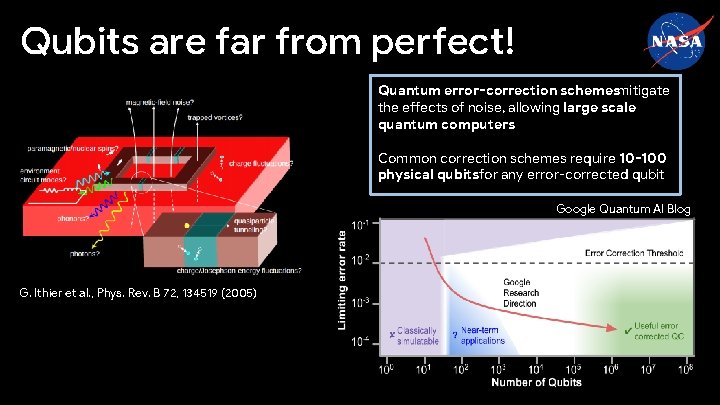
Qubits are far from perfect! Quantum error-correction schemesmitigate the effects of noise, allowing large scale quantum computers Common correction schemes require 10 -100 physical qubitsfor any error-corrected qubit Google Quantum AI Blog G. Ithier et al. , Phys. Rev. B 72, 134519 (2005)
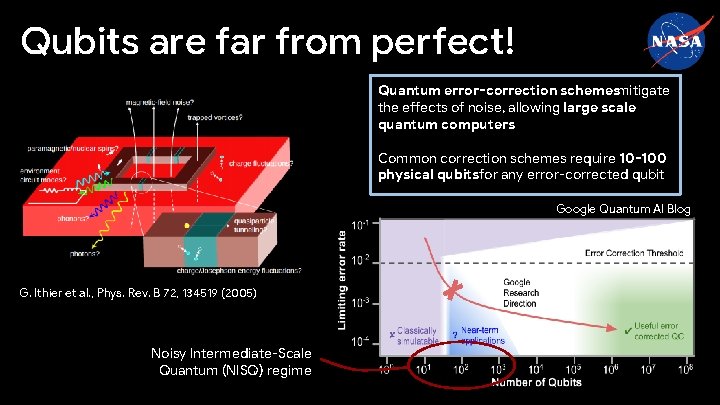
Qubits are far from perfect! Quantum error-correction schemesmitigate the effects of noise, allowing large scale quantum computers Common correction schemes require 10 -100 physical qubitsfor any error-corrected qubit Google Quantum AI Blog G. Ithier et al. , Phys. Rev. B 72, 134519 (2005) Noisy Intermediate-Scale Quantum (NISQ) regime
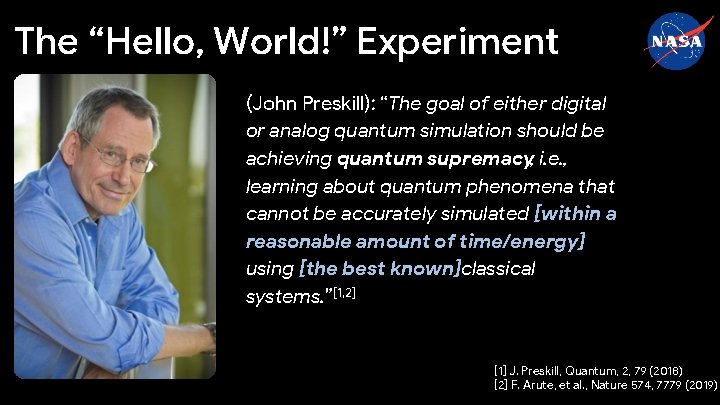
The “Hello, World!” Experiment (John Preskill): “The goal of either digital or analog quantum simulation should be achieving quantum supremacy, i. e. , learning about quantum phenomena that cannot be accurately simulated [within a reasonable amount of time/energy] using [the best known]classical systems. ”[1, 2] [1] J. Preskill, Quantum, 2, 79 (2018) [2] F. Arute, et al. , Nature 574, 7779 (2019)
The “Hello, World!” Experiment[1, 2] Sampling output bitstring [1] S. Boixo, et al. , Nature 14, 6 (2018) [2] F. Arute, et al. , Nature 574, 7779 (2019)
The “Hello, World!” Experiment[1, 2] Quantum Supremacy Sampling output bitstring Classically Simul atable Beyond classica l [1] S. Boixo, et al. , Nature 14, 6 (2018) [2] F. Arute, et al. , Nature 574, 7779 (2019)
The “Hello, World!” Experiment[1, 2] Each point correspond to an output bitstring [1] S. Boixo, et al. , Nature 14, 6 (2018) [2] F. Arute, et al. , Nature 574, 7779 (2019)
The “Hello, World!” Experiment[1, 2] Quantum Computer will sample the brightest spots Each point correspond to an output bitstring [1] S. Boixo, et al. , Nature 14, 6 (2018) [2] F. Arute, et al. , Nature 574, 7779 (2019)
The “Hello, World!” Experiment[1, 2] Quantum Computer will sample the brightest spots Each point correspond to an output bitstring [1] S. Boixo, et al. , Nature 14, 6 (2018) [2] F. Arute, et al. , Nature 574, 7779 (2019) Classical Computer will sample the homogeneously!! (including dark spots)
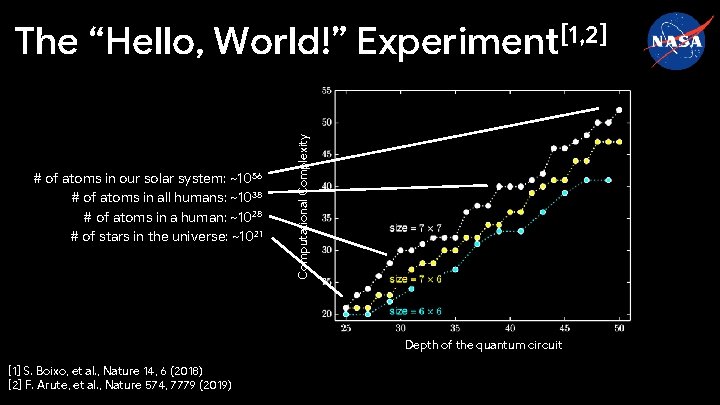
Computational Complexity The “Hello, World!” Experiment[1, 2] Depth of the quantum circuit [1] S. Boixo, et al. , Nature 14, 6 (2018) [2] F. Arute, et al. , Nature 574, 7779 (2019)
# of atoms in our solar system: ~1056 # of atoms in all humans: ~1038 # of atoms in a human: ~1028 # of stars in the universe: ~1021 Computational Complexity The “Hello, World!” Experiment[1, 2] Depth of the quantum circuit [1] S. Boixo, et al. , Nature 14, 6 (2018) [2] F. Arute, et al. , Nature 574, 7779 (2019)
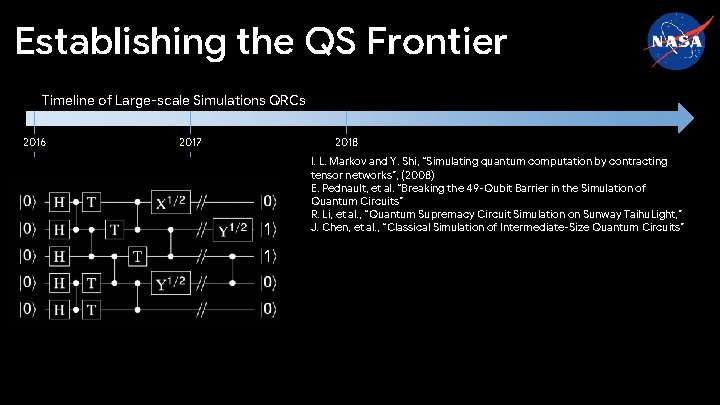
Establishing the QS Frontier Timeline of Large-scale Simulations QRCs
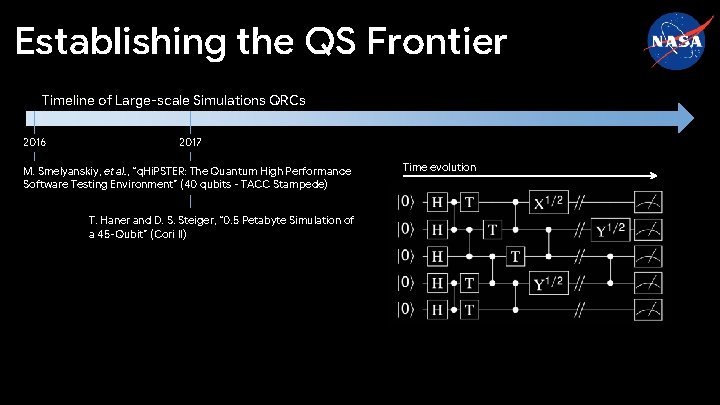
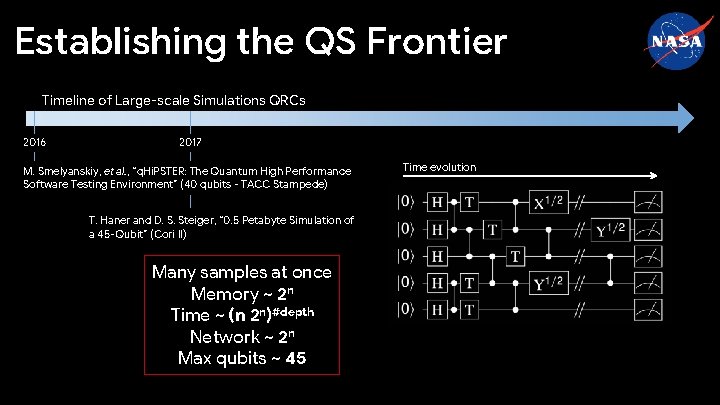
Establishing the QS Frontier Timeline of Large-scale Simulations QRCs 2016 2017 M. Smelyanskiy, et al. , “q. Hi. PSTER: The Quantum High Performance Software Testing Environment” (40 qubits - TACC Stampede) T. Haner and D. S. Steiger, “ 0. 5 Petabyte Simulation of a 45 -Qubit” (Cori II) Time evolution
Establishing the QS Frontier Timeline of Large-scale Simulations QRCs 2016 2017 M. Smelyanskiy, et al. , “q. Hi. PSTER: The Quantum High Performance Software Testing Environment” (40 qubits - TACC Stampede) T. Haner and D. S. Steiger, “ 0. 5 Petabyte Simulation of a 45 -Qubit” (Cori II) Many samples at once Memory ~ 2 n Time ~ (n 2 n)#depth Network ~ 2 n Max qubits ~ 45 Time evolution
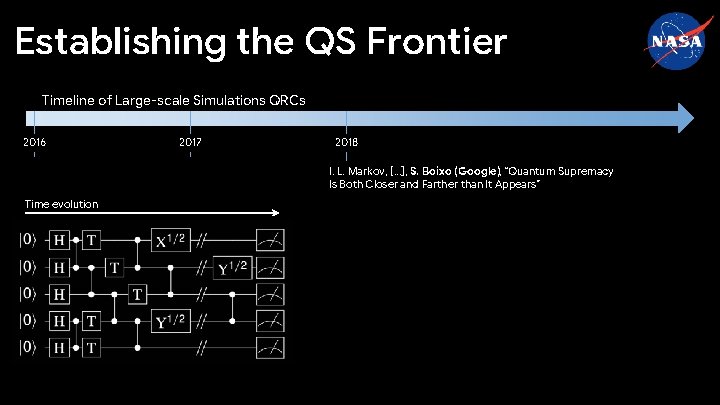
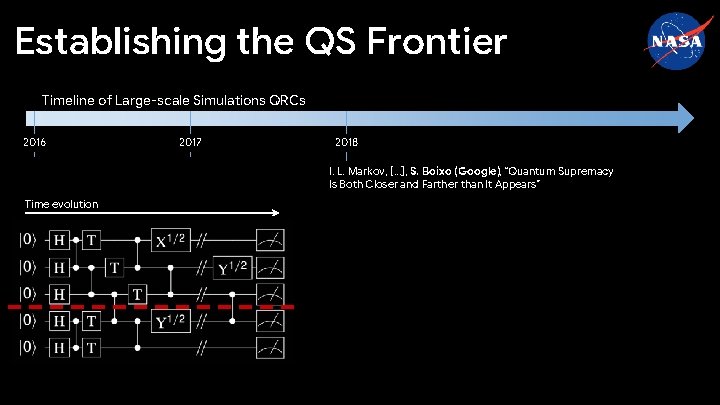
Establishing the QS Frontier Establishing Supremacy Frontier Timeline of Large-scale Simulations QRCs 2016 2017 2018 I. L. Markov, [. . . ], S. Boixo (Google), “Quantum Supremacy Is Both Closer and Farther than It Appears” Time evolution
Establishing the QS Frontier Timeline of Large-scale Simulations QRCs 2016 2017 2018 I. L. Markov, [. . . ], S. Boixo (Google), “Quantum Supremacy Is Both Closer and Farther than It Appears” Time evolution
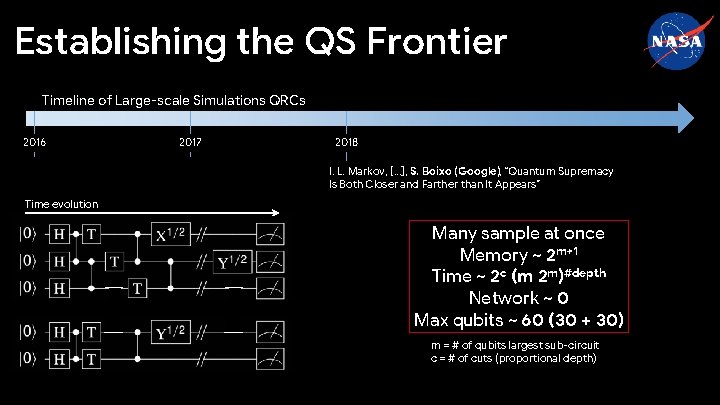
Establishing the QS Frontier Timeline of Large-scale Simulations QRCs 2016 2017 2018 I. L. Markov, [. . . ], S. Boixo (Google), “Quantum Supremacy Is Both Closer and Farther than It Appears” Time evolution Many sample at once Memory ~ 2 m+1 Time ~ 2 c (m 2 m)#depth Network ~ 0 Max qubits ~ 60 (30 + 30) m = # of qubits largest sub-circuit c = # of cuts (proportional depth)
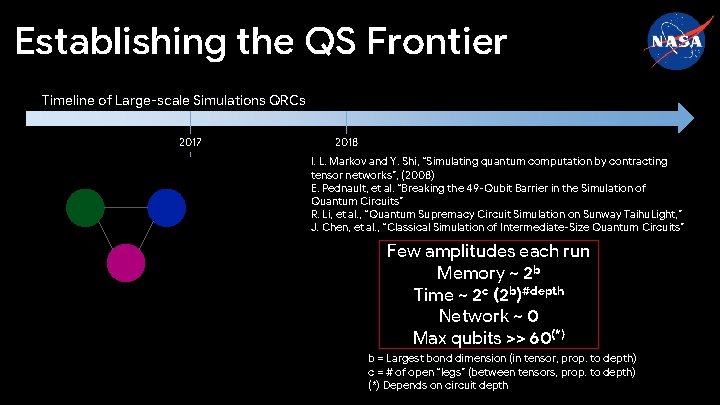
Establishing the QS Frontier Timeline of Large-scale Simulations QRCs 2016 2017 2018 1 1 I. L. Markov and Y. Shi, “Simulating quantum computation by contracting tensor networks”, (2008) E. Pednault, et al. “Breaking the 49 -Qubit Barrier in the Simulation of Quantum Circuits” R. Li, et al. , “Quantum Supremacy Circuit Simulation on Sunway Taihu. Light, ” J. Chen, et al. , “Classical Simulation of Intermediate-Size Quantum Circuits”
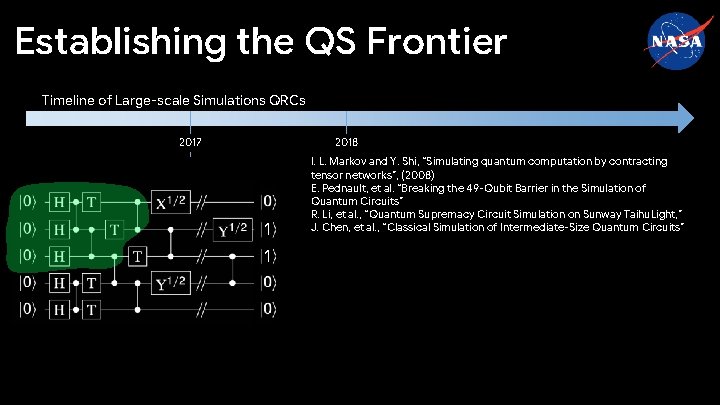
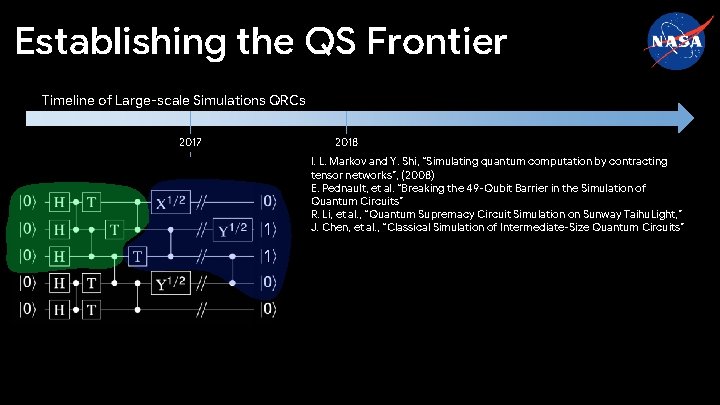
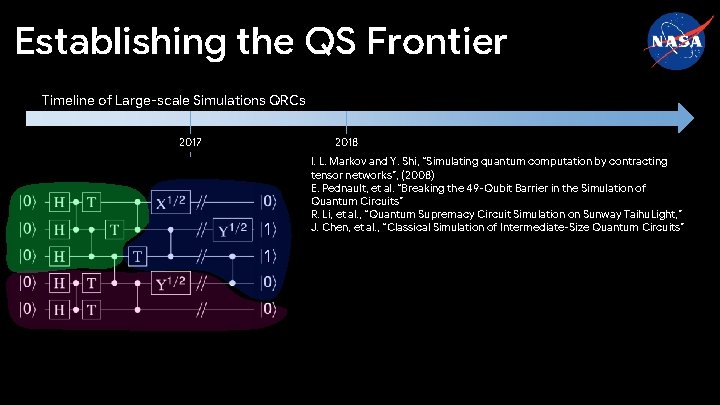
Establishing the QS Frontier Timeline of Large-scale Simulations QRCs 2017 2018 1 1 I. L. Markov and Y. Shi, “Simulating quantum computation by contracting tensor networks”, (2008) E. Pednault, et al. “Breaking the 49 -Qubit Barrier in the Simulation of Quantum Circuits” R. Li, et al. , “Quantum Supremacy Circuit Simulation on Sunway Taihu. Light, ” J. Chen, et al. , “Classical Simulation of Intermediate-Size Quantum Circuits”
Establishing the QS Frontier Timeline of Large-scale Simulations QRCs 2017 2018 1 1 I. L. Markov and Y. Shi, “Simulating quantum computation by contracting tensor networks”, (2008) E. Pednault, et al. “Breaking the 49 -Qubit Barrier in the Simulation of Quantum Circuits” R. Li, et al. , “Quantum Supremacy Circuit Simulation on Sunway Taihu. Light, ” J. Chen, et al. , “Classical Simulation of Intermediate-Size Quantum Circuits”
Establishing the QS Frontier Timeline of Large-scale Simulations QRCs 2017 2018 1 1 I. L. Markov and Y. Shi, “Simulating quantum computation by contracting tensor networks”, (2008) E. Pednault, et al. “Breaking the 49 -Qubit Barrier in the Simulation of Quantum Circuits” R. Li, et al. , “Quantum Supremacy Circuit Simulation on Sunway Taihu. Light, ” J. Chen, et al. , “Classical Simulation of Intermediate-Size Quantum Circuits”
Establishing the QS Frontier Timeline of Large-scale Simulations QRCs 2017 2018 I. L. Markov and Y. Shi, “Simulating quantum computation by contracting tensor networks”, (2008) E. Pednault, et al. “Breaking the 49 -Qubit Barrier in the Simulation of Quantum Circuits” R. Li, et al. , “Quantum Supremacy Circuit Simulation on Sunway Taihu. Light, ” J. Chen, et al. , “Classical Simulation of Intermediate-Size Quantum Circuits” Few amplitudes each run Memory ~ 2 b Time ~ 2 c (2 b)#depth Network ~ 0 Max qubits >> 60(*) b = Largest bond dimension (in tensor, prop. to depth) c = # of open “legs” (between tensors, prop. to depth) (*) Depends on circuit depth
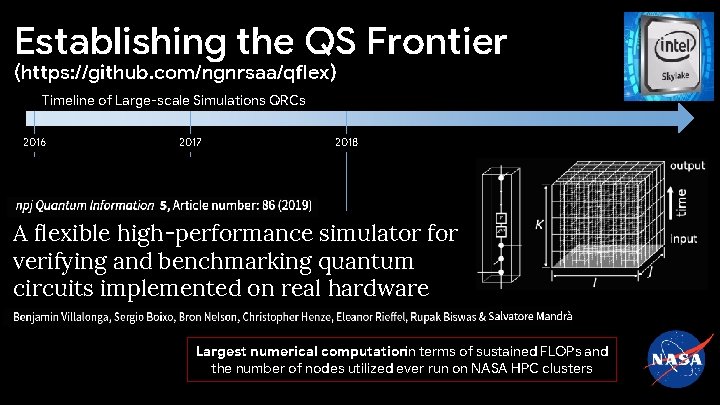
Establishing the QS Frontier (https: //github. com/ngnrsaa/qflex) Timeline of Large-scale Simulations QRCs 2016 2017 2018 A flexible high-performance simulator for verifying and benchmarking quantum circuits implemented on real hardware Largest numerical computationin terms of sustained FLOPs and the number of nodes utilized ever run on NASA HPC clusters
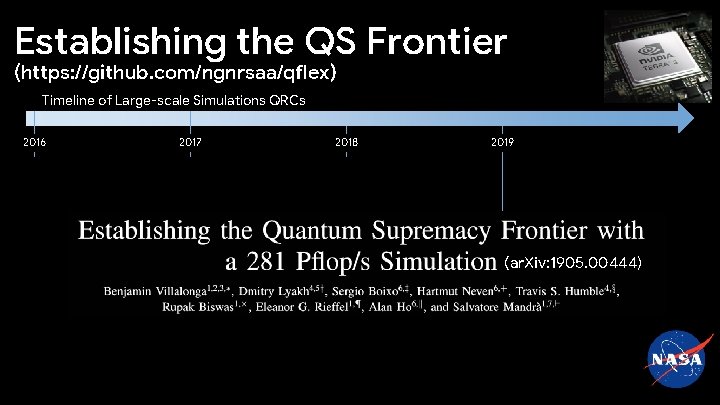
Establishing the QS Frontier (https: //github. com/ngnrsaa/qflex) Timeline of Large-scale Simulations QRCs 2016 2017 2018 2019 (ar. Xiv: 1905. 00444)
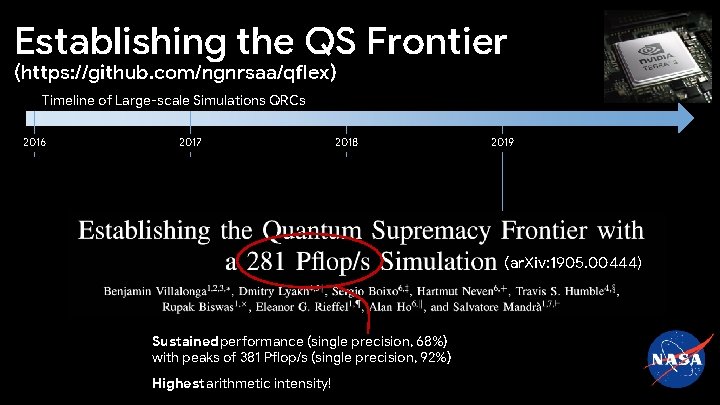
Establishing the QS Frontier (https: //github. com/ngnrsaa/qflex) Timeline of Large-scale Simulations QRCs 2016 2017 2018 2019 (ar. Xiv: 1905. 00444) Sustained performance (single precision, 68%) with peaks of 381 Pflop/s (single precision, 92%) Highest arithmetic intensity!
Quantum Supremacy Results[1] Sycamore [1] F. Arute, et al. , Nature 574, 7779 (2019)
Quantum Supremacy Results[1] Sycamore [1] F. Arute, et al. , Nature 574, 7779 (2019)
Quantum Supremacy Results[1] F. Arute, et al. , Nature 574, 7779 (2019)
Quantum Supremacy Results[1] Three Gorges Dam (world’s largest power station): ~22. 5 GW Denver (~1 k. W x 620, 000 [population]): ~0. 62 GW Google Sycamore (53 qubits): ~25 k. W [1] F. Arute, et al. , Nature 574, 7779 (2019)
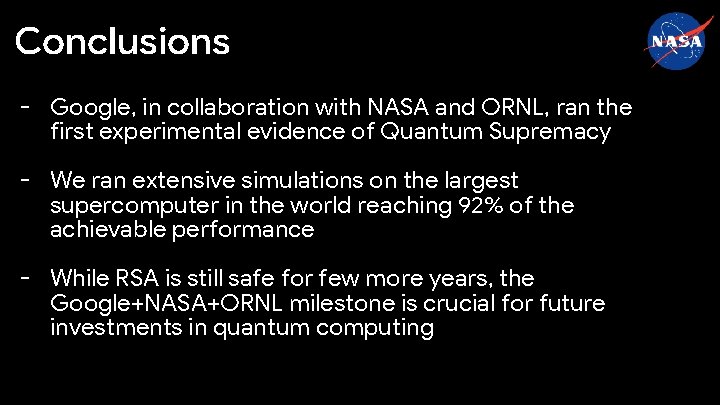
Conclusions - Google, in collaboration with NASA and ORNL, ran the first experimental evidence of Quantum Supremacy - We ran extensive simulations on the largest supercomputer in the world reaching 92% of the achievable performance - While RSA is still safe for few more years, the Google+NASA+ORNL milestone is crucial for future investments in quantum computing
Thanks for your Attention! Salvatore Mandra, Ph. D. Quantum Artificial Intelligence Lab (Qu. AIL) NASA Ames Research Center