
Achieving Livable Communities Through Transportation Purdue Road School
Achieving Livable Communities Through Transportation Purdue Road School March 8, 2011
Why Livable Communities �Livable … �is sustainable and can enhance environmental performance �Provides safe, reliable, economical transportation options �promotes reinvestment in existing communities �can improve community quality of life �meets the mobility needs of communities, families, and businesses.
How livable communities �Not just a single project…Not even two or three projects �Starts with Visioning �Then the planning and the process �There’s policy �There’s partnership �There’s design �And then…. The implementation and funding
Agenda �Safe Routes to School �St. Thomas Aquinas �The Project School �Why SRTS? �Bike Facilities �Madison, Wisconsin �Why Bike Facilities? �Pedestrian and Multi- Use Facilities �B-Line �National Road Heritage Trail �Why Trails? �Traffic Calming �Road Diets �Other Types of Traffic Calming �Why Traffic Calming? �Safety �Plainfield/Indianapolis �Why Safety?
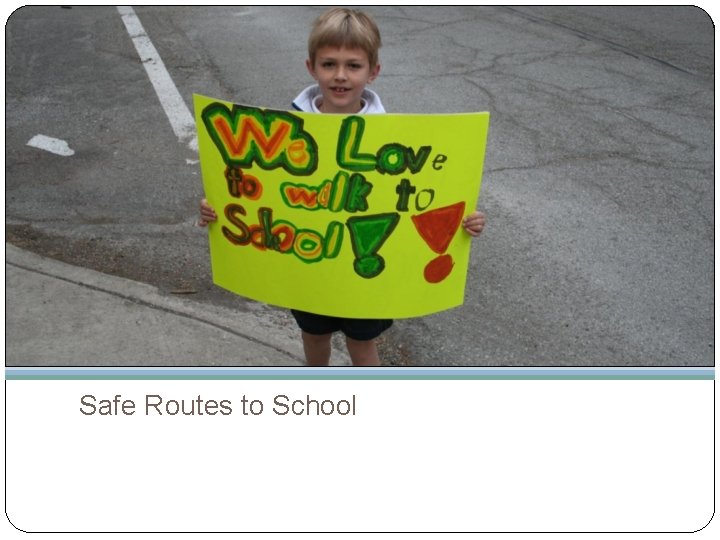
Safe Routes to School
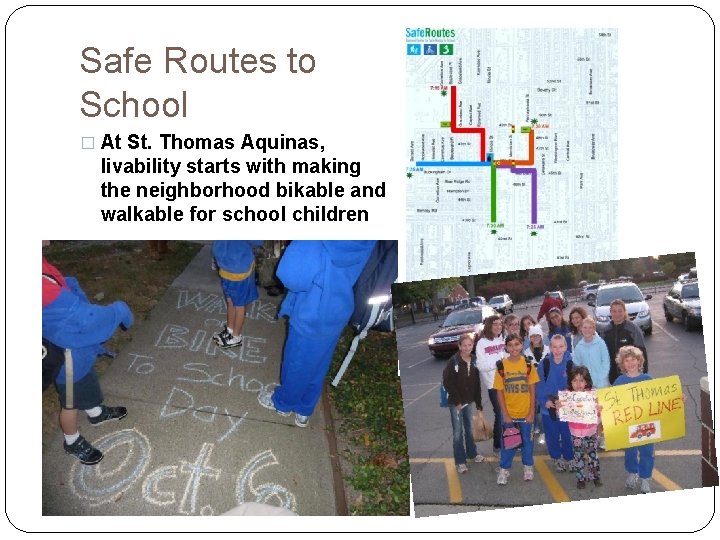
Safe Routes to School � At St. Thomas Aquinas, livability starts with making the neighborhood bikable and walkable for school children
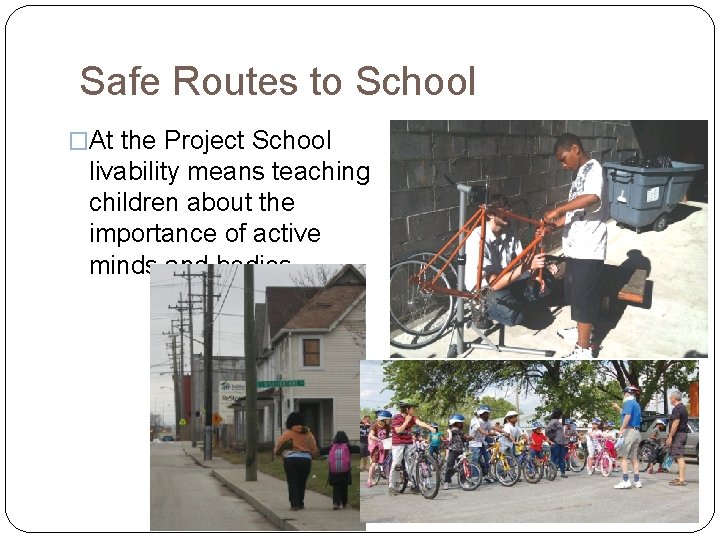
Safe Routes to School �At the Project School livability means teaching children about the importance of active minds and bodies
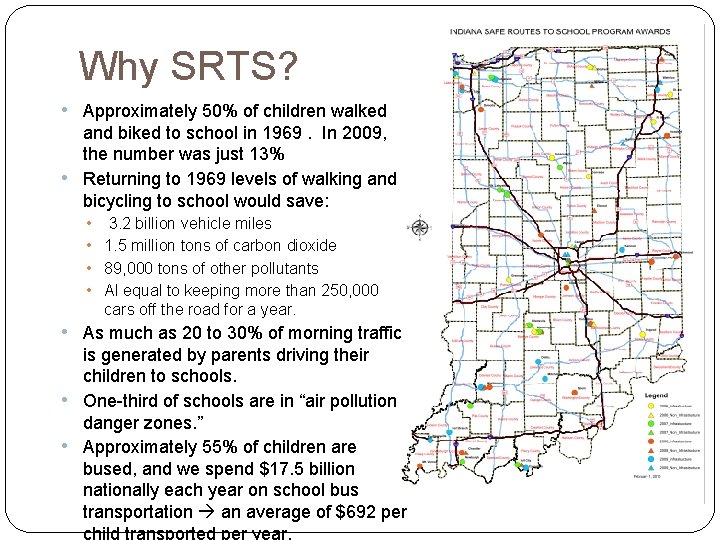
Why SRTS? • Approximately 50% of children walked and biked to school in 1969. In 2009, the number was just 13% • Returning to 1969 levels of walking and bicycling to school would save: • 3. 2 billion vehicle miles • 1. 5 million tons of carbon dioxide • 89, 000 tons of other pollutants • Al equal to keeping more than 250, 000 cars off the road for a year. • As much as 20 to 30% of morning traffic is generated by parents driving their children to schools. • One-third of schools are in “air pollution danger zones. ” • Approximately 55% of children are bused, and we spend $17. 5 billion nationally each year on school bus transportation an average of $692 per child transported per year.
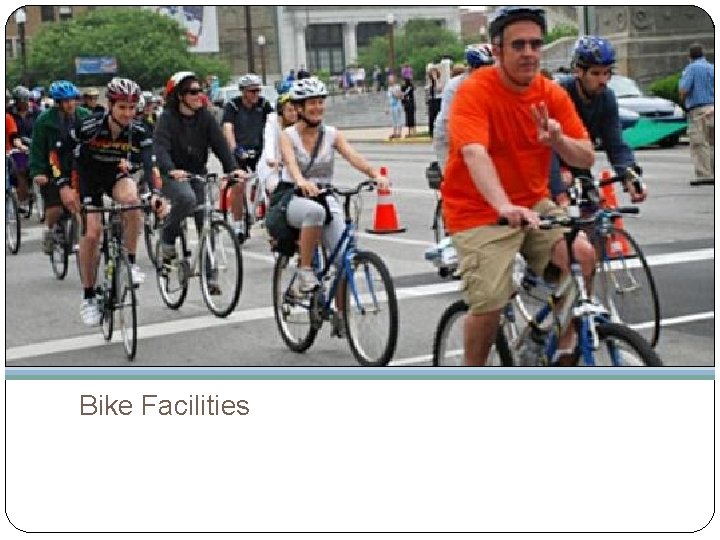
Bike Facilities
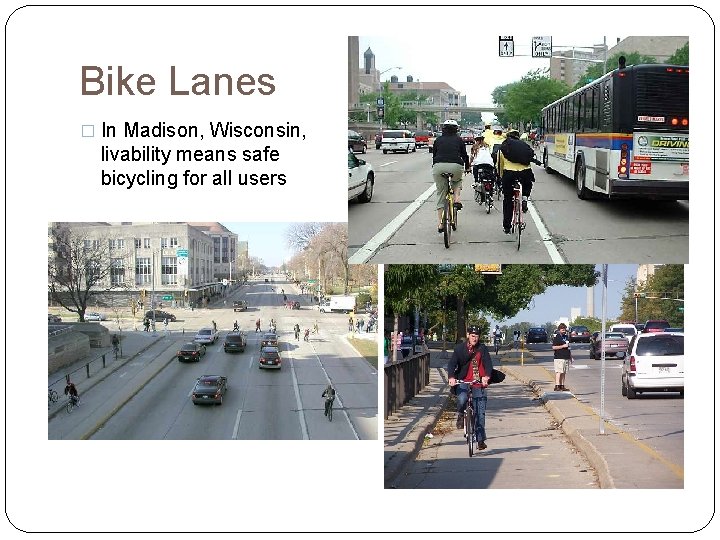
Bike Lanes � In Madison, Wisconsin, livability means safe bicycling for all users
Why Bike Facilities? � Bicycling contributes $1. 5 billion to Wisconsin's economy every year. � 13, 200 bike-related jobs � $535 million in tourism dollars from out-of-state visitors � reduced health care costs � Tourism � Sparta, Wisconsin welcomes 15, 500 visiting bicyclists each year to the Elroy Sparta bike trail. The Wisconsin DNR reports that 100, 000 people use the trail annually. � Business � Bicycle Corporation, Saris Cycling Group, Planet Bike, Pacific Cycles, Waterford Precision Cycles reside in Wisconsin. � Hundreds of locally-owned bike shops and bicycle-friendly businesses support the vitality of local economies. � Wisconsin bicycle industry adds nearly $600 million annually to the state's economy. � Health Care
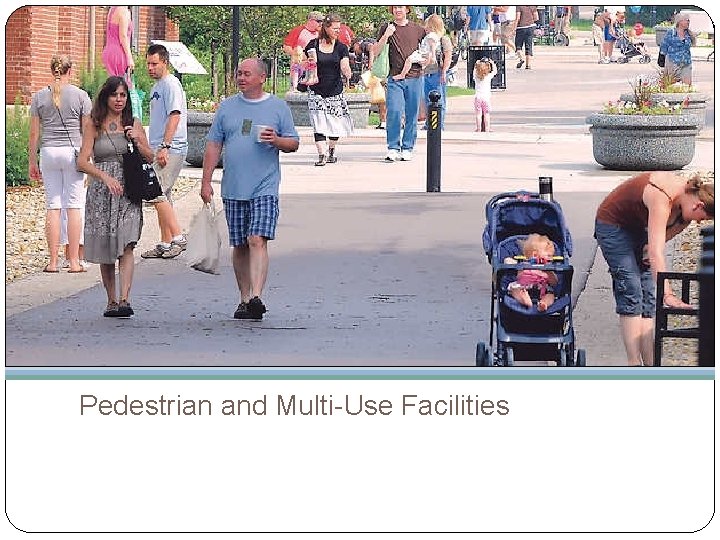
Pedestrian and Multi-Use Facilities
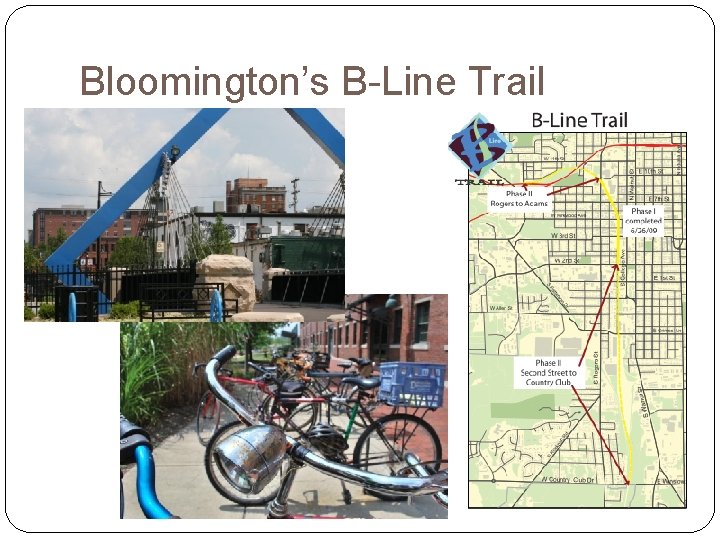
Bloomington’s B-Line Trail
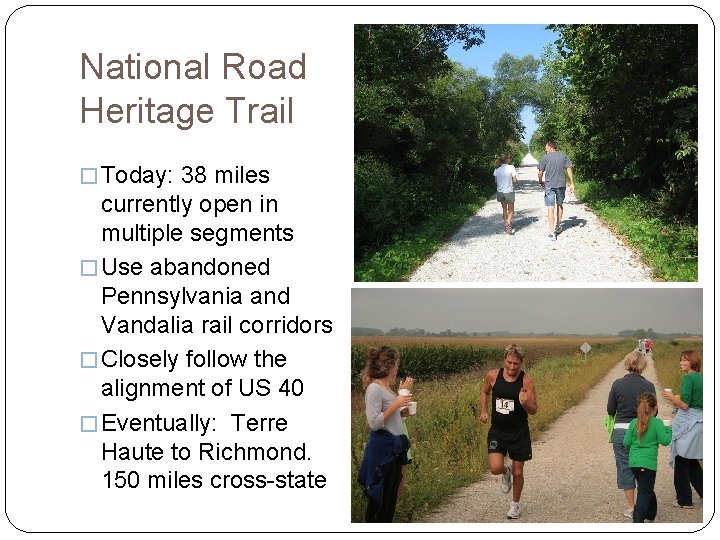
National Road Heritage Trail � Today: 38 miles currently open in multiple segments � Use abandoned Pennsylvania and Vandalia rail corridors � Closely follow the alignment of US 40 � Eventually: Terre Haute to Richmond. 150 miles cross-state
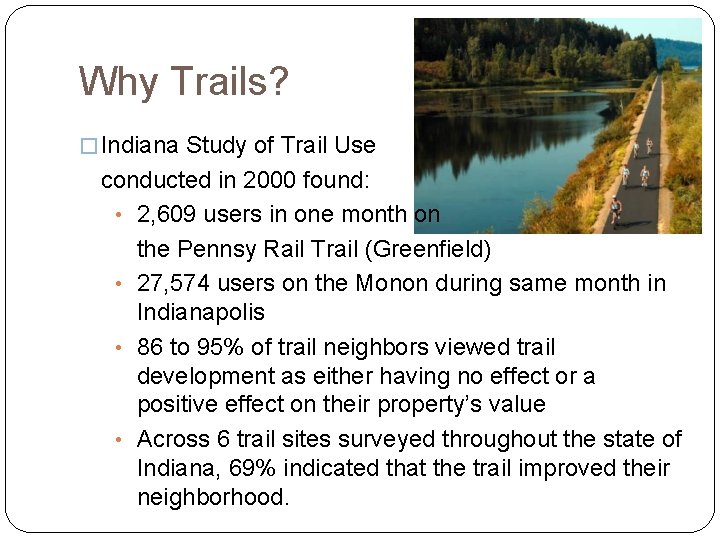
Why Trails? � Indiana Study of Trail Use conducted in 2000 found: • 2, 609 users in one month on the Pennsy Rail Trail (Greenfield) • 27, 574 users on the Monon during same month in Indianapolis • 86 to 95% of trail neighbors viewed trail development as either having no effect or a positive effect on their property’s value • Across 6 trail sites surveyed throughout the state of Indiana, 69% indicated that the trail improved their neighborhood.
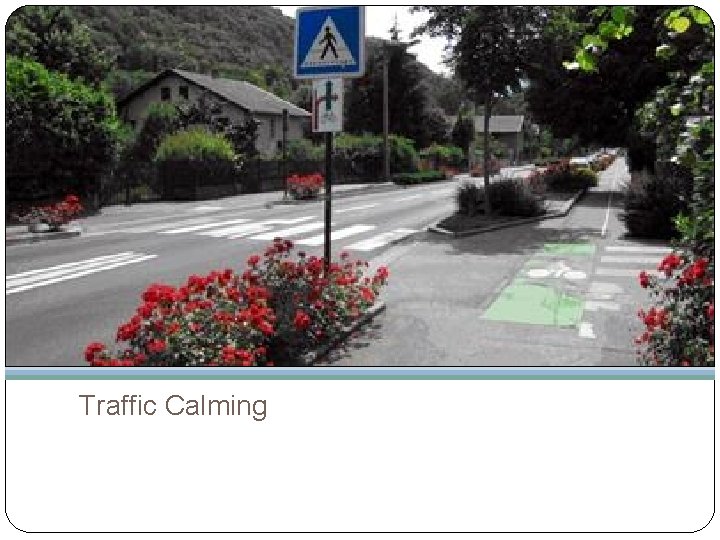
Traffic Calming
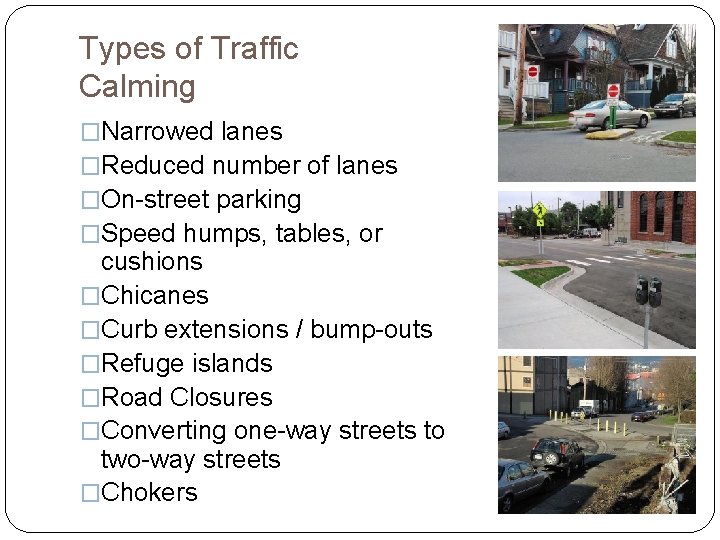
Types of Traffic Calming �Narrowed lanes �Reduced number of lanes �On-street parking �Speed humps, tables, or cushions �Chicanes �Curb extensions / bump-outs �Refuge islands �Road Closures �Converting one-way streets to two-way streets �Chokers
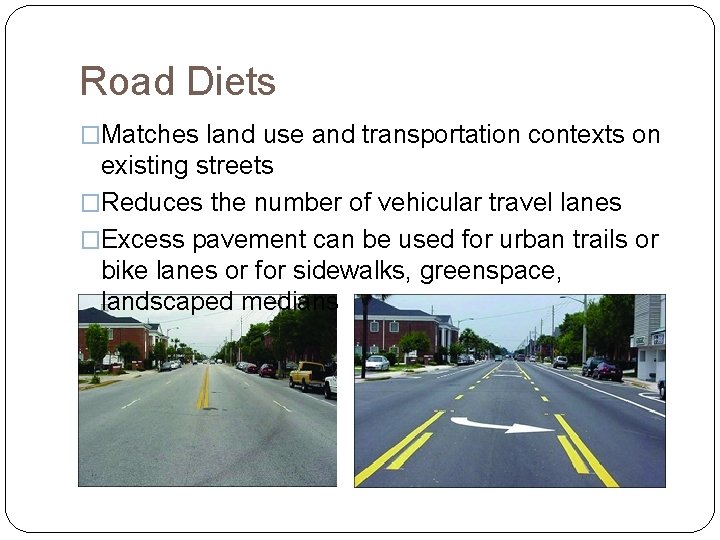
Road Diets �Matches land use and transportation contexts on existing streets �Reduces the number of vehicular travel lanes �Excess pavement can be used for urban trails or bike lanes or for sidewalks, greenspace, landscaped medians
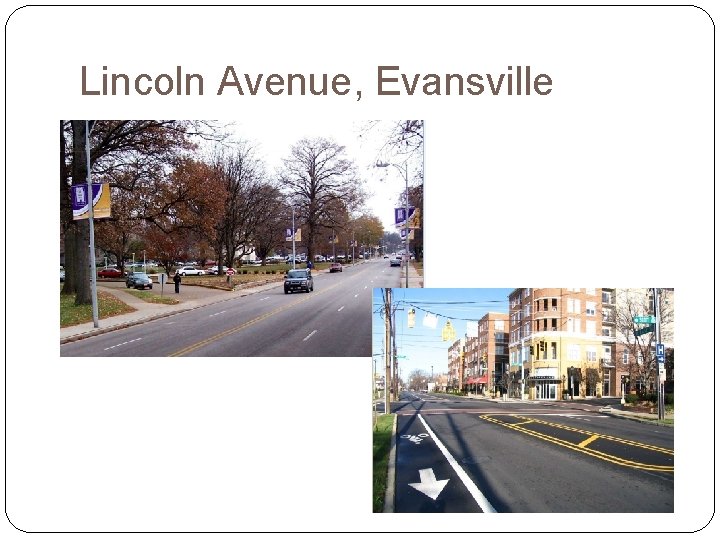
Lincoln Avenue, Evansville
Road Diet Case Study �Valencia Street, San Francisco �Reduced from 4 lanes with on-street parking to 2 lanes with on-street parking plus bike lanes and center TWLTL �Bike usage increased 144% from 88 to 215 bicycles during the PM peak hour �Motor vehicle traffic decreased by 10% from 22, 000 ADT to 20, 000 ADT �Traffic on nearby streets increased by 3. 8% �No significant changes in collision rates on Valencia or parallel routes
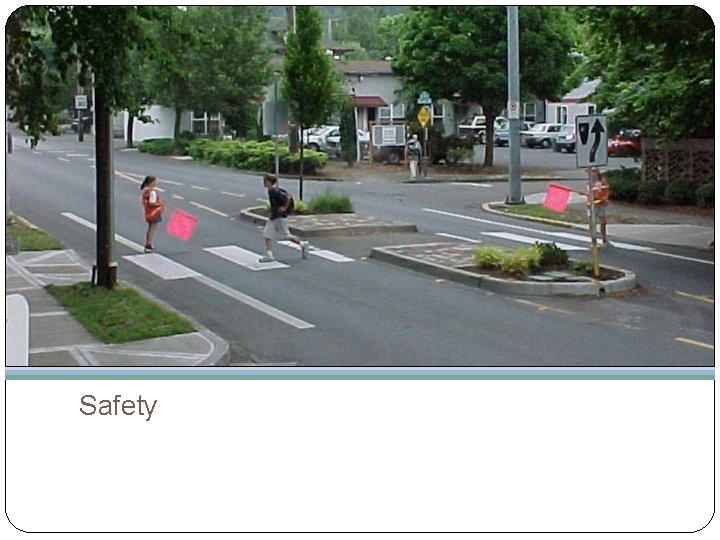
Safety
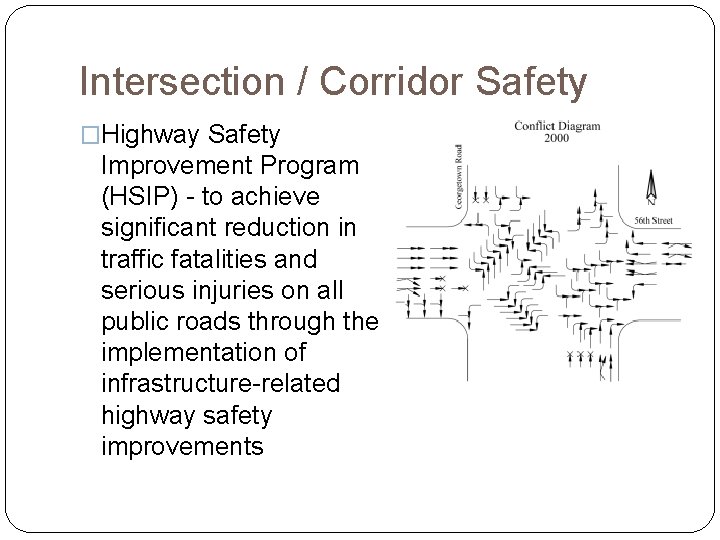
Intersection / Corridor Safety �Highway Safety Improvement Program (HSIP) - to achieve significant reduction in traffic fatalities and serious injuries on all public roads through the implementation of infrastructure-related highway safety improvements
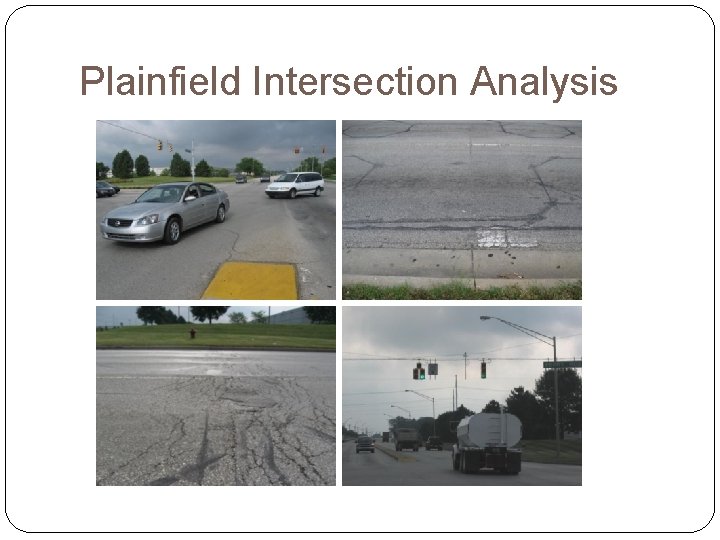
Plainfield Intersection Analysis
Proven Safety Countermeasures Road Safety Audits Rumble Strips and Rumble Stripes Median Barriers Safety Edges Roundabouts Left and Right-Turn Lanes at Stop-Controlled Intersections 7. Yellow Change Intervals 8. Medians and Pedestrian Refuge Islands in Urban and Suburban Areas 9. Walkways 1. 2. 3. 4. 5. 6.
Achieving Livability �What has worked in your communities?
Thank you Jennifer Pyrz Parsons Brinckerhoff pyrz@pbworld. com 317. 287. 3411
Bicycling Industry Metrics �In Portland, the bicycling industry is robust. And growing. �Bicycle-related activity brings in about $90 M �The bicycle-related industry sector has increased by 38% since 2006 �Number of bicycle-related companies has grown by 50% since 2006. Most new businesses are small and locally-owned. �The bicycle-related industry provides between 850 and 1150 jobs �Nearly 4, 000 annual races, rides, events and tours are held in Portland every year. This is nearly a doubling of 2006 numbers. Source: Alta Planning + Design
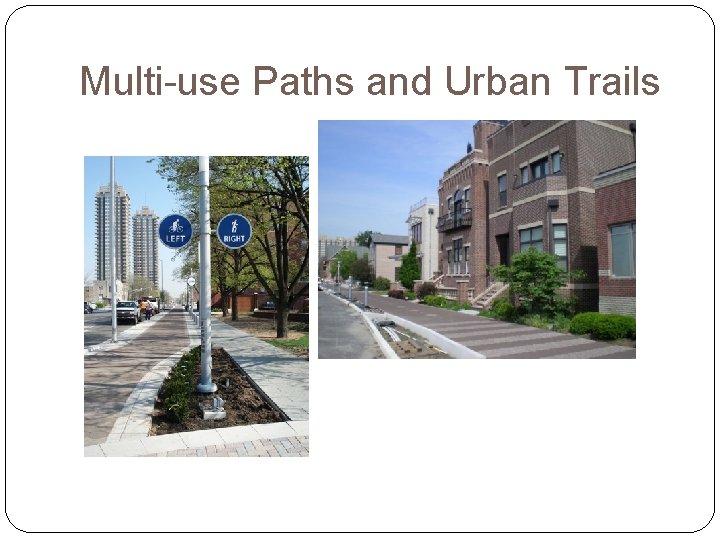
Multi-use Paths and Urban Trails
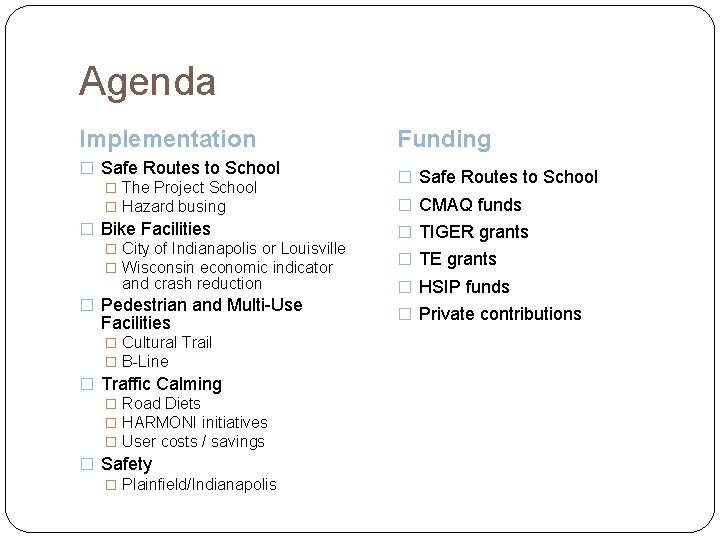
Agenda Implementation � Safe Routes to School � The Project School � Hazard busing � Bike Facilities � City of Indianapolis or Louisville � Wisconsin economic indicator and crash reduction � Pedestrian and Multi-Use Facilities � Cultural Trail � B-Line � Traffic Calming � Road Diets � HARMONI initiatives � User costs / savings � Safety � Plainfield/Indianapolis Funding � Safe Routes to School � CMAQ funds � TIGER grants � TE grants � HSIP funds � Private contributions
- Slides: 29