
Achieving Consistency in the MultiMission Ocean Color Data


- Slides: 37
Achieving Consistency in the Multi-Mission Ocean Color Data Record Bryan Franz and the NASA Ocean Biology Processing Group MODIS Science Team Meeting 19 May 2011 – College Park, MD
Outline How we define a Climate Data Record How we achieve CDR quality Results of latest reprocessing effort Future directions
What is a Climate Data Record? "A climate data record is a time series of measurements of sufficient length, consistency, and continuity to determine climate variability and change. " U. S. National Research Council, 2004
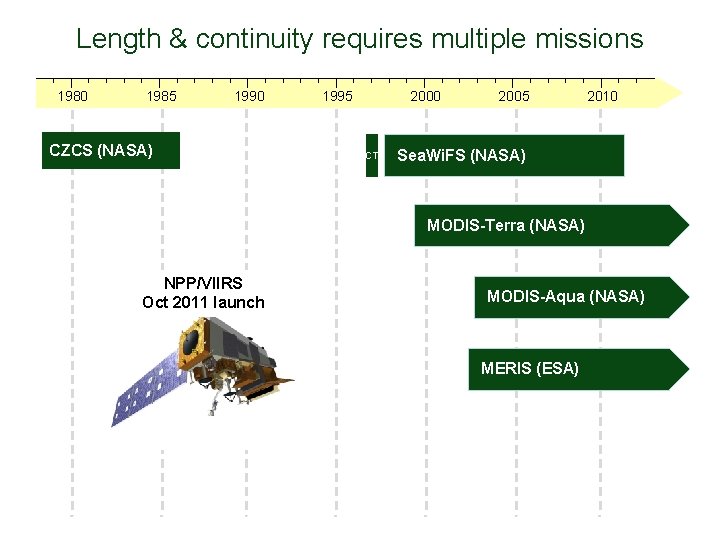
Length & continuity requires multiple missions 1980 1985 1990 CZCS (NASA) 1995 2000 OCTS 2005 2010 Sea. Wi. FS (NASA) MODIS-Terra (NASA) NPP/VIIRS Oct 2011 launch MODIS-Aqua (NASA) MERIS (ESA)
How do we achieve consistency?
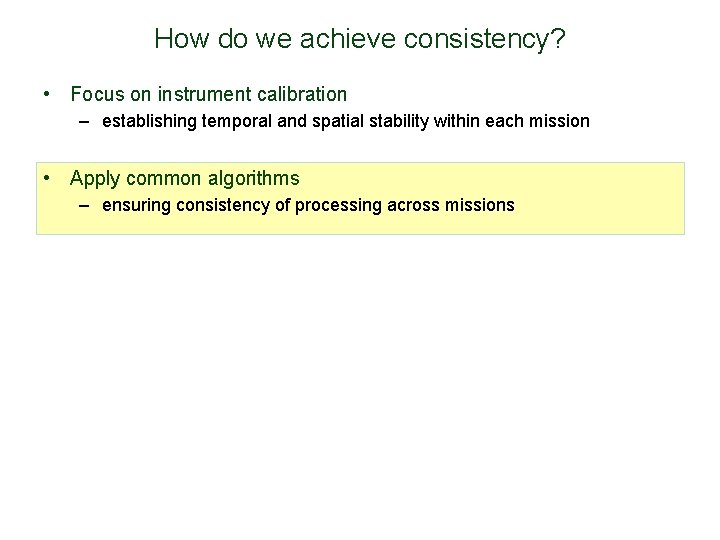
How do we achieve consistency? • Focus on instrument calibration – establishing temporal and spatial stability within each mission
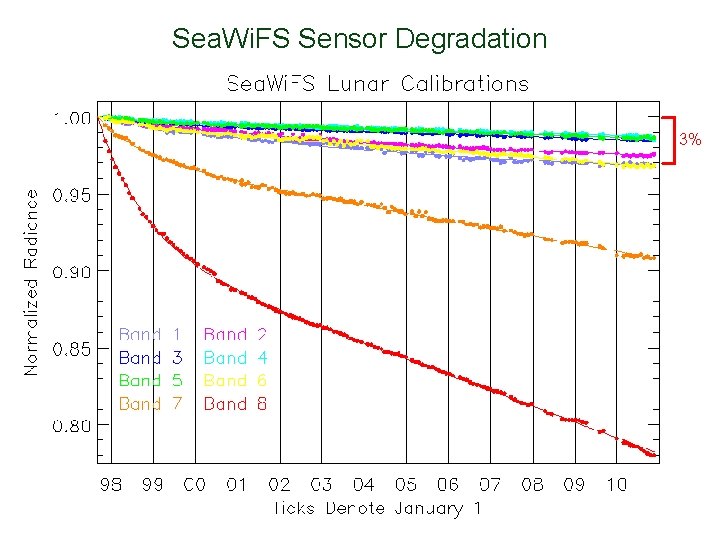
Sea. Wi. FS Sensor Degradation 3%
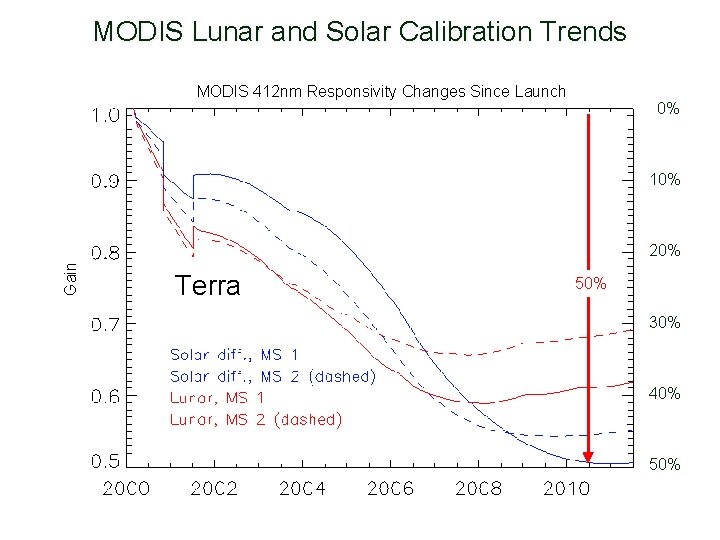
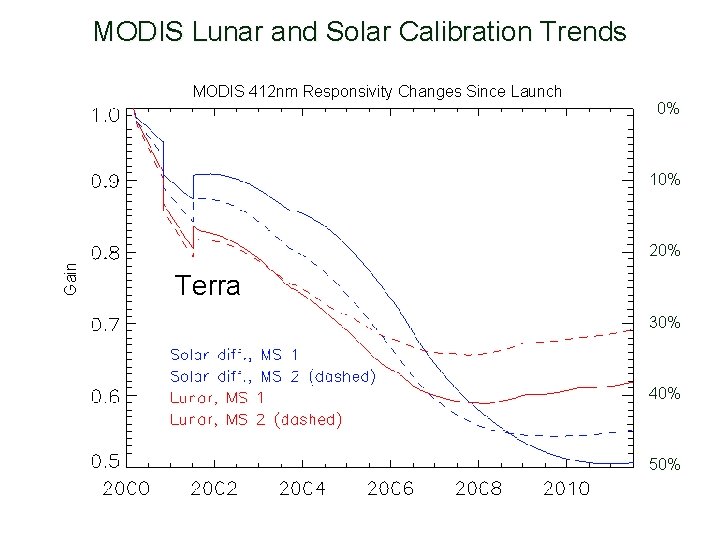
MODIS Lunar and Solar Calibration Trends MODIS 412 nm Responsivity Changes Since Launch 0% 10% Gain 20% Terra 50% 30% 40% 50%
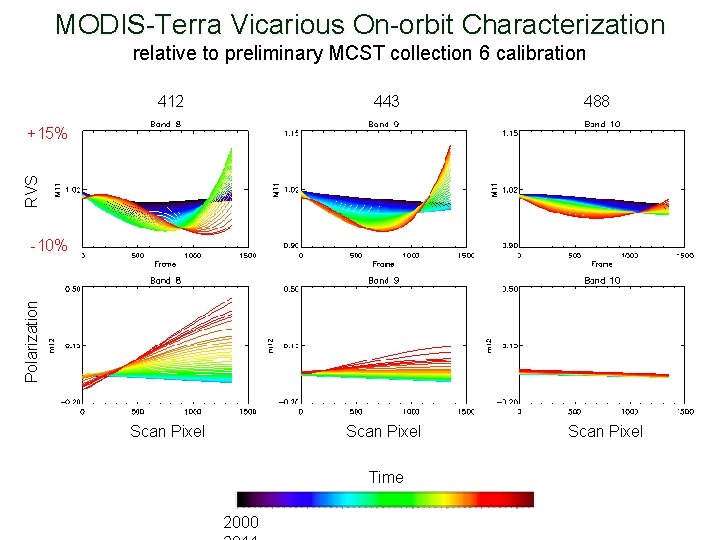
MODIS-Terra Vicarious On-orbit Characterization relative to preliminary MCST collection 6 calibration 412 443 Scan Pixel 488 RVS +15% Polarization -10% Time 2000 Scan Pixel
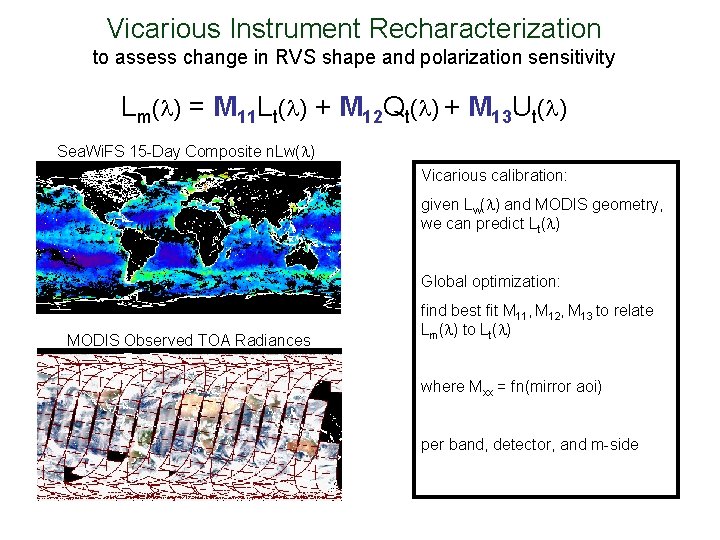
Vicarious Instrument Recharacterization to assess change in RVS shape and polarization sensitivity Lm( ) = M 11 Lt( ) + M 12 Qt( ) + M 13 Ut( ) Sea. Wi. FS 15 -Day Composite n. Lw( ) Vicarious calibration: given Lw( ) and MODIS geometry, we can predict Lt( ) Global optimization: MODIS Observed TOA Radiances find best fit M 11, M 12, M 13 to relate Lm( ) to Lt( ) where Mxx = fn(mirror aoi) per band, detector, and m-side 10
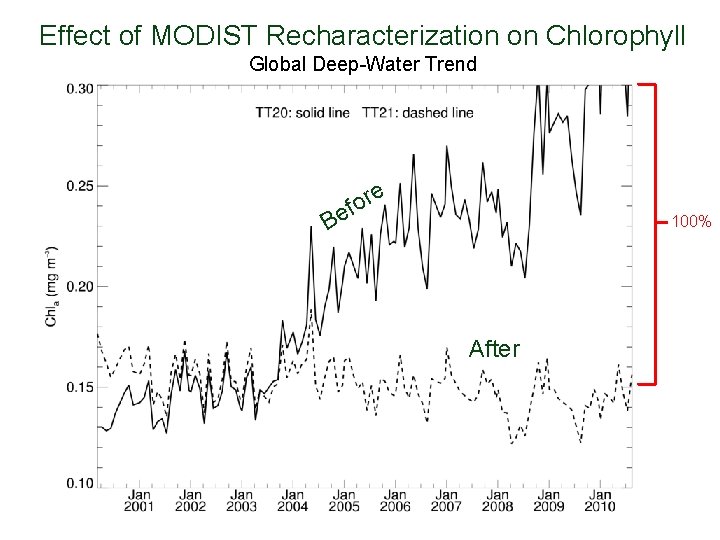
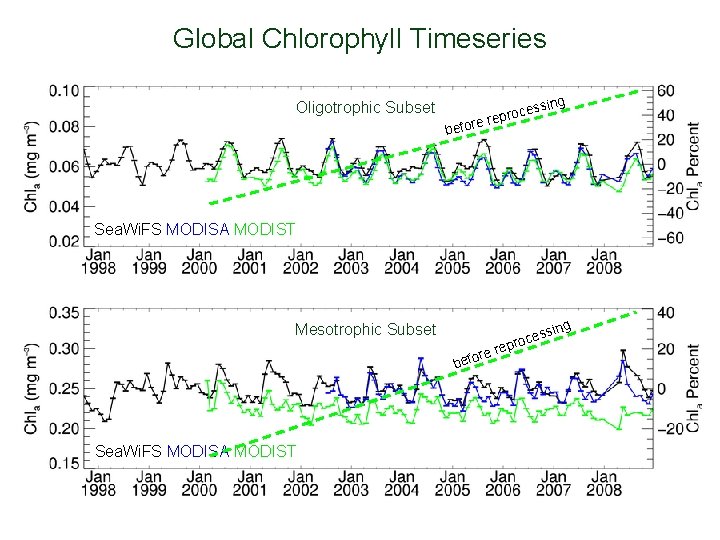
Effect of MODIST Recharacterization on Chlorophyll Global Deep-Water Trend re o f Be 100% After
MODIS Lunar and Solar Calibration Trends MODIS 412 nm Responsivity Changes Since Launch 0% Aqua 10% Gain 20% Terra 30% 40% 50%
How do we achieve consistency? • Focus on instrument calibration – establishing temporal and spatial stability within each mission
How do we achieve consistency? • Focus on instrument calibration – establishing temporal and spatial stability within each mission • Apply common algorithms – ensuring consistency of processing across missions
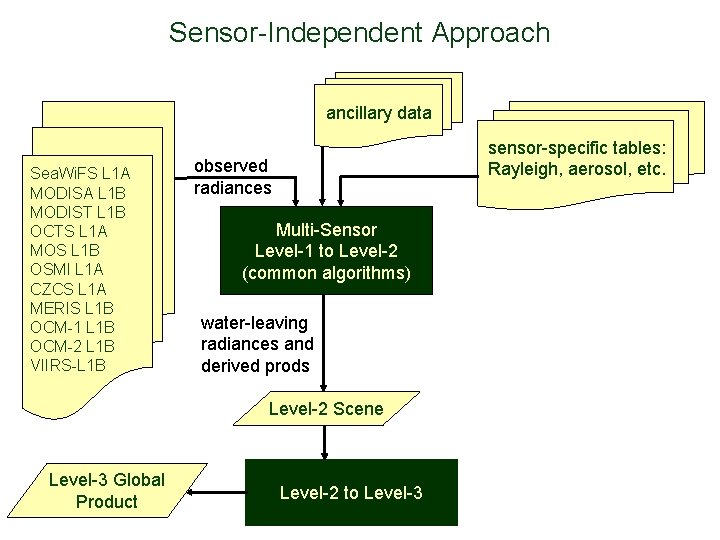
Sensor-Independent Approach ancillary data Sea. Wi. FS L 1 A MODISA L 1 B MODIST L 1 B OCTS L 1 A MOS L 1 B OSMI L 1 A CZCS L 1 A MERIS L 1 B OCM-1 L 1 B OCM-2 L 1 B VIIRS-L 1 B sensor-specific tables: Rayleigh, aerosol, etc. observed radiances Multi-Sensor Level-1 to Level-2 (common algorithms) water-leaving radiances and derived prods Level-2 Scene Level-3 Global Product Level-2 to Level-3
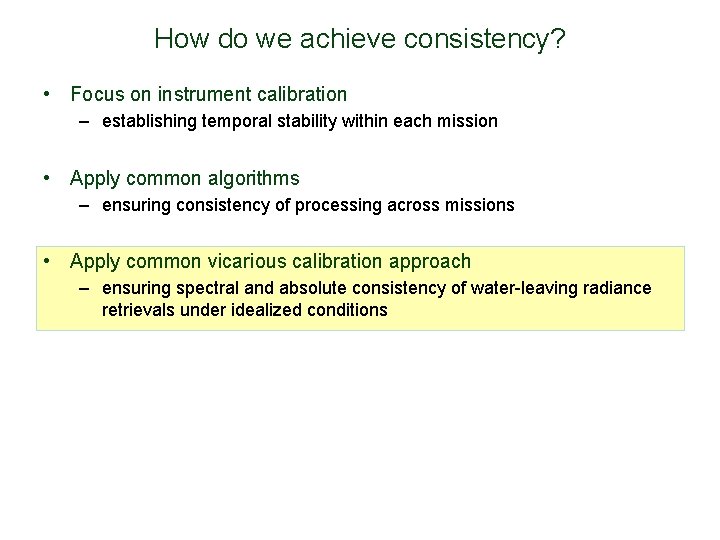
How do we achieve consistency? • Focus on instrument calibration – establishing temporal stability within each mission • Apply common algorithms – ensuring consistency of processing across missions • Apply common vicarious calibration approach – ensuring spectral and absolute consistency of water-leaving radiance retrievals under idealized conditions
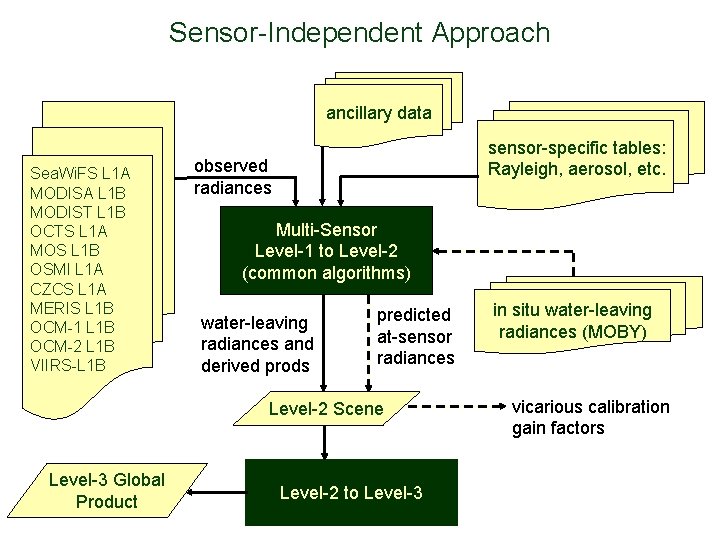
Sensor-Independent Approach ancillary data Sea. Wi. FS L 1 A MODISA L 1 B MODIST L 1 B OCTS L 1 A MOS L 1 B OSMI L 1 A CZCS L 1 A MERIS L 1 B OCM-1 L 1 B OCM-2 L 1 B VIIRS-L 1 B sensor-specific tables: Rayleigh, aerosol, etc. observed radiances Multi-Sensor Level-1 to Level-2 (common algorithms) water-leaving radiances and derived prods predicted at-sensor radiances Level-2 Scene Level-3 Global Product Level-2 to Level-3 in situ water-leaving radiances (MOBY) vicarious calibration gain factors
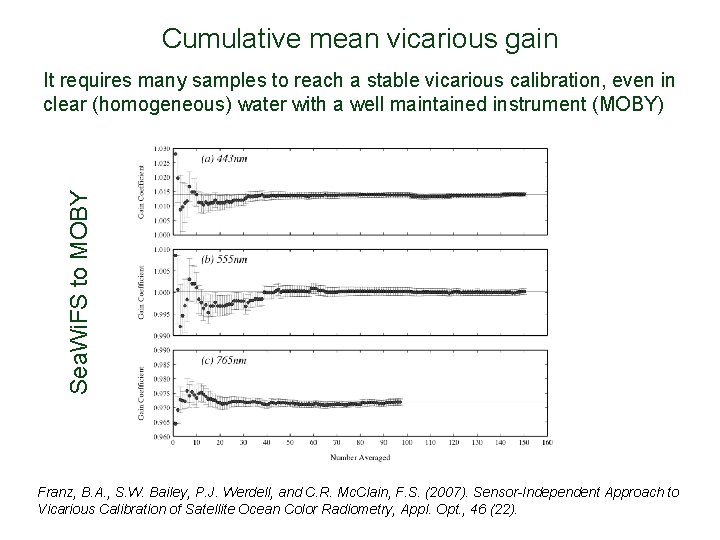
Cumulative mean vicarious gain Sea. Wi. FS to MOBY It requires many samples to reach a stable vicarious calibration, even in clear (homogeneous) water with a well maintained instrument (MOBY) Franz, B. A. , S. W. Bailey, P. J. Werdell, and C. R. Mc. Clain, F. S. (2007). Sensor-Independent Approach to Vicarious Calibration of Satellite Ocean Color Radiometry, Appl. Opt. , 46 (22).
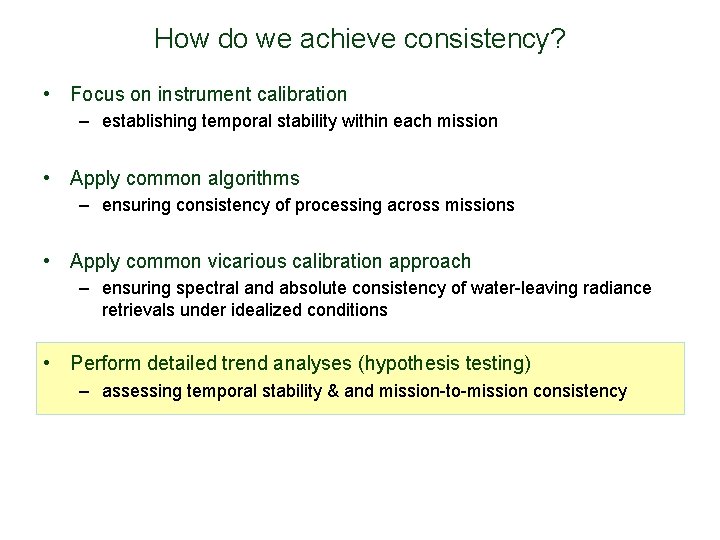
How do we achieve consistency? • Focus on instrument calibration – establishing temporal stability within each mission • Apply common algorithms – ensuring consistency of processing across missions • Apply common vicarious calibration approach – ensuring spectral and absolute consistency of water-leaving radiance retrievals under idealized conditions • Perform detailed trend analyses (hypothesis testing) – assessing temporal stability & and mission-to-mission consistency
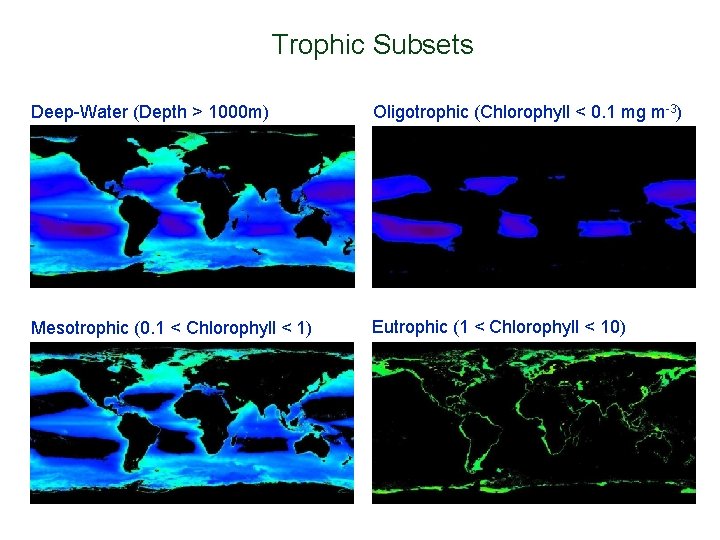
Trophic Subsets Deep-Water (Depth > 1000 m) Oligotrophic (Chlorophyll < 0. 1 mg m-3) Mesotrophic (0. 1 < Chlorophyll < 1) Eutrophic (1 < Chlorophyll < 10)
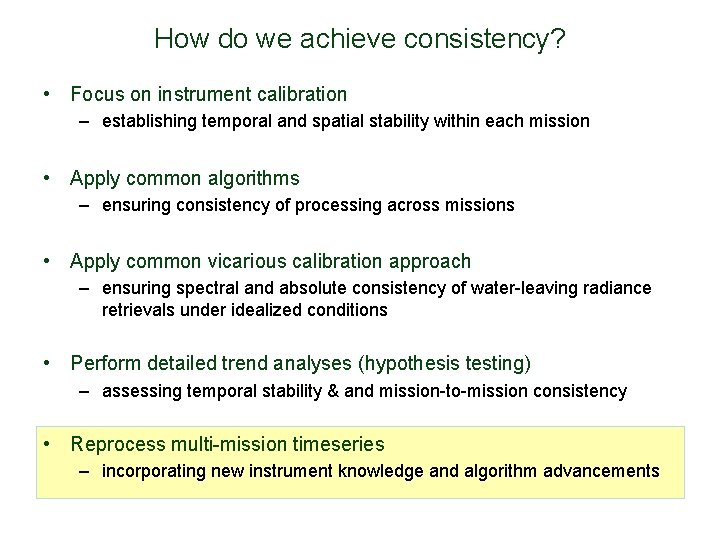
How do we achieve consistency? • Focus on instrument calibration – establishing temporal and spatial stability within each mission • Apply common algorithms – ensuring consistency of processing across missions • Apply common vicarious calibration approach – ensuring spectral and absolute consistency of water-leaving radiance retrievals under idealized conditions • Perform detailed trend analyses (hypothesis testing) – assessing temporal stability & and mission-to-mission consistency • Reprocess multi-mission timeseries – incorporating new instrument knowledge and algorithm advancements
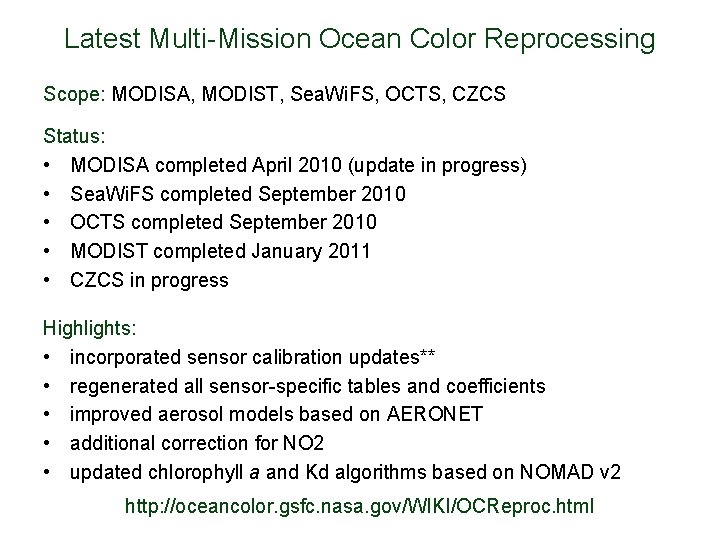
Latest Multi-Mission Ocean Color Reprocessing Scope: MODISA, MODIST, Sea. Wi. FS, OCTS, CZCS Status: • MODISA completed April 2010 (update in progress) • Sea. Wi. FS completed September 2010 • OCTS completed September 2010 • MODIST completed January 2011 • CZCS in progress Highlights: • incorporated sensor calibration updates** • regenerated all sensor-specific tables and coefficients • improved aerosol models based on AERONET • additional correction for NO 2 • updated chlorophyll a and Kd algorithms based on NOMAD v 2 http: //oceancolor. gsfc. nasa. gov/WIKI/OCReproc. html
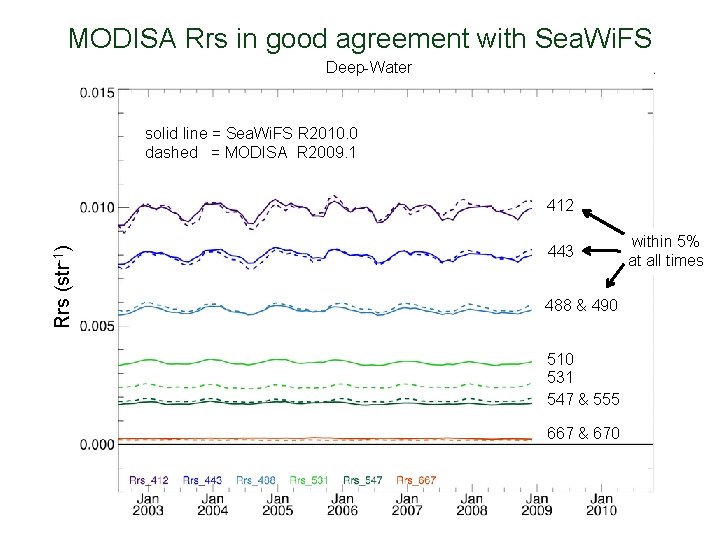
MODISA Rrs in good agreement with Sea. Wi. FS Deep-Water solid line = Sea. Wi. FS R 2010. 0 dashed = MODISA R 2009. 1 Rrs (str-1) 412 443 488 & 490 510 531 547 & 555 667 & 670 within 5% at all times
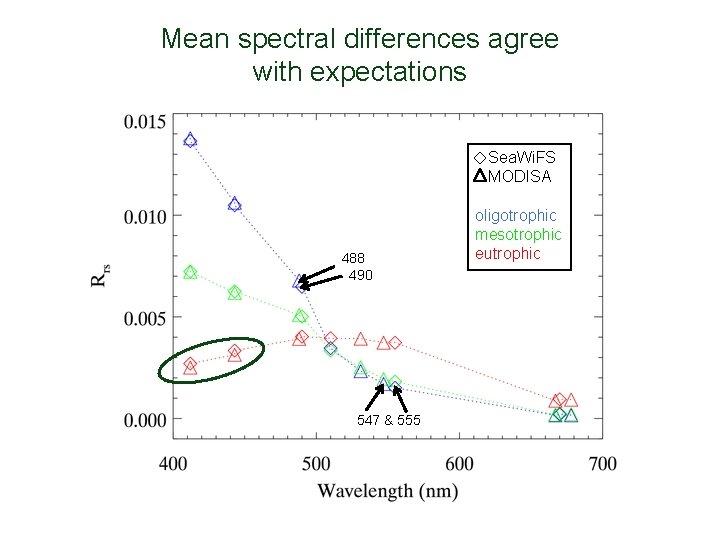
Mean spectral differences agree with expectations Sea. Wi. FS MODISA 488 490 547 & 555 oligotrophic mesotrophic eutrophic
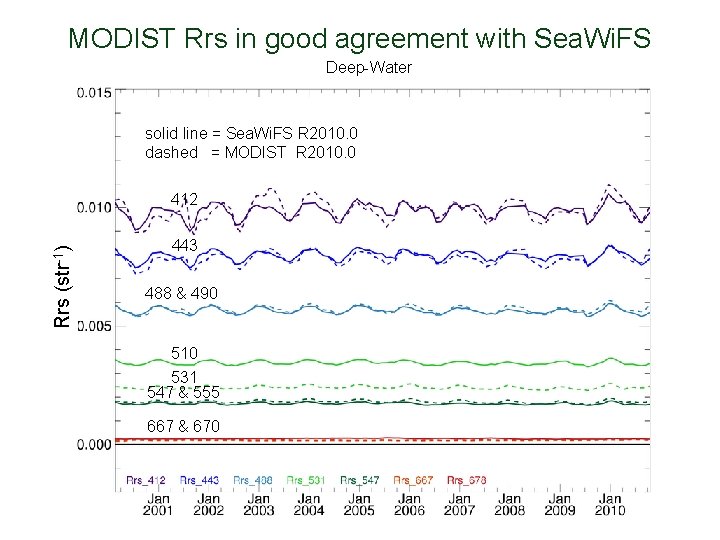
MODIST Rrs in good agreement with Sea. Wi. FS Deep-Water solid line = Sea. Wi. FS R 2010. 0 dashed = MODIST R 2010. 0 Rrs (str-1) 412 443 488 & 490 510 531 547 & 555 667 & 670
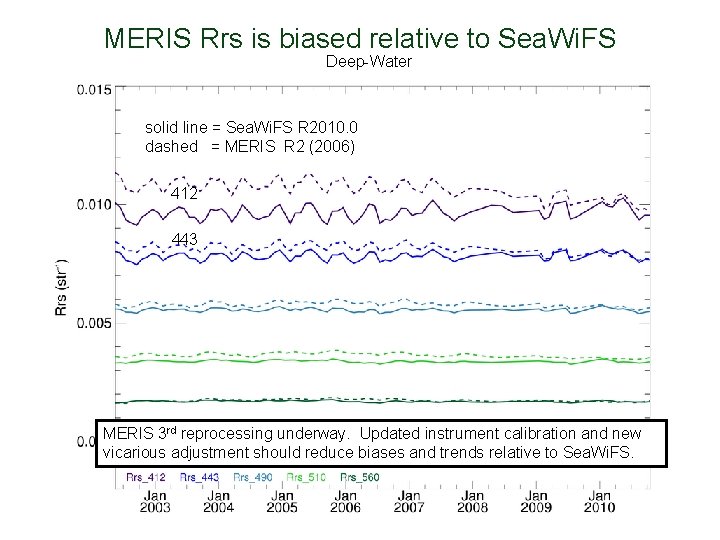
MERIS Rrs is biased relative to Sea. Wi. FS Deep-Water solid line = Sea. Wi. FS R 2010. 0 dashed = MERIS R 2 (2006) 412 443 MERIS 3 rd reprocessing underway. Updated instrument calibration and new vicarious adjustment should reduce biases and trends relative to Sea. Wi. FS.
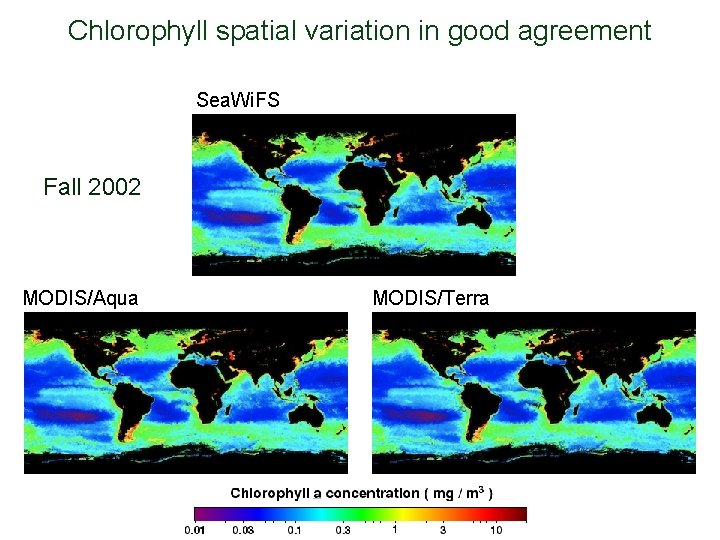
Chlorophyll spatial variation in good agreement Sea. Wi. FS Fall 2002 MODIS/Aqua MODIS/Terra
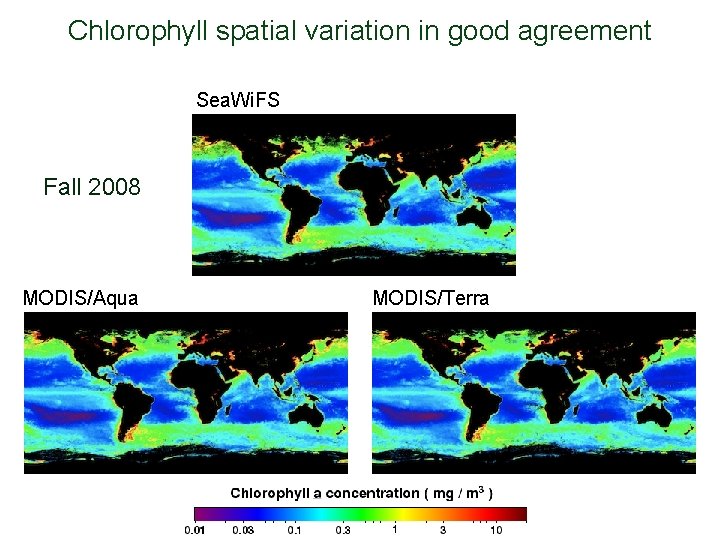
Chlorophyll spatial variation in good agreement Sea. Wi. FS Fall 2008 MODIS/Aqua MODIS/Terra
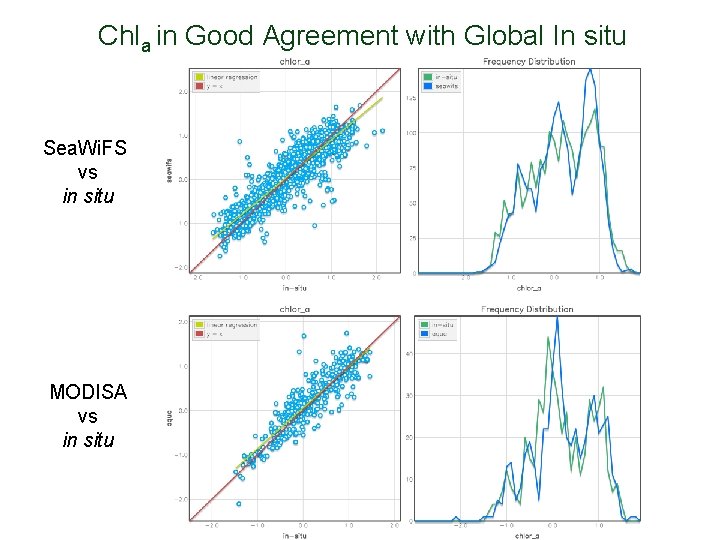
Chla in Good Agreement with Global In situ Sea. Wi. FS vs in situ MODISA vs in situ
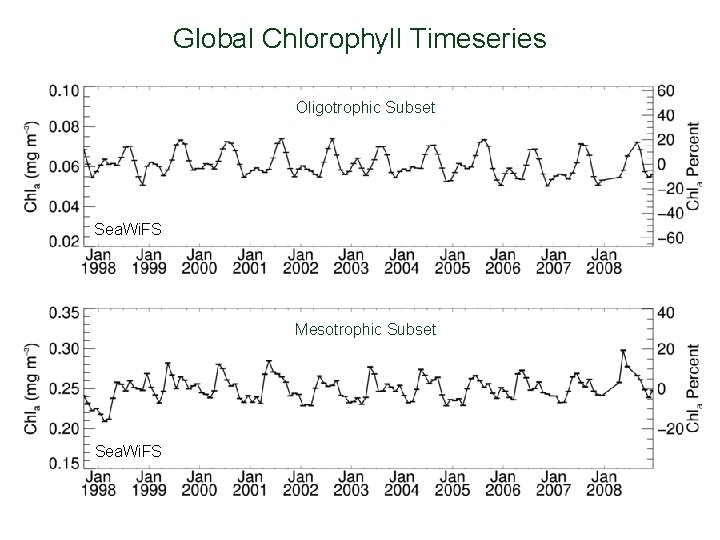
Global Chlorophyll Timeseries Oligotrophic Subset Sea. Wi. FS Mesotrophic Subset Sea. Wi. FS
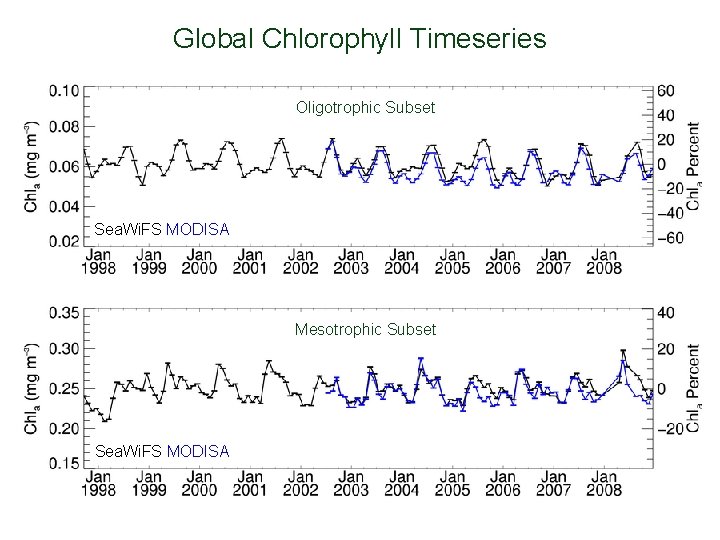
Global Chlorophyll Timeseries Oligotrophic Subset Sea. Wi. FS MODISA Mesotrophic Subset Sea. Wi. FS MODISA
Global Chlorophyll Timeseries Oligotrophic Subset e befor ces repro sing Sea. Wi. FS MODISA MODIST ing Mesotrophic Subset re befo Sea. Wi. FS MODISA MODIST rep ss roce
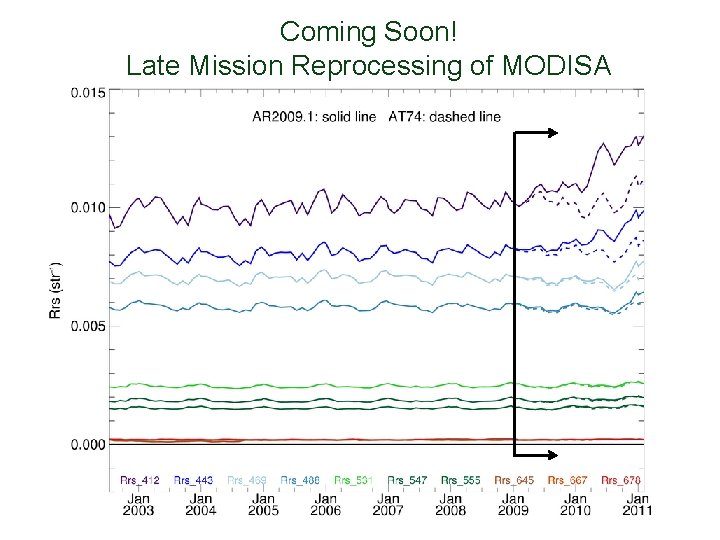
Coming Soon! Late Mission Reprocessing of MODISA
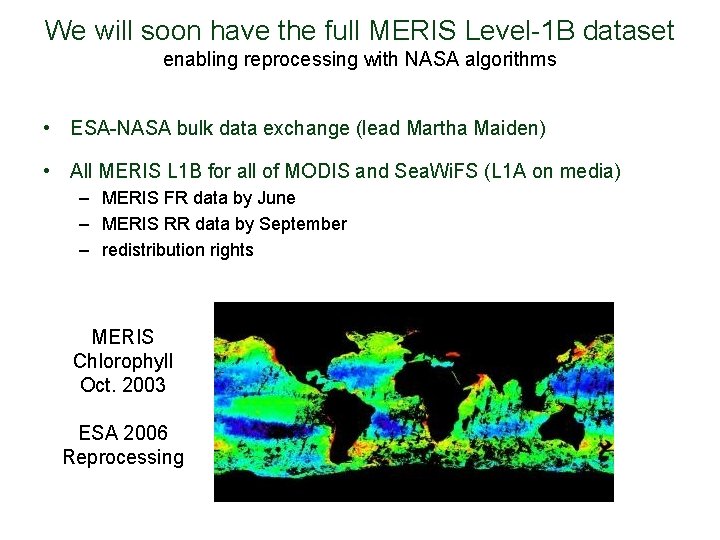
We will soon have the full MERIS Level-1 B dataset enabling reprocessing with NASA algorithms • ESA-NASA bulk data exchange (lead Martha Maiden) • All MERIS L 1 B for all of MODIS and Sea. Wi. FS (L 1 A on media) – MERIS FR data by June – MERIS RR data by September – redistribution rights MERIS Chlorophyll Oct. 2003 ESA 2006 Reprocessing
Summary • Sea. Wi. FS has provided the first decadal-scale climate data record for ocean chlorophyll and, by proxy, phytoplankton biomass. • MODIS/Aqua open-ocean timeseries in very good agreement, suggesting the potential to extend the CDR into the future. – but biases remain that vary by bioregime (20% high in eutrophic waters) – revised calibration model / reprocessing needed to fix late mission trends • MODIS/Terra in much better agreement with Sea. Wi. FS & MODIS/Aqua, but after extensive recharacterization using Sea. Wi. FS. – not an independent climate data record beyond seasonal scale • MERIS needs reassesment after revised ESA calibration and reprocessing with common NASA algorithms. • Common algorithms is an essential first step to multi-mission CDR.
characterization of instrument degradation is the primary challenge to development of ocean color climate data records as it was for MODIS, so it will be for VIIRS. . .