
Achieving Clear Communication in Educational for Student Success






- Slides: 77
Achieving Clear Communication in Educational for Student Success Cheryl Johnson, Ed. D. The ADEvantage Consulting www. adevantage. com Cheryl@Colorado. edu
Access for Success A
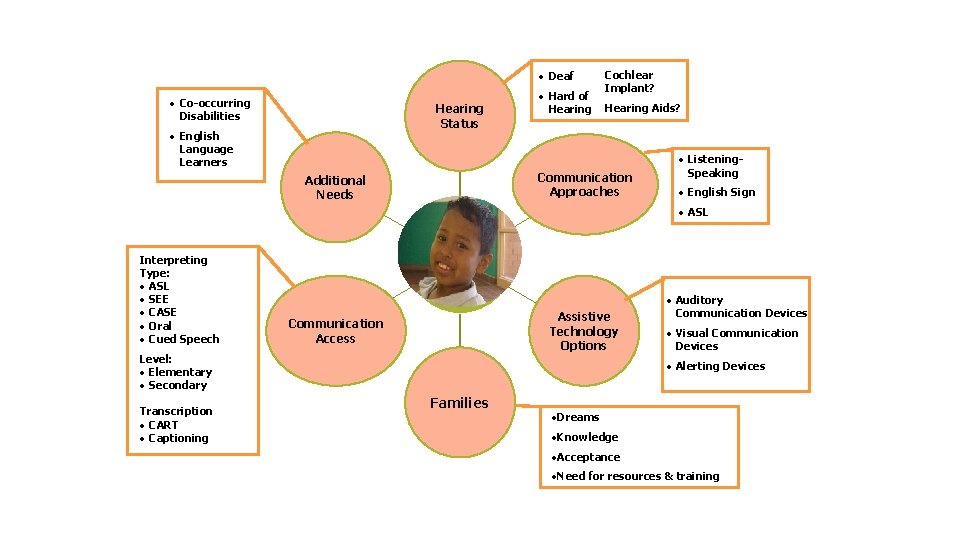
• Deaf • Co-occurring Disabilities Hearing Status • English Language Learners • Hard of Hearing Cochlear Implant? Hearing Aids? • Listening. Speaking Communication Approaches Additional Needs • English Sign • ASL Interpreting Type: • ASL • SEE • CASE • Oral • Cued Speech Assistive Technology Options Communication Access Level: • Elementary • Secondary Transcription • CART • Captioning • Auditory Communication Devices • Visual Communication Devices • Alerting Devices Families • Dreams • Knowledge • Acceptance • Need for resources & training
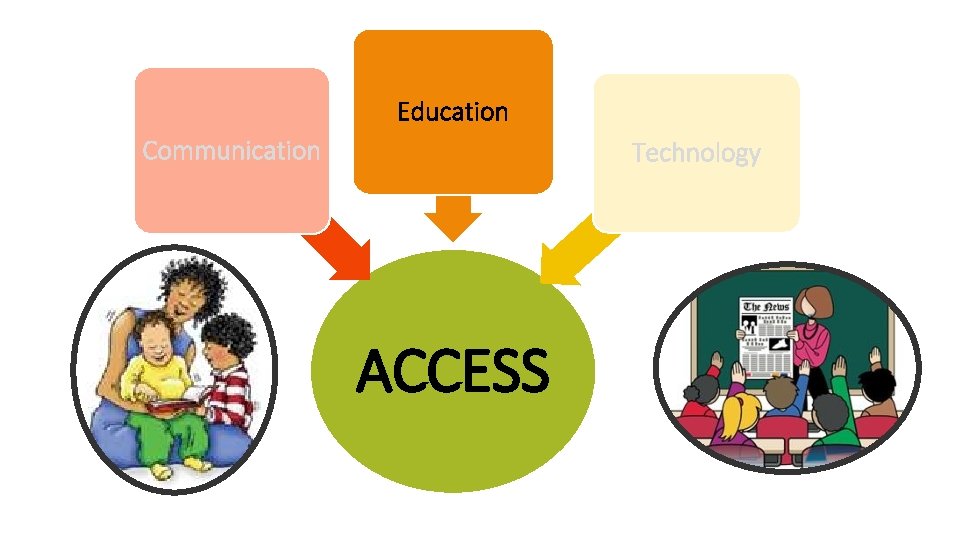
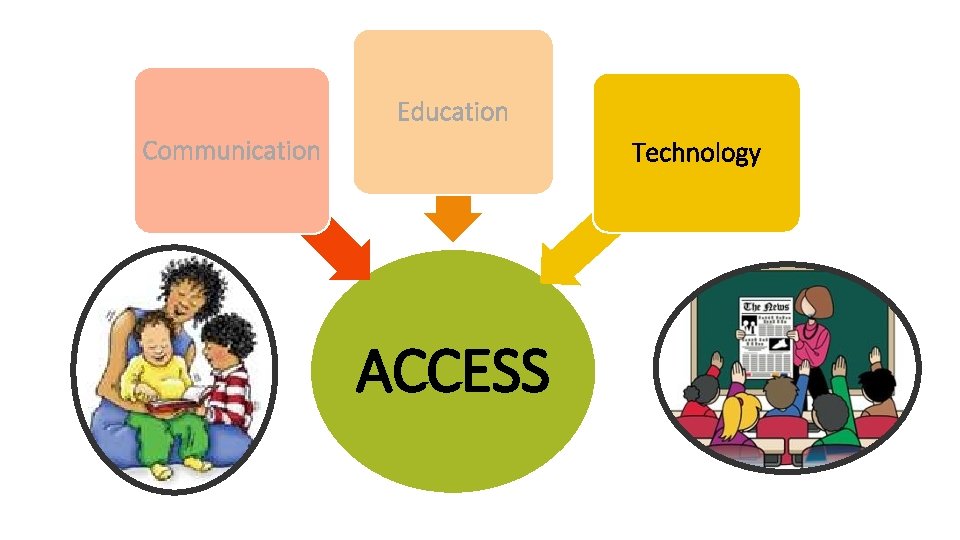
Today’s Topics § Importance of Access § Communication § Education § Technology § Development of Self, Self-Concept, Self. Determination, Self-Advocacy § Strategies Considerations & Discussion
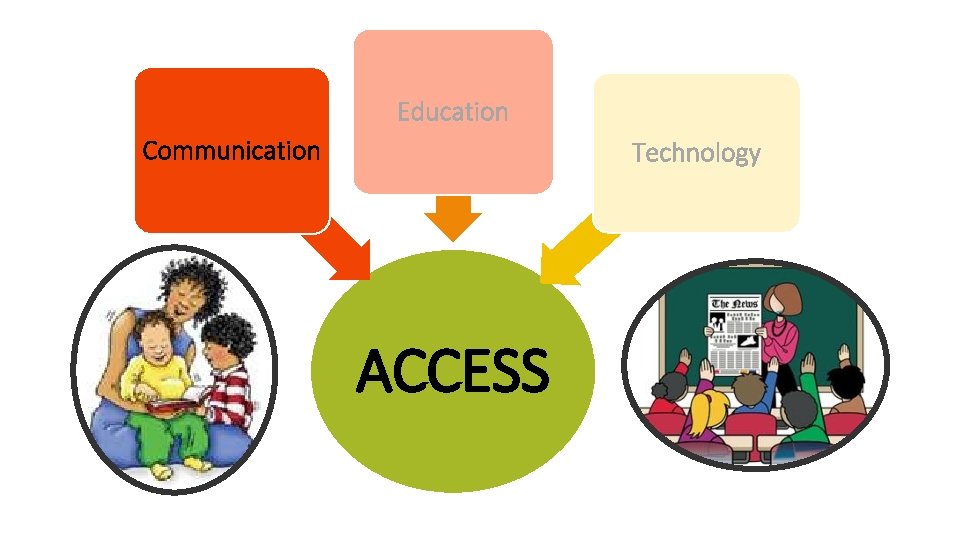
Education Communication Technology ACCESS
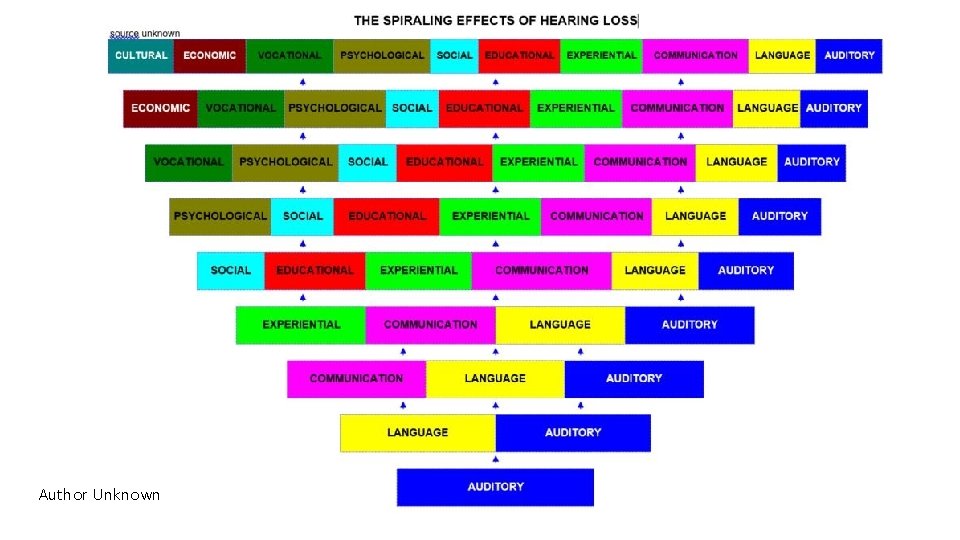
Author Unknown
Communication Access: What does it mean to you? Communication ACCESS
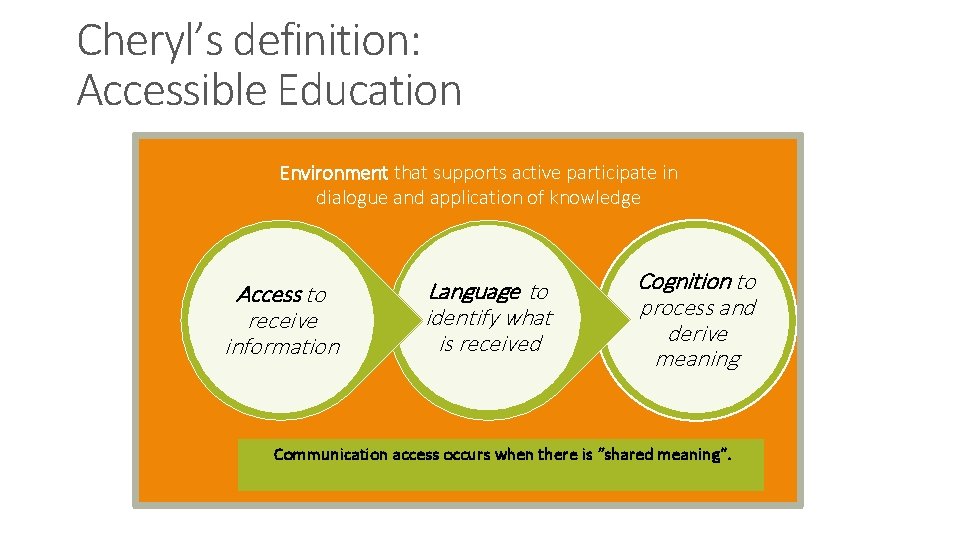
Cheryl’s definition: Accessible Education Environment that supports active participate in dialogue and application of knowledge Access to receive information Language to identify what is received Cognition to process and derive meaning Communication access occurs when there is “shared meaning”.
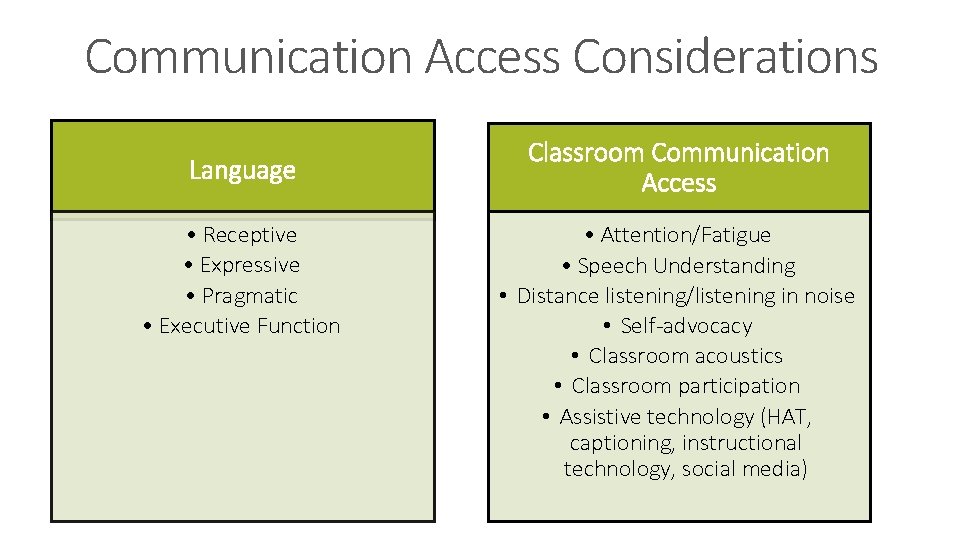
Communication Access Considerations Language • Receptive • Expressive • Pragmatic • Executive Function Classroom Communication Access • Attention/Fatigue • Speech Understanding • Distance listening/listening in noise • Self-advocacy • Classroom acoustics • Classroom participation • Assistive technology (HAT, captioning, instructional technology, social media)
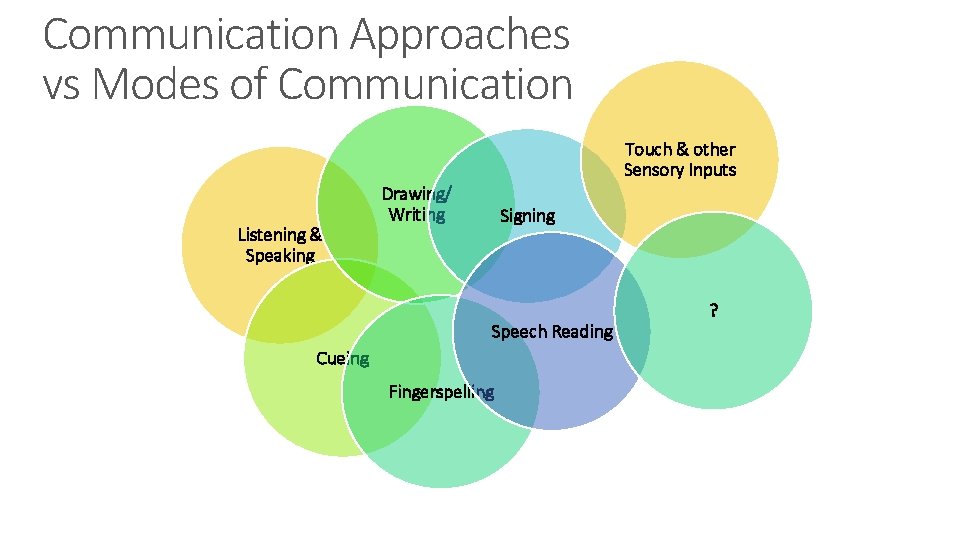
Communication Approaches vs Modes of Communication Touch & other Sensory Inputs Listening & Speaking Drawing/ Writing Signing Speech Reading Cueing Fingerspelling ?
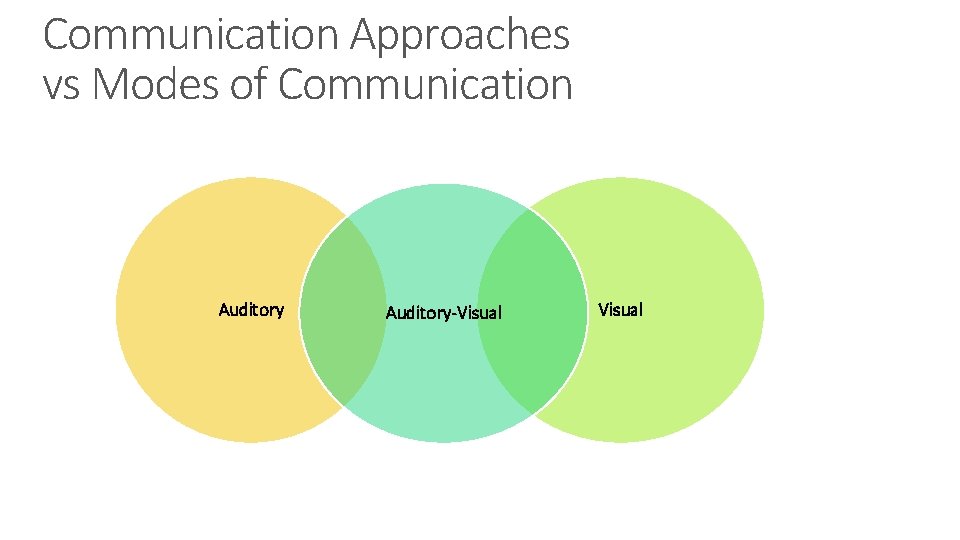
Communication Approaches vs Modes of Communication Auditory-Visual
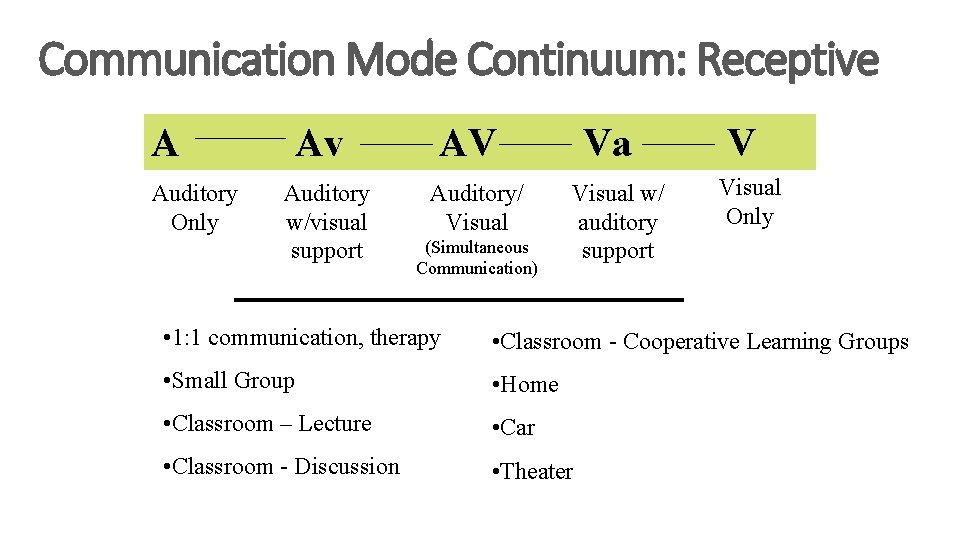
Communication Mode Continuum: Receptive A Auditory Only Av Auditory w/visual support AV Auditory/ Visual (Simultaneous Communication) Va Visual w/ auditory support V Visual Only • 1: 1 communication, therapy • Classroom - Cooperative Learning Groups • Small Group • Home • Classroom – Lecture • Car • Classroom - Discussion • Theater
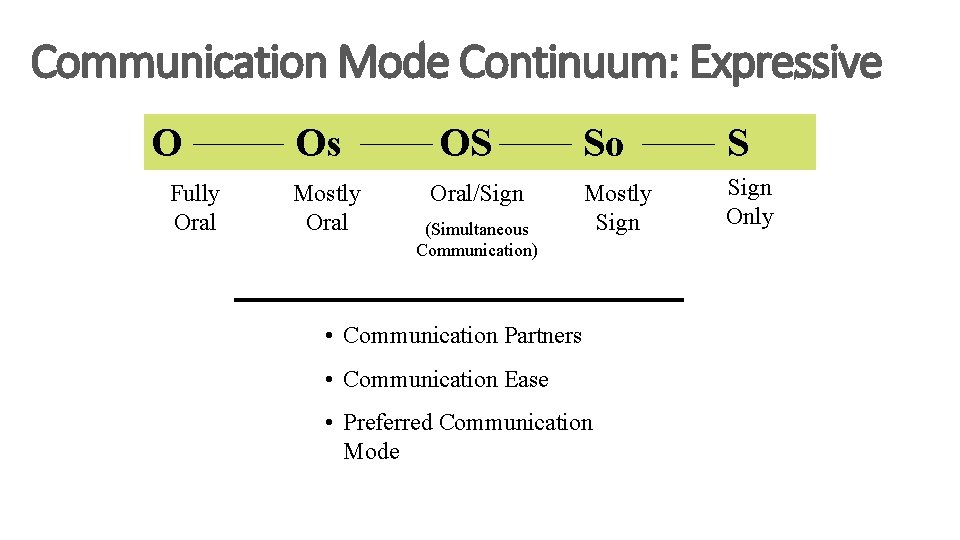
Communication Mode Continuum: Expressive O Fully Oral Os Mostly Oral OS Oral/Sign (Simultaneous Communication) So S Mostly Sign Only • Communication Partners • Communication Ease • Preferred Communication Mode
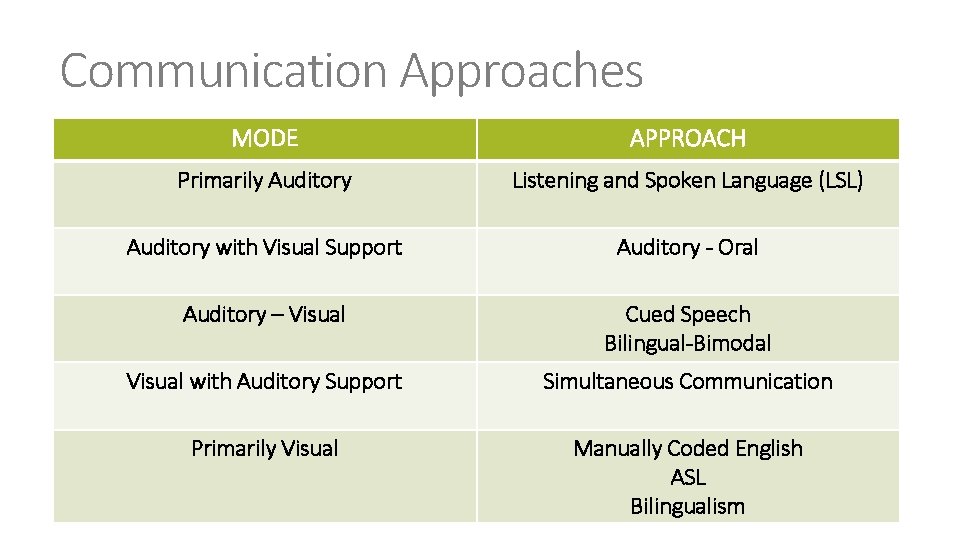
Communication Approaches MODE APPROACH Primarily Auditory Listening and Spoken Language (LSL) Auditory with Visual Support Auditory - Oral Auditory – Visual Cued Speech Bilingual-Bimodal Visual with Auditory Support Simultaneous Communication Primarily Visual Manually Coded English ASL Bilingualism
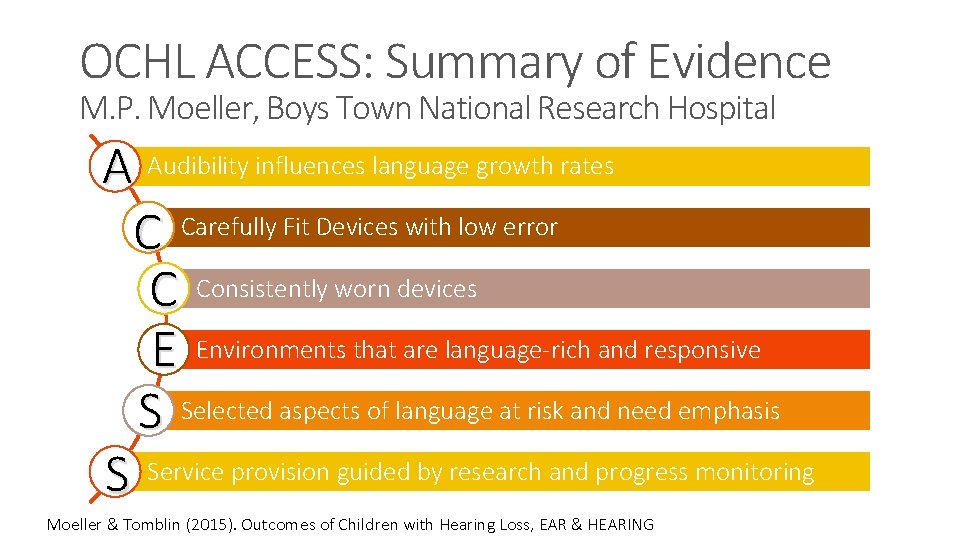
OCHL ACCESS: Summary of Evidence M. P. Moeller, Boys Town National Research Hospital A Audibility influences language growth rates Carefully Fit Devices with low error C C Consistently worn devices E Environments that are language-rich and responsive S Selected aspects of language at risk and need emphasis S Service provision guided by research and progress monitoring Moeller & Tomblin (2015). Outcomes of Children with Hearing Loss, EAR & HEARING
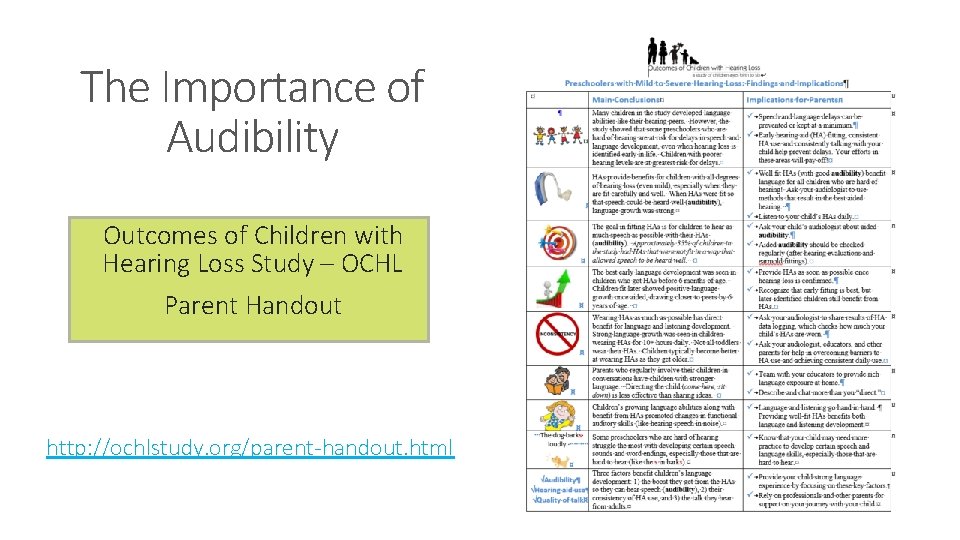
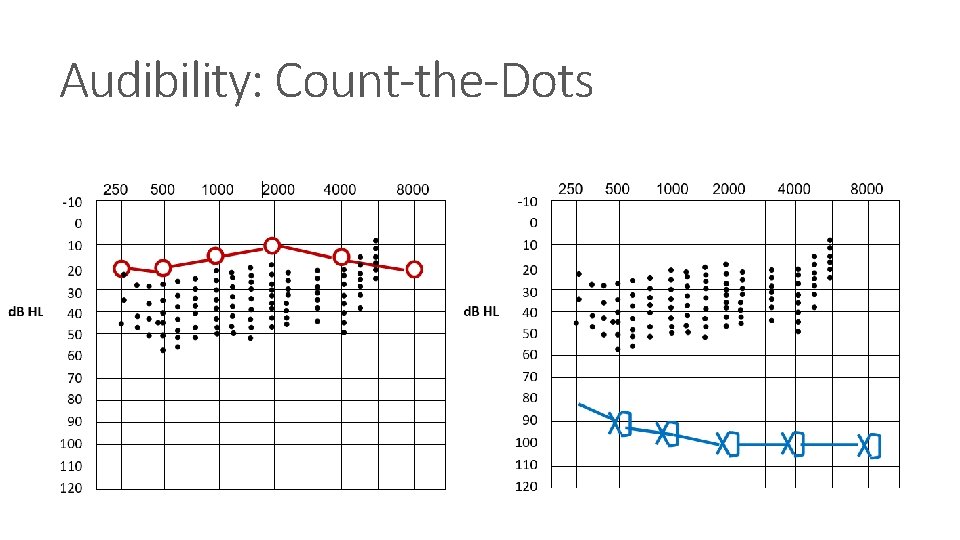
The Importance of Audibility Outcomes of Children with Hearing Loss Study – OCHL Parent Handout http: //ochlstudy. org/parent-handout. html
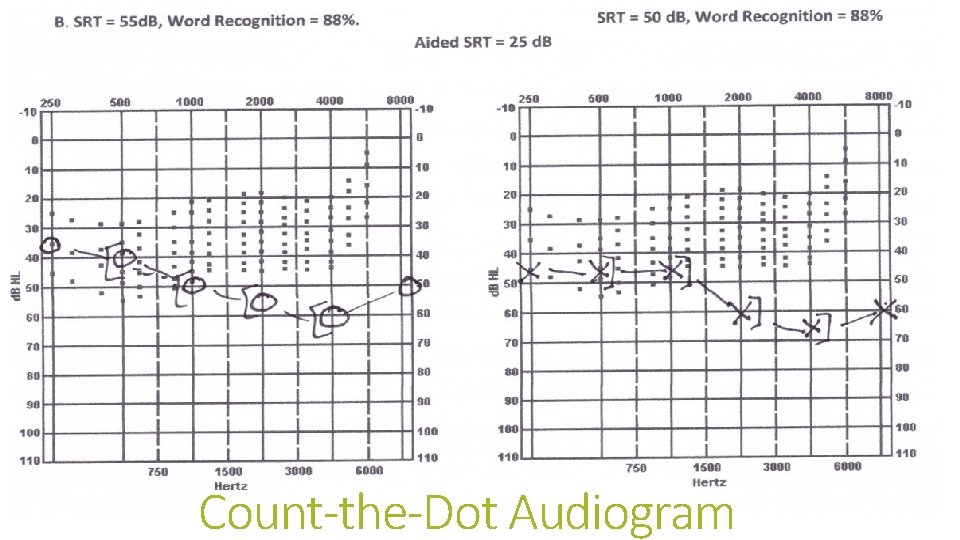
Count-the-Dot Audiogram
Audibility: Count-the-Dots
Minimal, Mild, Unilateral, Single-sided Deafness (MMUSSD) Educational Audiology Association (2017); School-Based Audiology Advocacy Series www. edaud. org § Difficulties understanding speech both in ideal and in challenging listening environments such as the classroom setting (Crandell, 1993) and poorer performance on complex listening tasks (Lewis et al. , 2014). § For those with UHL, difficulties locating the direction of sounds (Bess, 1986). § Increased risk of speech production errors, language delays and deficits especially in structural language (Tharpe, 2008; Walker et al. , 2015; Winiger et al. , 2016). § Phonological delays and difficulties with reading comprehension (Ross et al. , 2008).
Minimal, Mild, Unilateral, Single-sided Deafness (MMUSSD) Educational Audiology Association (2017); School-Based Audiology Advocacy Series www. edaud. org § Low attention, lack of motivation, poor attention in class, and reduced class participation (Flexer, 1995; Porter et al. , 2013) § Behavioral problems associated with high internal stress such as noncompliance, aggression, impulsivity, and inflexibility. (Winiger et al. , 2016). § Strained communication with peers, difficulties making friends, and poorer peer relations (Tharpe, 2008; Winiger, et al. , 2016). § Low self-esteem (Bess, Dodd-Murphy, & Parker, 1998; Winiger et al. , 2016). § Higher fatigue, increased listening effort, and stress levels as compared to peers (Bess, Gustafson, & Hornsby 2014; Tharpe, 2008; Lieu et al. , 2012).
Education Communication Technology ACCESS
Education Access: What does it mean to you? Education ACCESS
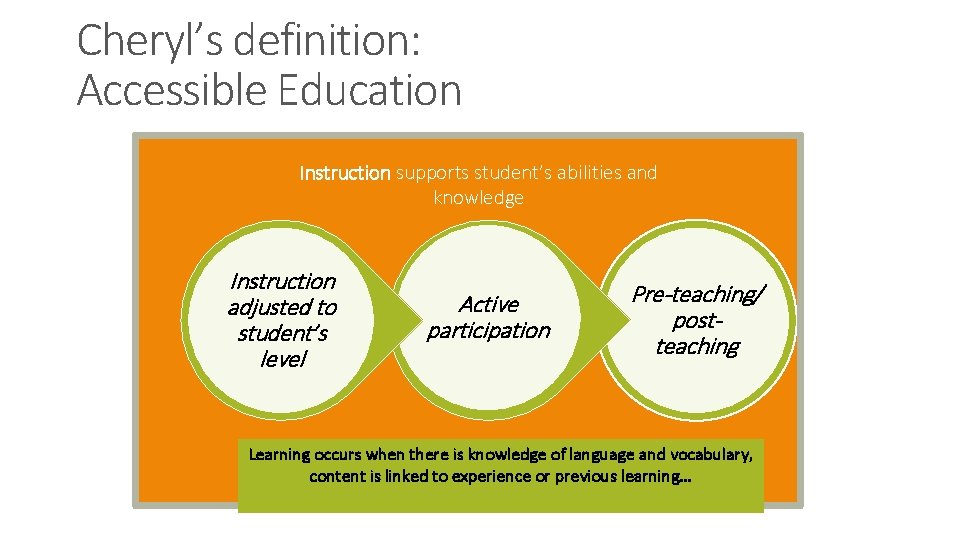
Cheryl’s definition: Accessible Education Instruction supports student’s abilities and knowledge Instruction adjusted to student’s level Active participation Pre-teaching/ postteaching Learning occurs when there is knowledge of language and vocabulary, content is linked to experience or previous learning…
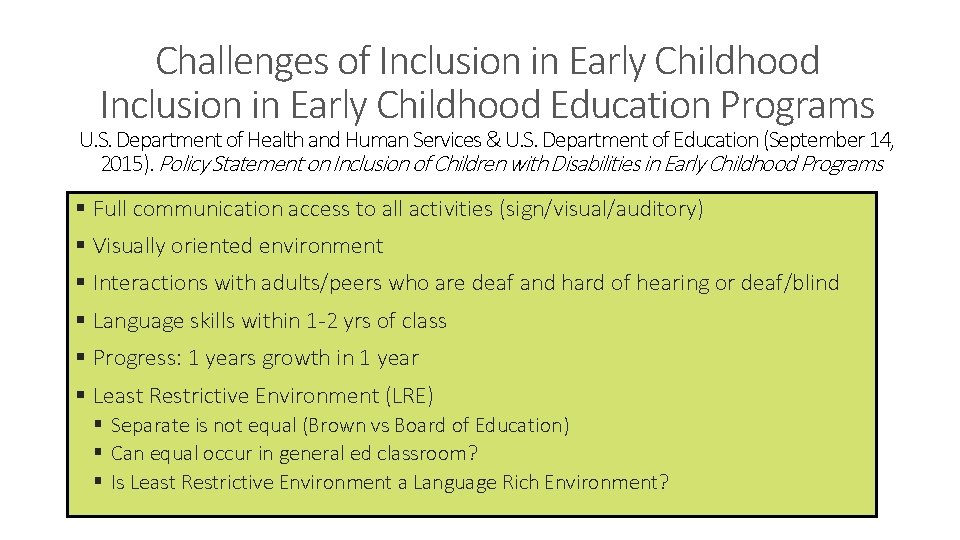
Challenges of Inclusion in Early Childhood Education Programs U. S. Department of Health and Human Services & U. S. Department of Education (September 14, 2015). Policy Statement on Inclusion of Children with Disabilities in Early Childhood Programs § Full communication access to all activities (sign/visual/auditory) § Visually oriented environment § Interactions with adults/peers who are deaf and hard of hearing or deaf/blind § Language skills within 1 -2 yrs of class § Progress: 1 years growth in 1 year § Least Restrictive Environment (LRE) § Separate is not equal (Brown vs Board of Education) § Can equal occur in general ed classroom? § Is Least Restrictive Environment a Language Rich Environment?
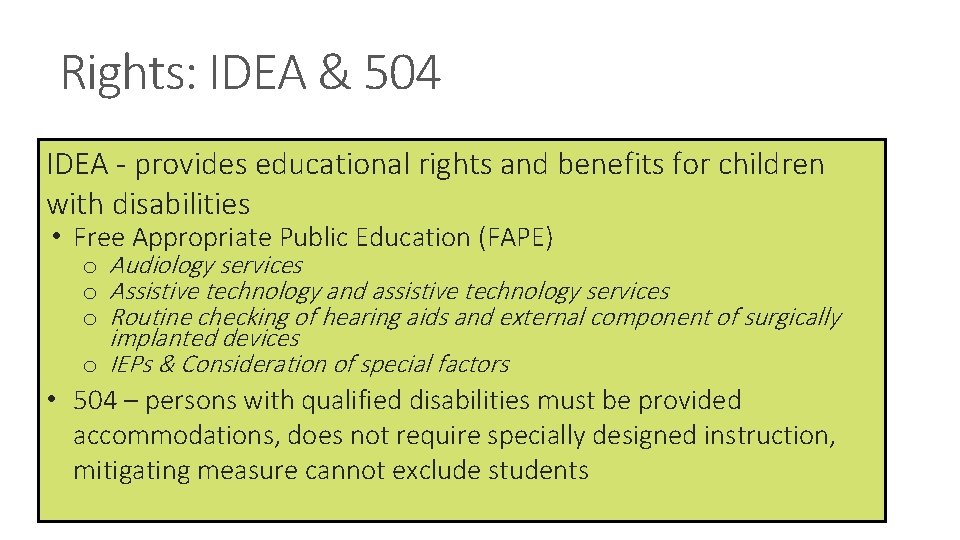
Rights: IDEA & 504 IDEA - provides educational rights and benefits for children with disabilities • Free Appropriate Public Education (FAPE) o Audiology services o Assistive technology and assistive technology services o Routine checking of hearing aids and external component of surgically implanted devices o IEPs & Consideration of special factors • 504 – persons with qualified disabilities must be provided accommodations, does not require specially designed instruction, mitigating measure cannot exclude students
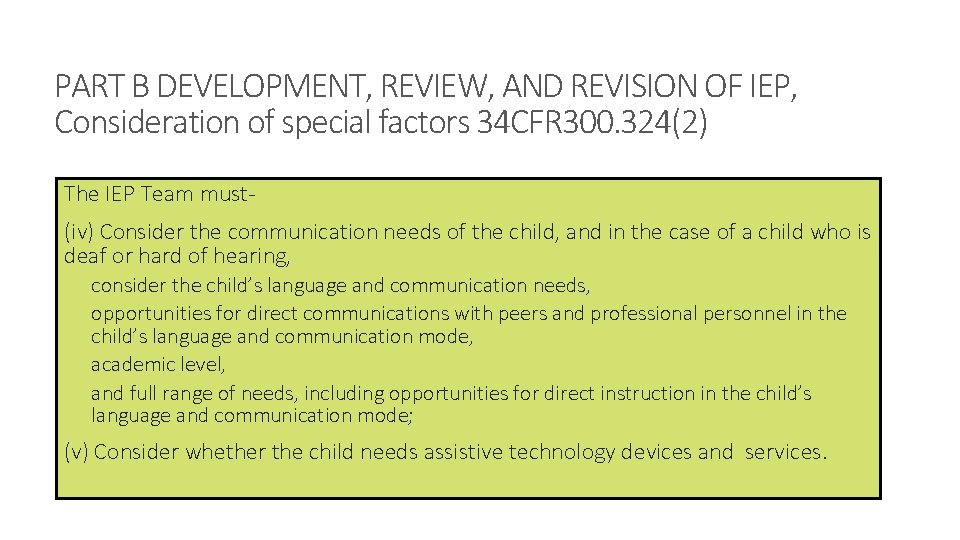
PART B DEVELOPMENT, REVIEW, AND REVISION OF IEP, Consideration of special factors 34 CFR 300. 324(2) The IEP Team must- (iv) Consider the communication needs of the child, and in the case of a child who is deaf or hard of hearing, consider the child’s language and communication needs, opportunities for direct communications with peers and professional personnel in the child’s language and communication mode, academic level, and full range of needs, including opportunities for direct instruction in the child’s language and communication mode; (v) Consider whether the child needs assistive technology devices and services.
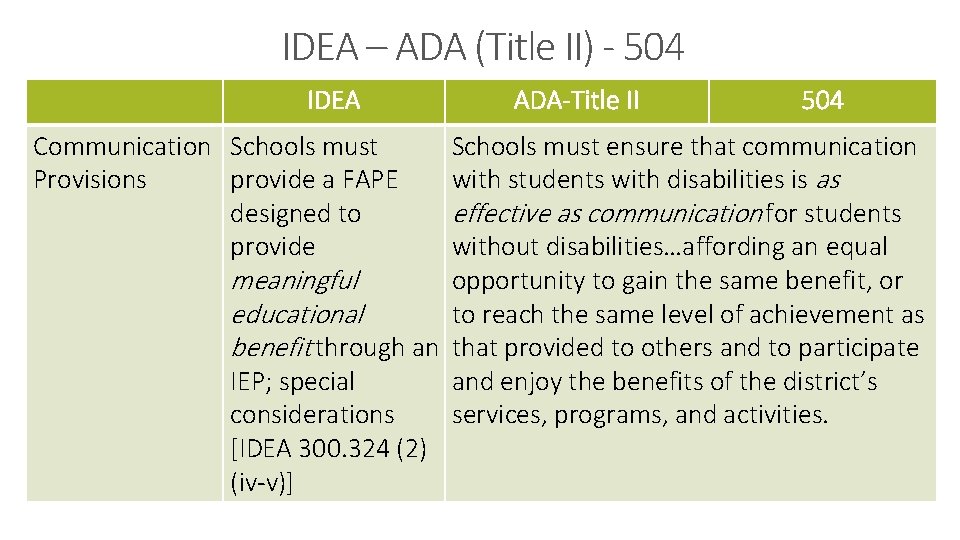
IDEA – ADA (Title II) - 504 IDEA Communication Schools must Provisions provide a FAPE designed to provide ADA-Title II 504 Schools must ensure that communication with students with disabilities is as effective as communication for students without disabilities…affording an equal meaningful opportunity to gain the same benefit, or educational to reach the same level of achievement as benefit through an that provided to others and to participate IEP; special and enjoy the benefits of the district’s considerations services, programs, and activities. [IDEA 300. 324 (2) (iv-v)]
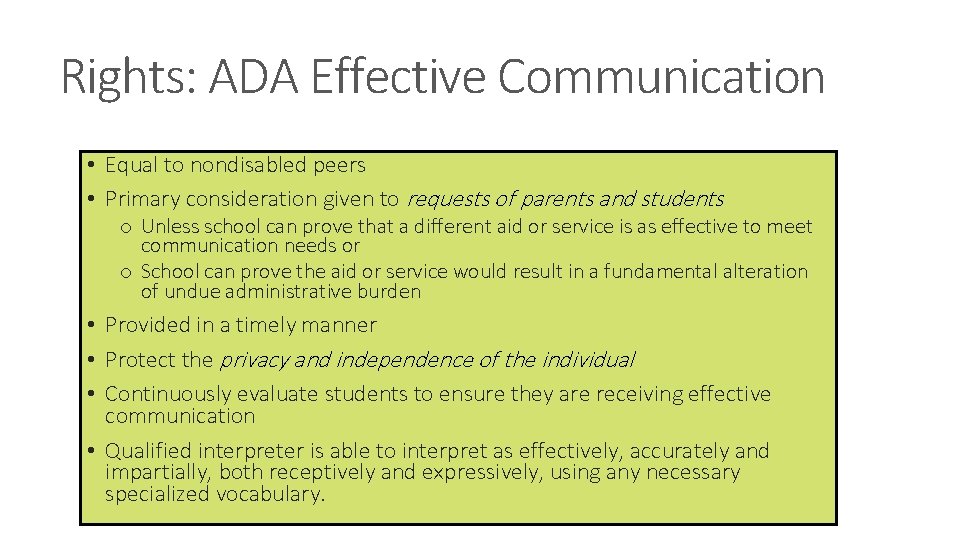
Rights: ADA Effective Communication • Equal to nondisabled peers • Primary consideration given to requests of parents and students o Unless school can prove that a different aid or service is as effective to meet communication needs or o School can prove the aid or service would result in a fundamental alteration of undue administrative burden • Provided in a timely manner • Protect the privacy and independence of the individual • Continuously evaluate students to ensure they are receiving effective communication • Qualified interpreter is able to interpret as effectively, accurately and impartially, both receptively and expressively, using any necessary specialized vocabulary.
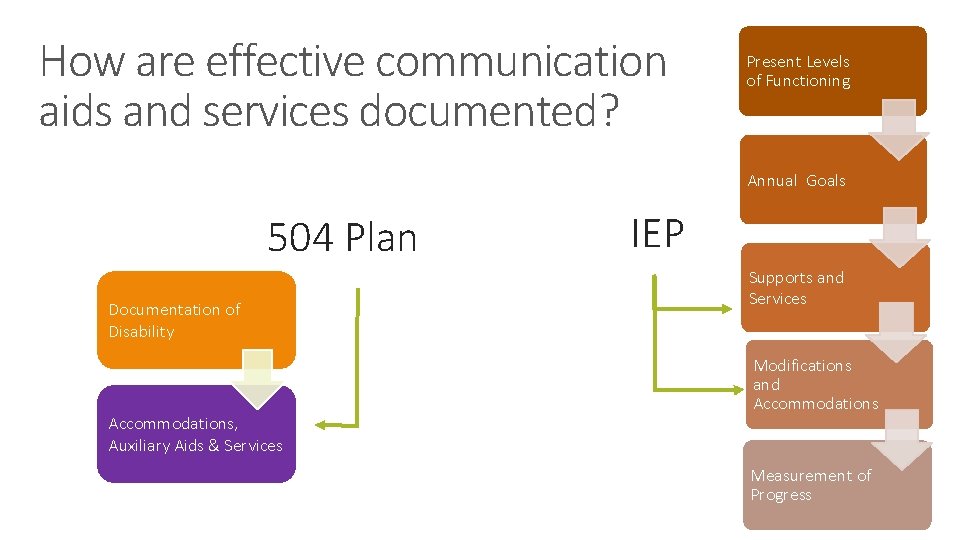
How are effective communication aids and services documented? Present Levels of Functioning Annual Goals 504 Plan Documentation of Disability Accommodations, Auxiliary Aids & Services IEP Supports and Services Modifications and Accommodations Measurement of Progress
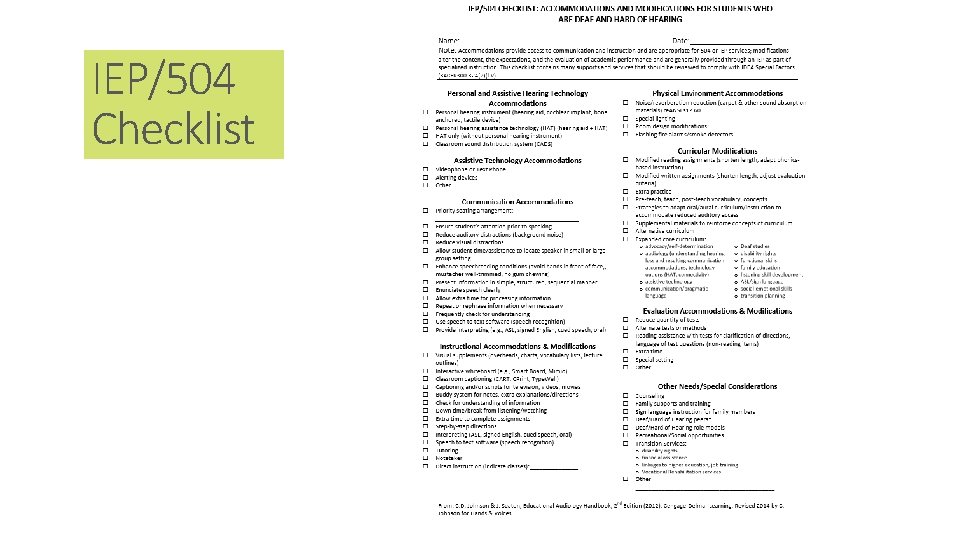
IEP/504 Checklist
PARC: Placement And Readiness Checklists The Student: Readiness Checklists General Education Inclusion Readiness (adapted from Nevins & Chute, 1996) Interpreted/Transliterated Education Readiness (adapted from Schick, 2004) Captioning/Transcribing Readiness Checklist Instructional Communication Access (adapted from Children’s Hospital of Boston, 2003) The Environment: Placement Checklists Preschool/Kindergarten Elementary Secondary
Education Communication Technology ACCESS
Technology Access: What does it look like? Technology ACCESS
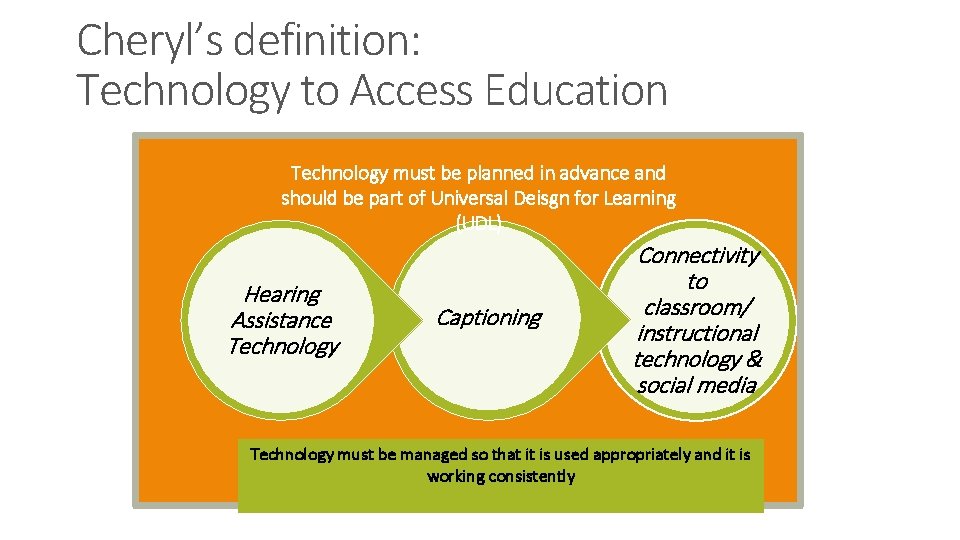
Cheryl’s definition: Technology to Access Education Technology must be planned in advance and should be part of Universal Deisgn for Learning (UDL) Hearing Assistance Technology Captioning Connectivity to classroom/ instructional technology & social media Technology must be managed so that it is used appropriately and it is working consistently
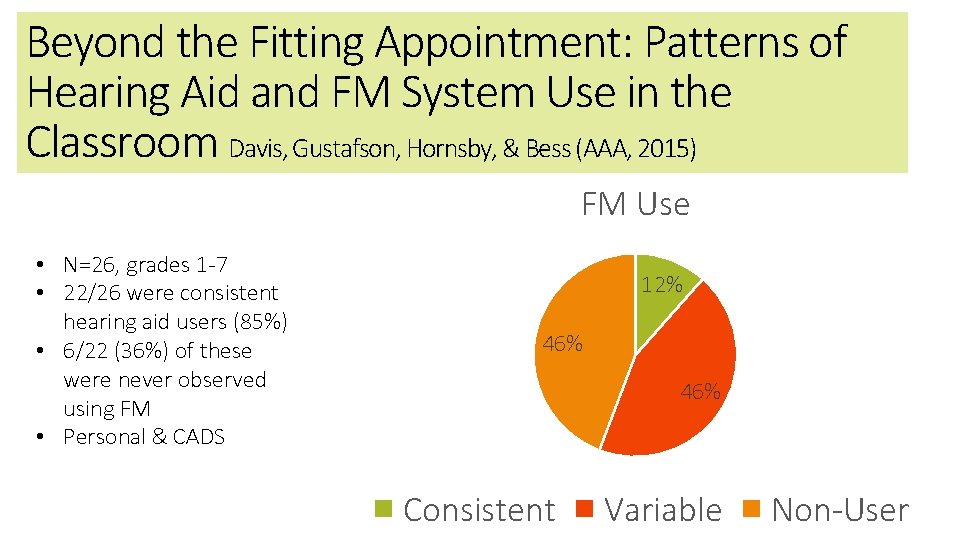
Beyond the Fitting Appointment: Patterns of Hearing Aid and FM System Use in the Classroom Davis, Gustafson, Hornsby, & Bess (AAA, 2015) FM Use • N=26, grades 1 -7 • 22/26 were consistent hearing aid users (85%) • 6/22 (36%) of these were never observed using FM • Personal & CADS 12% 46% Consistent Variable Non-User
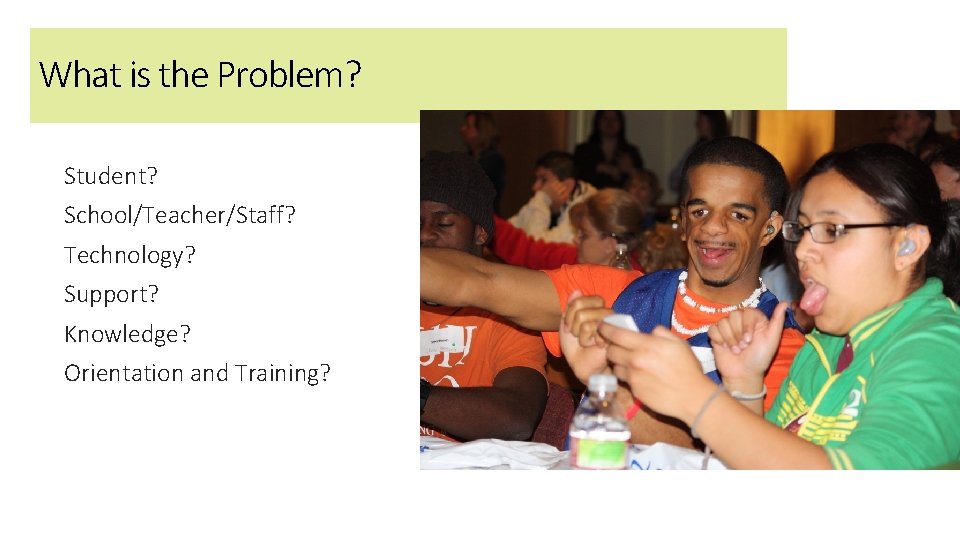
What is the Problem? Student? School/Teacher/Staff? Technology? Support? Knowledge? Orientation and Training?
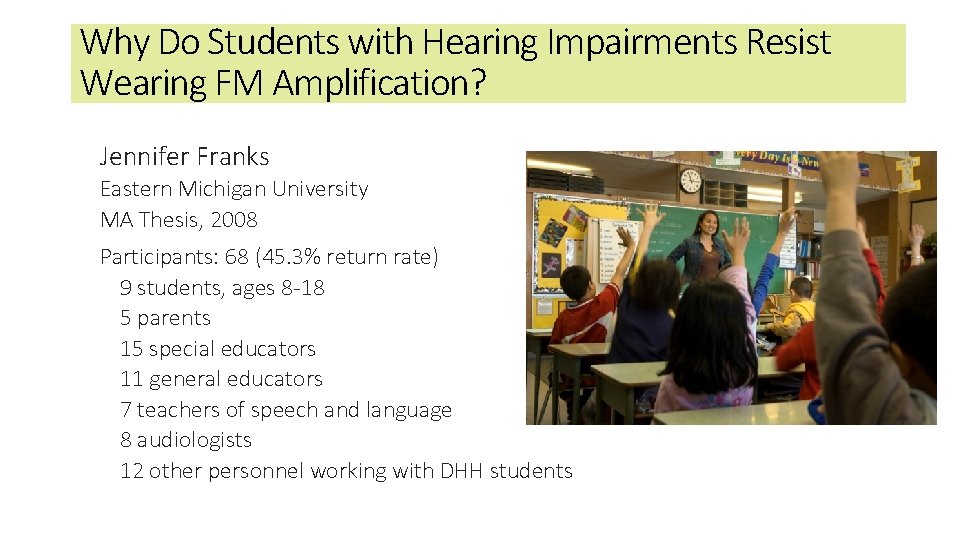
Why Do Students with Hearing Impairments Resist Wearing FM Amplification? Jennifer Franks Eastern Michigan University MA Thesis, 2008 Participants: 68 (45. 3% return rate) 9 students, ages 8 -18 5 parents 15 special educators 11 general educators 7 teachers of speech and language 8 audiologists 12 other personnel working with DHH students
Development of Self, Self. Concept, Self. Determination, Self. Advocacy
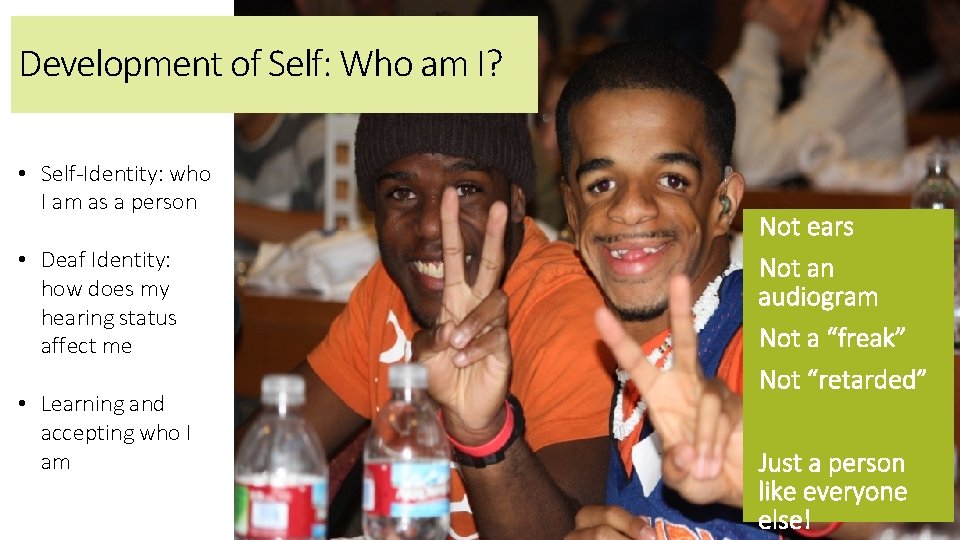
Development of Self: Who am I? • Self-Identity: who I am as a person • Deaf Identity: how does my hearing status affect me • Learning and accepting who I am Not ears Not an audiogram Not a “freak” Not “retarded” Just a person like everyone else!
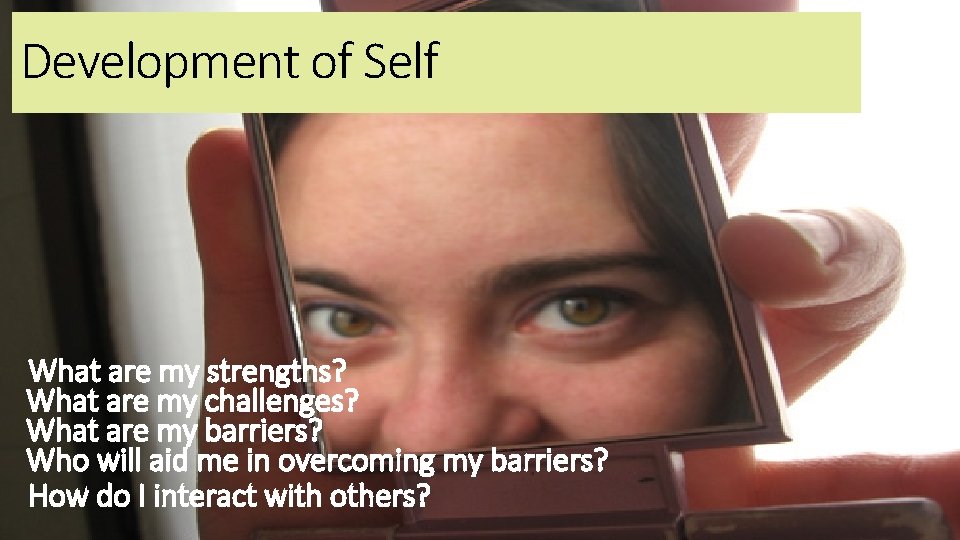
Development of Self What are my strengths? What are my challenges? What are my barriers? Who will aid me in overcoming my barriers? How do I interact with others?
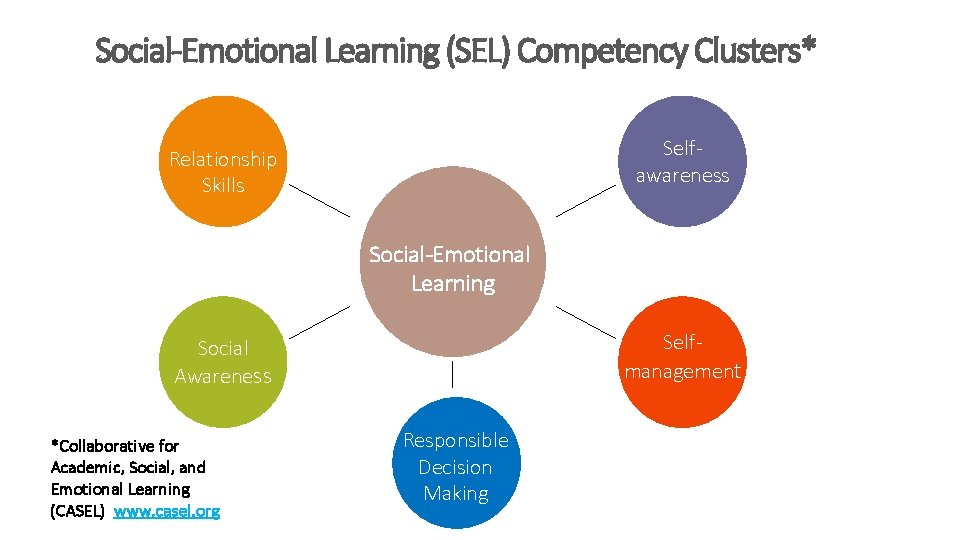
Social-Emotional Learning (SEL) Competency Clusters* Selfawareness Relationship Skills Social-Emotional Learning Selfmanagement Social Awareness *Collaborative for Academic, Social, and Emotional Learning (CASEL) www. casel. org Responsible Decision Making
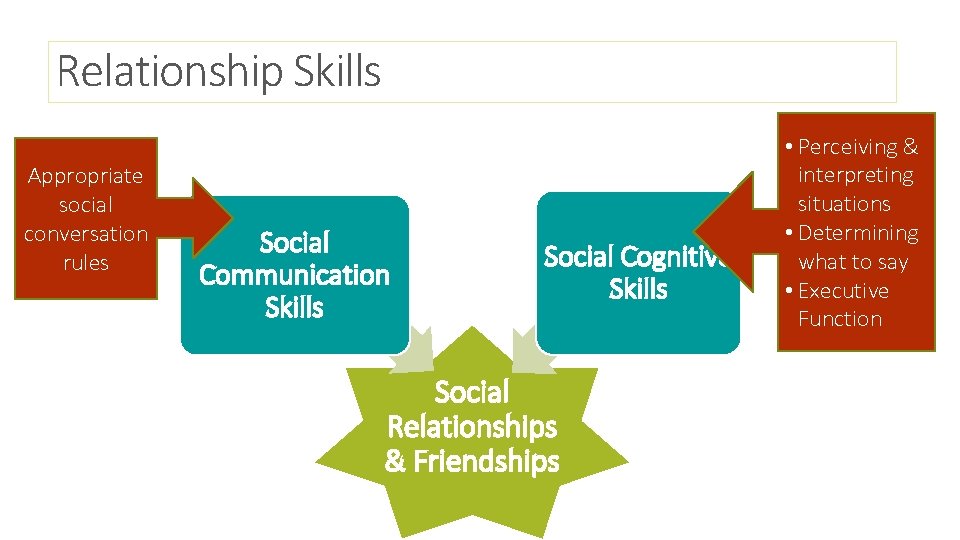
Relationship Skills Appropriate social conversation rules Social Communication Skills Social Cognitive Skills Social Relationships & Friendships • Perceiving & interpreting situations • Determining what to say • Executive Function
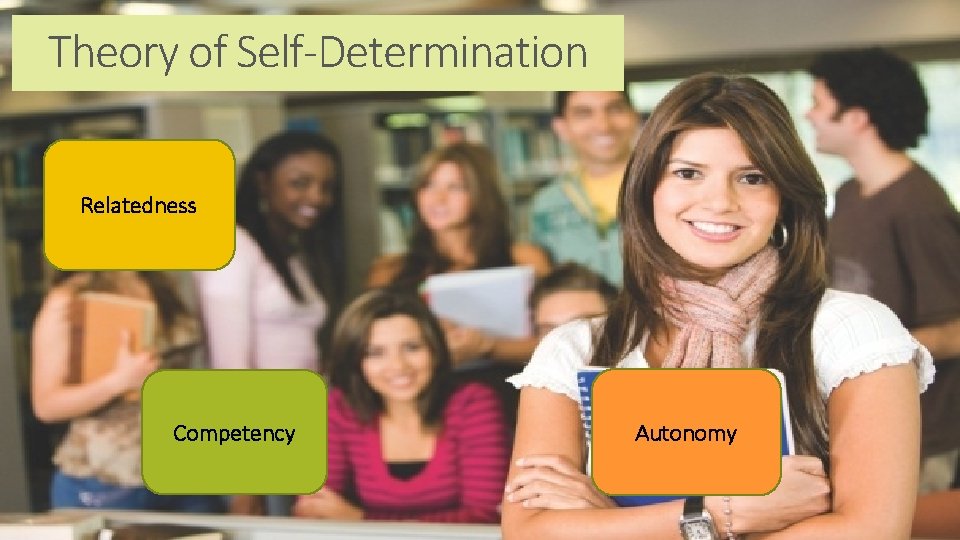
Theory of Self-Determination Relatedness Competency Autonomy
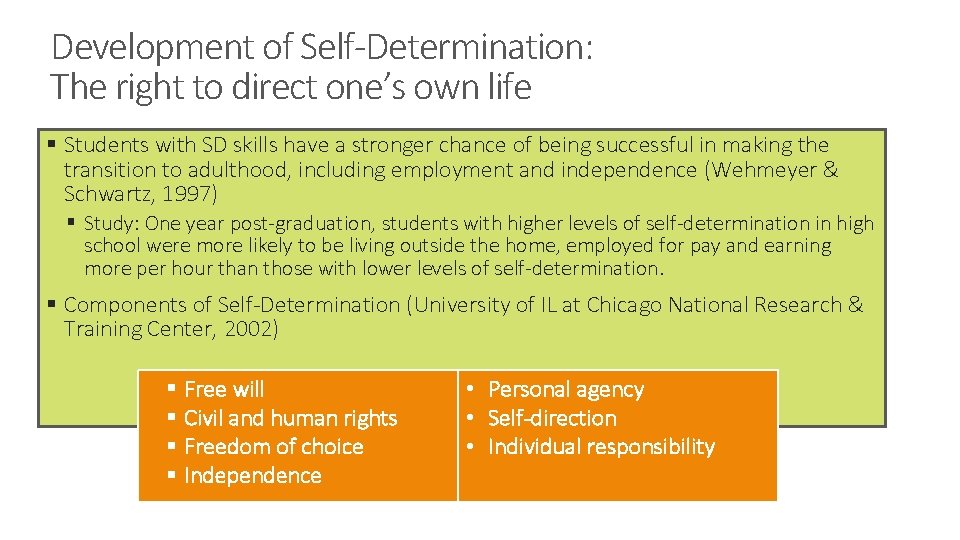
Development of Self-Determination: The right to direct one’s own life § Students with SD skills have a stronger chance of being successful in making the transition to adulthood, including employment and independence (Wehmeyer & Schwartz, 1997) § Study: One year post-graduation, students with higher levels of self-determination in high school were more likely to be living outside the home, employed for pay and earning more per hour than those with lower levels of self-determination. § Components of Self-Determination (University of IL at Chicago National Research & Training Center, 2002) § Free will § Civil and human rights § Freedom of choice § Independence • Personal agency • Self-direction • Individual responsibility
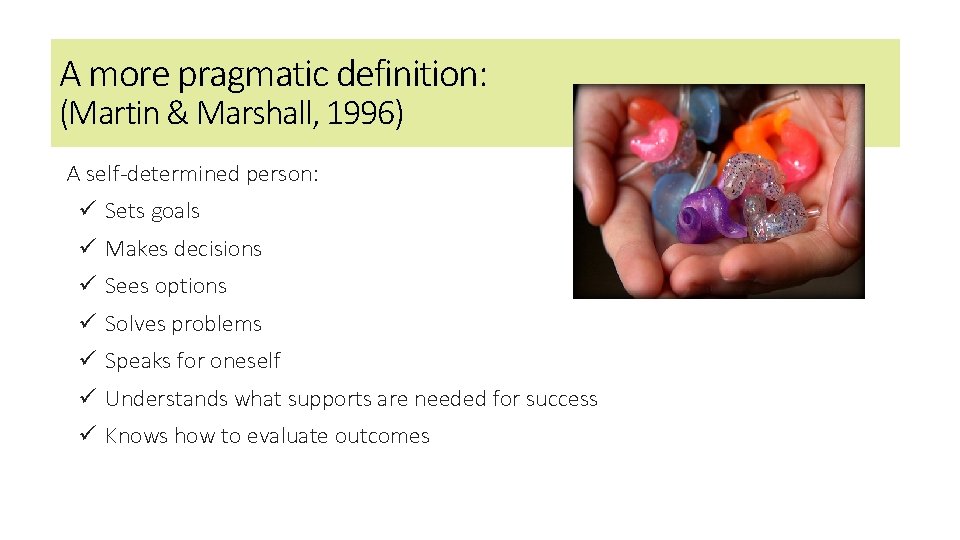
A more pragmatic definition: (Martin & Marshall, 1996) A self-determined person: ü Sets goals ü Makes decisions ü Sees options ü Solves problems ü Speaks for oneself ü Understands what supports are needed for success ü Knows how to evaluate outcomes
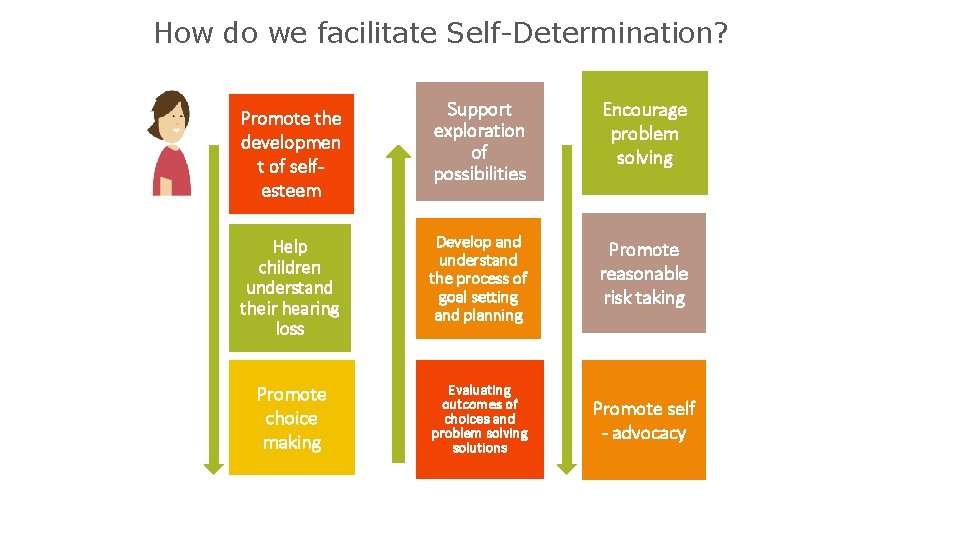
How do we facilitate Self-Determination? Support exploration of possibilities Encourage problem solving Help children understand their hearing loss Develop and understand the process of goal setting and planning Promote reasonable risk taking Promote choice making Evaluating outcomes of choices and problem solving solutions Promote self - advocacy Promote the developmen t of selfesteem
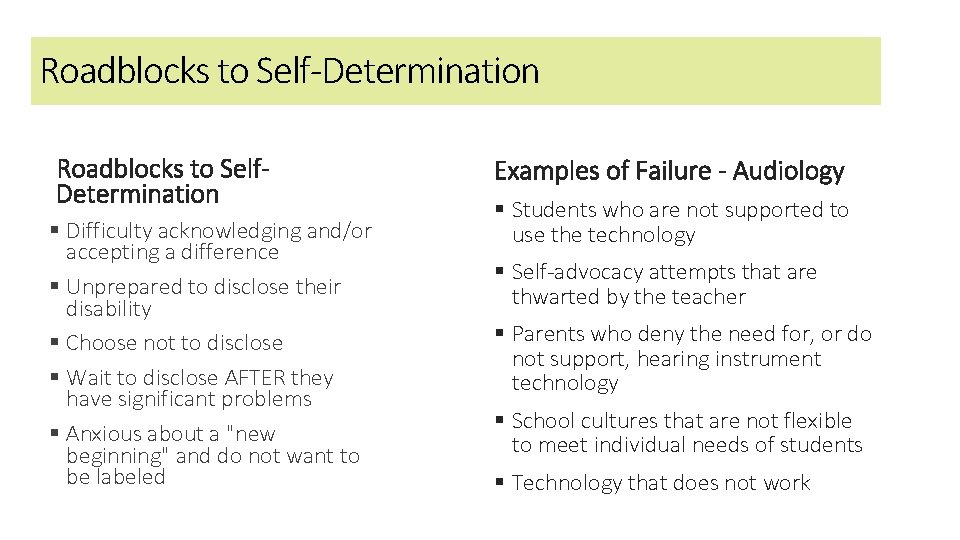
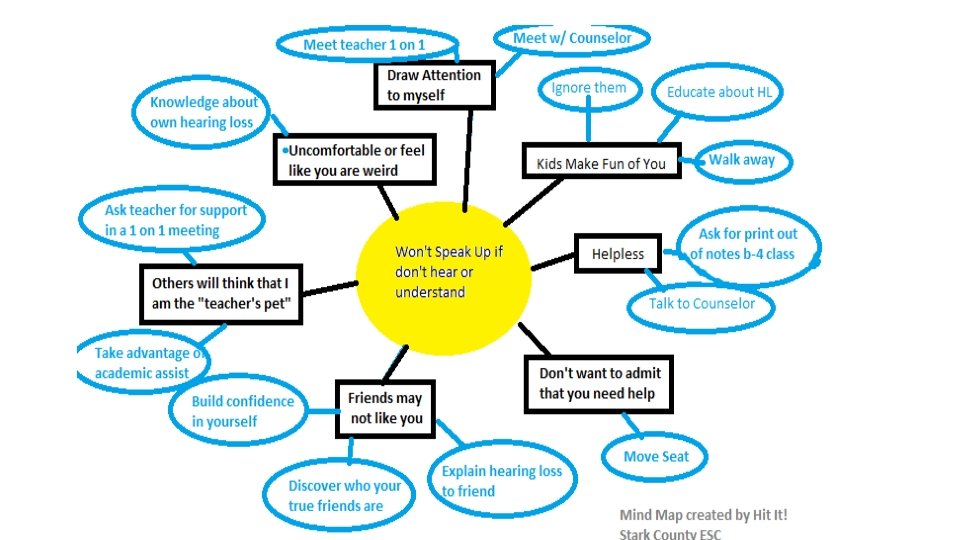
Roadblocks to Self-Determination Roadblocks to Self. Determination § Difficulty acknowledging and/or accepting a difference § Unprepared to disclose their disability § Choose not to disclose § Wait to disclose AFTER they have significant problems § Anxious about a "new beginning" and do not want to be labeled Examples of Failure - Audiology § Students who are not supported to use the technology § Self-advocacy attempts that are thwarted by the teacher § Parents who deny the need for, or do not support, hearing instrument technology § School cultures that are not flexible to meet individual needs of students § Technology that does not work
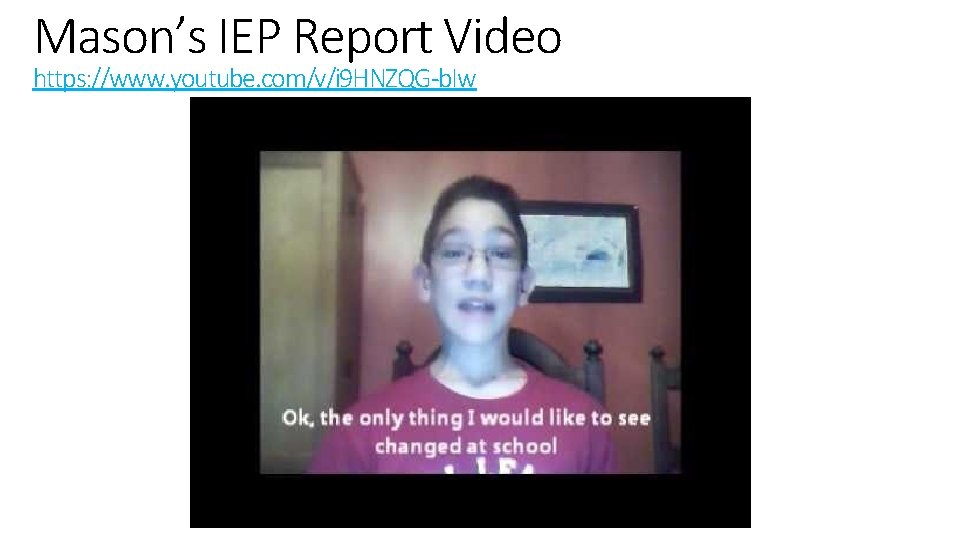
Mason’s IEP Report Video https: //www. youtube. com/v/i 9 HNZQG-b. Iw
Strategies and Solutions
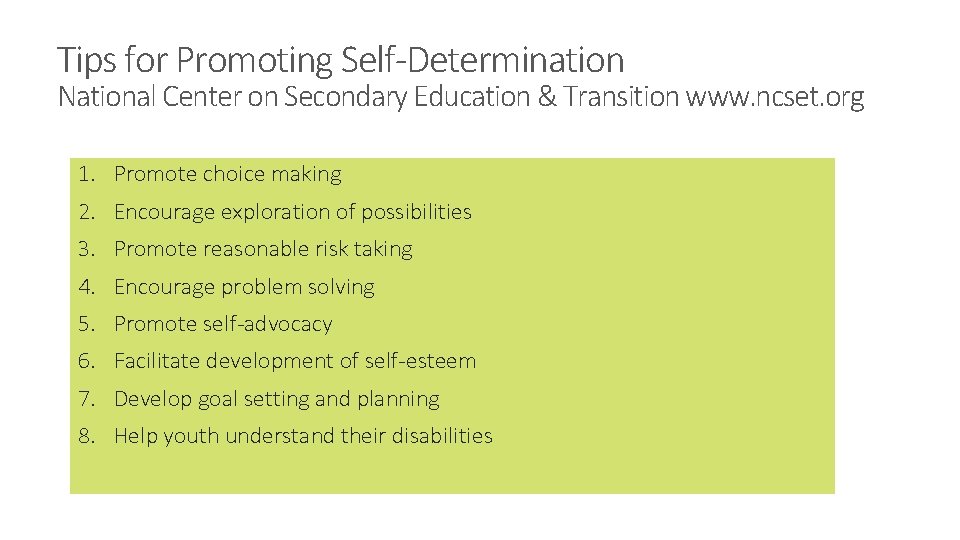
Tips for Promoting Self-Determination National Center on Secondary Education & Transition www. ncset. org 1. Promote choice making 2. Encourage exploration of possibilities 3. Promote reasonable risk taking 4. Encourage problem solving 5. Promote self-advocacy 6. Facilitate development of self-esteem 7. Develop goal setting and planning 8. Help youth understand their disabilities
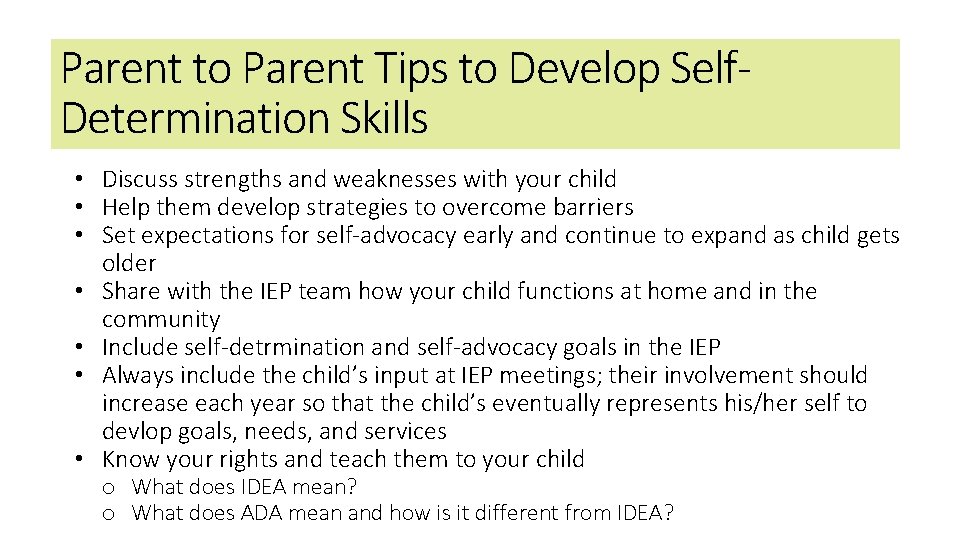
Parent to Parent Tips to Develop Self. Determination Skills • Discuss strengths and weaknesses with your child • Help them develop strategies to overcome barriers • Set expectations for self-advocacy early and continue to expand as child gets older • Share with the IEP team how your child functions at home and in the community • Include self-detrmination and self-advocacy goals in the IEP • Always include the child’s input at IEP meetings; their involvement should increase each year so that the child’s eventually represents his/her self to devlop goals, needs, and services • Know your rights and teach them to your child o What does IDEA mean? o What does ADA mean and how is it different from IDEA?
2. JUDICIOUS USE OF AMPLIFICATION
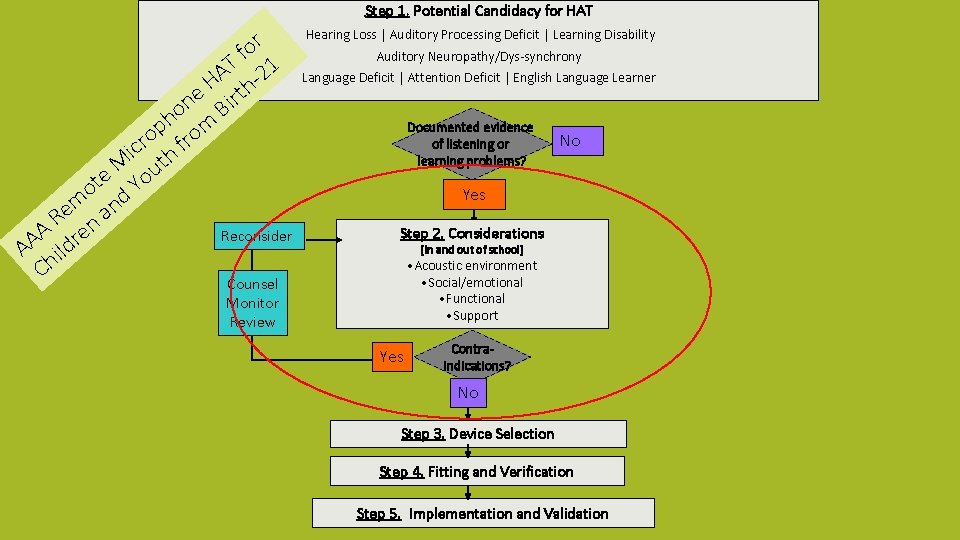
Step 1. Potential Candidacy for HAT r o f 1 T A -2 H h t e r n Bi o h m p o o ci r h fr M out e ot d Y m an e R en A Reconsider r A d A il Ch Counsel Hearing Loss | Auditory Processing Deficit | Learning Disability Auditory Neuropathy/Dys-synchrony Language Deficit | Attention Deficit | English Language Learner Documented evidence of listening or learning problems? No Yes Step 2. Considerations [in and out of school] • Acoustic environment • Social/emotional • Functional • Support Monitor Review Yes Contra. Indications? No Step 3. Device Selection Step 4. Fitting and Verification Step 5. Implementation and Validation
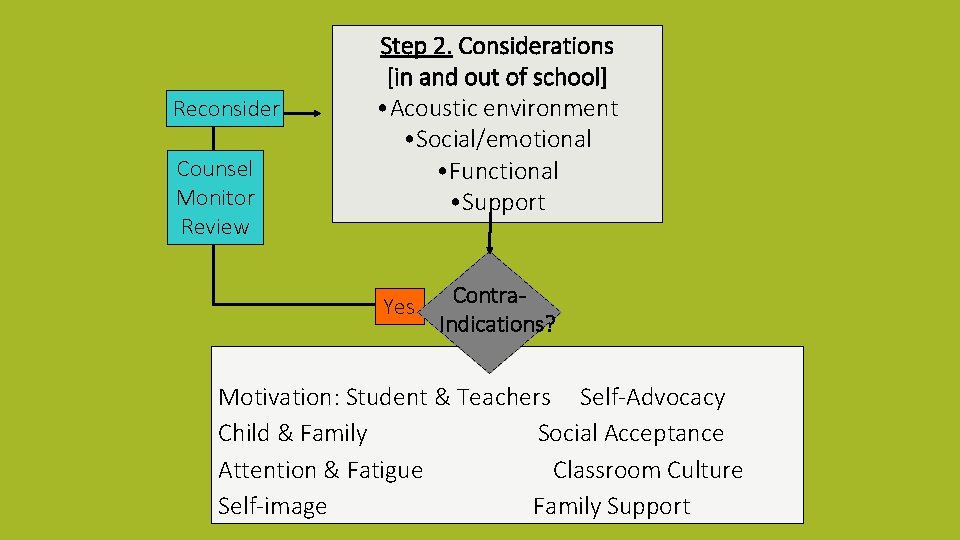
Reconsider Counsel Monitor Review Step 2. Considerations [in and out of school] • Acoustic environment • Social/emotional • Functional • Support Yes Contra. Indications? Motivation: Student & Teachers Self-Advocacy Child & Family Social Acceptance Attention & Fatigue Classroom Culture Self-image Family Support
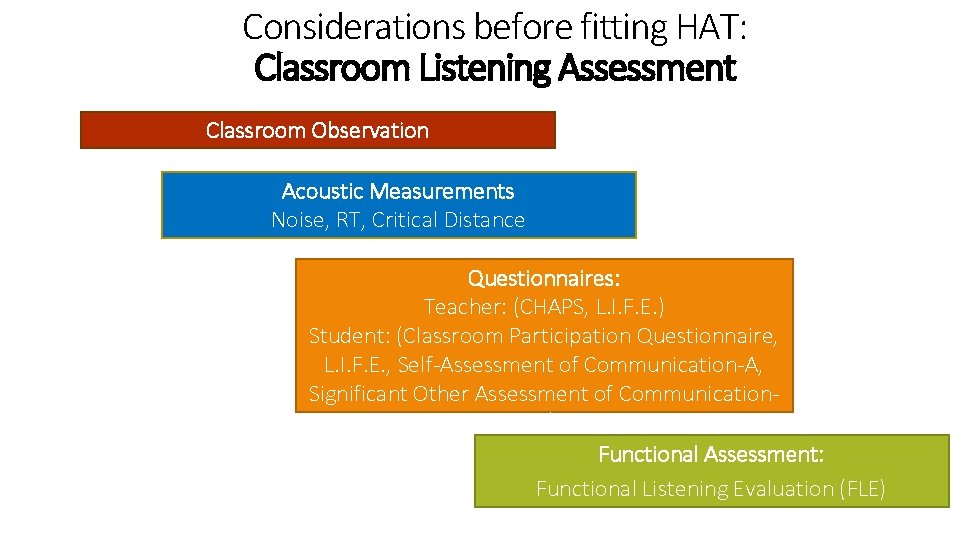
Considerations before fitting HAT: Classroom Listening Assessment Classroom Observation Acoustic Measurements Noise, RT, Critical Distance Questionnaires: Teacher: (CHAPS, L. I. F. E. ) Student: (Classroom Participation Questionnaire, L. I. F. E. , Self-Assessment of Communication-A, Significant Other Assessment of Communication. A) Functional Assessment: Functional Listening Evaluation (FLE)
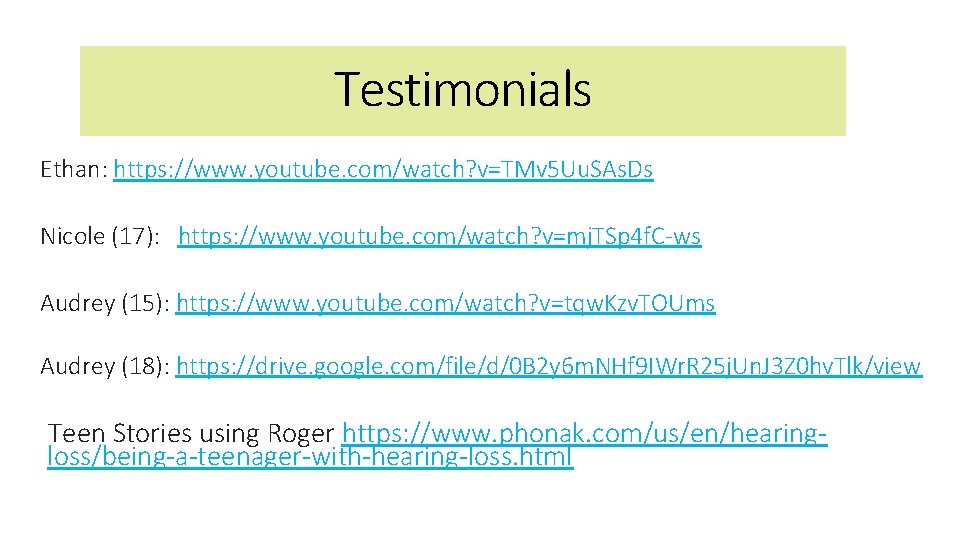
Testimonials Ethan: https: //www. youtube. com/watch? v=TMv 5 Uu. SAs. Ds Nicole (17): https: //www. youtube. com/watch? v=mj. TSp 4 f. C-ws Audrey (15): https: //www. youtube. com/watch? v=tqw. Kzv. TOUms Audrey (18): https: //drive. google. com/file/d/0 B 2 y 6 m. NHf 9 IWr. R 25 j. Un. J 3 Z 0 hv. Tlk/view Teen Stories using Roger https: //www. phonak. com/us/en/hearingloss/being-a-teenager-with-hearing-loss. html
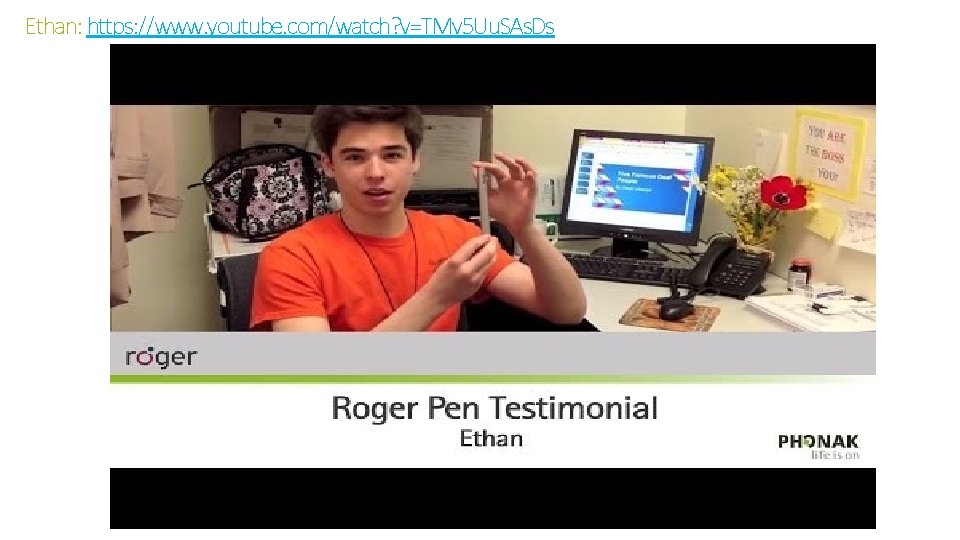
Ethan: https: //www. youtube. com/watch? v=TMv 5 Uu. SAs. Ds
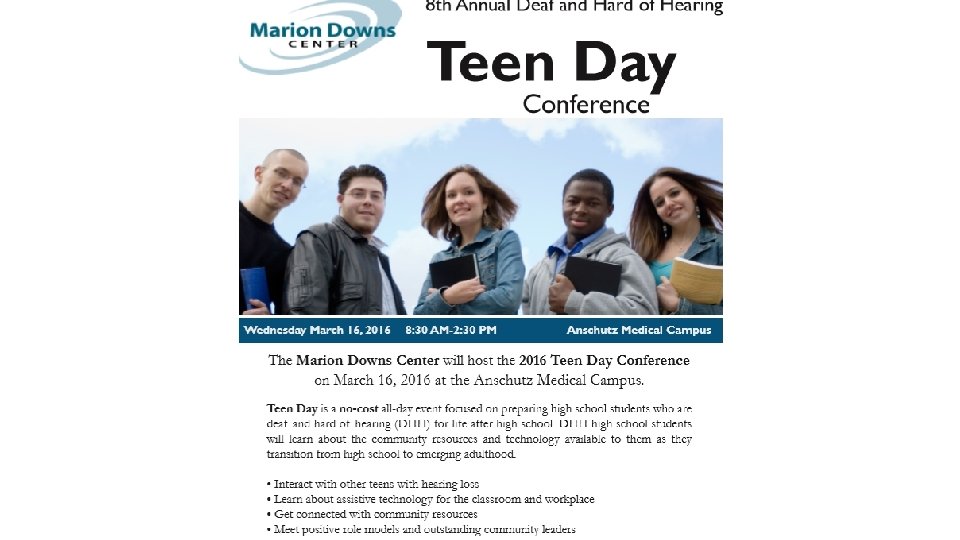
3. Peer Group Opportunities Transitioning out of School
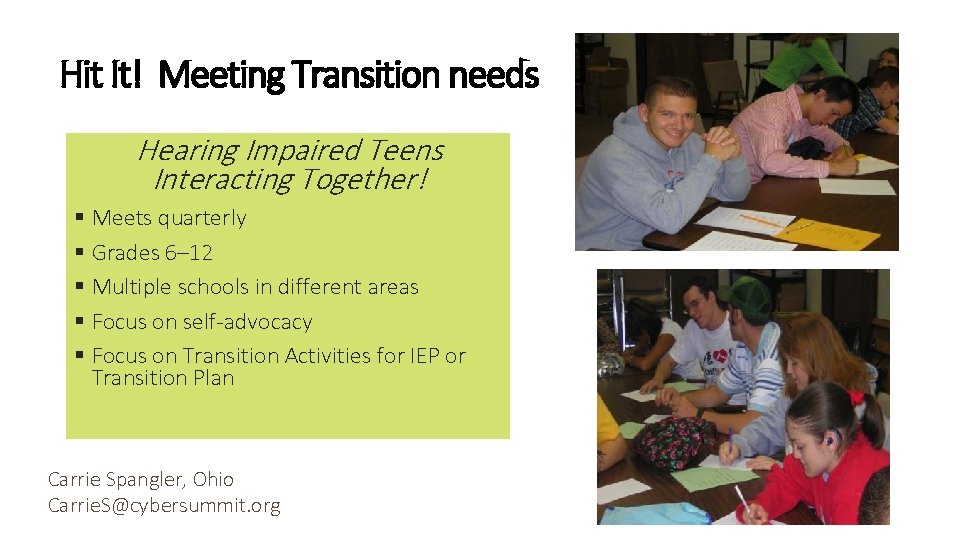
Hit It! Meeting Transition needs Hearing Impaired Teens Interacting Together! § Meets quarterly § Grades 6– 12 § Multiple schools in different areas § Focus on self-advocacy § Focus on Transition Activities for IEP or Transition Plan Carrie Spangler, Ohio Carrie. S@cybersummit. org
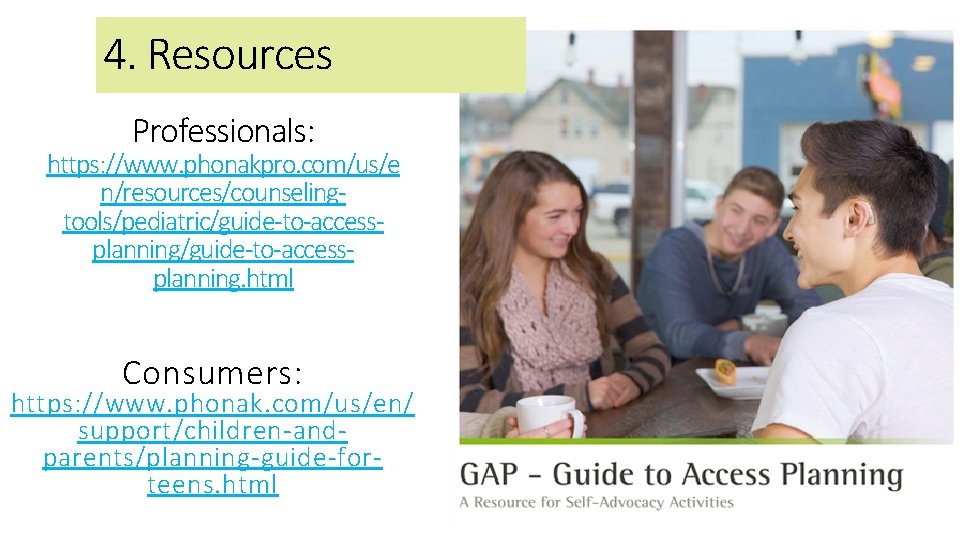
4. Resources Professionals: https: //www. phonakpro. com/us/e n/resources/counselingtools/pediatric/guide-to-accessplanning. html Consumers: https: //www. phonak. com/us/en/ support/children-andparents/planning-guide-forteens. html
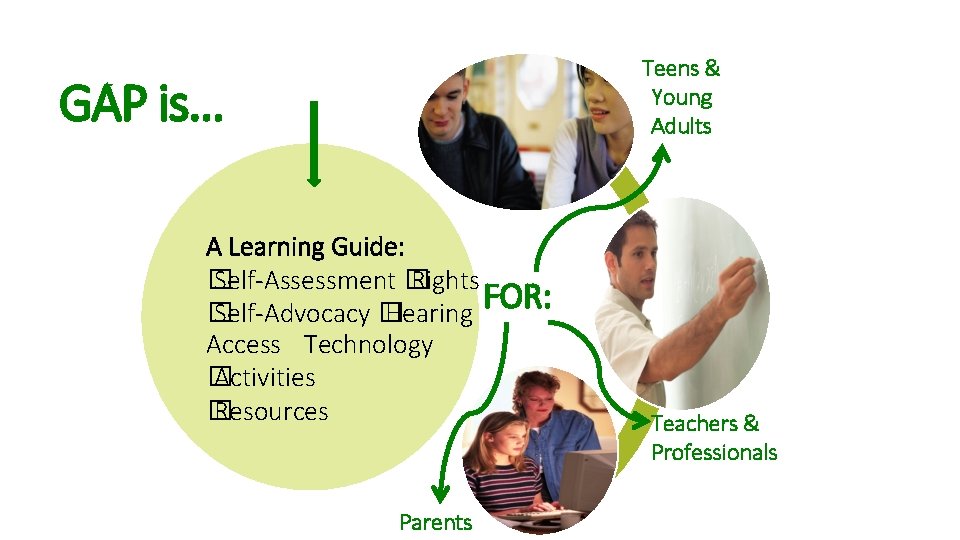
Teens & Young Adults GAP is… A Learning Guide: � Self-Assessment � Rights FOR: � Self-Advocacy � Hearing Access Technology � Activities � Resources Parents Teachers & Professionals
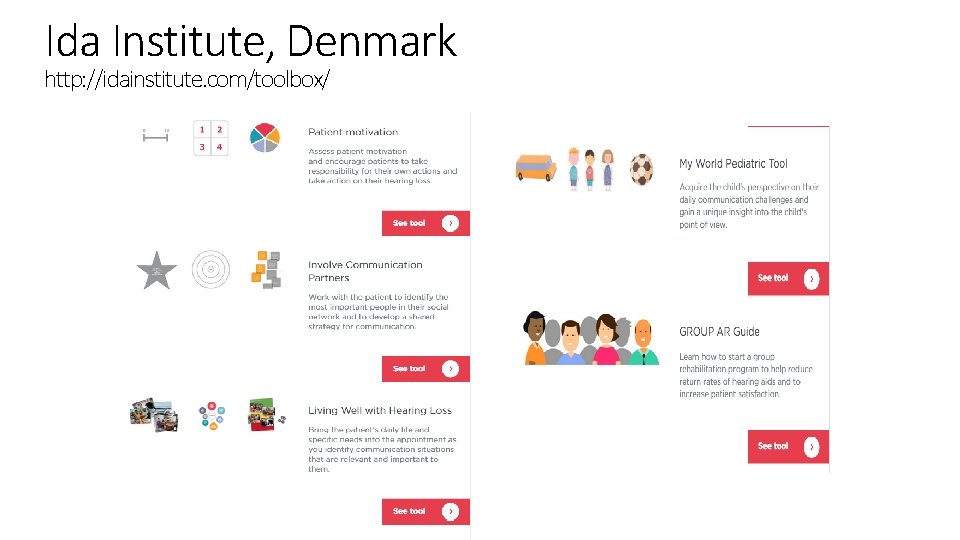
Ida Institute, Denmark http: //idainstitute. com/toolbox/
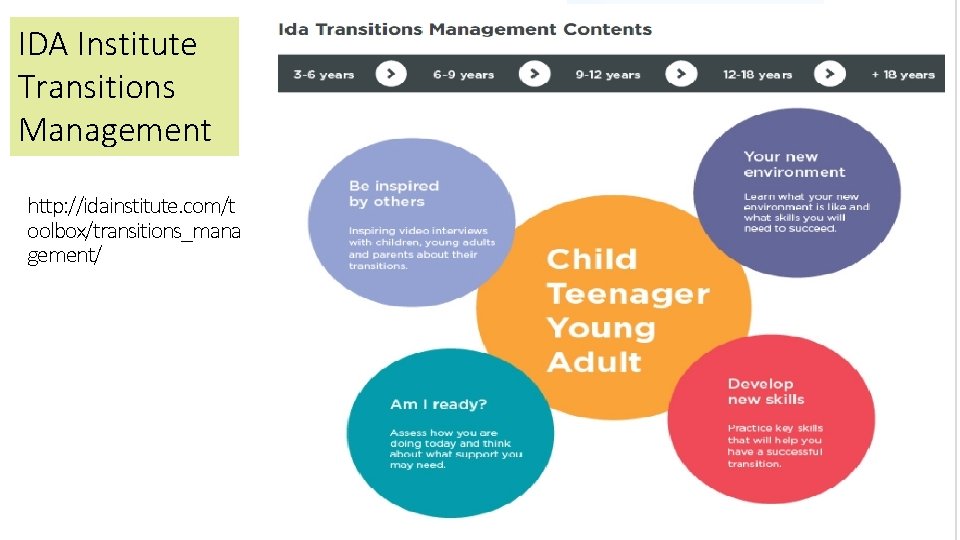
IDA Institute Transitions Management http: //idainstitute. com/t oolbox/transitions_mana gement/
http: //www. pepnet. org/map-it
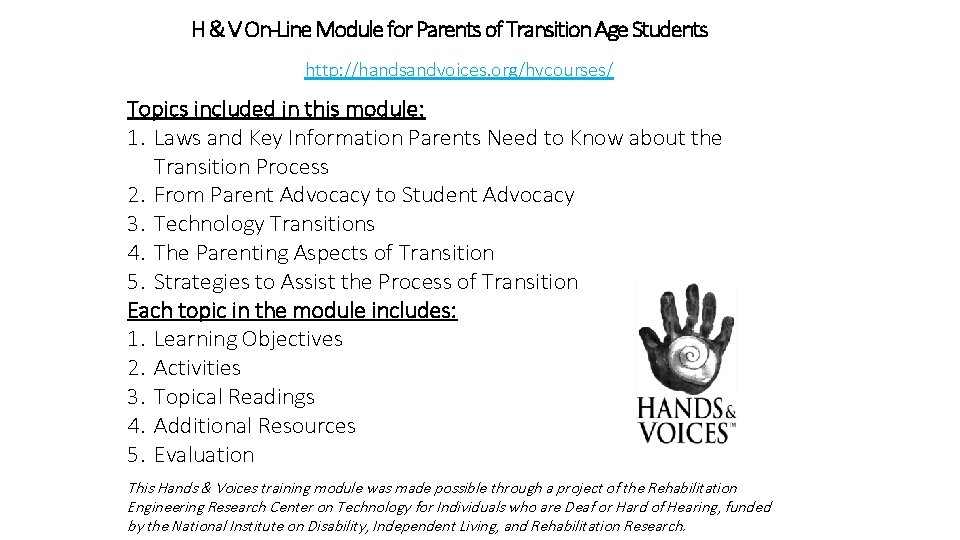
H & V On-Line Module for Parents of Transition Age Students http: //handsandvoices. org/hvcourses/ Topics included in this module: 1. Laws and Key Information Parents Need to Know about the Transition Process 2. From Parent Advocacy to Student Advocacy 3. Technology Transitions 4. The Parenting Aspects of Transition 5. Strategies to Assist the Process of Transition Each topic in the module includes: 1. Learning Objectives 2. Activities 3. Topical Readings 4. Additional Resources 5. Evaluation This Hands & Voices training module was made possible through a project of the Rehabilitation Engineering Research Center on Technology for Individuals who are Deaf or Hard of Hearing, funded by the National Institute on Disability, Independent Living, and Rehabilitation Research.
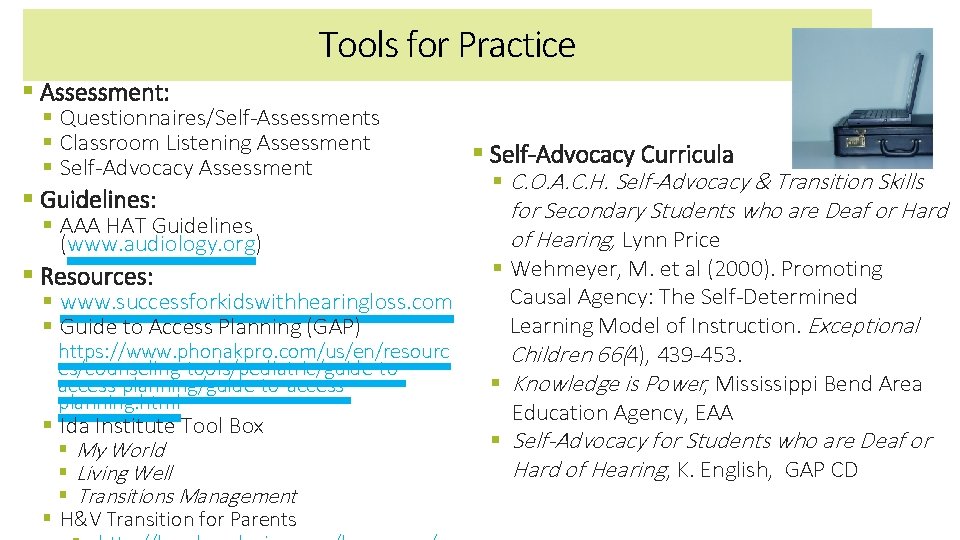
Tools for Practice § Assessment: § Questionnaires/Self-Assessments § Classroom Listening Assessment § Self-Advocacy Assessment § Guidelines: § AAA HAT Guidelines (www. audiology. org) § Resources: § www. successforkidswithhearingloss. com § Guide to Access Planning (GAP) https: //www. phonakpro. com/us/en/resourc es/counseling-tools/pediatric/guide-toaccess-planning/guide-to-accessplanning. html § Ida Institute Tool Box § My World § Living Well § Transitions Management § H&V Transition for Parents § Self-Advocacy Curricula § C. O. A. C. H. Self-Advocacy & Transition Skills for Secondary Students who are Deaf or Hard of Hearing, Lynn Price § Wehmeyer, M. et al (2000). Promoting Causal Agency: The Self-Determined Learning Model of Instruction. Exceptional Children 66(4), 439 -453. § Knowledge is Power, Mississippi Bend Area Education Agency, EAA § Self-Advocacy for Students who are Deaf or Hard of Hearing , K. English, GAP CD
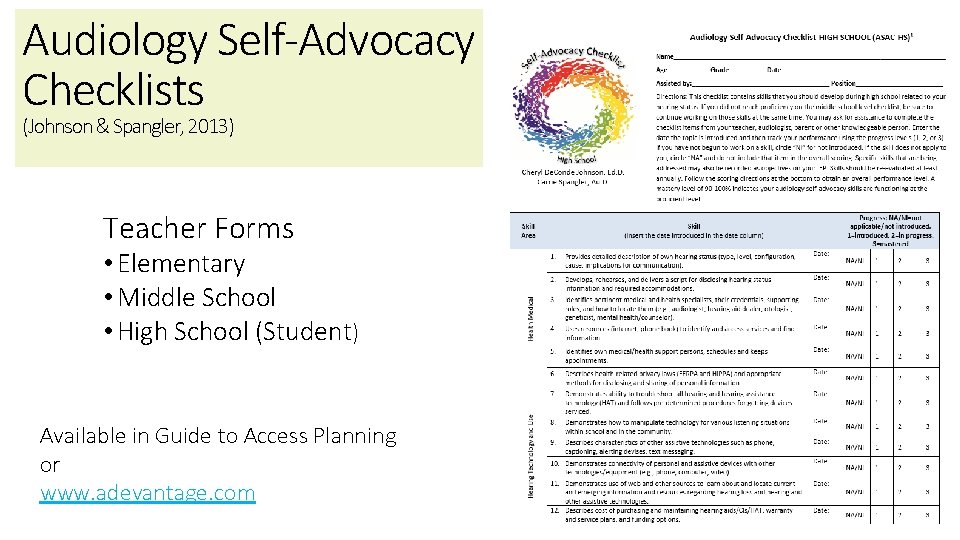
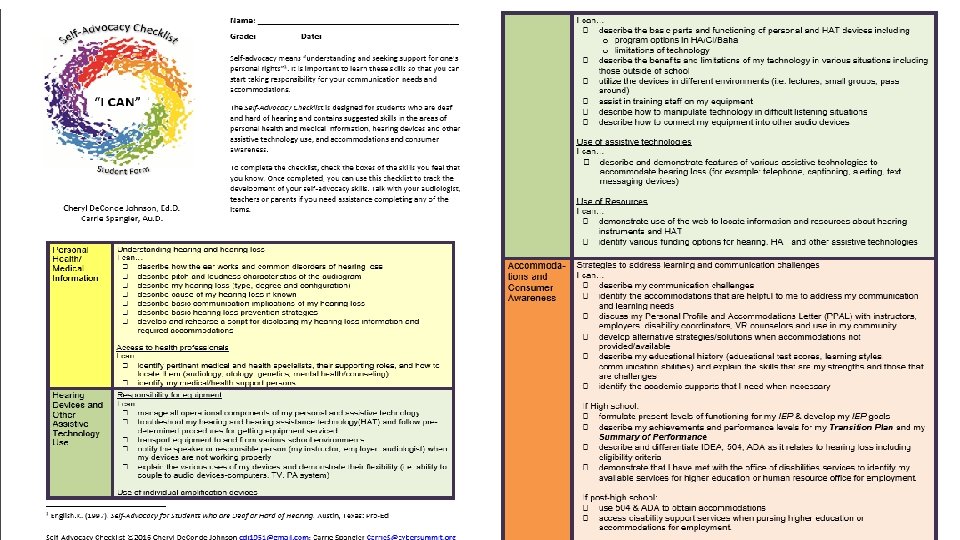
Audiology Self-Advocacy Checklists (Johnson & Spangler, 2013) Teacher Forms • Elementary • Middle School • High School (Student) Available in Guide to Access Planning or www. adevantage. com
EAA: Input Requested https: //www. surveymmonkey. com/r/WLSYC 7 K www. edaud. org Supporting Student who are Deaf and Hard of Hearing: Shared and Suggested Roles of Educational Audiologists, Teachers of the Deaf and Hard of Hearing, and Speech-Language Pathologists A checklist to discuss and distribute roles/responsibilities.
Learning Outcomes 1. Differentiate between self-determination and self-advocacy. 2. Describe a strategy for supporting families and their children as they move from preschool to adulthood. 3. Discuss strategies for implementing self-determination and selfadvocacy goals into the IEP.