
ACHIEVEMENTS AND DEVELOPMENT OF HYBRID RICE IN CHINA
ACHIEVEMENTS AND DEVELOPMENT OF HYBRID RICE IN CHINA Dr. Ma Guohui Deputy Director General China National Hybrid Rice R & D Center July, 2, Bangkok
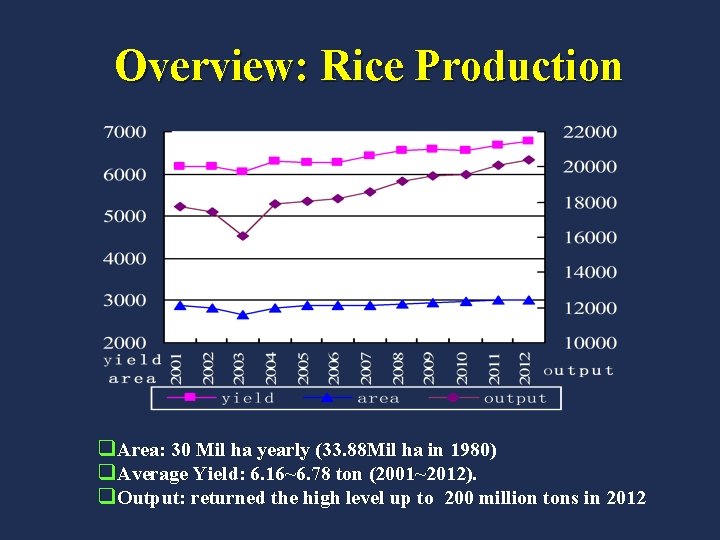
Overview: Rice Production q. Area: 30 Mil ha yearly (33. 88 Mil ha in 1980) q. Average Yield: 6. 16~6. 78 ton (2001~2012). q. Output: returned the high level up to 200 million tons in 2012
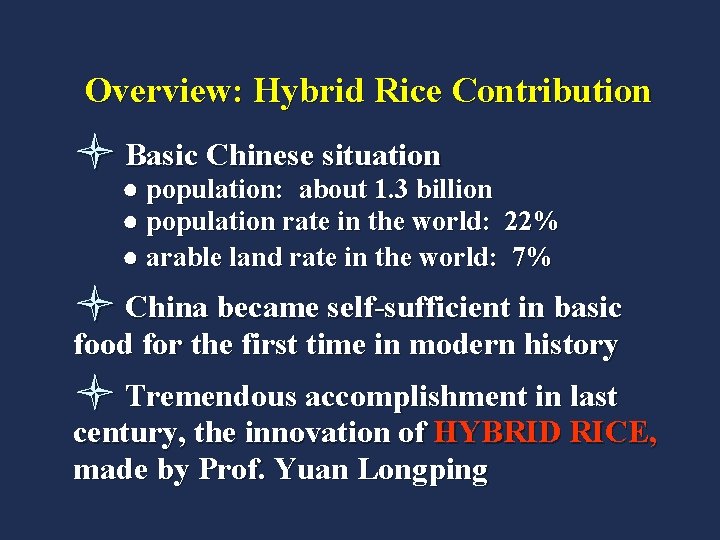
Overview: Hybrid Rice Contribution l Basic Chinese situation ● population: about 1. 3 billion ● population rate in the world: 22% ● arable land rate in the world: 7% l China became self-sufficient in basic food for the first time in modern history l Tremendous accomplishment in last century, the innovation of HYBRID RICE, made by Prof. Yuan Longping
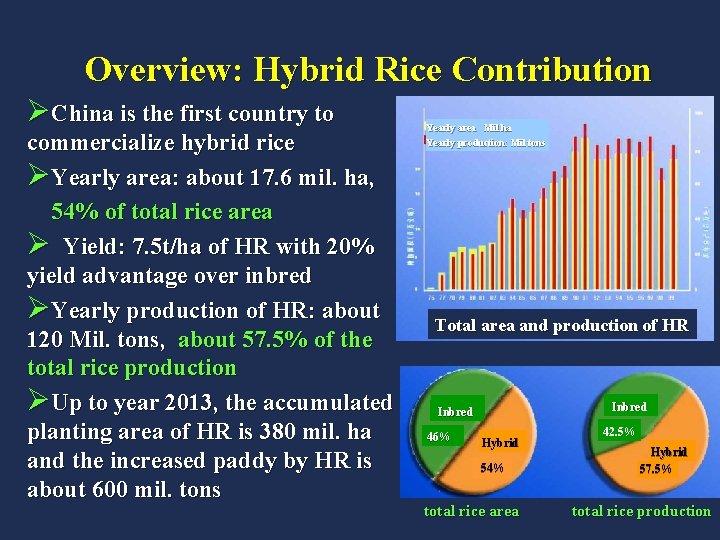
Overview: Hybrid Rice Contribution ØChina is the first country to commercialize hybrid rice ØYearly area: about 17. 6 mil. ha, 54% of total rice area Ø Yield: 7. 5 t/ha of HR with 20% yield advantage over inbred ØYearly production of HR: about 120 Mil. tons, about 57. 5% of the total rice production ØUp to year 2013, the accumulated planting area of HR is 380 mil. ha and the increased paddy by HR is about 600 mil. tons Yearly area Mil ha Yearly production: Mil tons Total area and production of HR Inbred 46% Hybrid 54% total rice area 42. 5% Hybrid 57. 5% total rice production
Overview: Hybrid Rice Contribution v Seed enterprises (in 2012) 520 Seed enterprises which have the capacity to the breeding, seed production and marketing for HR production v The commercial seeds of HR 283 million kg/y v Employment opportunities Direct: 0. 1 million/y Indirect: 1. 0 million/y
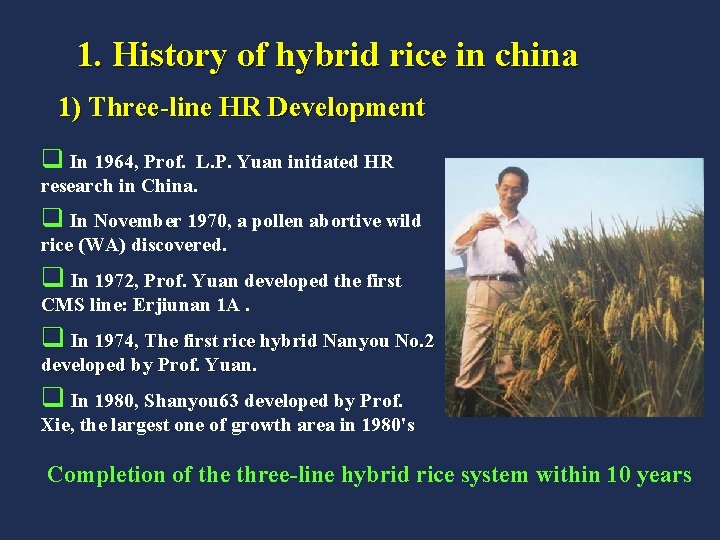
1. History of hybrid rice in china 1) Three-line HR Development q In 1964, Prof. L. P. Yuan initiated HR research in China. q In November 1970, a pollen abortive wild rice (WA) discovered. q In 1972, Prof. Yuan developed the first CMS line: Erjiunan 1 A. q In 1974, The first rice hybrid Nanyou No. 2 developed by Prof. Yuan q In 1980, Shanyou 63 developed by Prof. Xie, the largest one of growth area in 1980's Completion of the three-line hybrid rice system within 10 years
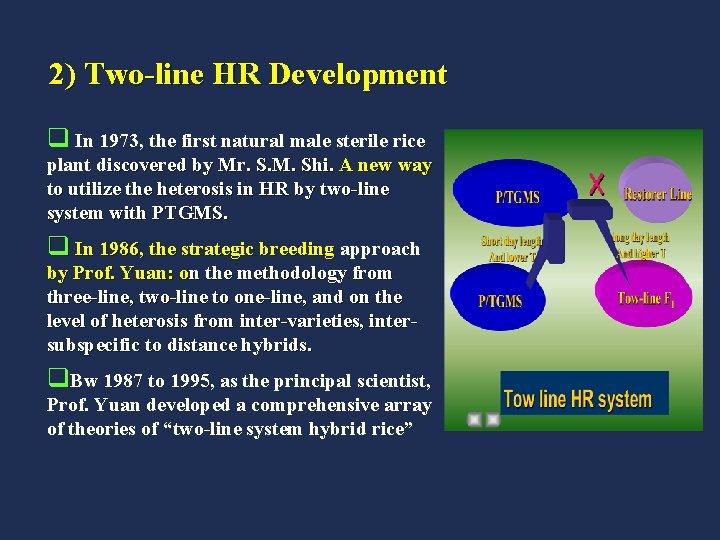
2) Two-line HR Development q In 1973, the first natural male sterile rice plant discovered by Mr. S. M. Shi. A new way to utilize the heterosis in HR by two-line system with PTGMS. q In 1986, the strategic breeding approach by Prof. Yuan: on the methodology from three-line, two-line to one-line, and on the level of heterosis from inter-varieties, intersubspecific to distance hybrids. q. Bw 1987 to 1995, as the principal scientist, Prof. Yuan developed a comprehensive array of theories of “two-line system hybrid rice”
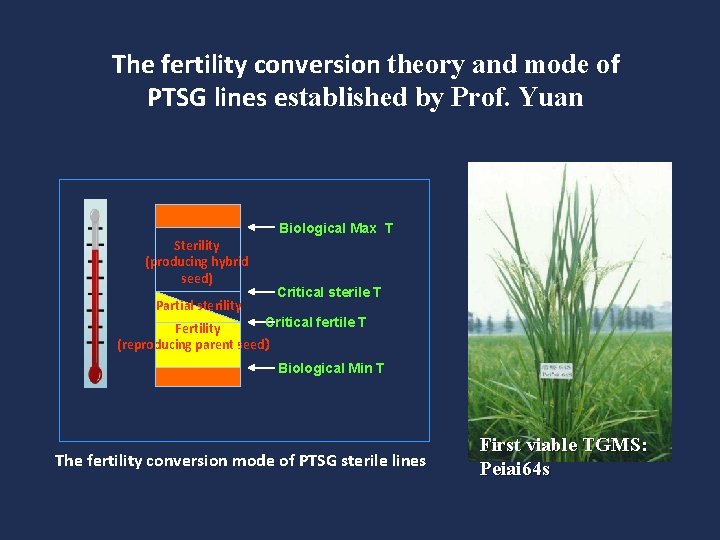
The fertility conversion theory and mode of PTSG lines established by Prof. Yuan Biological Max T Sterility (producing hybrid seed) Partial sterility Critical sterile T Critical fertile T Fertility (reproducing parent seed) Biological Min T The fertility conversion mode of PTSG sterile lines First viable TGMS: Peiai 64 s
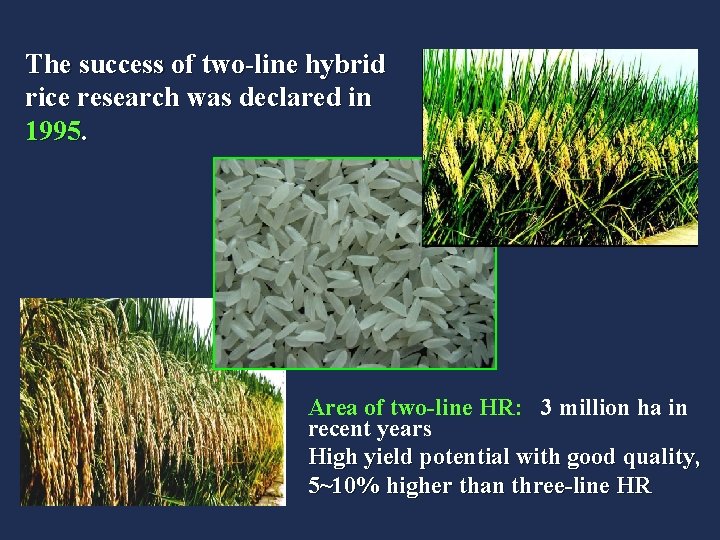
The success of two-line hybrid rice research was declared in 1995. Area of two-line HR: 3 million ha in recent years High yield potential with good quality, 5~10% higher than three-line HR
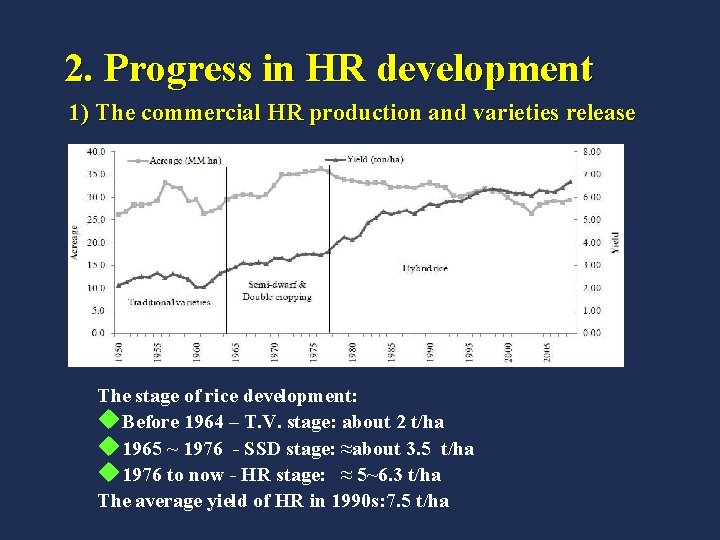
2. Progress in HR development 1) The commercial HR production and varieties release The stage of rice development: u. Before 1964 – T. V. stage: about 2 t/ha u 1965 ~ 1976 - SSD stage: ≈about 3. 5 t/ha u 1976 to now - HR stage: ≈ 5~6. 3 t/ha The average yield of HR in 1990 s: 7. 5 t/ha
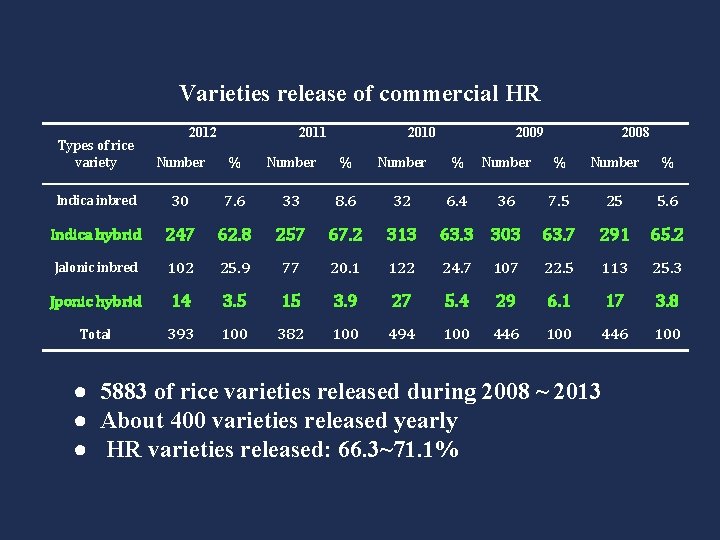
Varieties release of commercial HR 2012 2011 2010 2009 2008 Types of rice variety Number % Number % Indica inbred 30 7. 6 33 8. 6 32 6. 4 36 7. 5 25 5. 6 Indica hybrid 247 62. 8 257 67. 2 313 63. 3 303 63. 7 291 65. 2 Jalonic inbred 102 25. 9 77 20. 1 122 24. 7 107 22. 5 113 25. 3 Jponic hybrid 14 3. 5 15 3. 9 27 5. 4 29 6. 1 17 3. 8 Total 393 100 382 100 494 100 446 100 ● 5883 of rice varieties released during 2008 ~ 2013 ● About 400 varieties released yearly ● HR varieties released: 66. 3~71. 1%
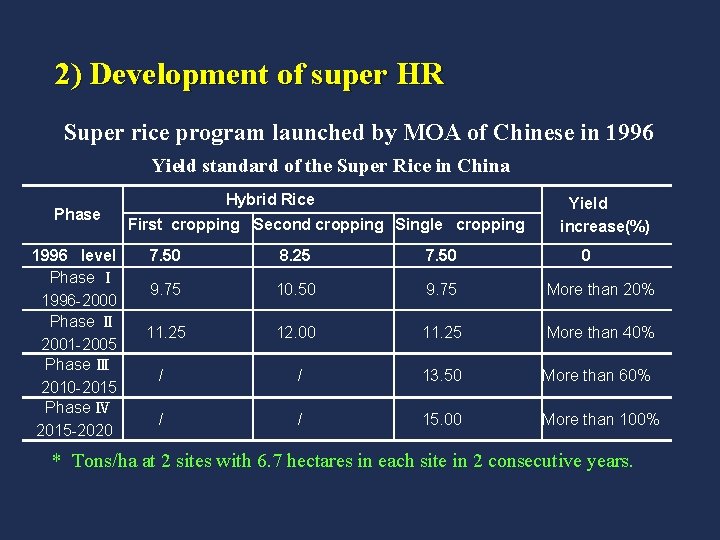
2) Development of super HR Super rice program launched by MOA of Chinese in 1996 Yield standard of the Super Rice in China Phase 1996 level Phase Ⅰ 1996 -2000 Phase Ⅱ 2001 -2005 Phase Ⅲ 2010 -2015 Phase Ⅳ 2015 -2020 Hybrid Rice First cropping Second cropping Single cropping Yield increase(%) 7. 50 8. 25 7. 50 0 9. 75 10. 50 9. 75 More than 20% 11. 25 12. 00 11. 25 More than 40% / / 13. 50 More than 60% / / 15. 00 More than 100% * Tons/ha at 2 sites with 6. 7 hectares in each site in 2 consecutive years.
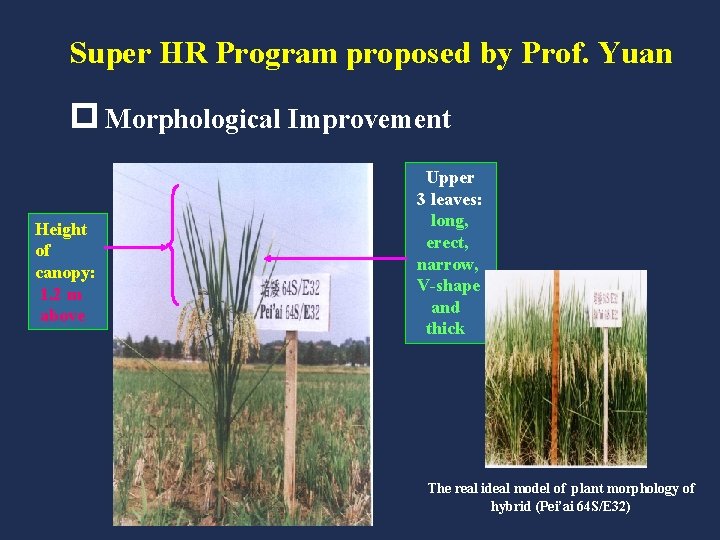
Super HR Program proposed by Prof. Yuan p Morphological Improvement Height of canopy: 1. 2 m above Upper 3 leaves: long, erect, narrow, V-shape and thick The real ideal model of plant morphology of hybrid (Pei’ai 64 S/E 32)
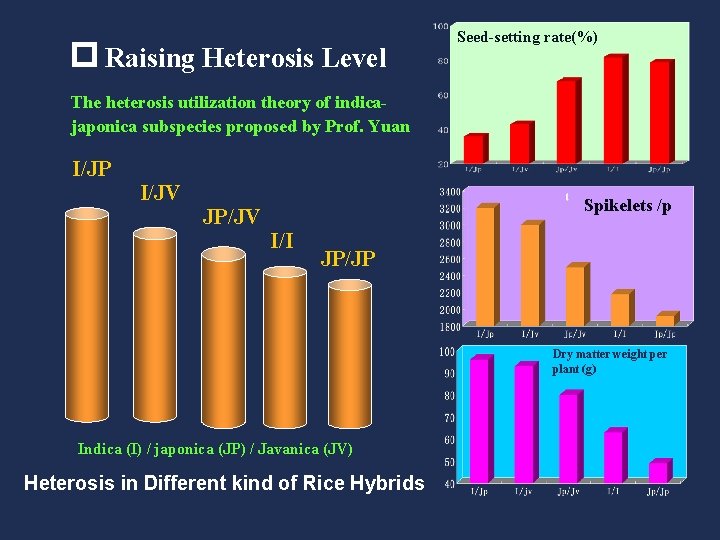
p Raising Heterosis Level Seed-setting rate(%) The heterosis utilization theory of indicajaponica subspecies proposed by Prof. Yuan I/JP I/JV JP/JV Spikelets /p I/I JP/JP Dry matter weight per plant (g) Indica (I) / japonica (JP) / Javanica (JV) Heterosis in Different kind of Rice Hybrids
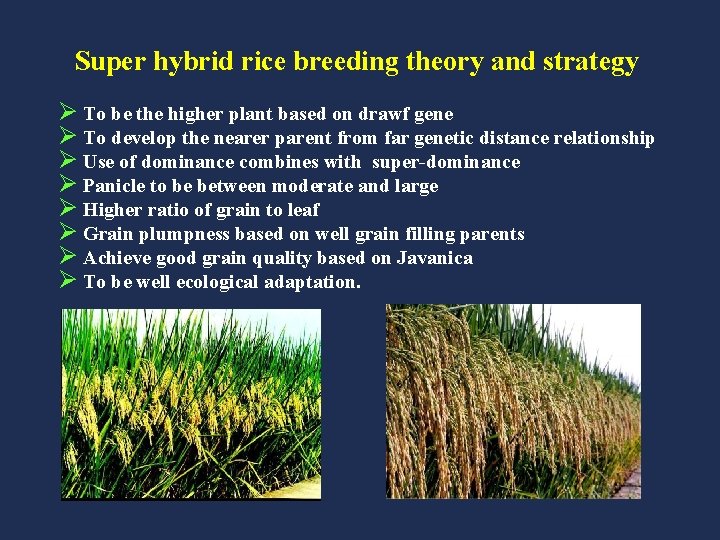
Super hybrid rice breeding theory and strategy Ø To be the higher plant based on drawf gene Ø To develop the nearer parent from far genetic distance relationship Ø Use of dominance combines with super-dominance Ø Panicle to be between moderate and large Ø Higher ratio of grain to leaf Ø Grain plumpness based on well grain filling parents Ø Achieve good grain quality based on Javanica Ø To be well ecological adaptation.
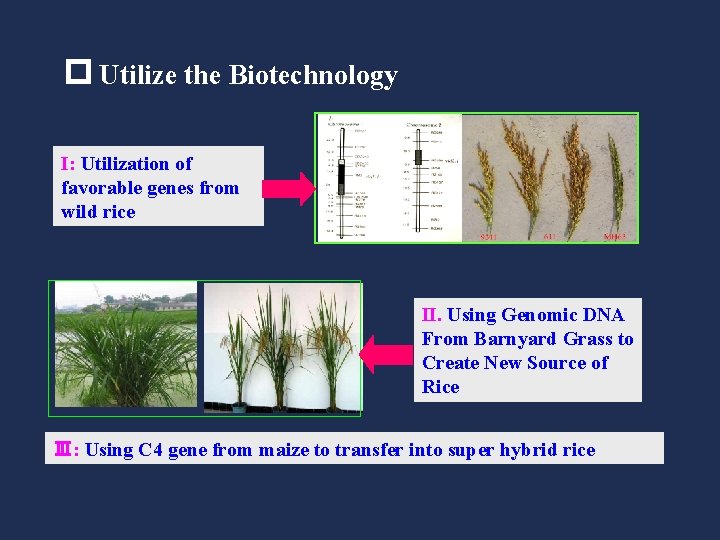
p Utilize the Biotechnology I: Utilization of favorable genes from wild rice II. Using Genomic DNA From Barnyard Grass to Create New Source of Rice Ⅲ: Using C 4 gene from maize to transfer into super hybrid rice
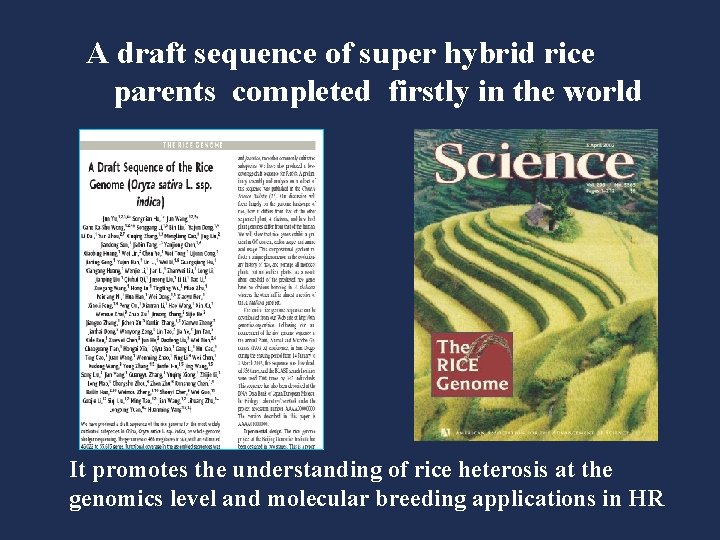
A draft sequence of super hybrid rice parents completed firstly in the world It promotes the understanding of rice heterosis at the genomics level and molecular breeding applications in HR
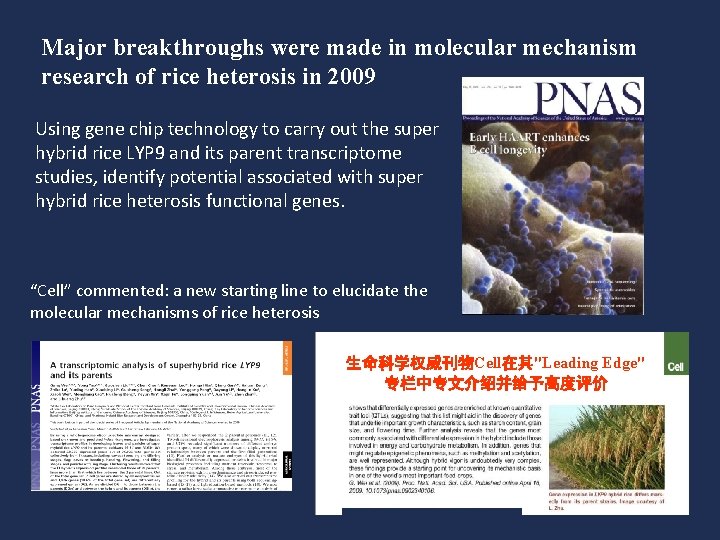
Major breakthroughs were made in molecular mechanism research of rice heterosis in 2009 Using gene chip technology to carry out the super hybrid rice LYP 9 and its parent transcriptome studies, identify potential associated with super hybrid rice heterosis functional genes. “Cell” commented: a new starting line to elucidate the molecular mechanisms of rice heterosis 生命科学权威刊物Cell在其"Leading Edge" 专栏中专文介绍并给予高度评价
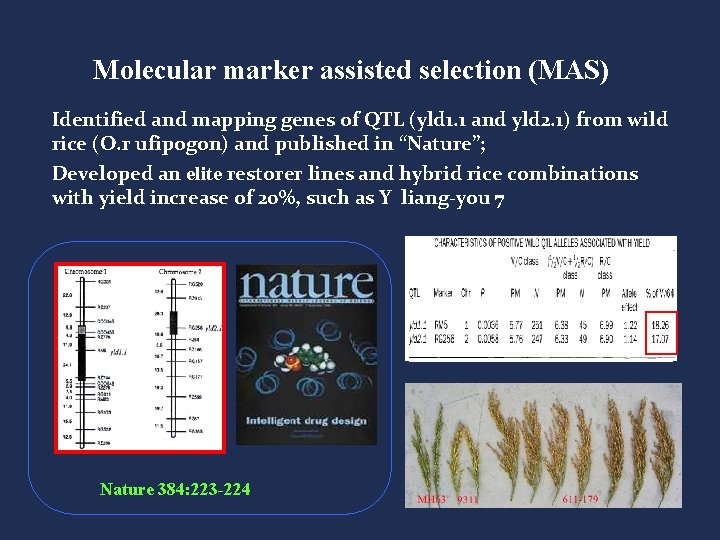
Molecular marker assisted selection (MAS) Identified and mapping genes of QTL (yld 1. 1 and yld 2. 1) from wild rice (O. r ufipogon) and published in “Nature”; Developed an elite restorer lines and hybrid rice combinations with yield increase of 20%, such as Y liang-you 7 Nature 384: 223 -224
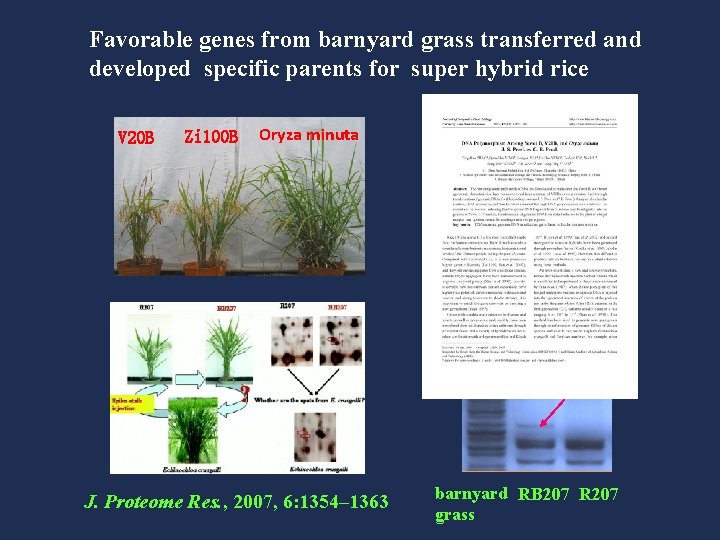
Favorable genes from barnyard grass transferred and developed specific parents for super hybrid rice V 20 B Zi 100 B Oryza minuta J. Proteome Res. , 2007, 6: 1354– 1363 barnyard RB 207 R 207 grass
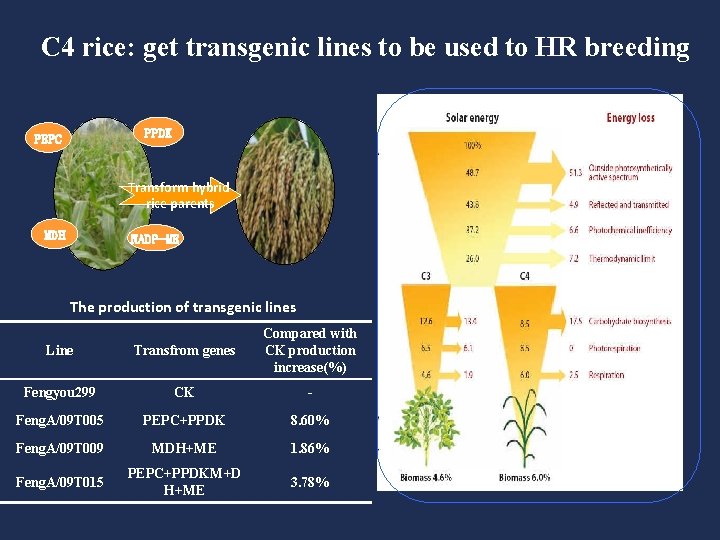
C 4 rice: get transgenic lines to be used to HR breeding PPDK PEPC Transform hybrid rice parents MDH NADP-ME The production of transgenic lines Line Transfrom genes Compared with CK production increase(%) Fengyou 299 CK - Feng. A/09 T 005 PEPC+PPDK 8. 60% Feng. A/09 T 009 MDH+ME 1. 86% Feng. A/09 T 015 PEPC+PPDKM+D H+ME 3. 78%
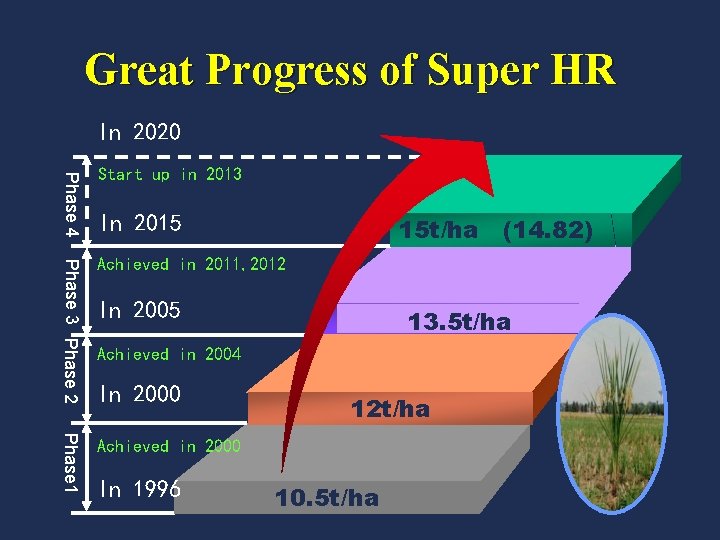
Great Progress of Super HR In 2020 Phase 4 Start up in 2013 Phase 2 Achieved in 2011, 2012 In 2015 15 t/ha (14. 82) In 2005 13. 5 t/ha Achieved in 2004 In 2000 12 t/ha Phase 1 Achieved in 2000 In 1996 10. 5 t/ha
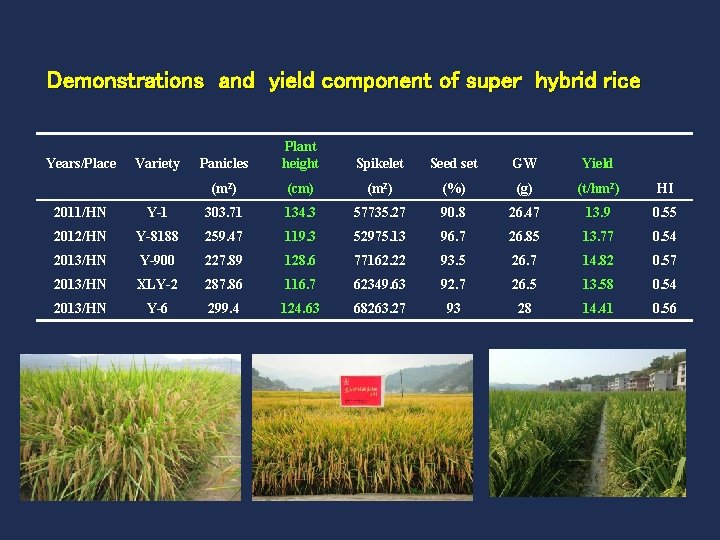
Demonstrations and yield component of super hybrid rice Years/Place Variety Panicles Plant height Spikelet Seed set GW Yield (m 2) (cm) (m 2) (%) (g) (t/hm 2) HI 2011/HN Y-1 303. 71 134. 3 57735. 27 90. 8 26. 47 13. 9 0. 55 2012/HN Y-8188 259. 47 119. 3 52975. 13 96. 7 26. 85 13. 77 0. 54 2013/HN Y-900 227. 89 128. 6 77162. 22 93. 5 26. 7 14. 82 0. 57 2013/HN XLY-2 287. 86 116. 7 62349. 63 92. 7 26. 5 13. 58 0. 54 2013/HN Y-6 299. 4 124. 63 68263. 27 93 28 14. 41 0. 56
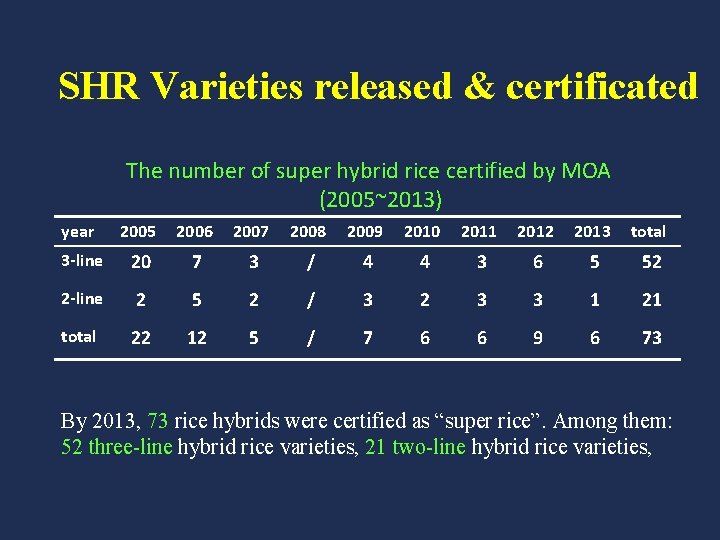
SHR Varieties released & certificated The number of super hybrid rice certified by MOA (2005~2013) year 2005 2006 2007 2008 2009 2010 2011 2012 2013 total 3 -line 20 7 3 / 4 4 3 6 5 52 2 -line 2 5 2 / 3 2 3 3 1 21 total 22 12 5 / 7 6 6 9 6 73 By 2013, 73 rice hybrids were certified as “super rice”. Among them: 52 three-line hybrid rice varieties, 21 two-line hybrid rice varieties,
3) HR seed production ★ Its difficult to utilize heterosis in rice Dr. J. N. Rutger -Earlirose male-sterile plants averaged 2. 4% open-pollinated seed-set From《Innovative approaches to rice breeding》 ★ The key problem for the HR commercialization ● lower pollen load ● Panicle is not exerted out easily ● Out-crossing rate is very low
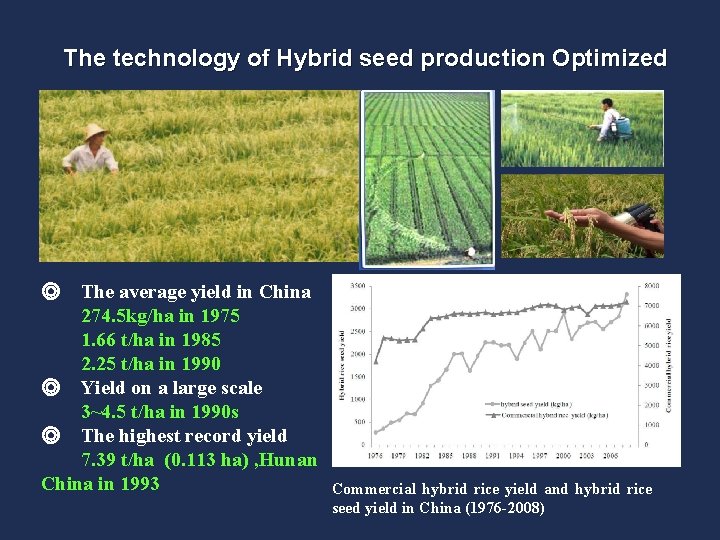
The technology of Hybrid seed production Optimized ◎ The average yield in China 274. 5 kg/ha in 1975 1. 66 t/ha in 1985 2. 25 t/ha in 1990 ◎ Yield on a large scale 3~4. 5 t/ha in 1990 s ◎ The highest record yield 7. 39 t/ha (0. 113 ha) , Hunan China in 1993 Commercial hybrid rice yield and hybrid rice seed yield in China (1976 -2008)
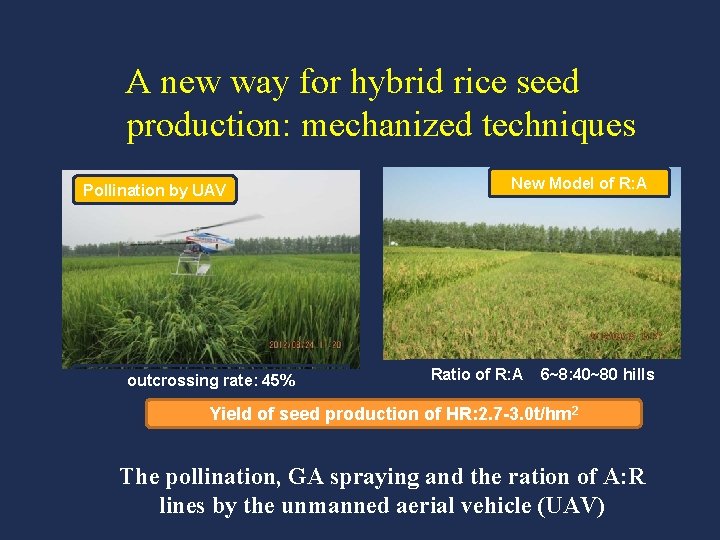
A new way for hybrid rice seed production: mechanized techniques Pollination by UAV outcrossing rate: 45% New Model of R: A Ratio of R: A 6~8: 40~80 hills Yield of seed production of HR: 2. 7 -3. 0 t/hm 2 The pollination, GA spraying and the ration of A: R lines by the unmanned aerial vehicle (UAV)
4) Field management of HR Chinese hybrid rice agronomists developed the systematic methods for high-yielding field management: Ø"3 -ding”Cultivation Technology for Super Hybrid Rice ØRice Precise and Quantitative Cultivation Technique for High Yield ØThe Improved System of Rice Intensification (MSRI) ØNitrogen-efficiency and lodging resistance cultivation technique
3. Constraints in HR development Ø The Area of HR at a Standstill for Years (17. 6 million ha in 1991) Ø Lack of japonica hybrid rice with strong heterosis (0. 1 mil ha, only 1%-2% in China). Ø Ø Great yield gap for super hybrid rice (about 5. 16 t/ha). Lack of the breakthrough combinations but HR varieties released yearly with about 400. Ø Need of the breakthrough for the mechanized technology of HR seed production.
4. Main Reasons for the success of HR l Strong Govt. Leadership: be committed, supportive, l High efficient organization and coordination: l Resources and techniques: qualified, distributive and l Technology generation and dissemination: R and D well organized to HR R and D. Leading Group, Consultancy Committee, frequent conferences; shared cooperation networks, Training, yield trials, on-farm demonstration , study tour and propaganda
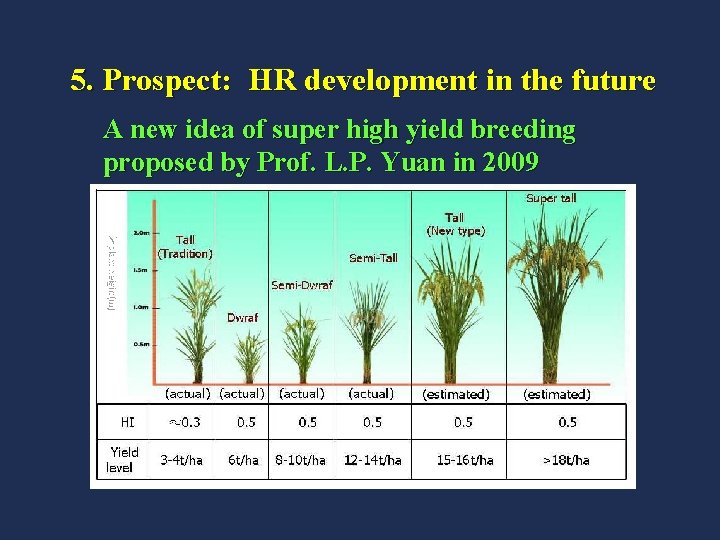
5. Prospect: HR development in the future A new idea of super high yield breeding proposed by Prof. L. P. Yuan in 2009 Øplant height(m)
New approach for high yield of HR Grain yield = Harvest Index X Biomass Nowadays the harvest index (HI) is much higher (above 0. 5). Further lifting of rice yield ceiling should rely on increasing biomass because further improvement of HI is quite limited. From view point of morphology, Ø Further raising rice yield ceiling should rely on increasing biomass. Ø Increasing plant height is an effective and feasible way to increase biomass
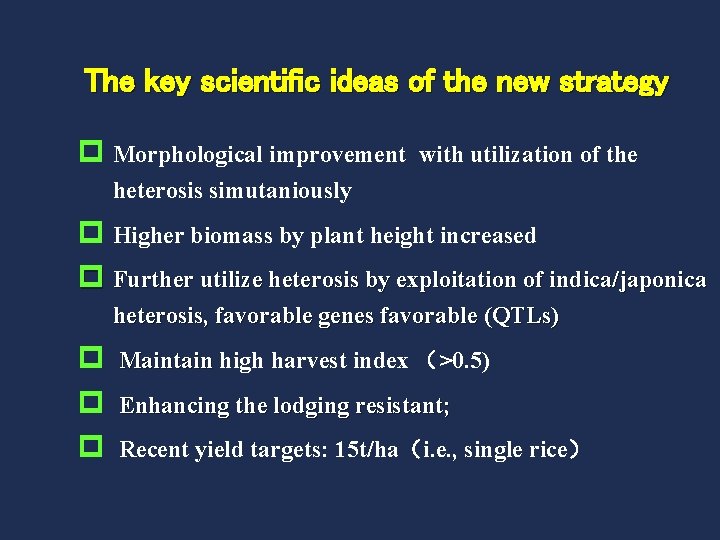
The key scientific ideas of the new strategy p Morphological improvement with utilization of the heterosis simutaniously p Higher biomass by plant height increased p Further utilize heterosis by exploitation of indica/japonica heterosis, favorable genes favorable (QTLs) p p p Maintain high harvest index (>0. 5) Enhancing the lodging resistant; Recent yield targets: 15 t/ha(i. e. , single rice)

Thank you !
- Slides: 34