
ACGIHs Role in the Development of Exposure Assessment
- Slides: 28
ACGIH’s Role in the Development of Exposure Assessment Guidelines for Occupational Hygiene Scott E. Merkle, CIH AIHA Carolinas Section -- Spring Conference Charlotte, NC March 13 -15, 2002
Overview • Some background on TLVs®. • How TLVs are developed. • The legal challenges of 2001. • Where do we go from here?
What is ACGIH®? • Membership Society – Multi-disciplinary – Core membership from government & academic institutions • Neutral on Public Positions • No programs in credentialing, job placement, or associated business services
What Does ACGIH Do? • Develop health-based occupational exposure guidelines. – TLVs and BEIs • Develop practice guidelines for occupational hygiene methodology. – Industrial Ventilation and Air Sampling Instruments
® TLVs and ® BEIs • Threshold Limit Values for Chemical Substances • Threshold Limit Values for Physical Agents • Biological Exposure Indices for Chemical Substances
Selected Milestones in the History of TLVs/BEIs 1941 - Committee established. 1946 - First list published. 1954 - Notice of Intended Changes published. 1955 - Begin to develop Documentation for each TLV. 1962 - First Edition of Documentation published. 1968 - TLV Committee for Physical Agents appointed.
Selected Milestones in the History of TLVs/BEIs 1980 - Committee guidelines and procedures approved and published. Updated in 1987, 1989, 1992, 1994, 1998, 2001 1983 - BEI Committee appointed 2000 - Bylaws and conflict of interest policy revised to allow expanded voting privileges 2001 - Litigation defense (3 cases)
TLVs Defined TLV “Airborne concentrations of substances and represent conditions under which it is believed that nearly all workers may be repeatedly exposed day after day without adverse health effects. ”
Core TLV Principles • Airborne exposure values for the occupational setting. • Health-based values. Technical, economic, and analytic feasibility is not considered. • Not intended for legal adoption; TLVs are not consensus standards.
Core TLV Principles • Guidance values to be applied by persons trained in occupational hygiene. • The “threshold” concept. • Established to protect “nearly all” workers. • Not appropriate for use as index of relative toxicity.
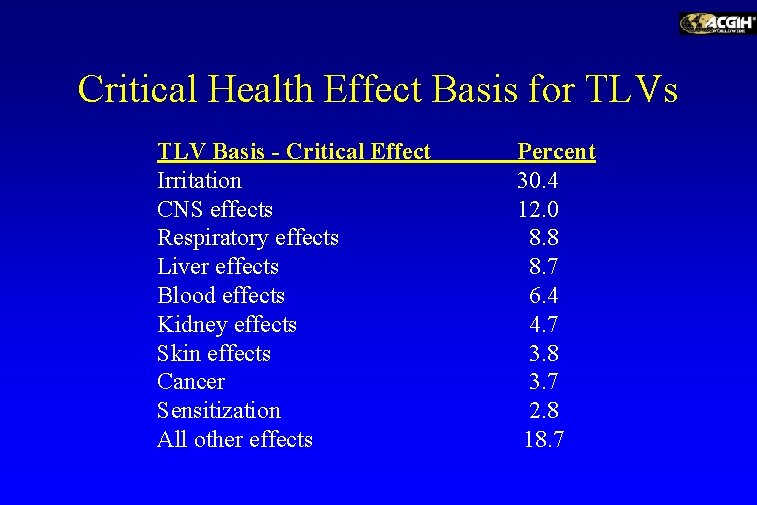
Critical Health Effect Basis for TLVs TLV Basis - Critical Effect Irritation CNS effects Respiratory effects Liver effects Blood effects Kidney effects Skin effects Cancer Sensitization All other effects Percent 30. 4 12. 0 8. 8 8. 7 6. 4 4. 7 3. 8 3. 7 2. 8 18. 7
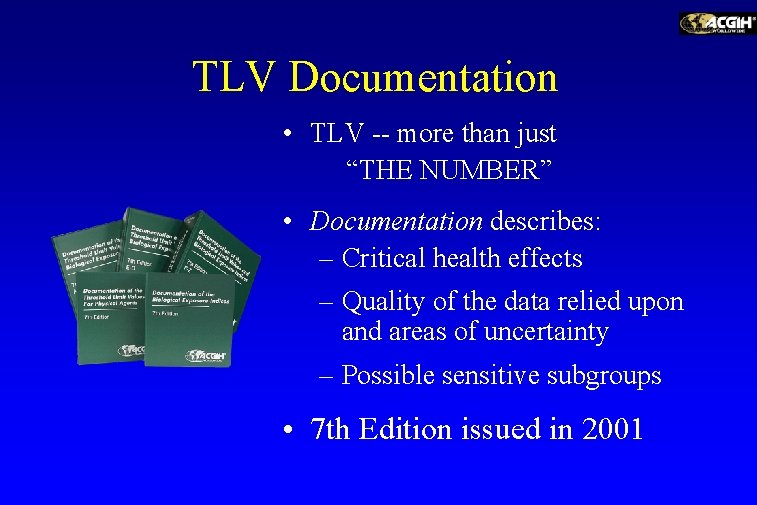
TLV Documentation • TLV -- more than just “THE NUMBER” • Documentation describes: – Critical health effects – Quality of the data relied upon and areas of uncertainty – Possible sensitive subgroups • 7 th Edition issued in 2001
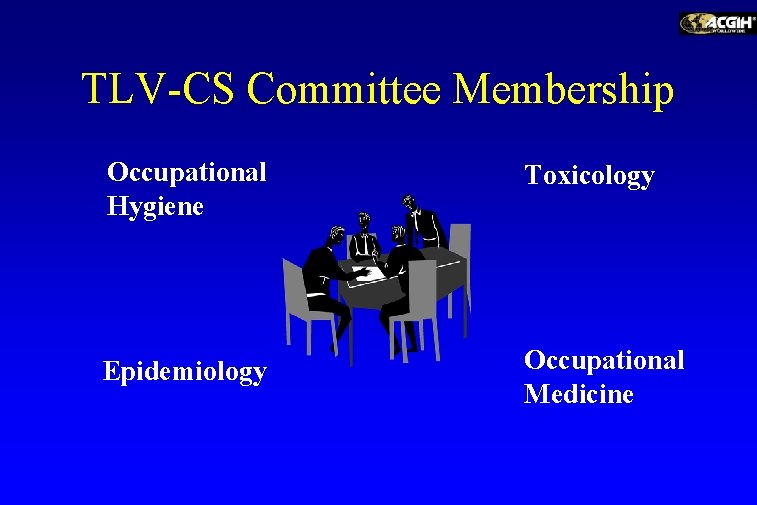
TLV-CS Committee Membership Occupational Hygiene Toxicology Epidemiology Occupational Medicine
TLV-CS Committee Structure
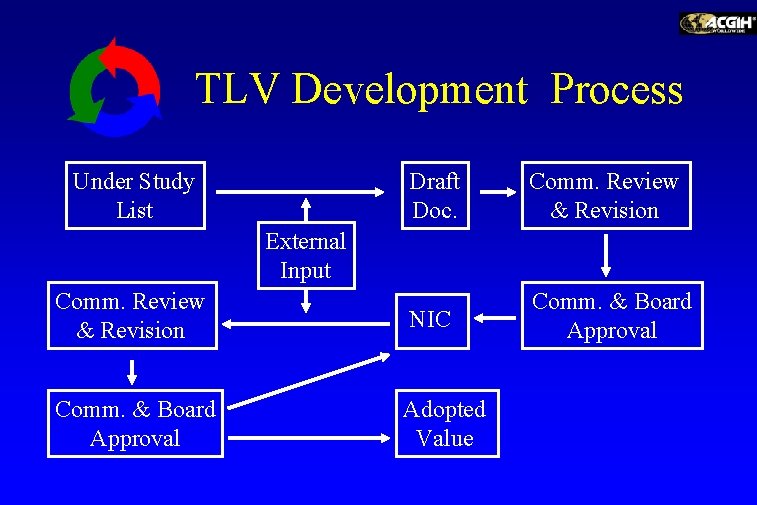
TLV Development Process Under Study List Draft Doc. Comm. Review & Revision NIC Comm. & Board Approval Adopted Value External Input
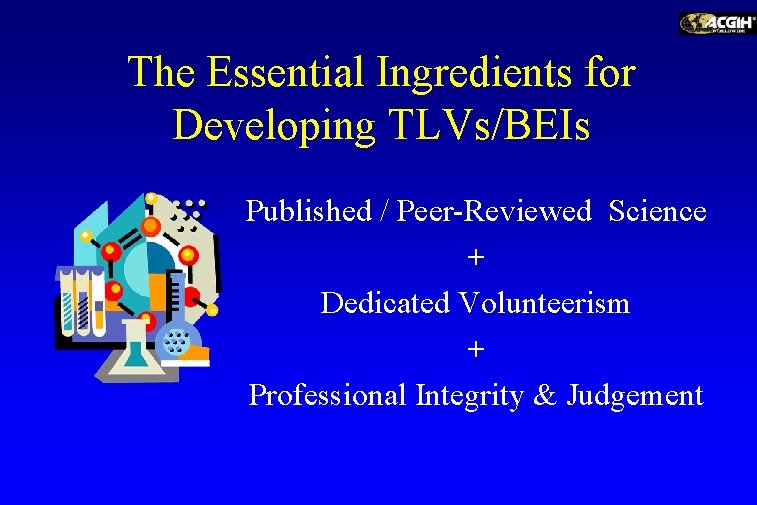
The Essential Ingredients for Developing TLVs/BEIs Published / Peer-Reviewed Science + Dedicated Volunteerism + Professional Integrity & Judgement
Legal Challenges of 2001 In December 2000, ACGIH was named as a defendant in 3 separate lawsuits - • The “Staples” Case -- Carlin David Staples, et. al. vs. DOW Chemical Company, et. al. – ACGIH one of many defendants. Plaintiffs allege conspiracy to withhold information on hazards of vinyl chloride exposure. – Case has been resolved. There are no longer any claims against ACGIH.
Legal Challenges of 2001 • The “RCFC” Case -- Refractory Ceramic Fibers Coalition, et. al. vs. ACGIH – Adoption of TLV for refractory ceramic fibers (0. 2 fibers/cc, TWA) – Settled July, 2001 • The “Trona” Case -- Anchor Glass Container Corp. , et. al. vs. ACGIH, U. S. DOL, and U. S. DHHS – Proposed TLV for Trona (sodium sesquicarbonate) – Settled September, 2001
Legal Issues • Free Speech (First Amendment) – ACGIH’s Right to Publish • Federal Advisory Committee Act – ACGIH is a Private Professional Society and not a Quasi. Governmental Organization • Deceptive Trade Practice & Product Defamation – Economic harm • Due Process – TLVs/BEIs are not developed using a consensus process – Perceived promises & conflicts
Impacts of the Lawsuits ACGIH • Financial – Insurance coverage – Indirect and opportunity costs • Volunteer Service • Misinformation and Misperceptions – Lobby efforts to “reform” ACGIH
Legal Settlements • Complete resolution of issues between the parties. • Some aspects may be confidential. • No court judgments awarding monetary damages; All parties paid their own legal expenses. • Public statements. • No precedent setting value.
Lessons • TLVs provide vitally important benchmarks for occupational exposure assessment. • The status of TLVs as guidelines - not standards - is not understood. • The “ 3 C’s” of the TLV development process.
OMMUNICATION • Clearly established procedures for internal and external communications. • Publicly available information sources on the TLV process and how/when interested parties can have input.
ONFIDENTIALITY • Preliminary drafts and discussions should stay within the Committee. • The TLV and Documentation are products of ACGIH and the Committee. The identity of individual authors should be protected.
ONFLICT OF INTEREST • Conflicts can be actual or perceived. • Conflicts can range from minor to significant. • Committee members must declare all potential conflicts to their peers. • Actions to protect the process and prevent conflicts must be consistently applied.
Where Do We Go From Here? • TLV/BEI Operation Manuals. – Internal organization and procedures. • AIHce Forums on TLV/BEI issues. • TLV/BEI section on the ACGIH website, e. g. : – NIC and Substances Under Study Lists. – Procedures and timeframes for communications. • Statement of Position.
Where Do We Go From Here? • Specific guidelines on conflict of interest – Augments current policy – Addresses relationships involving the Private sector, Government (regulatory), and Academia • Retreat on long-range issues – Resource needs – Explore the possible role for external peer review & scientific advisory panels
A Sunrise or Sunset? • Out-dated OSHA PELs. • Professional society role in developing practice guidelines. • Promises & pitfalls of the consensus process. • Will future be driven by tort and product liability? • Our role in protecting worker health.