
ACF 101 102 Introductory Financial Accounting Introductory Financial

- Slides: 34
ACF 101 -102 Introductory Financial Accounting Introductory Financial Statement Analysis LECTURE 6
Learning Outcome Understand the basics underlying financial accounting and financial statements Prepare basic financial statements for profit -making and non-profit making organisations by analysing, explaining and interpreting information.
Topics Demonstrate understanding and knowledge of basic accounting statements in relation to; Profit and Loss Accounts, Balance Sheets, Cash Flow Reports , trading accounts Financial Ratios
Adjustments to the Accounts Explicit transactions are ◦ Observable events that trigger nearly all day-to-day routine entries ◦ Supported by source documents Implicit transactions ◦ Do not generate source documents or any visible evidence that the event actually occurred ◦ Are recorded in end-of-period entries called adjustments
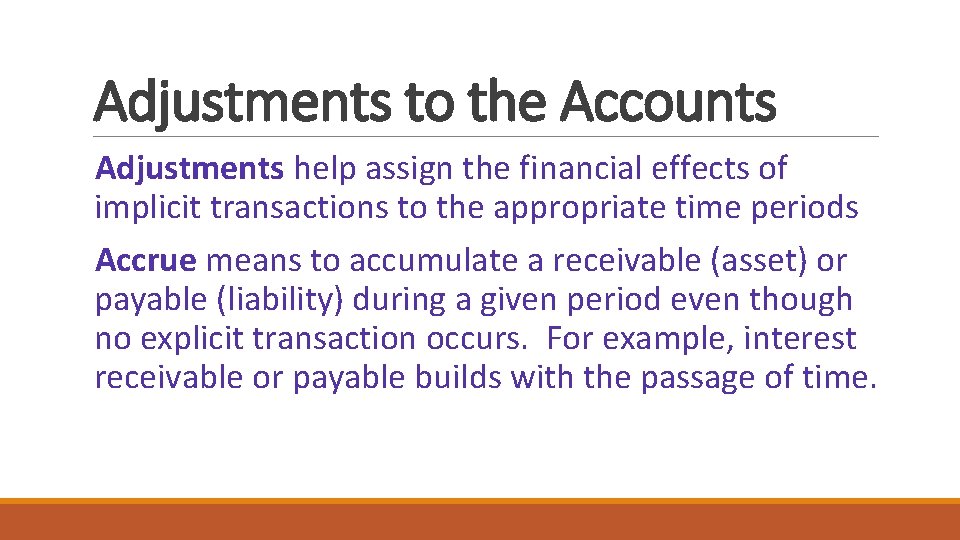
Adjustments to the Accounts Adjustments help assign the financial effects of implicit transactions to the appropriate time periods Accrue means to accumulate a receivable (asset) or payable (liability) during a given period even though no explicit transaction occurs. For example, interest receivable or payable builds with the passage of time.
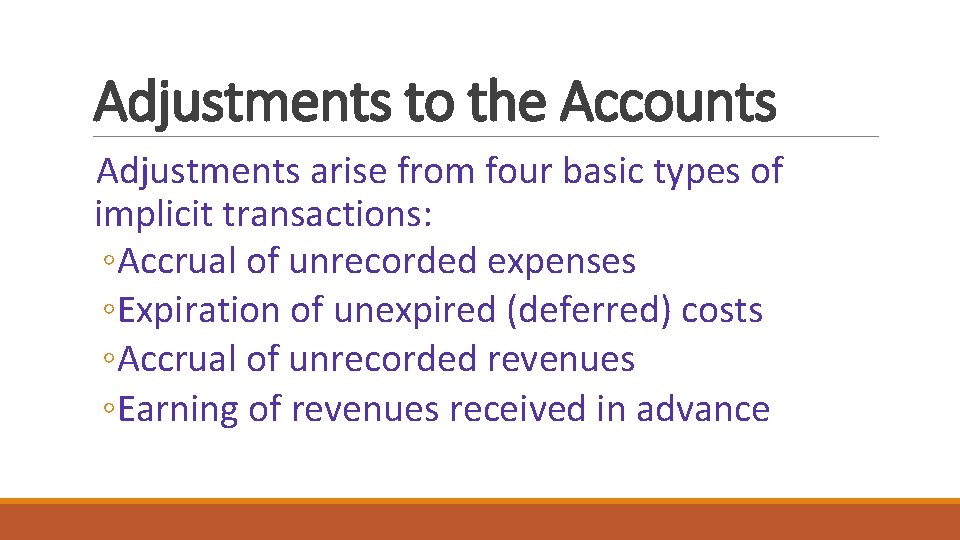
Adjustments to the Accounts Adjustments arise from four basic types of implicit transactions: ◦Accrual of unrecorded expenses ◦Expiration of unexpired (deferred) costs ◦Accrual of unrecorded revenues ◦Earning of revenues received in advance
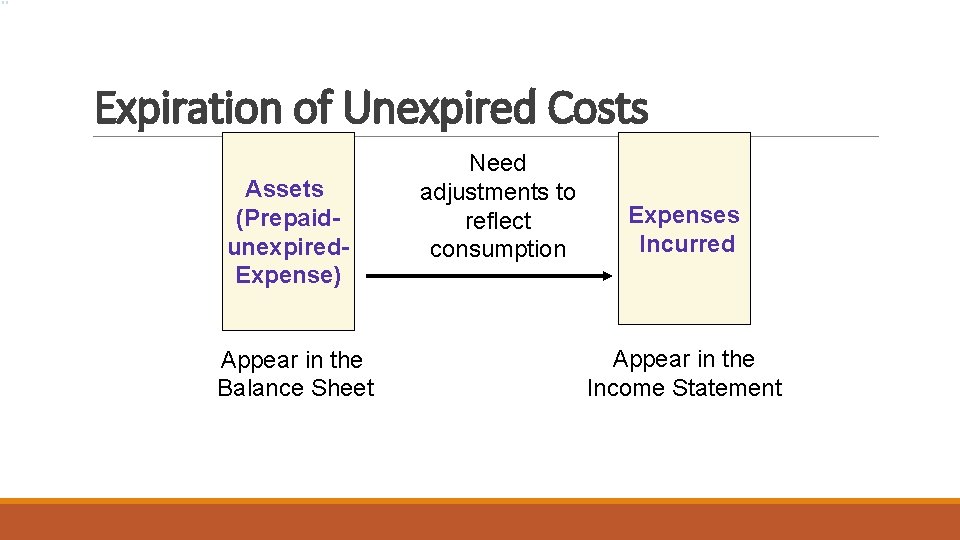
Expiration of Unexpired Costs Assets (Prepaidunexpired. Expense) Appear in the Balance Sheet Need adjustments to reflect consumption Expenses Incurred Appear in the Income Statement
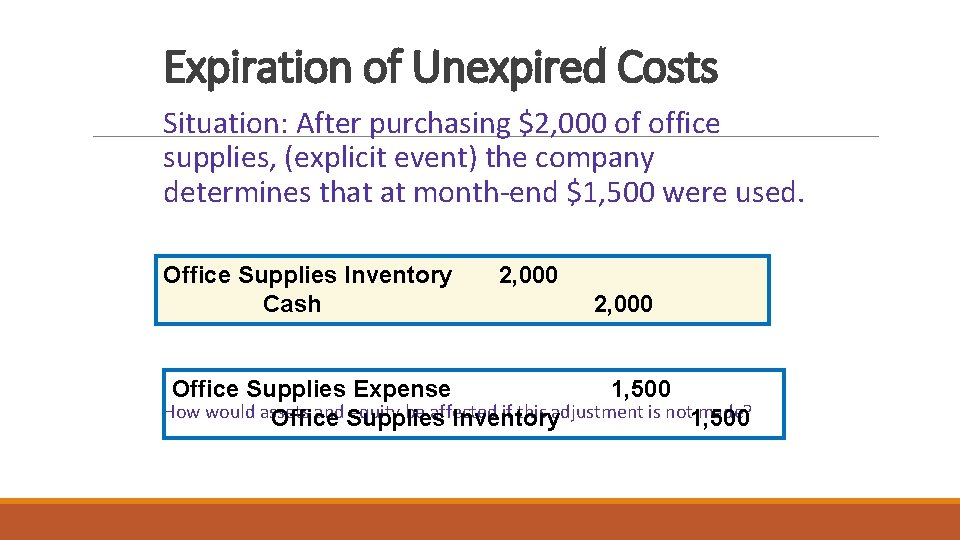
Expiration of Unexpired Costs Situation: After purchasing $2, 000 of office supplies, (explicit event) the company determines that at month-end $1, 500 were used. Office Supplies Inventory Adjustment required: Cash 2, 000 Office Supplies Expense 1, 500 How would assets and Supplies equity be affected if this adjustment is not 1, 500 made? Office Inventory
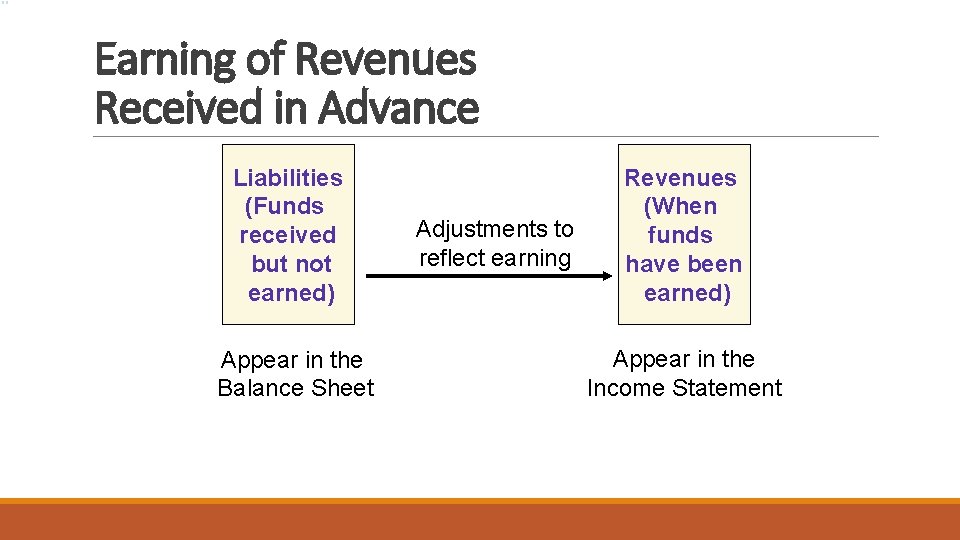
Earning of Revenues Received in Advance Liabilities (Funds received but not earned) Appear in the Balance Sheet Adjustments to reflect earning Revenues (When funds have been earned) Appear in the Income Statement
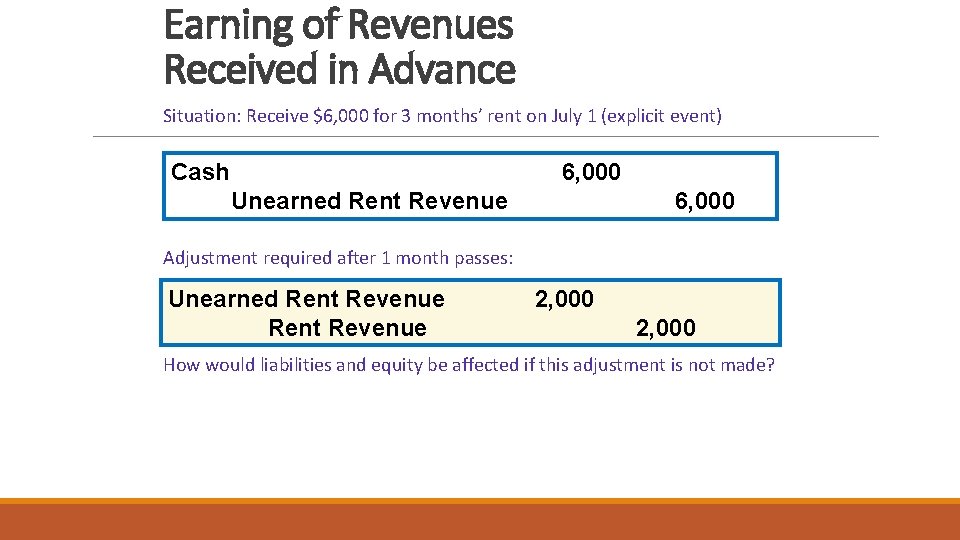
Earning of Revenues Received in Advance Situation: Receive $6, 000 for 3 months’ rent on July 1 (explicit event) Cash 6, 000 Unearned Rent Revenue 6, 000 Adjustment required after 1 month passes: Unearned Rent Revenue 2, 000 How would liabilities and equity be affected if this adjustment is not made?
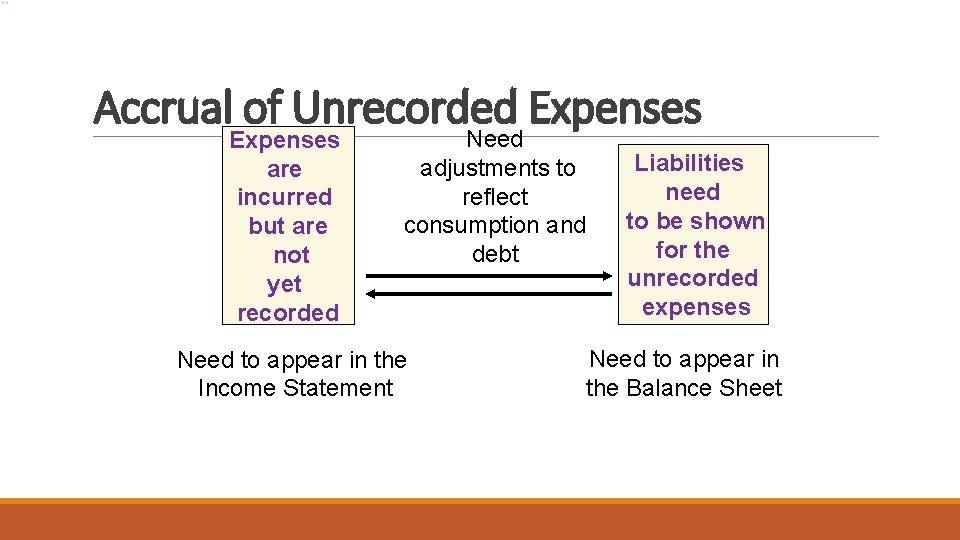
Accrual of Unrecorded Expenses are incurred but are not yet recorded Need adjustments to reflect consumption and debt Need to appear in the Income Statement Liabilities need to be shown for the unrecorded expenses Need to appear in the Balance Sheet
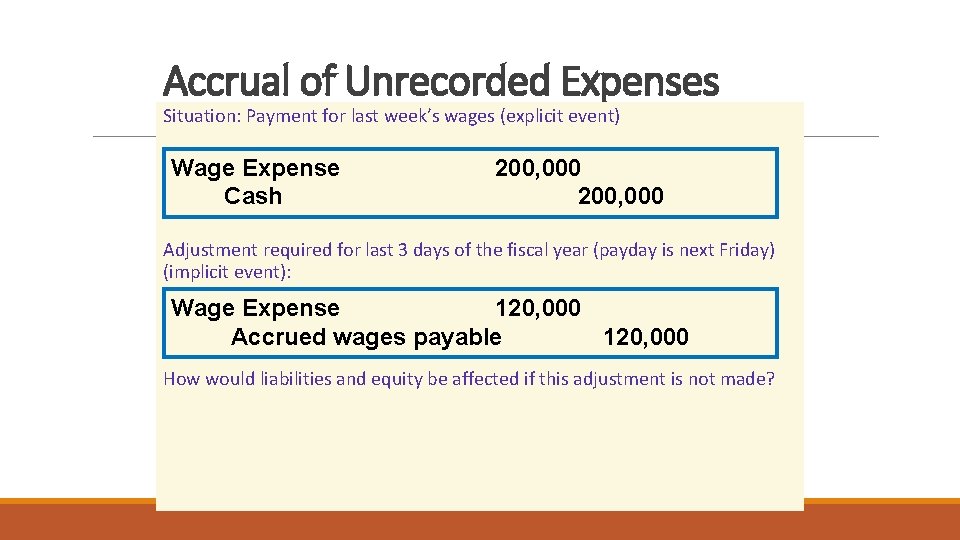
Accrual of Unrecorded Expenses Situation: Payment for last week’s wages (explicit event) Wage Expense Cash 200, 000 Adjustment required for last 3 days of the fiscal year (payday is next Friday) (implicit event): Wage Expense 120, 000 Accrued wages payable 120, 000 How would liabilities and equity be affected if this adjustment is not made?
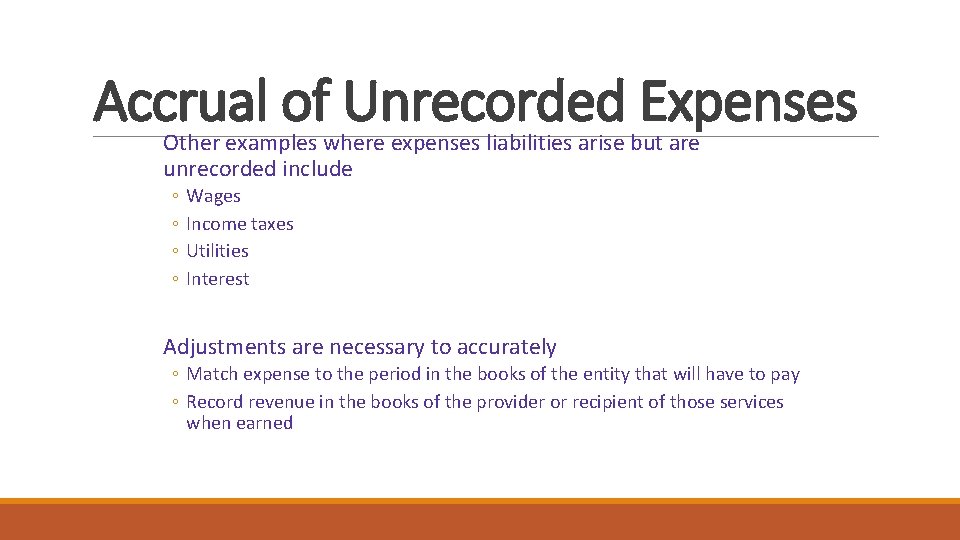
Accrual of Unrecorded Expenses Other examples where expenses liabilities arise but are unrecorded include ◦ ◦ Wages Income taxes Utilities Interest Adjustments are necessary to accurately ◦ Match expense to the period in the books of the entity that will have to pay ◦ Record revenue in the books of the provider or recipient of those services when earned
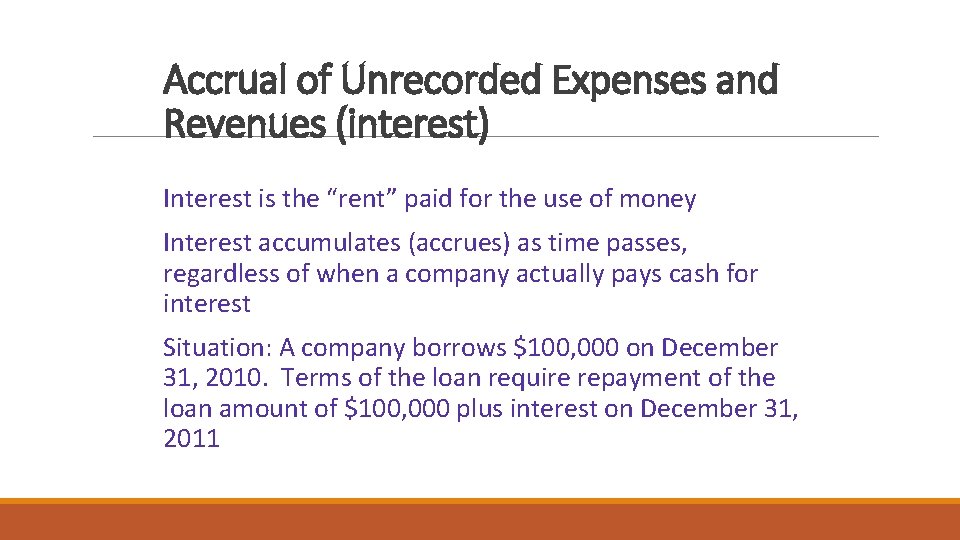
Accrual of Unrecorded Expenses and Revenues (interest) Interest is the “rent” paid for the use of money Interest accumulates (accrues) as time passes, regardless of when a company actually pays cash for interest Situation: A company borrows $100, 000 on December 31, 2010. Terms of the loan require repayment of the loan amount of $100, 000 plus interest on December 31, 2011
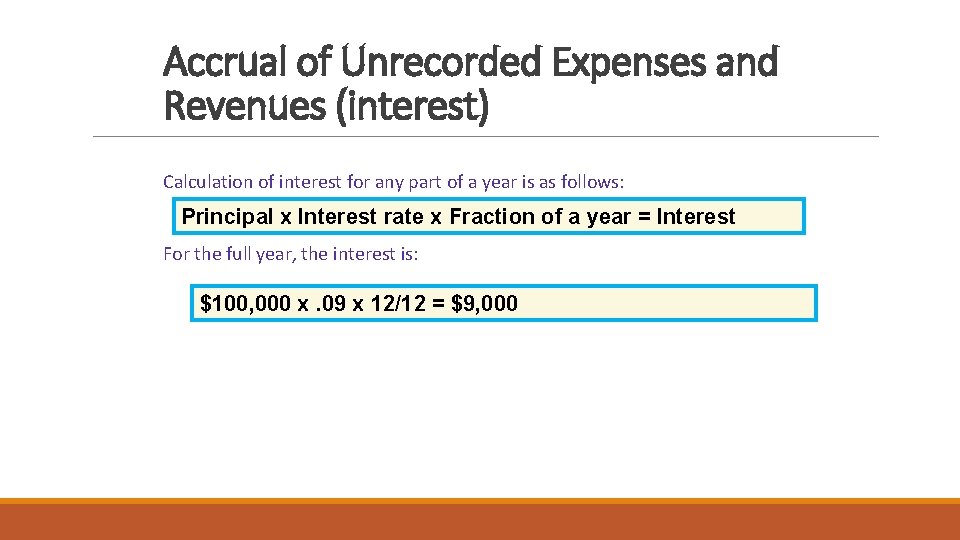
Accrual of Unrecorded Expenses and Revenues (interest) Calculation of interest for any part of a year is as follows: Principal x Interest rate x Fraction of a year = Interest For the full year, the interest is: $100, 000 x. 09 x 12/12 = $9, 000
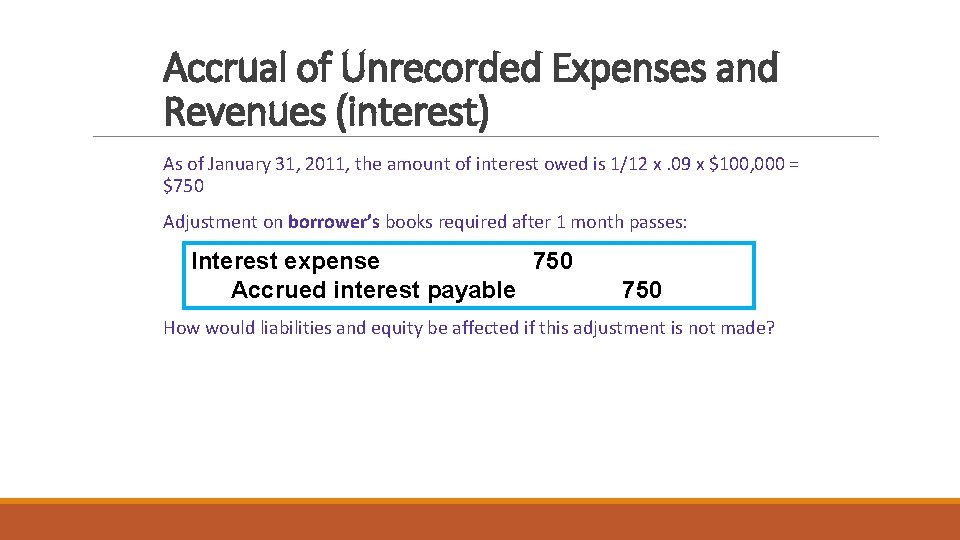
Accrual of Unrecorded Expenses and Revenues (interest) As of January 31, 2011, the amount of interest owed is 1/12 x. 09 x $100, 000 = $750 Adjustment on borrower’s books required after 1 month passes: Interest expense 750 Accrued interest payable 750 How would liabilities and equity be affected if this adjustment is not made?
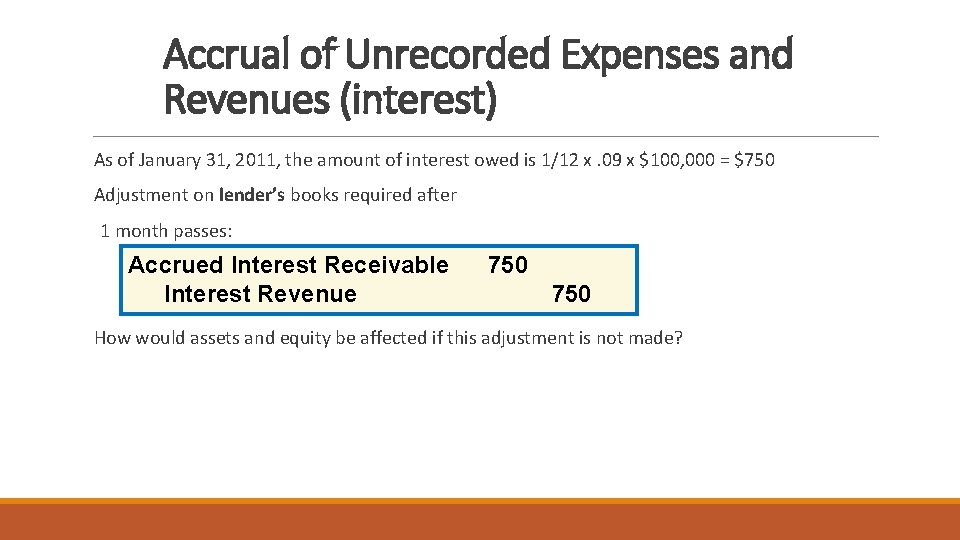
Accrual of Unrecorded Expenses and Revenues (interest) As of January 31, 2011, the amount of interest owed is 1/12 x. 09 x $100, 000 = $750 Adjustment on lender’s books required after 1 month passes: Accrued Interest Receivable Interest Revenue 750 How would assets and equity be affected if this adjustment is not made?
One of the keys to recognizing expenses in the accounts is the cost recovery concept. Under cost recovery, some purchases of goods or services are recorded as assets because the costs are expected to be recovered in the form of cash inflows (or reduced cash outflows) in future periods—for example, long-lived or fixed assets.
Account for cash dividends and prepare a statement of stockholders’ equity….
Retained earnings increase as profits accumulate and decrease as cash dividends are paid out to stockholders and when a net loss occurs.
Cash dividends are distributions of assets that reduce a portion of the ownership claim. Cash dividends are not expenses, and, therefore, not deductible.
The amount of cash dividends is declared by the board of directors of a company on the declaration date, is payable to those stockholders on record as owning stock on a second date (record date), and is actually paid on a third date (payment date).
Retained earnings and cash are two separate accounts. Cash is needed to pay the declared dividend.
The statement of stockholders’ equity shows all changes during the year in each stockholders’ equity account.
Changes in stockholders’ equity arise from three main sources:
A period’s net income (or net loss) increases (decreases) the balance of the retained earnings portion of stockholders’ equity.
Transactions with shareholders such as the payment of dividends and purchase or sale of shares of stock affect the contributed capital portion of stockholders’ equity.
Other comprehensive income are specific changes in stockholders’ equity that do not result from net income or transactions with shareholders.
FINANCIAL RATIOS Calculated results mean nothing unless ◦ Same accounting principals are used ◦ Totals are reported similarly ◦ There are other numbers to make comparisons (budget, historical, competitors) Comparisons mean nothing unless other data ◦ Has underlying comparable quality ◦ Covers comparable periods ◦ Uses the same formulas
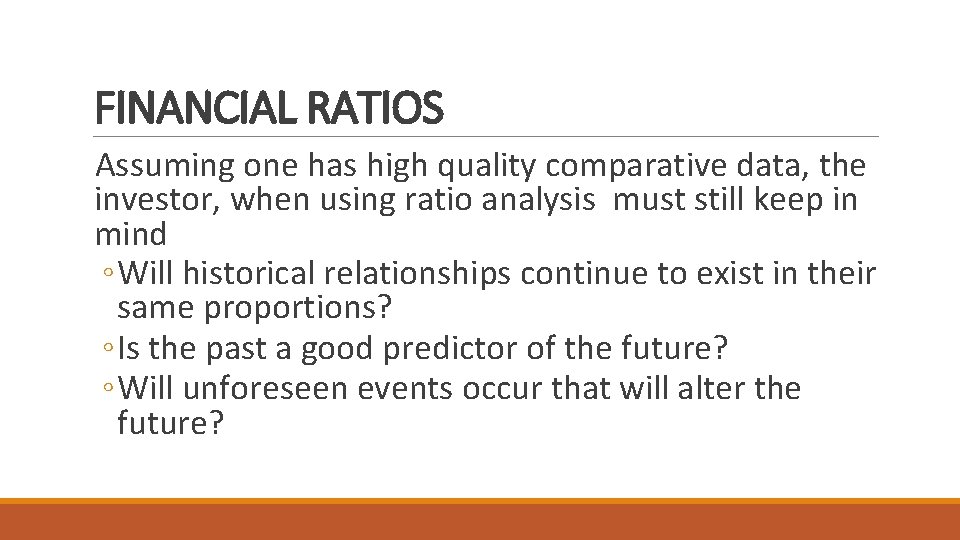
FINANCIAL RATIOS Assuming one has high quality comparative data, the investor, when using ratio analysis must still keep in mind ◦ Will historical relationships continue to exist in their same proportions? ◦ Is the past a good predictor of the future? ◦ Will unforeseen events occur that will alter the future?
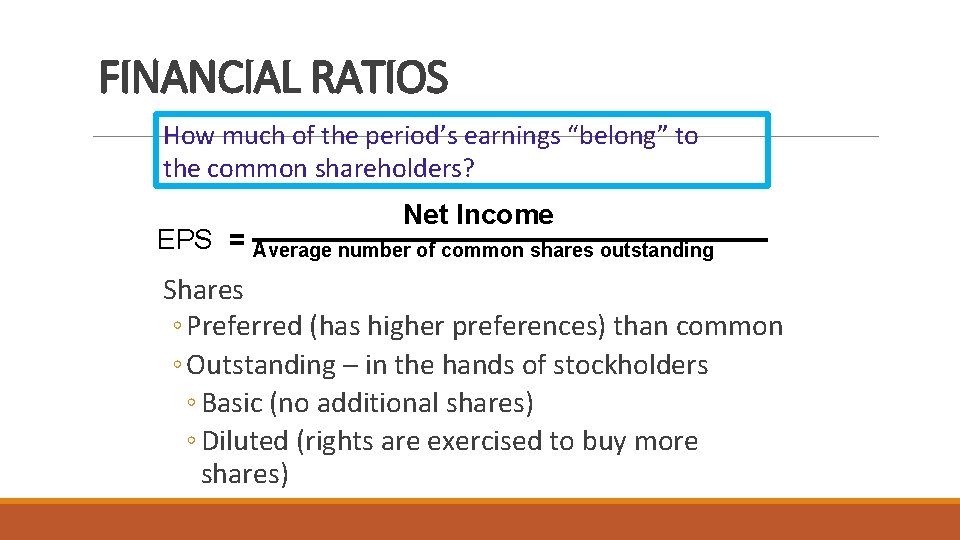
FINANCIAL RATIOS How much of the period’s earnings “belong” to the common shareholders? Net Income EPS = Average number of common shares outstanding Shares ◦ Preferred (has higher preferences) than common ◦ Outstanding – in the hands of stockholders ◦ Basic (no additional shares) ◦ Diluted (rights are exercised to buy more shares)
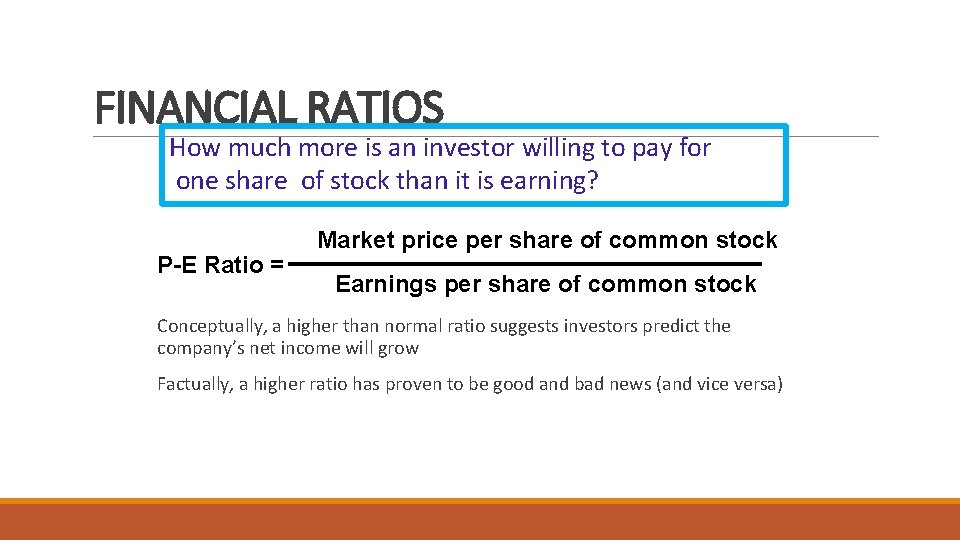
FINANCIAL RATIOS How much more is an investor willing to pay for one share of stock than it is earning? P-E Ratio = Market price per share of common stock Earnings per share of common stock Conceptually, a higher than normal ratio suggests investors predict the company’s net income will grow Factually, a higher ratio has proven to be good and bad news (and vice versa)
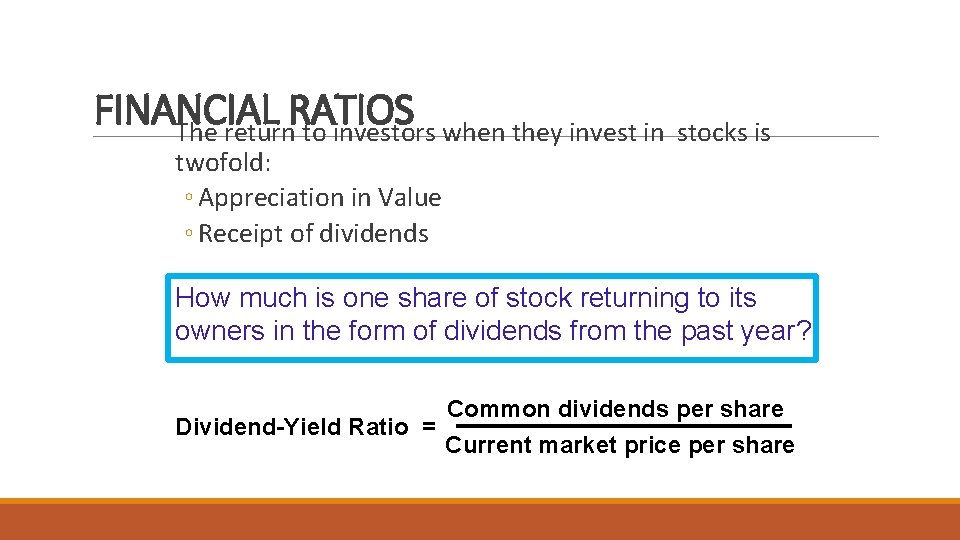
FINANCIAL RATIOS The return to investors when they invest in stocks is twofold: ◦ Appreciation in Value ◦ Receipt of dividends How much is one share of stock returning to its owners in the form of dividends from the past year? Common dividends per share Dividend-Yield Ratio = Current market price per share
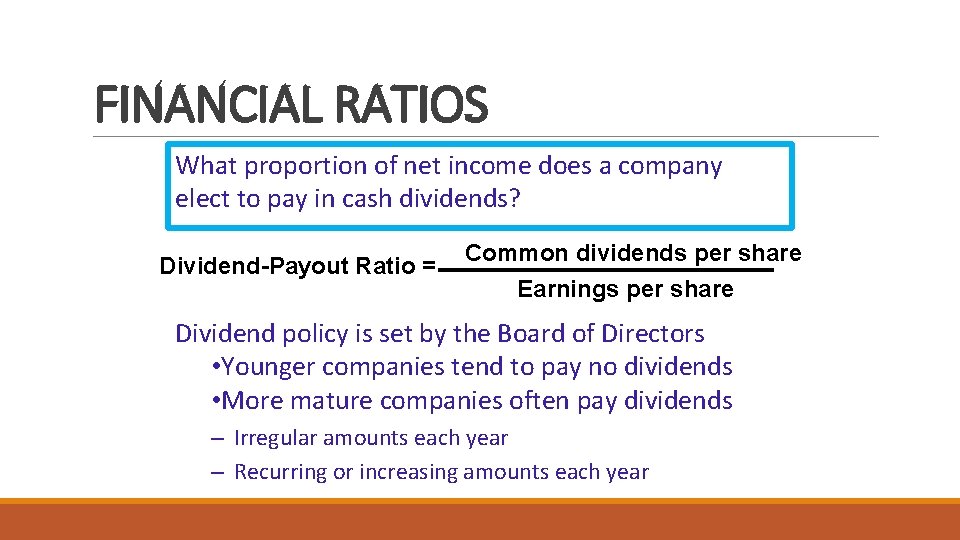
FINANCIAL RATIOS What proportion of net income does a company elect to pay in cash dividends? Dividend-Payout Ratio = Common dividends per share Earnings per share Dividend policy is set by the Board of Directors • Younger companies tend to pay no dividends • More mature companies often pay dividends – Irregular amounts each year – Recurring or increasing amounts each year