
ACF 101 102 Introductory Financial Accounting Introductory Financial
- Slides: 42
ACF 101 -102 Introductory Financial Accounting Introductory Financial Statement Analysis LECTURE 13
Learning Outcome Understand the accounting concepts and conventions present in accepted accounting principles and their application in financial statements analysis.
Topics Current liabilities Long-term liabilities Leases
Liabilities in Perspective
Liabilities are one entity’s obligations to pay cash or to provide goods and services to other entities (e. g. , wages due to employees, payables to suppliers, taxes to government, etc. ). These obligations arise from transactions with an outside party or sometimes they may arise from the imposition of taxes or the loss of a lawsuit
Current liabilities are obligations that fall due within the coming year or within the normal operating cycle if longer than a year.
Long-term liabilities are obligations that fall due more than 1 year beyond the balance sheet date. Some longterm liabilities are paid gradually, in monthly or yearly installments.
Account for current liabilities
Some liabilities are recorded automatically as a result of a transaction with an outside entity. Other liabilities are recorded with an adjusting journal entry to acknowledge an obligation arising over time (e. g. , interest, wages).
Accounts payable (trade accounts payable) are obligations resulting from purchasing goods and services on credit and are owed to suppliers. Internal control systems generally require managers to make all payments by check.
Good systems also require source documents to support all checks. First, there must be a purchase order, which specifies the quantities and prices of items ordered.
Second is the receiving report, which indicates that the company received shipment of everything ordered. Then, accountants match the purchase order and receiving report to the invoice, a bill from the seller.
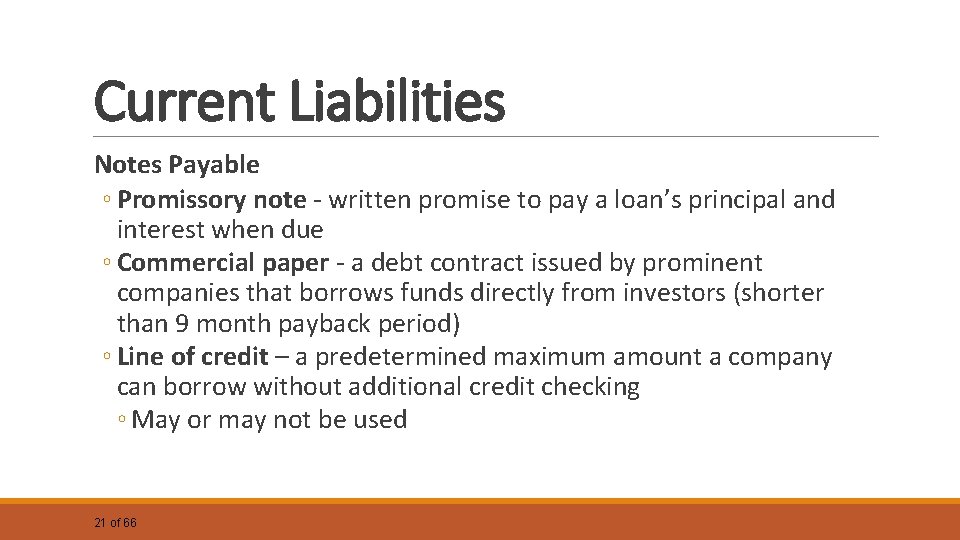
Obligations represented by a promissory note given by the borrower to the creditor are called notes payable. A promissory note is a written promise to repay principal plus interest at a specific date.
Commercial paper is a debt contract issued by prominent companies that borrow directly from investors. Notes payable often result from lines of credit, which are agreements with a bank to automatically provide short-term loans up to some preestablished maximum without significant checking or other time-consuming procedures.
Expenses that have been incurred and recognized on the income statement but not yet paid are accrued liabilities. Employee-related liabilities account for a large part of most companies’ accrued liabilities.
Payroll taxes are amounts paid to the government for items such as the employer’s portion of Social Security, federal and state unemployment taxes, and workers’ compensation taxes. Fringe benefits include employee pensions, life and health insurance, and vacation pay
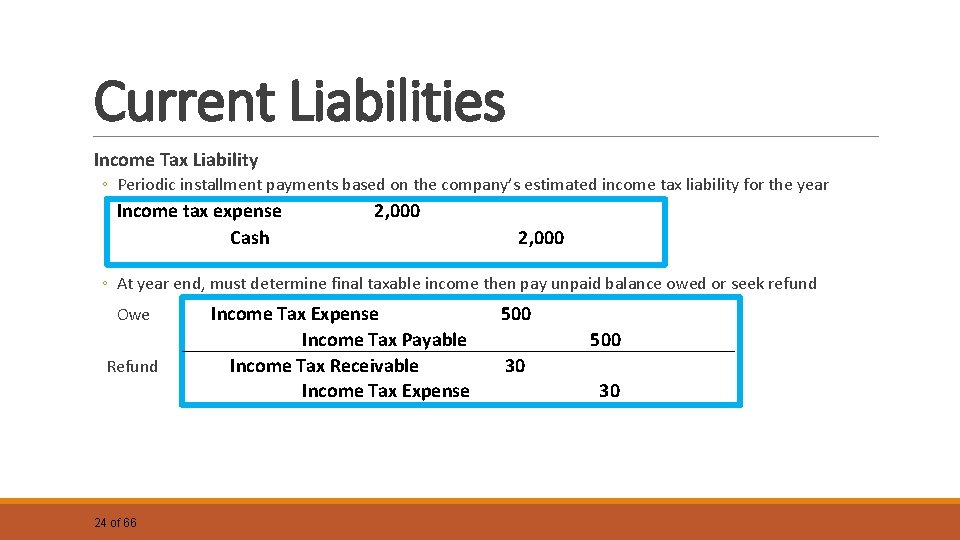
A corporation must pay income taxes as a percentage of its earnings. Corporations make periodic installment payments based on their estimated tax for the year. Therefore, the accrued liability for income taxes (income taxes payable) at the year end is generally much smaller than the annual income tax expense.
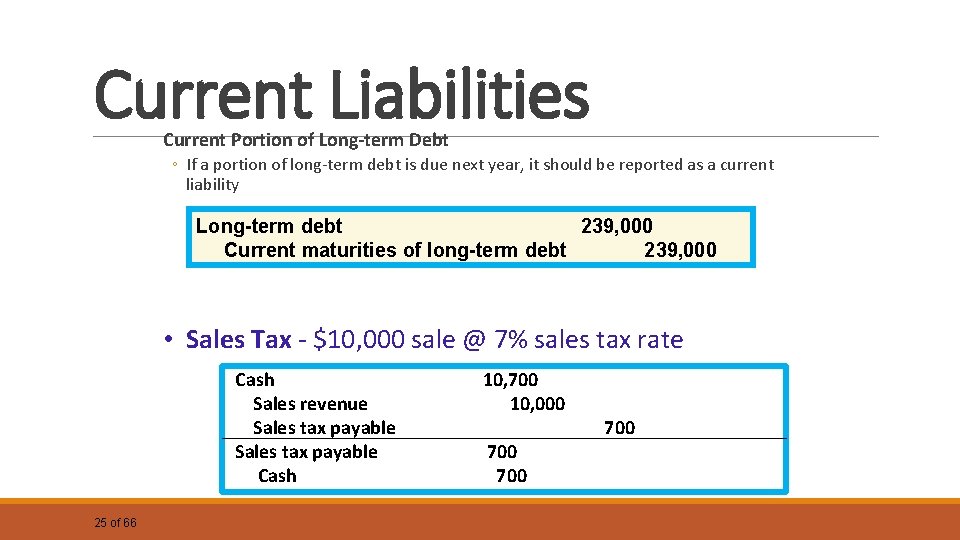
A company’s long-term debt often includes some payments due within a year (current portion of long-term debt) that should be reclassified as current liabilities.
Current Liabilities = current obligations to pay cash or to provide goods and services in the future as a result of past transactions or events ◦ Long-term liabilities are those that fall due more than 1 year beyond the balance sheet date ◦ Reclassify portion due next year as a current liability ◦ Current liabilities are obligations that fall due within 1 year or the normal operating cycle, if longer ◦ Use many specific ledger accounts in the records ◦ Combined into “accrued liabilities” when reported ◦ “Accrue” – to build up over time 19 of 66
Current Liabilities Accounts payable ◦ Buying goods/services from suppliers on credit ◦ Large outflow of money justifies comprehensive documentation and strong internal controls over the entire process ◦ Purchase order - specifies the quantities and prices of items ordered ◦ Receiving report - indicates that the company received the goods ◦ Invoice - the bill from the seller ◦ The above are matched and authorization to pay should precede disbursement of cash 20 of 66
Current Liabilities Notes Payable ◦ Promissory note - written promise to pay a loan’s principal and interest when due ◦ Commercial paper - a debt contract issued by prominent companies that borrows funds directly from investors (shorter than 9 month payback period) ◦ Line of credit – a predetermined maximum amount a company can borrow without additional credit checking ◦ May or may not be used 21 of 66
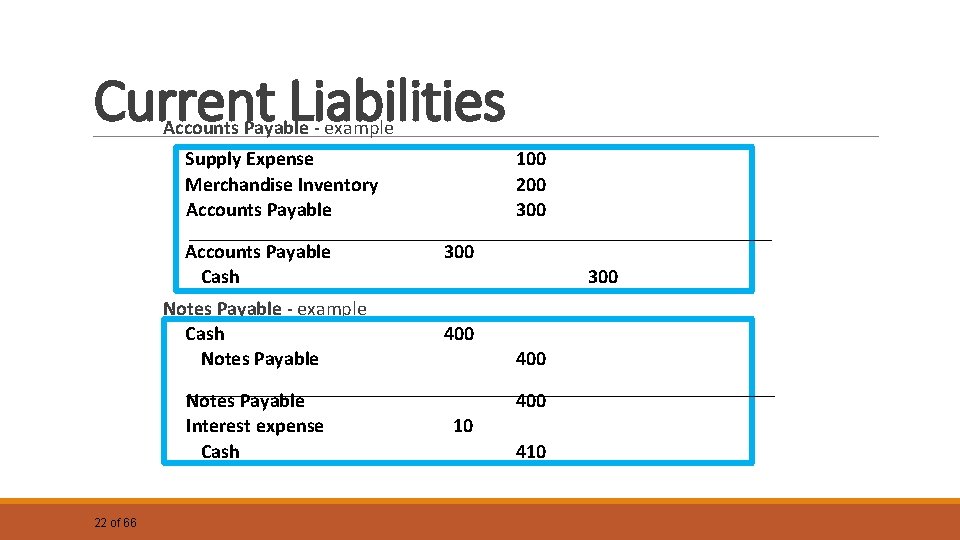
Current Liabilities Accounts Payable - example Supply Expense Merchandise Inventory Accounts Payable Cash Notes Payable - example Cash Notes Payable Interest expense Cash 22 of 66 100 200 300 300 400 400 10 410
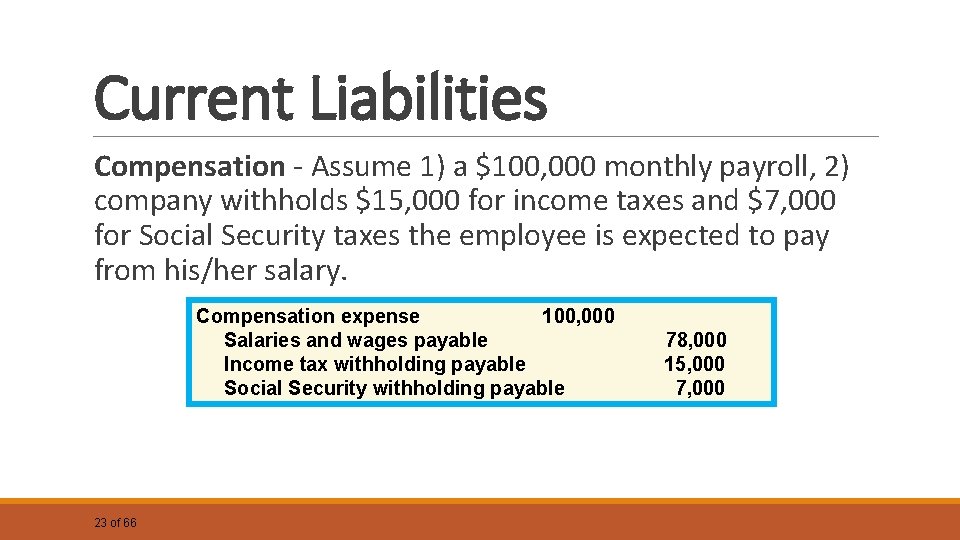
Current Liabilities Compensation - Assume 1) a $100, 000 monthly payroll, 2) company withholds $15, 000 for income taxes and $7, 000 for Social Security taxes the employee is expected to pay from his/her salary. Compensation expense 100, 000 Salaries and wages payable Income tax withholding payable Social Security withholding payable 23 of 66 78, 000 15, 000 7, 000
Current Liabilities Income Tax Liability ◦ Periodic installment payments based on the company’s estimated income tax liability for the year Income tax expense Cash 2, 000 ◦ At year end, must determine final taxable income then pay unpaid balance owed or seek refund Owe Refund 24 of 66 Income Tax Expense Income Tax Payable Income Tax Receivable Income Tax Expense 500 30 30
Current Liabilities Current Portion of Long-term Debt ◦ If a portion of long-term debt is due next year, it should be reported as a current liability Long-term debt 239, 000 Current maturities of long-term debt 239, 000 • Sales Tax - $10, 000 sale @ 7% sales tax rate Cash Sales revenue Sales tax payable Cash 25 of 66 10, 700 10, 000 700 700
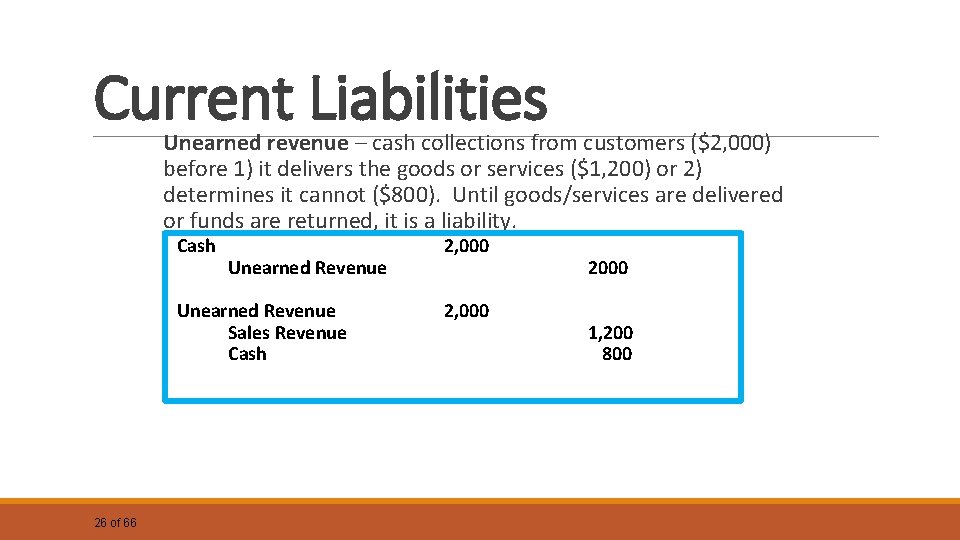
Current Liabilities Unearned revenue – cash collections from customers ($2, 000) before 1) it delivers the goods or services ($1, 200) or 2) determines it cannot ($800). Until goods/services are delivered or funds are returned, it is a liability. Cash Unearned Revenue Sales Revenue Cash 26 of 66 2, 000 2000 1, 200 800
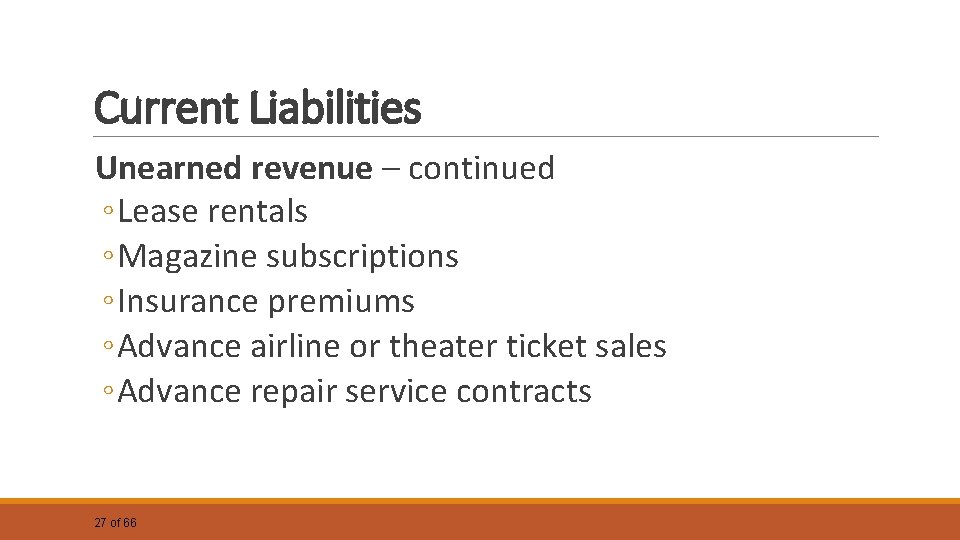
Current Liabilities Unearned revenue – continued ◦ Lease rentals ◦ Magazine subscriptions ◦ Insurance premiums ◦ Advance airline or theater ticket sales ◦ Advance repair service contracts 27 of 66
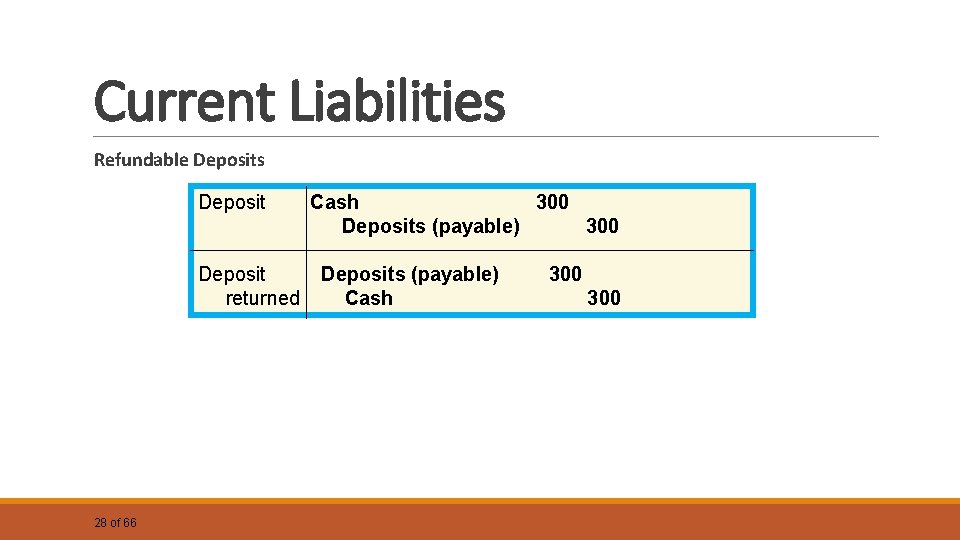
Current Liabilities Refundable Deposits Deposit returned 28 of 66 Cash 300 Deposits (payable) Cash 300
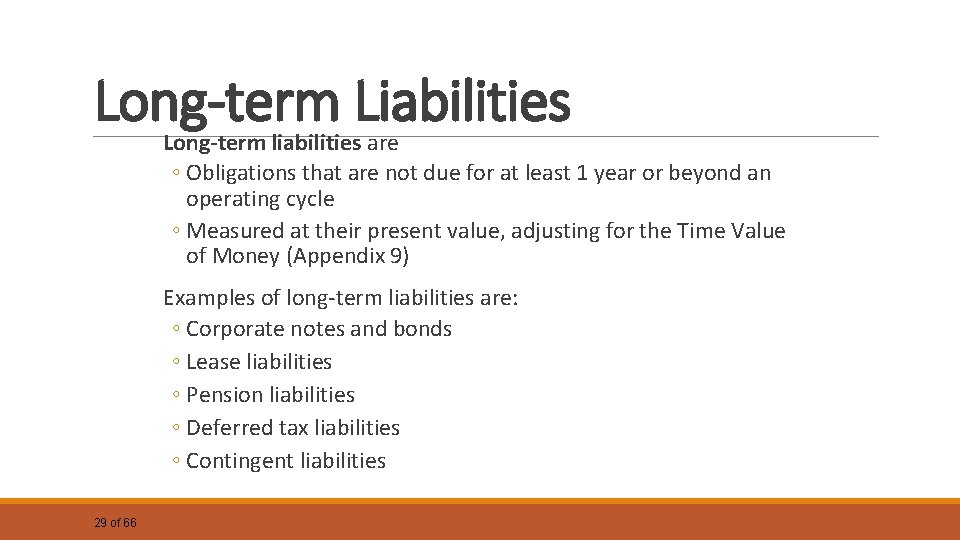
Long-term Liabilities Long-term liabilities are ◦ Obligations that are not due for at least 1 year or beyond an operating cycle ◦ Measured at their present value, adjusting for the Time Value of Money (Appendix 9) Examples of long-term liabilities are: ◦ Corporate notes and bonds ◦ Lease liabilities ◦ Pension liabilities ◦ Deferred tax liabilities ◦ Contingent liabilities 29 of 66
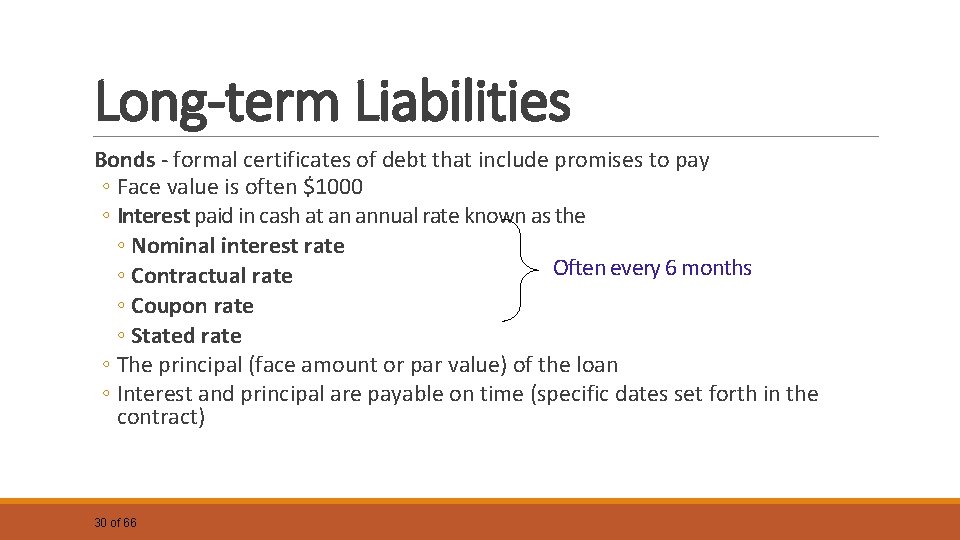
Long-term Liabilities Bonds - formal certificates of debt that include promises to pay ◦ Face value is often $1000 ◦ Interest paid in cash at an annual rate known as the ◦ Nominal interest rate Often every 6 months ◦ Contractual rate ◦ Coupon rate ◦ Stated rate ◦ The principal (face amount or par value) of the loan ◦ Interest and principal are payable on time (specific dates set forth in the contract) 30 of 66
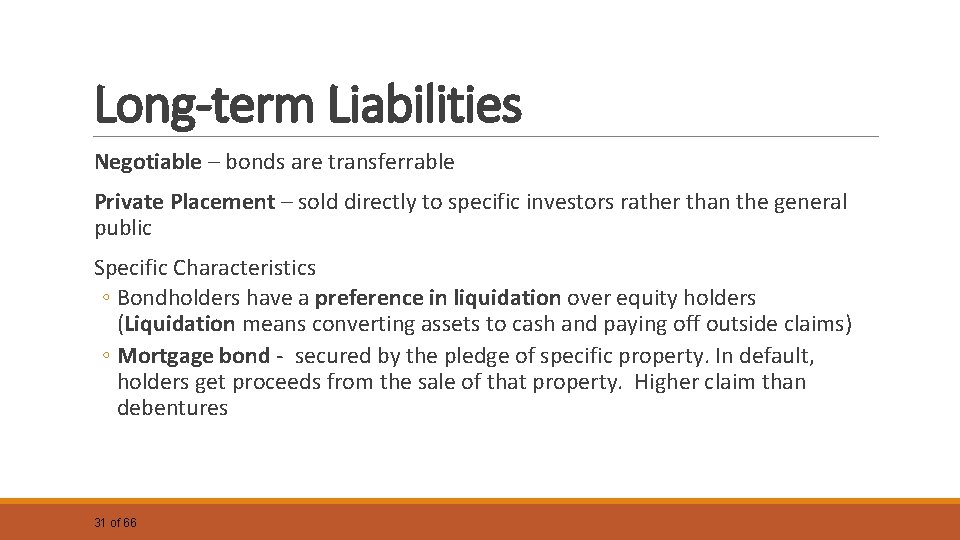
Long-term Liabilities Negotiable – bonds are transferrable Private Placement – sold directly to specific investors rather than the general public Specific Characteristics ◦ Bondholders have a preference in liquidation over equity holders (Liquidation means converting assets to cash and paying off outside claims) ◦ Mortgage bond - secured by the pledge of specific property. In default, holders get proceeds from the sale of that property. Higher claim than debentures 31 of 66
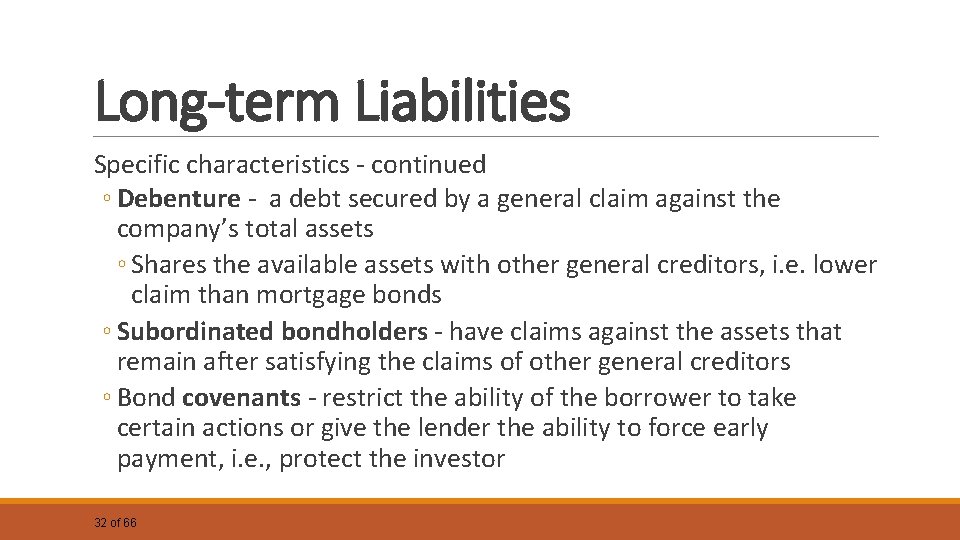
Long-term Liabilities Specific characteristics - continued ◦ Debenture - a debt secured by a general claim against the company’s total assets ◦ Shares the available assets with other general creditors, i. e. lower claim than mortgage bonds ◦ Subordinated bondholders - have claims against the assets that remain after satisfying the claims of other general creditors ◦ Bond covenants - restrict the ability of the borrower to take certain actions or give the lender the ability to force early payment, i. e. , protect the investor 32 of 66
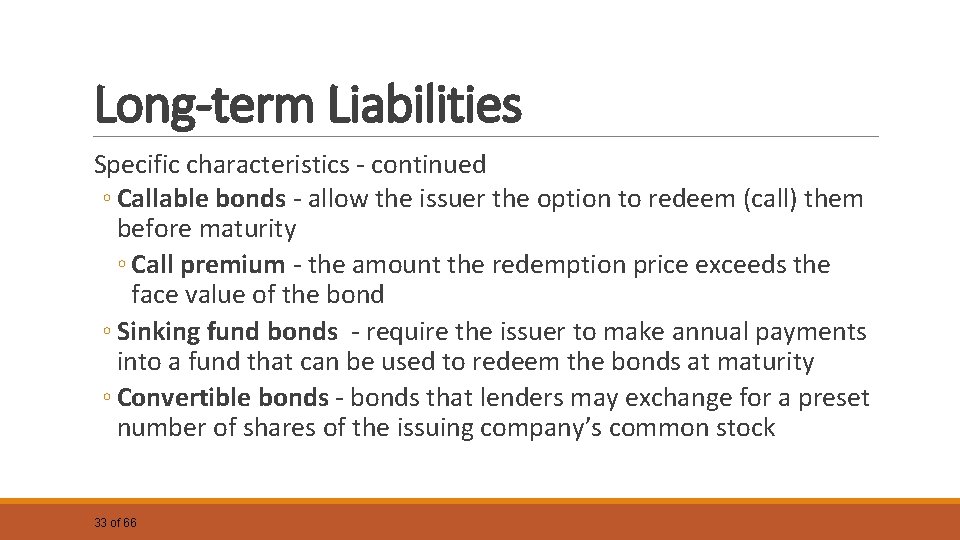
Long-term Liabilities Specific characteristics - continued ◦ Callable bonds - allow the issuer the option to redeem (call) them before maturity ◦ Call premium - the amount the redemption price exceeds the face value of the bond ◦ Sinking fund bonds - require the issuer to make annual payments into a fund that can be used to redeem the bonds at maturity ◦ Convertible bonds - bonds that lenders may exchange for a preset number of shares of the issuing company’s common stock 33 of 66
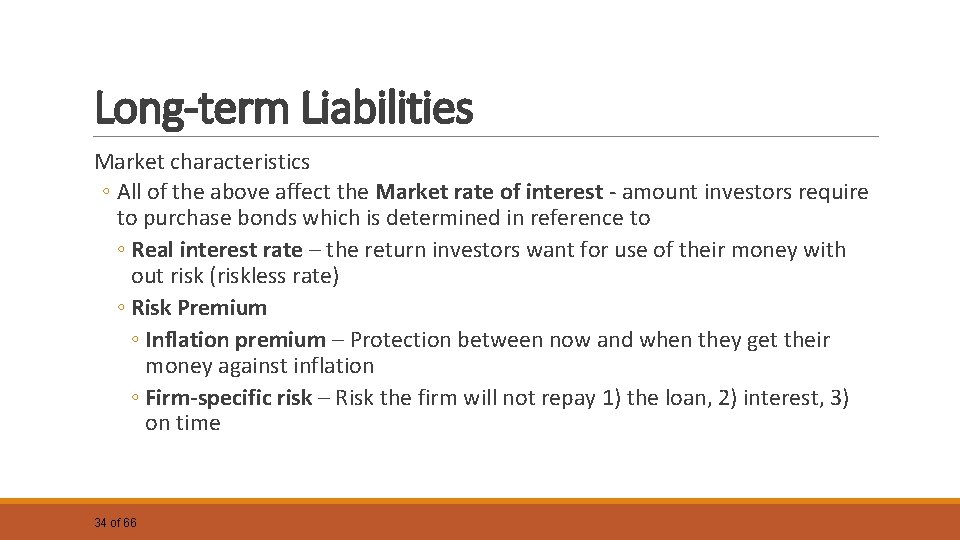
Long-term Liabilities Market characteristics ◦ All of the above affect the Market rate of interest - amount investors require to purchase bonds which is determined in reference to ◦ Real interest rate – the return investors want for use of their money with out risk (riskless rate) ◦ Risk Premium ◦ Inflation premium – Protection between now and when they get their money against inflation ◦ Firm-specific risk – Risk the firm will not repay 1) the loan, 2) interest, 3) on time 34 of 66
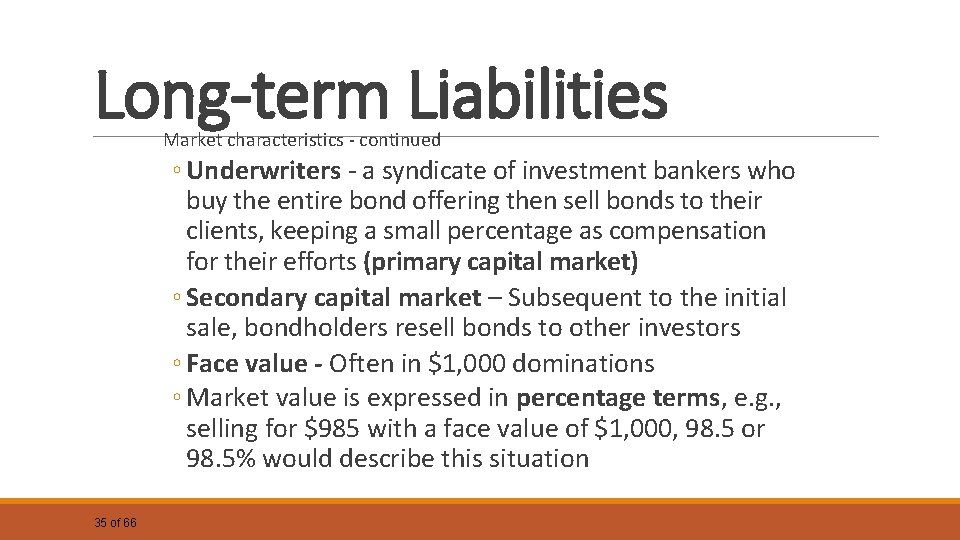
Long-term Liabilities Market characteristics - continued ◦ Underwriters - a syndicate of investment bankers who buy the entire bond offering then sell bonds to their clients, keeping a small percentage as compensation for their efforts (primary capital market) ◦ Secondary capital market – Subsequent to the initial sale, bondholders resell bonds to other investors ◦ Face value - Often in $1, 000 dominations ◦ Market value is expressed in percentage terms, e. g. , selling for $985 with a face value of $1, 000, 98. 5 or 98. 5% would describe this situation 35 of 66
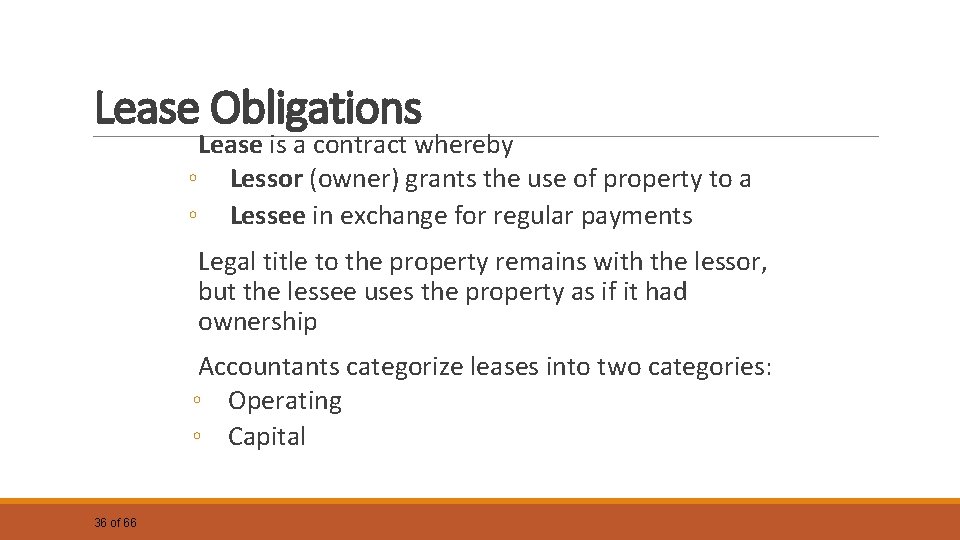
Lease Obligations Lease is a contract whereby ◦ Lessor (owner) grants the use of property to a ◦ Lessee in exchange for regular payments Legal title to the property remains with the lessor, but the lessee uses the property as if it had ownership Accountants categorize leases into two categories: ◦ Operating ◦ Capital 36 of 66
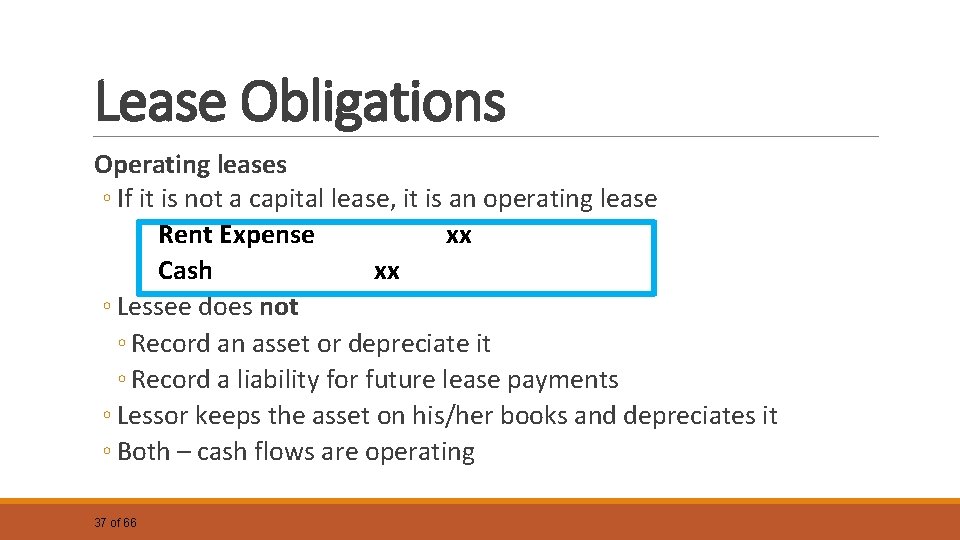
Lease Obligations Operating leases ◦ If it is not a capital lease, it is an operating lease Rent Expense xx Cash xx ◦ Lessee does not ◦ Record an asset or depreciate it ◦ Record a liability for future lease payments ◦ Lessor keeps the asset on his/her books and depreciates it ◦ Both – cash flows are operating 37 of 66
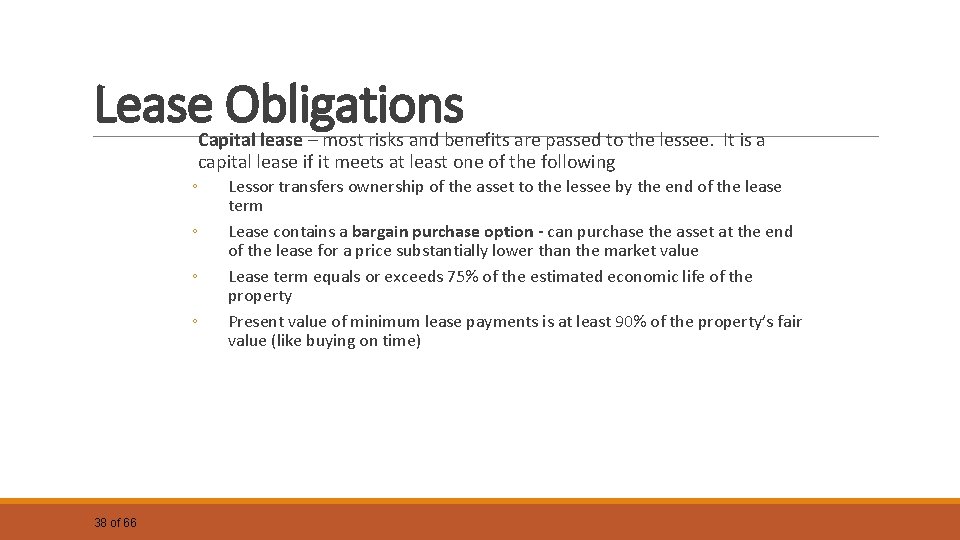
Lease Obligations Capital lease – most risks and benefits are passed to the lessee. It is a capital lease if it meets at least one of the following ◦ ◦ 38 of 66 Lessor transfers ownership of the asset to the lessee by the end of the lease term Lease contains a bargain purchase option - can purchase the asset at the end of the lease for a price substantially lower than the market value Lease term equals or exceeds 75% of the estimated economic life of the property Present value of minimum lease payments is at least 90% of the property’s fair value (like buying on time)
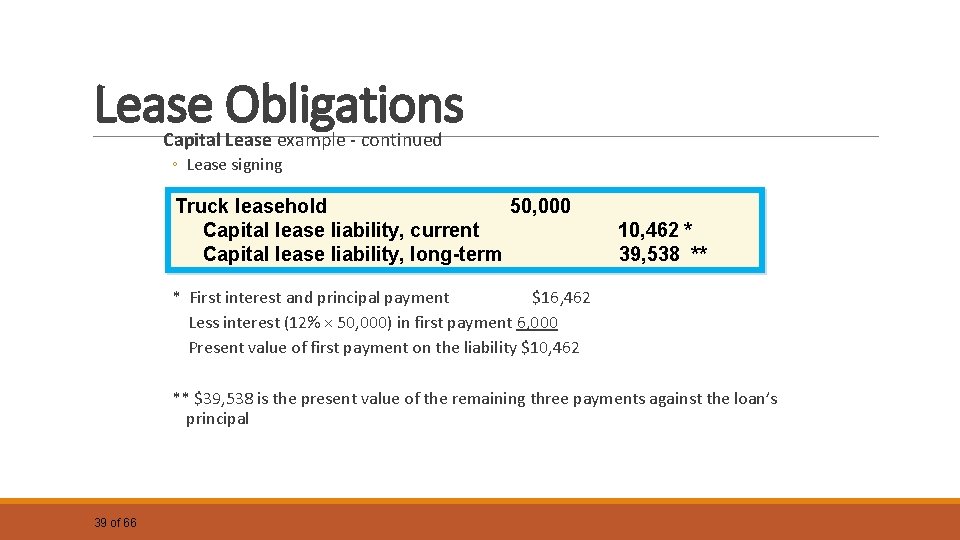
Lease Obligations Capital Lease example - continued ◦ Lease signing Truck leasehold 50, 000 Capital lease liability, current Capital lease liability, long-term 10, 462 * 39, 538 ** * First interest and principal payment $16, 462 Less interest (12% × 50, 000) in first payment 6, 000 Present value of first payment on the liability $10, 462 ** $39, 538 is the present value of the remaining three payments against the loan’s principal 39 of 66
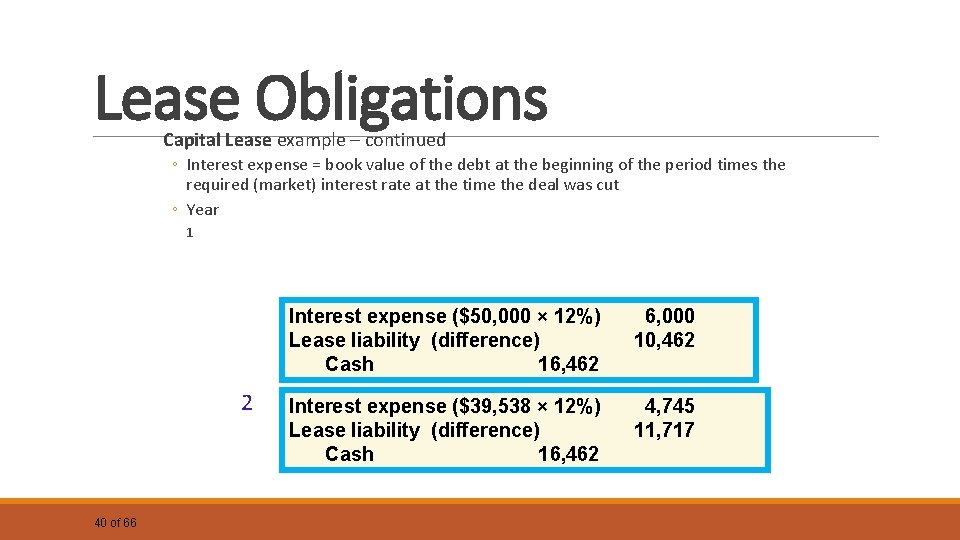
Lease Obligations Capital Lease example – continued ◦ Interest expense = book value of the debt at the beginning of the period times the required (market) interest rate at the time the deal was cut ◦ Year 1 2 40 of 66 Interest expense ($50, 000 × 12%) Lease liability (difference) Cash 16, 462 6, 000 10, 462 Interest expense ($39, 538 × 12%) Lease liability (difference) Cash 16, 462 4, 745 11, 717
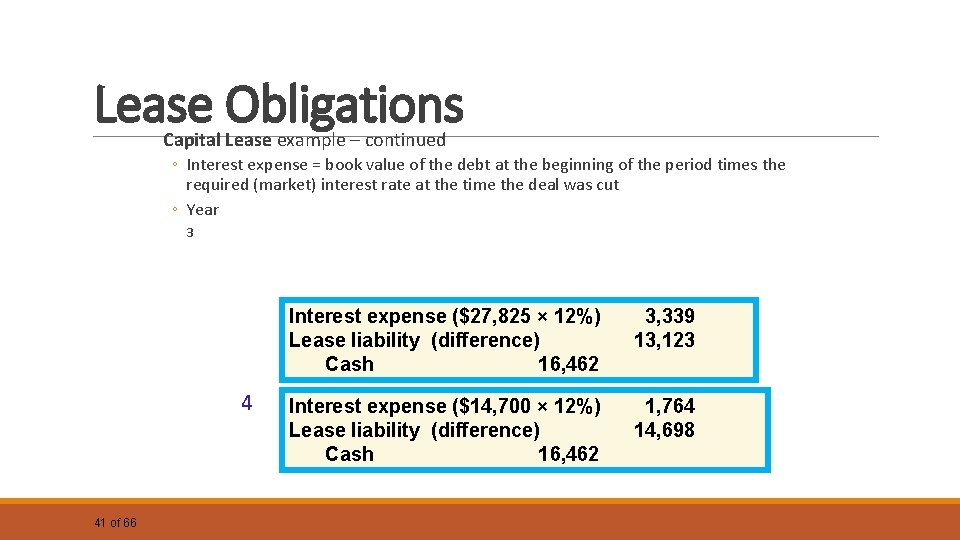
Lease Obligations Capital Lease example – continued ◦ Interest expense = book value of the debt at the beginning of the period times the required (market) interest rate at the time the deal was cut ◦ Year 3 4 41 of 66 Interest expense ($27, 825 × 12%) Lease liability (difference) Cash 16, 462 3, 339 13, 123 Interest expense ($14, 700 × 12%) Lease liability (difference) Cash 16, 462 1, 764 14, 698
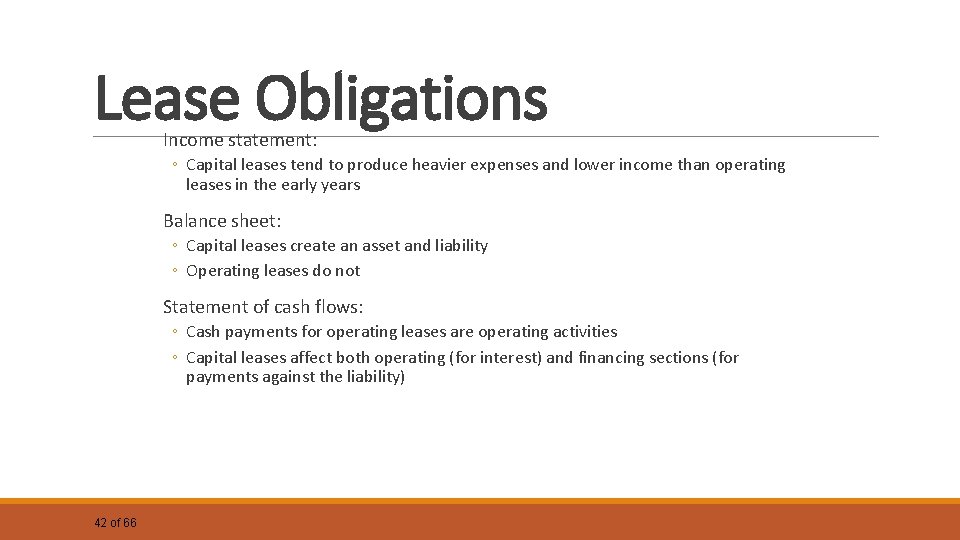
Lease Obligations Income statement: ◦ Capital leases tend to produce heavier expenses and lower income than operating leases in the early years Balance sheet: ◦ Capital leases create an asset and liability ◦ Operating leases do not Statement of cash flows: ◦ Cash payments for operating leases are operating activities ◦ Capital leases affect both operating (for interest) and financing sections (for payments against the liability) 42 of 66