
ACESloan Faculty Retirement Transitions Projects Jean M Mc
- Slides: 34
ACE|Sloan Faculty Retirement Transitions Projects Jean M. Mc. Laughlin American Council on Education Presentation to HERC NJ April 2, 2014
Agenda 1. Background on ACE/Sloan retirement projects & Faculty Retirement 101 quiz (5) How did we get to here? (20 -10) 2. • • 3. Overview of issues surrounding faculty retirement Faculty satisfaction and awareness of institutional programs and supports What are the Challenges & Some Solutions? (10 -15) • • 4. Legal Issues & burning questions Best practices in faculty retirement transitions The Challenges Ahead (5) • • 5. The challenge of working with academic affairs The challenge of being humane Concluding Thoughts (5 -5) • Why HERC should care 2
Background of the ACE|Sloan Faculty Retirement Projects • ACE, like HERC, is a presidential-member association, with approximately 1800 members. • ACE has been partnering with the Sloan Foundation to investigate faculty career flexibility since 2003; 5 awards programs; 3 invitational conferences; lots of presentations • New grants in 2009 & 2010 to investigate institutions which were becoming concerned about the pace of faculty retirements. • Activities (e. g. , literature review, site visits, interviews, focus groups, invitational conference) were designed to examine the perspectives from both faculty and administrators to learn on the campuses what these experiences are. 3
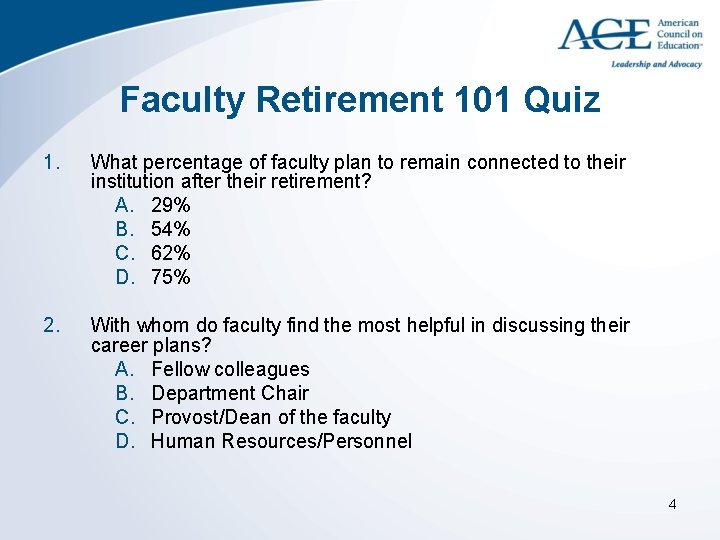
Faculty Retirement 101 Quiz 1. What percentage of faculty plan to remain connected to their institution after their retirement? A. 29% B. 54% C. 62% D. 75% 2. With whom do faculty find the most helpful in discussing their career plans? A. Fellow colleagues B. Department Chair C. Provost/Dean of the faculty D. Human Resources/Personnel 4
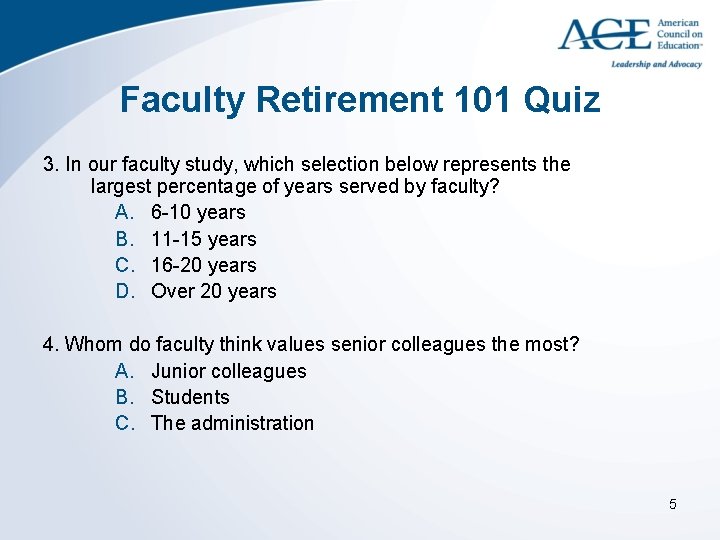
Faculty Retirement 101 Quiz 3. In our faculty study, which selection below represents the largest percentage of years served by faculty? A. 6 -10 years B. 11 -15 years C. 16 -20 years D. Over 20 years 4. Whom do faculty think values senior colleagues the most? A. Junior colleagues B. Students C. The administration 5
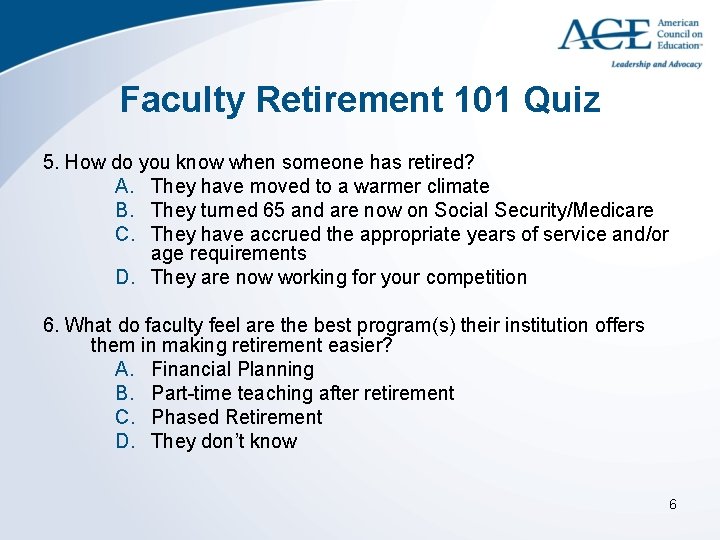
Faculty Retirement 101 Quiz 5. How do you know when someone has retired? A. They have moved to a warmer climate B. They turned 65 and are now on Social Security/Medicare C. They have accrued the appropriate years of service and/or age requirements D. They are now working for your competition 6. What do faculty feel are the best program(s) their institution offers them in making retirement easier? A. Financial Planning B. Part-time teaching after retirement C. Phased Retirement D. They don’t know 6
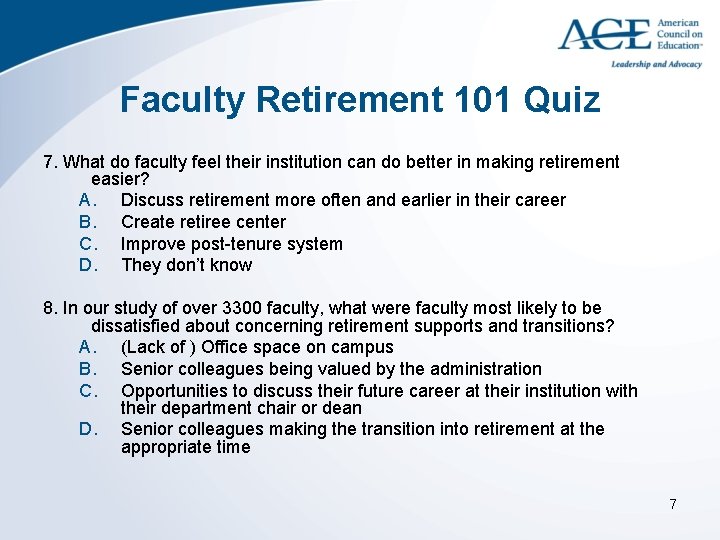
Faculty Retirement 101 Quiz 7. What do faculty feel their institution can do better in making retirement easier? A. Discuss retirement more often and earlier in their career B. Create retiree center C. Improve post-tenure system D. They don’t know 8. In our study of over 3300 faculty, what were faculty most likely to be dissatisfied about concerning retirement supports and transitions? A. (Lack of ) Office space on campus B. Senior colleagues being valued by the administration C. Opportunities to discuss their future career at their institution with their department chair or dean D. Senior colleagues making the transition into retirement at the appropriate time 7
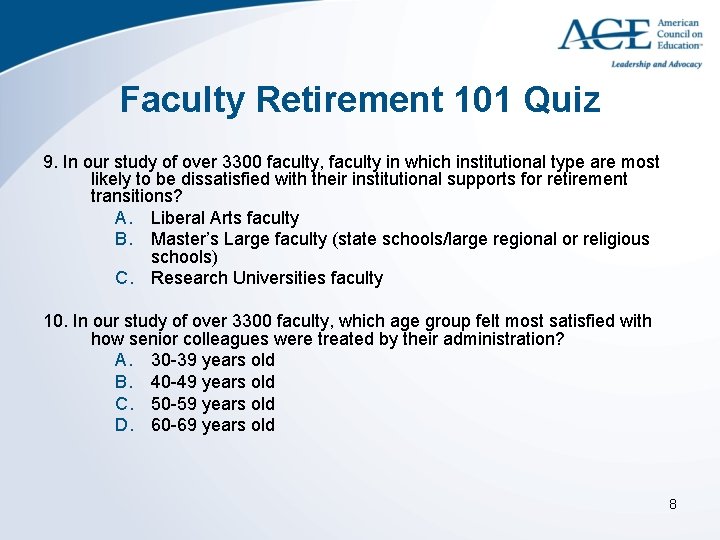
Faculty Retirement 101 Quiz 9. In our study of over 3300 faculty, faculty in which institutional type are most likely to be dissatisfied with their institutional supports for retirement transitions? A. Liberal Arts faculty B. Master’s Large faculty (state schools/large regional or religious schools) C. Research Universities faculty 10. In our study of over 3300 faculty, which age group felt most satisfied with how senior colleagues were treated by their administration? A. 30 -39 years old B. 40 -49 years old C. 50 -59 years old D. 60 -69 years old 8
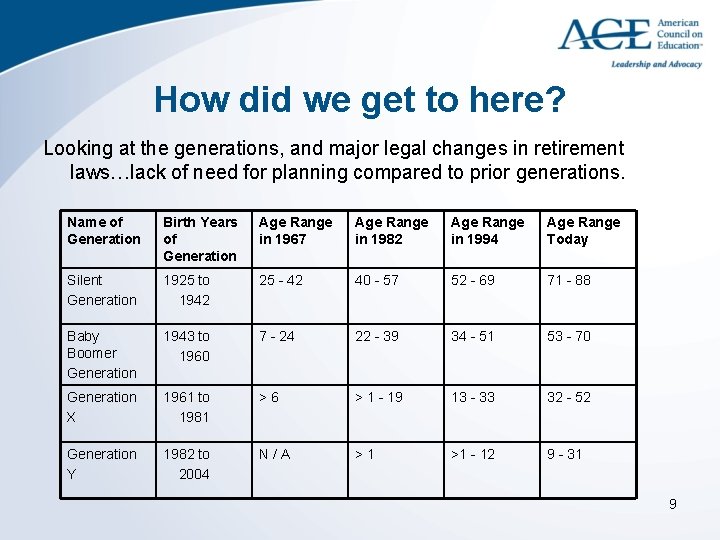
How did we get to here? Looking at the generations, and major legal changes in retirement laws…lack of need for planning compared to prior generations. Name of Generation Birth Years of Generation Age Range in 1967 Age Range in 1982 Age Range in 1994 Age Range Today Silent Generation 1925 to 1942 25 - 42 40 - 57 52 - 69 71 - 88 Baby Boomer Generation 1943 to 1960 7 - 24 22 - 39 34 - 51 53 - 70 Generation X 1961 to 1981 >6 > 1 - 19 13 - 33 32 - 52 Generation Y 1982 to 2004 N/A >1 >1 - 12 9 - 31 9
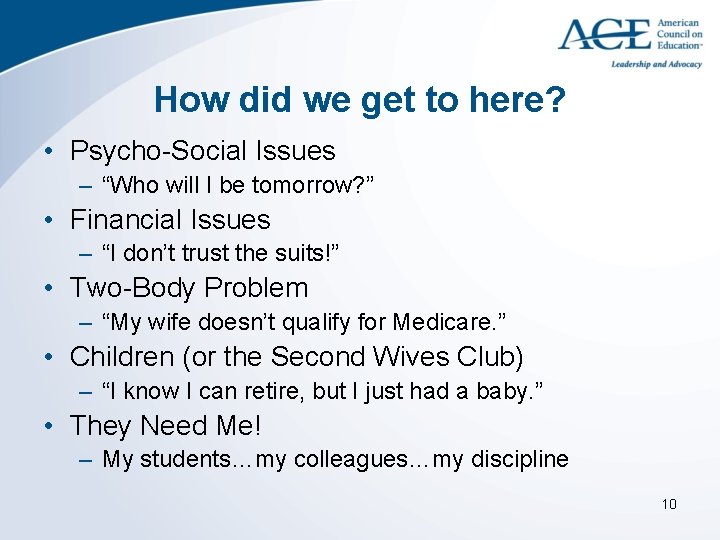
How did we get to here? • Psycho-Social Issues – “Who will I be tomorrow? ” • Financial Issues – “I don’t trust the suits!” • Two-Body Problem – “My wife doesn’t qualify for Medicare. ” • Children (or the Second Wives Club) – “I know I can retire, but I just had a baby. ” • They Need Me! – My students…my colleagues…my discipline 10
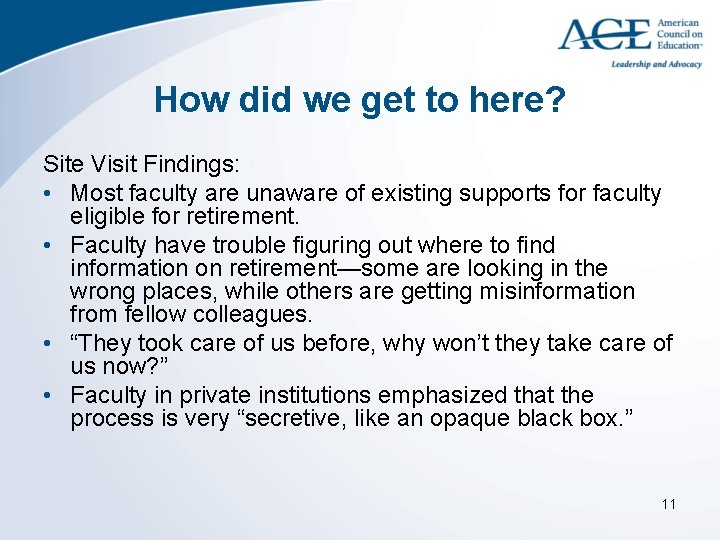
How did we get to here? Site Visit Findings: • Most faculty are unaware of existing supports for faculty eligible for retirement. • Faculty have trouble figuring out where to find information on retirement—some are looking in the wrong places, while others are getting misinformation from fellow colleagues. • “They took care of us before, why won’t they take care of us now? ” • Faculty in private institutions emphasized that the process is very “secretive, like an opaque black box. ” 11
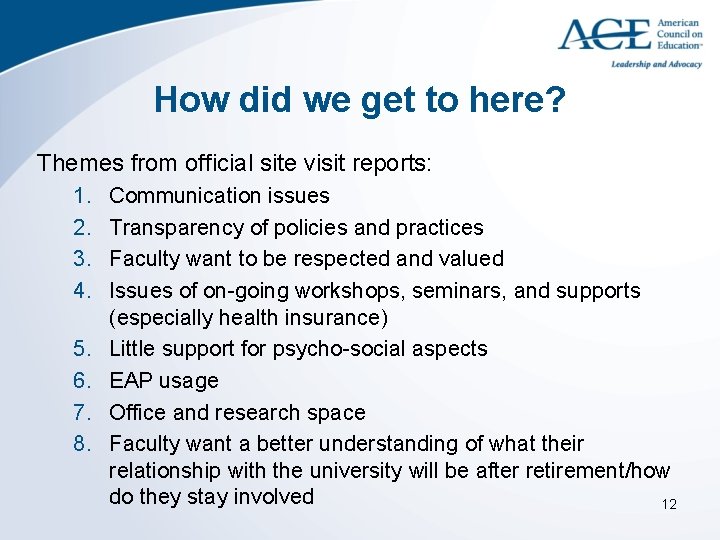
How did we get to here? Themes from official site visit reports: 1. 2. 3. 4. 5. 6. 7. 8. Communication issues Transparency of policies and practices Faculty want to be respected and valued Issues of on-going workshops, seminars, and supports (especially health insurance) Little support for psycho-social aspects EAP usage Office and research space Faculty want a better understanding of what their relationship with the university will be after retirement/how do they stay involved 12
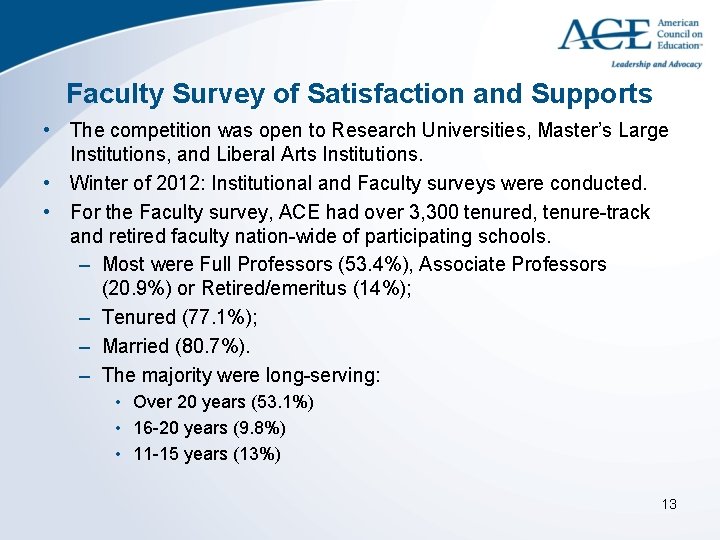
Faculty Survey of Satisfaction and Supports • The competition was open to Research Universities, Master’s Large Institutions, and Liberal Arts Institutions. • Winter of 2012: Institutional and Faculty surveys were conducted. • For the Faculty survey, ACE had over 3, 300 tenured, tenure-track and retired faculty nation-wide of participating schools. – Most were Full Professors (53. 4%), Associate Professors (20. 9%) or Retired/emeritus (14%); – Tenured (77. 1%); – Married (80. 7%). – The majority were long-serving: • Over 20 years (53. 1%) • 16 -20 years (9. 8%) • 11 -15 years (13%) 13
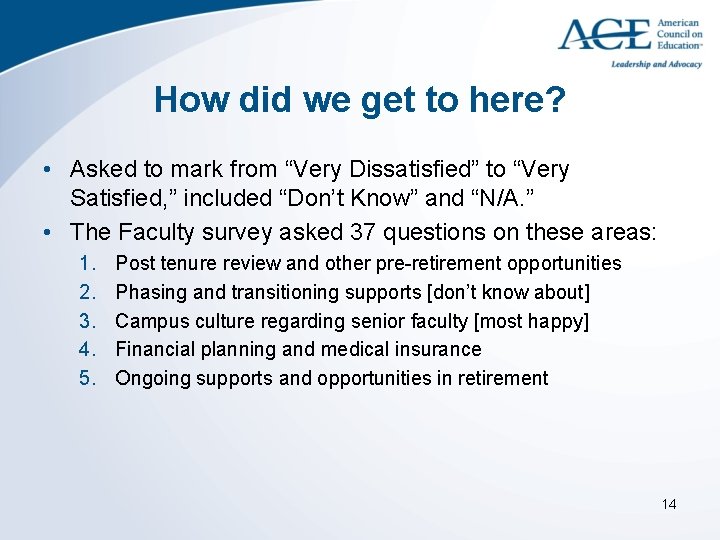
How did we get to here? • Asked to mark from “Very Dissatisfied” to “Very Satisfied, ” included “Don’t Know” and “N/A. ” • The Faculty survey asked 37 questions on these areas: 1. 2. 3. 4. 5. Post tenure review and other pre-retirement opportunities Phasing and transitioning supports [don’t know about] Campus culture regarding senior faculty [most happy] Financial planning and medical insurance Ongoing supports and opportunities in retirement 14
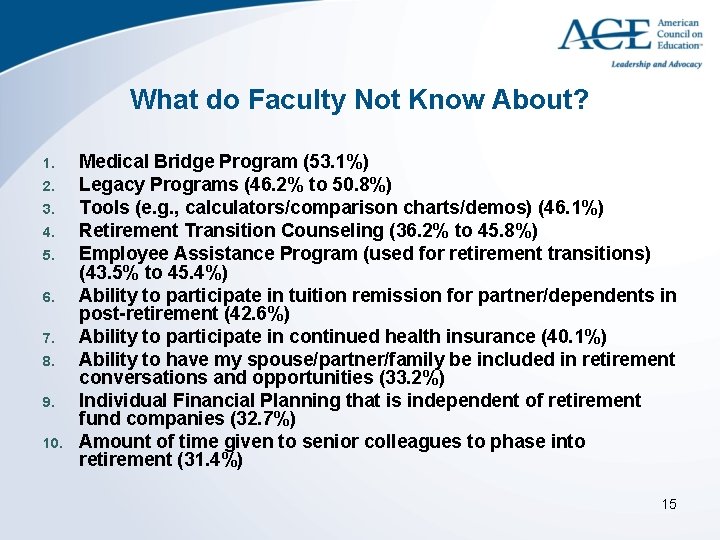
What do Faculty Not Know About? 1. 2. 3. 4. 5. 6. 7. 8. 9. 10. Medical Bridge Program (53. 1%) Legacy Programs (46. 2% to 50. 8%) Tools (e. g. , calculators/comparison charts/demos) (46. 1%) Retirement Transition Counseling (36. 2% to 45. 8%) Employee Assistance Program (used for retirement transitions) (43. 5% to 45. 4%) Ability to participate in tuition remission for partner/dependents in post-retirement (42. 6%) Ability to participate in continued health insurance (40. 1%) Ability to have my spouse/partner/family be included in retirement conversations and opportunities (33. 2%) Individual Financial Planning that is independent of retirement fund companies (32. 7%) Amount of time given to senior colleagues to phase into retirement (31. 4%) 15
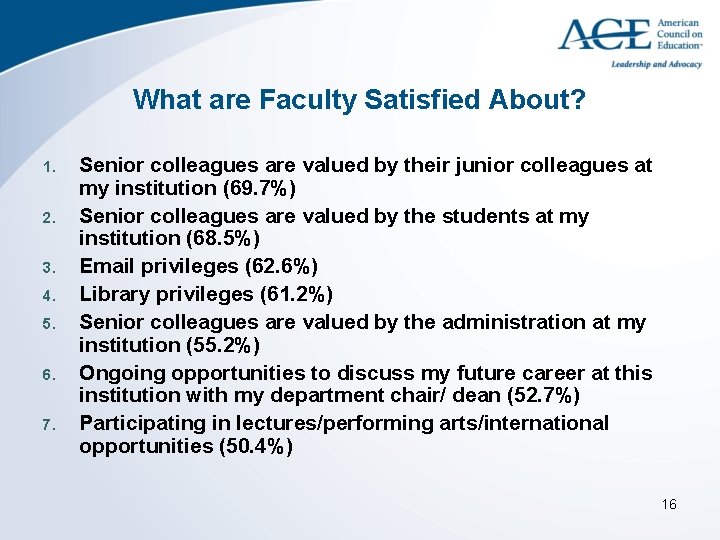
What are Faculty Satisfied About? 1. 2. 3. 4. 5. 6. 7. Senior colleagues are valued by their junior colleagues at my institution (69. 7%) Senior colleagues are valued by the students at my institution (68. 5%) Email privileges (62. 6%) Library privileges (61. 2%) Senior colleagues are valued by the administration at my institution (55. 2%) Ongoing opportunities to discuss my future career at this institution with my department chair/ dean (52. 7%) Participating in lectures/performing arts/international opportunities (50. 4%) 16
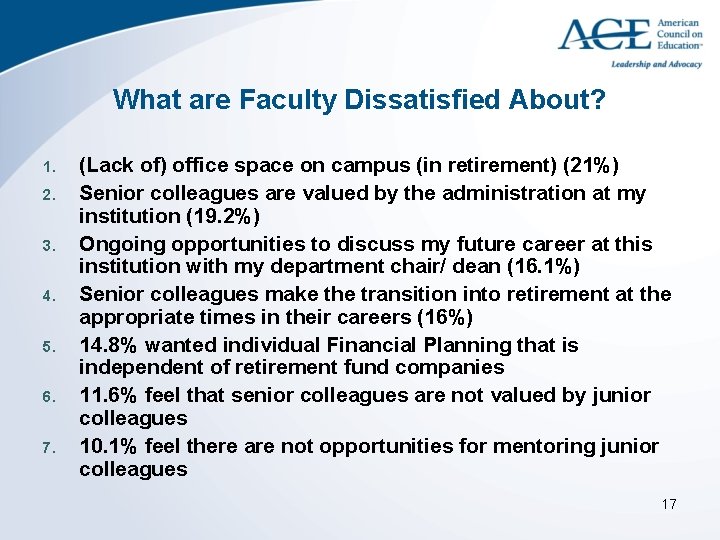
What are Faculty Dissatisfied About? 1. 2. 3. 4. 5. 6. 7. (Lack of) office space on campus (in retirement) (21%) Senior colleagues are valued by the administration at my institution (19. 2%) Ongoing opportunities to discuss my future career at this institution with my department chair/ dean (16. 1%) Senior colleagues make the transition into retirement at the appropriate times in their careers (16%) 14. 8% wanted individual Financial Planning that is independent of retirement fund companies 11. 6% feel that senior colleagues are not valued by junior colleagues 10. 1% feel there are not opportunities for mentoring junior colleagues 17
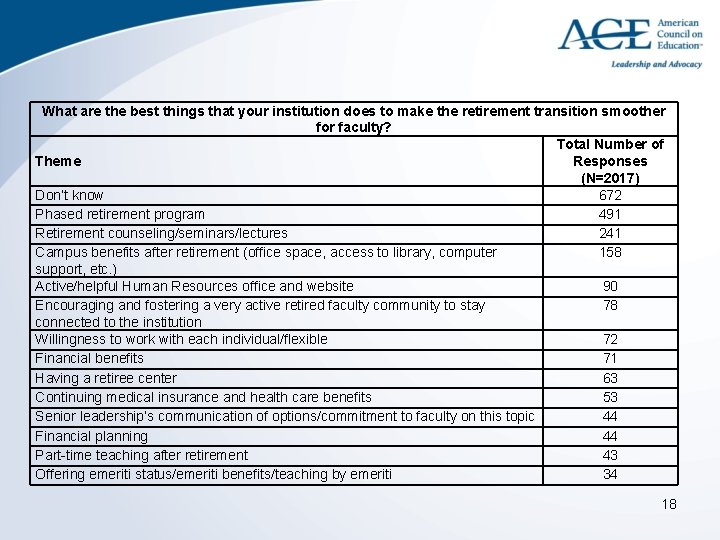
What are the best things that your institution does to make the retirement transition smoother for faculty? Total Number of Responses Theme (N=2017) Don’t know 672 Phased retirement program 491 Retirement counseling/seminars/lectures 241 Campus benefits after retirement (office space, access to library, computer 158 support, etc. ) Active/helpful Human Resources office and website 90 Encouraging and fostering a very active retired faculty community to stay 78 connected to the institution Willingness to work with each individual/flexible 72 Financial benefits 71 Having a retiree center 63 Continuing medical insurance and health care benefits 53 Senior leadership’s communication of options/commitment to faculty on this topic 44 Financial planning 44 Part-time teaching after retirement 43 Offering emeriti status/emeriti benefits/teaching by emeriti 34 18
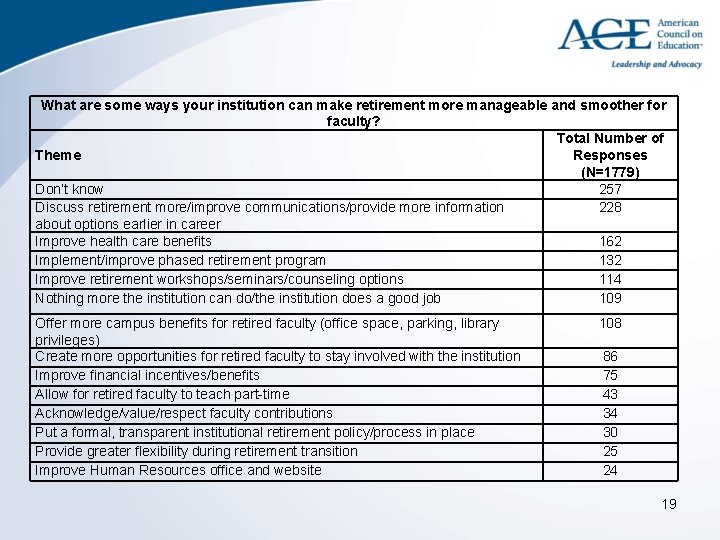
What are some ways your institution can make retirement more manageable and smoother for faculty? Total Number of Responses Theme (N=1779) Don’t know 257 Discuss retirement more/improve communications/provide more information 228 about options earlier in career Improve health care benefits 162 Implement/improve phased retirement program 132 Improve retirement workshops/seminars/counseling options 114 Nothing more the institution can do/the institution does a good job 109 Offer more campus benefits for retired faculty (office space, parking, library privileges) Create more opportunities for retired faculty to stay involved with the institution Improve financial incentives/benefits Allow for retired faculty to teach part-time Acknowledge/value/respect faculty contributions Put a formal, transparent institutional retirement policy/process in place Provide greater flexibility during retirement transition Improve Human Resources office and website 108 86 75 43 34 30 25 24 19
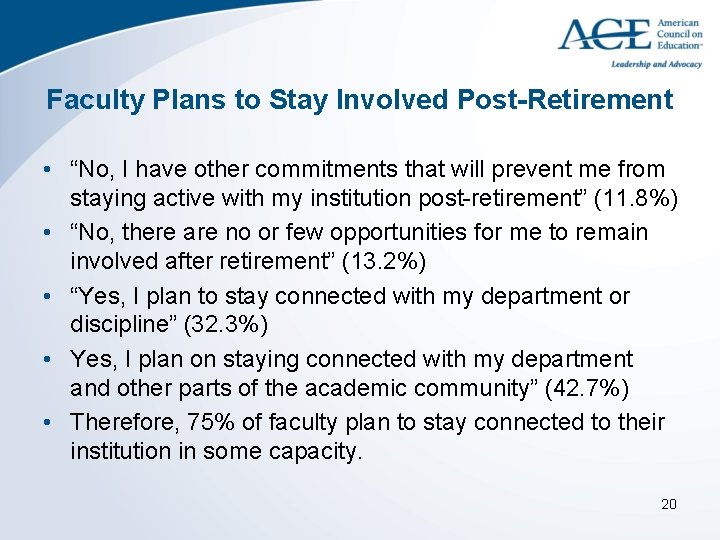
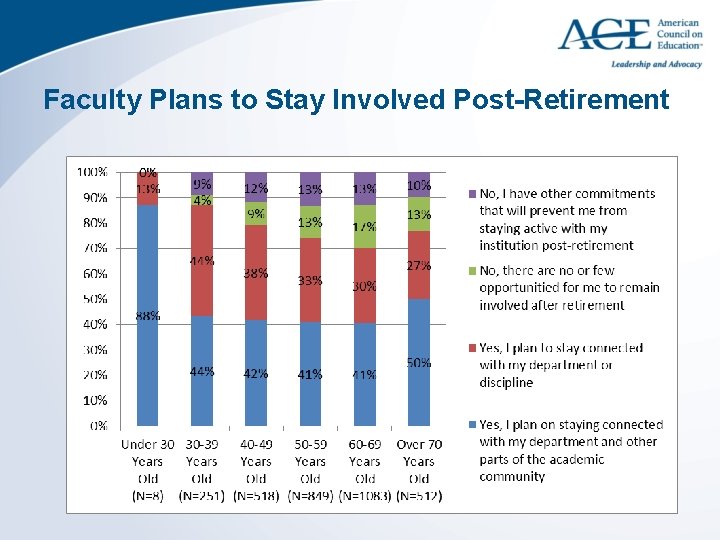
Faculty Plans to Stay Involved Post-Retirement • “No, I have other commitments that will prevent me from staying active with my institution post-retirement” (11. 8%) • “No, there are no or few opportunities for me to remain involved after retirement” (13. 2%) • “Yes, I plan to stay connected with my department or discipline” (32. 3%) • Yes, I plan on staying connected with my department and other parts of the academic community” (42. 7%) • Therefore, 75% of faculty plan to stay connected to their institution in some capacity. 20
Faculty Plans to Stay Involved Post-Retirement 21
What are the Challenges & Some Solutions? 3 Types of Laws Create Difficulties for Institutions • Age Discrimination Laws – Federal – State • Employee Retirement Income Security Act (ERISA) • Internal Revenue Code • To avoid problems with laws: – – Read our legal issues brief and bring it to your legal counsel! Make sure that retirement decisions are voluntary Use third parties to conduct financial planning seminars Ask about someone’s retirement plan in the “right way” 22
What are the Challenges & Some Solutions? • Legal difficulties stem from institutional need to balance faculty compositions. Several types of retirement plans are offered. These plans include: – – Use of individual buy-outs Phased retirement programs Time-based retirement plans (aka Window Plans) Age-based retirement plans (Must ensure “one bite” rule) 23
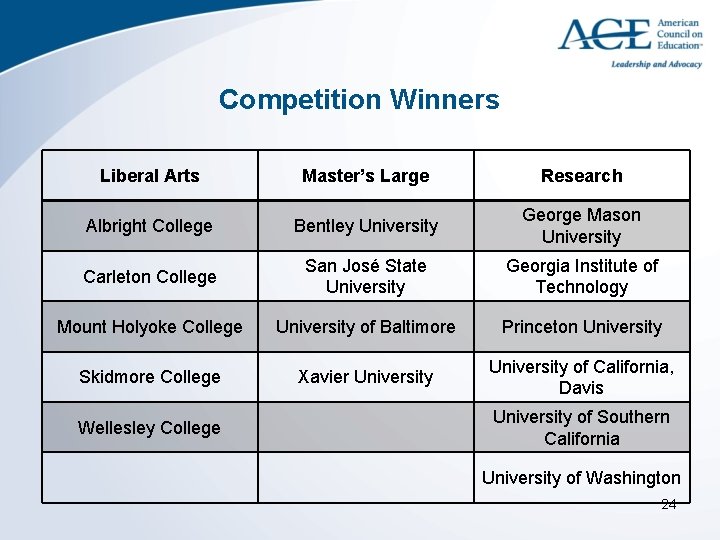
Competition Winners Liberal Arts Master’s Large Research Albright College Bentley University George Mason University Carleton College San José State University Georgia Institute of Technology Mount Holyoke College University of Baltimore Princeton University Skidmore College Xavier University of California, Davis Wellesley College University of Southern California University of Washington 24
Best Practices in Faculty Retirement Transitions • • • Mentoring program partnering retired and new faculty Life-planning seminars Online tool for evaluating financial plans Emeriti center and emeriti college Dedicated and private office and laboratory space Transition grants, which faculty can use to complete specific projects before retirement • Post-retirement opportunities both on campus and within the community, such as encore careers 25
Best Practices in Faculty Retirement Transitions Pre-Retirement • Comprehensive “one-stop-shop” website for retirement • Retirement checklist for faculty • Communications campaign • Discussing retirement process with senior faculty without violating age discrimination laws • Financial planning with an outside expert • Health insurance transition planning • Individual counseling—life planning sessions 26
Best Practices in Faculty Retirement Transitions Retirement • Phased retirement policy options • Transparent policies • Tracking usage of policies • Legacy projects • Acknowledgement and celebration of career upon retirement 27
Best Practices in Faculty Retirement Transitions Post-Retirement • Creating a culture that includes retirees • Ensuring that retired faculty can maintain connections to the campus • Supports post-retirement (maintaining email, library privileges, shared office space) • Retiree associations • Encore career programs • Volunteer options within the community • Part-time teaching at campus 28
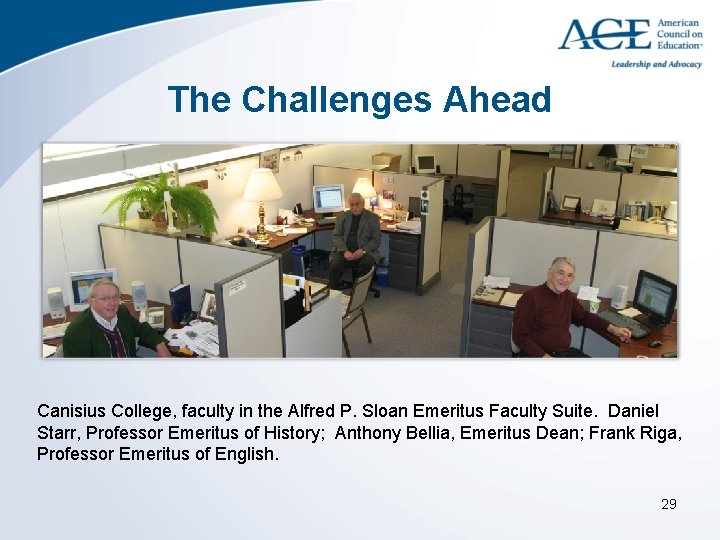
The Challenges Ahead Canisius College, faculty in the Alfred P. Sloan Emeritus Faculty Suite. Daniel Starr, Professor Emeritus of History; Anthony Bellia, Emeritus Dean; Frank Riga, Professor Emeritus of English. 29
The Challenges Ahead The Challenge of Working with Academic Affairs: • Institutions worry that their outreach to faculty may be perceived as discriminatory, so institutions do little to no outreach. • Since the institution has worked with the faculty to manage their careers up to this point, the faculty feel that the administration should continue to reach out to them to support them in their retirement transition as well. • Each campus needs to determine how to communicate to faculty at this stage in ways that are transparent, humane, and legally compliant. 30
The Challenges Ahead • Be able to explain the transformational value of the oftentimes transactional nature of faculty retirement options that HR offices provide • Position your office as offering strategic recruitment and retention options to deans and department chairs, even for young faculty – Mentality is “I have time to make up my retirement portfolio” • Know who your faculty gatekeepers are. Befriend them! 31
The Challenges Ahead The Challenge of Being Humane • “When you make sure your emeriti are treated well, you reinforce a culture where people naturally make the decision to retire, because they’re not giving up what’s made them a successful member of the community for so long. ” – Steven Poskanzer, President, Carleton College 32
Concluding Thoughts • “This is supposed to be a humane profession, but are we treat each other, in our most private lives, so harshly. ” – Female Academic Surgeon • Younger generations are not saving enough for retirement. • Faculty Retirement is a presidential issue! – – Their board asks them about this issue Strategic HR Retirement vendors’ push Their own retirement 33
Q&A • Any questions, comments, or thoughts? • For more information: – http: //www. acenet. edu/leadership/programs/Pages/Faculty. Retirement-Transitions. aspx 34