
ACE Inhibitor Angiotensinconverting enzyme inhibitors ACE inhibitors Inhibit

ACE Inhibitor
Angiotensin-converting enzyme inhibitors (ACE inhibitors) Inhibit the conversion of angiotensin I to angiotensin II. The main indications of ACE inhibitors are shown below. 1 -Heart Failure ACE inhibitors are used in all grades of heart failure, usually combined with a beta-blocker. -Potassium supplements and potassium-sparing diuretics should be discontinued before introducing an ACE inhibitor because of the risk of hyperkalaemia. -low dose of spironolactone may be beneficial in severe heart failure and can be used with an ACE inhibitor provided serum potassium is monitored carefully. Profound first-dose hypotension may occur when ACE inhibitors are introduced to patients with heart failure who are already taking a high dose of a loop diuretic 80 mg daily or more
2 -Hypertension An ACE inhibitor may be the most appropriate initial drug for hypertension in younger Caucasian patients; Afro- Caribbean patients, those aged over 55 years, and those with primary aldosteronism respond less well. ACE inhibitors are particularly indicated for hypertension in patients with type 1 diabetes with nephropathy. 3 -Diabetic nephropathy ACE inhibitors have a role in the management of diabetic nephropathy. 4 -Prophylaxis of cardiovascular events ACE inhibitors are used in the early and long-term management of patients who have had a myocardial infarction. ACE inhibitors may also have a role in preventing cardiovascular events.

-Temporary withdrawal of the loop diuretic reduces the risk, but may cause severe rebound pulmonary oedema. So for patients on high doses of loop diuretics, the ACE inhibitor may need to be initiated under specialist supervision. An ACE inhibitor can be initiated in patients who are receiving a low dose of a diuretic or who are not otherwise at risk of serious hypotension;
ACE Iintiated under supervision in patients: 1 -Receiving multiple or high-dose diuretic therapy (e. g. more than 80 mg of furosemide daily or its equivalent) 2 - Receiving concomitant angiotensin-II receptor antagonist or aliskiren 3 - With hypovolaemia 4 - With hyponatraemia (plasma-sodium concentration below 130 mmol/litre); 5 -With hypotension (systolic blood pressure below 90 mm. Hg) 6 - With unstable heart failure 7 -Receiving high-dose vasodilator therapy 8 - Known renovascular disease.
Concomitant treatment with NSAIDs increases the risk of renal damage, and potassium-sparing diuretics (or potassium-containing salt substitutes) increase the risk of hyperkalaemia. In patients with severe bilateral renal artery stenosis (or severe stenosis of the artery supplying a single functioning kidney), ACE inhibitors reduce or abolish glomerular filtration and are likely to cause severe and progressive renal failure. They are therefore not recommended in patients known to have these forms of critical renovascular disease.
Drug drug interaction of ACEI 1 - Aliskirine 2 -NSAID 3 -Allopurinol 4 -Azothioprine 5 -Increase concentration of lithium
ACE-I Captopril, Enalapril, Ramipril ARABS Candesartan, Losartan, Telmisartan, Valsartan
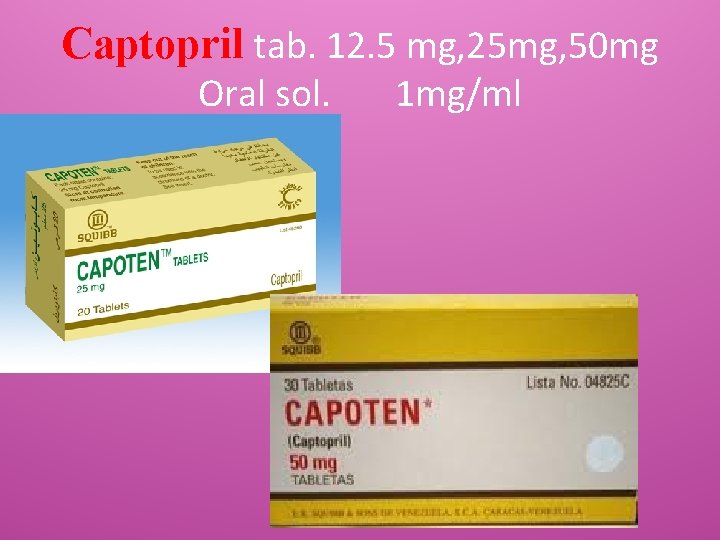
Captopril tab. 12. 5 mg, 25 mg, 50 mg Oral sol. 1 mg/ml

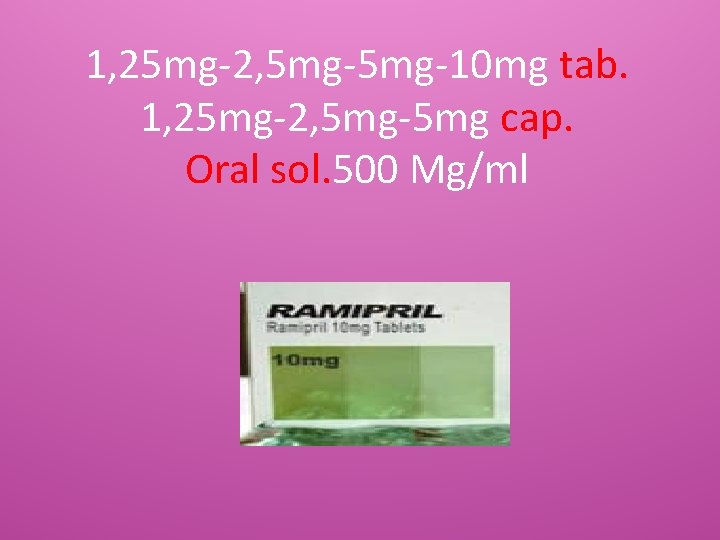
1, 25 mg-2, 5 mg-10 mg tab. 1, 25 mg-2, 5 mg-5 mg cap. Oral sol. 500 Mg/ml
Angiotensin-II receptor antagonists Unlike ACE inhibitors, they do not inhibit the breakdown of bradykinin and other kinins, and thus are less likely to cause the persistent dry cough which can complicate ACE inhibitor therapy. They are therefore a useful alternative for patients who have to discontinue an ACE inhibitor because of persistent cough. An angiotensin-II receptor antagonist may be used as an alternative to an ACE inhibitor in the management of heart failure or diabetic nephropathy. Candesartan cilexetil and valsartan are also licensed as adjuncts to ACE inhibitors under specialist supervision, in the management of heart failure when other treatments are unsuitable. Renal effects Angiotensin-II receptor antagonists should be used with caution in renal artery stenosis
CONTRA-INDICATIONS 1 -The combination of an angiotensin- II receptor antagonist with aliskiren is contra-indicated in patients with an e. GFR less than 60 m. L/minute/1. 73 m 2. 2 -the combination of an angiotensin-II receptor antagonist with aliskiren is contra-indictated in patients with diabetes mellitus CAUTIONS 1 -Afro-Caribbean patients—particularly those with left ventricular hypertrophy (may not benefit from an angiotensin-II receptor antagonist). 2 -Aortic or mitral valve stenosis. 3 -Elderly (lower initial doses may be appropriate). 4 -Hypertrophic cardiomyopathy. 5 - Patients with a history of angioedema. 6 - Patients with primary aldosteronism (may not benefit from an angiotensin-II receptor antagonist). 7 - Renal artery stenosis
SIDE-EFFECTS ▶ Common or very common Abdominal pain. asthenia. back pain. cough. diarrhoea. dizziness. headache. hyperkalaemia. hypotension. nausea. Posturalhypotension (more common in patients with intravascular volume depletion, e. g. those taking high-dose diuretics). renal impairment. vertigo. Vomiting PREGNANCY Angiotensin-II receptor antagonists should be avoided in pregnancy unless essential. They may adversely affect fetal and neonatal blood pressure control and renal function; neonatal skull defects and oligohydramnios have also been reported. BREAST FEEDING Information on the use of angiotensin-II receptor antagonists in breast-feeding is limited. They are not recommended in breast-feeding
HEPATIC IMPAIRMENT In general, manufacturers advise caution in mild to moderate impairment avoid in severe impairment RENAL IMPAIRMENT Dose adjustments Use with caution, starting with low dose, and adjust according to response. MONITORING REQUIREMENTS Monitor plasma-potassium concentration, particularly in the elderly and in patients with renal impairment.
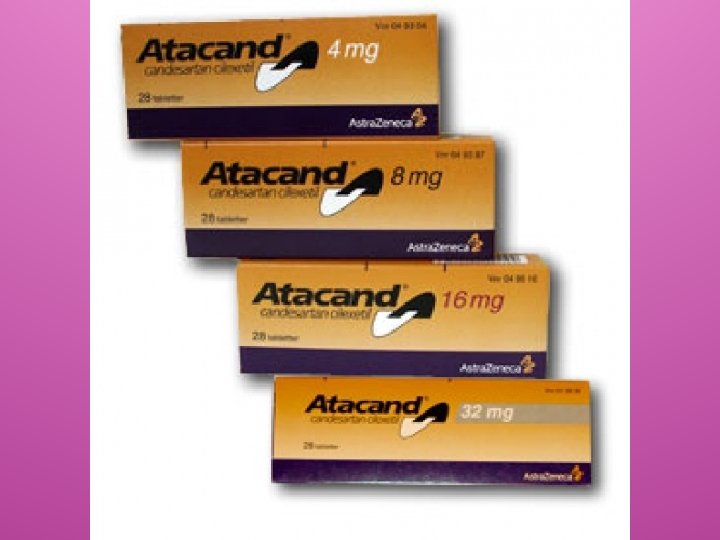
INDICATIONS AND DOSE 1 -Hypertension ▶ BY MOUTH ▶ Adult: Initially 8 mg once daily, increased if necessary up to 32 mg once daily, doses to be increased at intervals of 4 weeks; usual dose 8 mg once daily 2 -Hypertension with intravascular volume depletion 3 -Heart failure with impaired left ventricular systolic function when ACE inhibitors are not tolerated 4 - Heart failure with impaired left ventricular systolic function in conjunction with an ACE inhibitor (under expert supervision) CONTRA-INDICATIONS Cholestasis SIDE-EFFECTS ▶ Common or very common Increased risk of infection HEPATIC IMPAIRMENT Manufacturer advises avoid in severe impairment or cholestasis. Dose adjustments Manufacturer advises initial dose reduction to 4 mg once daily in mild to moderate impairment; adjust according to response. RENAL IMPAIRMENT Use with caution if e. GFR less than 15 m. L/minute/1. 73 m 2— limited experience. Dose adjustments Initially 4 mg daily.

Losartan potassium INDICATIONS AND DOSE 1 -Diabetic nephropathy in type 2 diabetes mellitus 2 -Chronic heart failure when ACE inhibitors are unsuitable or contraindicated 3 -Hypertension (including reduction of stroke risk in hypertension with left ventricular hypertrophy ▶ Adult 18– 75 years: Initially 50 mg once daily for several weeks, then increased if necessary to 100 mg once daily ▶ Adult 76 years and over: Initially 25 mg once daily for several weeks, then increased if necessary to 100 mg once daily 4 -Hypertension with intravascular volume depletion ▶ BY MOUTH ▶ Adult 18– 75 years: Initially 25 mg once daily for several weeks, then increased if necessary up to 100 mg once daily

CAUTIONS Severe heart failure SIDE-EFFECTS ▶ Common or very common Anaemia. hypoglycaemia. postural disorders
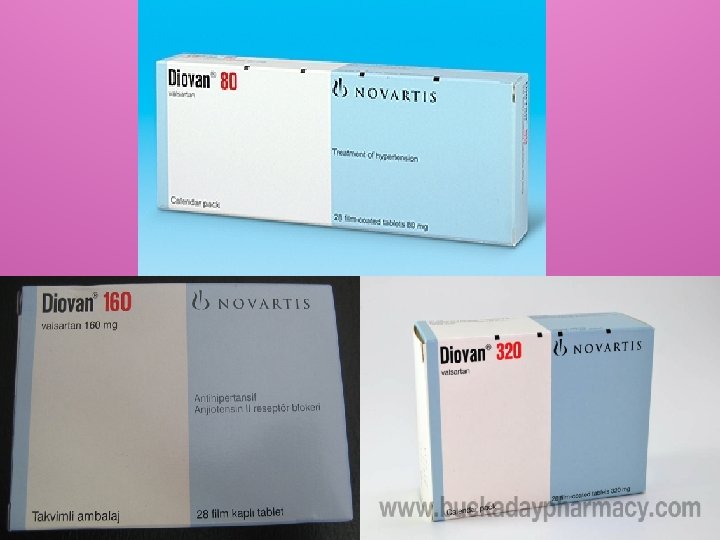
Valsartan NDICATIONS AND DOSE 1 -Hypertension ▶ Adult: Initially 80 mg once daily, increased if necessary up to 320 mg daily, doses to be increased at intervals of 4 weeks 2 -Hypertension with intravascular volume depletion ▶ Adult: Initially 40 mg once daily, increased if necessary up to 320 mg daily, doses to be increased at intervals of 4 weeks 3 -Heart failure when ACE inhibitors cannot be used, or in conjunction with an ACE inhibitor when a beta-blocker cannot be used 4 -Myocardial infarction with left ventricular failure or left ventricular systolic dysfunction (adjunct) CONTRA-INDICATIONS Biliary cirrhosis. cholestasis SIDE-EFFECTS ▶ Uncommon Heart failure. syncope HEPATIC IMPAIRMENT Dose adjustments Manufacturer advises maximum 80 mg daily in mild to moderate impairment. RENAL IMPAIRMENT Use with caution
MEDICINAL FORMS oral suspension, oralsolution Tablet Valsartan 40 mg Valsartan 160 mg Valsartan 320 mg Capsule Valsartan 40 mg Valsartan 80 mg Valsartan 160 mg

- Slides: 24