
Accurate completion of disability forms in a 30
Accurate completion of disability forms in a 30 min office visit: Part 1 Kenya I. Sekoni, MD, FAAFP Assistant Professor, Michigan State University Chinmay Zinzuvadia, Ph. D Physical Therapy
Goals 1. Family and Internal Medicine graduates will complete a DHS 49 form/FMLA form within a 30 minute patient encounter. 2. Family and Internal Medicine resident graduates will write work restrictions that are consistent with the patient’s residual functional capacity.
Disability Learning Objectives 1. Given a disability form to complete, residents will be able to distinguish State vs Federal vs Employer and complete it within 30 min. 2. When presented with a patient scenario of chronic medical conditions that have deteriorated residents will be able to assess functional capacity adequately within 20 minutes. 3. Given a patient’s residual functional capacity, residents will be able to write work restrictions appropriate for the acquired disability.
State VS Federal Disability Programs • State – Medicaid – State employee early retirement due to disability • Duty • Non-Duty • Federal – Supplemental Security Income – Retirement Supplemental Disability Income – Medicare
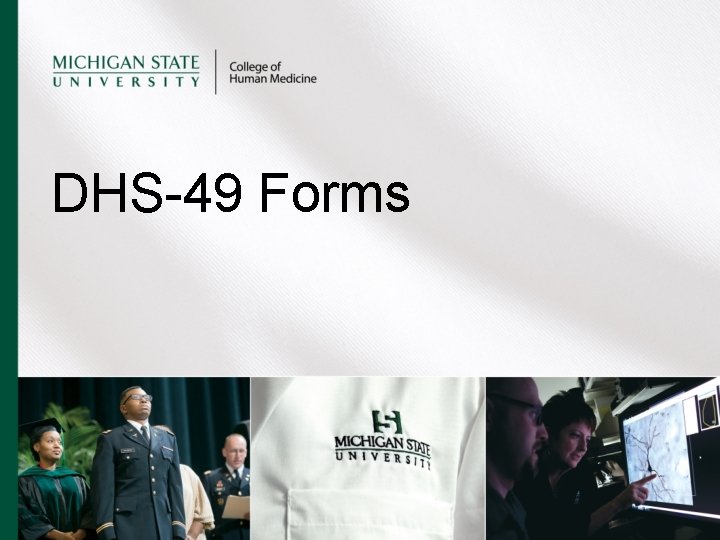
DHS-49 Forms
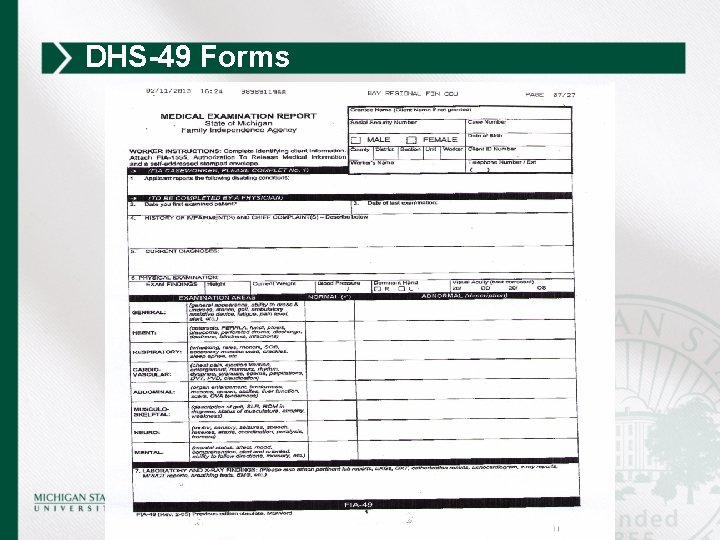
DHS-49 Forms
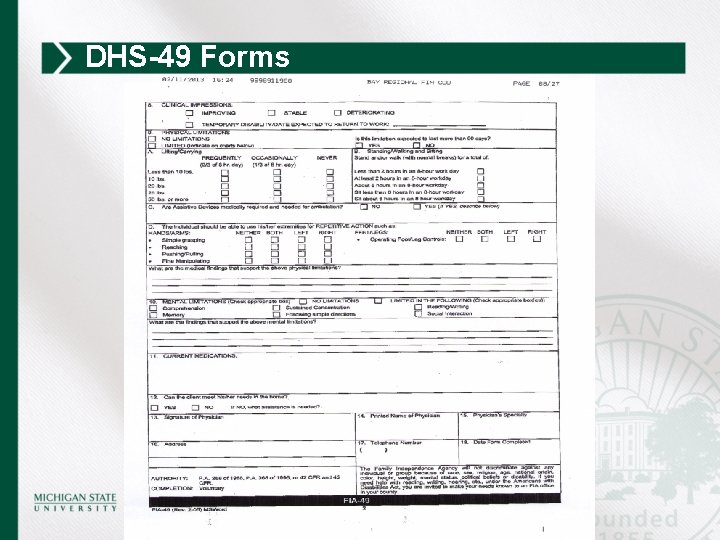
DHS-49 Forms
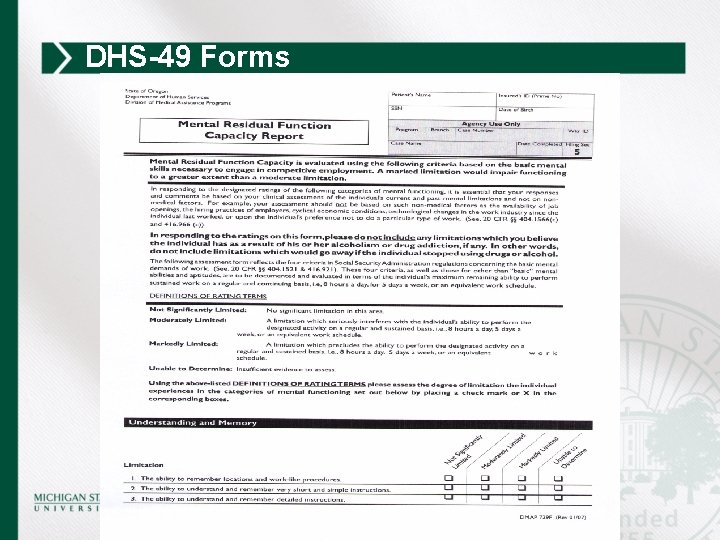
DHS-49 Forms
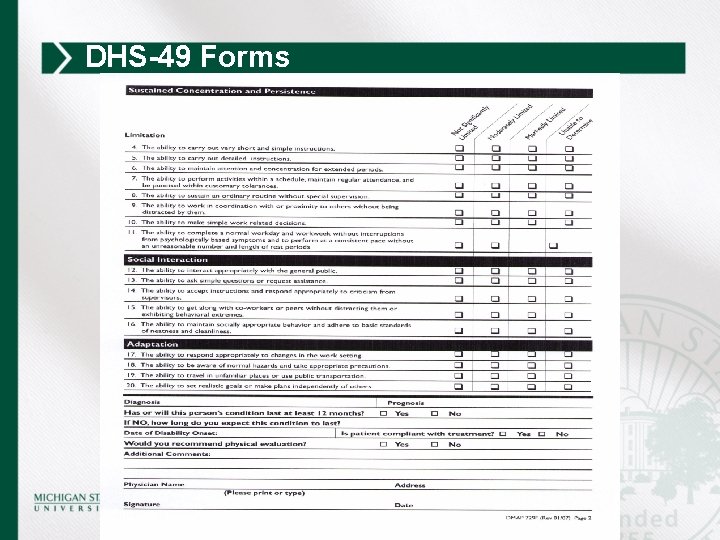
DHS-49 Forms
Pertinent Records to Include in Medical Record Requests • Include everything because everything is considered. – HPI should document how patient’s problems affect • • • ADL and IADL Home Social Psych How they are coping • Have an up to date comprehensive medical review at the top
Patient preparation – Summary of their progression to current functional state – Oswestry Low Back pain questionnaire – U of M pain disability index – Review it with the patient to ensure you have supporting documents. – Forms must be completed within 10 days of request.
Review Questionnaires 1. Oswestry low back pain questionnaire • Used to measure a patient's permanent functional disability. • The test is considered the ‘gold standard’ of low back functional outcome tools. 2. U of M pain disability index • Measures the impact that pain has on the ability of a person to participate in essential life activities. • This can be used to evaluate patients initially to monitor them over time and to judge the effectiveness of interventions. • The index was developed at St. Louis University Medical Center.
Three Practice Cases 1. Retirement: Back Pain and depression 2. Mental: COPD, asthma, Learning disability 3. Physical: Feet, back, heart, knees, gout, HBP
Disability Workshop Questions 1. Which of the following are examples of State Disability programs (CIRCLE ALL THAT ARE TRUE)? A. B. C. D. Supplemental Security Income Medicaid PATH Early Retirement due to disability for teachers E. none
Disability Workshop Questions 2. Which of the following are examples of Federal Disability programs (CIRCLE ALL THAT ARE TRUE)? A. State Disability Assistance B. Medicare C. Retirement supplemental disability income for non-state employees. D. Veterans Association health benefits. E. none
Disability Workshop Questions 3. True or False, state Early retirement program requires permanent disability from ALL types of jobs? – True – False. Unable to do their current job.
Disability Workshop Questions 4. True or false, a Nurse Practitioner can complete and sign a DHS-49 Medical Examination form? – True – False. Only a MD or DO can sign the form.
Disability Workshop Questions 5. When completing the DHS-49 Medical Examination report you should (ONE ANSWER) A. Fill it out based on the patient’s current presentation for the debilitating condition(s). B. Fill it out based on the patient’s worst presentation for the debilitating condition(s). C. Fill it out based on the patient’s baseline presentation for the debilitating condition(s). D. How you think the patient’s condition will progress.
Disability Workshop Questions 6. What are pertinent medical records to include when medical records are requested? (CIRLCLE ALL THAT ARE TRUE) A. MRI reports B. Physical therapy initial and final reports C. Labs D. Family history E. Narcotic agreements
- Slides: 19