
Accuracy vs Resolution Accuracy is how well you
- Slides: 2
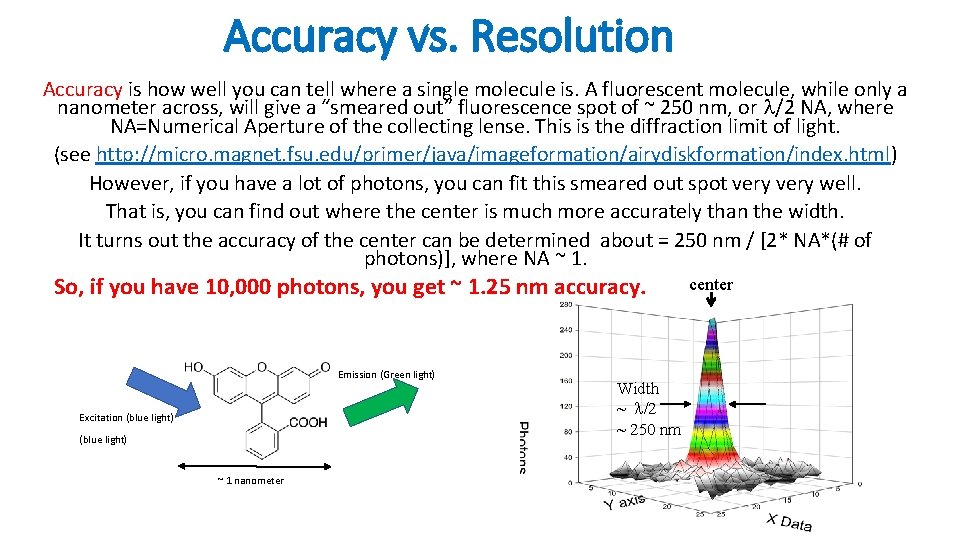
Accuracy vs. Resolution Accuracy is how well you can tell where a single molecule is. A fluorescent molecule, while only a nanometer across, will give a “smeared out” fluorescence spot of ~ 250 nm, or l/2 NA, where NA=Numerical Aperture of the collecting lense. This is the diffraction limit of light. (see http: //micro. magnet. fsu. edu/primer/java/imageformation/airydiskformation/index. html) However, if you have a lot of photons, you can fit this smeared out spot very well. That is, you can find out where the center is much more accurately than the width. It turns out the accuracy of the center can be determined about = 250 nm / [2* NA*(# of photons)], where NA ~ 1. So, if you have 10, 000 photons, you get ~ 1. 25 nm accuracy. Emission (Green light) Excitation (blue light) ~ 1 nanometer Width ~ l/2 ~ 250 nm center
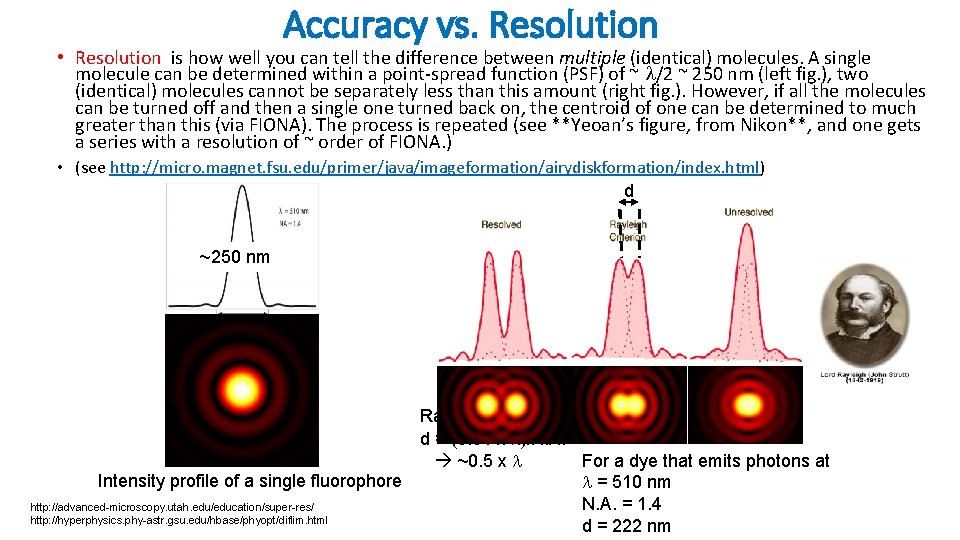
Accuracy vs. Resolution • Resolution is how well you can tell the difference between multiple (identical) molecules. A single molecule can be determined within a point-spread function (PSF) of ~ l/2 ~ 250 nm (left fig. ), two (identical) molecules cannot be separately less than this amount (right fig. ). However, if all the molecules can be turned off and then a single one turned back on, the centroid of one can be determined to much greater than this (via FIONA). The process is repeated (see **Yeoan’s figure, from Nikon**, and one gets a series with a resolution of ~ order of FIONA. ) • (see http: //micro. magnet. fsu. edu/primer/java/imageformation/airydiskformation/index. html) d ~250 nm Intensity profile of a single fluorophore http: //advanced-microscopy. utah. edu/education/super-res/ http: //hyperphysics. phy-astr. gsu. edu/hbase/phyopt/diflim. html Rayleigh Criterion d = (0. 61 x l)/N. A. For a dye that emits photons at ~0. 5 x l l = 510 nm N. A. = 1. 4 d = 222 nm