
Accuracy Robert Strzodka Overview Precision and Accuracy Hardware
Accuracy Robert Strzodka
Overview • Precision and Accuracy • Hardware Resources • Mixed Precision Iterative Refinement 2

Roundoff and Cancellation Roundoff examples for the float s 23 e 8 format additive roundoff multiplicative roundoff cancellation c=a, b a= 1 + 0. 00000004 =fl 1 b= 1. 0002 * 0. 9998 =fl 1 (c-1) * 108 =fl 0 Cancellation promotes the small error 0. 00000004 to the absolute error 4 and a relative error 1. Order of operations can be crucial: 1 + 0. 00000004 – 1=fl 0 1 – 1 + 0. 00000004=fl 0. 00000004 3
![More Precision Evaluating (with powers as multiplications) for [S. M. Rump, 1988] gives float](http://slidetodoc.com/presentation_image_h2/de13c0e570984b9ee55cf68b8266266c/image-4.jpg "More Precision Evaluating (with powers as multiplications) for [S. M. Rump, 1988] gives float")
More Precision Evaluating (with powers as multiplications) for [S. M. Rump, 1988] gives float s 23 e 8 double s 52 e 11 long double s 63 e 15 1. 17260394005318 1. 172603940053178631 This is all wrong, even the sign is wrong!! The correct result is -0. 82739605994682136814116509547981629… Lesson learnt: Computational Precision ≠ Accuracy of Result 4
Precision and Accuracy • There is no monotonic relation between the computational precision and the accuracy of the final result. • Increasing precision can decrease accuracy ! • Even when one can prove positive effects of increased precision, it is very difficult to quantify them. • We often simply rely on the experience that increased precision helps in common cases. • But for common cases we need high precision only in very few places to obtain the desired accuracy. 5
Overview • Precision and Accuracy • Hardware Resources • Mixed Precision Iterative Refinement 6
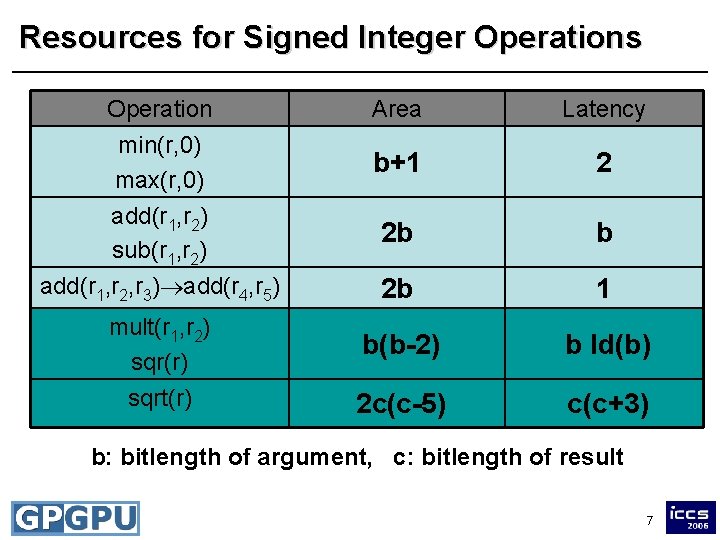
Resources for Signed Integer Operations Operation Area Latency min(r, 0) max(r, 0) b+1 2 add(r 1, r 2) sub(r 1, r 2) 2 b b add(r 1, r 2, r 3) add(r 4, r 5) 2 b 1 mult(r 1, r 2) sqr(r) b(b-2) b ld(b) sqrt(r) 2 c(c-5) c(c+3) b: bitlength of argument, c: bitlength of result 7
Arithmetic Area Consumption on a FPGA 8
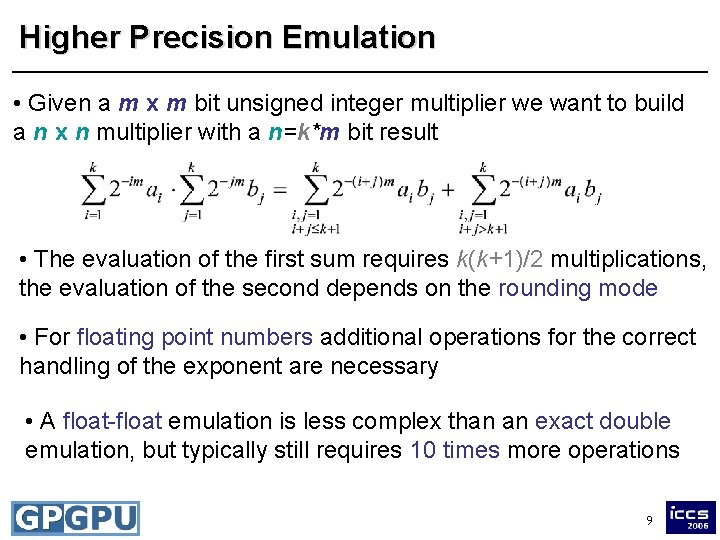
Higher Precision Emulation • Given a m x m bit unsigned integer multiplier we want to build a n x n multiplier with a n=k*m bit result • The evaluation of the first sum requires k(k+1)/2 multiplications, the evaluation of the second depends on the rounding mode • For floating point numbers additional operations for the correct handling of the exponent are necessary • A float-float emulation is less complex than an exact double emulation, but typically still requires 10 times more operations 9
Overview • Precision and Accuracy • Hardware Resources • Mixed Precision Iterative Refinement 10
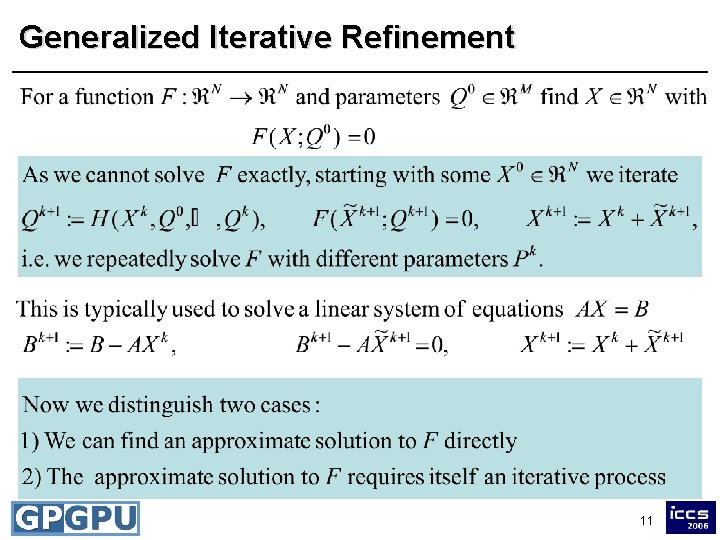
Generalized Iterative Refinement 11
![Direct Scheme Example: LU Solver [J. Dongarra et al. , 2006] 12](http://slidetodoc.com/presentation_image_h2/de13c0e570984b9ee55cf68b8266266c/image-12.jpg "Direct Scheme Example: LU Solver [J. Dongarra et al. , 2006] 12")
Direct Scheme Example: LU Solver [J. Dongarra et al. , 2006] 12

Iterative Refinement: First and Second Step High precision path through fine nodes Low precision path through coarse nodes 13
![Iterative Scheme Example: Stationary Solver [D. Göddeke et al. , 2005] To clarify the](http://slidetodoc.com/presentation_image_h2/de13c0e570984b9ee55cf68b8266266c/image-14.jpg "Iterative Scheme Example: Stationary Solver [D. Göddeke et al. , 2005] To clarify the")
Iterative Scheme Example: Stationary Solver [D. Göddeke et al. , 2005] To clarify the interaction of these two iterative schemes let us consider a general convergent iterative scheme We obtain a convergent series: 14
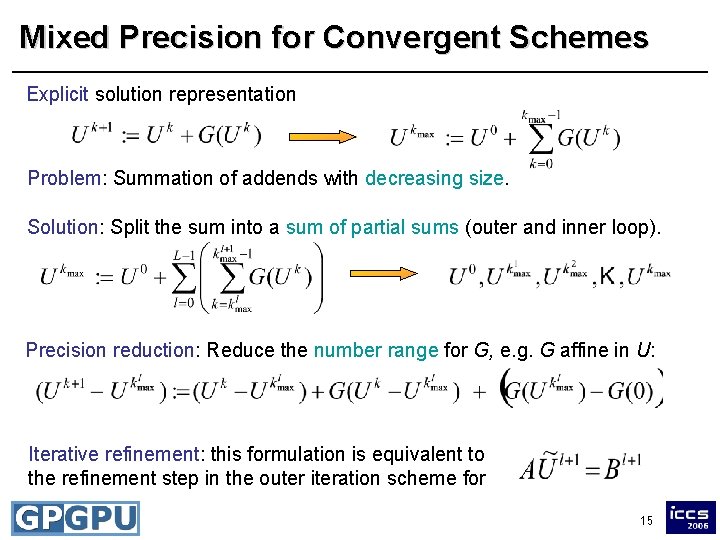
Mixed Precision for Convergent Schemes Explicit solution representation Problem: Summation of addends with decreasing size. Solution: Split the sum into a sum of partial sums (outer and inner loop). Precision reduction: Reduce the number range for G, e. g. G affine in U: Iterative refinement: this formulation is equivalent to the refinement step in the outer iteration scheme for 15
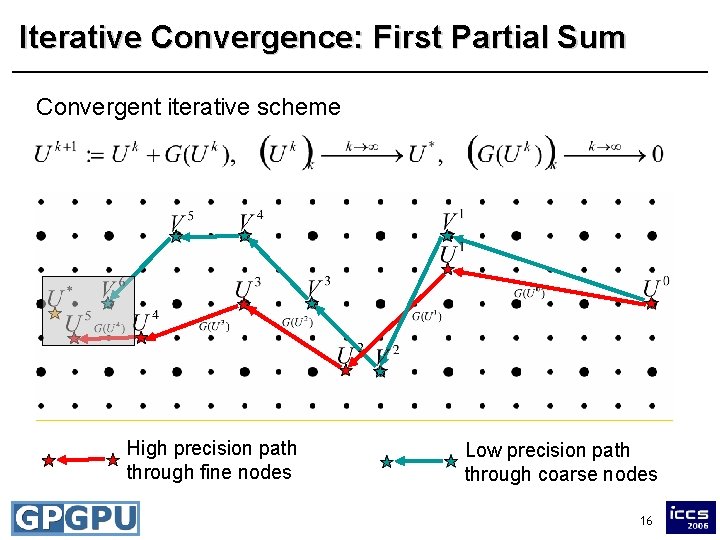
Iterative Convergence: First Partial Sum Convergent iterative scheme High precision path through fine nodes Low precision path through coarse nodes 16
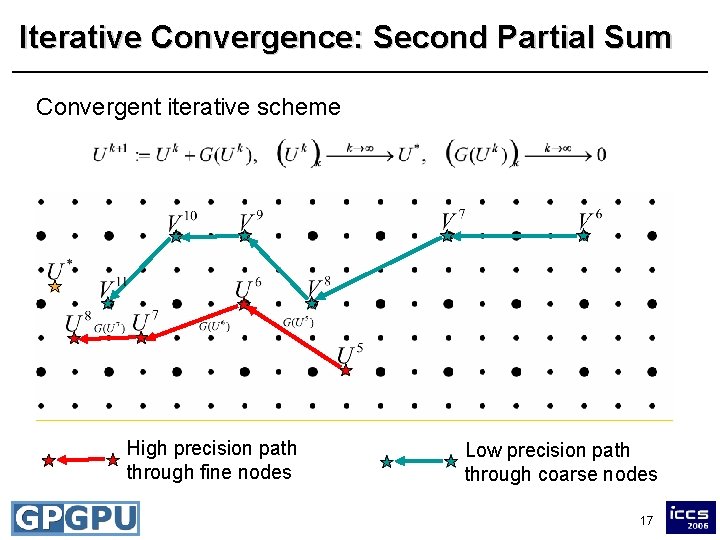
Iterative Convergence: Second Partial Sum Convergent iterative scheme High precision path through fine nodes Low precision path through coarse nodes 17
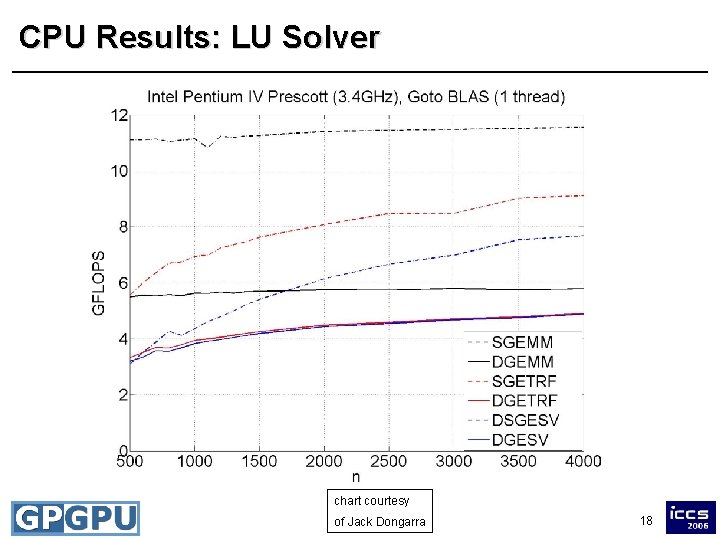
CPU Results: LU Solver chart courtesy of Jack Dongarra 18
GPU Results: Conjugate Gradient and Multigrid 19
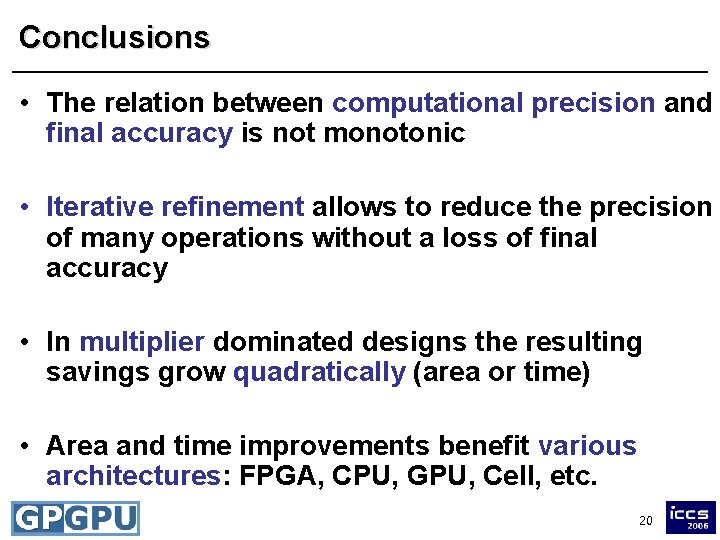
Conclusions • The relation between computational precision and final accuracy is not monotonic • Iterative refinement allows to reduce the precision of many operations without a loss of final accuracy • In multiplier dominated designs the resulting savings grow quadratically (area or time) • Area and time improvements benefit various architectures: FPGA, CPU, GPU, Cell, etc. 20
- Slides: 20