
Accuracy of Remote Sensing Estimates of Multiple Forest
- Slides: 1
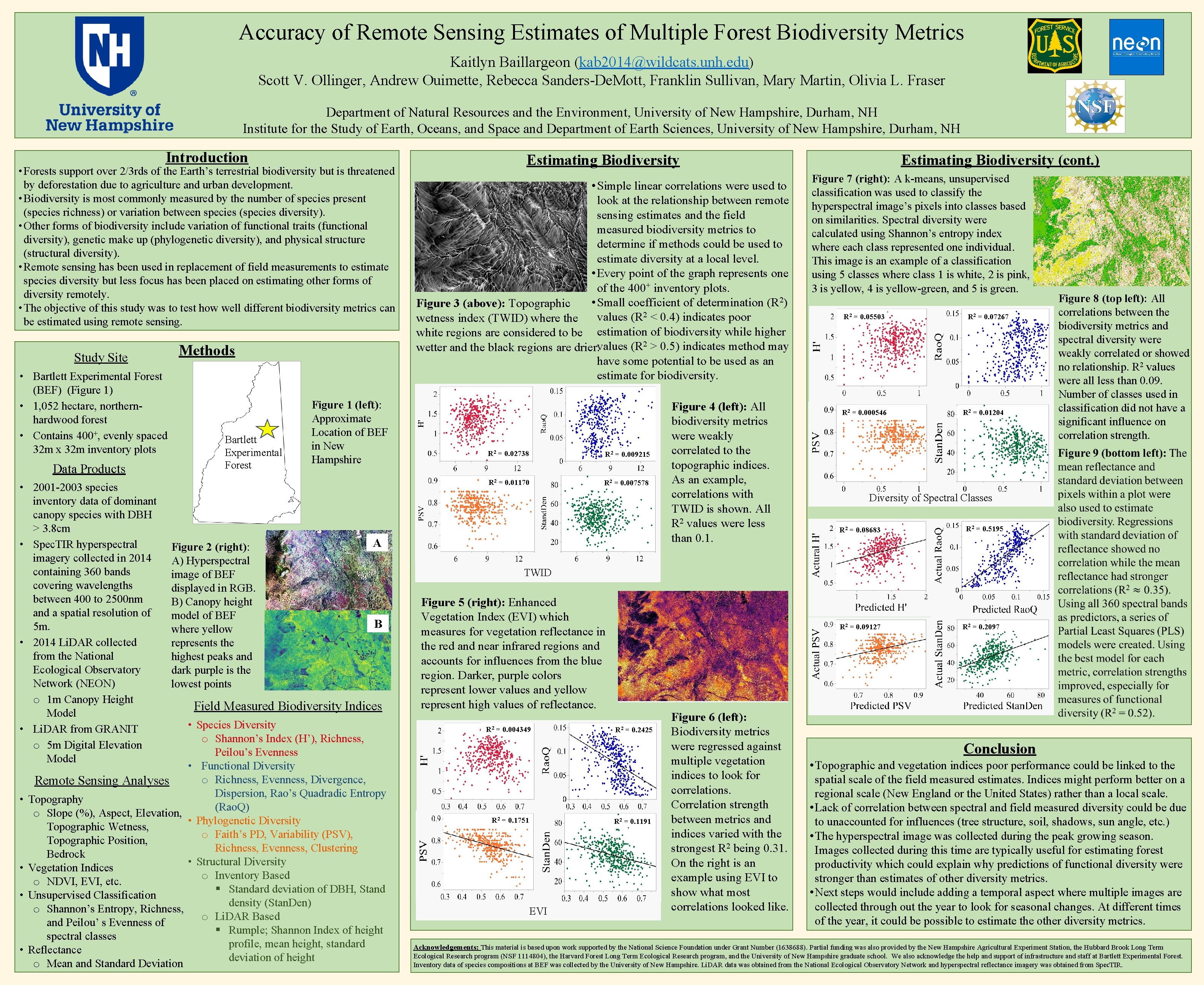
Accuracy of Remote Sensing Estimates of Multiple Forest Biodiversity Metrics Kaitlyn Baillargeon (kab 2014@wildcats. unh. edu) Scott V. Ollinger, Andrew Ouimette, Rebecca Sanders-De. Mott, Franklin Sullivan, Mary Martin, Olivia L. Fraser Department of Natural Resources and the Environment, University of New Hampshire, Durham, NH Institute for the Study of Earth, Oceans, and Space and Department of Earth Sciences, University of New Hampshire, Durham, NH Introduction • Forests support over 2/3 rds of the Earth’s terrestrial biodiversity but is threatened by deforestation due to agriculture and urban development. • Biodiversity is most commonly measured by the number of species present (species richness) or variation between species (species diversity). • Other forms of biodiversity include variation of functional traits (functional diversity), genetic make up (phylogenetic diversity), and physical structure (structural diversity). • Remote sensing has been used in replacement of field measurements to estimate species diversity but less focus has been placed on estimating other forms of diversity remotely. • The objective of this study was to test how well different biodiversity metrics can be estimated using remote sensing. Study Site • Bartlett Experimental Forest (BEF) (Figure 1) • 1, 052 hectare, northernhardwood forest • Contains 400+, evenly spaced 32 m x 32 m inventory plots Data Products • 2001 -2003 species inventory data of dominant canopy species with DBH > 3. 8 cm • Spec. TIR hyperspectral imagery collected in 2014 containing 360 bands covering wavelengths between 400 to 2500 nm and a spatial resolution of 5 m. • 2014 Li. DAR collected from the National Ecological Observatory Network (NEON) o 1 m Canopy Height Model • Li. DAR from GRANIT o 5 m Digital Elevation Model • • Methods Bartlett Experimental Forest Figure 2 (right): A) Hyperspectral image of BEF displayed in RGB. B) Canopy height model of BEF where yellow represents the highest peaks and dark purple is the lowest points Figure 1 (left): Approximate Location of BEF in New Hampshire Estimating Biodiversity • Simple linear correlations were used to look at the relationship between remote sensing estimates and the field measured biodiversity metrics to determine if methods could be used to estimate diversity at a local level. • Every point of the graph represents one of the 400+ inventory plots. • Small coefficient of determination (R 2) Figure 3 (above): Topographic values (R 2 < 0. 4) indicates poor wetness index (TWID) where the white regions are considered to be estimation of biodiversity while higher wetter and the black regions are drier. values (R 2 > 0. 5) indicates method may have some potential to be used as an estimate for biodiversity. R 2 = 0. 02738 R 2 = 0. 009215 R 2 = 0. 01170 R 2 = 0. 007578 A Figure 4 (left): All biodiversity metrics were weakly correlated to the topographic indices. As an example, correlations with TWID is shown. All R 2 values were less than 0. 1. Estimating Biodiversity (cont. ) Figure 7 (right): A k-means, unsupervised classification was used to classify the hyperspectral image’s pixels into classes based on similarities. Spectral diversity were calculated using Shannon’s entropy index where each class represented one individual. This image is an example of a classification using 5 classes where class 1 is white, 2 is pink, 3 is yellow, 4 is yellow-green, and 5 is green. R 2 = 0. 05503 R 2 = 0. 000546 R 2 = 0. 07267 R 2 = 0. 01204 Figure 8 (top left): All correlations between the biodiversity metrics and spectral diversity were weakly correlated or showed no relationship. R 2 values were all less than 0. 09. Number of classes used in classification did not have a significant influence on correlation strength. Diversity of Spectral Classes R 2 = 0. 08683 R 2 = 0. 5195 TWID B Field Measured Biodiversity Indices • Species Diversity o Shannon’s Index (H’), Richness, Peilou’s Evenness • Functional Diversity o Richness, Evenness, Divergence, Remote Sensing Analyses Dispersion, Rao’s Quadradic Entropy Topography (Rao. Q) o Slope (%), Aspect, Elevation, • Phylogenetic Diversity Topographic Wetness, o Faith’s PD, Variability (PSV), Topographic Position, Richness, Evenness, Clustering Bedrock • Structural Diversity Vegetation Indices o Inventory Based o NDVI, EVI, etc. § Standard deviation of DBH, Stand Unsupervised Classification density (Stan. Den) o Shannon’s Entropy, Richness, o Li. DAR Based and Peilou’ s Evenness of § Rumple; Shannon Index of height spectral classes profile, mean height, standard Reflectance deviation of height o Mean and Standard Deviation Figure 5 (right): Enhanced Vegetation Index (EVI) which measures for vegetation reflectance in the red and near infrared regions and accounts for influences from the blue region. Darker, purple colors represent lower values and yellow represent high values of reflectance. R 2 = 0. 004349 R 2 = 0. 1751 R 2 = 0. 09127 R 2 = 0. 2425 R 2 = 0. 1191 EVI Figure 6 (left): Biodiversity metrics were regressed against multiple vegetation indices to look for correlations. Correlation strength between metrics and indices varied with the strongest R 2 being 0. 31. On the right is an example using EVI to show what most correlations looked like. R 2 = 0. 2097 Conclusion • Topographic and vegetation indices poor performance could be linked to the spatial scale of the field measured estimates. Indices might perform better on a regional scale (New England or the United States) rather than a local scale. • Lack of correlation between spectral and field measured diversity could be due to unaccounted for influences (tree structure, soil, shadows, sun angle, etc. ) • The hyperspectral image was collected during the peak growing season. Images collected during this time are typically useful for estimating forest productivity which could explain why predictions of functional diversity were stronger than estimates of other diversity metrics. • Next steps would include adding a temporal aspect where multiple images are collected through out the year to look for seasonal changes. At different times of the year, it could be possible to estimate the other diversity metrics. Acknowledgements: This material is based upon work supported by the National Science Foundation under Grant Number (1638688). Partial funding was also provided by the New Hampshire Agricultural Experiment Station, the Hubbard Brook Long Term Ecological Research program (NSF 1114804), the Harvard Forest Long Term Ecological Research program, and the University of New Hampshire graduate school. We also acknowledge the help and support of infrastructure and staff at Bartlett Experimental Forest. Inventory data of species compositions at BEF was collected by the University of New Hampshire. Li. DAR data was obtained from the National Ecological Observatory Network and hyperspectral reflectance imagery was obtained from Spec. TIR.