
Accuracy of OCTbased FFR in Identifying Hemodynamic Significance
Accuracy of OCT-based FFR in Identifying Hemodynamic Significance of Coronary Stenosis Shengxian Tu 1, Wei Yu 1, Jiayue Huang 1, Dean Jia 2, Shaoliang Chen 3, Owen C. Raffel 4, Daixin Ding 1, Feng Tian 5, Jing Kan 3, Su Zhang 1, Fuhua Yan 7, Yundai Chen 5, Hiram Bezerra 6, William Wijns 8 1 Med-X Research Institute, Shanghai Jiao Tong University, Shanghai, China; 2 Department of Cardiology, Beijing Anzhen Hospital, Capital Medical University, Beijing, China; 3 Division of Cardiology, Nanjing First Hospital, Nanjing Medical University, Nanjing, China; 4 Department of Cardiology, Prince Charles Hospital, Queensland, Australia; 5 Department of Cardiology, Chinese PLA General Hospital, Beijing, China; 6 Harrington Heart & Vascular Institute, University Hospitals Cleveland Medical Center, Cleveland, Ohio, USA ; 7 Department of Radiology, Ruijin Hospital, Shanghai Jiao Tong University School of Medicine, Shanghai, China; 7 The Lambe Institute for Translational Medicine and Curam, National University of Ireland, Galway, and Saolta University Healthcare Group, Galway, Ireland.
Potential conflicts of interest Speaker's name : Shengxian Tu ☑ I have the following potential conflicts of interest to declare: Receipt of grants / research supports: Medis medical imaging systems, Pulse medical imaging technology
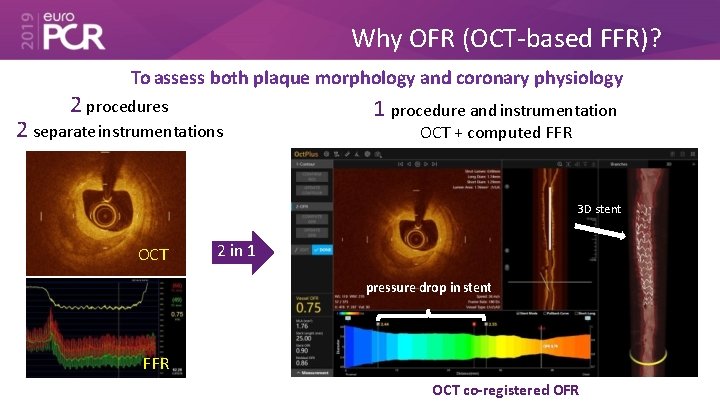
Why OFR (OCT-based FFR)? To assess both plaque morphology and coronary physiology 2 procedures 2 separate instrumentations 1 procedure and instrumentation OCT + computed FFR 3 D stent OCT 2 in 1 pressure drop in stent FFR OCT co-registered OFR
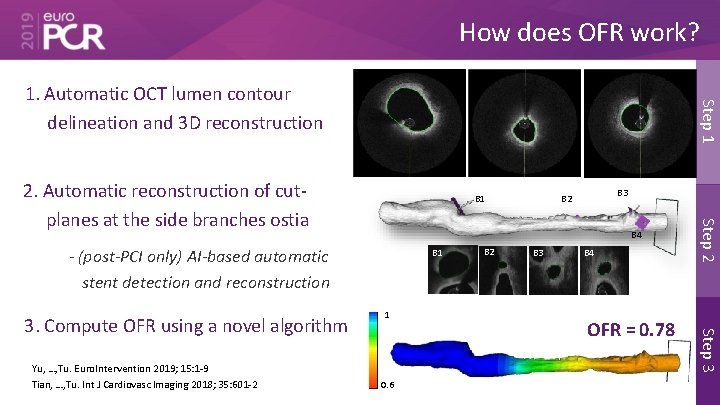
How does OFR work? Step 1 1. Automatic OCT lumen contour delineation and 3 D reconstruction B 1 B 4 - (post-PCI only) AI-based automatic stent detection and reconstruction Yu, …, Tu. Euro. Intervention 2019; 15: 1 -9 Tian, …, Tu. Int J Cardiovasc Imaging 2018; 35: 601 -2 B 1 1 0. 6 B 2 B 3 B 4 OFR = 0. 78 Step 3 3. Compute OFR using a novel algorithm B 3 B 2 Step 2 2. Automatic reconstruction of cutplanes at the side branches ostia
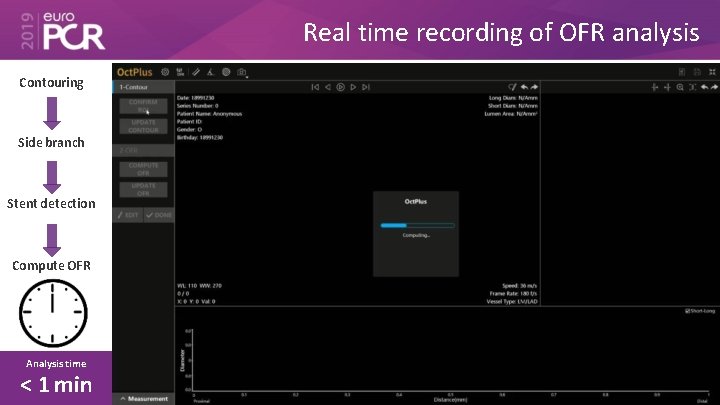
Real time recording of OFR analysis Contouring Side branch Stent detection Compute OFR Analysis time < 1 min
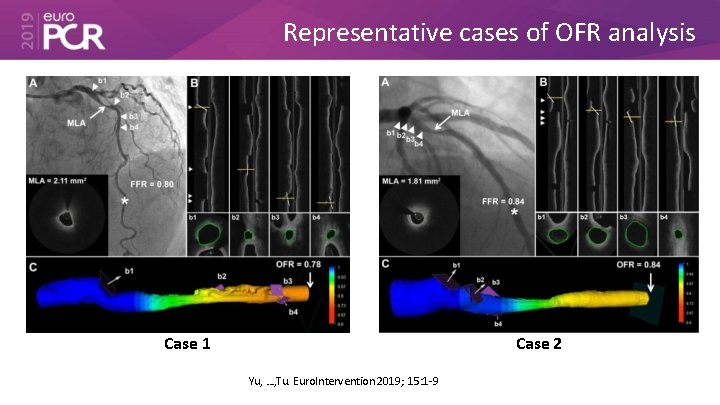
Representative cases of OFR analysis Case 1 Case 2 Yu, …, Tu. Euro. Intervention 2019; 15: 1 -9
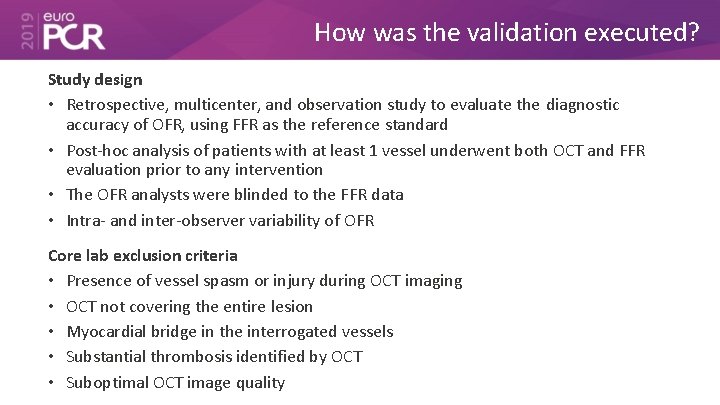
How was the validation executed? Study design • Retrospective, multicenter, and observation study to evaluate the diagnostic accuracy of OFR, using FFR as the reference standard • Post-hoc analysis of patients with at least 1 vessel underwent both OCT and FFR evaluation prior to any intervention • The OFR analysts were blinded to the FFR data • Intra- and inter-observer variability of OFR Core lab exclusion criteria • Presence of vessel spasm or injury during OCT imaging • OCT not covering the entire lesion • Myocardial bridge in the interrogated vessels • Substantial thrombosis identified by OCT • Suboptimal OCT image quality
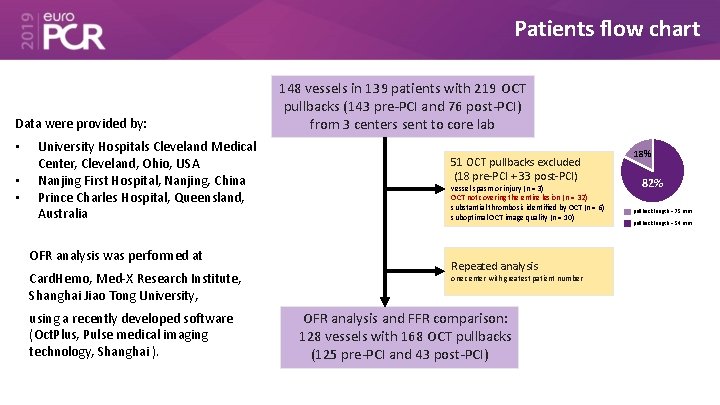
Patients flow chart Data were provided by: • • • University Hospitals Cleveland Medical Center, Cleveland, Ohio, USA Nanjing First Hospital, Nanjing, China Prince Charles Hospital, Queensland, Australia OFR analysis was performed at Card. Hemo, Med-X Research Institute, Shanghai Jiao Tong University, using a recently developed software (Oct. Plus, Pulse medical imaging technology, Shanghai ). 148 vessels in 139 patients with 219 OCT pullbacks (143 pre-PCI and 76 post-PCI) from 3 centers sent to core lab 51 OCT pullbacks excluded (18 pre-PCI + 33 post-PCI) vessel spasm or injury (n = 3) OCT not covering the entire lesion (n = 32) substantial thrombosis identified by OCT (n = 6) suboptimal OCT image quality (n = 10) Repeated analysis one center with greatest patient number OFR analysis and FFR comparison: 128 vessels with 168 OCT pullbacks (125 pre-PCI and 43 post-PCI) 18% 82% pullback length = 75 mm pullback length = 54 mm
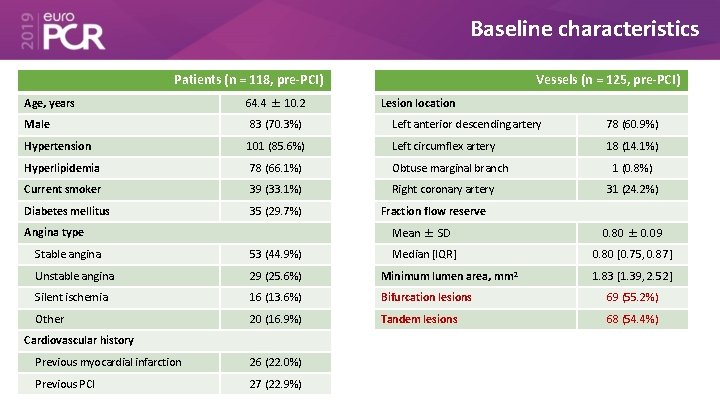
Baseline characteristics Patients (n = 118, pre-PCI) Age, years 64. 4 ± 10. 2 Vessels (n = 125, pre-PCI) Lesion location Male 83 (70. 3%) Left anterior descending artery 78 (60. 9%) Hypertension 101 (85. 6%) Left circumflex artery 18 (14. 1%) Hyperlipidemia 78 (66. 1%) Obtuse marginal branch Current smoker 39 (33. 1%) Right coronary artery Diabetes mellitus 35 (29. 7%) Angina type 1 (0. 8%) 31 (24. 2%) Fraction flow reserve Mean ± SD 0. 80 ± 0. 09 Median [IQR] 0. 80 [0. 75, 0. 87] Stable angina 53 (44. 9%) Unstable angina 29 (25. 6%) Minimum lumen area, mm 2 Silent ischemia 16 (13. 6%) Bifurcation lesions 69 (55. 2%) Other 20 (16. 9%) Tandem lesions 68 (54. 4%) Cardiovascular history Previous myocardial infarction 26 (22. 0%) Previous PCI 27 (22. 9%) 1. 83 [1. 39, 2. 52]
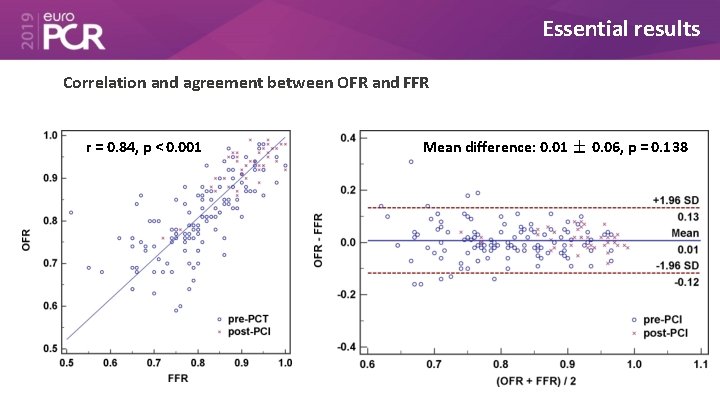
Essential results Correlation and agreement between OFR and FFR r = 0. 84, p < 0. 001 Mean difference: 0. 01 ± 0. 06, p = 0. 138
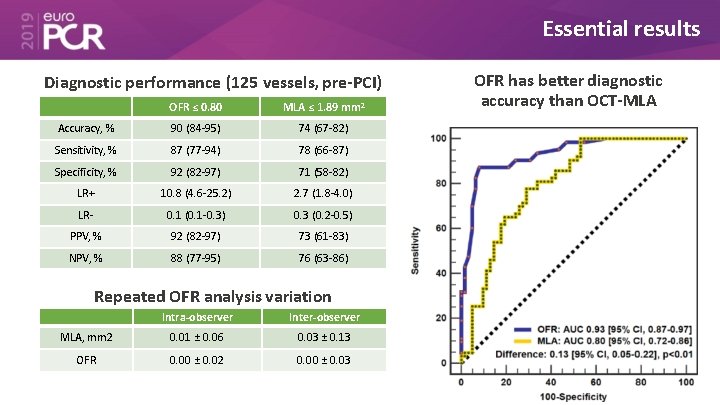
Essential results Diagnostic performance (125 vessels, pre-PCI) OFR ≤ 0. 80 MLA ≤ 1. 89 mm 2 Accuracy, % 90 (84 -95) 74 (67 -82) Sensitivity, % 87 (77 -94) 78 (66 -87) Specificity, % 92 (82 -97) 71 (58 -82) LR+ 10. 8 (4. 6 -25. 2) 2. 7 (1. 8 -4. 0) LR- 0. 1 (0. 1 -0. 3) 0. 3 (0. 2 -0. 5) PPV, % 92 (82 -97) 73 (61 -83) NPV, % 88 (77 -95) 76 (63 -86) Repeated OFR analysis variation Intra-observer Inter-observer MLA, mm 2 0. 01 ± 0. 06 0. 03 ± 0. 13 OFR 0. 00 ± 0. 02 0. 00 ± 0. 03 OFR has better diagnostic accuracy than OCT-MLA
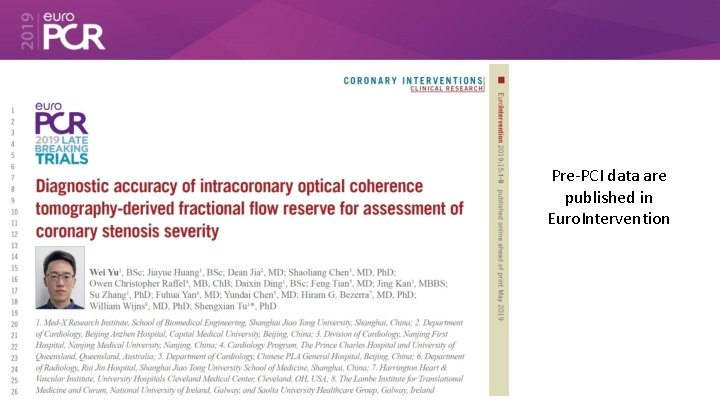
Pre-PCI data are published in Euro. Intervention

The essentials to remember OFR provides lesion morphology and physiological assessment in a single OCT image pullback. Compared with FFR, OFR showed good diagnostic accuracy, excellent reproducibility and short analysis time. OFR had substantially better diagnostic accuracy than OCT-MLA. OFR is promising for use in the cath lab for PCI optimization.
- Slides: 13