
Accuracy of CV determination systems for calculation of
- Slides: 14
Accuracy of CV determination systems for calculation of FWACV Dave Lander Update 12 th October 2011
Overview § Based on work previously carried out October 2006 § Examines how consumers gas bills are estimated § Examines how the accuracy of all of the inputs into the calculation affects the overall accuracy of the gas bill § Poses questions about: • fairness • the appropriate level of acuracy Accuracy of CV determination systems - Page 2
Introductory concepts: error, uncertainty, bias. . . § Uncertainty • "Parameter that characterises the spread of values that could reasonably be attributed to the measurand. " • Range and an associated probability § Error • Measured result minus a “true” value § Bias • Mean value of a distribution of errors. • Associated with an agreed set of conditions (each showing an error) Accuracy of CV determination systems - Page 3
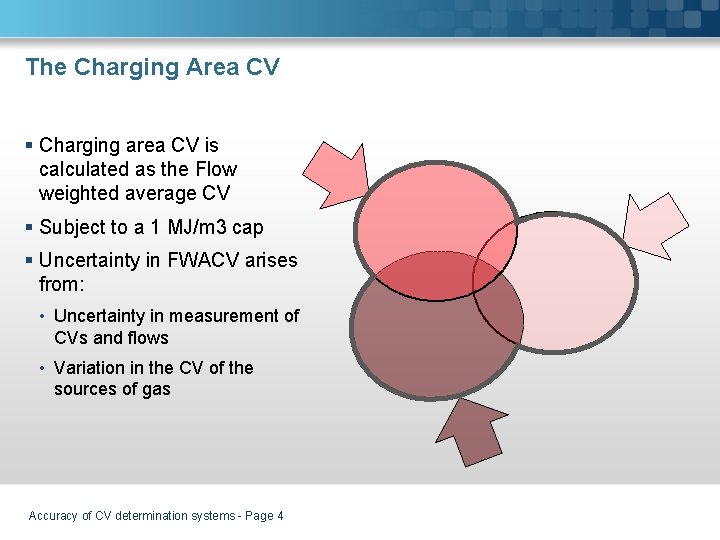
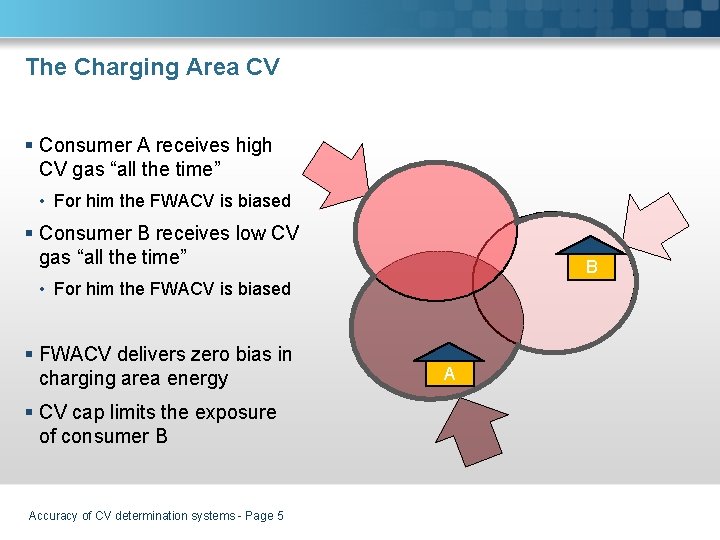
The Charging Area CV § Charging area CV is calculated as the Flow weighted average CV § Subject to a 1 MJ/m 3 cap § Uncertainty in FWACV arises from: • Uncertainty in measurement of CVs and flows • Variation in the CV of the sources of gas Accuracy of CV determination systems - Page 4
The Charging Area CV § Consumer A receives high CV gas “all the time” • For him the FWACV is biased § Consumer B receives low CV gas “all the time” B • For him the FWACV is biased § FWACV delivers zero bias in charging area energy § CV cap limits the exposure of consumer B Accuracy of CV determination systems - Page 5 A
The Consumers’ Energy Bill § Energy = quantity of gas x representative calorific value § Quantity is expressed as volume at reference conditions • Consumer: • actual metered volume x conversion factor • conversion factor is provided in the Regulations § Representative calorific value represents the CV of the gas seen by the consumer • Consumer: • average of charging area CVs over the billing period • determined through use of approved CVDDs Accuracy of CV determination systems - Page 6
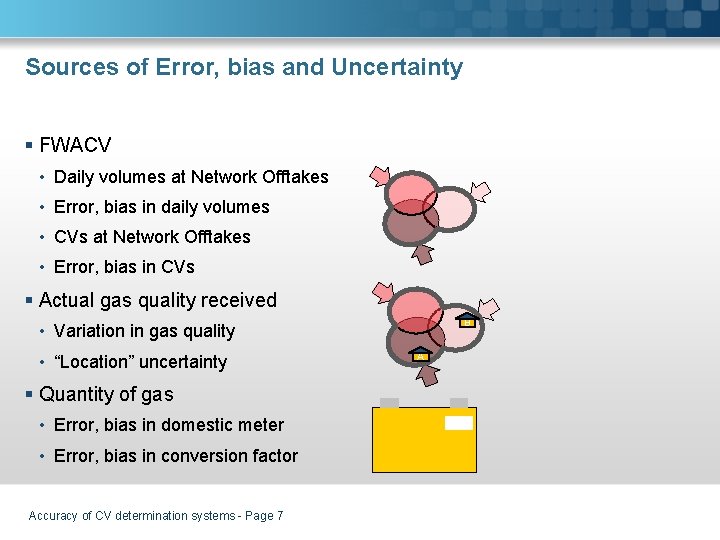
Sources of Error, bias and Uncertainty § FWACV • Daily volumes at Network Offtakes • Error, bias in daily volumes • CVs at Network Offtakes • Error, bias in CVs § Actual gas quality received B • Variation in gas quality • “Location” uncertainty § Quantity of gas • Error, bias in domestic meter • Error, bias in conversion factor Accuracy of CV determination systems - Page 7 A
Estimating error, bias and uncertainty § Principles suggested by Marcogaz Energy Measurement Working Group • Provides guidance on implementation of OIML Recommendation “Gas Metering” • Estimates errors and bias in each component of measurement, which are then combined arithmetically to provide and overall bias in energy measurement • Estimates uncertainties in bias for each source, which are then combined in quadrature to provide an overall uncertainty in bias. • Sources: measurement instrumentation; fixed factors; representative CV calculation Accuracy of CV determination systems - Page 8
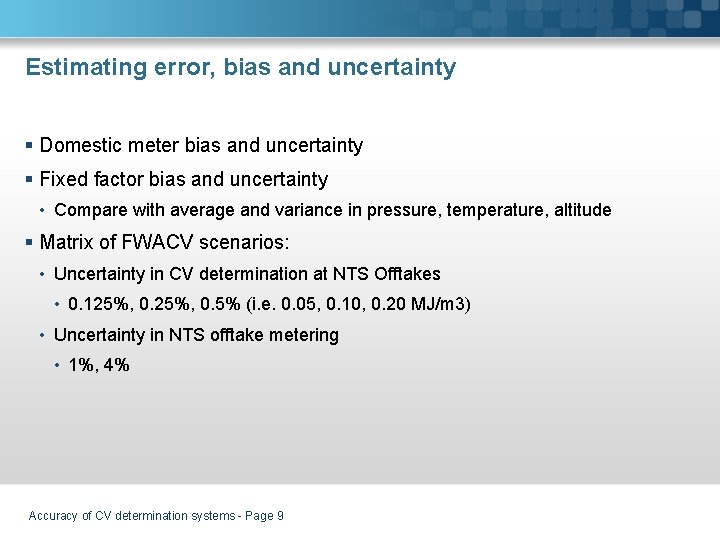
Estimating error, bias and uncertainty § Domestic meter bias and uncertainty § Fixed factor bias and uncertainty • Compare with average and variance in pressure, temperature, altitude § Matrix of FWACV scenarios: • Uncertainty in CV determination at NTS Offtakes • 0. 125%, 0. 5% (i. e. 0. 05, 0. 10, 0. 20 MJ/m 3) • Uncertainty in NTS offtake metering • 1%, 4% Accuracy of CV determination systems - Page 9
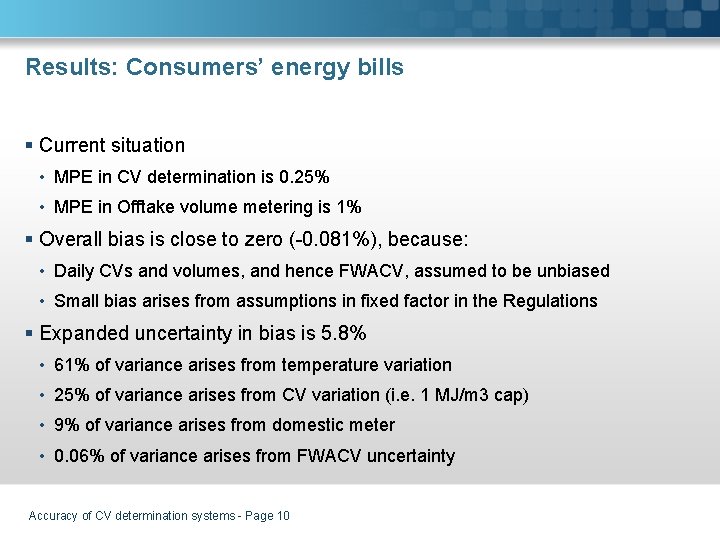
Results: Consumers’ energy bills § Current situation • MPE in CV determination is 0. 25% • MPE in Offtake volume metering is 1% § Overall bias is close to zero (-0. 081%), because: • Daily CVs and volumes, and hence FWACV, assumed to be unbiased • Small bias arises from assumptions in fixed factor in the Regulations § Expanded uncertainty in bias is 5. 8% • 61% of variance arises from temperature variation • 25% of variance arises from CV variation (i. e. 1 MJ/m 3 cap) • 9% of variance arises from domestic meter • 0. 06% of variance arises from FWACV uncertainty Accuracy of CV determination systems - Page 10
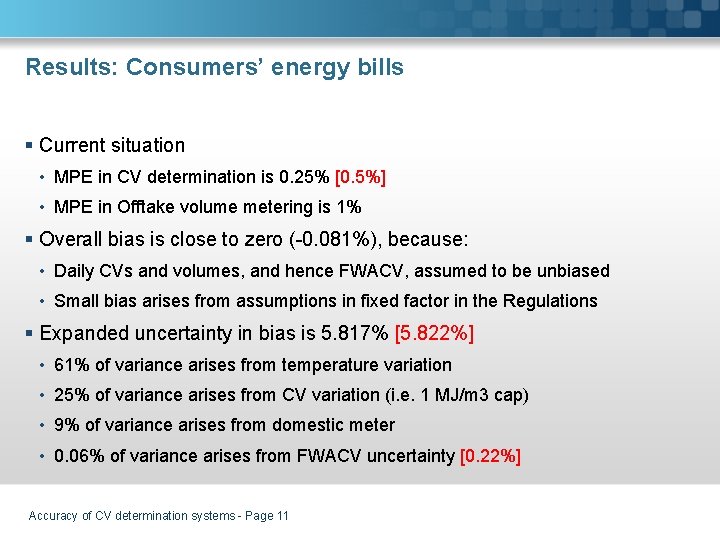
Results: Consumers’ energy bills § Current situation • MPE in CV determination is 0. 25% [0. 5%] • MPE in Offtake volume metering is 1% § Overall bias is close to zero (-0. 081%), because: • Daily CVs and volumes, and hence FWACV, assumed to be unbiased • Small bias arises from assumptions in fixed factor in the Regulations § Expanded uncertainty in bias is 5. 817% [5. 822%] • 61% of variance arises from temperature variation • 25% of variance arises from CV variation (i. e. 1 MJ/m 3 cap) • 9% of variance arises from domestic meter • 0. 06% of variance arises from FWACV uncertainty [0. 22%] Accuracy of CV determination systems - Page 11
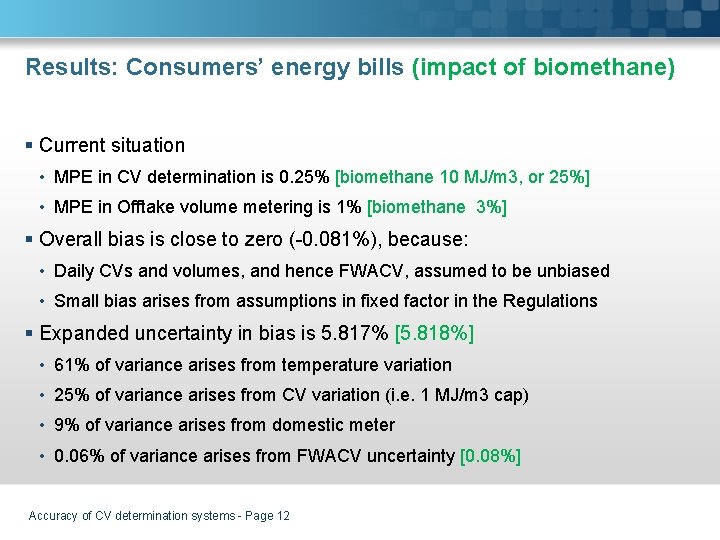
Results: Consumers’ energy bills (impact of biomethane) § Current situation • MPE in CV determination is 0. 25% [biomethane 10 MJ/m 3, or 25%] • MPE in Offtake volume metering is 1% [biomethane 3%] § Overall bias is close to zero (-0. 081%), because: • Daily CVs and volumes, and hence FWACV, assumed to be unbiased • Small bias arises from assumptions in fixed factor in the Regulations § Expanded uncertainty in bias is 5. 817% [5. 818%] • 61% of variance arises from temperature variation • 25% of variance arises from CV variation (i. e. 1 MJ/m 3 cap) • 9% of variance arises from domestic meter • 0. 06% of variance arises from FWACV uncertainty [0. 08%] Accuracy of CV determination systems - Page 12
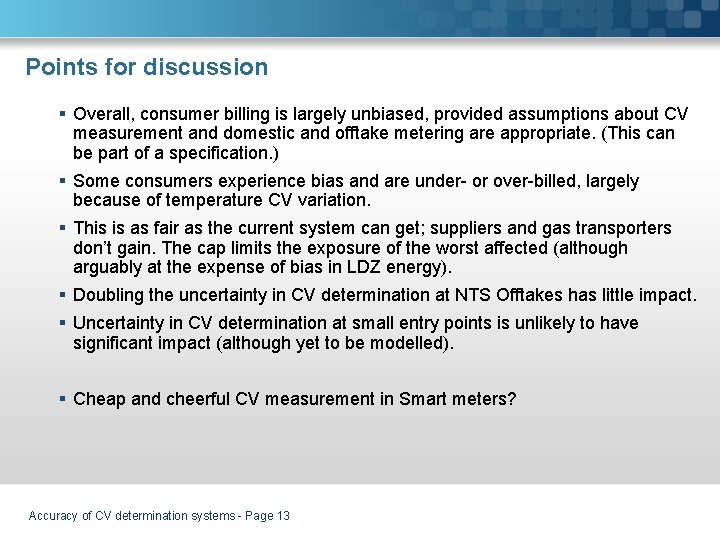
Points for discussion § Overall, consumer billing is largely unbiased, provided assumptions about CV measurement and domestic and offtake metering are appropriate. (This can be part of a specification. ) § Some consumers experience bias and are under- or over-billed, largely because of temperature CV variation. § This is as fair as the current system can get; suppliers and gas transporters don’t gain. The cap limits the exposure of the worst affected (although arguably at the expense of bias in LDZ energy). § Doubling the uncertainty in CV determination at NTS Offtakes has little impact. § Uncertainty in CV determination at small entry points is unlikely to have significant impact (although yet to be modelled). § Cheap and cheerful CV measurement in Smart meters? Accuracy of CV determination systems - Page 13
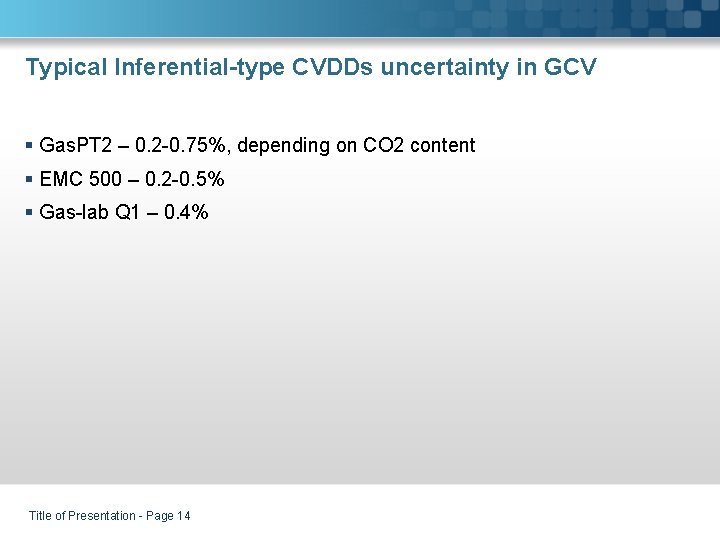
Typical Inferential-type CVDDs uncertainty in GCV § Gas. PT 2 – 0. 2 -0. 75%, depending on CO 2 content § EMC 500 – 0. 2 -0. 5% § Gas-lab Q 1 – 0. 4% Title of Presentation - Page 14