
Accuracy of calculation procedures for offshore wind turbine

Accuracy of calculation procedures for offshore wind turbine support structures Pauline de Valk – 27 th of August 2013
Content � Introduction � Approach � Modeling � Results � Conclusions and recommendations 1
Content � Introduction � Approach � Modeling � Results � Conclusions and recommendations 1
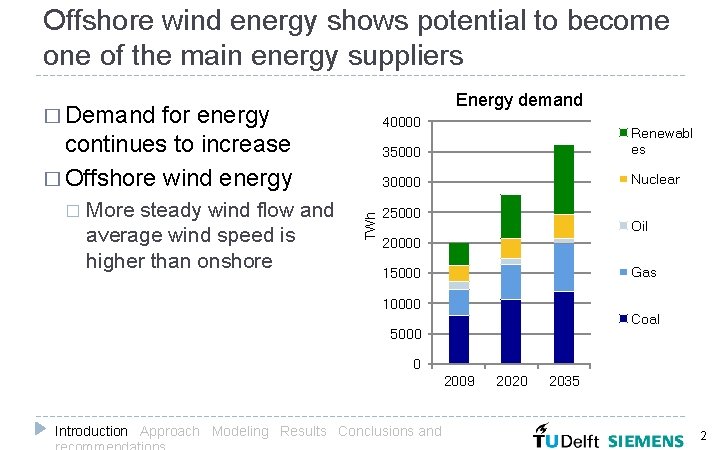
Offshore wind energy shows potential to become one of the main energy suppliers Energy demand � Demand for energy continues to increase � Offshore wind energy More steady wind flow and average wind speed is higher than onshore TWh � 40000 35000 Renewabl es 30000 Nuclear 25000 Oil 20000 Gas 15000 10000 Coal 5000 0 2009 Introduction Approach Modeling Results Conclusions and 2020 2035 2
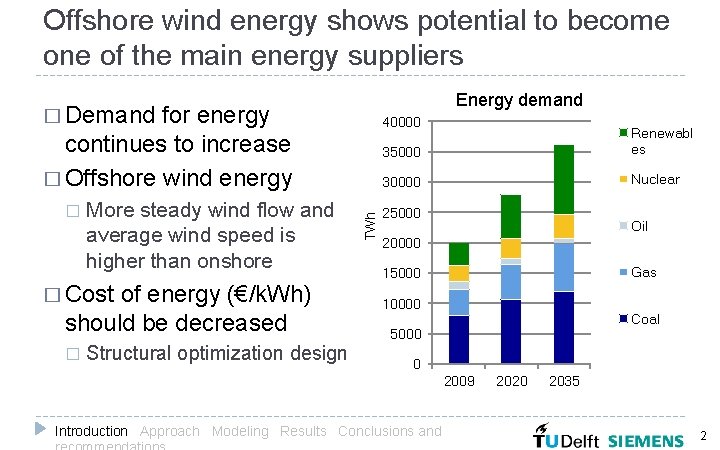
Offshore wind energy shows potential to become one of the main energy suppliers Energy demand � Demand for energy continues to increase � Offshore wind energy More steady wind flow and average wind speed is higher than onshore � Cost of energy (€/k. Wh) should be decreased � Structural optimization design TWh � 40000 35000 Renewabl es 30000 Nuclear 25000 Oil 20000 Gas 15000 10000 Coal 5000 0 2009 Introduction Approach Modeling Results Conclusions and 2020 2035 2
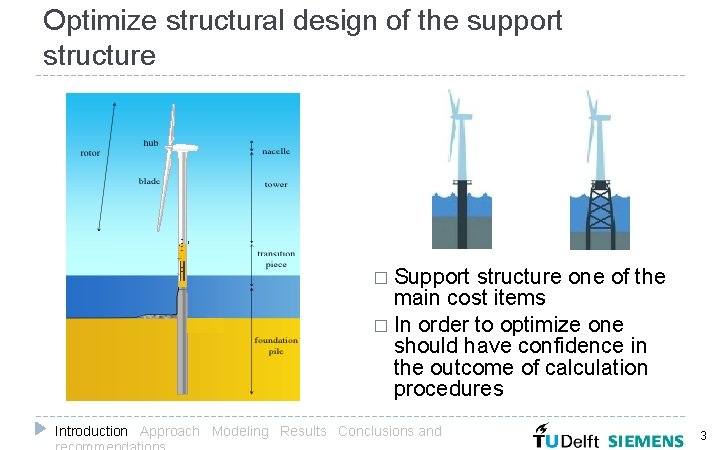
Optimize structural design of the support structure � Support structure one of the main cost items � In order to optimize one should have confidence in the outcome of calculation procedures Introduction Approach Modeling Results Conclusions and 3
Thesis objective ‘‘Investigate the validity and conservatism Introduction Approach Modeling Results Conclusions and 4
Thesis objective ‘‘Investigate the validity and conservatism of the current calculation procedures Introduction Approach Modeling Results Conclusions and 4
Thesis objective ‘‘Investigate the validity and conservatism of the current calculation procedures for offshore wind turbine support structures Introduction Approach Modeling Results Conclusions and 4
Thesis objective ‘‘Investigate the validity and conservatism of the current calculation procedures for offshore wind turbine support structures and propose improved procedures Introduction Approach Modeling Results Conclusions and 4
Thesis objective ‘‘Investigate the validity and conservatism of the current calculation procedures for offshore wind turbine support structures and propose improved procedures based on these findings. ” Introduction Approach Modeling Results Conclusions and 4
Content � Introduction � Approach � Modeling � Results � Conclusions and recommendations 5
Offshore wind turbine support structure is custom engineered for every wind farm Foundation designer (FD) Turbine designer (TD) Introduction Approach Modeling Results Conclusions and 6
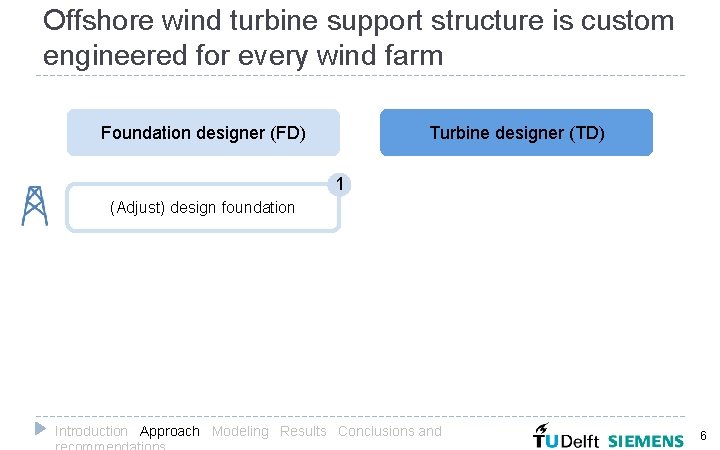
Offshore wind turbine support structure is custom engineered for every wind farm Foundation designer (FD) Turbine designer (TD) 1 (Adjust) design foundation Introduction Approach Modeling Results Conclusions and 6
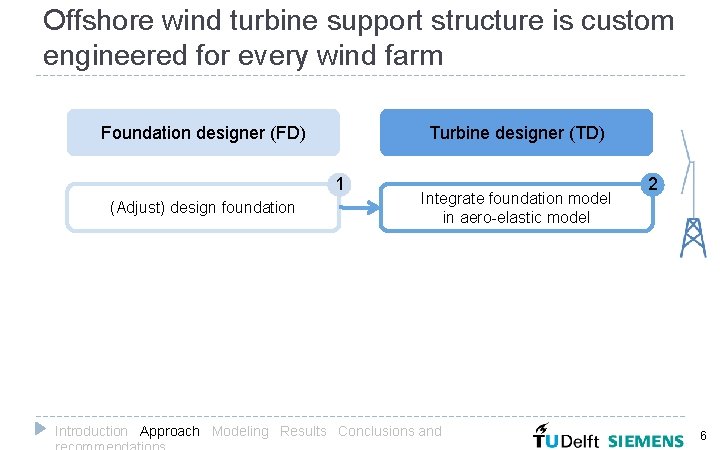
Offshore wind turbine support structure is custom engineered for every wind farm Foundation designer (FD) Turbine designer (TD) 1 (Adjust) design foundation Integrate foundation model in aero-elastic model Introduction Approach Modeling Results Conclusions and 2 6
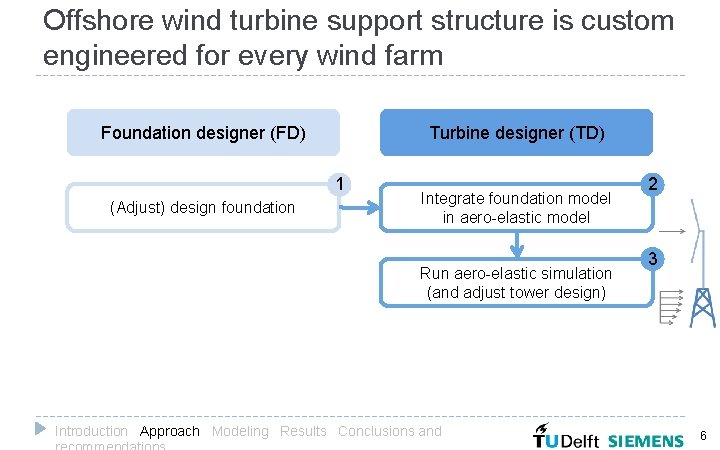
Offshore wind turbine support structure is custom engineered for every wind farm Foundation designer (FD) Turbine designer (TD) 1 (Adjust) design foundation Integrate foundation model in aero-elastic model Run aero-elastic simulation (and adjust tower design) Introduction Approach Modeling Results Conclusions and 2 3 6
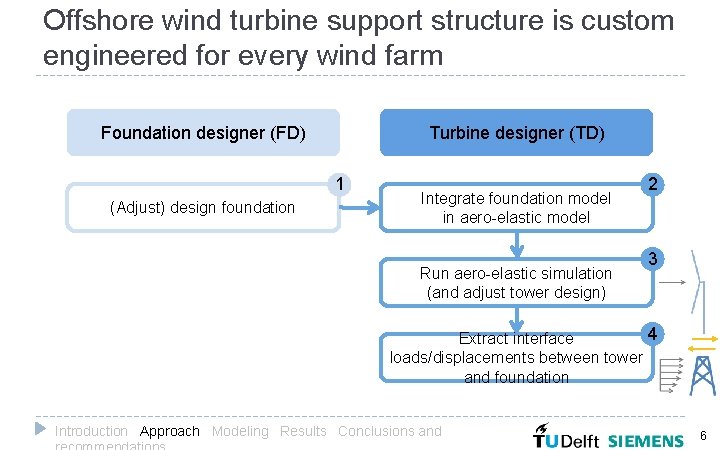
Offshore wind turbine support structure is custom engineered for every wind farm Foundation designer (FD) Turbine designer (TD) 1 (Adjust) design foundation Integrate foundation model in aero-elastic model Run aero-elastic simulation (and adjust tower design) 2 3 4 Extract interface loads/displacements between tower and foundation Introduction Approach Modeling Results Conclusions and 6
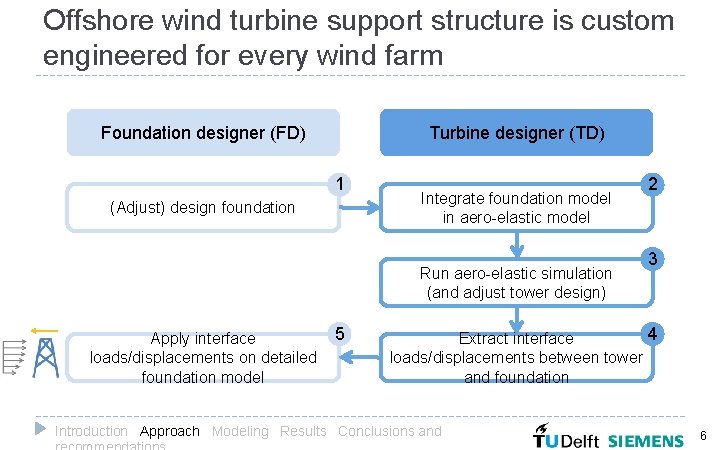
Offshore wind turbine support structure is custom engineered for every wind farm Foundation designer (FD) Turbine designer (TD) 1 (Adjust) design foundation Integrate foundation model in aero-elastic model Run aero-elastic simulation (and adjust tower design) Apply interface loads/displacements on detailed foundation model 5 2 3 4 Extract interface loads/displacements between tower and foundation Introduction Approach Modeling Results Conclusions and 6
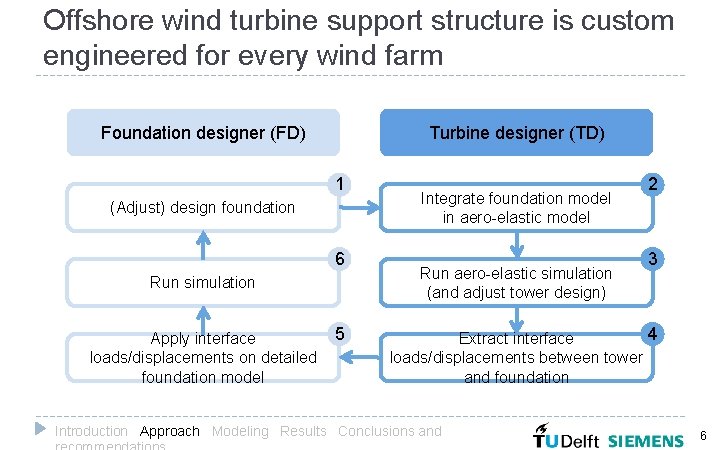
Offshore wind turbine support structure is custom engineered for every wind farm Foundation designer (FD) Turbine designer (TD) 1 (Adjust) design foundation 6 Run simulation Apply interface loads/displacements on detailed foundation model 5 Integrate foundation model in aero-elastic model Run aero-elastic simulation (and adjust tower design) 2 3 4 Extract interface loads/displacements between tower and foundation Introduction Approach Modeling Results Conclusions and 6
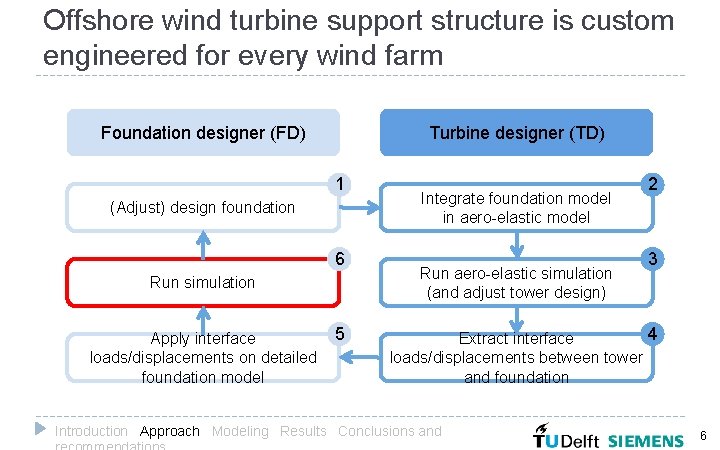
Offshore wind turbine support structure is custom engineered for every wind farm Foundation designer (FD) Turbine designer (TD) 1 (Adjust) design foundation 6 Run simulation Apply interface loads/displacements on detailed foundation model 5 Integrate foundation model in aero-elastic model Run aero-elastic simulation (and adjust tower design) 2 3 4 Extract interface loads/displacements between tower and foundation Introduction Approach Modeling Results Conclusions and 6
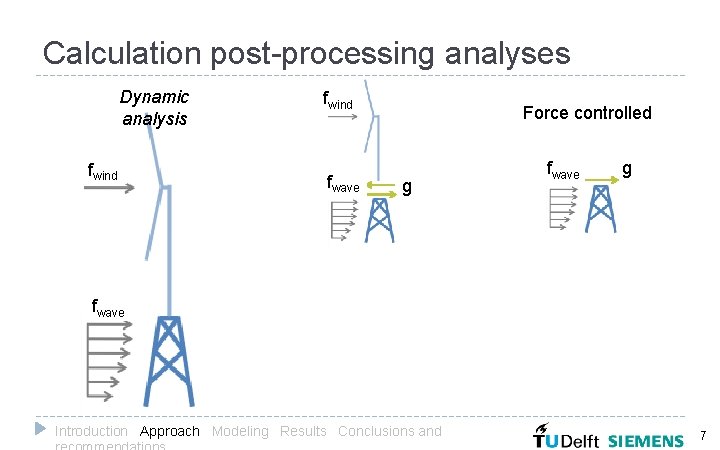
Calculation post-processing analyses Dynamic analysis fwind fwave Force controlled g fwave Introduction Approach Modeling Results Conclusions and 7
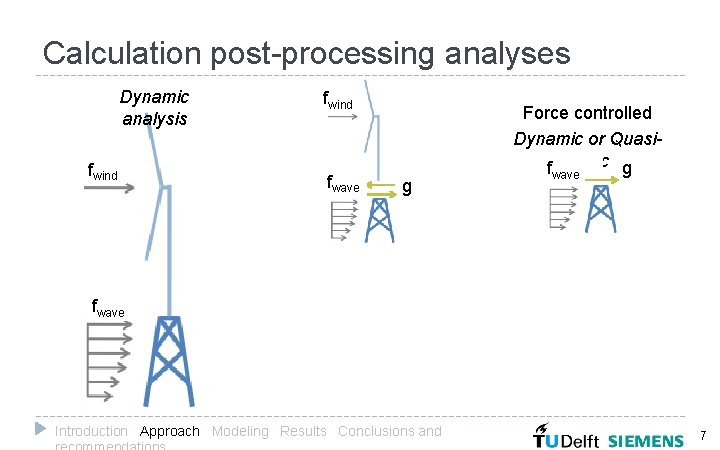
Calculation post-processing analyses Dynamic analysis fwind fwave g Force controlled Dynamic or Quasif static g wave fwave Introduction Approach Modeling Results Conclusions and 7
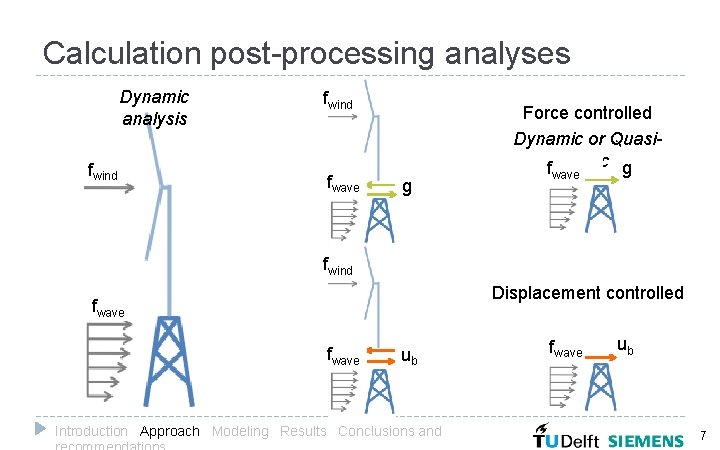
Calculation post-processing analyses Dynamic analysis fwind fwave g Force controlled Dynamic or Quasif static g wave fwind Displacement controlled fwave ub Introduction Approach Modeling Results Conclusions and fwave ub 7
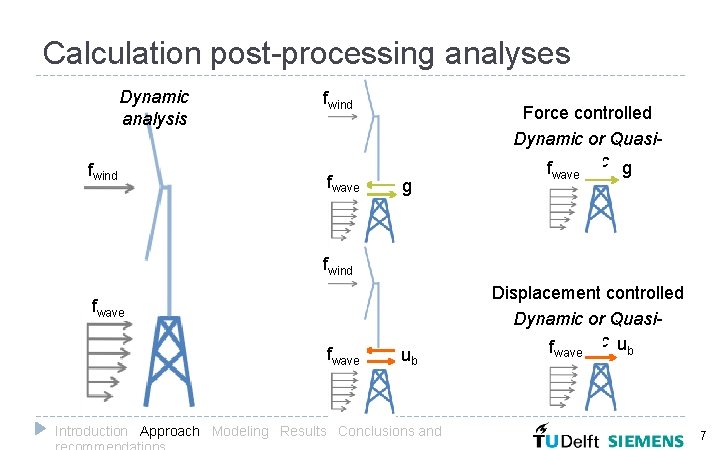
Calculation post-processing analyses Dynamic analysis fwind fwave g Force controlled Dynamic or Quasif static g wave fwind fwave ub Introduction Approach Modeling Results Conclusions and Displacement controlled Dynamic or Quasistatic ub fwave 7
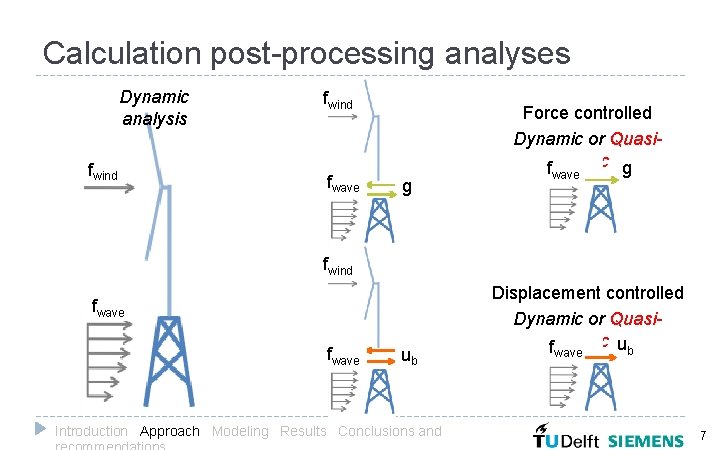
Calculation post-processing analyses Dynamic analysis fwind fwave g Force controlled Dynamic or Quasif static g wave fwind fwave ub Introduction Approach Modeling Results Conclusions and Displacement controlled Dynamic or Quasistatic ub fwave 7
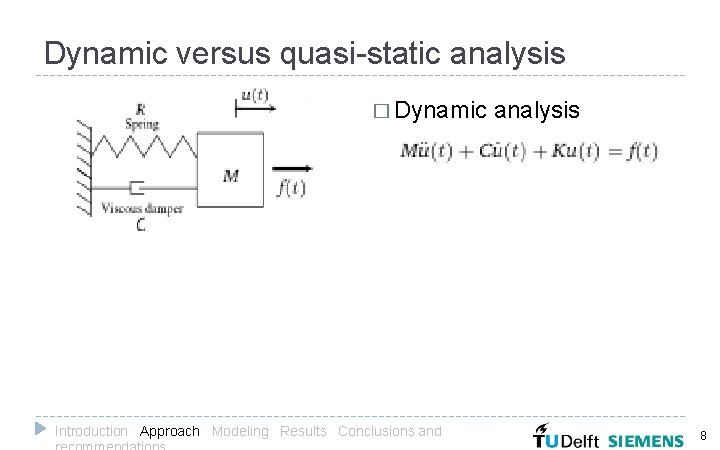
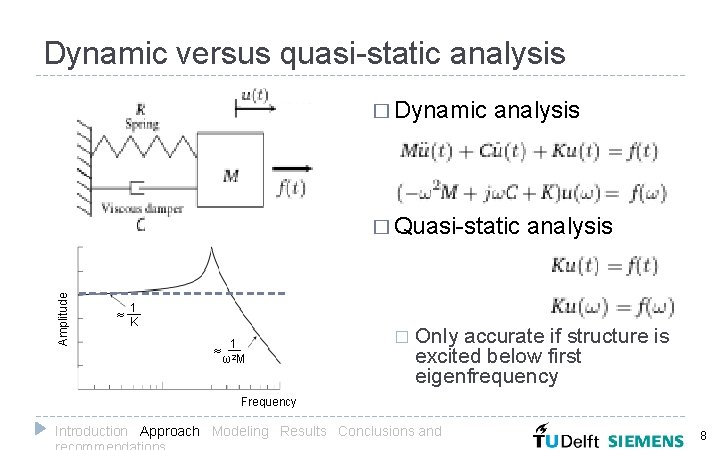
Dynamic versus quasi-static analysis � Dynamic analysis � Quasi-static � analysis Only accurate if structure is excited below first eigenfrequency Introduction Approach Modeling Results Conclusions and 8
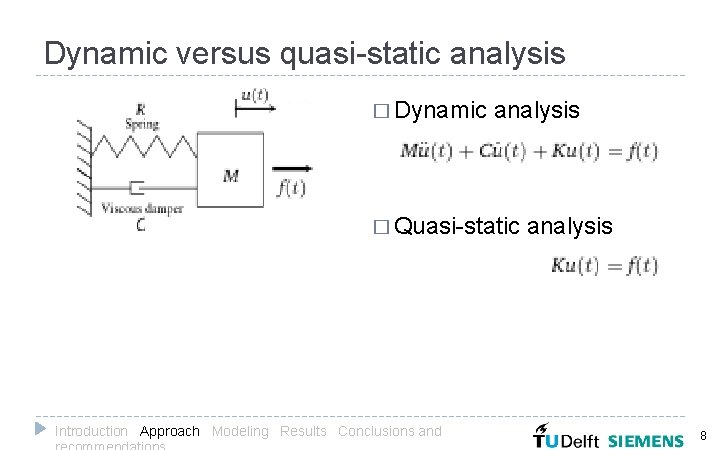
Dynamic versus quasi-static analysis � Dynamic analysis � Quasi-static � analysis Only accurate if structure is excited below first eigenfrequency Introduction Approach Modeling Results Conclusions and 8
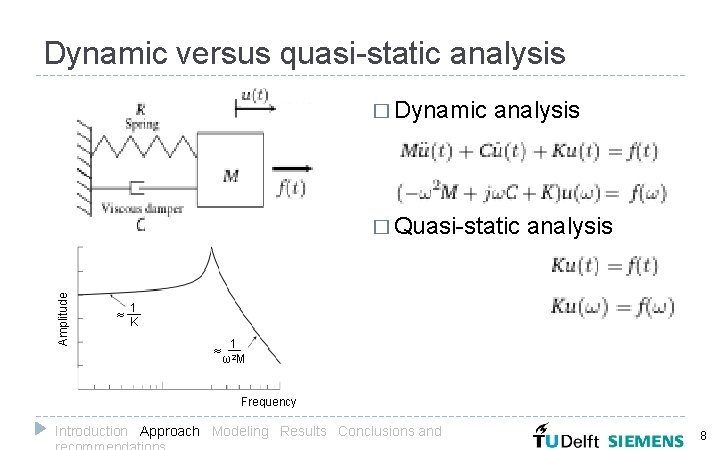
Dynamic versus quasi-static analysis � Dynamic analysis Amplitude � Quasi-static 1 __ ≈ K 1 __ ≈ 2 ωM � analysis Only accurate if structure is excited below first eigenfrequency Frequency Introduction Approach Modeling Results Conclusions and 8
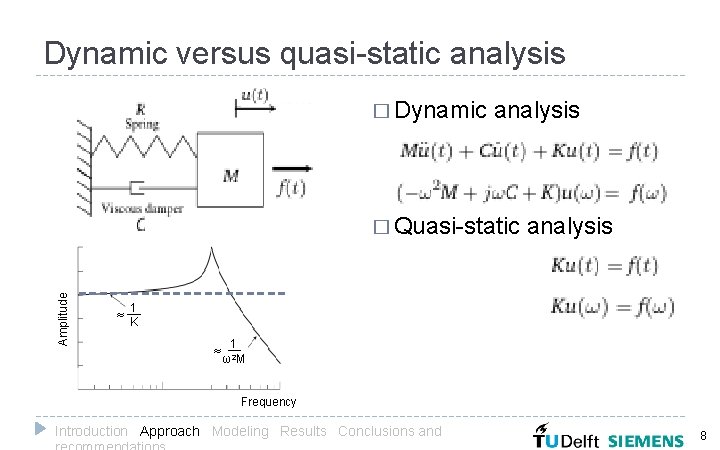
Dynamic versus quasi-static analysis � Dynamic analysis Amplitude � Quasi-static 1 __ ≈ K 1 __ ≈ 2 ωM � analysis Only accurate if structure is excited below first eigenfrequency Frequency Introduction Approach Modeling Results Conclusions and 8
Dynamic versus quasi-static analysis � Dynamic analysis Amplitude � Quasi-static 1 __ ≈ K 1 __ ≈ 2 ωM � analysis Only accurate if structure is excited below first eigenfrequency Frequency Introduction Approach Modeling Results Conclusions and 8
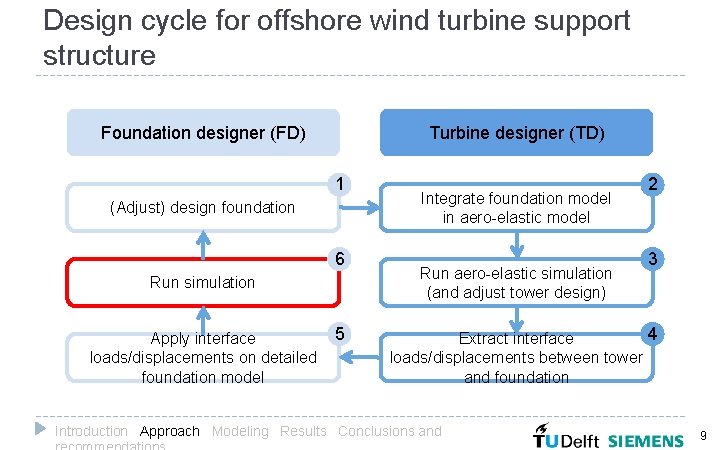
Design cycle for offshore wind turbine support structure Foundation designer (FD) Turbine designer (TD) 1 (Adjust) design foundation 6 Run simulation Apply interface loads/displacements on detailed foundation model 5 Integrate foundation model in aero-elastic model Run aero-elastic simulation (and adjust tower design) 2 3 4 Extract interface loads/displacements between tower and foundation Introduction Approach Modeling Results Conclusions and 9
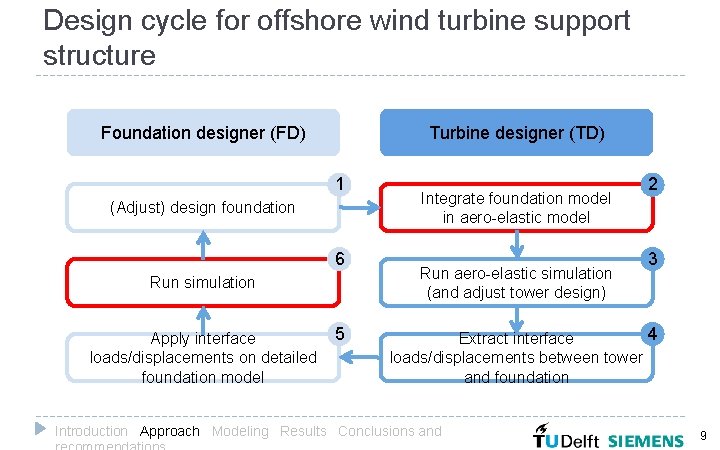
Design cycle for offshore wind turbine support structure Foundation designer (FD) Turbine designer (TD) 1 (Adjust) design foundation 6 Run simulation Apply interface loads/displacements on detailed foundation model 5 Integrate foundation model in aero-elastic model Run aero-elastic simulation (and adjust tower design) 2 3 4 Extract interface loads/displacements between tower and foundation Introduction Approach Modeling Results Conclusions and 9
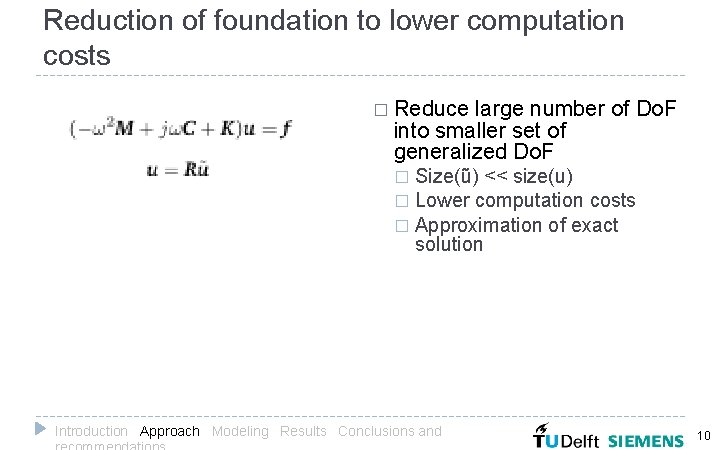
Reduction of foundation to lower computation costs � Reduce large number of Do. F into smaller set of generalized Do. F Size(ũ) << size(u) � Lower computation costs � Approximation of exact solution � � Reduction basis contains limited number of deformation shapes � Only accurate if Spectral convergence � Spatial convergence � Introduction Approach Modeling Results Conclusions and 10
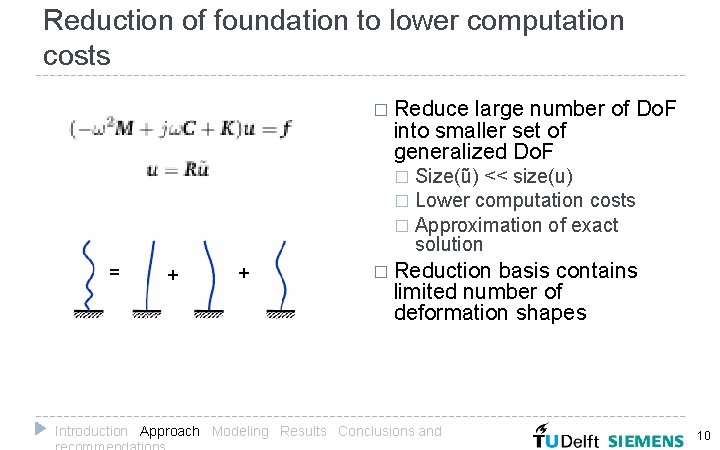
Reduction of foundation to lower computation costs � Reduce large number of Do. F into smaller set of generalized Do. F Size(ũ) << size(u) � Lower computation costs � Approximation of exact solution � = + + � Reduction basis contains limited number of deformation shapes � Only accurate if Spectral convergence � Spatial convergence � Introduction Approach Modeling Results Conclusions and 10
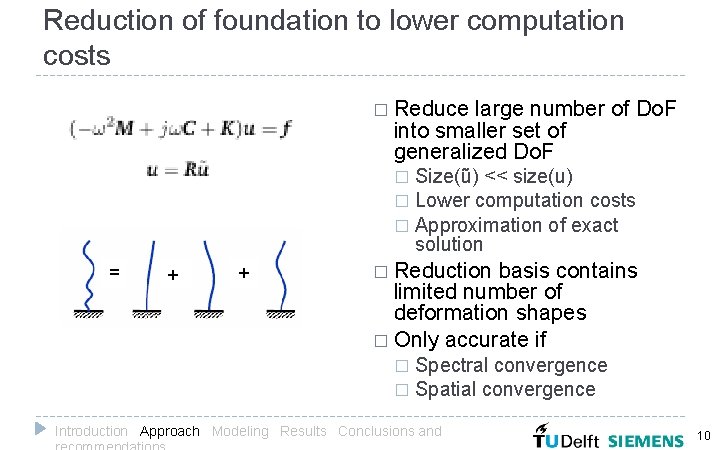
Reduction of foundation to lower computation costs � Reduce large number of Do. F into smaller set of generalized Do. F Size(ũ) << size(u) � Lower computation costs � Approximation of exact solution � = + + � Reduction basis contains limited number of deformation shapes � Only accurate if Spectral convergence � Spatial convergence � Introduction Approach Modeling Results Conclusions and 10
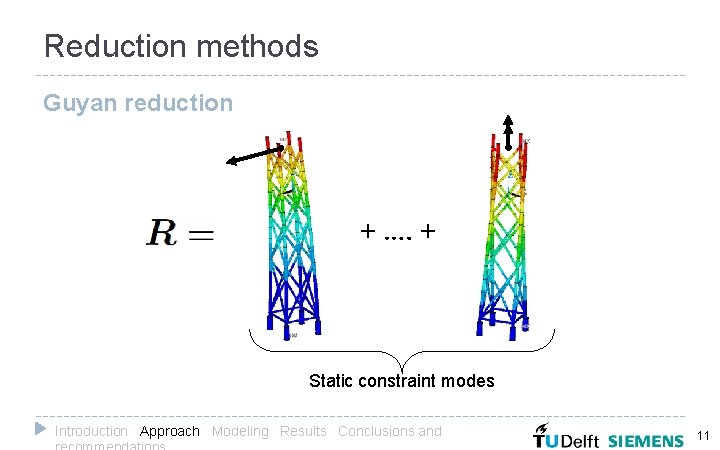
Reduction methods Guyan reduction + …. + Static constraint modes Introduction Approach Modeling Results Conclusions and 11
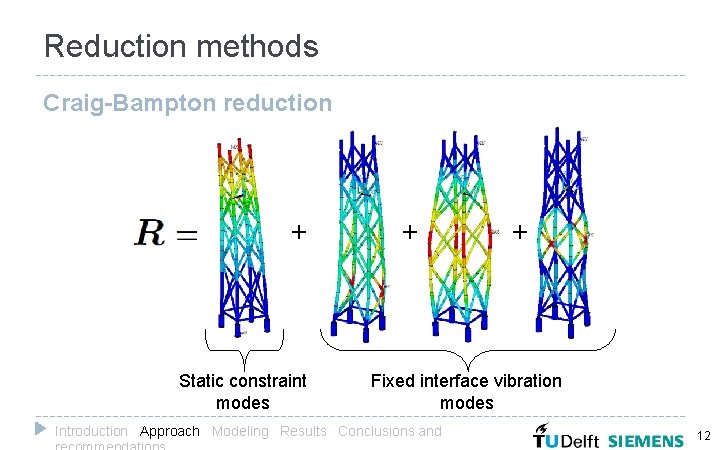
Reduction methods Craig-Bampton reduction + Static constraint modes + + Fixed interface vibration modes Introduction Approach Modeling Results Conclusions and 12
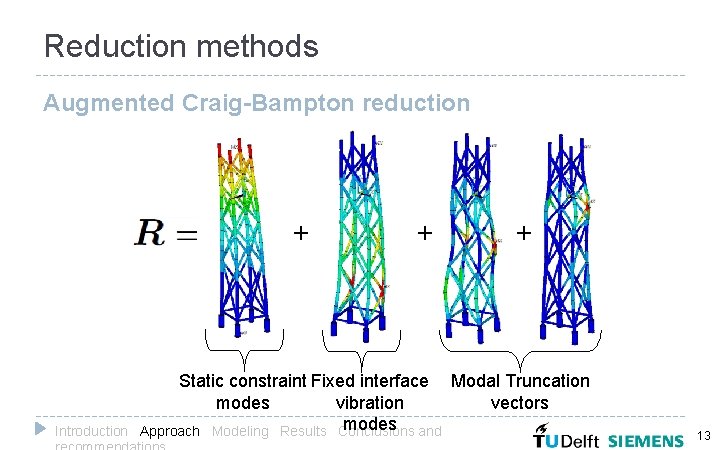
Reduction methods Augmented Craig-Bampton reduction + Introduction + + Static constraint Fixed interface Modal Truncation vibration vectors modes and Approach Modeling Results Conclusions 13
Impact on fatigue damage results � Offshore wind turbine exposed to cyclic loading � Fatigue is one of the main design drivers � Impact of error in the reponse on the accuracy of the fatigue damage results Introduction Approach Modeling Results Conclusions and 14
Content �Introduction �Approach �Modeling �Results �Conclusions and recommendations 15
![Monopile versus Jacket Eigenfrequency 1 st OWT model [Hz] Foundation ωfree [Hz] 0. 30](http://slidetodoc.com/presentation_image_h2/c200a5943a59db8f8a90320a5e945a3c/image-41.jpg "Monopile versus Jacket Eigenfrequency 1 st OWT model [Hz] Foundation ωfree [Hz] 0. 30")
Monopile versus Jacket Eigenfrequency 1 st OWT model [Hz] Foundation ωfree [Hz] 0. 30 OWT model [Hz] 6. 73 Foundation ωfree [Hz] 0. 27 Introduction Approach Modeling Results Conclusions and 1. 06 Foundation ωfixed [Hz] 42. 8 Foundation ωfixed [Hz] 4. 09 16
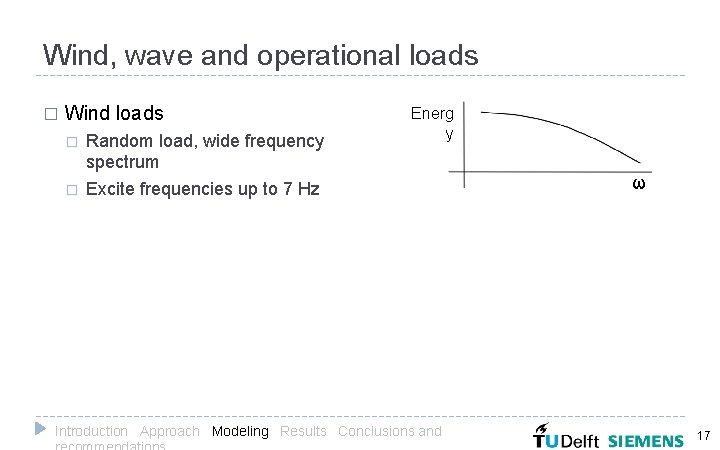
Wind, wave and operational loads � Wind loads � � Random load, wide frequency spectrum Excite frequencies up to 7 Hz Energ y Introduction Approach Modeling Results Conclusions and ω 17
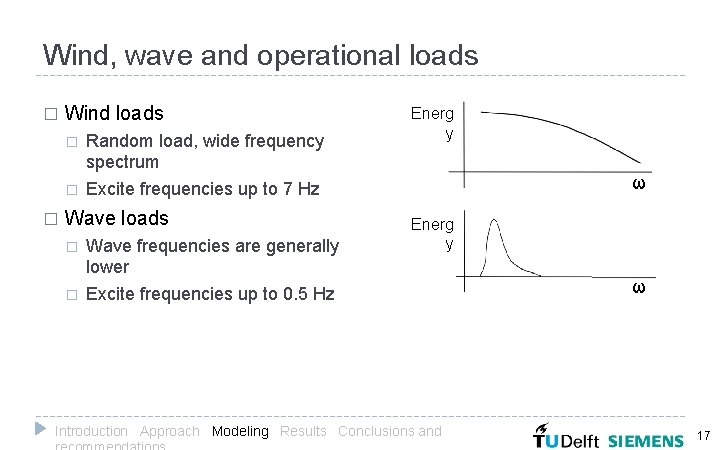
Wind, wave and operational loads � Wind loads � � � Random load, wide frequency spectrum Excite frequencies up to 7 Hz Wave loads � � Wave frequencies are generally lower Excite frequencies up to 0. 5 Hz Energ y ω Energ y Introduction Approach Modeling Results Conclusions and ω 17
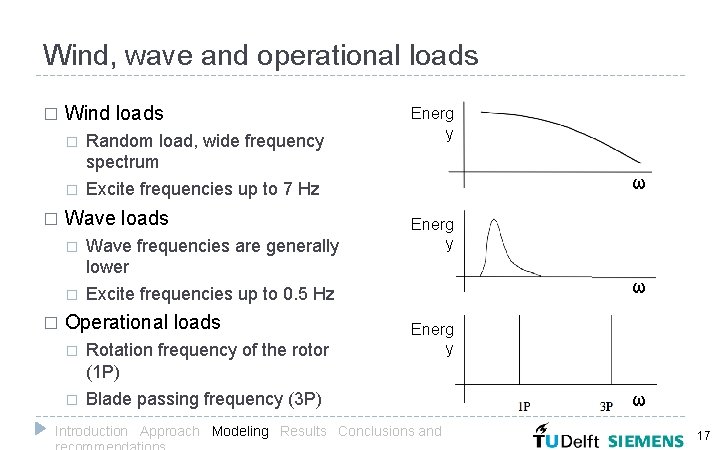
Wind, wave and operational loads � Wind loads � � � Wave loads � � � Random load, wide frequency spectrum Excite frequencies up to 7 Hz Wave frequencies are generally lower Excite frequencies up to 0. 5 Hz Operational loads � � Rotation frequency of the rotor (1 P) Blade passing frequency (3 P) Energ y ω Energ y Introduction Approach Modeling Results Conclusions and ω 17
Content �Introduction �Approach �Modeling �Results �Conclusions and recommendations 18
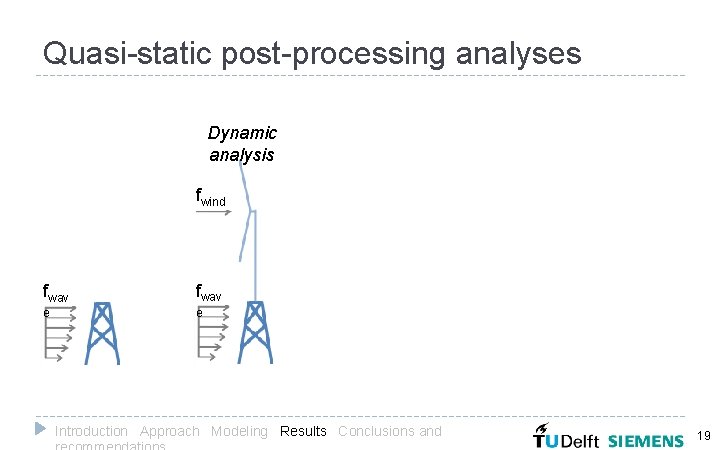
Quasi-static post-processing analyses Dynamic analysis fwind fwav e e Introduction Approach Modeling Results Conclusions and 19
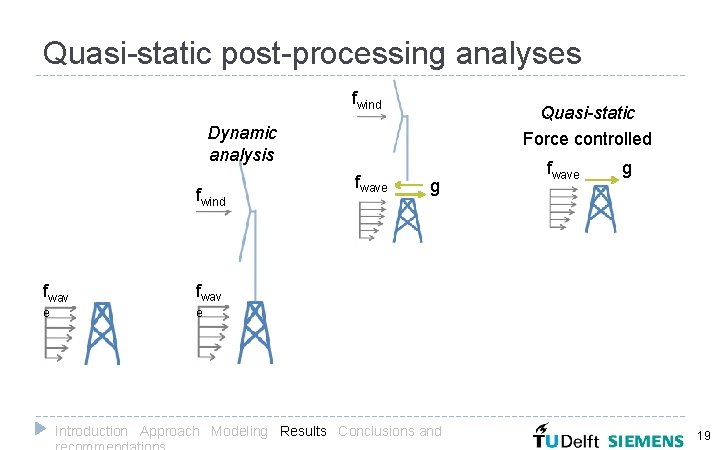
Quasi-static post-processing analyses fwind Quasi-static Force controlled Dynamic analysis fwind fwav e e fwave g Introduction Approach Modeling Results Conclusions and fwave g 19
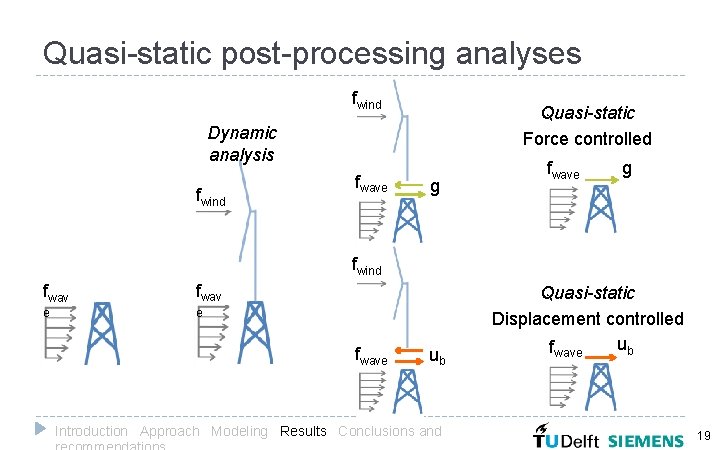
Quasi-static post-processing analyses fwind Quasi-static Force controlled Dynamic analysis fwind fwave g fwind fwav e e fwave ub Introduction Approach Modeling Results Conclusions and Quasi-static Displacement controlled ub fwave 19
![Accuracy of quasi-static post-processing Energy [ J[]J ] Elastic energy in the foundation structure](http://slidetodoc.com/presentation_image_h2/c200a5943a59db8f8a90320a5e945a3c/image-49.jpg "Accuracy of quasi-static post-processing Energy [ J[]J ] Elastic energy in the foundation structure")
Accuracy of quasi-static post-processing Energy [ J[]J ] Elastic energy in the foundation structure ωfree Excitation frequency [Hz] Introduction Approach Modeling Results Conclusions and 20
![Accuracy of quasi-static post-processing Energy [ J ] Elastic energy in the foundation structure](http://slidetodoc.com/presentation_image_h2/c200a5943a59db8f8a90320a5e945a3c/image-50.jpg "Accuracy of quasi-static post-processing Energy [ J ] Elastic energy in the foundation structure")
Accuracy of quasi-static post-processing Energy [ J ] Elastic energy in the foundation structure ωfree Energy [ J ] ωfixed Excitation frequency [Hz] Introduction Approach Modeling Results Conclusions and 20
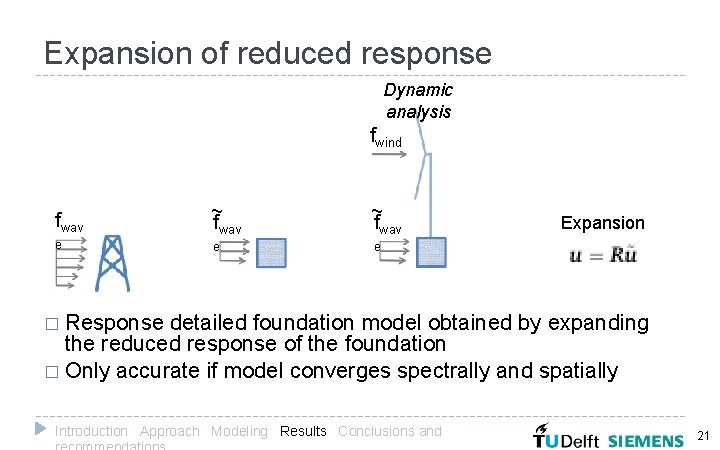
Expansion of reduced response Dynamic analysis fwind fwav ~ fwav e e e Expansion � Response detailed foundation model obtained by expanding the reduced response of the foundation � Only accurate if model converges spectrally and spatially Introduction Approach Modeling Results Conclusions and 21
![Spectral convergence Relative difference eigenfrequencies of reduced OWT model Frequency [Hz] Introduction Approach Modeling](http://slidetodoc.com/presentation_image_h2/c200a5943a59db8f8a90320a5e945a3c/image-52.jpg "Spectral convergence Relative difference eigenfrequencies of reduced OWT model Frequency [Hz] Introduction Approach Modeling")
Spectral convergence Relative difference eigenfrequencies of reduced OWT model Frequency [Hz] Introduction Approach Modeling Results Conclusions and 22
![Spectral convergence Relative difference eigenfrequencies of reduced OWT model Frequency [Hz] Introduction Approach Modeling](http://slidetodoc.com/presentation_image_h2/c200a5943a59db8f8a90320a5e945a3c/image-53.jpg "Spectral convergence Relative difference eigenfrequencies of reduced OWT model Frequency [Hz] Introduction Approach Modeling")
Spectral convergence Relative difference eigenfrequencies of reduced OWT model Frequency [Hz] Introduction Approach Modeling Results Conclusions and 22
![Expansion of reduced response Relative energy difference of expanded response Excitation frequency [Hz] Introduction](http://slidetodoc.com/presentation_image_h2/c200a5943a59db8f8a90320a5e945a3c/image-54.jpg "Expansion of reduced response Relative energy difference of expanded response Excitation frequency [Hz] Introduction")
Expansion of reduced response Relative energy difference of expanded response Excitation frequency [Hz] Introduction Approach Modeling Results Conclusions and 23
![Expansion of reduced response Relative energy difference of expanded response Excitation frequency [Hz] Residual](http://slidetodoc.com/presentation_image_h2/c200a5943a59db8f8a90320a5e945a3c/image-55.jpg "Expansion of reduced response Relative energy difference of expanded response Excitation frequency [Hz] Residual")
Expansion of reduced response Relative energy difference of expanded response Excitation frequency [Hz] Residual correction Introduction Approach Modeling Results Conclusions and 23
![Expansion of reduced response Relative energy difference of expanded response Excitation frequency [Hz] Residual](http://slidetodoc.com/presentation_image_h2/c200a5943a59db8f8a90320a5e945a3c/image-56.jpg "Expansion of reduced response Relative energy difference of expanded response Excitation frequency [Hz] Residual")
Expansion of reduced response Relative energy difference of expanded response Excitation frequency [Hz] Residual correction Introduction Approach Modeling Results Conclusions and 23
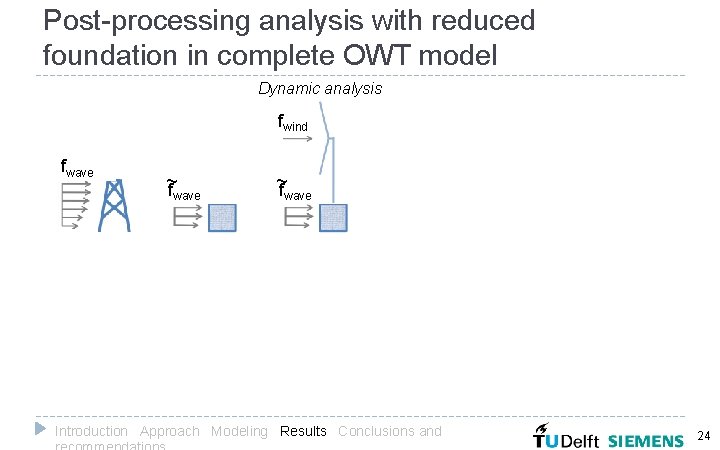
Post-processing analysis with reduced foundation in complete OWT model Dynamic analysis fwind fwave ~f wave Introduction Approach Modeling Results Conclusions and 24
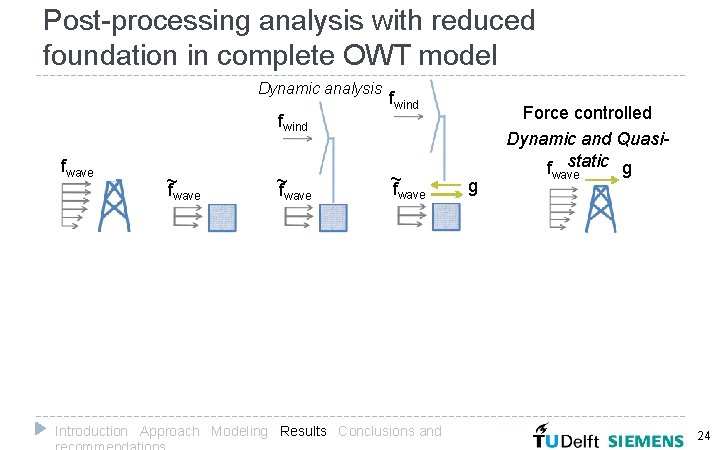
Post-processing analysis with reduced foundation in complete OWT model Dynamic analysis fwind fwave ~f wave fwind ~ fwave Introduction Approach Modeling Results Conclusions and g Force controlled Dynamic and Quasif static g wave 24
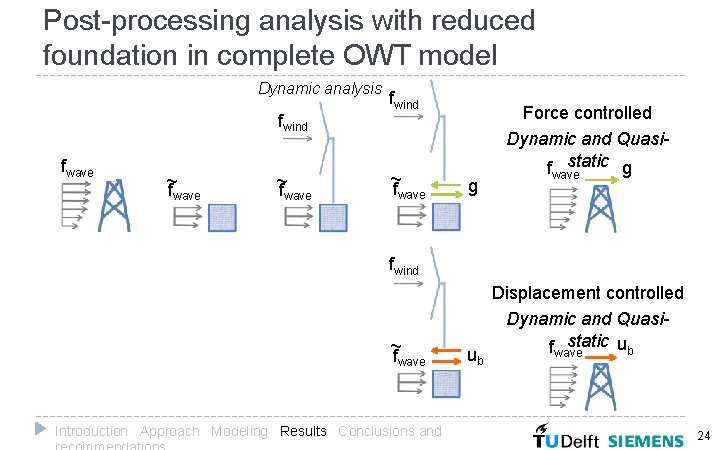
Post-processing analysis with reduced foundation in complete OWT model Dynamic analysis fwind fwave ~f wave fwind ~ fwave g Force controlled Dynamic and Quasif static g wave fwind ~ fwave Introduction Approach Modeling Results Conclusions and ub Displacement controlled Dynamic and Quasistatic ub fwave 24
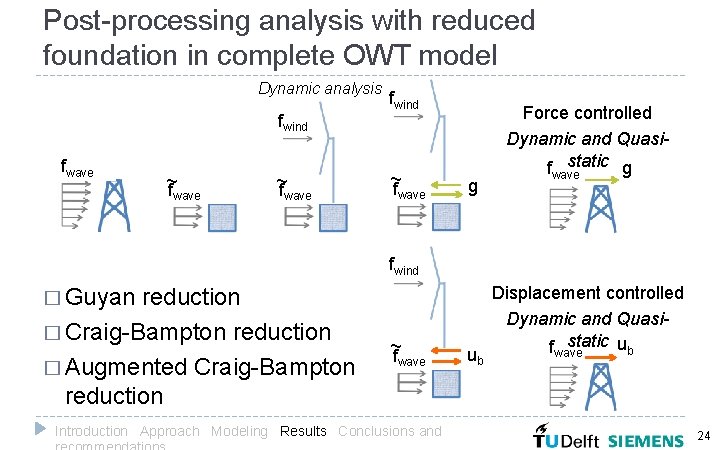
Post-processing analysis with reduced foundation in complete OWT model Dynamic analysis fwind fwave ~f wave fwind ~ fwave g Force controlled Dynamic and Quasif static g wave fwind � Guyan reduction � Craig-Bampton reduction � Augmented Craig-Bampton reduction ~ fwave Introduction Approach Modeling Results Conclusions and ub Displacement controlled Dynamic and Quasistatic ub fwave 24
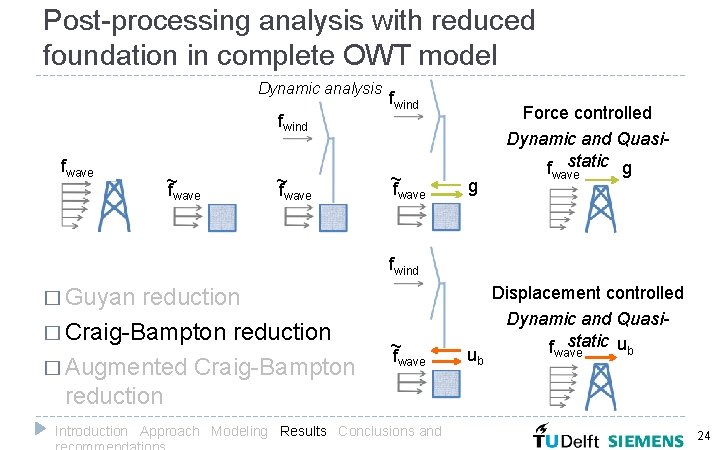
Post-processing analysis with reduced foundation in complete OWT model Dynamic analysis fwind fwave ~f wave fwind ~ fwave g Force controlled Dynamic and Quasif static g wave fwind � Guyan reduction � Craig-Bampton reduction � Augmented Craig-Bampton reduction ~ fwave Introduction Approach Modeling Results Conclusions and ub Displacement controlled Dynamic and Quasistatic ub fwave 24
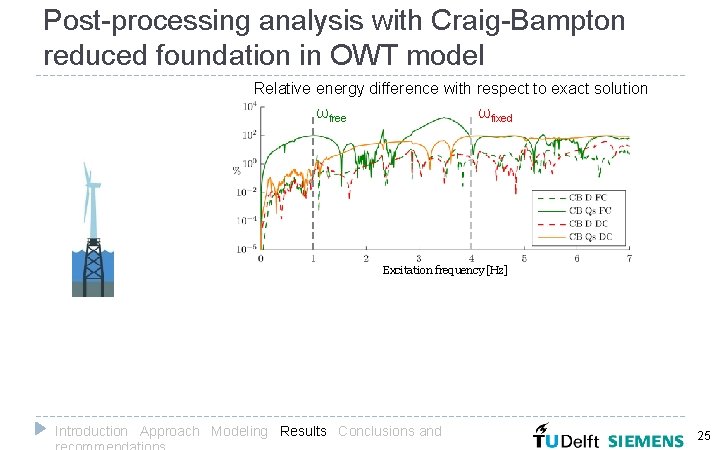
Post-processing analysis with Craig-Bampton reduced foundation in OWT model Relative energy difference with respect to exact solution ωfree ωfixed Excitation frequency [Hz] Introduction Approach Modeling Results Conclusions and 25
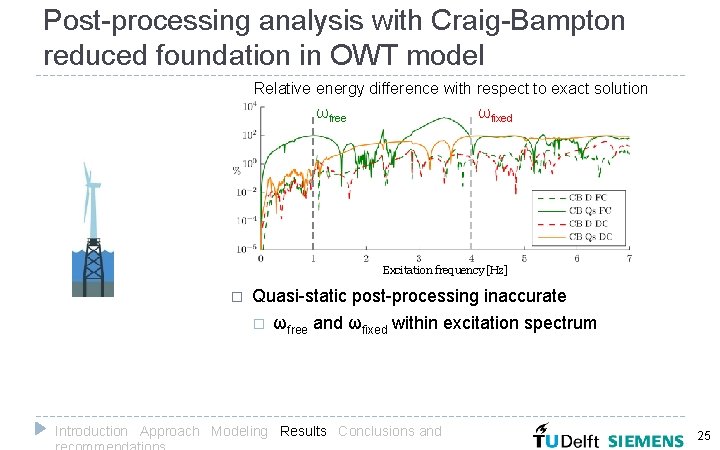
Post-processing analysis with Craig-Bampton reduced foundation in OWT model Relative energy difference with respect to exact solution ωfree ωfixed Excitation frequency [Hz] � Quasi-static post-processing inaccurate � ωfree and ωfixed within excitation spectrum � Dynamic post-processing accurate � CB reduced model spectrally converged � Internal dynamics included Introduction Approach Modeling Results Conclusions and 25
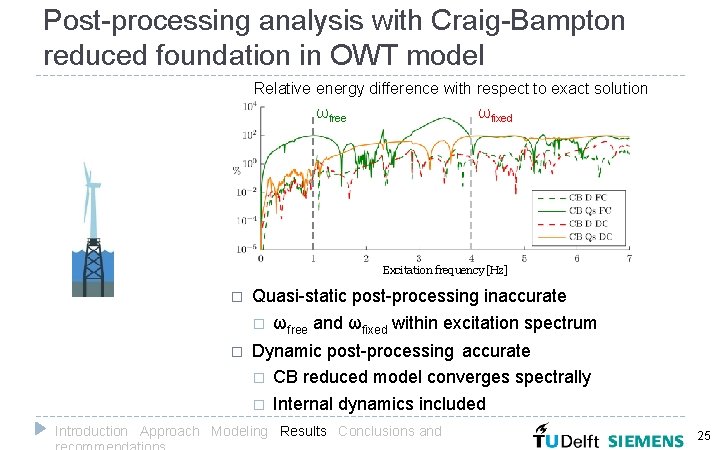
Post-processing analysis with Craig-Bampton reduced foundation in OWT model Relative energy difference with respect to exact solution ωfree ωfixed Excitation frequency [Hz] � Quasi-static post-processing inaccurate � ωfree and ωfixed within excitation spectrum � Dynamic post-processing accurate � CB reduced model converges spectrally � Internal dynamics included Introduction Approach Modeling Results Conclusions and 25
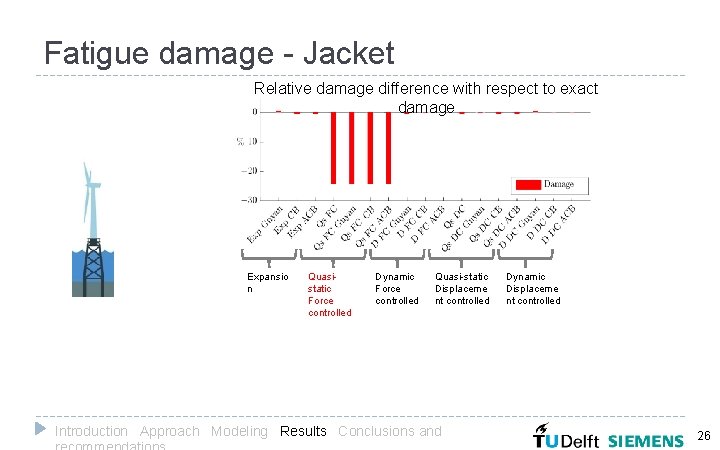
Fatigue damage - Jacket Relative damage difference with respect to exact damage Expansio n Quasistatic Force controlled Dynamic Force controlled Quasi-static Displaceme nt controlled Introduction Approach Modeling Results Conclusions and Dynamic Displaceme nt controlled 26
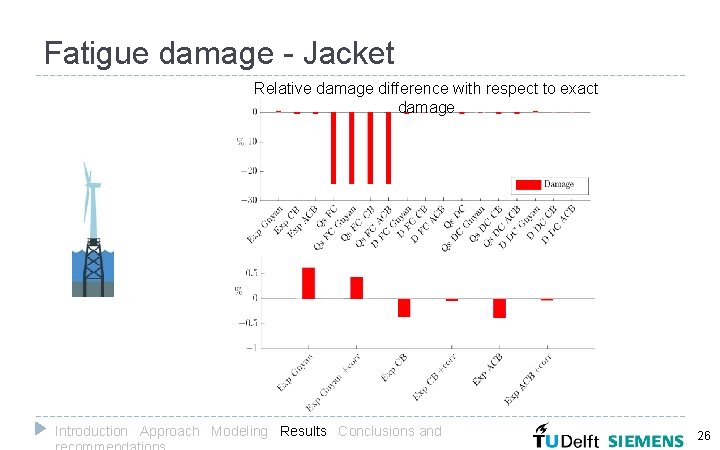
Fatigue damage - Jacket Relative damage difference with respect to exact damage Introduction Approach Modeling Results Conclusions and 26
Content �Introduction �Approach �Modeling �Results � Conclusions and recommendations 27
Conclusions � Following aspects tend to influence the accuracy of the calculation procedures: � The characteristics of the structure � First fixed and free interface eigenfrequency � Qs FC significantly underestimates fatigue damage for jacket � Use of a reduced foundation model in complete OWT model � Spectral and spatial convergence � Residual correction improves accuracy fatigue damage results � Post-processing method � Dynamic post-processing provides accurate fatigue damage results despite errors in interface loads/displacements Introduction Approach Modeling Results Conclusions and 28
Conclusions � Following aspects tend to influence the accuracy of the calculation procedures: � The characteristics of the structure � First fixed and free interface eigenfrequency � Qs FC significantly underestimates fatigue damage for jacket � Use of a reduced foundation model in complete OWT model � Spectral and spatial convergence � Residual correction improves accuracy fatigue damage results � Post-processing method � Dynamic post-processing provides accurate fatigue damage results despite errors in interface loads/displacements Introduction Approach Modeling Results Conclusions and 28
Conclusions � Following aspects tend to influence the accuracy of the calculation procedures: � The characteristics of the structure � First fixed and free interface eigenfrequency � Qs FC significantly underestimates fatigue damage for jacket � Use of a reduced foundation model in complete OWT model � Spectral and spatial convergence � Residual correction improves accuracy fatigue damage results � Post-processing method � Dynamic post-processing provides accurate fatigue damage results despite errors in interface loads/displacements Introduction Approach Modeling Results Conclusions and 28
Conclusions � Following aspects tend to influence the accuracy of the calculation procedures: � The characteristics of the structure � First fixed and free interface eigenfrequency � Qs FC significantly underestimates fatigue damage for jacket � Use of a reduced foundation model in complete OWT model � Spectral and spatial convergence � Residual correction improves accuracy fatigue damage results � Post-processing method � Dynamic post-processing provides accurate fatigue damage results despite use of reduced foundation Introduction Approach Modeling Results Conclusions and 28
Recommendations � Apply the different calculation procedures in BHaw. C with different load cases Introduction Approach Modeling Results Conclusions and 29
Recommendations � Apply the different calculation procedures in BHaw. C with different load cases � Set up clear guidelines for spatial convergence � Error estimation methods Introduction Approach Modeling Results Conclusions and 29
Recommendations � Apply the different calculation procedures in BHaw. C with different load cases � Set up clear guidelines for spatial convergence � Error estimation methods � Determine an efficient and accurate calculation procedure for more complex models Introduction Approach Modeling Results Conclusions and 29
Recommendations � Apply the different calculation procedures in BHaw. C with different load cases � Set up clear guidelines for spatial convergence � Error estimation methods � Determine an efficient and accurate calculation procedure for more complex models � Validate results with real OWTs and loads Introduction Approach Modeling Results Conclusions and 29

Thank you for your attention

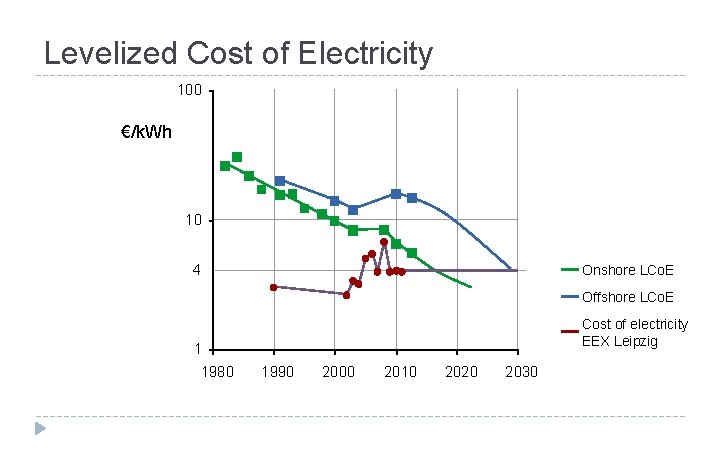
Levelized Cost of Electricity 100 €/k. Wh 10 4 Onshore LCo. E Offshore LCo. E Cost of electricity EEX Leipzig 1 1980 1990 2000 2010 2020 2030
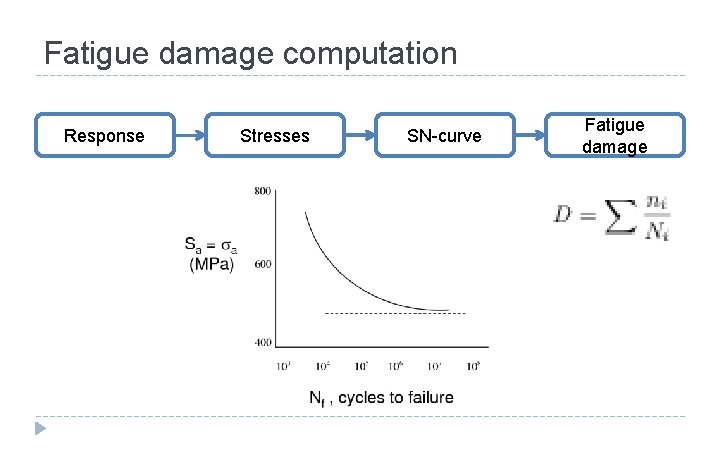
Fatigue damage computation Response Stresses SN-curve Fatigue damage
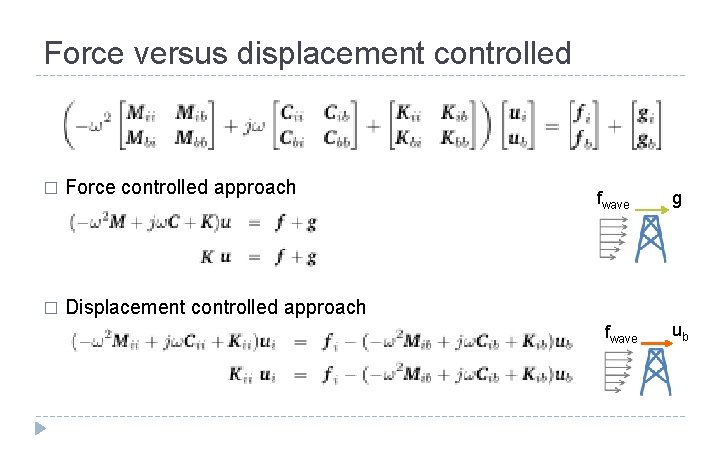
Force versus displacement controlled � Force controlled approach � Displacement controlled approach fwave g ub
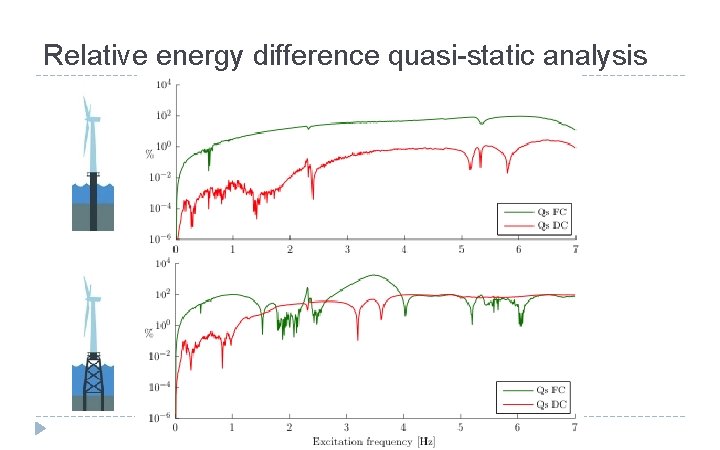
Relative energy difference quasi-static analysis
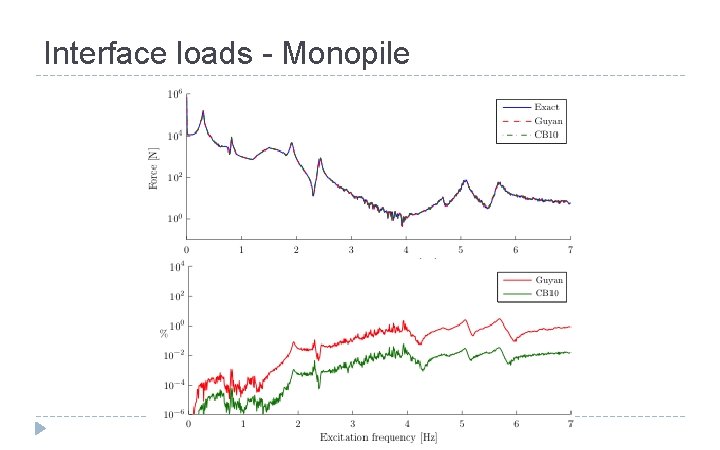
Interface loads - Monopile
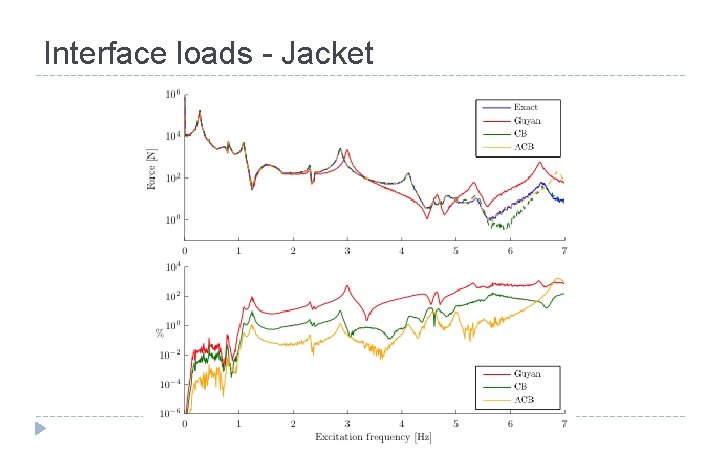
Interface loads - Jacket
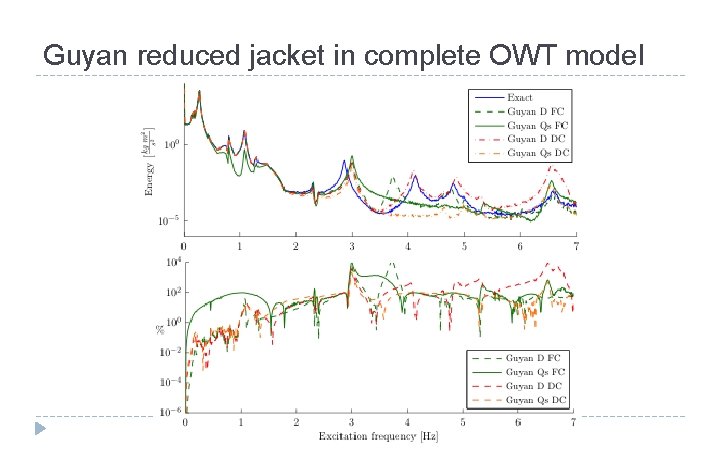
Guyan reduced jacket in complete OWT model
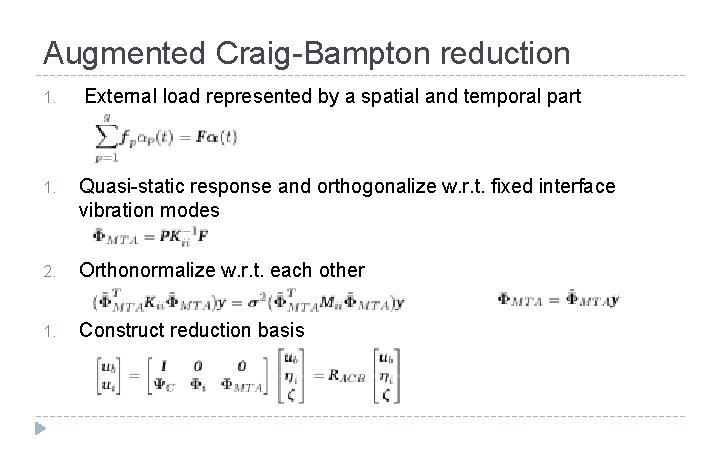
Augmented Craig-Bampton reduction 1. External load represented by a spatial and temporal part 1. Quasi-static response and orthogonalize w. r. t. fixed interface vibration modes 2. Orthonormalize w. r. t. each other 1. Construct reduction basis
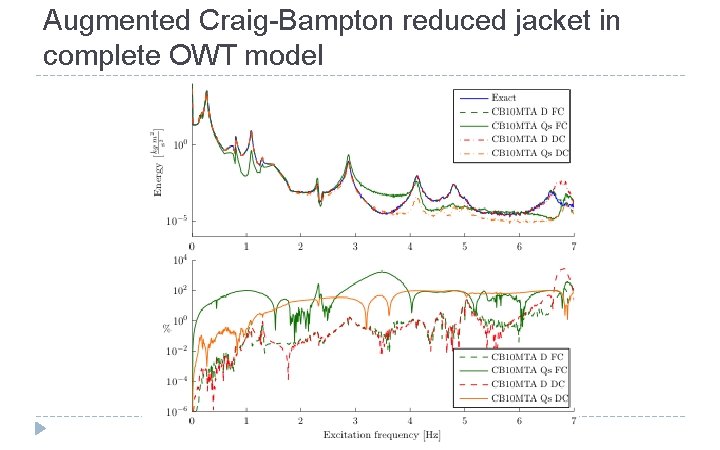
Augmented Craig-Bampton reduced jacket in complete OWT model
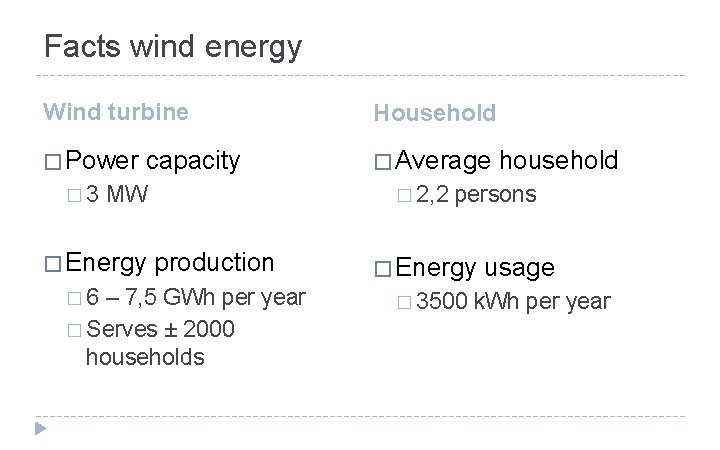
Facts wind energy Wind turbine Household � Power � Average � 3 capacity MW � Energy � 6 � 2, 2 production – 7, 5 GWh per year � Serves ± 2000 households household persons � Energy � 3500 usage k. Wh per year
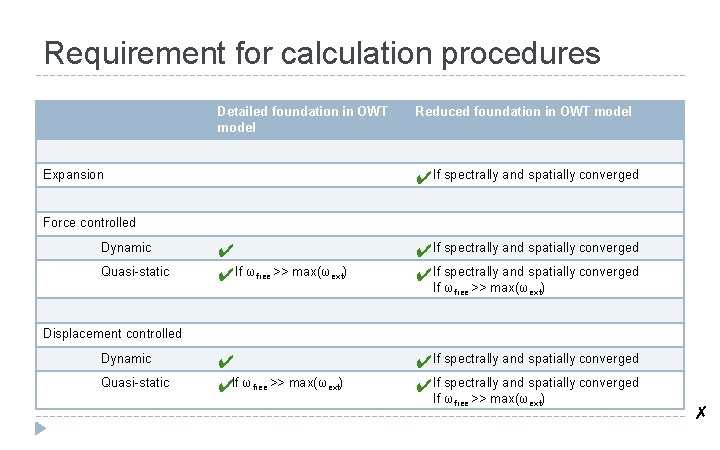
Requirement for calculation procedures Detailed foundation in OWT model Expansion Reduced foundation in OWT model ✔If spectrally and spatially converged Force controlled Dynamic Quasi-static ✔ ✔If ωfree >> max(ωext) ✔If spectrally and spatially converged If ωfree >> max(ωext) Displacement controlled Dynamic Quasi-static If ωfree >> max(ωext) ✗
- Slides: 88