
ACCURACY BUILDS CREDIBILITY BUDAPESTI GAZDASGI FISKOLA INTERNATIONAL MARKETING

ACCURACY BUILDS CREDIBILITY
BUDAPESTI GAZDASÁGI FŐISKOLA INTERNATIONAL MARKETING LECTURE- 9 In English 27 th April 2012 – FRIDAY 0940 hr – 1110 hr (E. F. 13 -15) Miklós (Nicholas) SOÓS 0630 265 9638 miklosoos@hotmail. com somi
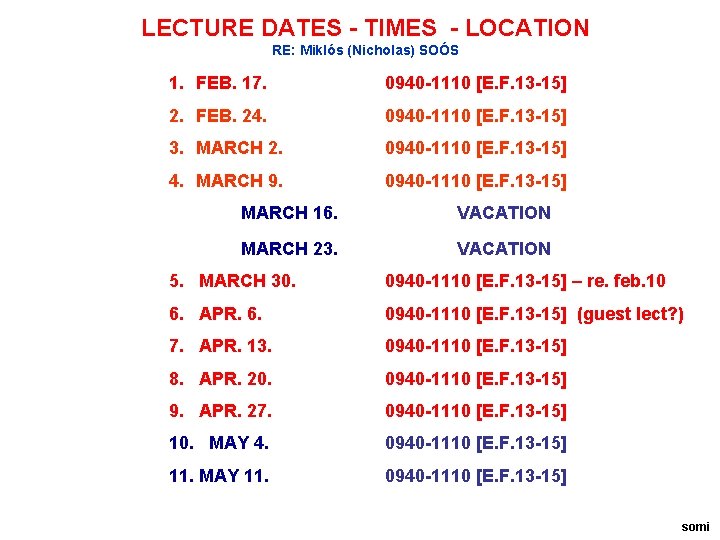
LECTURE DATES - TIMES - LOCATION RE: Miklós (Nicholas) SOÓS 1. FEB. 17. 0940 -1110 [E. F. 13 -15] 2. FEB. 24. 0940 -1110 [E. F. 13 -15] 3. MARCH 2. 0940 -1110 [E. F. 13 -15] 4. MARCH 9. 0940 -1110 [E. F. 13 -15] MARCH 16. VACATION MARCH 23. VACATION 5. MARCH 30. 0940 -1110 [E. F. 13 -15] – re. feb. 10 6. APR. 6. 0940 -1110 [E. F. 13 -15] (guest lect? ) 7. APR. 13. 0940 -1110 [E. F. 13 -15] 8. APR. 20. 0940 -1110 [E. F. 13 -15] 9. APR. 27. 0940 -1110 [E. F. 13 -15] 10. MAY 4. 0940 -1110 [E. F. 13 -15] 11. MAY 11. 0940 -1110 [E. F. 13 -15] somi
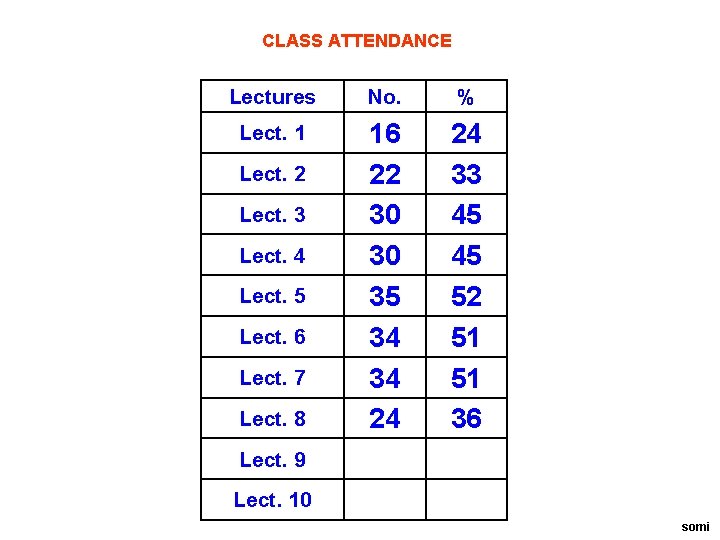
CLASS ATTENDANCE Lectures No. % Lect. 1 16 22 30 30 35 34 34 24 24 33 45 45 52 51 51 36 Lect. 2 Lect. 3 Lect. 4 Lect. 5 Lect. 6 Lect. 7 Lect. 8 Lect. 9 Lect. 10 somi

Please ensure that you personally sign the attendance sheet every time you attend a lecture. somi
The visual contents of lectures will be available internally on the following site: K: HallgatokANGOLSoós tanár úr (available internally only) somi
SOURCES, REFERENCES – SUGGESTED READINGS The course is NOT based on any specific textbook. The following are recommended. International Marketing, Cateora, P. & Graham, J. (2005) 12 th edition, Mc. Graw-Hill Global Marketing, Hollensen, S. (2004) 3 rd edition, Prentice Hall International Marketing Strategy, Doole, I. & Lowe, R (2004) 4 th edition Thomson International Marketing and Export Management, Albaum G, Prentice Hall London Principles of Marketing, Kotler P et. Al, 2 nd European edition, Prentice Hall E. 2003 Principles of Marketing, Jobber D, Mc. Graw-Hill Principles of Marketing, Brassington F, Financial Times Prentice Hall, 2000 Marketing on the Internet: Principles of online marketing, Strauss J & Raymond F, Prentice Hall, 1999 Internet sites: www. pmcinc. org/ www. tradeport. org www. FAS. USDA. gov somi
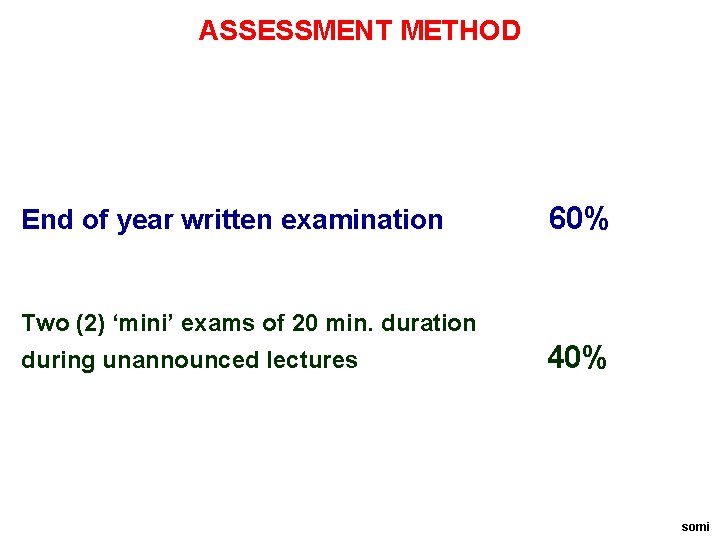
ASSESSMENT METHOD End of year written examination 60% Two (2) ‘mini’ exams of 20 min. duration during unannounced lectures 40% somi

Where we finished last week. somi
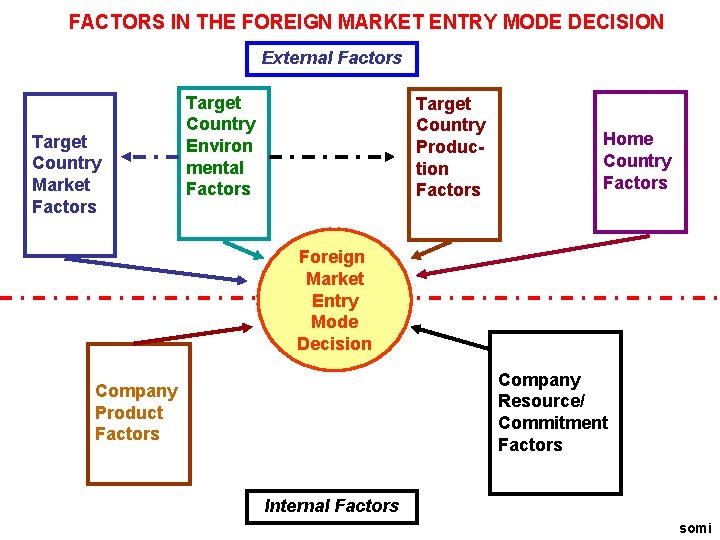
FACTORS IN THE FOREIGN MARKET ENTRY MODE DECISION External Factors Target Country Market Factors Target Country Environ mental Factors Target Country Production Factors Home Country Factors Foreign Market Entry Mode Decision Company Resource/ Commitment Factors Company Product Factors Internal Factors somi
MARKET RESEARCH EMPHASIS ON INTERNATIONAL MARKET RESEARCH somi
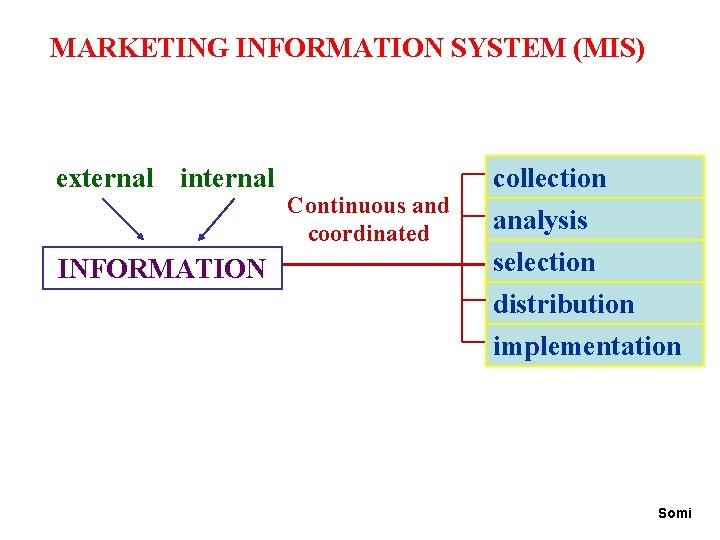
MARKETING INFORMATION SYSTEM (MIS) external internal INFORMATION Continuous and coordinated 17. collection analysis selection distribution implementation Somi
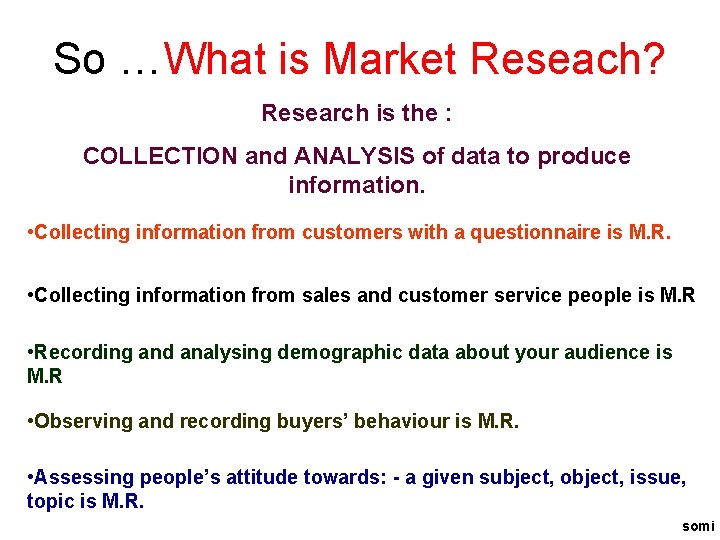
So …What is Market Reseach? Research is the : COLLECTION and ANALYSIS of data to produce information. • Collecting information from customers with a questionnaire is M. R. • Collecting information from sales and customer service people is M. R • Recording and analysing demographic data about your audience is M. R • Observing and recording buyers’ behaviour is M. R. • Assessing people’s attitude towards: - a given subject, object, issue, topic is M. R. somi
WHETHER KNOWINGLY OR UNKNOWINGLY PURPOSELY OR INCIDENTALY CONSCIOUSLY OR SUBCONSCIOUSLY IN A PLANNED OR UNPLANNED WAY BY DESIGN OR ACCIDENTALY WILLINGLY OR UNWILLINGLY WE ARE ALL ENGAGED IN CONTINOUS DAILY RESEARCH OF OUR SOCIAL AND PHYSICAL SURROUNDING somi
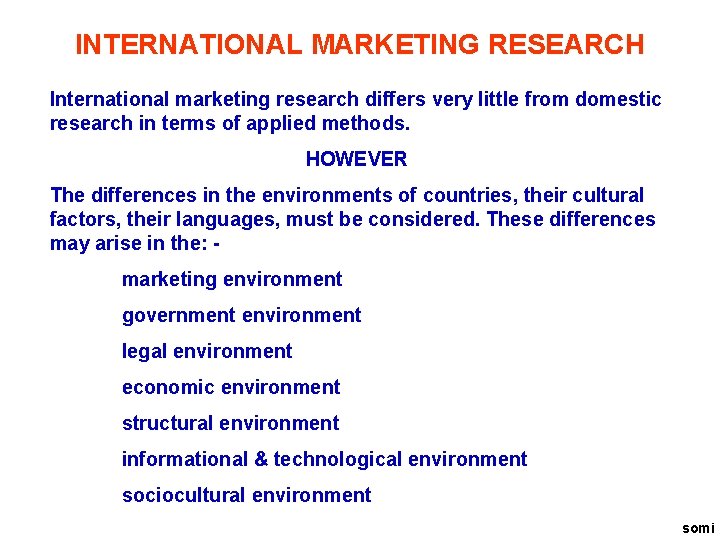
INTERNATIONAL MARKETING RESEARCH International marketing research differs very little from domestic research in terms of applied methods. HOWEVER The differences in the environments of countries, their cultural factors, their languages, must be considered. These differences may arise in the: - marketing environment government environment legal environment economic environment structural environment informational & technological environment sociocultural environment somi
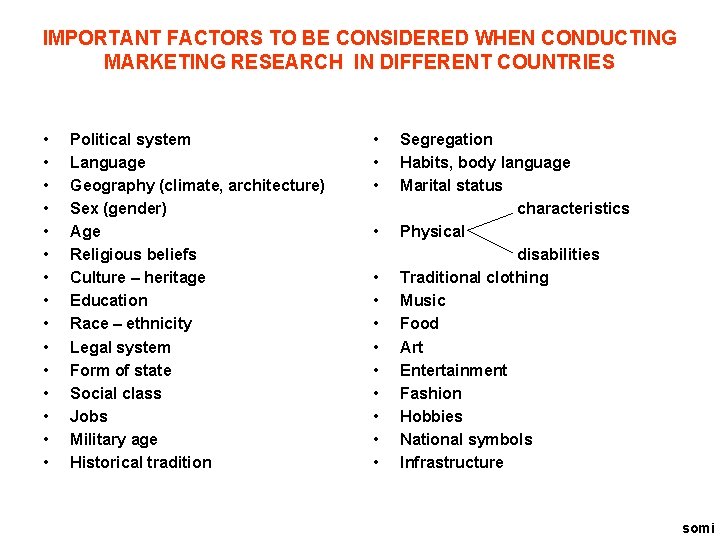
IMPORTANT FACTORS TO BE CONSIDERED WHEN CONDUCTING MARKETING RESEARCH IN DIFFERENT COUNTRIES • • • • Political system Language Geography (climate, architecture) Sex (gender) Age Religious beliefs Culture – heritage Education Race – ethnicity Legal system Form of state Social class Jobs Military age Historical tradition • • • • Segregation Habits, body language Marital status characteristics Physical disabilities Traditional clothing Music Food Art Entertainment Fashion Hobbies National symbols Infrastructure somi
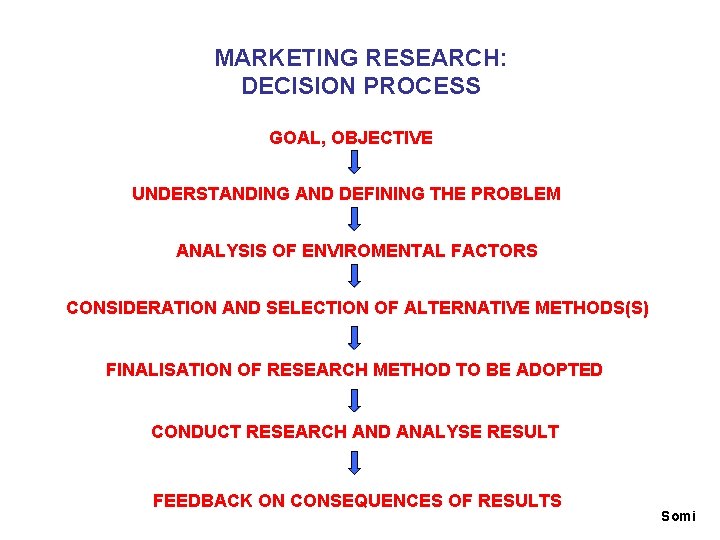
MARKETING RESEARCH: DECISION PROCESS GOAL, OBJECTIVE UNDERSTANDING AND DEFINING THE PROBLEM ANALYSIS OF ENVIROMENTAL FACTORS CONSIDERATION AND SELECTION OF ALTERNATIVE METHODS(S) FINALISATION OF RESEARCH METHOD TO BE ADOPTED CONDUCT RESEARCH AND ANALYSE RESULT FEEDBACK ON CONSEQUENCES OF RESULTS Somi
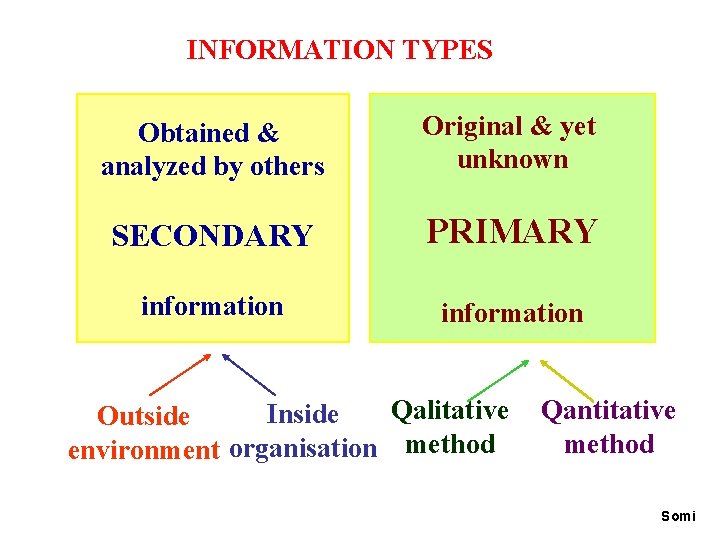
20. INFORMATION TYPES Obtained & analyzed by others Original & yet unknown SECONDARY PRIMARY information Qalitative Inside Outside environment organisation method Qantitative method Somi
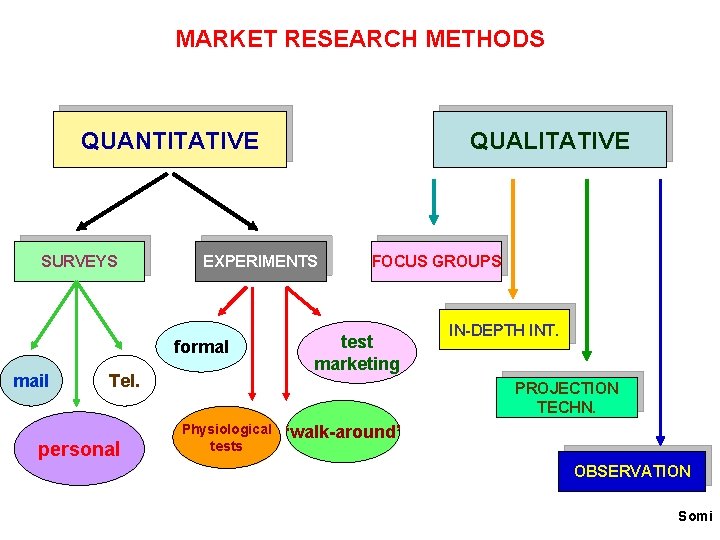
MARKET RESEARCH METHODS QUANTITATIVE SURVEYS EXPERIMENTS formal mail Tel. personal QUALITATIVE FOCUS GROUPS test marketing IN-DEPTH INT. PROJECTION TECHN. Physiological tests ‘walk-around’ OBSERVATION Somi
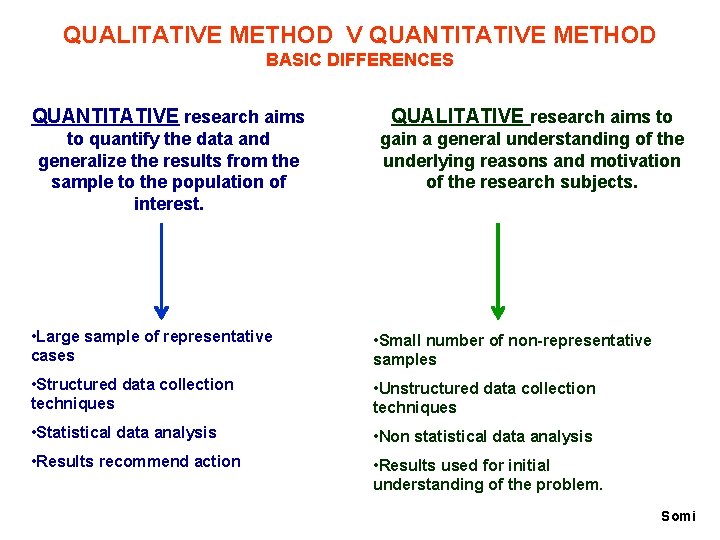
QUALITATIVE METHOD V QUANTITATIVE METHOD BASIC DIFFERENCES QUANTITATIVE research aims QUALITATIVE research aims to quantify the data and generalize the results from the sample to the population of interest. gain a general understanding of the underlying reasons and motivation of the research subjects. • Large sample of representative cases • Small number of non-representative samples • Structured data collection techniques • Unstructured data collection techniques • Statistical data analysis • Non statistical data analysis • Results recommend action • Results used for initial understanding of the problem. Somi
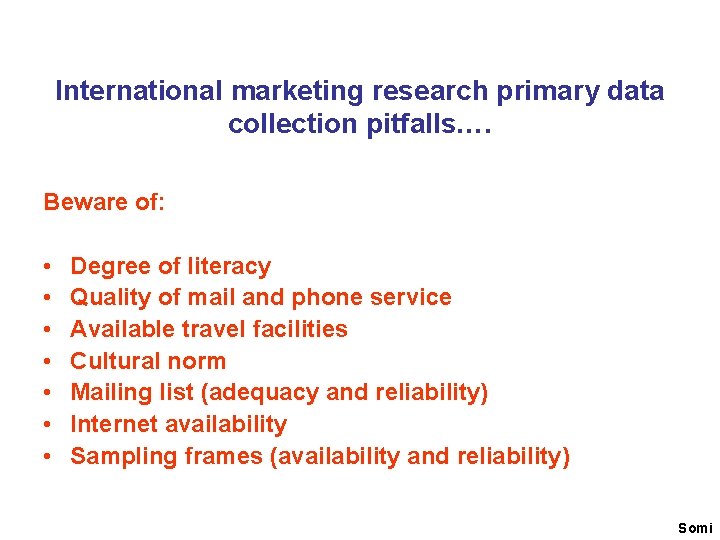
International marketing research primary data collection pitfalls…. Beware of: • • Degree of literacy Quality of mail and phone service Available travel facilities Cultural norm Mailing list (adequacy and reliability) Internet availability Sampling frames (availability and reliability) Somi
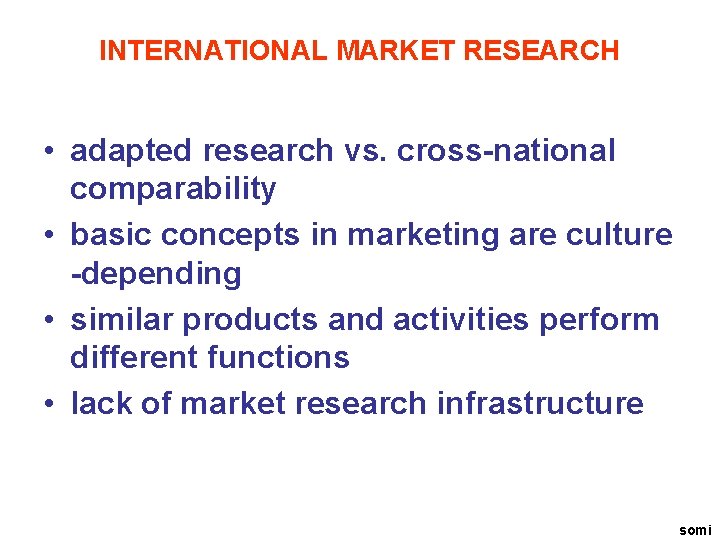
INTERNATIONAL MARKET RESEARCH • adapted research vs. cross-national comparability • basic concepts in marketing are culture -depending • similar products and activities perform different functions • lack of market research infrastructure somi
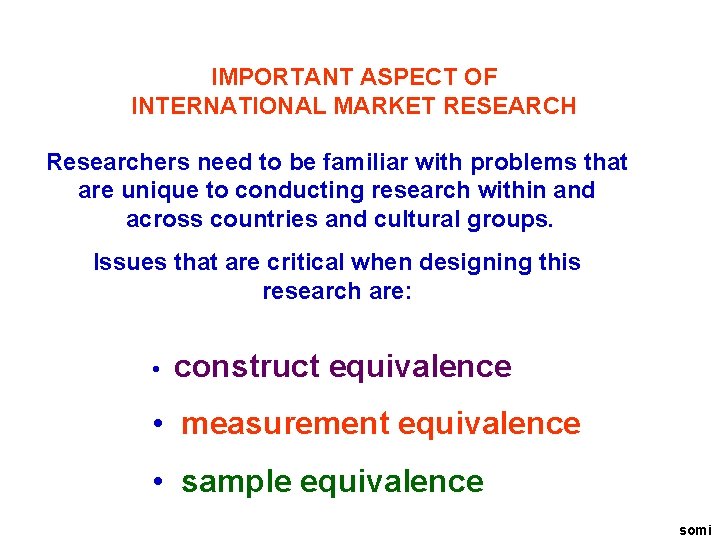
IMPORTANT ASPECT OF INTERNATIONAL MARKET RESEARCH Researchers need to be familiar with problems that are unique to conducting research within and across countries and cultural groups. Issues that are critical when designing this research are: • construct equivalence • measurement equivalence • sample equivalence somi
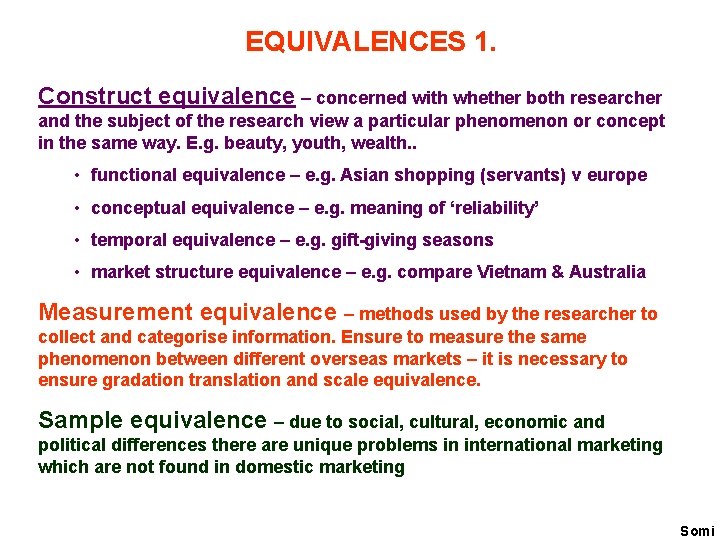
EQUIVALENCES 1. Construct equivalence – concerned with whether both researcher and the subject of the research view a particular phenomenon or concept in the same way. E. g. beauty, youth, wealth. . • functional equivalence – e. g. Asian shopping (servants) v europe • conceptual equivalence – e. g. meaning of ‘reliability’ • temporal equivalence – e. g. gift-giving seasons • market structure equivalence – e. g. compare Vietnam & Australia Measurement equivalence – methods used by the researcher to collect and categorise information. Ensure to measure the same phenomenon between different overseas markets – it is necessary to ensure gradation translation and scale equivalence. Sample equivalence – due to social, cultural, economic and political differences there are unique problems in international marketing which are not found in domestic marketing Somi
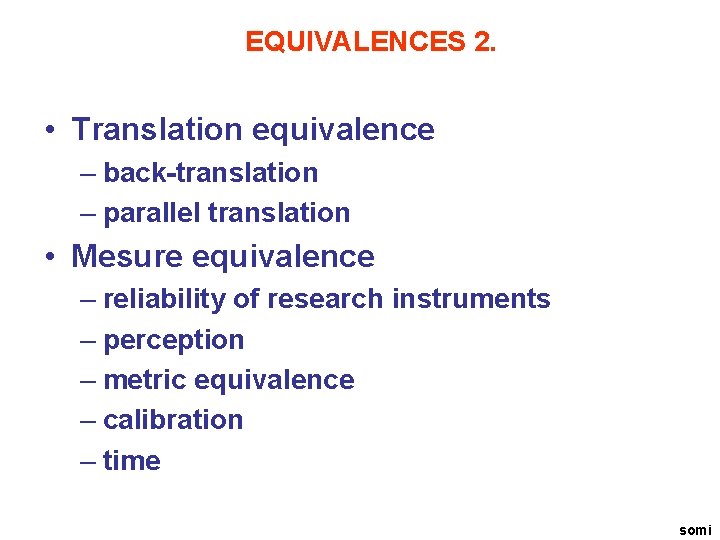
EQUIVALENCES 2. • Translation equivalence – back-translation – parallel translation • Mesure equivalence – reliability of research instruments – perception – metric equivalence – calibration – time somi
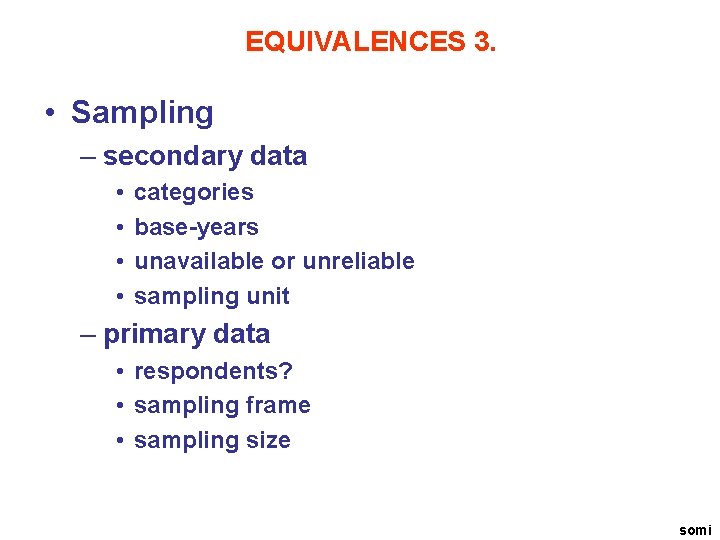
EQUIVALENCES 3. • Sampling – secondary data • • categories base-years unavailable or unreliable sampling unit – primary data • respondents? • sampling frame • sampling size somi
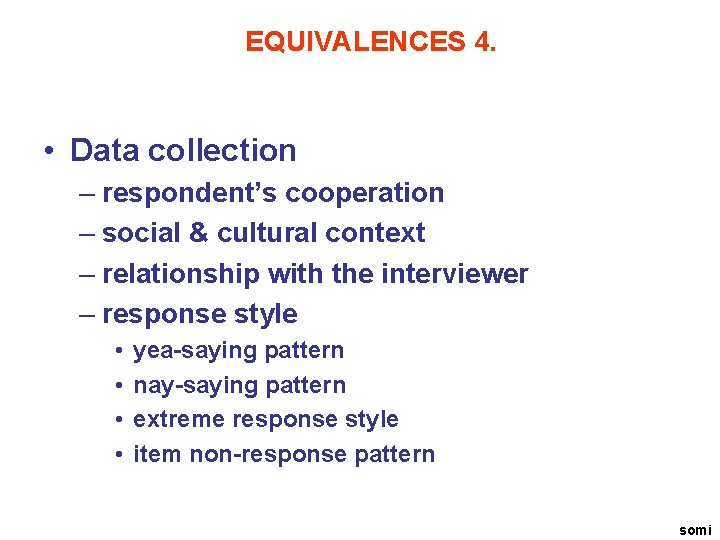
EQUIVALENCES 4. • Data collection – respondent’s cooperation – social & cultural context – relationship with the interviewer – response style • • yea-saying pattern nay-saying pattern extreme response style item non-response pattern somi
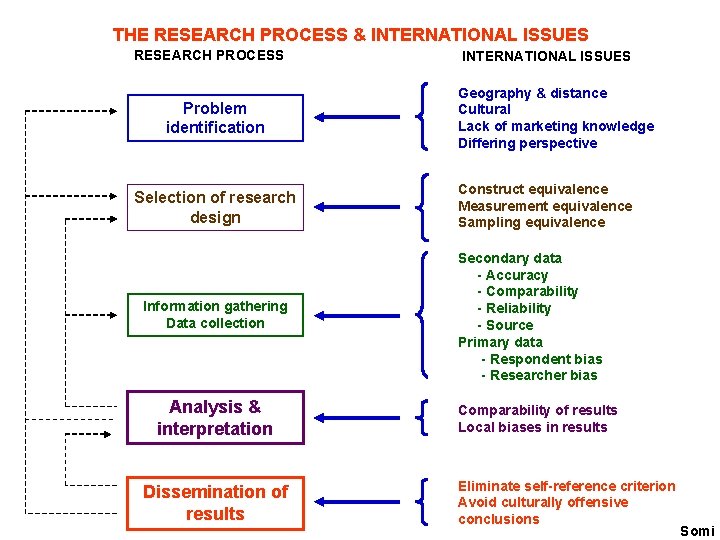
THE RESEARCH PROCESS & INTERNATIONAL ISSUES RESEARCH PROCESS Problem identification Selection of research design Information gathering Data collection INTERNATIONAL ISSUES Geography & distance Cultural Lack of marketing knowledge Differing perspective Construct equivalence Measurement equivalence Sampling equivalence Secondary data - Accuracy - Comparability - Reliability - Source Primary data - Respondent bias - Researcher bias Analysis & interpretation Comparability of results Local biases in results Dissemination of results Eliminate self-reference criterion Avoid culturally offensive conclusions Somi
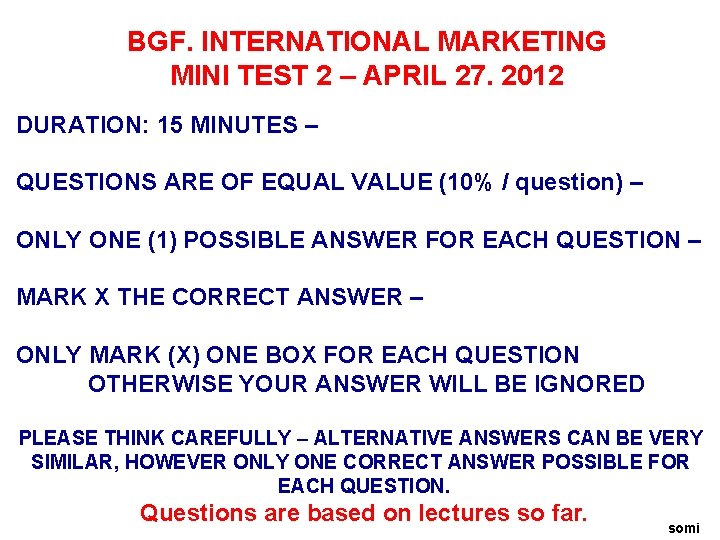
BGF. INTERNATIONAL MARKETING MINI TEST 2 – APRIL 27. 2012 DURATION: 15 MINUTES – QUESTIONS ARE OF EQUAL VALUE (10% / question) – ONLY ONE (1) POSSIBLE ANSWER FOR EACH QUESTION – MARK X THE CORRECT ANSWER – ONLY MARK (X) ONE BOX FOR EACH QUESTION OTHERWISE YOUR ANSWER WILL BE IGNORED PLEASE THINK CAREFULLY – ALTERNATIVE ANSWERS CAN BE VERY SIMILAR, HOWEVER ONLY ONE CORRECT ANSWER POSSIBLE FOR EACH QUESTION. Questions are based on lectures so far. somi

TIME IS THE BEST KEPT SECRET OF THE RICH. somi
- Slides: 30