
Accumulation of biodegradable plastics in soil CIPA Congress
Accumulation of (bio)degradable plastics in soil CIPA Congress 2018, Arcachon, May 29, 2017
TOPICS • OWS • Different end-of-life options • Expert statement (commissioned by European Bioplastics) 2
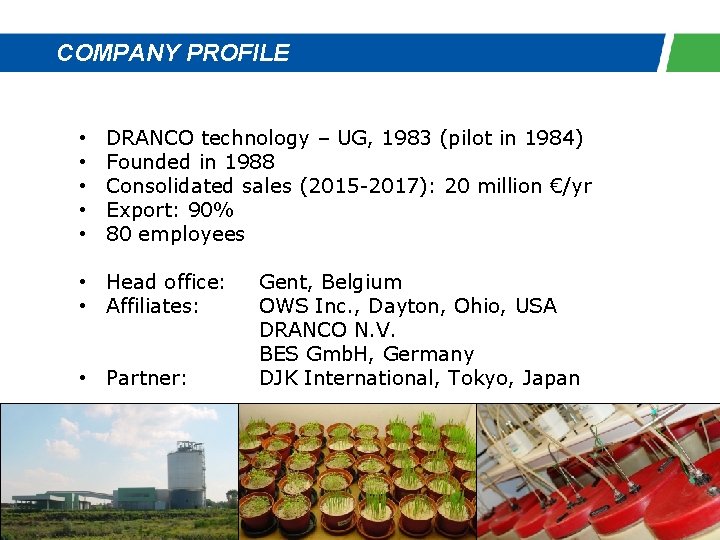
COMPANY PROFILE • • • DRANCO technology – UG, 1983 (pilot in 1984) Founded in 1988 Consolidated sales (2015 -2017): 20 million €/yr Export: 90% 80 employees • Head office: • Affiliates: • Partner: Gent, Belgium OWS Inc. , Dayton, Ohio, USA DRANCO N. V. BES Gmb. H, Germany DJK International, Tokyo, Japan 3

CONTRACT RESEARCH LABORATORY • ‘One-stop’ laboratory for biodegradability & compostability testing • Strictly independent • Quality control: ISO 17025 • Recognized by all certification bureaus worldwide • Active in standardization: CEN/ASTM/ISO • Member of several certification committees & industrial associations (Eu. BP, BBP, …) • More than 30 years of experience • 10, 000+ samples tested for 1, 250+ clients 4
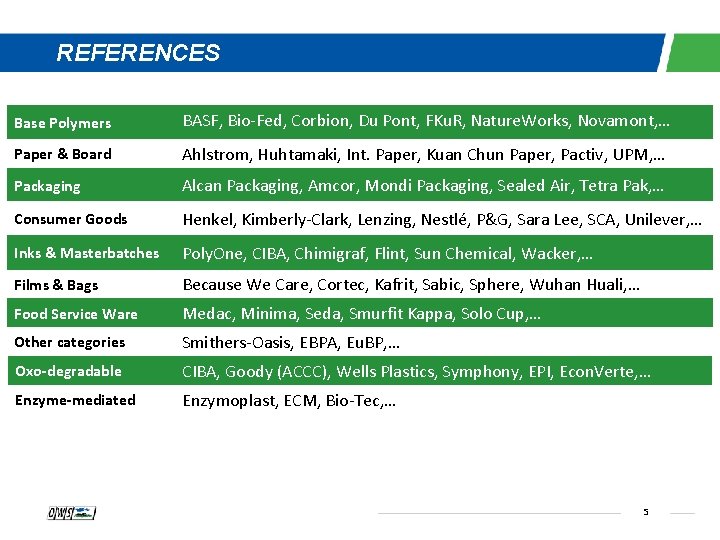
REFERENCES Base Polymers BASF, Bio-Fed, Corbion, Du Pont, FKu. R, Nature. Works, Novamont, … Paper & Board Ahlstrom, Huhtamaki, Int. Paper, Kuan Chun Paper, Pactiv, UPM, … Packaging Alcan Packaging, Amcor, Mondi Packaging, Sealed Air, Tetra Pak, … Consumer Goods Henkel, Kimberly-Clark, Lenzing, Nestlé, P&G, Sara Lee, SCA, Unilever, … Inks & Masterbatches Poly. One, CIBA, Chimigraf, Flint, Sun Chemical, Wacker, … Films & Bags Because We Care, Cortec, Kafrit, Sabic, Sphere, Wuhan Huali, … Food Service Ware Medac, Minima, Seda, Smurfit Kappa, Solo Cup, … Other categories Smithers-Oasis, EBPA, Eu. BP, … Oxo-degradable CIBA, Goody (ACCC), Wells Plastics, Symphony, EPI, Econ. Verte, … Enzyme-mediated Enzymoplast, ECM, Bio-Tec, … 5
TOPICS • OWS • Different end-of-life options • Expert statement 6
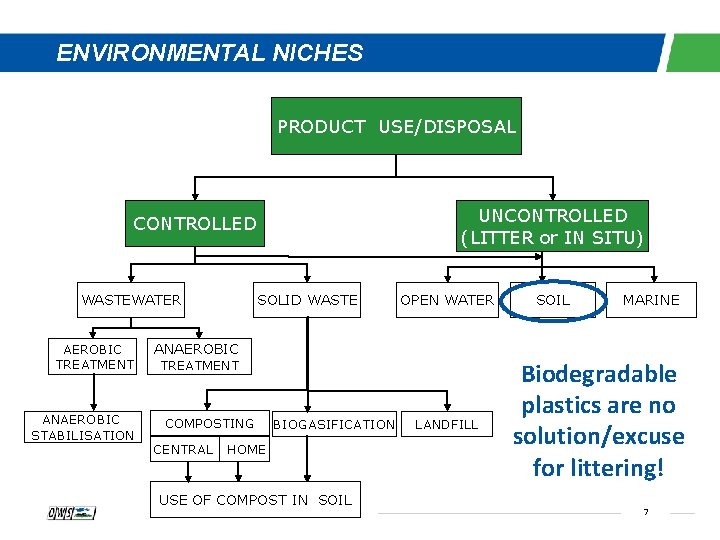
ENVIRONMENTAL NICHES PRODUCT USE/DISPOSAL UNCONTROLLED (LITTER or IN SITU) CONTROLLED WASTEWATER AEROBIC TREATMENT ANAEROBIC STABILISATION SOLID WASTE OPEN WATER SOIL MARINE ANAEROBIC TREATMENT COMPOSTING CENTRAL BIOGASIFICATION HOME USE OF COMPOST IN SOIL LANDFILL Biodegradable plastics are no solution/excuse for littering! 7
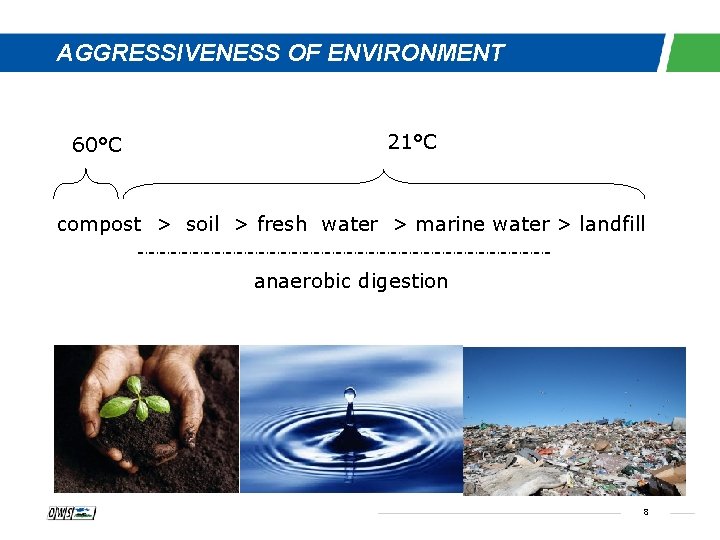
AGGRESSIVENESS OF ENVIRONMENT 60°C 21°C compost > soil > fresh water > marine water > landfill anaerobic digestion 8
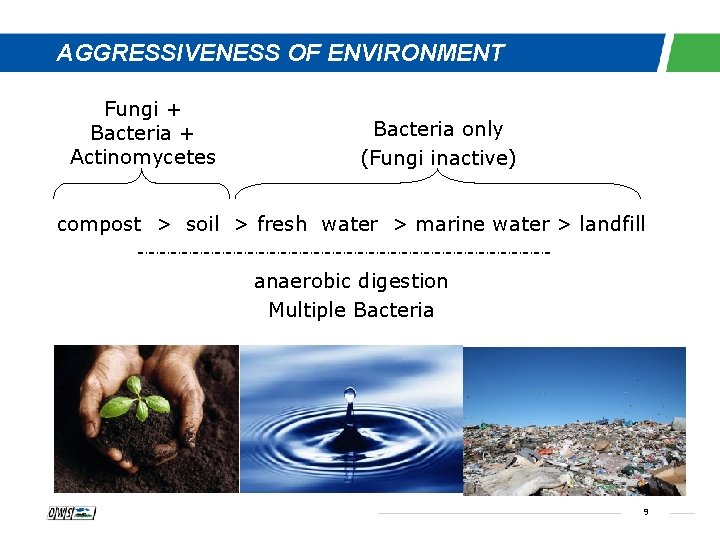
AGGRESSIVENESS OF ENVIRONMENT Fungi + Bacteria + Actinomycetes Bacteria only (Fungi inactive) compost > soil > fresh water > marine water > landfill anaerobic digestion Multiple Bacteria 9

BIODEGRADATION vs. ENVIRONMENTAL NICHE AEROBIC (WATER) + ANAEROBIC BACTERIA, NO FUNGI High T (50 -60°C) Low T (≤ 35 °C) AEROBIC (COMPOST & SOIL) BACTERIA & FUNGI Chemical pulp Mechanical pulp Starch PLA THERMOPHILIC INDUSTRIAL Starch/PCL DIGESTION COMPOSTING PHA PBAT Chemical pulp Starch/PCL PHA MESOPHILIC HOME DIGESTION COMPOSTING WATER SOIL PBAT PHA Starch/PCL Starch Chemical pulp Mechanical pulp 10
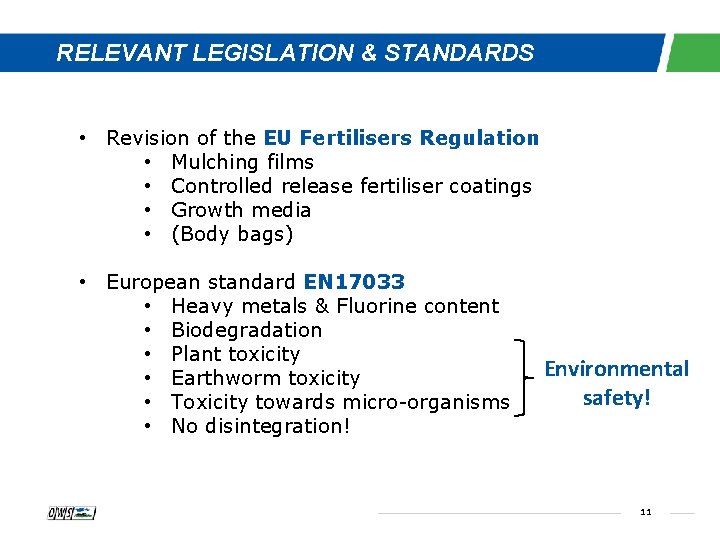
RELEVANT LEGISLATION & STANDARDS • Revision of the EU Fertilisers Regulation • Mulching films • Controlled release fertiliser coatings • Growth media • (Body bags) • European standard EN 17033 • Heavy metals & Fluorine content • Biodegradation • Plant toxicity • Earthworm toxicity • Toxicity towards micro-organisms • No disintegration! Environmental safety! 11
TOPICS • OWS • Different end-of-life options • Expert statement • What is “complete” biodegradation? • Accumulation of plastics in soil 12
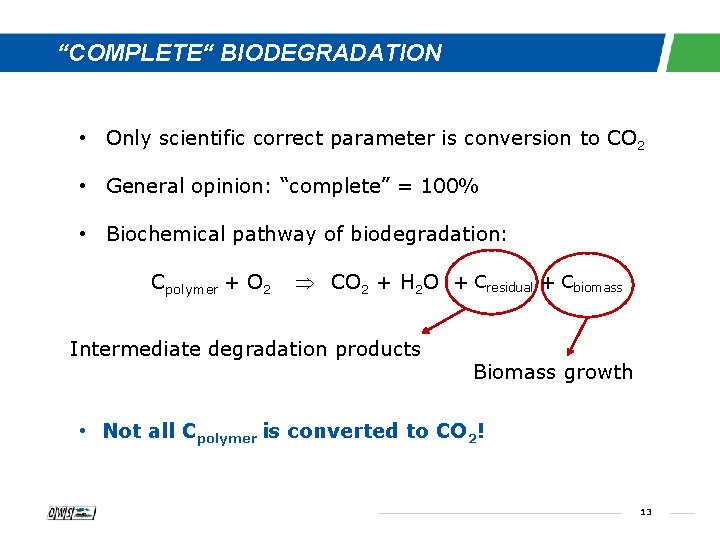
“COMPLETE“ BIODEGRADATION • Only scientific correct parameter is conversion to CO 2 • General opinion: “complete” = 100% • Biochemical pathway of biodegradation: Cpolymer + O 2 CO 2 + H 2 O + Cresidual + Cbiomass Intermediate degradation products Biomass growth • Not all Cpolymer is converted to CO 2! 13

“COMPLETE“ BIODEGRADATION • Biochemical pathway of biodegradation: Cpolymer + O 2 Can be quantified CO 2 + H 2 O + Cresidual + Cbiomass Cannot be quantified • EN 17033 (2018) standard on soil biodegradation : complete biodegradation = 90% (absolute or relative) 14
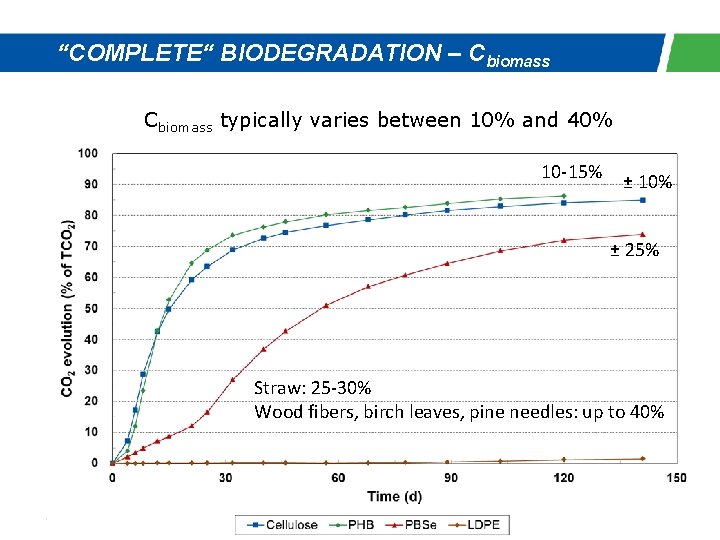
“COMPLETE“ BIODEGRADATION – Cbiomass typically varies between 10% and 40% 10 -15% ± 10% ± 25% Straw: 25 -30% Wood fibers, birch leaves, pine needles: up to 40% 15
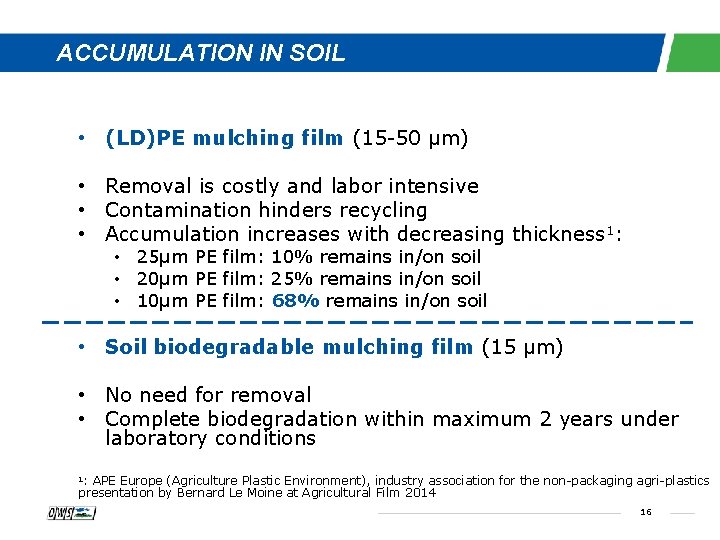
ACCUMULATION IN SOIL • (LD)PE mulching film (15 -50 µm) • Removal is costly and labor intensive • Contamination hinders recycling • Accumulation increases with decreasing thickness 1: • 25µm PE film: 10% remains in/on soil • 20µm PE film: 25% remains in/on soil • 10µm PE film: 68% remains in/on soil • Soil biodegradable mulching film (15 µm) • No need for removal • Complete biodegradation within maximum 2 years under laboratory conditions 1: APE Europe (Agriculture Plastic Environment), industry association for the non-packaging agri-plastics presentation by Bernard Le Moine at Agricultural Film 2014 16
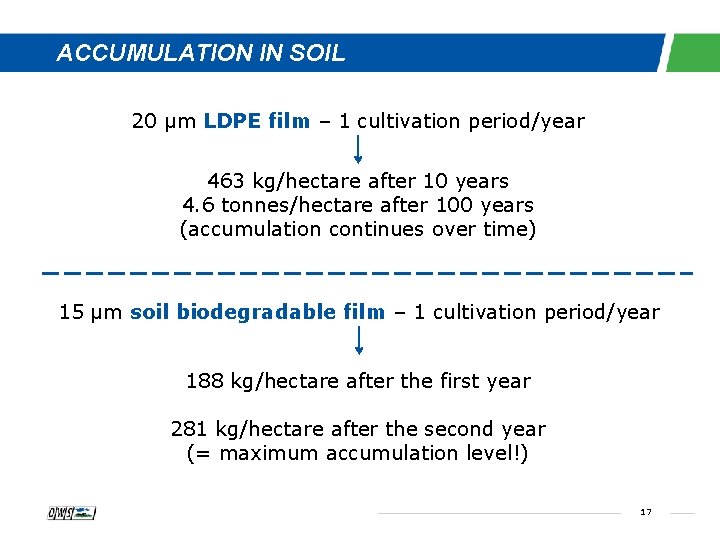
ACCUMULATION IN SOIL 20 µm LDPE film – 1 cultivation period/year 463 kg/hectare after 10 years 4. 6 tonnes/hectare after 100 years (accumulation continues over time) 15 µm soil biodegradable film – 1 cultivation period/year 188 kg/hectare after the first year 281 kg/hectare after the second year (= maximum accumulation level!) 17
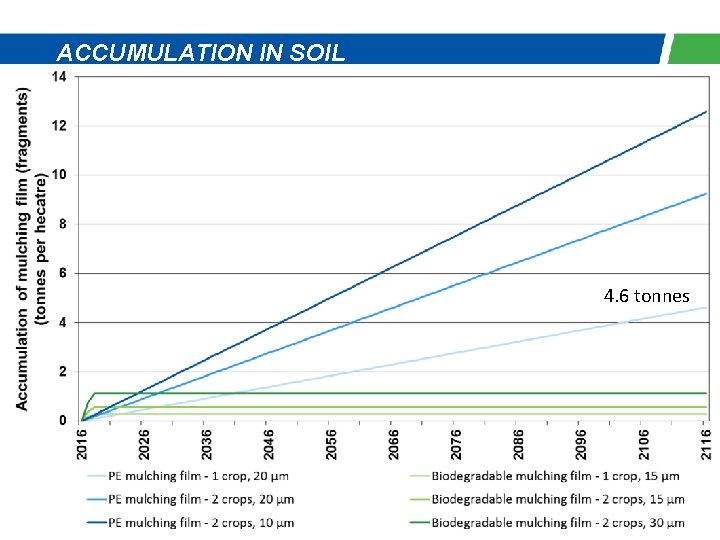
ACCUMULATION IN SOIL 4. 6 tonnes 18
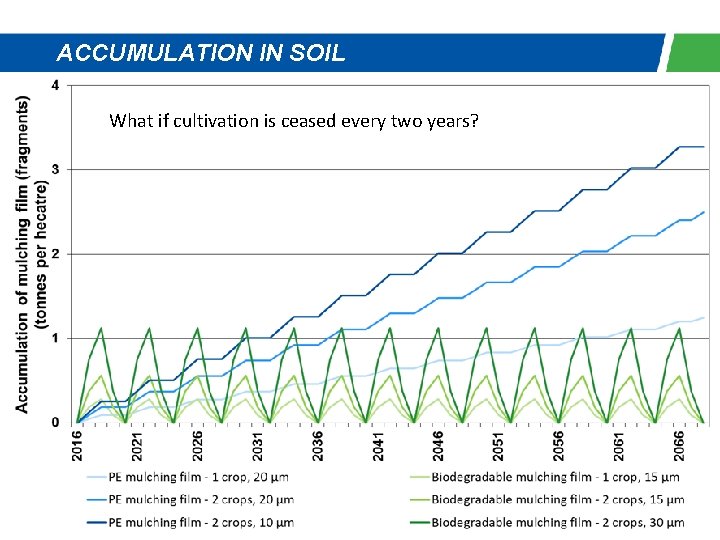
ACCUMULATION IN SOIL What if cultivation is ceased every two years? 19
CONCLUSIONS • Complete biodegradation does not mean “ 100% conversion to CO 2”. • Conventional (LD)PE mulching films accumulate at a rate of 463 kg per hectare per decade 1. • Soil biodegradable mulching films have a maximum accumulation level of 281 kg per hectare 1, returning to no accumulation if cultivation is ceased for two years. • (LD)PE mulching films cannot be downgauged as this increases the relative level of contamination and decreases the recovery rate. 1: Assuming one cultivation period per year and a thickness of 20 µm for LDPE and 15 µm for soil biodegradable mulching films 20
THANK YOU FOR YOUR ATTENTION OWS nv, Dok-Noord 5, B-9000 Gent, Belgium Email: sam. deconinck@ows. be Website: www. ows. be 21
- Slides: 21