
Accretion Disks Prof Hannah JangCondell Accretion Disks Galaxy



- Slides: 40
Accretion Disks Prof. Hannah Jang-Condell
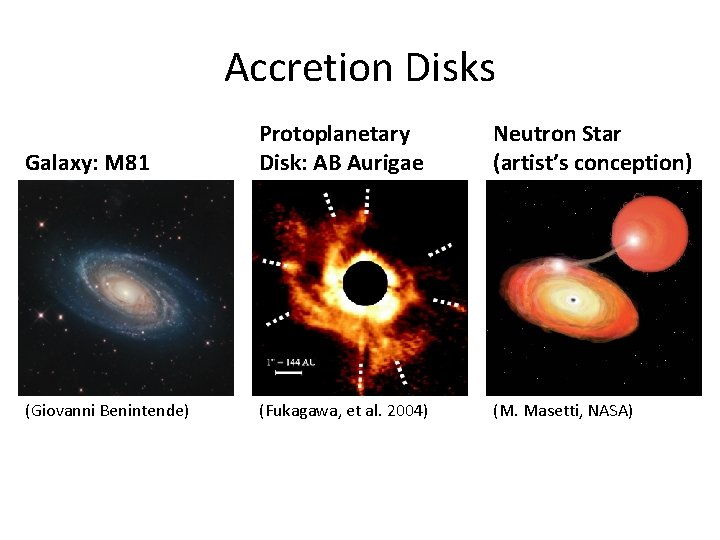
Accretion Disks Galaxy: M 81 Protoplanetary Disk: AB Aurigae Neutron Star (artist’s conception) (Giovanni Benintende) (Fukagawa, et al. 2004) (M. Masetti, NASA)
Why are disks so common?
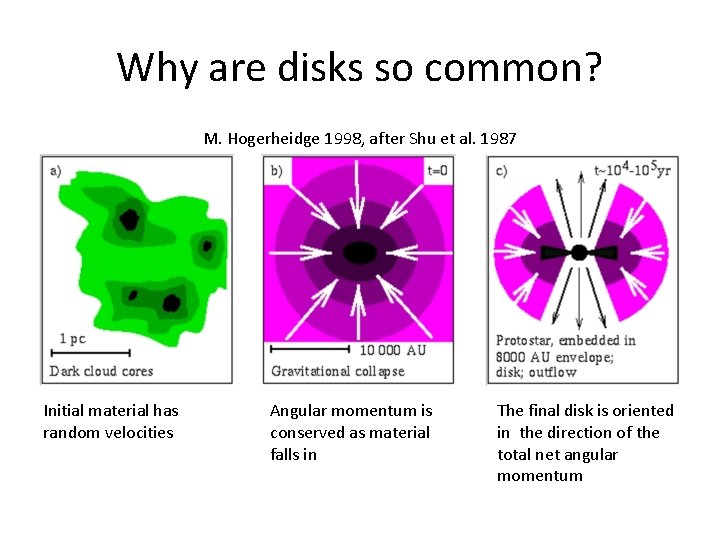
Why are disks so common? M. Hogerheidge 1998, after Shu et al. 1987 Initial material has random velocities Angular momentum is conserved as material falls in The final disk is oriented in the direction of the total net angular momentum
Side note: Galaxies • Why are elliptical galaxies not disk-like? • Stars are collisionless, don’t get canceling of angular momentum as with gas.
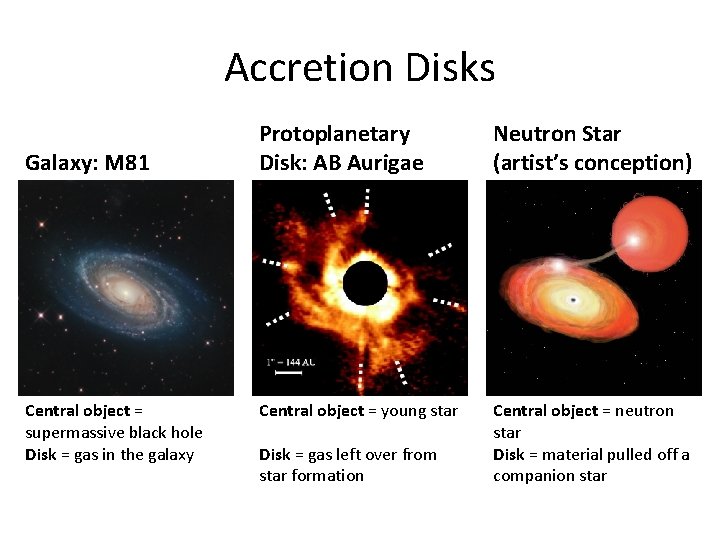
Accretion Disks Galaxy: M 81 Central object = supermassive black hole Disk = gas in the galaxy Protoplanetary Disk: AB Aurigae Neutron Star (artist’s conception) Central object = young star Central object = neutron star Disk = material pulled off a companion star Disk = gas left over from star formation
Definition • An accretion disk a structure that enables the transport and dissipation of angular momentum so that gaseous material can fall onto a central object.
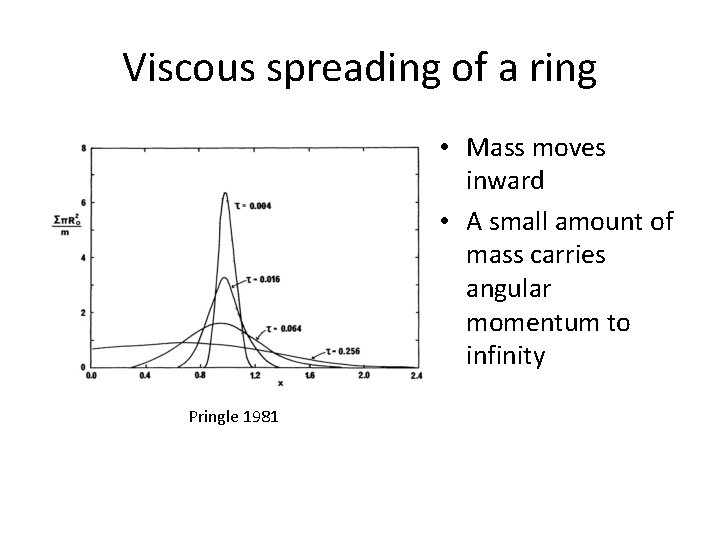
Viscous spreading of a ring • Mass moves inward • A small amount of mass carries angular momentum to infinity Pringle 1981
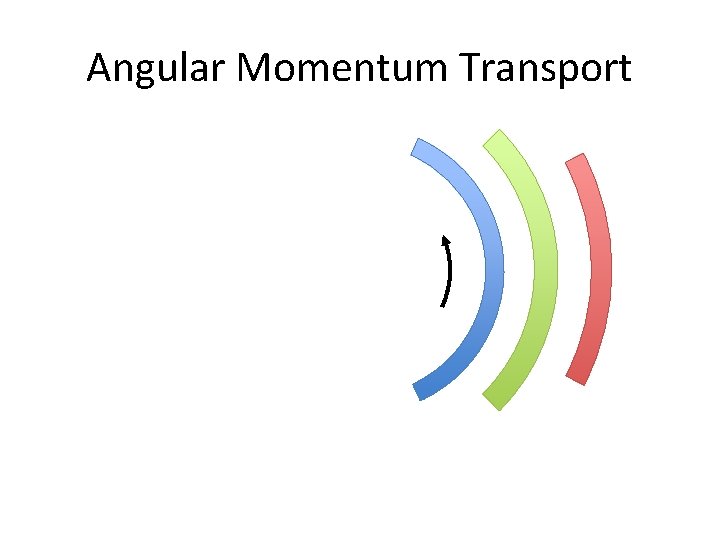
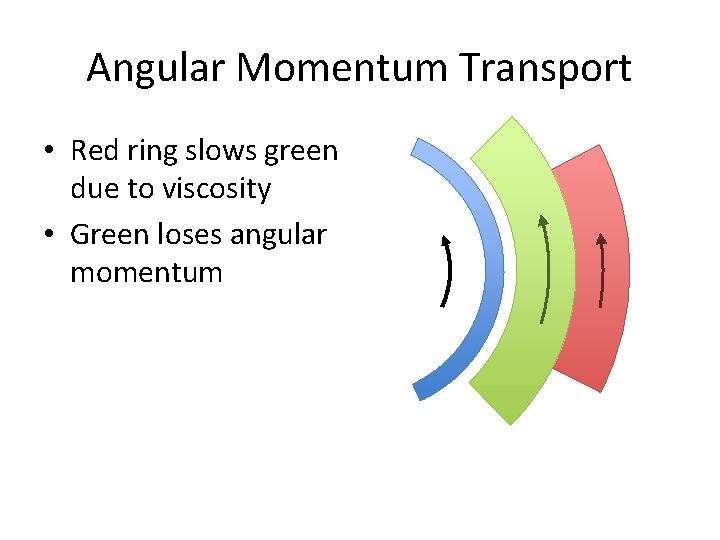
Angular Momentum Transport
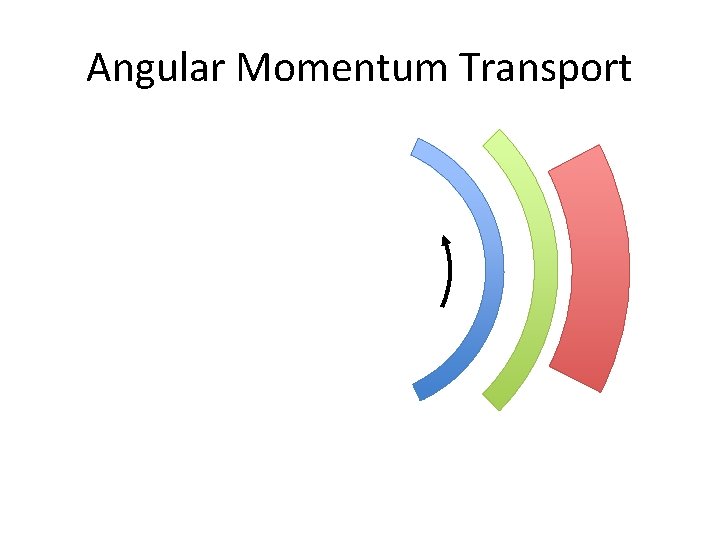
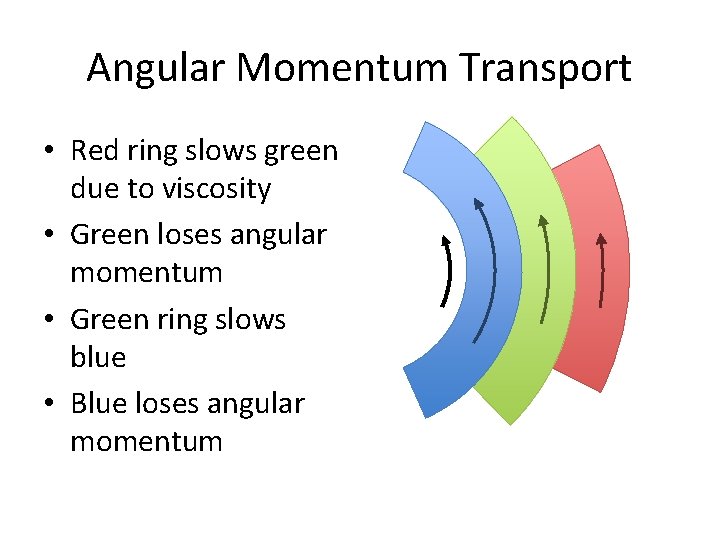
Angular Momentum Transport
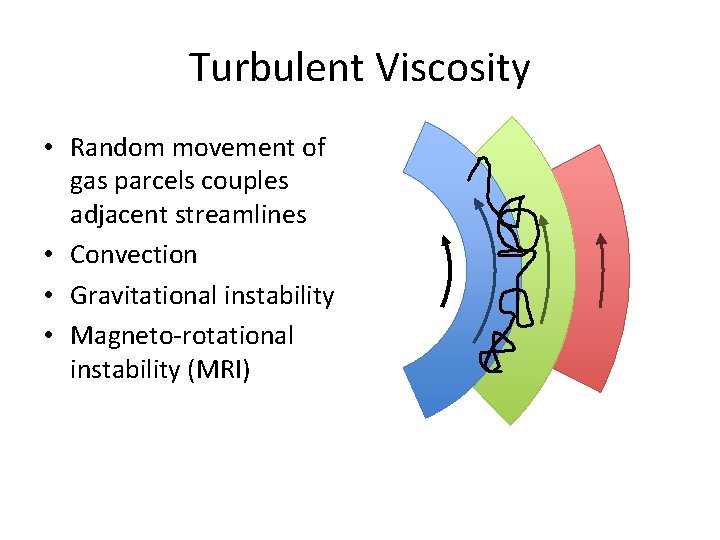
Angular Momentum Transport • Red ring slows green due to viscosity • Green loses angular momentum
Angular Momentum Transport • Red ring slows green due to viscosity • Green loses angular momentum • Green ring slows blue • Blue loses angular momentum
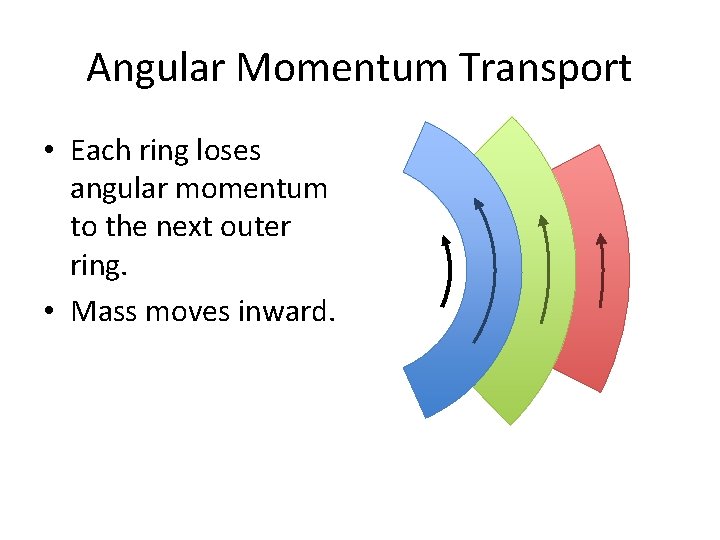
Angular Momentum Transport • Each ring loses angular momentum to the next outer ring. • Mass moves inward.
Viscosity • Needed to enable angular momentum transport • Molecular viscosity of gas is not enough • Prime suspect: turbulence
Turbulent Viscosity • Random movement of gas parcels couples adjacent streamlines • Convection • Gravitational instability • Magneto-rotational instability (MRI)
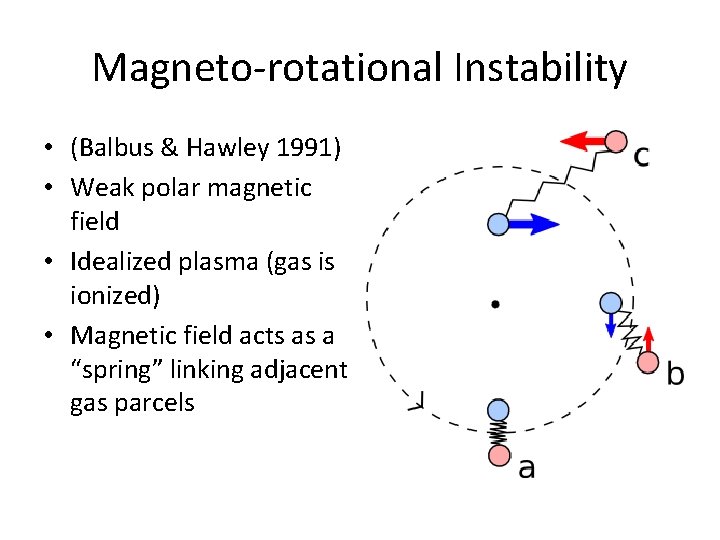
Magneto-rotational Instability • (Balbus & Hawley 1991) • Weak polar magnetic field • Idealized plasma (gas is ionized) • Magnetic field acts as a “spring” linking adjacent gas parcels
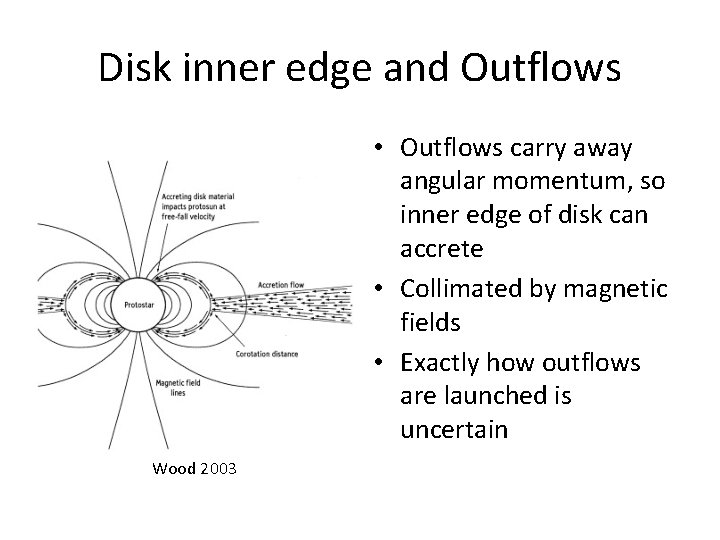
Disk inner edge and Outflows • Outflows carry away angular momentum, so inner edge of disk can accrete • Collimated by magnetic fields • Exactly how outflows are launched is uncertain Wood 2003
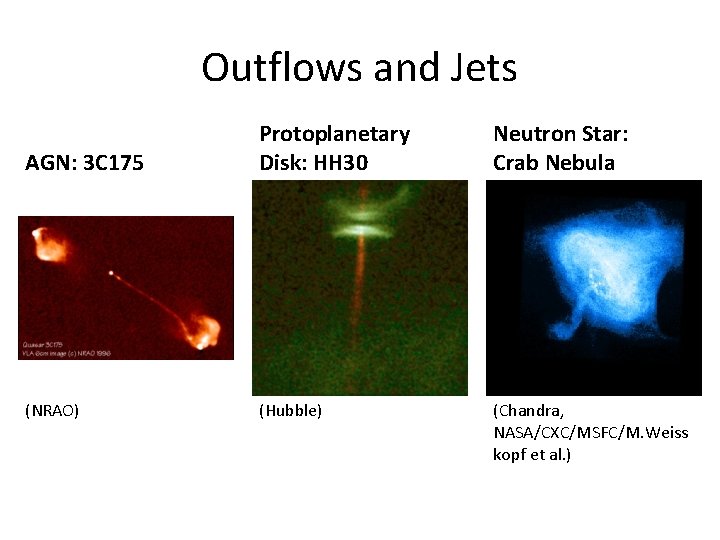
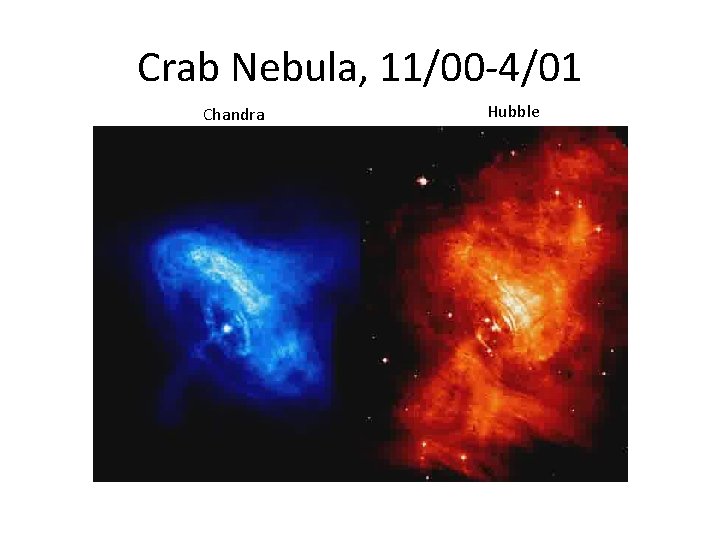
Outflows and Jets AGN: 3 C 175 Protoplanetary Disk: HH 30 Neutron Star: Crab Nebula (NRAO) (Hubble) (Chandra, NASA/CXC/MSFC/M. Weiss kopf et al. )
Crab Nebula, 11/00 -4/01 Chandra Hubble
Disk Structure • Viscosity acts like “friction” allowing angular momentum transport • This “friction” also dissipates energy and heats the disk
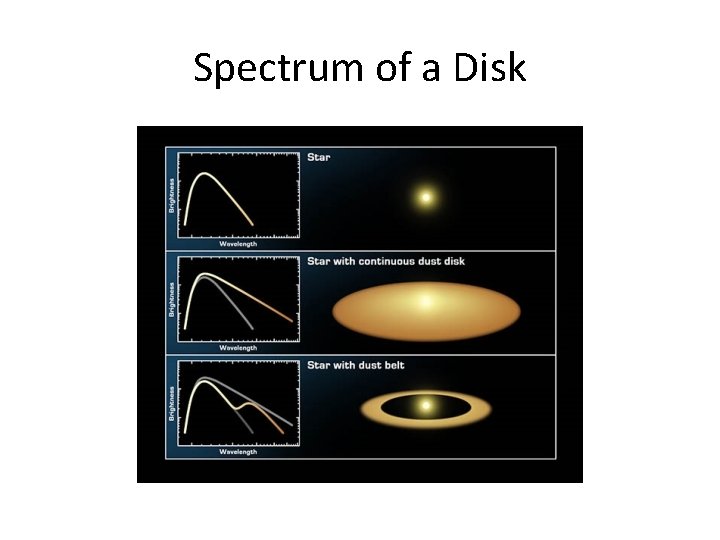
Spectrum of a Disk
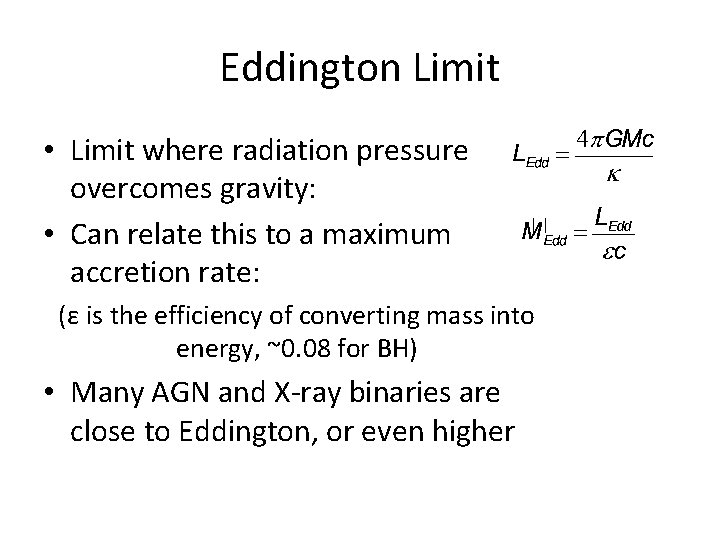
Eddington Limit • Limit where radiation pressure overcomes gravity: • Can relate this to a maximum accretion rate: (ε is the efficiency of converting mass into energy, ~0. 08 for BH) • Many AGN and X-ray binaries are close to Eddington, or even higher
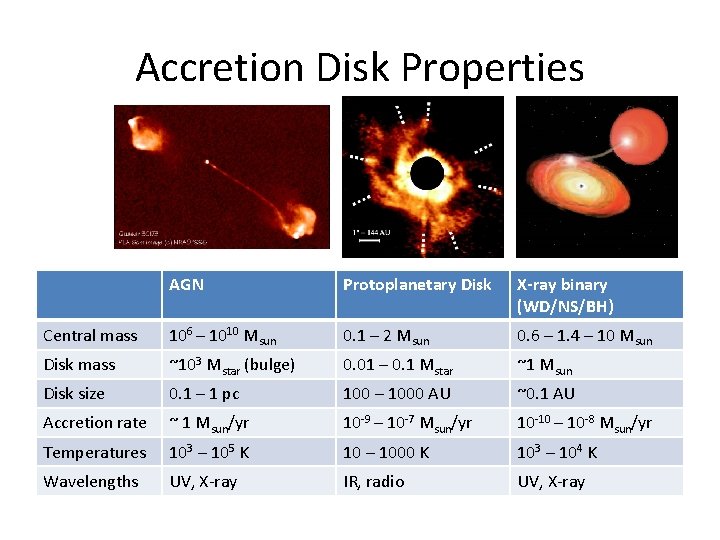
Accretion Disk Properties AGN Protoplanetary Disk X-ray binary (WD/NS/BH) Central mass 106 – 1010 Msun 0. 1 – 2 Msun 0. 6 – 1. 4 – 10 Msun Disk mass ~103 Mstar (bulge) 0. 01 – 0. 1 Mstar ~1 Msun Disk size 0. 1 – 1 pc 100 – 1000 AU ~0. 1 AU Accretion rate ~ 1 Msun/yr 10 -9 – 10 -7 Msun/yr 10 -10 – 10 -8 Msun/yr Temperatures 103 – 105 K 10 – 1000 K 103 – 104 K Wavelengths UV, X-ray IR, radio UV, X-ray
My research • Protoplanetary disks • Passively accreting – well below Eddington (not a compact object) • Primary heat source is stellar illumination beyond a few AU • How do planets forming planets interact with disks?
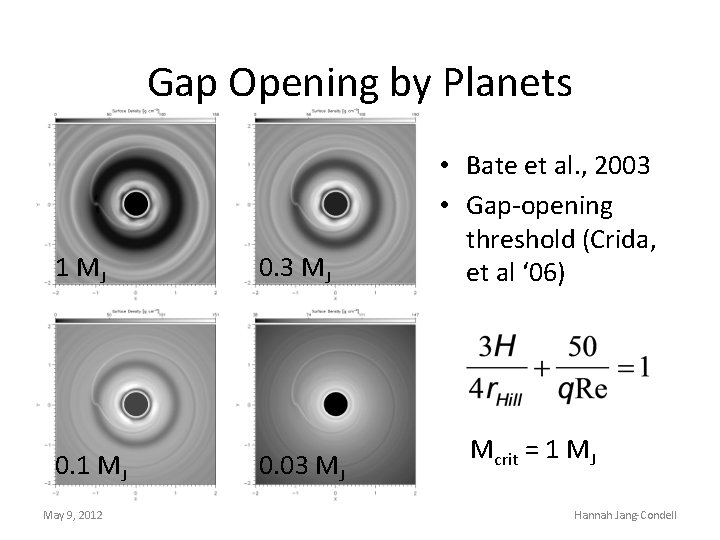
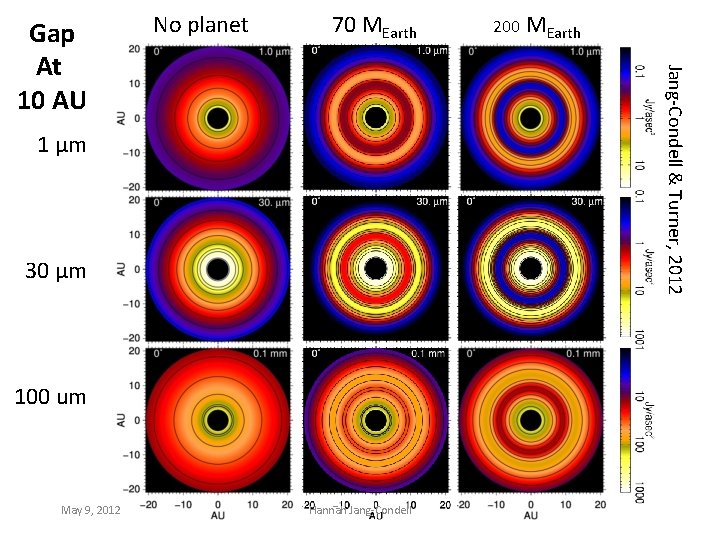
Gap Opening by Planets 1 MJ 0. 1 MJ May 9, 2012 0. 3 MJ 0. 03 MJ • Bate et al. , 2003 • Gap-opening threshold (Crida, et al ‘ 06) Mcrit = 1 MJ Hannah Jang-Condell
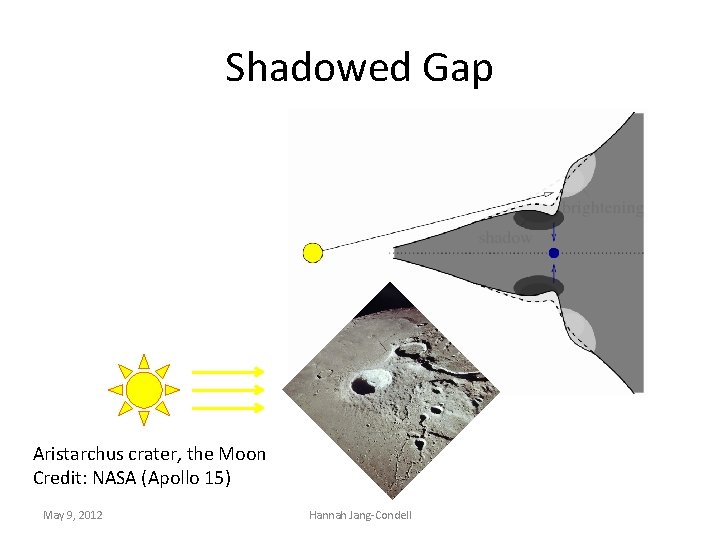
Shadowed Gap Aristarchus crater, the Moon Credit: NASA (Apollo 15) May 9, 2012 Hannah Jang-Condell
No planet 70 MEarth 1 μm 30 μm 100 um May 9, 2012 200 MEarth Jang-Condell & Turner, 2012 Gap At 10 AU Hannah Jang-Condell
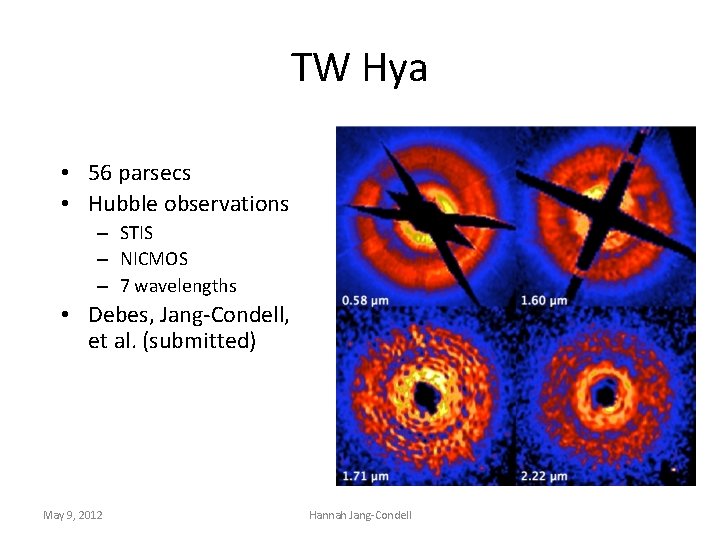
TW Hya • 56 parsecs • Hubble observations – STIS – NICMOS – 7 wavelengths • Debes, Jang-Condell, et al. (submitted) May 9, 2012 Hannah Jang-Condell
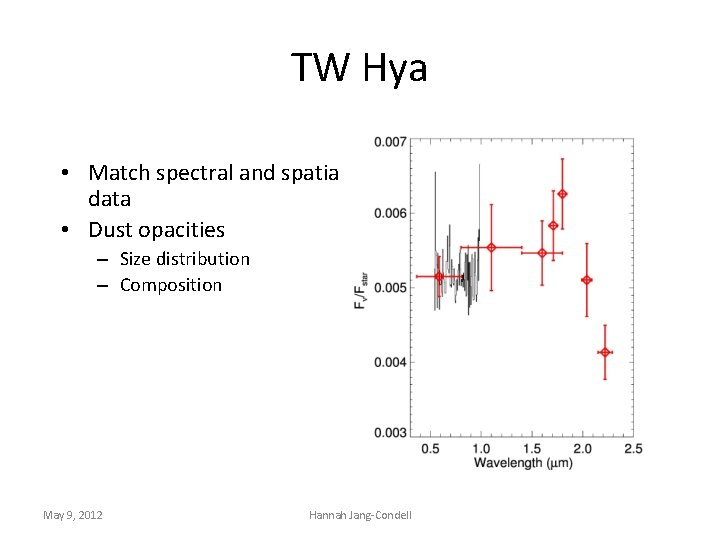
TW Hya • Match spectral and spatial data • Dust opacities – Size distribution – Composition May 9, 2012 Hannah Jang-Condell
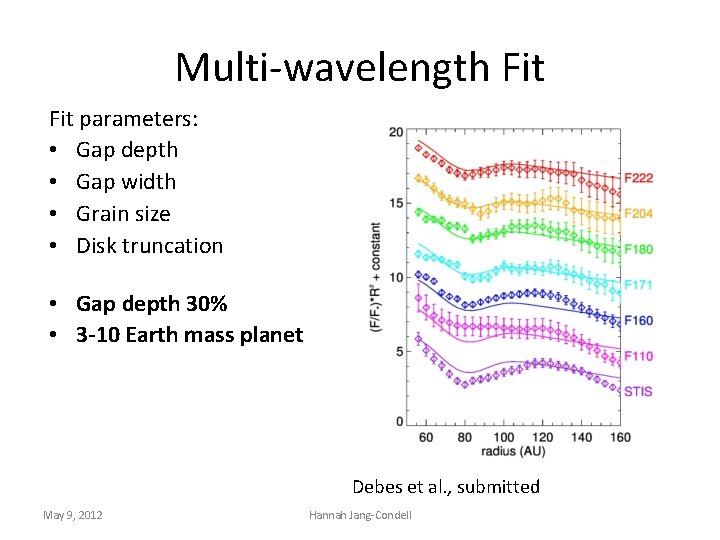
Multi-wavelength Fit parameters: • Gap depth • Gap width • Grain size • Disk truncation • Gap depth 30% • 3 -10 Earth mass planet Debes et al. , submitted May 9, 2012 Hannah Jang-Condell
Inclined Disks
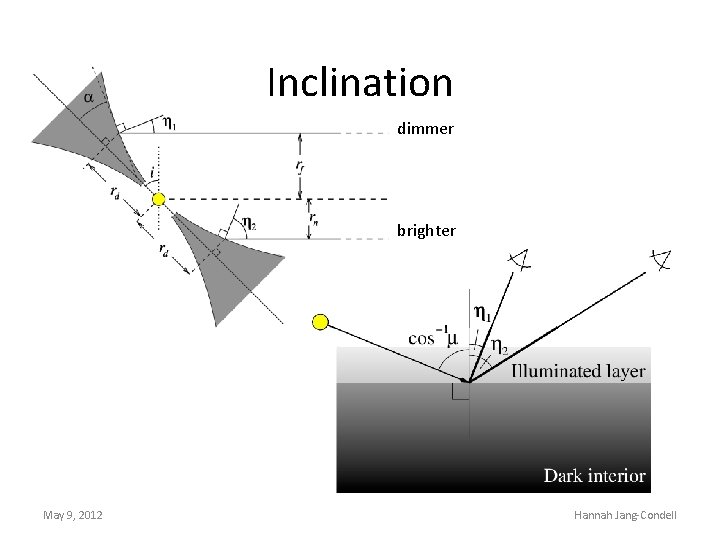
Inclination dimmer brighter May 9, 2012 Hannah Jang-Condell
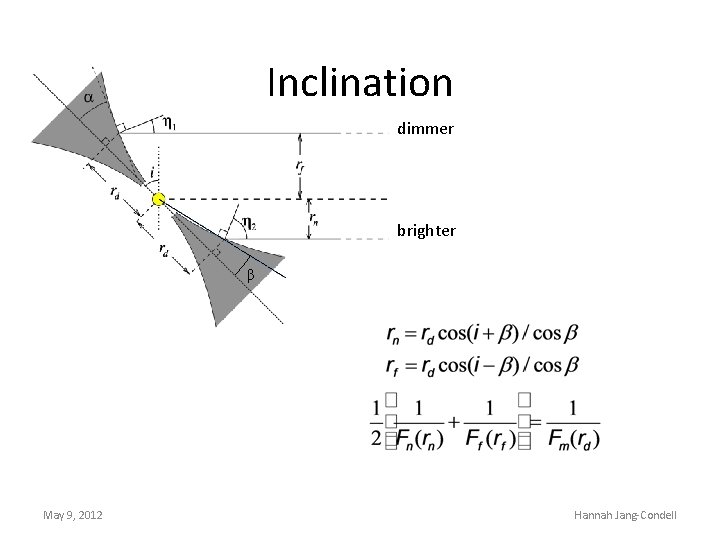
Inclination dimmer brighter β May 9, 2012 Hannah Jang-Condell
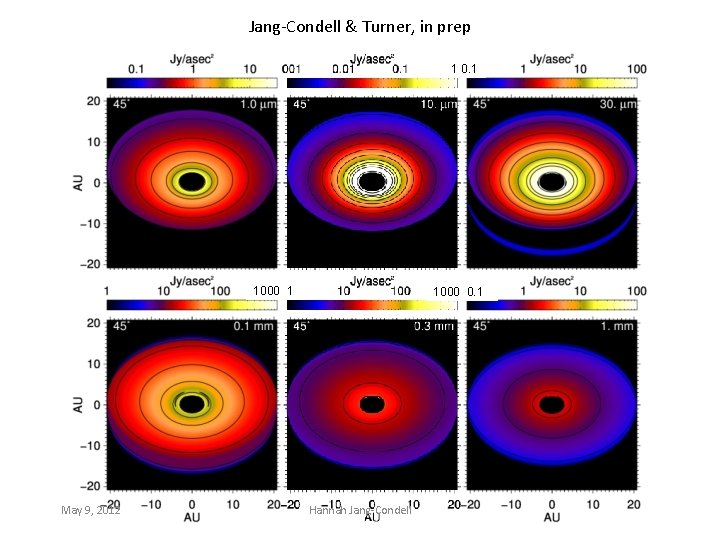
Jang-Condell & Turner, in prep 1 0. 1 1000 1 May 9, 2012 1000 0. 1 Hannah Jang-Condell
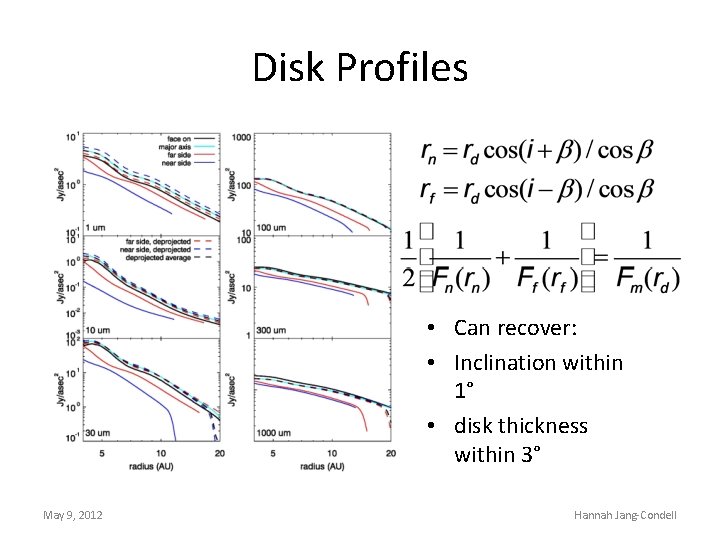
Disk Profiles • Can recover: • Inclination within 1° • disk thickness within 3° May 9, 2012 Hannah Jang-Condell
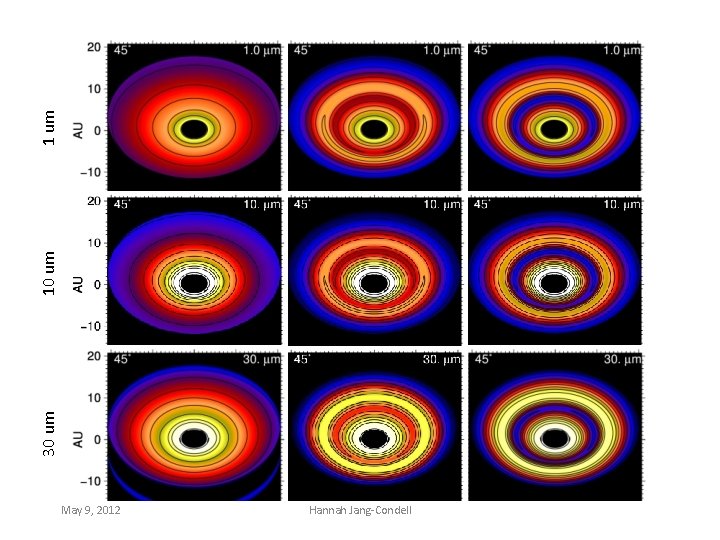
1 um 10 um 30 um May 9, 2012 Hannah Jang-Condell
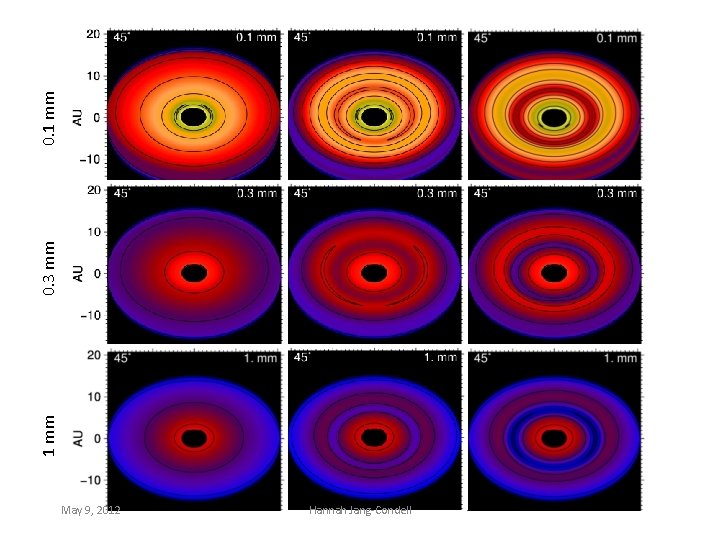
0. 1 mm 0. 3 mm 1 mm May 9, 2012 Hannah Jang-Condell
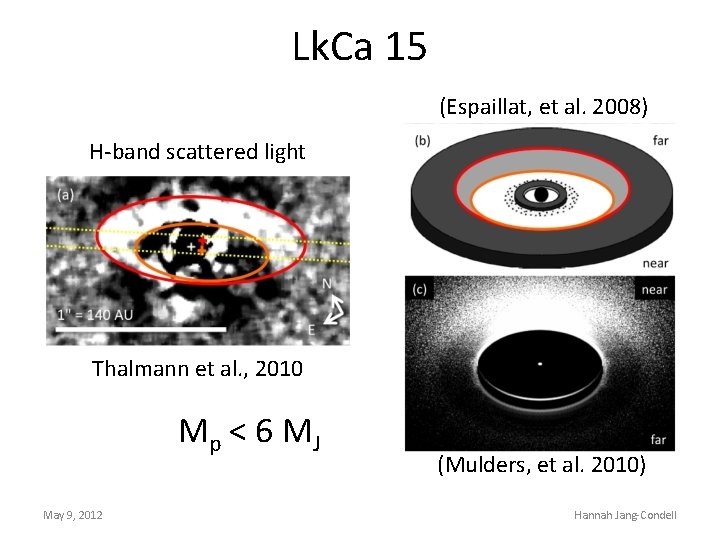
Lk. Ca 15 (Espaillat, et al. 2008) H-band scattered light Thalmann et al. , 2010 Mp < 6 M J May 9, 2012 (Mulders, et al. 2010) Hannah Jang-Condell
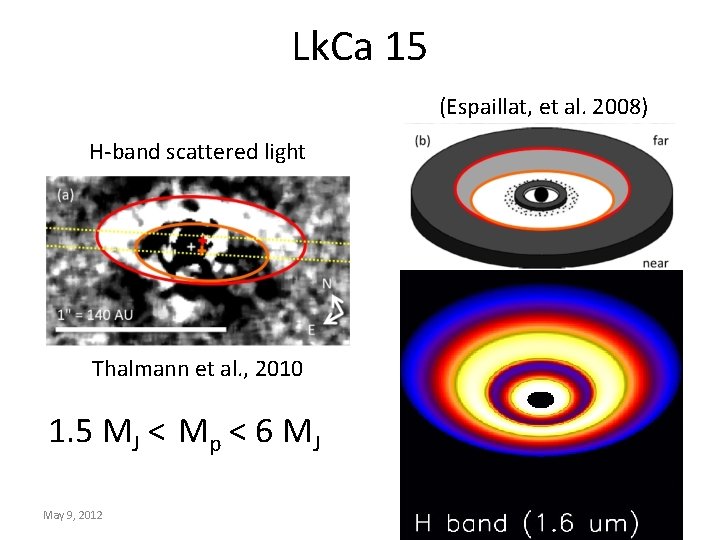
Lk. Ca 15 (Espaillat, et al. 2008) H-band scattered light Thalmann et al. , 2010 1. 5 MJ < Mp < 6 MJ May 9, 2012 (Mulders, et al. 2010) Hannah Jang-Condell
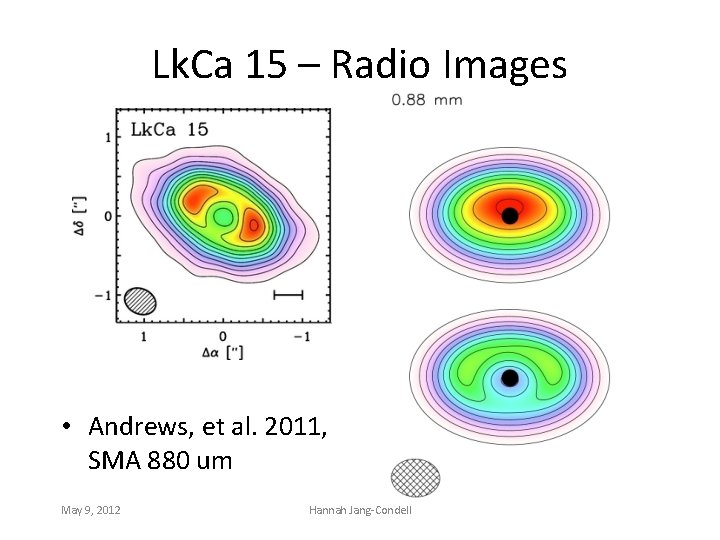
Lk. Ca 15 – Radio Images • Andrews, et al. 2011, SMA 880 um May 9, 2012 Hannah Jang-Condell