
ACCRETING XRAY MILLISECOND PULSARS IN OUTBURST MAURIZIO FALANGA
ACCRETING X-RAY MILLISECOND PULSARS IN OUTBURST MAURIZIO FALANGA Service d‘Astrophysique, CEA –Saclay Collaborators: J. Poutanen, L. Kuipers, E. Bonning W. Hermsen, J. M. Bonnet-Bidaud, L. Stella Decembre 3, 2007 ISSI Bern 1
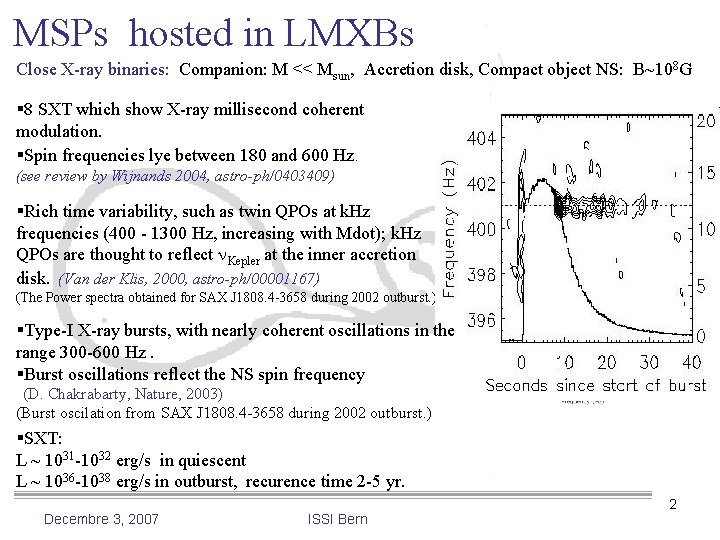
MSPs hosted in LMXBs Close X-ray binaries: Companion: M << Msun, Accretion disk, Compact object NS: B~108 G § 8 SXT which show X-ray millisecond coherent modulation. §Spin frequencies lye between 180 and 600 Hz. (see review by Wijnands 2004, astro-ph/0403409) §Rich time variability, such as twin QPOs at k. Hz frequencies (400 - 1300 Hz, increasing with Mdot); k. Hz QPOs are thought to reflect Kepler at the inner accretion disk. (Van der Klis, 2000, astro-ph/00001167) (The Power spectra obtained for SAX J 1808. 4 -3658 during 2002 outburst. ) §Type-I X-ray bursts, with nearly coherent oscillations in the range 300 -600 Hz. §Burst oscillations reflect the NS spin frequency (D. Chakrabarty, Nature, 2003) (Burst oscilation from SAX J 1808. 4 -3658 during 2002 outburst. ) §SXT: L ~ 1031 -1032 erg/s in quiescent L ~ 1036 -1038 erg/s in outburst, recurence time 2 -5 yr. Decembre 3, 2007 ISSI Bern 2
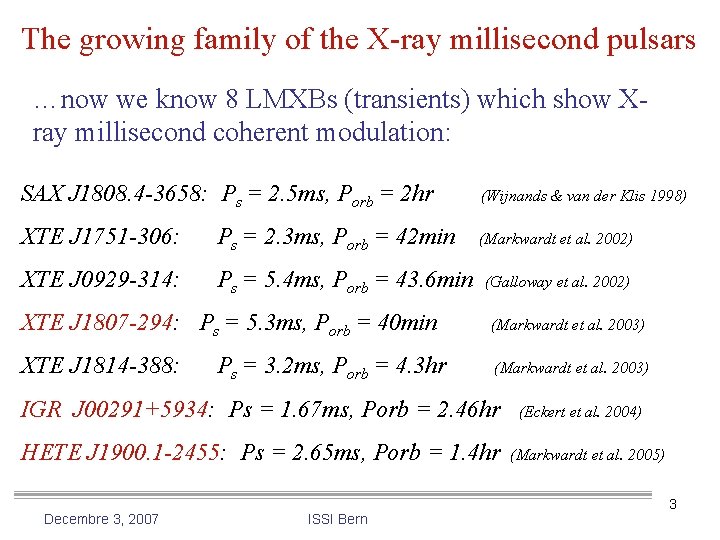
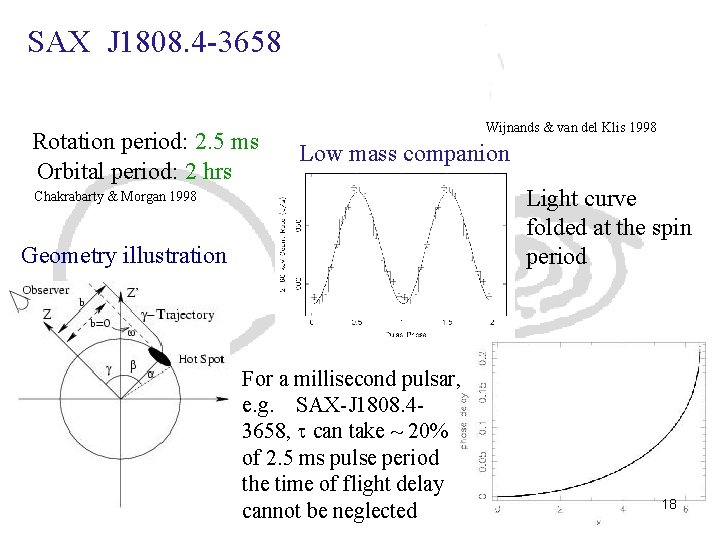
The growing family of the X-ray millisecond pulsars …now we know 8 LMXBs (transients) which show Xray millisecond coherent modulation: SAX J 1808. 4 -3658: Ps = 2. 5 ms, Porb = 2 hr (Wijnands & van der Klis 1998) XTE J 1751 -306: Ps = 2. 3 ms, Porb = 42 min (Markwardt et al. 2002) XTE J 0929 -314: Ps = 5. 4 ms, Porb = 43. 6 min (Galloway et al. 2002) XTE J 1807 -294: Ps = 5. 3 ms, Porb = 40 min (Markwardt et al. 2003) XTE J 1814 -388: (Markwardt et al. 2003) Ps = 3. 2 ms, Porb = 4. 3 hr IGR J 00291+5934: Ps = 1. 67 ms, Porb = 2. 46 hr HETE J 1900. 1 -2455: Ps = 2. 65 ms, Porb = 1. 4 hr Decembre 3, 2007 ISSI Bern (Eckert et al. 2004) (Markwardt et al. 2005) 3
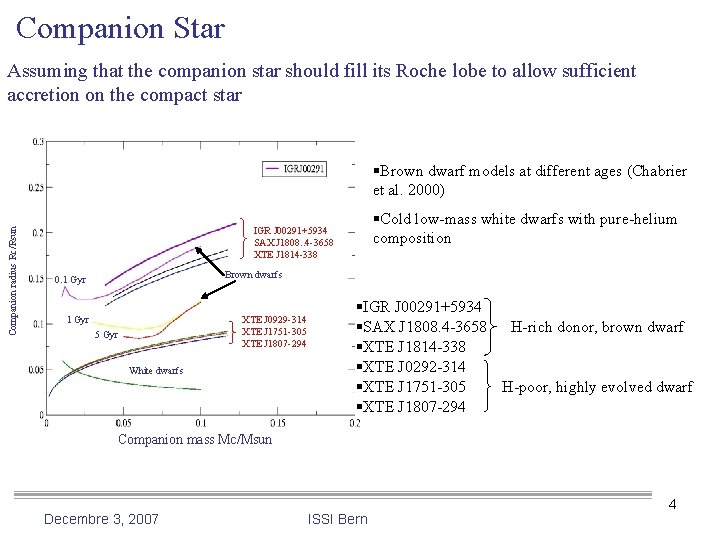
Companion Star Assuming that the companion star should fill its Roche lobe to allow sufficient accretion on the compact star Companion radius Rc/Rsun §Brown dwarf models at different ages (Chabrier et al. 2000) §Cold low-mass white dwarfs with pure-helium composition IGR J 00291+5934 SAX J 1808. . 4 -3658 XTE J 1814 -338 Brown dwarfs 0. 1 Gyr XTE J 0929 -314 XTE J 1751 -305 XTE J 1807 -294 5 Gyr White dwarfs §IGR J 00291+5934 §SAX J 1808. 4 -3658 H-rich donor, brown dwarf §XTE J 1814 -338 §XTE J 0292 -314 §XTE J 1751 -305 H-poor, highly evolved dwarf §XTE J 1807 -294 Companion mass Mc/Msun Decembre 3, 2007 ISSI Bern 4
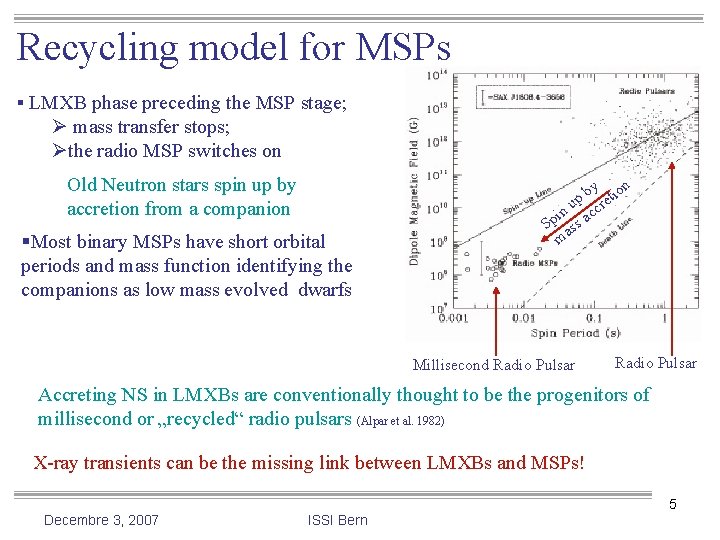
Recycling model for MSPs § LMXB phase preceding the MSP stage; Ø mass transfer stops; Øthe radio MSP switches on Old Neutron stars spin up by accretion from a companion §Most binary MSPs have short orbital periods and mass function identifying the companions as low mass evolved dwarfs y ion b p ret u in acc p S ass m Millisecond Radio Pulsar Accreting NS in LMXBs are conventionally thought to be the progenitors of millisecond or „recycled“ radio pulsars (Alpar et al. 1982) X-ray transients can be the missing link between LMXBs and MSPs! 5 Decembre 3, 2007 ISSI Bern
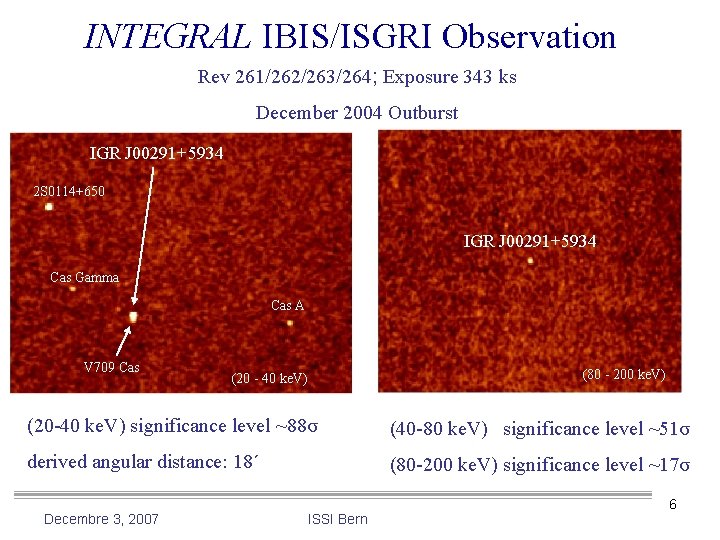
INTEGRAL IBIS/ISGRI Observation Rev 261/262/263/264; Exposure 343 ks December 2004 Outburst IGR J 00291+5934 2 S 0114+650 IGR J 00291+5934 Cas Gamma Cas A V 709 Cas (80 - 200 ke. V) (20 - 40 ke. V) (20 -40 ke. V) significance level ~88σ (40 -80 ke. V) significance level ~51σ derived angular distance: 18´ (80 -200 ke. V) significance level ~17σ Decembre 3, 2007 ISSI Bern 6
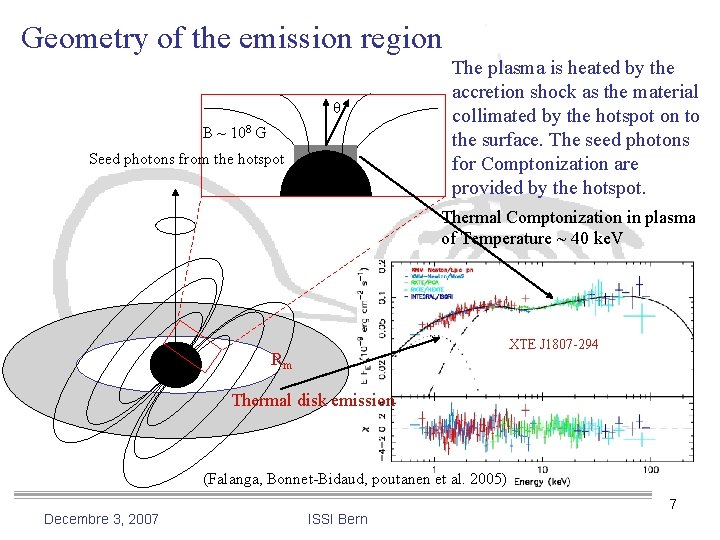
Geometry of the emission region θ B ~ 108 G Seed photons from the hotspot The plasma is heated by the accretion shock as the material collimated by the hotspot on to the surface. The seed photons for Comptonization are provided by the hotspot. Thermal Comptonization in plasma of Temperature ~ 40 ke. V XTE J 1807 -294 Rm Thermal disk emission (Falanga, Bonnet-Bidaud, poutanen et al. 2005) Decembre 3, 2007 ISSI Bern 7
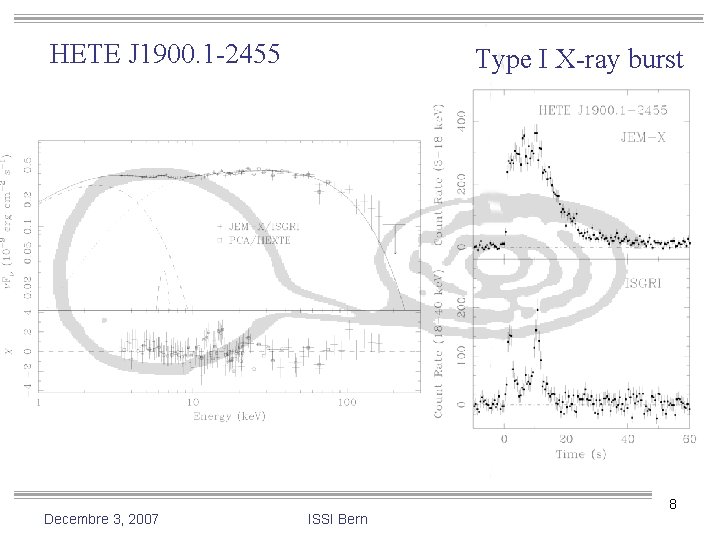
HETE J 1900. 1 -2455 Decembre 3, 2007 Type I X-ray burst ISSI Bern 8
(Eckert et al. 2004) From RXTE (Galloway et al. ke. V 2005) ISGRI 20 -100 Decembre 3, 2007 Pdot = +8. 4 x 10 -13 Hz/s Ps = 1. 67 ms Porbit = 2. 457 hr ISSI Bern Discovery Rev 261/262/263, ~205 IGR J 00291+5934 OUTBURST PROFILE (Falanga, Kuiper, Poutanen et al. 2005)
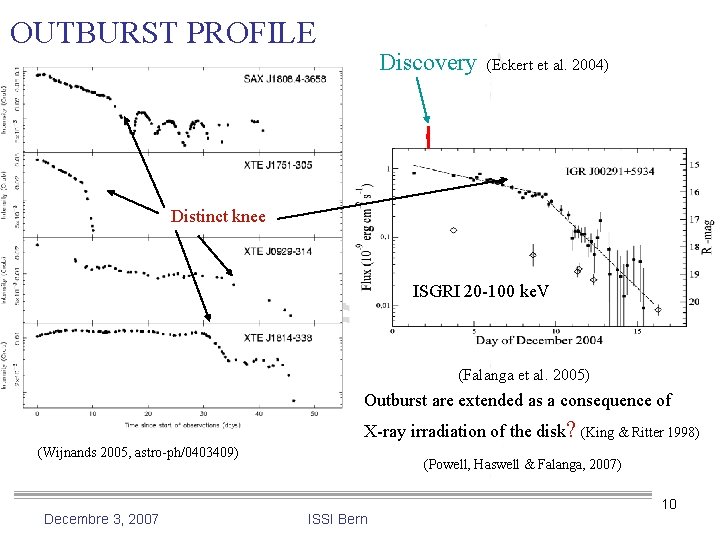
OUTBURST PROFILE Discovery (Eckert et al. 2004) XTE J 1807 -294 Distinct knee From RXTE (Galloway et al. ke. V 2005) ISGRI 20 -100 (Falanga et al. 2005) Outburst are extended as a consequence of X-ray irradiation of the disk? (King & Ritter 1998) (Wijnands 2005, astro-ph/0403409) Decembre 3, 2007 (Powell, Haswell & Falanga, 2007) ISSI Bern 10
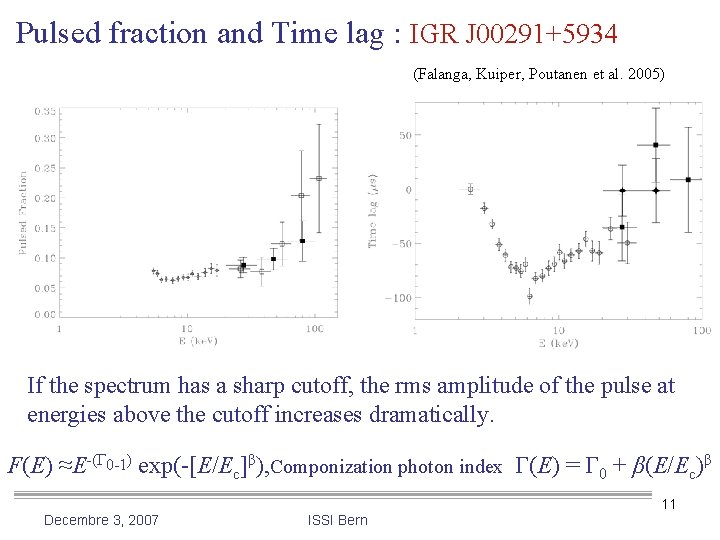
Pulsed fraction and Time lag : IGR J 00291+5934 (Falanga, Kuiper, Poutanen et al. 2005) (Falanga et al. 2005) If the spectrum has a sharp cutoff, the rms amplitude of the pulse at energies above the cutoff increases dramatically. F(E) ≈E-(Γ 0 -1) exp(-[E/Ec]β), Componization photon index Γ(E) = Γ 0 + β(E/Ec)β 11 Decembre 3, 2007 ISSI Bern
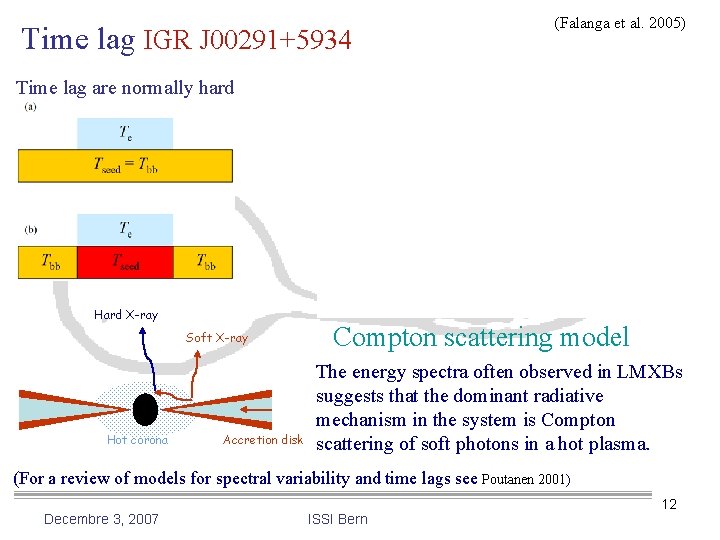
Time lag IGR J 00291+5934 (Falanga et al. 2005) Time lag are normally hard Hard X-ray Soft X-ray Hot corona Accretion disk Compton scattering model The energy spectra often observed in LMXBs suggests that the dominant radiative mechanism in the system is Compton scattering of soft photons in a hot plasma. (For a review of models for spectral variability and time lags see Poutanen 2001) Decembre 3, 2007 ISSI Bern 12
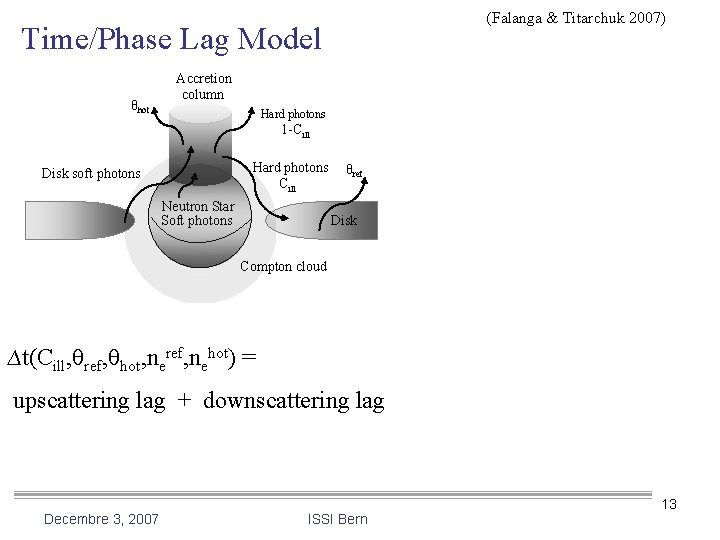
(Falanga & Titarchuk 2007) Time/Phase Lag Model θhot Accretion column Hard photons 1 -Cill Hard photons Cill Disk soft photons Neutron Star Soft photons θref Disk Compton cloud ∆t(Cill, ref, hot, neref, nehot) = upscattering lag + downscattering lag Decembre 3, 2007 ISSI Bern 13
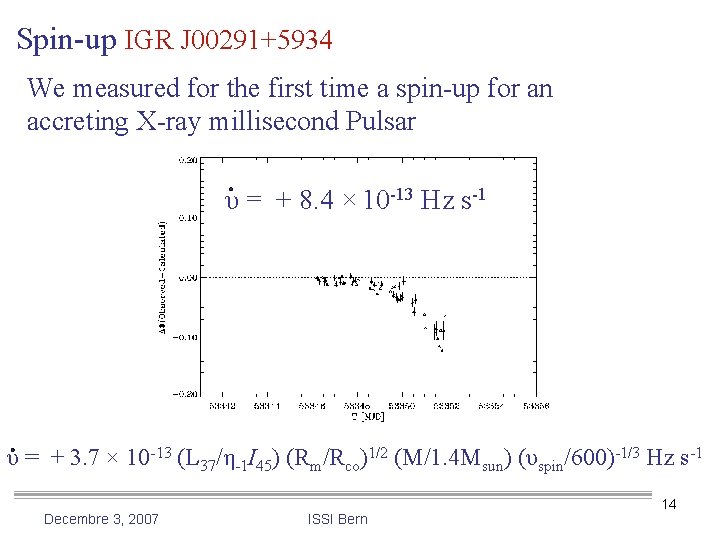
Spin-up IGR J 00291+5934 We measured for the first time a spin-up for an accreting X-ray millisecond Pulsar υ = + 8. 4 × 10 -13 Hz s-1 υ = + 3. 7 × 10 -13 (L 37/η-1 I 45) (Rm/Rco)1/2 (M/1. 4 Msun) (υspin/600)-1/3 Hz s-1 Decembre 3, 2007 ISSI Bern 14
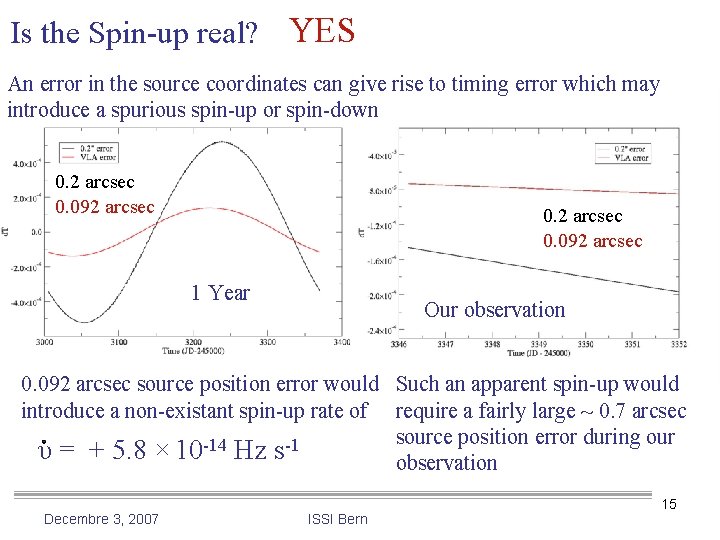
Is the Spin-up real? YES An error in the source coordinates can give rise to timing error which may introduce a spurious spin-up or spin-down 0. 2 arcsec 0. 092 arcsec 1 Year Our observation 0. 092 arcsec source position error would Such an apparent spin-up would introduce a non-existant spin-up rate of require a fairly large ~ 0. 7 arcsec source position error during our υ = + 5. 8 × 10 -14 Hz s-1 observation Decembre 3, 2007 ISSI Bern 15
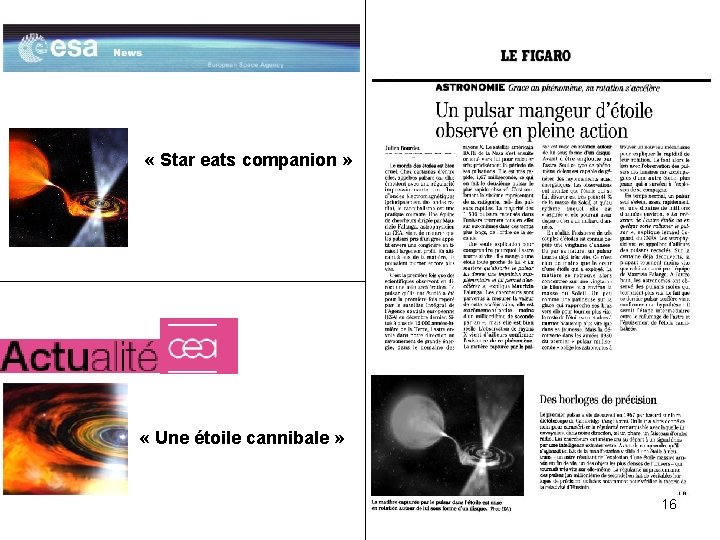
« Star eats companion » « Une étoile cannibale » 16
Pulsar spin-up Animation NASA, D. Barry 17
SAX J 1808. 4 -3658 Rotation period: 2. 5 ms Orbital period: 2 hrs Wijnands & van del Klis 1998 Low mass companion Light curve folded at the spin period Chakrabarty & Morgan 1998 Geometry illustration For a millisecond pulsar, e. g. SAX-J 1808. 43658, can take ~ 20% of 2. 5 ms pulse period the time of flight delay cannot be neglected 18
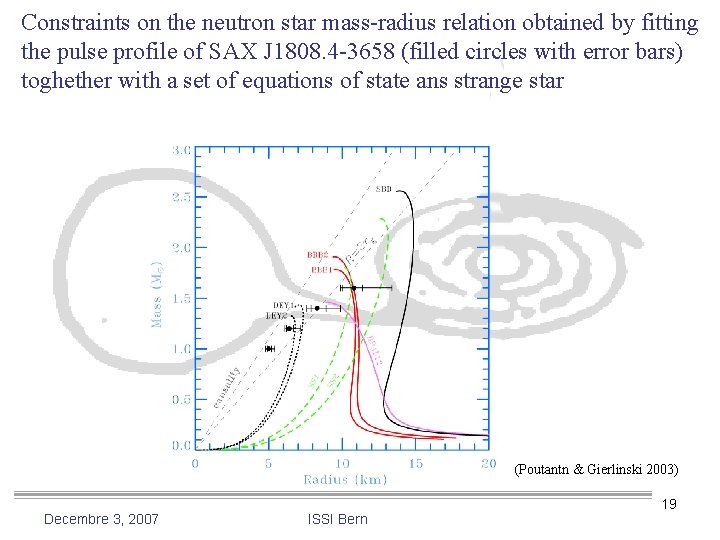
Constraints on the neutron star mass-radius relation obtained by fitting the pulse profile of SAX J 1808. 4 -3658 (filled circles with error bars) toghether with a set of equations of state ans strange star (Poutantn & Gierlinski 2003) Decembre 3, 2007 ISSI Bern 19
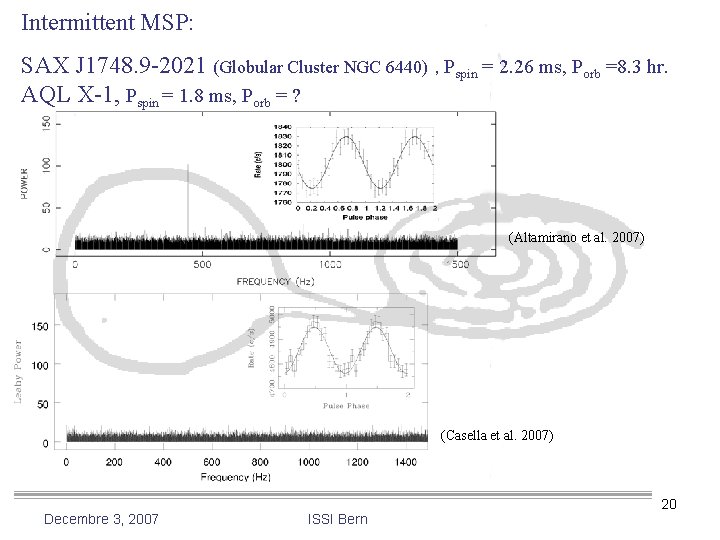
Intermittent MSP: SAX J 1748. 9 -2021 (Globular Cluster NGC 6440) , Pspin = 2. 26 ms, Porb =8. 3 hr. AQL X-1, Pspin = 1. 8 ms, Porb = ? (Altamirano et al. 2007) (Casella et al. 2007) Decembre 3, 2007 ISSI Bern 20
Important Questions §Missing link between LXMB and ms radio pulsar ? §Analysis suggests that the spin frequency is limited to 760 Hz (95% confidence; Chakrabarty et al. 2003) §Several have suggested that gravitational radiation from a non-spherical neutron star might limit the maximum fraquency (Bildsten et al. 1998) §Detection by LISA? §Detecting more of these source with more instrument than before Decembre 3, 2007 ISSI Bern 21
Thank You… Decembre 3, 2007 ISSI Bern 22
- Slides: 22