
Accreditation Standards and the Library Media Center Britany
Accreditation Standards and the Library Media Center Britany Howell LM 563 University of West Alabama
What is Accreditation? • Accreditation is intended to assure the public of the quality and integrity of institutions and programs, and to help those institutions and programs improve. These outcomes are achieved through rigorous internal and external review processes during which the institution is evaluated against a common set of standards. • When accreditation is awarded to an institution, it means that the institution has: – provided an appropriate mission to education – resources, programs, and services sufficient to accomplish and sustain its mission – clearly specified educational objectives that are consistent with its mission and appropriate to the degrees – successful in achieving its stated objectives

Basic Principles of Accreditation • Accreditation involves three major components for a school: – Meeting standards – Engaging in continuous improvement – Providing for quality assurance • In order for a school to be accredited or maintain accreditation, the standards must serve as the guide and benchmark for schools to access, allocate, and use its available resources for the benefit of student learning.
Who Grants Accreditation? • The Southern Association of Colleges and Schools Council on Accreditation and School Improvement – Most commonly referred to as SACS CASI. – A non-governmental, voluntary organization that accredits more than 13, 000 public and nonpublic institutions from early childhood through university • A peer review team is sent out to the institution to review its worthiness of accreditation • This process is repeated every five years for each institution

Library Accreditation Standards • There are 10 library media accreditation standards. – – – – – Knowledge of Learners Knowledge of Teaching and Learning Knowledge, Library, and Information Studies Integrating Instruction Leading Innovation Through the Library Media Program Administering the Library Media Program Reflective Practice Professional Growth Ethics, Equity, and Diversity Leadership, Advocacy, and Community Partnerships
Library Accreditation Standards STANDARD 1: Knowledge of Learners • Accomplished library media specialists have knowledge of learning styles and of human growth and development. • Library media specialists make a point of learning as much as they can about the way the members of their learning community learns and uses this information to shape instructional decisions. • Library media specialists understand experiential backgrounds that affect the acquisition of knowledge.
Library Accreditation Standards STANDARD 2: Knowledge of Teaching and Learning • Accomplished library media specialists know the principles of teaching and learning that contribute to an active learning environment. • Knowledge of learning theory • Knowledge of instructional design and development • Establishing an active and positive learning environment • Developing group management strategies • Strengthening and supporting school, district, and state curricula

Library Accreditation Standards STANDARD 3: Knowledge, Library, and Information Studies • Accomplished library media specialists know the principles of library and information studies needed to create effective, integrated library media programs. • Knowledge of the principles of profession • Knowledge of ethical and legal tenets • Knowledge of effective organization and practice • Knowledge of literature • Knowledge of information processing strategies • Knowledge of technology for the creation and management of information
Library Accreditation Standards STANDARD 4: Integrating Instruction • Accomplished library media specialists integrate information literacy through collaboration, planning, implementation, and assessment of learning. • Collaboration in planning learning • Implementing instructional activities • Assessing learning instruction
Library Accreditation Standards STANDARD 5: Leading Innovation through the Library Media Program • Accomplished library media specialists lead in providing equitable access to and effective use of technologies and innovations. • Providing access to technology information systems • Teaching effective use of technology and other resources • Engaging learners with technology • Enhance learning
Library Accreditation Standards STANDARD 6: Administering the Library Media Program • Accomplished library media specialists plan, develop, implement, manage, and evaluate library media programs to ensure that students and staff use ideas and information effectively. • Planning the library media program • Developing the library media program • Implementing the library media program • Managing the library media program • Evaluating the library media program
Library Accreditation Standards STANDARD 7: Reflective Practice • Accomplished library media specialists engage in reflective practice to increase their effectiveness. • Self reflection • Reflecting on the library media program
Library Accreditation Standards STANDARD 8: Professional Growth • Accomplished library media specialists model a strong commitment to lifelong learning and to their profession. • Furthering professional education • Networking opportunities

Library Accreditation Standards STANDARD 9: Ethics, Equity, and Diversity • Accomplished library media specialists uphold professional ethics and promote equity and diversity. • Ethical use of information • Promoting equity and diversity
Library Accreditation Standards STANDARD 10: Leadership, Advocacy, and Community Partnerships • Accomplished media specialists advocate for the library media program, involving the greater community. • Leadership • Advocacy • Community Partnerships
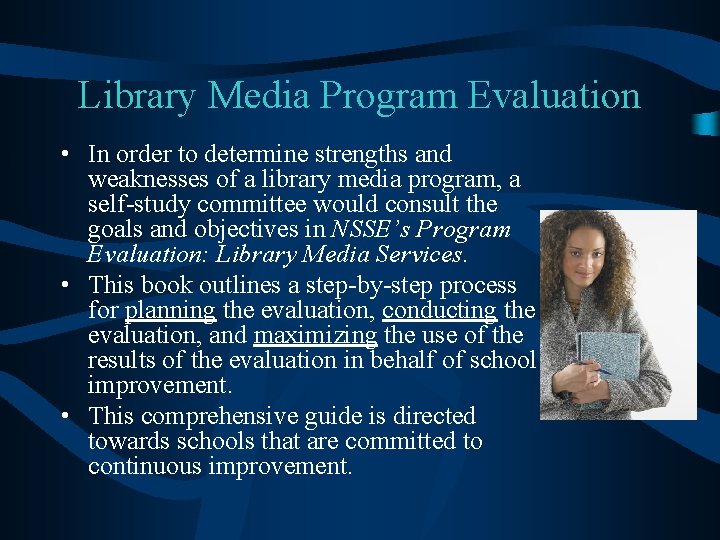
Library Media Program Evaluation • In order to determine strengths and weaknesses of a library media program, a self-study committee would consult the goals and objectives in NSSE’s Program Evaluation: Library Media Services. • This book outlines a step-by-step process for planning the evaluation, conducting the evaluation, and maximizing the use of the results of the evaluation in behalf of school improvement. • This comprehensive guide is directed towards schools that are committed to continuous improvement.
Overview of the Program Evaluation Process • A step-by-step process for conducting the program evaluation is outlined in two parts of Program Evaluation: Library Media Services. • The third part of the guide provides strategies and guidelines for putting results to work.

Overview of the Program Evaluation Process • Part 1 – Focusing on the Quality of the Work of Students – Step 1 – Defining the expectations for student learning – Step 2 – Analyzing student performance – Step 3 - Identifying priorities for improving student learning
Overview of the Program Evaluation Process • Part 2 – Focusing on the quality of work of the school – Step 4 – Analyzing instructional and organizational effectiveness – Step 5 – Collecting data and evidence – Step 6 – Identifying priorities for improving the quality of the work of the school
Overview of the Program Evaluation Process • Part 3 – Putting the indicators of schools of quality to work in behalf of school improvement – Gives strategies and guidelines for putting the results to work – Gives sample school improvement plans that address goals for improving the Library Media Program
References Accreditation and School Improvement: The Next Generation. (n. d. ). Retrieved February 11, 2008, from The University of West Alabama website: http: //bb. uwa. edu Benefits of Accreditation. (n. d. ). Retrieved February 11, 2008, from The University of West Alabama website: http: //bb. uwa. edu Fitzpatrick, Kathleen A. (1998). Program Evaluation: Library Media Services. National Study of School Evaluation: Schaumberg, IL. Guidelines for a School Seeking Accreditation: Recognizing Quality Schools. (n. d. ). Retrieved February 11, 2008, from The University of West Alabama website: http: //bb. uwa. edu National Board for Professional Teaching Standards: Library Media Specialist. (n. d. ). Retrieved February 11, 2008, from The University of West Alabama website: http: //bb. uwa. edu National Study of School The Place of the School Library Media Program in the Accreditation Process. (n. d. ). Retrieved February 11, 2008, from The University of West Alabama website: http: //bb. uwa. edu SACS/CASI Public School Standards K-12. (n. d. ). Retrieved February 11, 2008, from The University of West Alabama website: http: //bb. uwa. edu School District and System Accreditation. (n. d. ). Retrieved February 11, 2008, from The University of West Alabama website: http: //bb. uwa. edu Steps to Initial and Continued Accreditation. (n. d. ). Retrieved February 11, 2008, from The University of West Alabama website: http: //bb. uwa. edu
- Slides: 21