
Accreditation Meditation Lessons from the Field and Tips

- Slides: 57
Accreditation Meditation: Lessons from the Field and Tips for Success Janice Munroe, BSc. Pharm Regional Pharmacy Medication Safety Coordinator, Fraser Health, BC Julie Greenall, BSc. Phm, MHSc, ACPR, FISMPC Director of Projects and Education, ISMP Canada Canadian Society of Hospital Pharmacists Professional Practice Conference Sunday, January 31, 2016 Toronto ON
Presenter Disclosure � Presenters: Janice Munroe and Julie Greenall � ISMP Canada has received limited unrestricted honoraria from various pharmaceutical companies for educational presentations � Janice receives an honourarium from Accreditation Canada for surveys conducted � We have received no speaker fees for this learning activity
Commercial Support Disclosure � Janice has received support from CSHP to cover expenses associated with attending this conference to provide this presentation � Julie’s time to prepare and present today is supported through a grant from Health Canada through the Canadian Medication Incident Reporting and Prevention System
Disclosure The opinions expressed are those of the speakers and may not reflect the views of Accreditation Canada. Please consult Accreditation Canada directly for any questions related to their Standards and Required Organizational Practices. This presentation references Version 10 of the Accreditation Standards, applicable to organizations surveyed in 2016.
Learning Objectives � At the conclusion of this presentation, participants will: ◦ Understand key changes to the Medication Management Standards and Required Organizational Practices (ROPs) introduced in 2014; ◦ Understand the surveyor perspective on how the standards are assessed; ◦ Be aware of areas of ongoing challenge from a medication safety perspective; and ◦ Be aware of tips and tools to support organizations in identifying potential areas of vulnerability and implementing improvements.
Self Assessment Questions � When is an “interdisciplinary committee approved exception” appropriate? � How will changes to the Medication Reconciliation ROP for the Emergency program and peri-operative environment affect my practice?
Presentation Outline � Background � Management � New � Case of exceptions expectations for medication reconciliation studies and discussion � Tools and resources
Background � Accreditation Canada ◦ Qmentum ◦ Managing Medications Standards � Revised for surveys in January 2014 ◦ Medication Management Standards ◦ New format and flow ◦ Focus on responsibility of the organization for medication management (not just pharmacy) ◦ New, clearer ROPs �Exceptions introduced
Surveyor Selection and Training � Surveyors undergo an evaluation/screening before acceptance ◦ Qualifications ◦ Experience ◦ Real-time interview � Accepted ◦ ◦ surveyors receive detailed training Introduction to the accreditation process Different standards Ratings Software
Surveyor Training and Commitment � On site tracer ◦ Local hospital ◦ Hands on experience ◦ Receive feedback � Future surveys ◦ Minimum of 2 per year �Maintain experience �Change in frequency of organization surveys has made this challenging
Competency � All surveyors are required to successfully complete annual online education modules ◦ ◦ ◦ Varied topics Governance Report writing Rating Select Standards � Accreditation Canada coordinates a surveyor education conference every 3 years
Survey Planning � Developed collaboratively ◦ Organizational quality leads ◦ Assigned Accreditation Canada Specialist � Identify standards to be addressed � Identify sites to be evaluated � Balance assignments across surveyors ◦ 5 day survey period
Surveyor Challenges � Surveyors ◦ ◦ ◦ come from different walks of life CEO Physician Nurse Pharmacist Lab Technician � Organizations are challenged to correctly interpret standards �Standards apply across different settings (community/tertiary) and jurisdictions (provincial/territorial), requiring broad language �Overlap of content between sets of standards; content is sometimes inconsistent
Impact of Change in Accreditation Approach � Previous survey results “met” ROPs ◦ January 2014 - may be “unmet” AND expanded scope ◦ Organizations need to rethink their strategies Shifted organization’s goal from: successful survey rating safest system for patients � New High Alert ROP - ensures a targeted group of medications are safely handled from the time they enter the organization until they are administered to the patient.
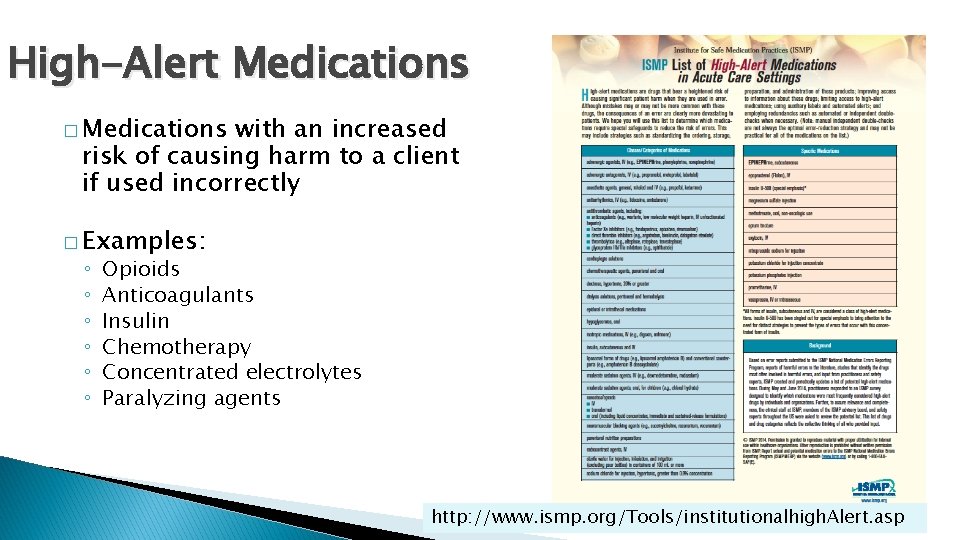
High-Alert Medications � Medications with an increased risk of causing harm to a client if used incorrectly � Examples: ◦ ◦ ◦ Opioids Anticoagulants Insulin Chemotherapy Concentrated electrolytes Paralyzing agents http: //www. ismp. org/Tools/institutionalhigh. Alert. asp
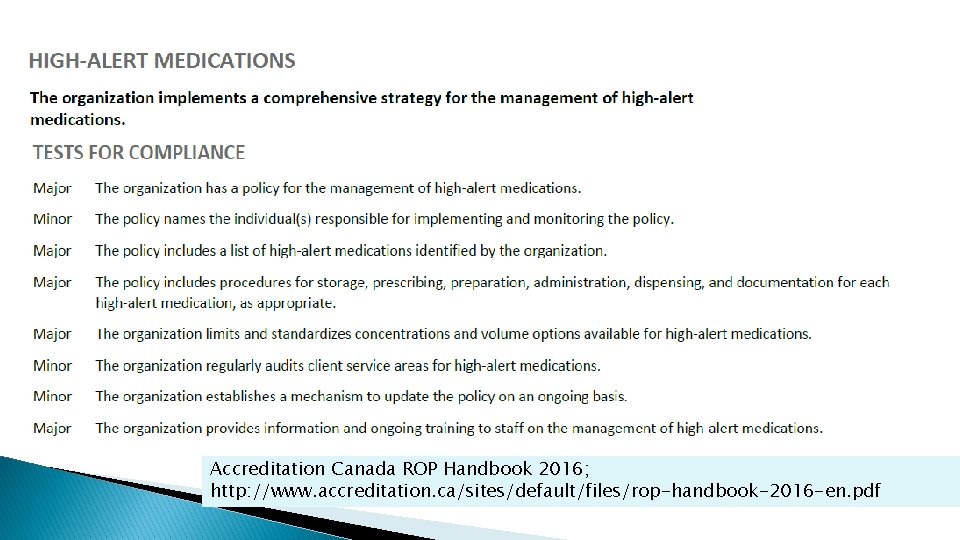
Accreditation Canada ROP Handbook 2016; http: //www. accreditation. ca/sites/default/files/rop-handbook-2016 -en. pdf
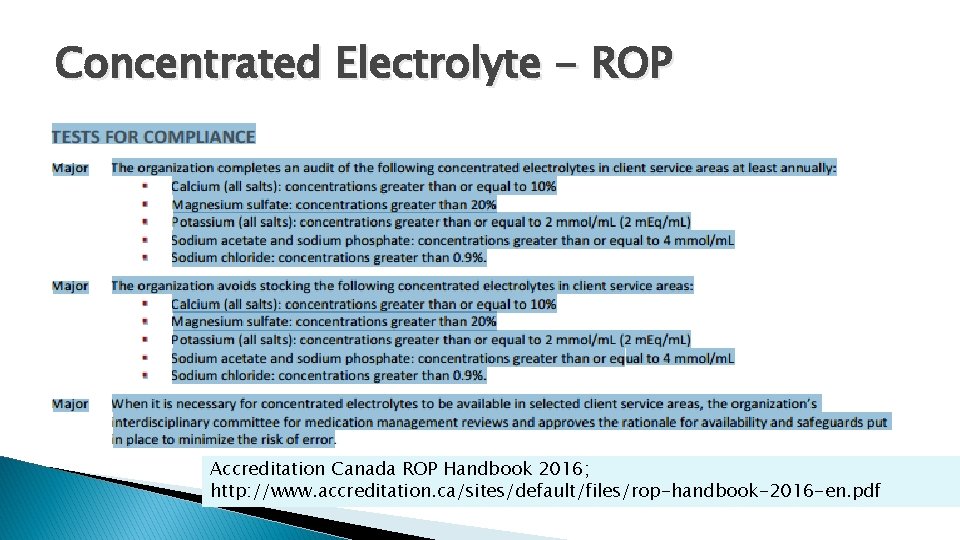
Concentrated Electrolyte - ROP Accreditation Canada ROP Handbook 2016; http: //www. accreditation. ca/sites/default/files/rop-handbook-2016 -en. pdf
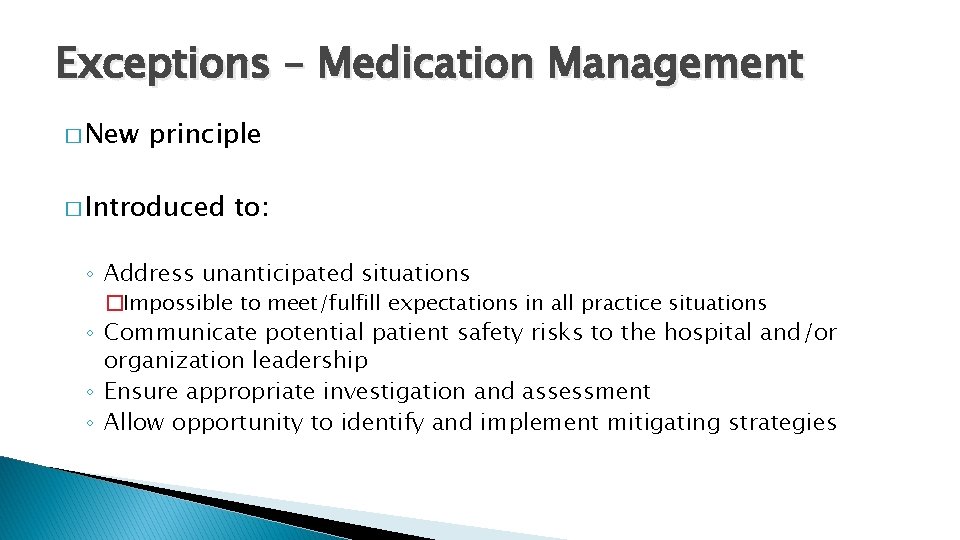
Exceptions – Medication Management � New principle � Introduced to: ◦ Address unanticipated situations �Impossible to meet/fulfill expectations in all practice situations ◦ Communicate potential patient safety risks to the hospital and/or organization leadership ◦ Ensure appropriate investigation and assessment ◦ Allow opportunity to identify and implement mitigating strategies
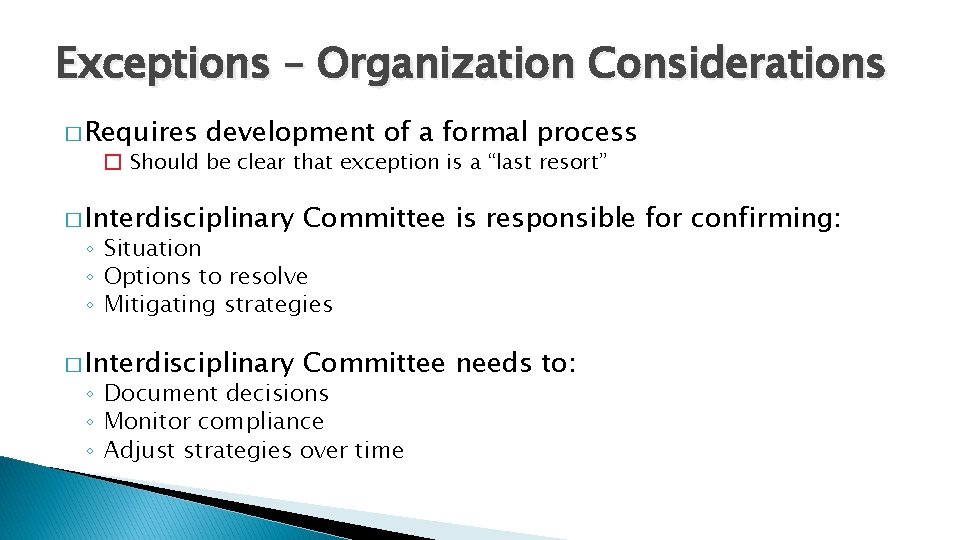
Exceptions – Organization Considerations � Requires development of a formal process � Should be clear that exception is a “last resort” � Interdisciplinary Committee is responsible for confirming: � Interdisciplinary Committee needs to: ◦ Situation ◦ Options to resolve ◦ Mitigating strategies ◦ Document decisions ◦ Monitor compliance ◦ Adjust strategies over time
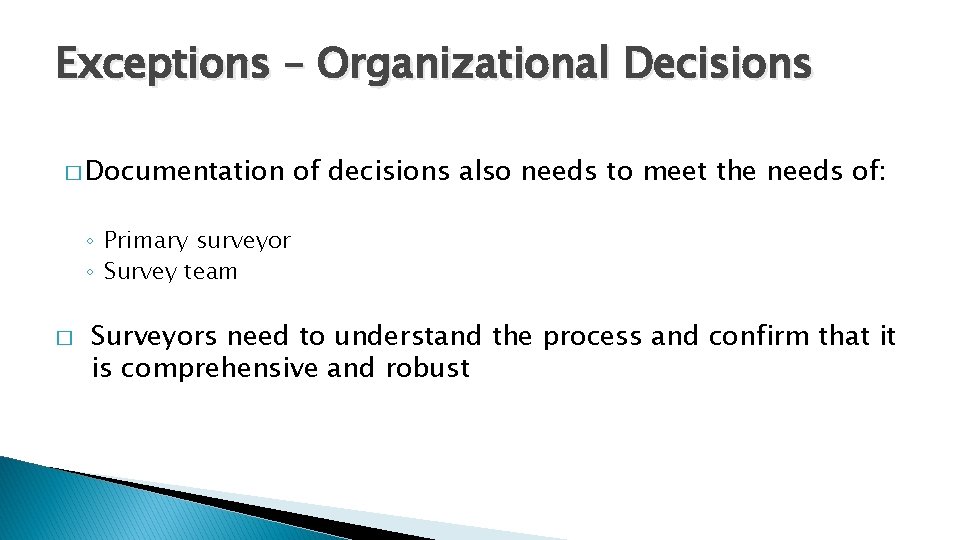
Exceptions – Organizational Decisions � Documentation of decisions also needs to meet the needs of: ◦ Primary surveyor ◦ Survey team � Surveyors need to understand the process and confirm that it is comprehensive and robust
Exceptions – Surveyor Considerations � Need ◦ ◦ to know: What the exception approval process is What the exceptions are Where they can expect to see an exception What the approved mitigating strategies are � Surveyor needs to confirm that the areas they have observed comply with the details of the exception
Accreditation Challenges � Standards drive change but organizations are challenged with compliance ◦ Example: to remove products - need more commercially prepared products �Manufacturers are slow to support due to initial low demand �Forces “in-house” preparation � Increases likelihood that exceptions will be needed/used
Accreditation Ratings � All accreditation standards are broken down into: ◦ Required Organizational Practices – Mandatory �Tests for Compliance ◦ Criteria – Different Weight � Accreditation decisions are based on performance in 3 categories: 1. ROP and Tests of Compliance 2. Instrument Thresholds 3. High Priority Criteria and all others
Accreditation Ratings 1. 2. 3. Accredited with Exemplary Standing Accredited with Commendation Accredited Key differences: ◦ Exemplary requires success on all ROP tests of compliance ◦ Percentage of met criteria (95% or more for exemplary)
Accreditation Ratings � Organizations � General typically focus on the ROPS and High Priority criteria are secondary � Connection between criteria and ROP ◦ Multi-dose vials and LMWH ◦ High Alert policy and secondary checks (barcoding or manual)
Examples of Challenges � Dialysis and Heparin � Calcium infusions ◦ ◦ Different machines across Canada Each requires different volume of heparin Some require different sizes of syringes Challenging to standardize commercial product needed ◦ Need commercially available standard doses and infusion solutions ◦ Would optimize Beyond Use Date ◦ Reduces need for on unit dilution and approved exceptions
Examples of Challenges (cont’d) � Magnesium Injection ◦ Historically, 50% most common ◦ Early adopters shifted to 20% but numbers were small ◦ Manufacturers see low yield if they switched from 50% to 20% before the
Medication Reconciliation
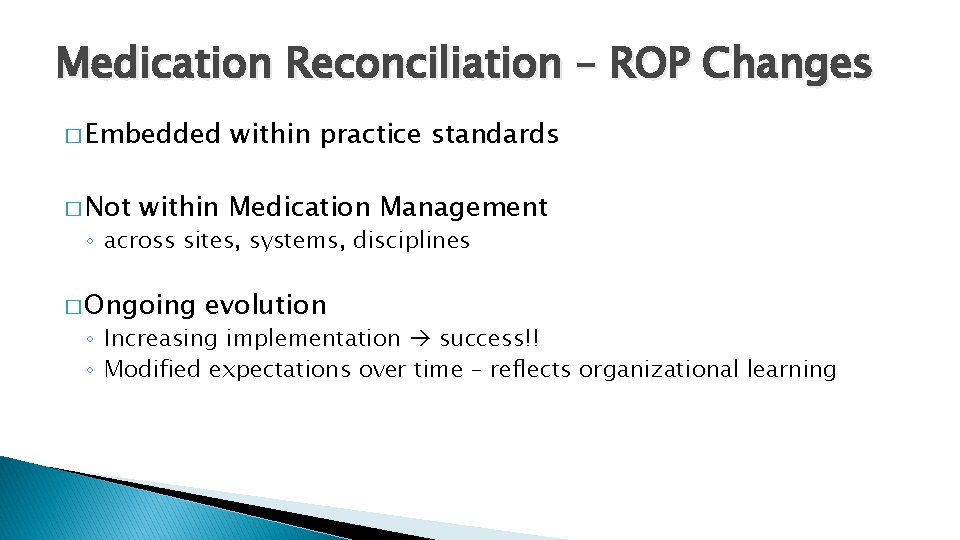
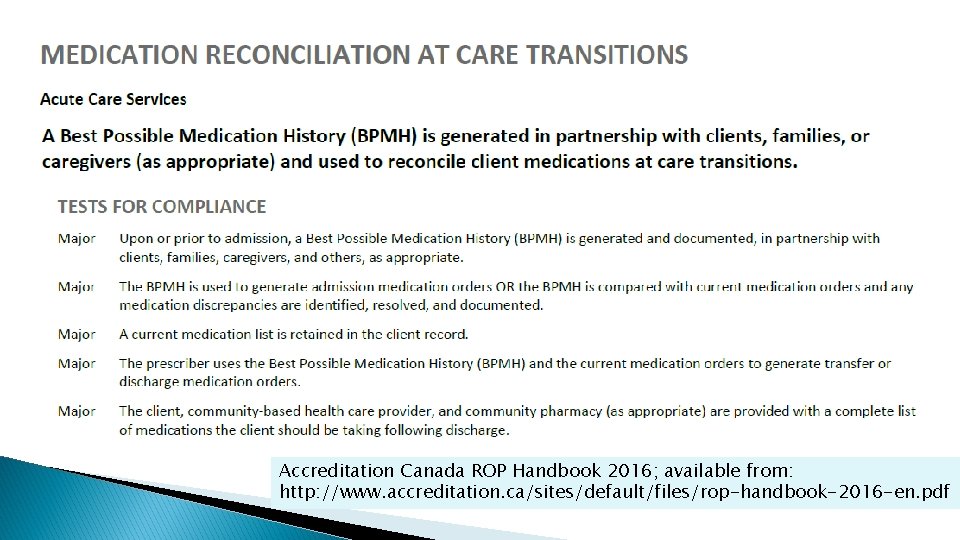
Medication Reconciliation – ROP Changes � Embedded � Not within practice standards within Medication Management ◦ across sites, systems, disciplines � Ongoing evolution ◦ Increasing implementation success!! ◦ Modified expectations over time – reflects organizational learning
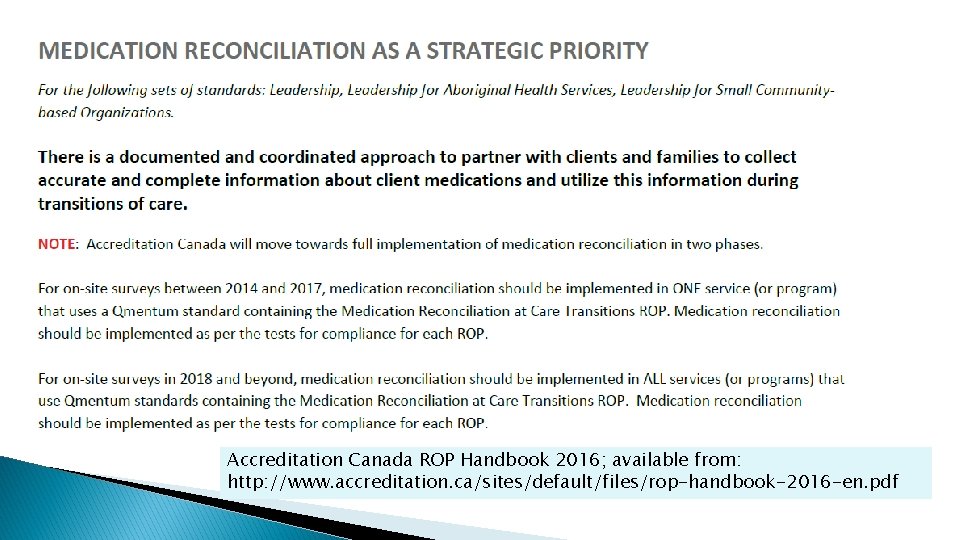
Accreditation Canada ROP Handbook 2016; available from: http: //www. accreditation. ca/sites/default/files/rop-handbook-2016 -en. pdf
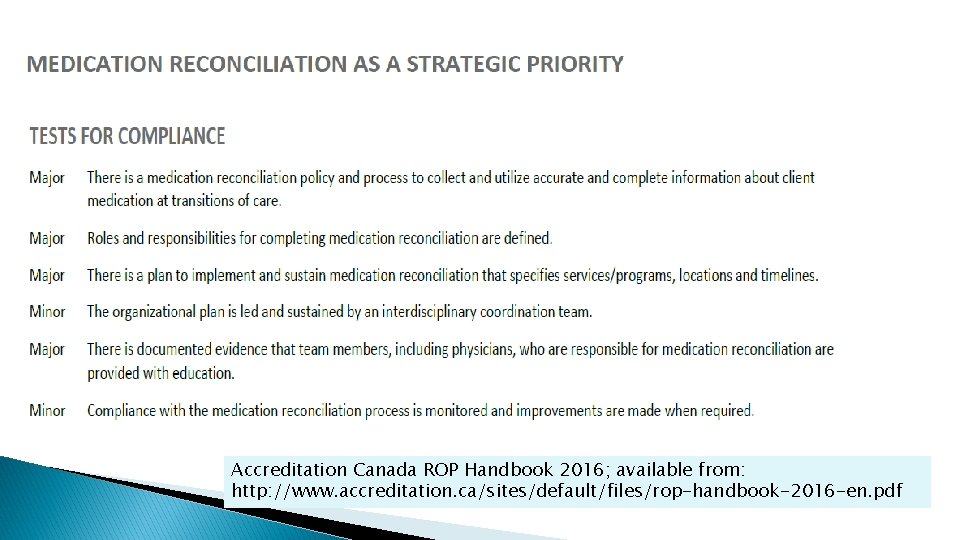
Accreditation Canada ROP Handbook 2016; available from: http: //www. accreditation. ca/sites/default/files/rop-handbook-2016 -en. pdf
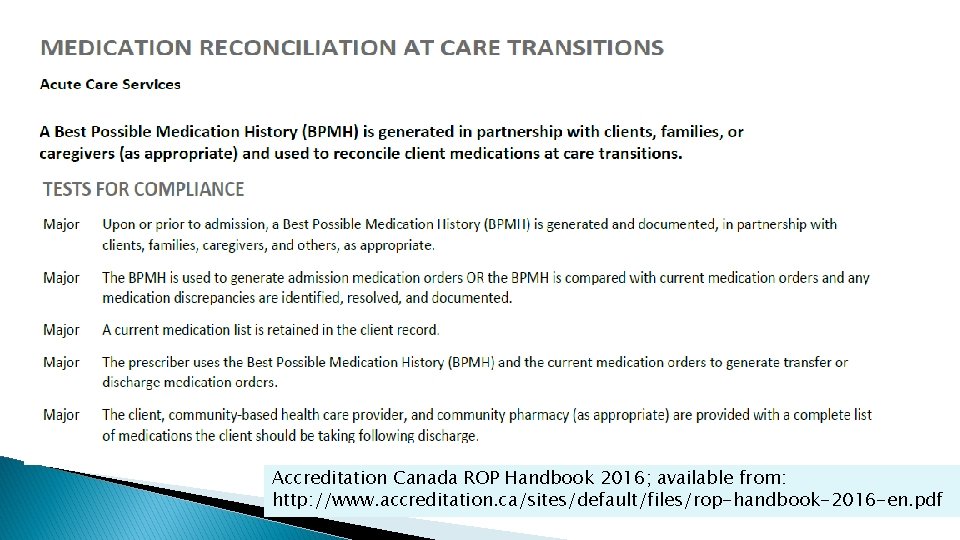
Accreditation Canada ROP Handbook 2016; available from: http: //www. accreditation. ca/sites/default/files/rop-handbook-2016 -en. pdf
Medication Reconciliation � Challenging to achieve ◦ Improves patient safety when completed comprehensively ◦ Potentially harmful when incomplete or rushed � Admission standards recently changed: ◦ Emergency Department ◦ Peri-operative
Former ROP: Emergency and Perioperative Services With the involvement of the client, family, or caregiver (as appropriate), the team generates a Best Possible Medication History (BPMH) and uses it to reconcile client medications at transitions of care.
New ROP: Emergency Services In partnership with clients, families, or caregivers (as appropriate), medication reconciliation is initiated for clients with a decision to admit and a target group of clients without a decision to admit who are at risk for potential adverse drug events (organizational policy specifies when medication reconciliation is initiated for clients without a decision to admit).
Emergency – Tests for Compliance Medication reconciliation is initiated for all clients with a decision to admit. The medication reconciliation process may begin in the emergency department and be completed in the receiving inpatient unit. A Best Possible Medication History (BPMH) is generated, in partnership with clients, families, or caregivers, and documented. For non-admitted clients in the target group, medication changes are communicated to the primary health care provider.
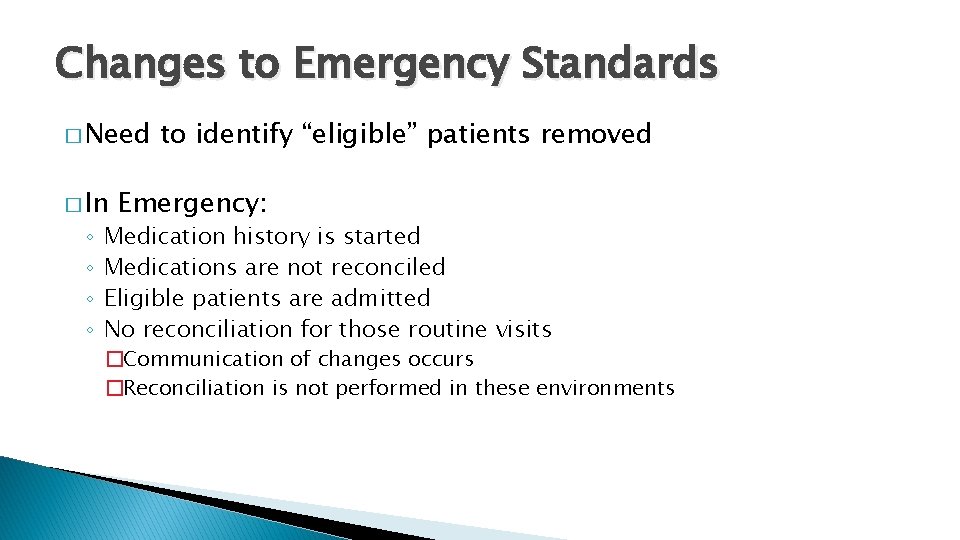
Changes to Emergency Standards � Need � In ◦ ◦ to identify “eligible” patients removed Emergency: Medication history is started Medications are not reconciled Eligible patients are admitted No reconciliation for those routine visits �Communication of changes occurs �Reconciliation is not performed in these environments
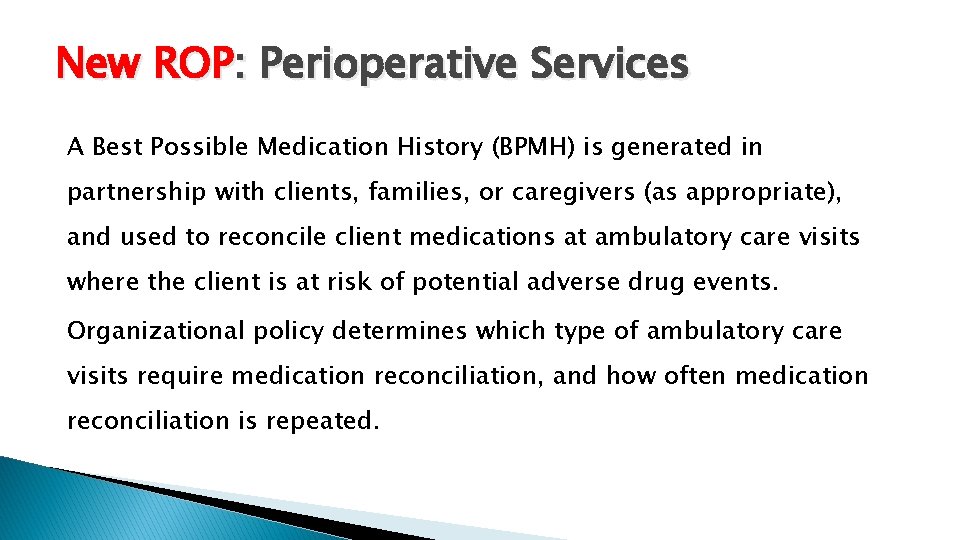
New ROP: Perioperative Services A Best Possible Medication History (BPMH) is generated in partnership with clients, families, or caregivers (as appropriate), and used to reconcile client medications at ambulatory care visits where the client is at risk of potential adverse drug events. Organizational policy determines which type of ambulatory care visits require medication reconciliation, and how often medication reconciliation is repeated.
Group Work
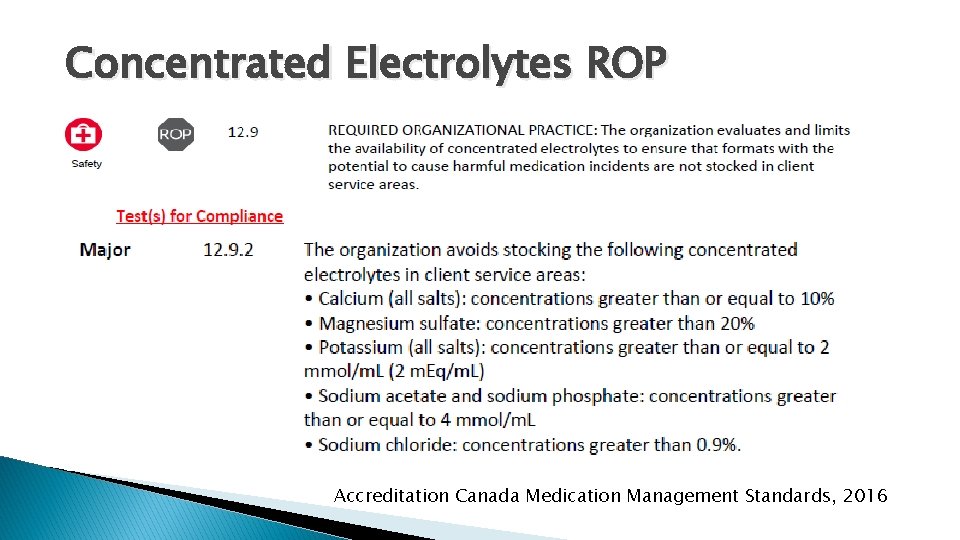
Concentrated Electrolytes ROP Accreditation Canada Medication Management Standards, 2016
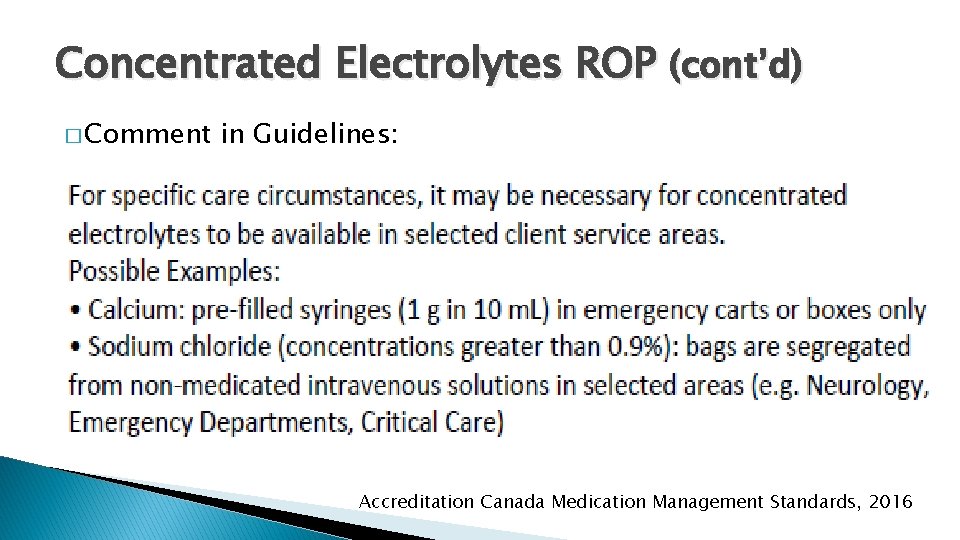
Concentrated Electrolytes ROP (cont’d) � Comment in Guidelines: Accreditation Canada Medication Management Standards, 2016
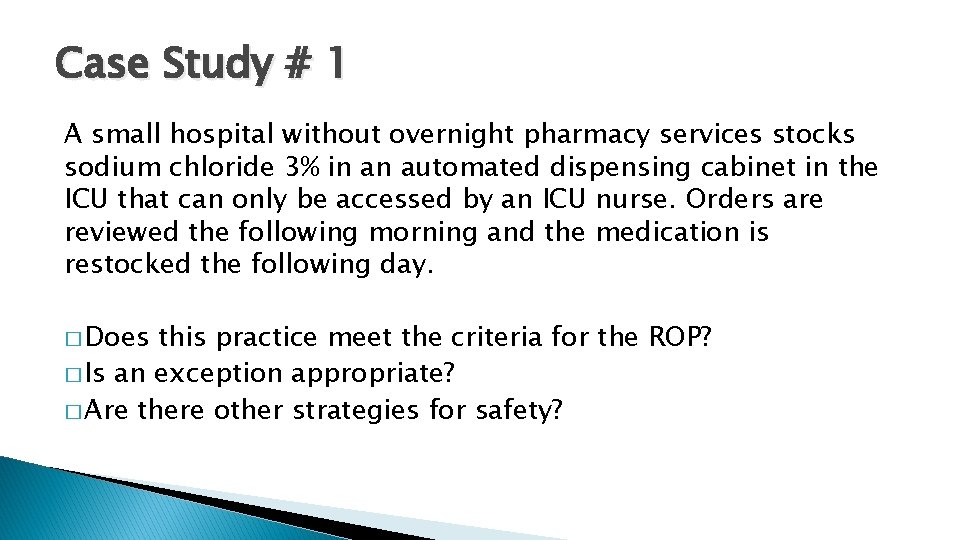
Case Study # 1 A small hospital without overnight pharmacy services stocks sodium chloride 3% in an automated dispensing cabinet in the ICU that can only be accessed by an ICU nurse. Orders are reviewed the following morning and the medication is restocked the following day. � Does this practice meet the criteria for the ROP? � Is an exception appropriate? � Are there other strategies for safety?
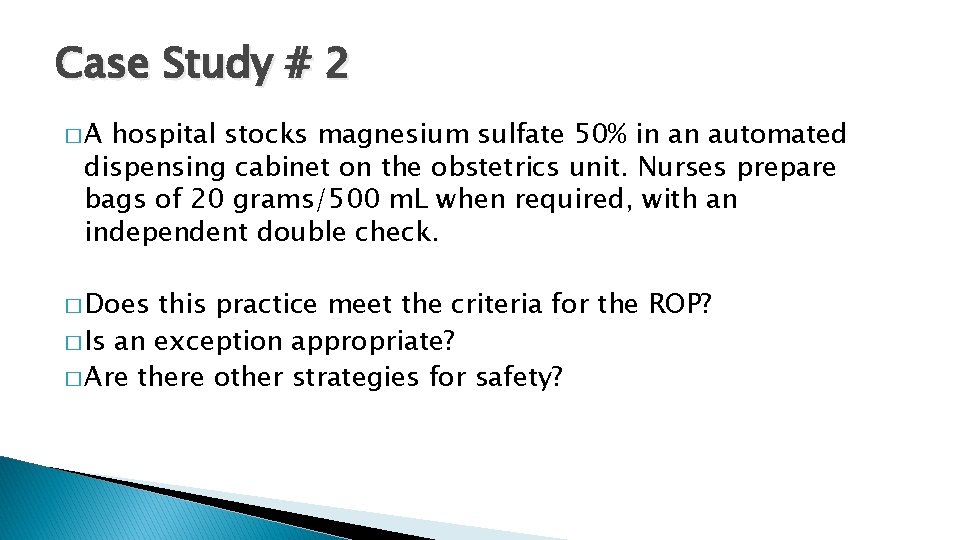
Case Study # 2 �A hospital stocks magnesium sulfate 50% in an automated dispensing cabinet on the obstetrics unit. Nurses prepare bags of 20 grams/500 m. L when required, with an independent double check. � Does this practice meet the criteria for the ROP? � Is an exception appropriate? � Are there other strategies for safety?
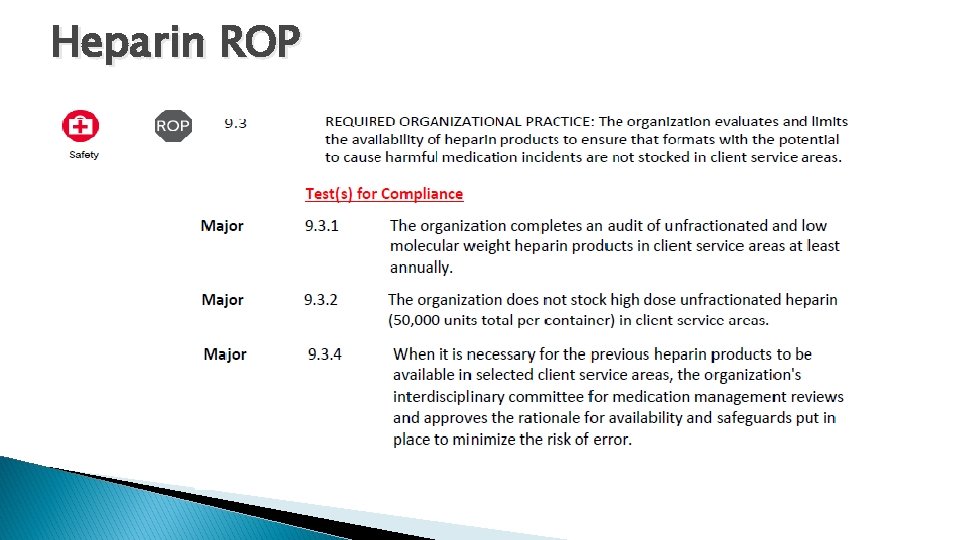
Heparin ROP
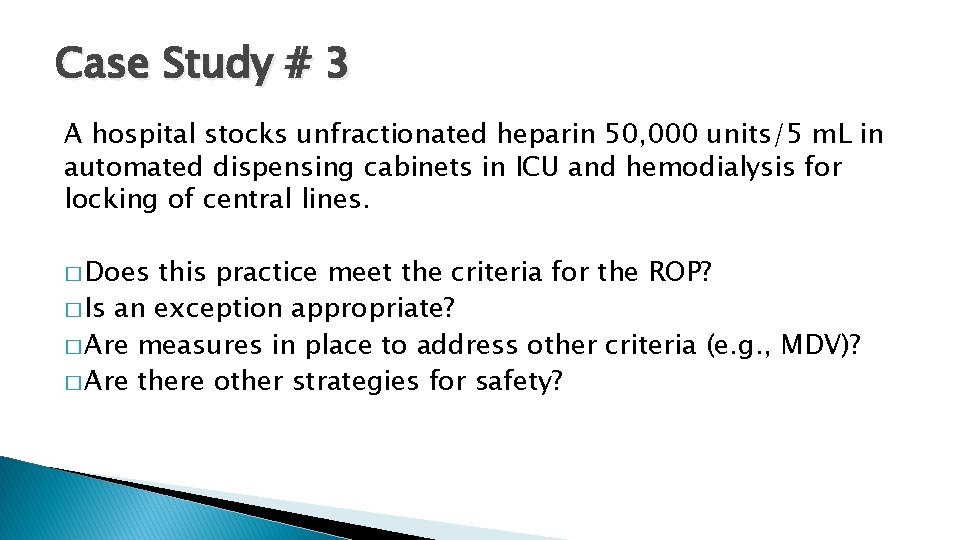
Case Study # 3 A hospital stocks unfractionated heparin 50, 000 units/5 m. L in automated dispensing cabinets in ICU and hemodialysis for locking of central lines. � Does this practice meet the criteria for the ROP? � Is an exception appropriate? � Are measures in place to address other criteria (e. g. , MDV)? � Are there other strategies for safety?
Accreditation Canada ROP Handbook 2016; available from: http: //www. accreditation. ca/sites/default/files/rop-handbook-2016 -en. pdf
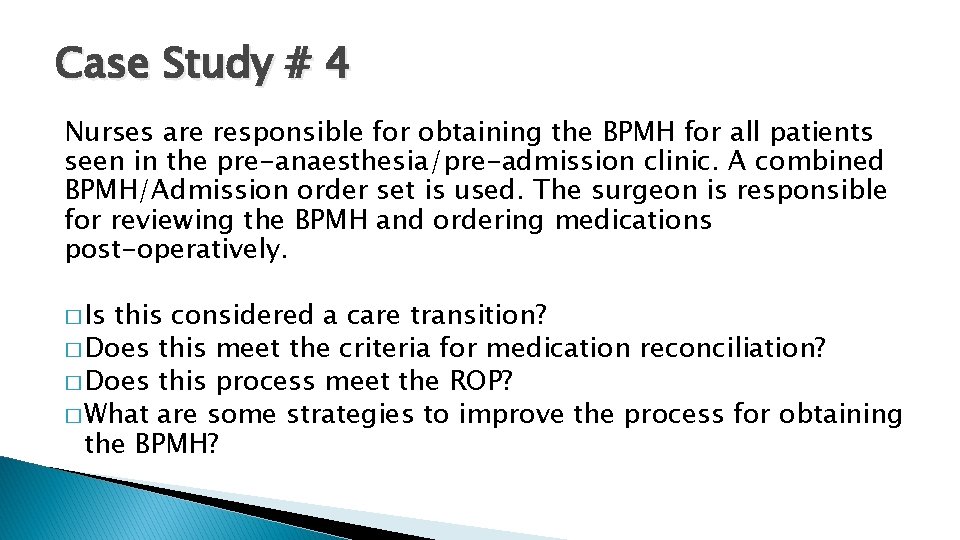
Case Study # 4 Nurses are responsible for obtaining the BPMH for all patients seen in the pre-anaesthesia/pre-admission clinic. A combined BPMH/Admission order set is used. The surgeon is responsible for reviewing the BPMH and ordering medications post-operatively. � Is this considered a care transition? � Does this meet the criteria for medication reconciliation? � Does this process meet the ROP? � What are some strategies to improve the process for obtaining the BPMH?
Discussion � Challenges � Help you are currently facing from others
Tools and Resources � Accreditation Canada ◦ Accreditation Specialists ◦ Medication Management FAQs �Available through the portal �Accreditation Leading Practices � Peer support ◦ CSHP Medication Safety PSN � ISMP Canada ◦ Safety Bulletins ◦ Medication Safety Self Assessment Programs ◦ Medication Reconciliation Getting Started Kits and other resources
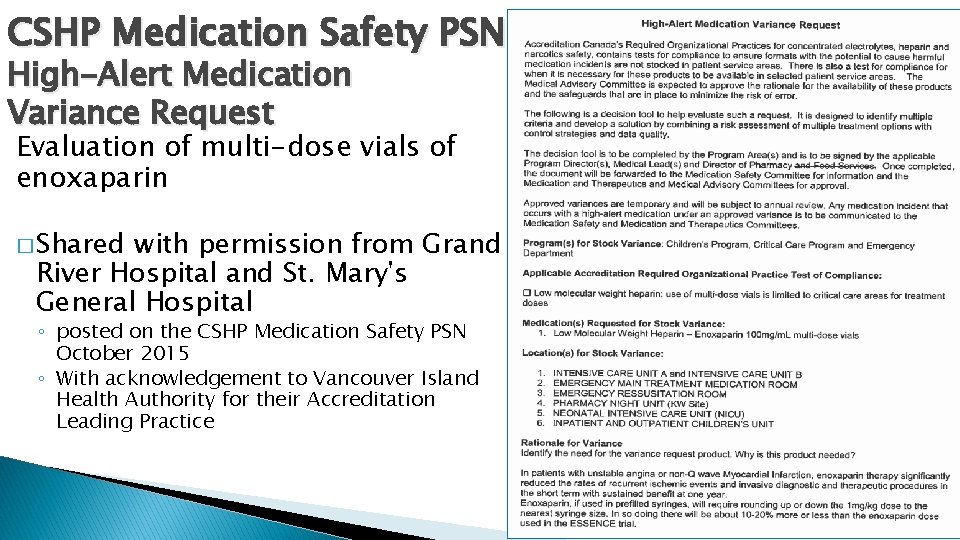
CSHP Medication Safety PSN High-Alert Medication Variance Request Evaluation of multi-dose vials of enoxaparin � Shared with permission from Grand River Hospital and St. Mary's General Hospital ◦ posted on the CSHP Medication Safety PSN October 2015 ◦ With acknowledgement to Vancouver Island Health Authority for their Accreditation Leading Practice
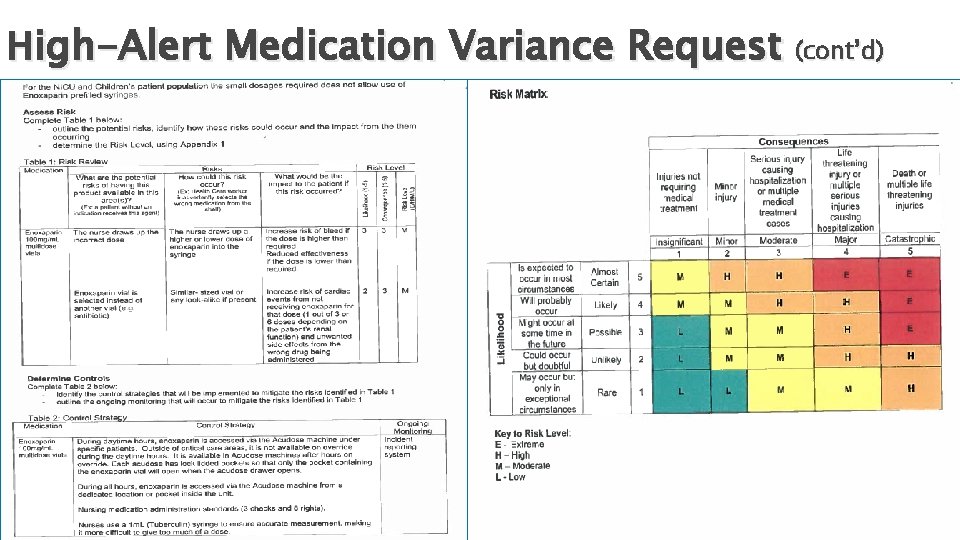
High-Alert Medication Variance Request (cont’d)
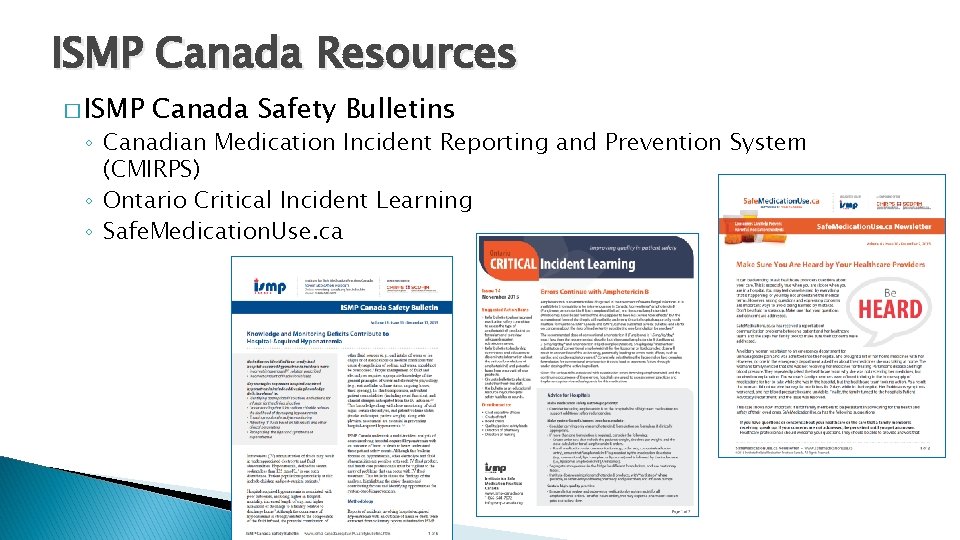
ISMP Canada Resources � ISMP Canada Safety Bulletins ◦ Canadian Medication Incident Reporting and Prevention System (CMIRPS) ◦ Ontario Critical Incident Learning ◦ Safe. Medication. Use. ca
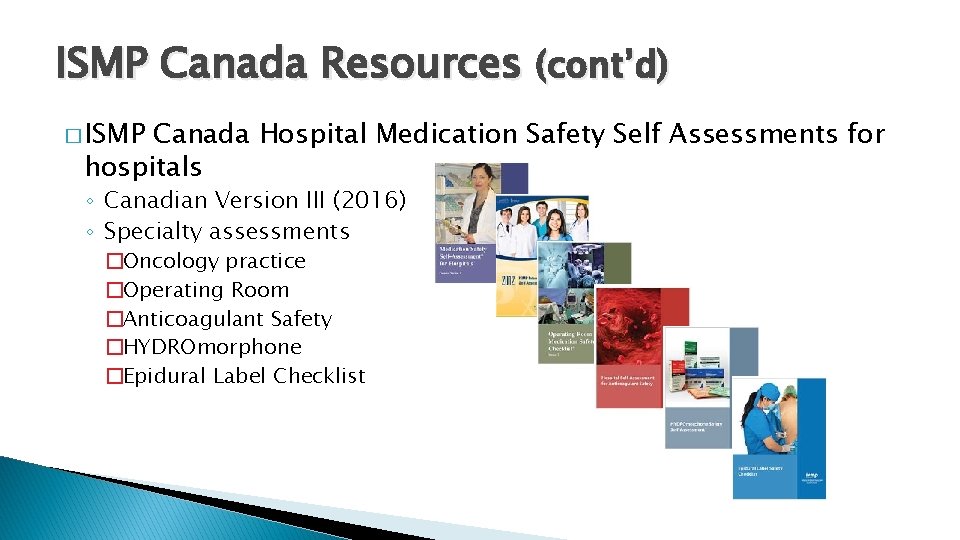
ISMP Canada Resources (cont’d) � ISMP Canada Hospital Medication Safety Self Assessments for hospitals ◦ Canadian Version III (2016) ◦ Specialty assessments �Oncology practice �Operating Room �Anticoagulant Safety �HYDROmorphone �Epidural Label Checklist
Revised Hospital MSSA – Canadian Version III (2016) � Updated from 2006 version with support from Health Canada, Ontario Ministry of Health and Long-Term Care and Health Quality Ontario � Includes new content from: ◦ CMIRPS ◦ Ontario Critical Incident Learning Program ◦ ISMP (US) 2011 Hospital assessment � Accreditation Canada standards reference the MSSA as a tool for overall evaluation of the medication system ◦ With thanks to Accreditation Canada, this version includes alignment with Medication Management Standards and ROPs
Medication Reconciliation Tools and Resources � Safer Healthcare Now! program funded by the Canadian Patient Safety Institute (CPSI) and led by ISMP Canada ◦ See: http: //www. ismp-canada. org/medrec/ and http: //www. patientsafetyinstitute. ca/en/Topic/Pages/medicationreconciliation-(med-rec). aspx � Getting Started Kits ◦ Acute Care and Long Term Care – revised versions available later in 2016 ◦ Home Care – revised 2015 � Community of Practice ◦ Post questions, share resources at http: //tools. patientsafetyinstitute. ca/Pages/welcome. aspx
Conclusion � Accreditation is a strong driver of practice change and enhancements to patient safety � Difficult to make standards “perfect”; need to consider different practice environments ◦ Rationale for exceptions �A variety of tools and resources are available to support organizations preparing for accreditation
Contact information Janice Munroe Janice. Munroe@fraserhealth. ca Julie Greenall jgreenall@ismp-canada. org