
Accounting Theory Practice Historical Development of Accounting Course

- Slides: 15
Accounting Theory & Practice Historical Development of Accounting Course Code : FAR 600 1
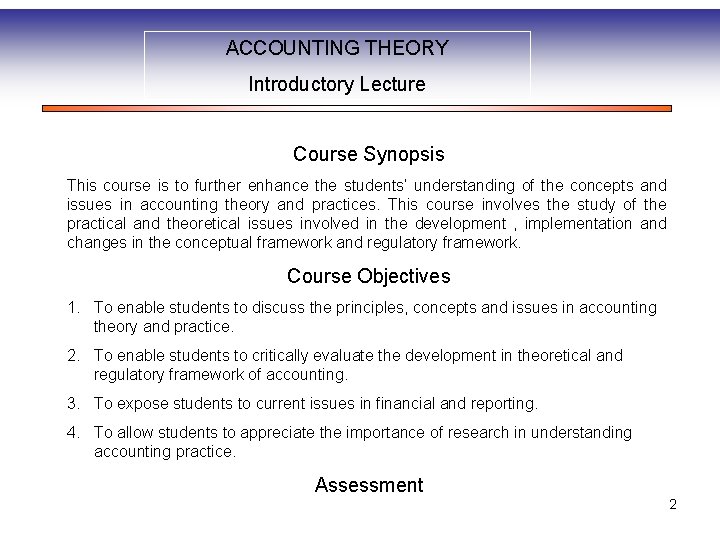
ACCOUNTING THEORY Introductory Lecture Course Synopsis This course is to further enhance the students’ understanding of the concepts and issues in accounting theory and practices. This course involves the study of the practical and theoretical issues involved in the development , implementation and changes in the conceptual framework and regulatory framework. Course Objectives 1. To enable students to discuss the principles, concepts and issues in accounting theory and practice. 2. To enable students to critically evaluate the development in theoretical and regulatory framework of accounting. 3. To expose students to current issues in financial and reporting. 4. To allow students to appreciate the importance of research in understanding accounting practice. Assessment 2
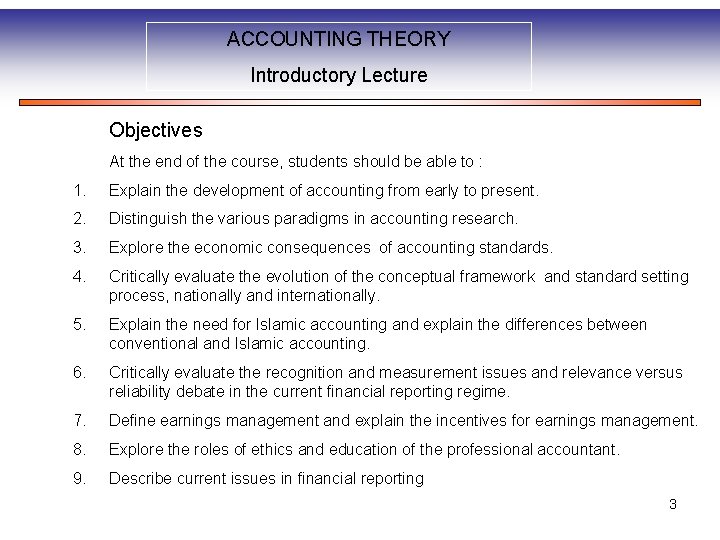
ACCOUNTING THEORY Introductory Lecture Objectives At the end of the course, students should be able to : 1. Explain the development of accounting from early to present. 2. Distinguish the various paradigms in accounting research. 3. Explore the economic consequences of accounting standards. 4. Critically evaluate the evolution of the conceptual framework and standard setting process, nationally and internationally. 5. Explain the need for Islamic accounting and explain the differences between conventional and Islamic accounting. 6. Critically evaluate the recognition and measurement issues and relevance versus reliability debate in the current financial reporting regime. 7. Define earnings management and explain the incentives for earnings management. 8. Explore the roles of ethics and education of the professional accountant. 9. Describe current issues in financial reporting 3
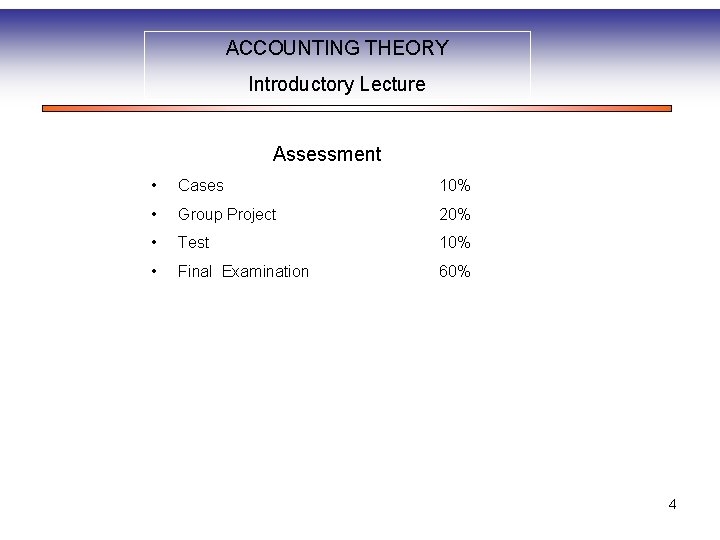
ACCOUNTING THEORY Introductory Lecture Assessment • Cases 10% • Group Project 20% • Test 10% • Final Examination 60% 4
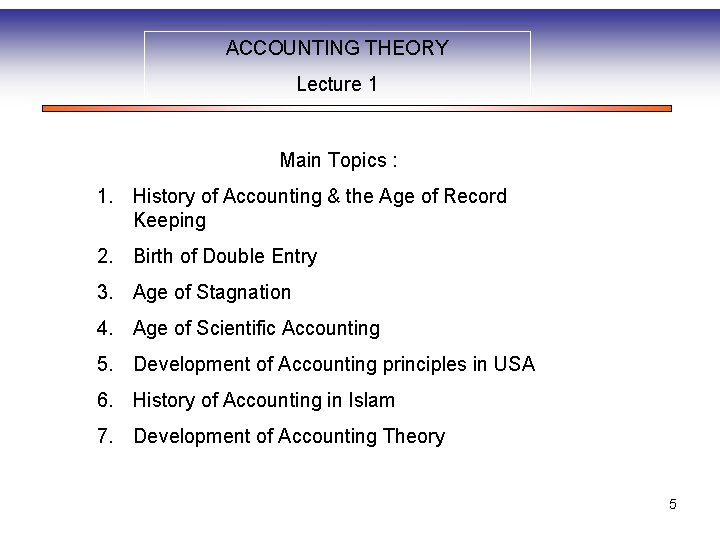
ACCOUNTING THEORY Lecture 1 Main Topics : 1. History of Accounting & the Age of Record Keeping 2. Birth of Double Entry 3. Age of Stagnation 4. Age of Scientific Accounting 5. Development of Accounting principles in USA 6. History of Accounting in Islam 7. Development of Accounting Theory 5
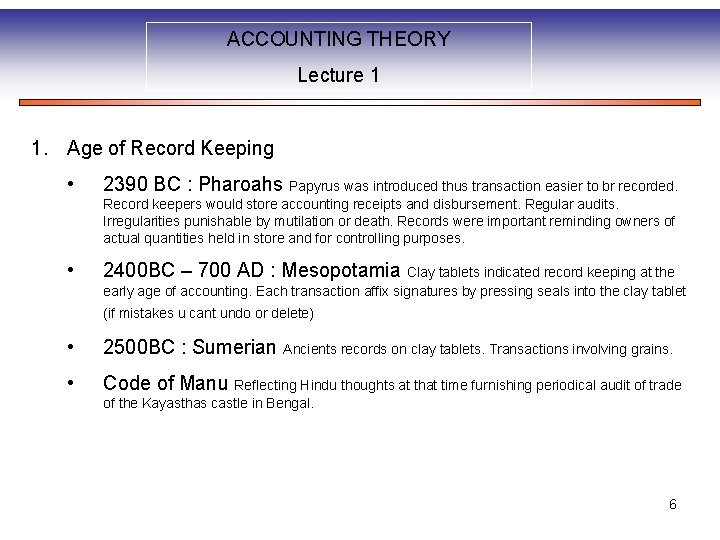
ACCOUNTING THEORY Lecture 1 1. Age of Record Keeping • 2390 BC : Pharoahs Papyrus was introduced thus transaction easier to br recorded. Record keepers would store accounting receipts and disbursement. Regular audits. Irregularities punishable by mutilation or death. Records were important reminding owners of actual quantities held in store and for controlling purposes. • 2400 BC – 700 AD : Mesopotamia Clay tablets indicated record keeping at the early age of accounting. Each transaction affix signatures by pressing seals into the clay tablet (if mistakes u cant undo or delete) • 2500 BC : Sumerian Ancients records on clay tablets. Transactions involving grains. • Code of Manu Reflecting Hindu thoughts at that time furnishing periodical audit of trade of the Kayasthas castle in Bengal. 6
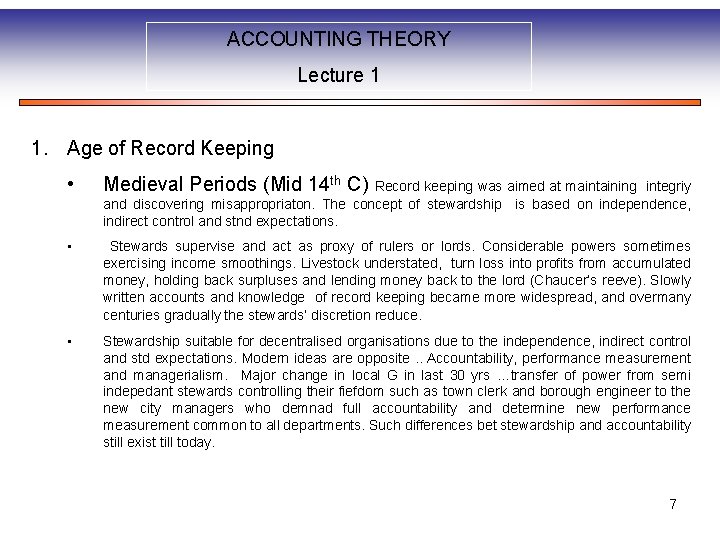
ACCOUNTING THEORY Lecture 1 1. Age of Record Keeping • Medieval Periods (Mid 14 th C) • Stewards supervise and act as proxy of rulers or lords. Considerable powers sometimes exercising income smoothings. Livestock understated, turn loss into profits from accumulated money, holding back surpluses and lending money back to the lord (Chaucer’s reeve). Slowly written accounts and knowledge of record keeping became more widespread, and overmany centuries gradually the stewards’ discretion reduce. • Stewardship suitable for decentralised organisations due to the independence, indirect control and std expectations. Modern ideas are opposite. . Accountability, performance measurement and managerialism. Major change in local G in last 30 yrs …transfer of power from semi indepedant stewards controlling their fiefdom such as town clerk and borough engineer to the new city managers who demnad full accountability and determine new performance measurement common to all departments. Such differences bet stewardship and accountability still exist till today. Record keeping was aimed at maintaining integriy and discovering misappropriaton. The concept of stewardship is based on independence, indirect control and stnd expectations. 7
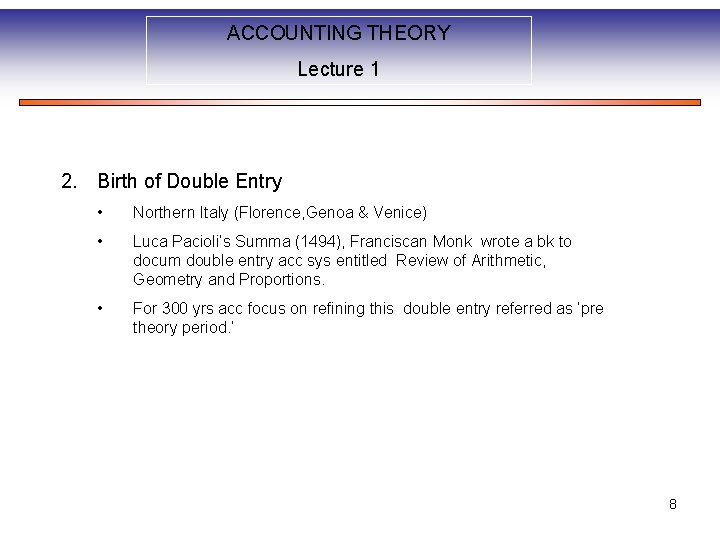
ACCOUNTING THEORY Lecture 1 2. Birth of Double Entry • Northern Italy (Florence, Genoa & Venice) • Luca Pacioli’s Summa (1494), Franciscan Monk wrote a bk to docum double entry acc sys entitled Review of Arithmetic, Geometry and Proportions. • For 300 yrs acc focus on refining this double entry referred as ‘pre theory period. ’ 8
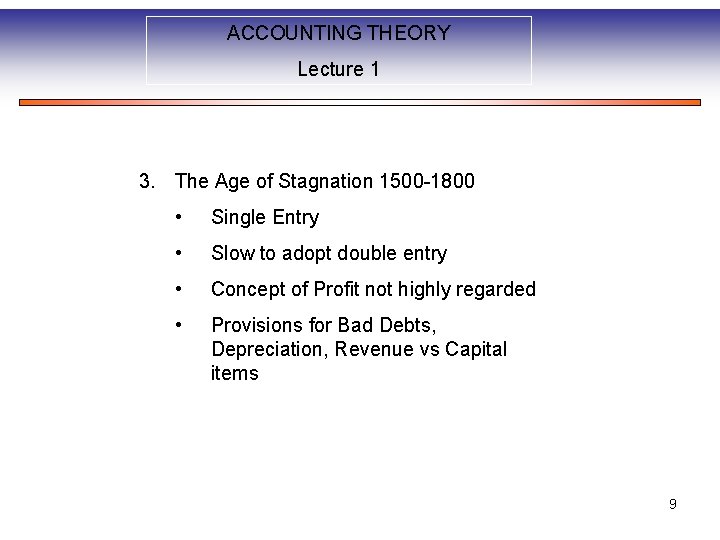
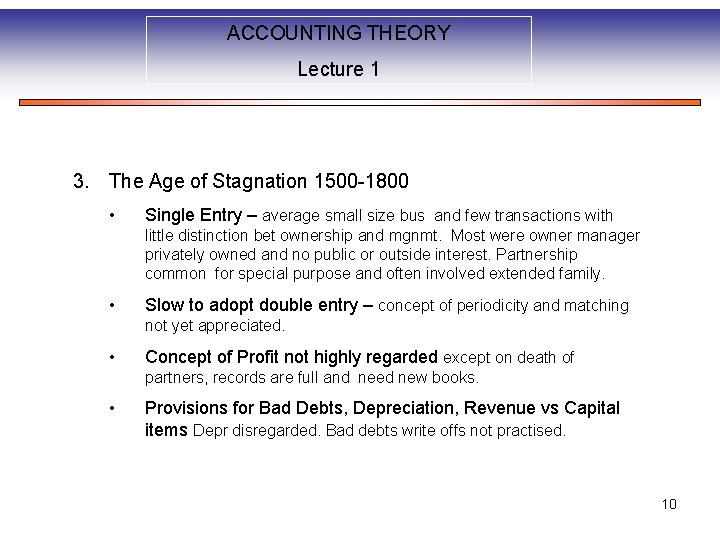
ACCOUNTING THEORY Lecture 1 3. The Age of Stagnation 1500 -1800 • Single Entry • Slow to adopt double entry • Concept of Profit not highly regarded • Provisions for Bad Debts, Depreciation, Revenue vs Capital items 9
ACCOUNTING THEORY Lecture 1 3. The Age of Stagnation 1500 -1800 • Single Entry – average small size bus and few transactions with little distinction bet ownership and mgnmt. Most were owner manager privately owned and no public or outside interest. Partnership common for special purpose and often involved extended family. • Slow to adopt double entry – concept of periodicity and matching not yet appreciated. • Concept of Profit not highly regarded except on death of partners, records are full and need new books. • Provisions for Bad Debts, Depreciation, Revenue vs Capital items Depr disregarded. Bad debts write offs not practised. 10
ACCOUNTING THEORY Lecture 1 4. The Age of Scientific Accounting • Industrial Revolution • Railway Companies • Creative Accounting • Accounting Problems 11
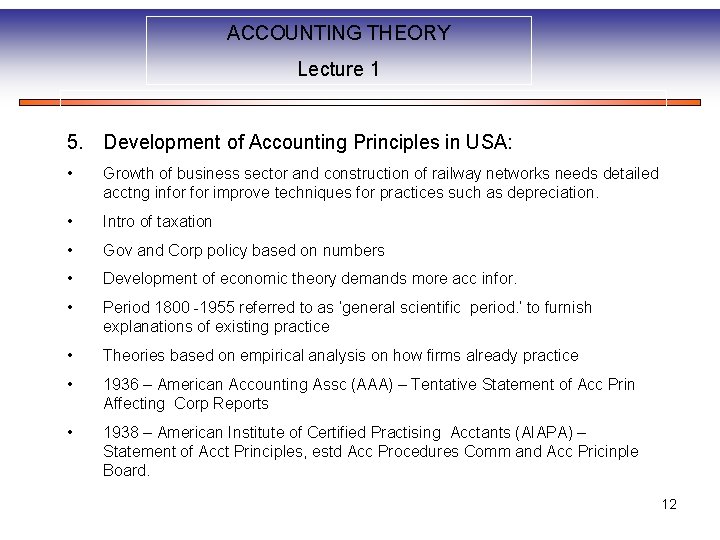
ACCOUNTING THEORY Lecture 1 5. Development of Accounting Principles in USA: • Growth of business sector and construction of railway networks needs detailed acctng infor improve techniques for practices such as depreciation. • Intro of taxation • Gov and Corp policy based on numbers • Development of economic theory demands more acc infor. • Period 1800 -1955 referred to as ‘general scientific period. ’ to furnish explanations of existing practice • Theories based on empirical analysis on how firms already practice • 1936 – American Accounting Assc (AAA) – Tentative Statement of Acc Prin Affecting Corp Reports • 1938 – American Institute of Certified Practising Acctants (AIAPA) – Statement of Acct Principles, estd Acc Procedures Comm and Acc Pricinple Board. 12
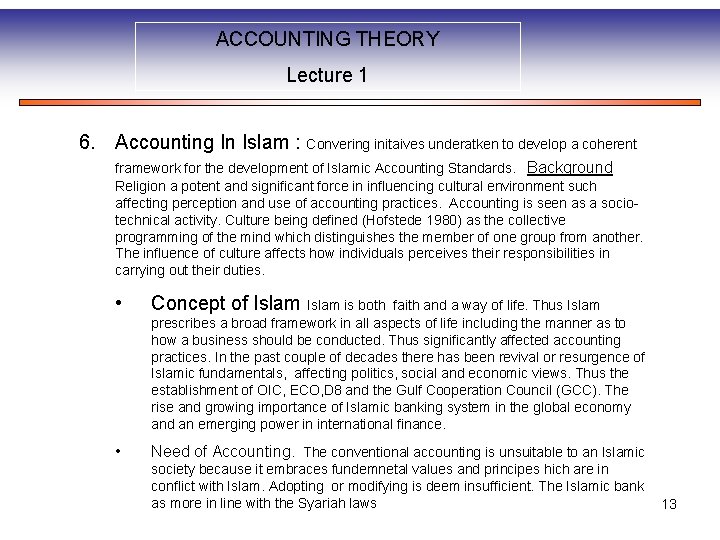
ACCOUNTING THEORY Lecture 1 6. Accounting In Islam : Convering initaives underatken to develop a coherent framework for the development of Islamic Accounting Standards. Background Religion a potent and significant force in influencing cultural environment such affecting perception and use of accounting practices. Accounting is seen as a sociotechnical activity. Culture being defined (Hofstede 1980) as the collective programming of the mind which distinguishes the member of one group from another. The influence of culture affects how individuals perceives their responsibilities in carrying out their duties. • Concept of Islam is both • Need of Accounting. The conventional accounting is unsuitable to an Islamic faith and a way of life. Thus Islam prescribes a broad framework in all aspects of life including the manner as to how a business should be conducted. Thus significantly affected accounting practices. In the past couple of decades there has been revival or resurgence of Islamic fundamentals, affecting politics, social and economic views. Thus the establishment of OIC, ECO, D 8 and the Gulf Cooperation Council (GCC). The rise and growing importance of Islamic banking system in the global economy and an emerging power in international finance. society because it embraces fundemnetal values and principes hich are in conflict with Islam. Adopting or modifying is deem insufficient. The Islamic bank as more in line with the Syariah laws 13
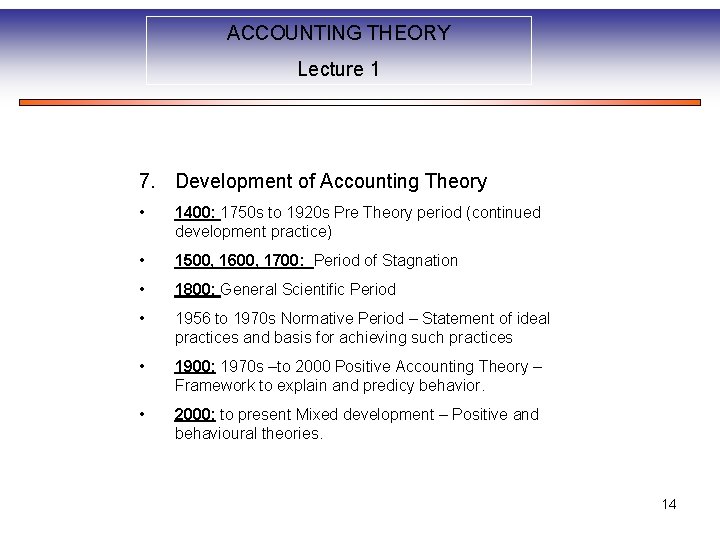
ACCOUNTING THEORY Lecture 1 7. Development of Accounting Theory • 1400: 1750 s to 1920 s Pre Theory period (continued development practice) • 1500, 1600, 1700: Period of Stagnation • 1800: General Scientific Period • 1956 to 1970 s Normative Period – Statement of ideal practices and basis for achieving such practices • 1900: 1970 s –to 2000 Positive Accounting Theory – Framework to explain and predicy behavior. • 2000: to present Mixed development – Positive and behavioural theories. 14
Some past years exam questions: Q 1 JUNE 2006 Q 1 Oct 2006 Q 2 a Oct 2007 Q 1 a Apr 2008 15