
Accounting The purpose of accounting Micha Suchanek KEi
- Slides: 40
Accounting The purpose of accounting Michał Suchanek KEi. FPT, University of Gdańsk
Assets • Assets are the accounting representation of the enterprise’s resources; • Assets are those resources which can be used by the enterprise to generate economic effects, by: – increasing the value of owned resources, – using the production ability
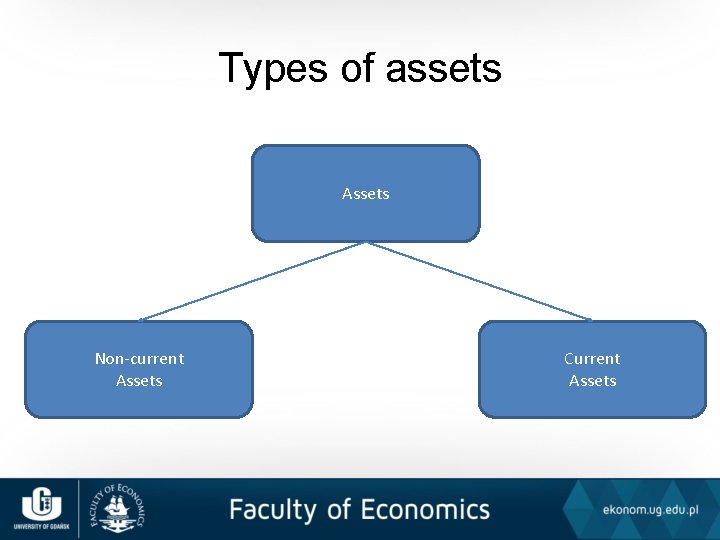
Types of assets Assets Non-current Assets Current Assets
Equity • the source of financing of the economic activity of an enterprise, • the owners’ interest in the business, • is equivalent with the net assets of an entity
Liability • a current obligation of an enterprise arising from past events, • an obligation that legally binds an enterprise to settle a debt, • „A liability is a present obligation of the enterprise arising from past events, the settlement of which is expected to result in an outflow from the enterprise of resources embodying economic benefits” - IASB
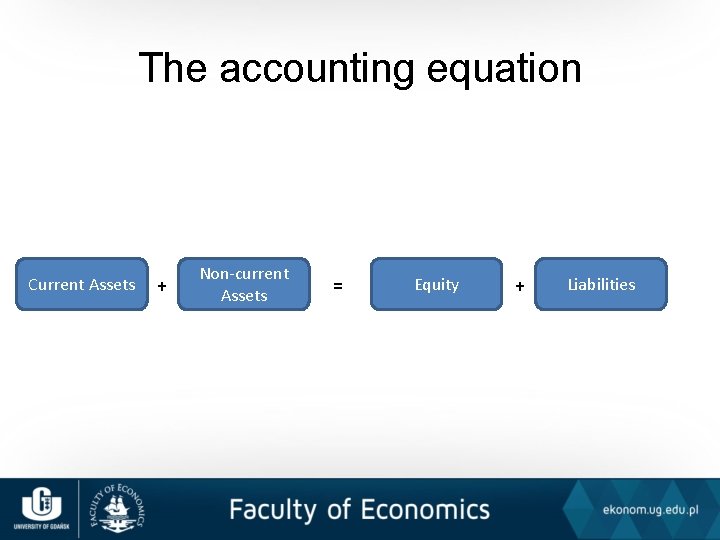
The accounting equation Current Assets + Non-current Assets = Equity + Liabilities
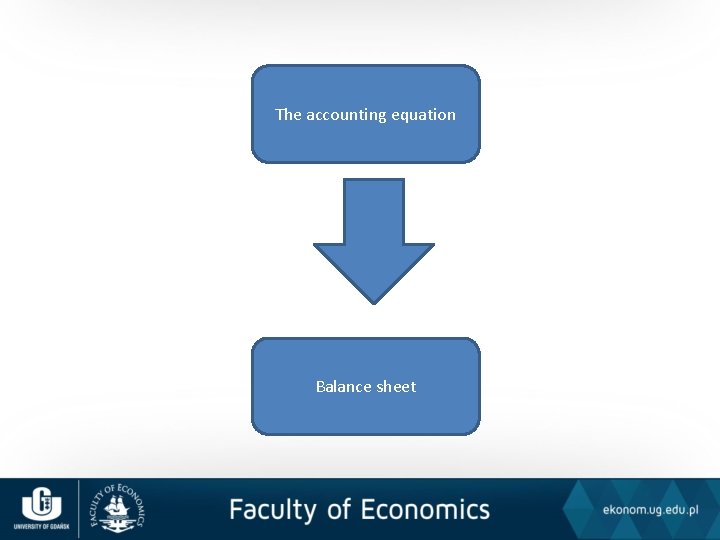
The accounting equation Balance sheet
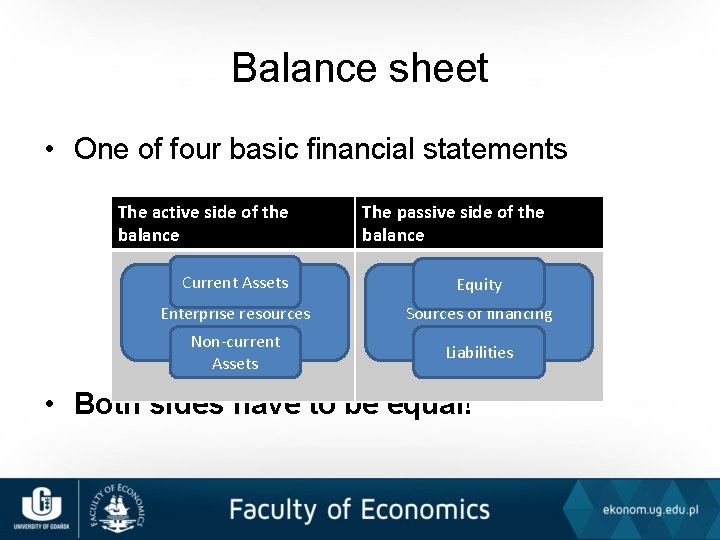
Balance sheet • One of four basic financial statements The active side of the balance The passive side of the balance Current Assets Equity Enterprise resources Sources of financing Non-current Assets Liabilities • Both sides have to be equal!
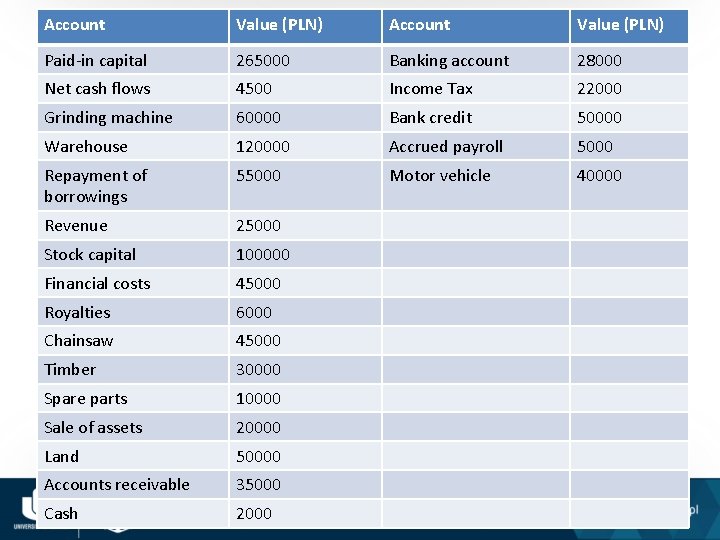
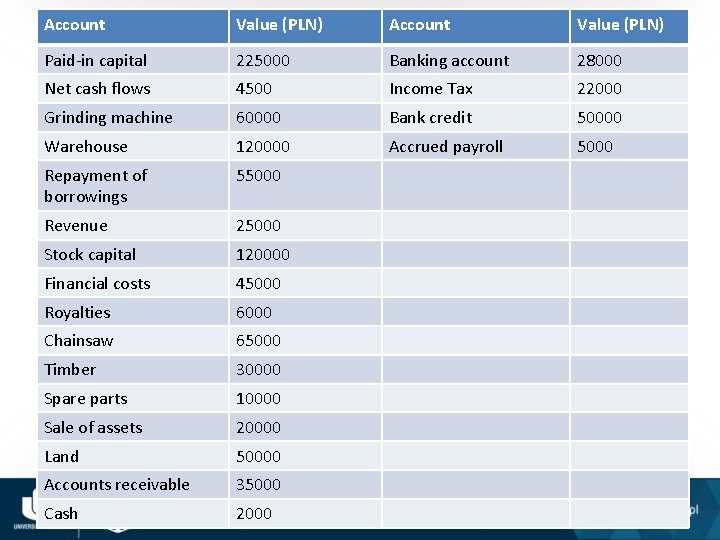
Task • First three students will be awarded bonus points! • Prepare a simplified balance sheet picking out the imporant information from the list below:
Account Value (PLN) Paid-in capital 265000 Banking account 28000 Net cash flows 4500 Income Tax 22000 Grinding machine 60000 Bank credit 50000 Warehouse 120000 Accrued payroll 5000 Repayment of borrowings 55000 Motor vehicle 40000 Revenue 25000 Stock capital 100000 Financial costs 45000 Royalties 6000 Chainsaw 45000 Timber 30000 Spare parts 10000 Sale of assets 20000 Land 50000 Accounts receivable 35000 Cash 2000
Account Value (PLN) Paid-in capital 225000 Banking account 28000 Net cash flows 4500 Income Tax 22000 Grinding machine 60000 Bank credit 50000 Warehouse 120000 Accrued payroll 5000 Repayment of borrowings 55000 Revenue 25000 Stock capital 120000 Financial costs 45000 Royalties 6000 Chainsaw 65000 Timber 30000 Spare parts 10000 Sale of assets 20000 Land 50000 Accounts receivable 35000 Cash 2000
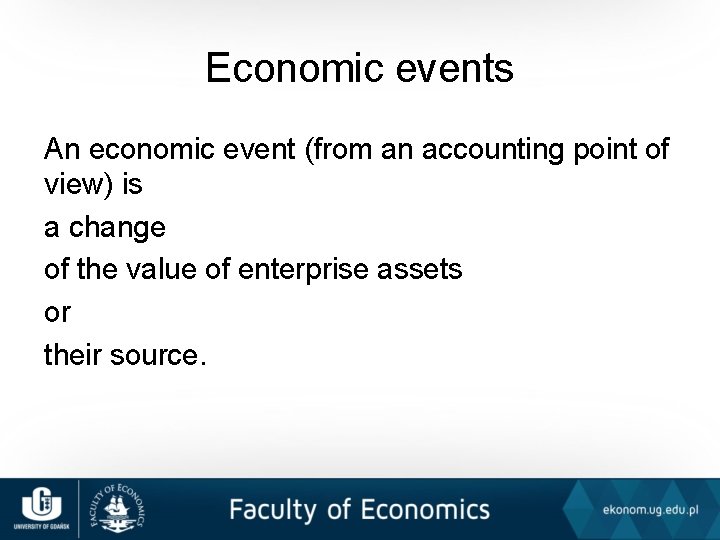
Economic events An economic event (from an accounting point of view) is a change of the value of enterprise assets or their source.
Economic operations Those economic events which are priced and recorded. • simple operations – connected with one event, • complex operations – connected with multiple events.
Operations – type and extent • balance operations, • profit/loss operations.
Operations accounting - balance Regardless of the operation, the balance equilibrium has to remain intact (A = P) Four types of operations: • active/active, • passive/passive, • +active/+passive, • -active/-passive.
A/A operation • changes occur on the active side of the balance sheet, • the balance sum remains the same, • one element of the assets increases its value, • another one decreases its value by the same amount, • e. g. buying raw materials for cash
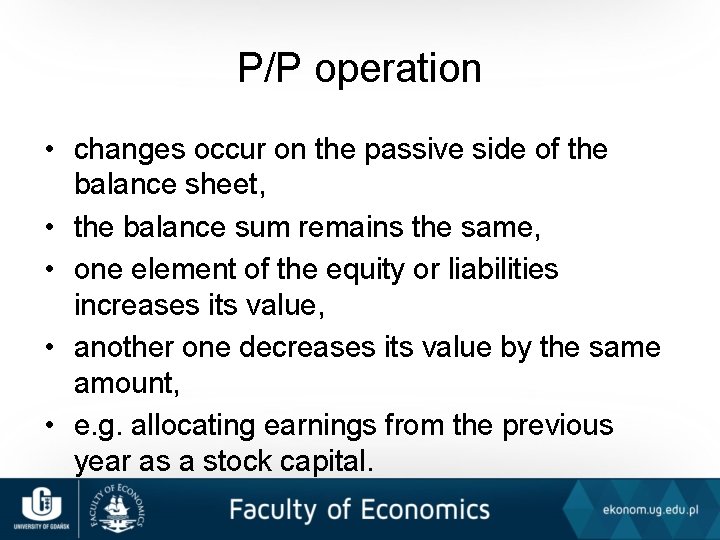
P/P operation • changes occur on the passive side of the balance sheet, • the balance sum remains the same, • one element of the equity or liabilities increases its value, • another one decreases its value by the same amount, • e. g. allocating earnings from the previous year as a stock capital.
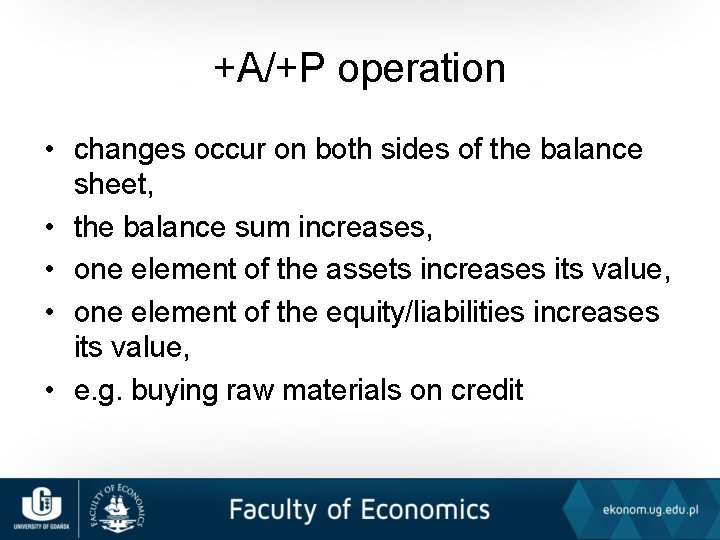
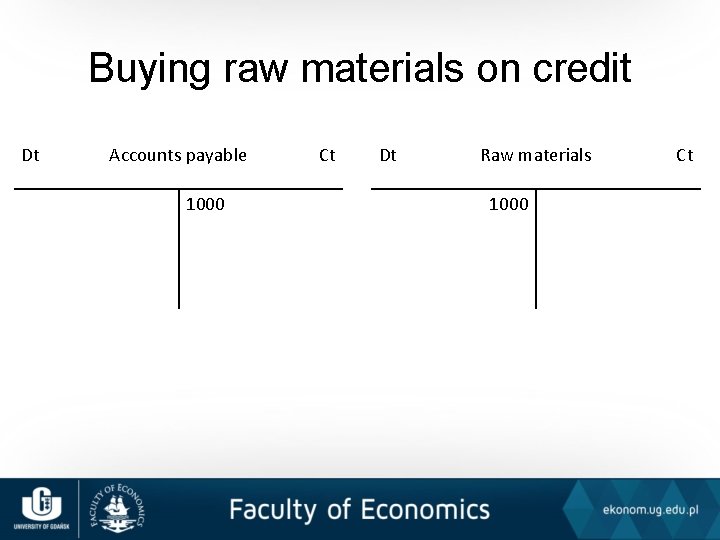
+A/+P operation • changes occur on both sides of the balance sheet, • the balance sum increases, • one element of the assets increases its value, • one element of the equity/liabilities increases its value, • e. g. buying raw materials on credit
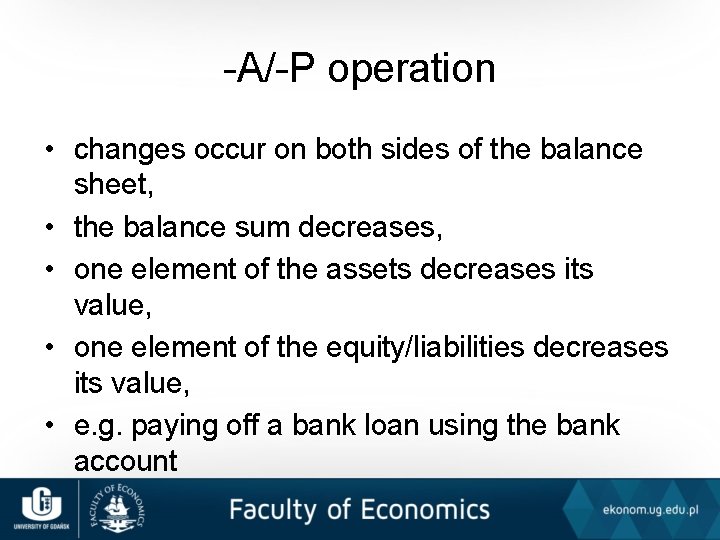
-A/-P operation • changes occur on both sides of the balance sheet, • the balance sum decreases, • one element of the assets decreases its value, • one element of the equity/liabilities decreases its value, • e. g. paying off a bank loan using the bank account
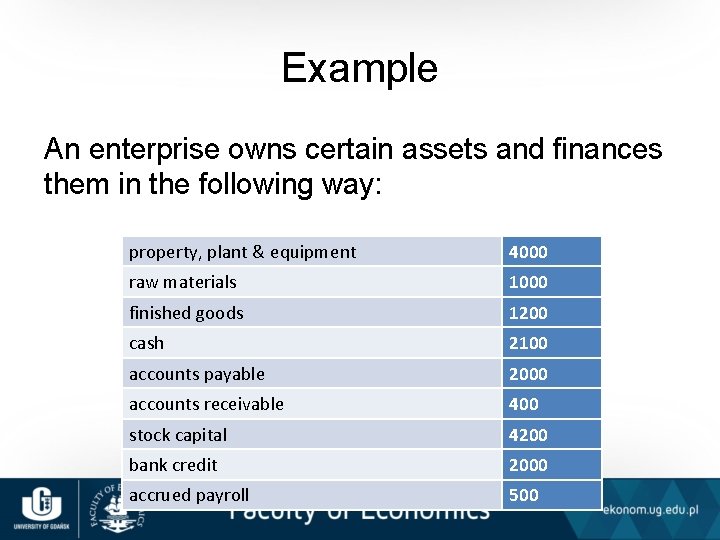
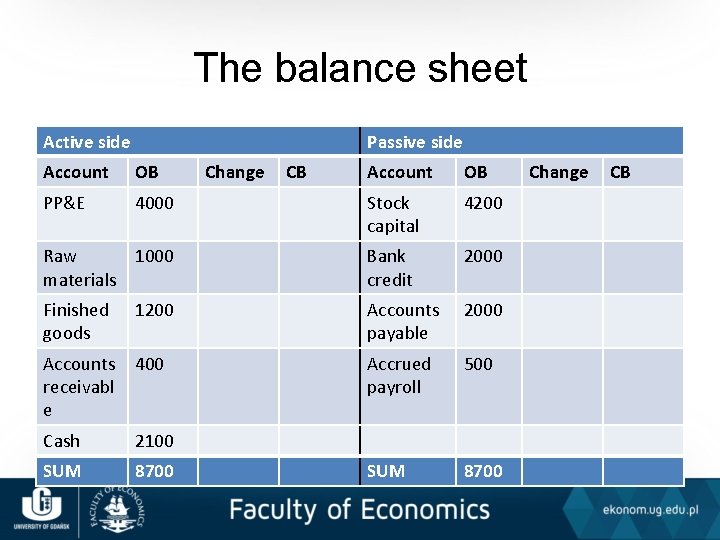
Example An enterprise owns certain assets and finances them in the following way: property, plant & equipment 4000 raw materials 1000 finished goods 1200 cash 2100 accounts payable 2000 accounts receivable 400 stock capital 4200 bank credit 2000 accrued payroll 500
The balance sheet Active side Passive side Account OB PP&E 4000 Account OB Stock capital 4200 Raw 1000 materials Bank credit 2000 Finished goods Accounts payable 2000 Accrued payroll 500 SUM 8700 1200 Accounts 400 receivabl e Cash 2100 SUM 8700 Change CB
Task • Determine the type of the following operations, value its impact on the balance sheet, calculate the changes and draw up the closing balance
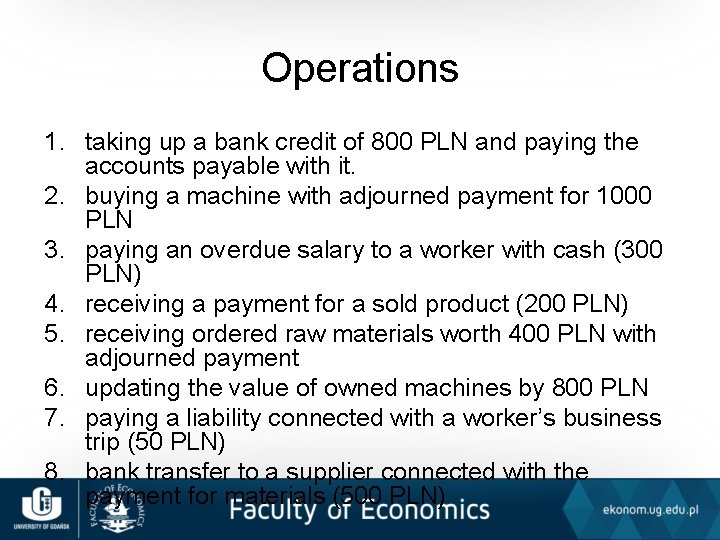
Operations 1. taking up a bank credit of 800 PLN and paying the accounts payable with it. 2. buying a machine with adjourned payment for 1000 PLN 3. paying an overdue salary to a worker with cash (300 PLN) 4. receiving a payment for a sold product (200 PLN) 5. receiving ordered raw materials worth 400 PLN with adjourned payment 6. updating the value of owned machines by 800 PLN 7. paying a liability connected with a worker’s business trip (50 PLN) 8. bank transfer to a supplier connected with the payment for materials (500 PLN)
Account • An account is the basic instrument used in recording economic operations, • An accounting system consists of various accounts (account plan or general ledger) which are used to register the changes of value of enterprise assets, liabilities and equity.
Account • Consists of • numerical symbol which makes it easy to identify it • And • The name which reflects the events registered.
Forms • T-account – simplified version, • Table form
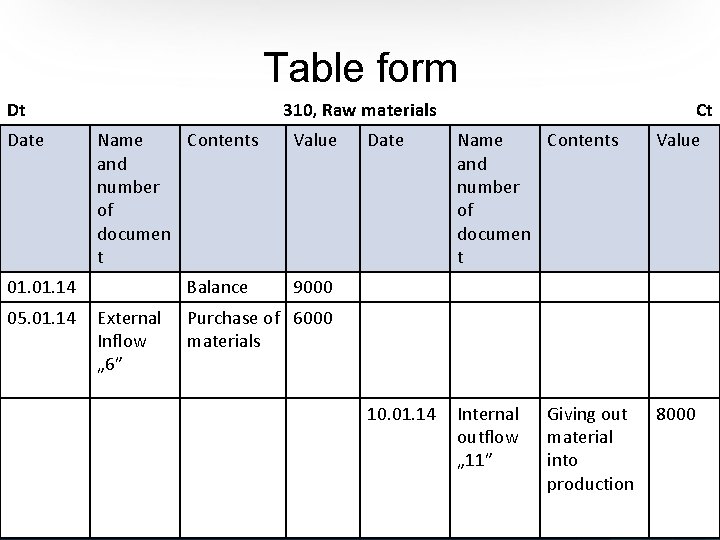
Table form Dt Date 310, Raw materials Name Contents and number of documen t 01. 14 05. 01. 14 Balance External Inflow „ 6” Value Ct Date Name Contents and number of documen t Value 10. 01. 14 Internal outflow „ 11” 8000 9000 Purchase of 6000 materials Giving out material into production
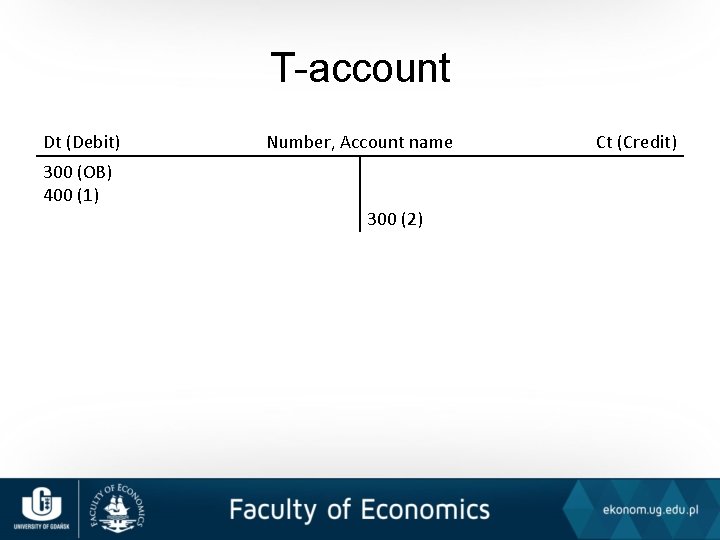
T-account Dt (Debit) 300 (OB) 400 (1) Number, Account name 300 (2) Ct (Credit)
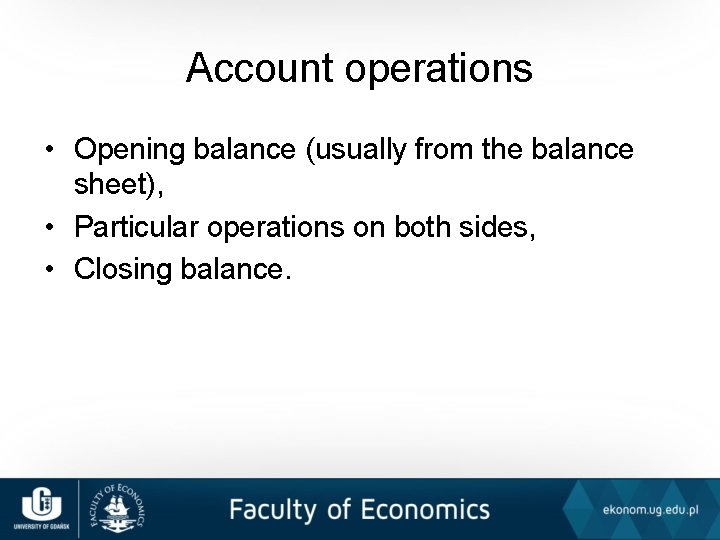
Account operations • Opening balance (usually from the balance sheet), • Particular operations on both sides, • Closing balance.
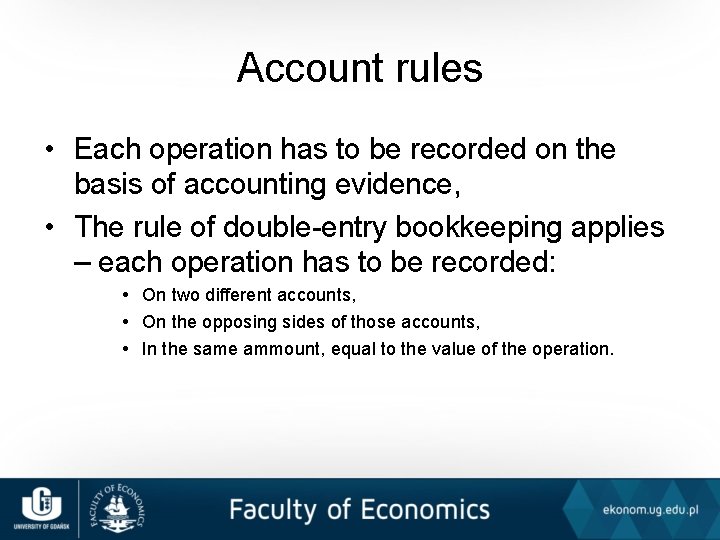
Account rules • Each operation has to be recorded on the basis of accounting evidence, • The rule of double-entry bookkeeping applies – each operation has to be recorded: • On two different accounts, • On the opposing sides of those accounts, • In the same ammount, equal to the value of the operation.
Buying raw materials on credit Dt Accounts payable 1000 Ct Dt Raw materials 1000 Ct
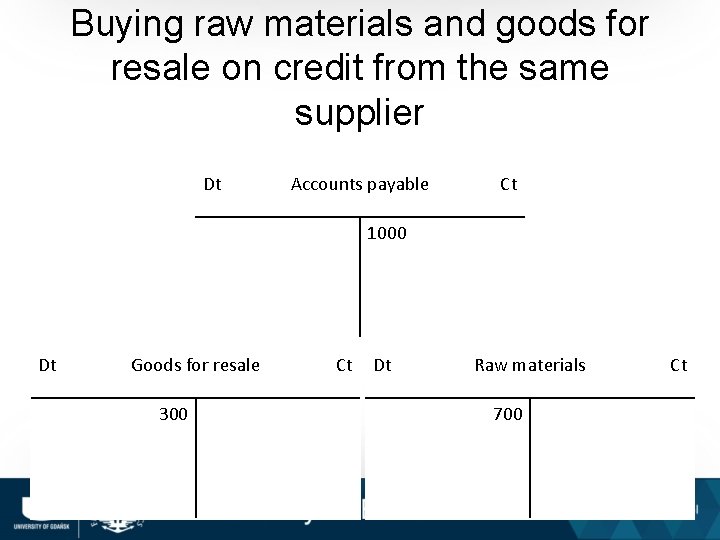
Buying raw materials and goods for resale on credit from the same supplier Dt Accounts payable Ct 1000 Dt Goods for resale 300 Ct Dt Raw materials 700 Ct
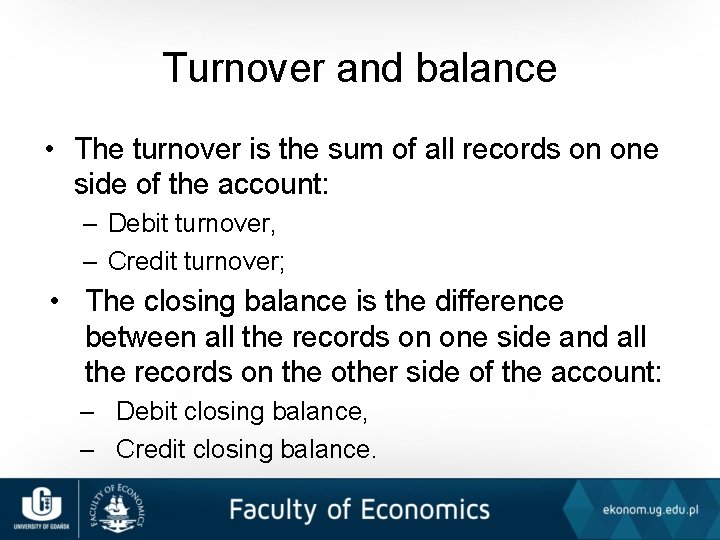
Turnover and balance • The turnover is the sum of all records on one side of the account: – Debit turnover, – Credit turnover; • The closing balance is the difference between all the records on one side and all the records on the other side of the account: – Debit closing balance, – Credit closing balance.
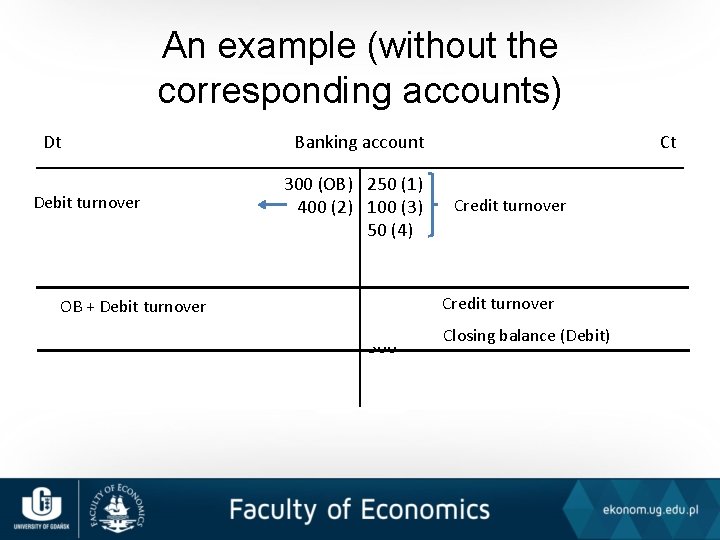
An example (without the corresponding accounts) Dt Debit turnover OB + Debit turnover Banking account 300 (OB) 250 (1) 400 (2) 100 (3) 50 (4) 700 400 300 700 Ct Credit turnover Closing balance (Debit)
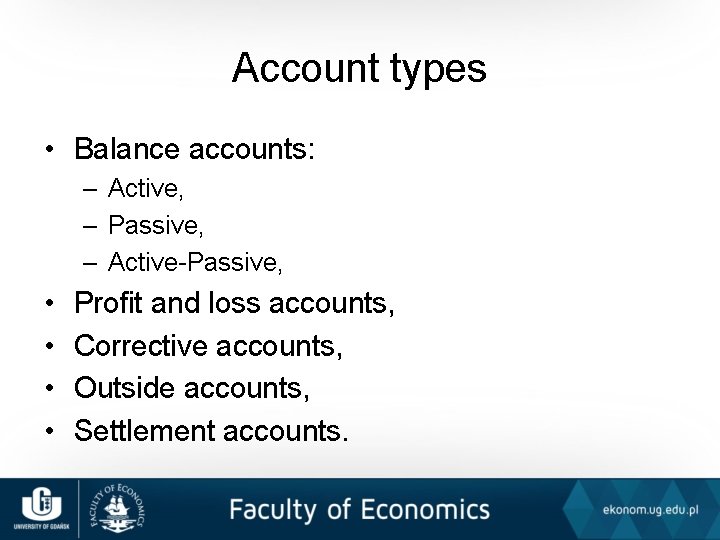
Account types • Balance accounts: – Active, – Passive, – Active-Passive, • • Profit and loss accounts, Corrective accounts, Outside accounts, Settlement accounts.
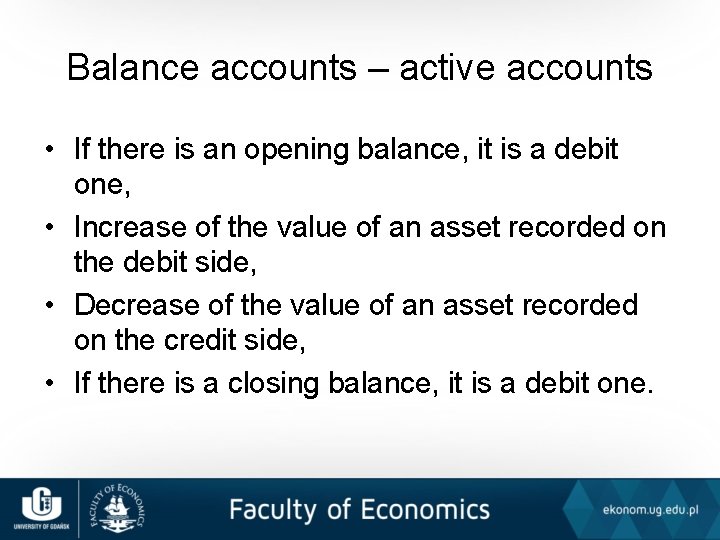
Balance accounts – active accounts • If there is an opening balance, it is a debit one, • Increase of the value of an asset recorded on the debit side, • Decrease of the value of an asset recorded on the credit side, • If there is a closing balance, it is a debit one.
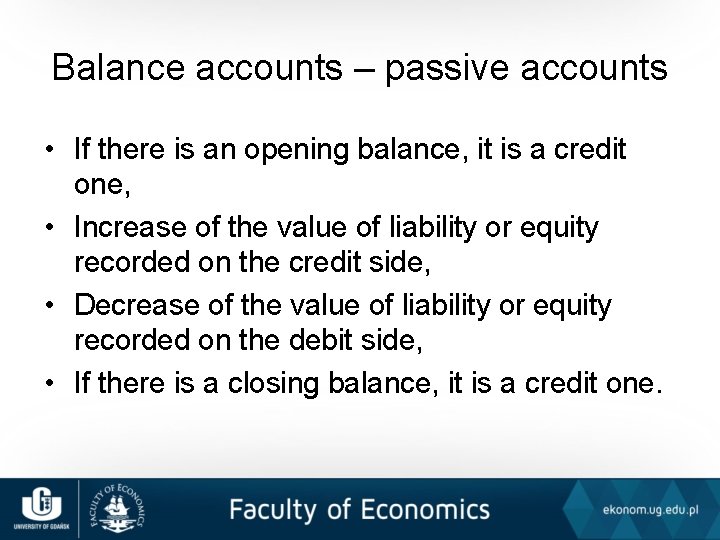
Balance accounts – passive accounts • If there is an opening balance, it is a credit one, • Increase of the value of liability or equity recorded on the credit side, • Decrease of the value of liability or equity recorded on the debit side, • If there is a closing balance, it is a credit one.
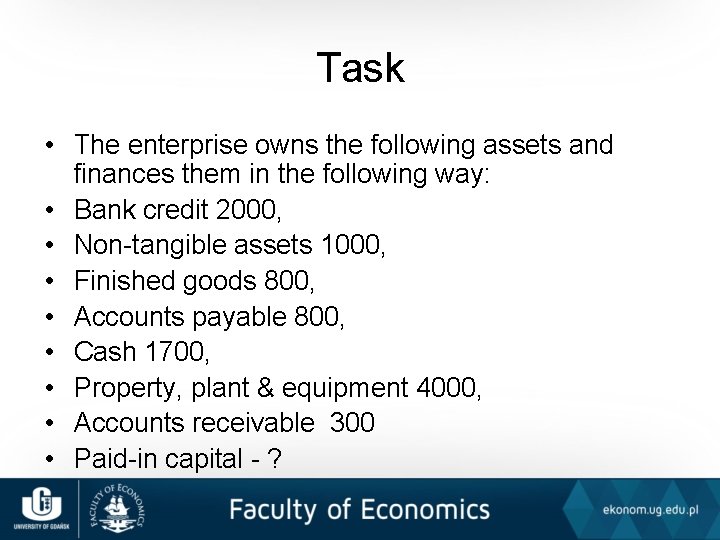
Task • The enterprise owns the following assets and finances them in the following way: • Bank credit 2000, • Non-tangible assets 1000, • Finished goods 800, • Accounts payable 800, • Cash 1700, • Property, plant & equipment 4000, • Accounts receivable 300 • Paid-in capital - ?
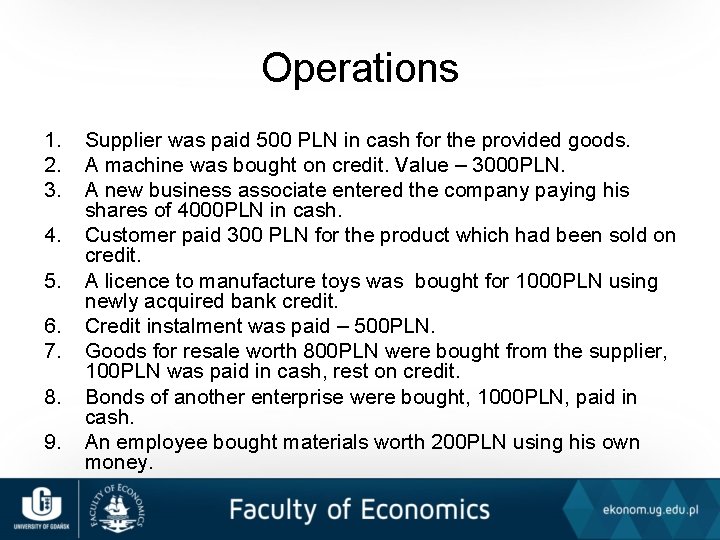
Operations 1. 2. 3. 4. 5. 6. 7. 8. 9. Supplier was paid 500 PLN in cash for the provided goods. A machine was bought on credit. Value – 3000 PLN. A new business associate entered the company paying his shares of 4000 PLN in cash. Customer paid 300 PLN for the product which had been sold on credit. A licence to manufacture toys was bought for 1000 PLN using newly acquired bank credit. Credit instalment was paid – 500 PLN. Goods for resale worth 800 PLN were bought from the supplier, 100 PLN was paid in cash, rest on credit. Bonds of another enterprise were bought, 1000 PLN, paid in cash. An employee bought materials worth 200 PLN using his own money.
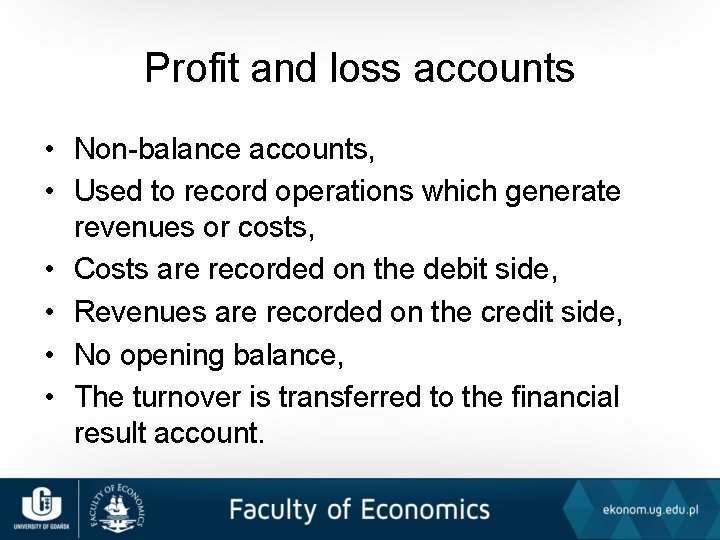
Profit and loss accounts • Non-balance accounts, • Used to record operations which generate revenues or costs, • Costs are recorded on the debit side, • Revenues are recorded on the credit side, • No opening balance, • The turnover is transferred to the financial result account.