
Accounting Principles 7 th Edition Weygandt Kieso Kimmel

- Slides: 49
Accounting Principles, 7 th Edition Weygandt • Kieso • Kimmel Chapter 9 Accounting for Receivables Prepared by Naomi Karolinski Monroe Community College and Marianne Bradford Bryant College John Wiley & Sons, Inc. © 2005
CHAPTER 9 ACCOUNTING FOR RECEIVABLES After studying this chapter, you should be able to: 1 Identify the different types of receivables. 2 Explain how accounts receivable are recognized in the accounts. 3 Distinguish between the methods and bases used to value accounts receivable. 4 Describe the entries to record the disposition of accounts receivable. 5 Compute the maturity date of and interest on notes receivable.
CHAPTER 9 ACCOUNTING FOR RECEIVABLES After studying this chapter, you should be able to: 6 Explain how notes receivable are recognized in the accounts. 7 Describe how notes receivable are valued. 8 Describe the entries to record the disposition of notes receivable. 9 Explain the statement presentation and analysis of receivables.
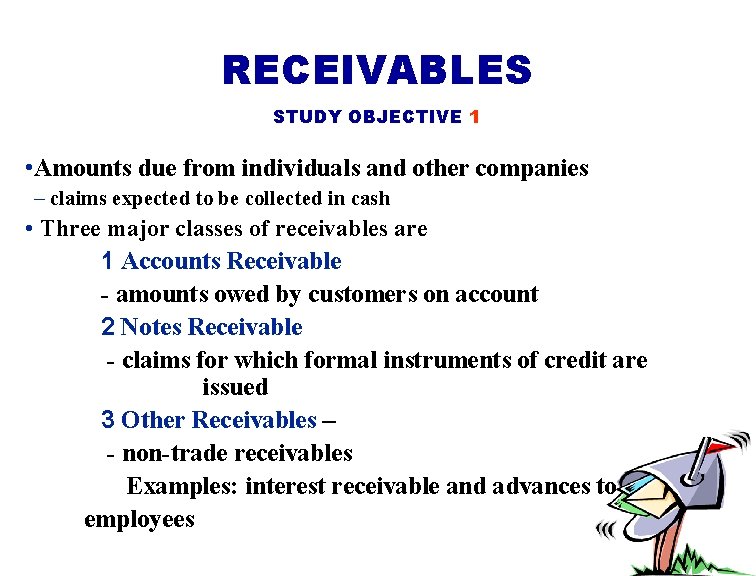
RECEIVABLES STUDY OBJECTIVE 1 • Amounts due from individuals and other companies – claims expected to be collected in cash • Three major classes of receivables are 1 Accounts Receivable - amounts owed by customers on account 2 Notes Receivable - claims for which formal instruments of credit are issued 3 Other Receivables – - non-trade receivables Examples: interest receivable and advances to employees
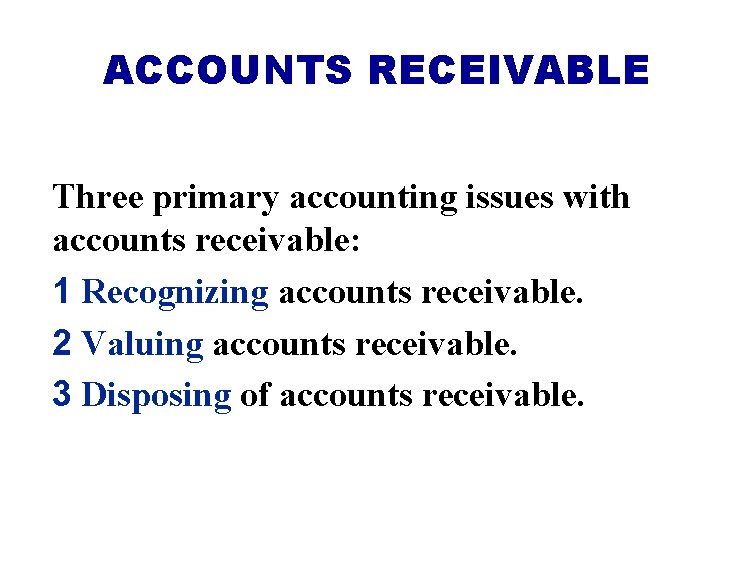
ACCOUNTS RECEIVABLE Three primary accounting issues with accounts receivable: 1 Recognizing accounts receivable. 2 Valuing accounts receivable. 3 Disposing of accounts receivable.
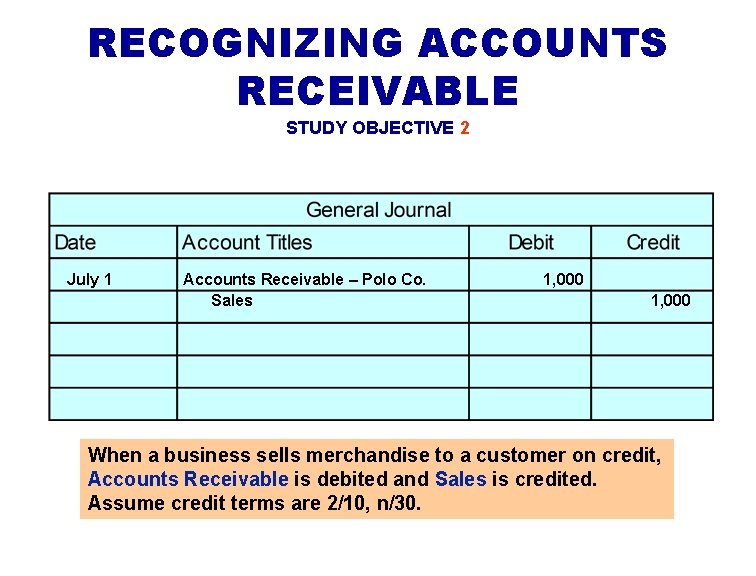
RECOGNIZING ACCOUNTS RECEIVABLE STUDY OBJECTIVE 2 July 1 Accounts Receivable – Polo Co. Sales 1, 000 When a business sells merchandise to a customer on credit, Accounts Receivable is debited and Sales is credited. Assume credit terms are 2/10, n/30.
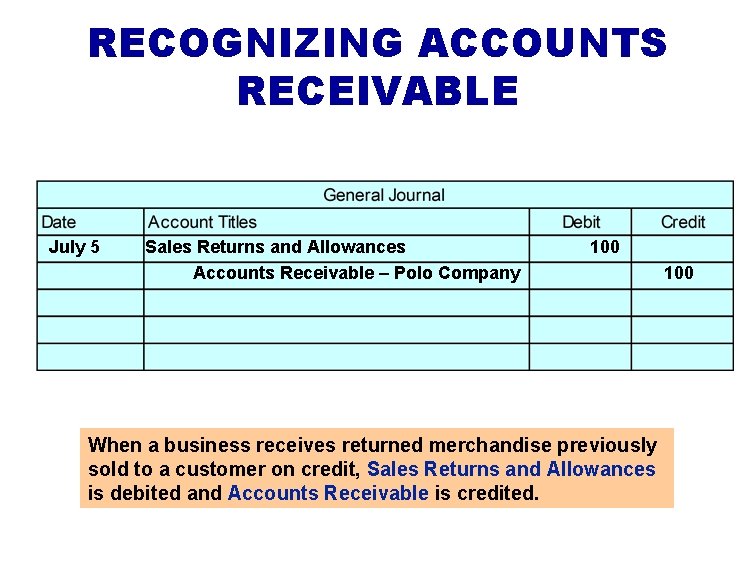
RECOGNIZING ACCOUNTS RECEIVABLE July 5 Sales Returns and Allowances Accounts Receivable – Polo Company 100 When a business receives returned merchandise previously When a business sells merchandise to a customer on credit, sold to a customer on credit, Sales Returns and Allowances Accounts Receivable is debited and Sales is credited. is debited and Accounts Receivable is credited. 100
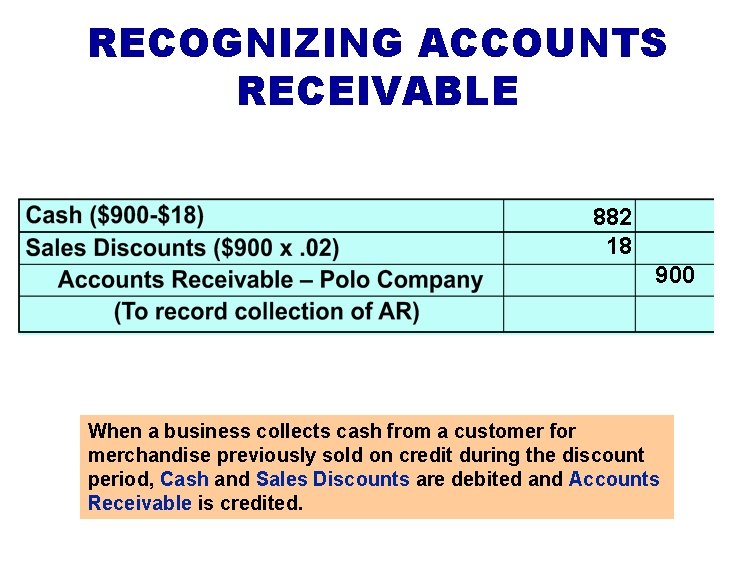
RECOGNIZING ACCOUNTS RECEIVABLE 882 18 900 When a business collects cash from a customer for When a business merchandise previously sells merchandise sold on credit to during a customer the discount on credit, Accounts Receivable is Discounts debited and Sales is credited. period, Cash and Sales are debited and Accounts Receivable is credited.
VALUING ACCOUNTS RECEIVABLE STUDY OBJECTIVE 3 • Cash (net) realizable value – net amount expected to be received in cash and excludes amounts that the company estimates it will not be able to collect • Credit losses – debited to Bad Debts Expense – considered a normal and necessary risk of doing business. • Two methods of accounting for uncollectible accounts are: 1 Direct write-off method 2 Allowance method
DIRECT WRITE-OFF METHOD • Direct write-off method – Bad debt losses are not anticipated and no allowance account is used – No entries are made for bad debts until an account is determined to be uncollectible at which time the loss is charged to Bad Debts Expense • No matching • No cash realizable value of accounts receivable on the balance sheet • Not acceptable for financial reporting purposes
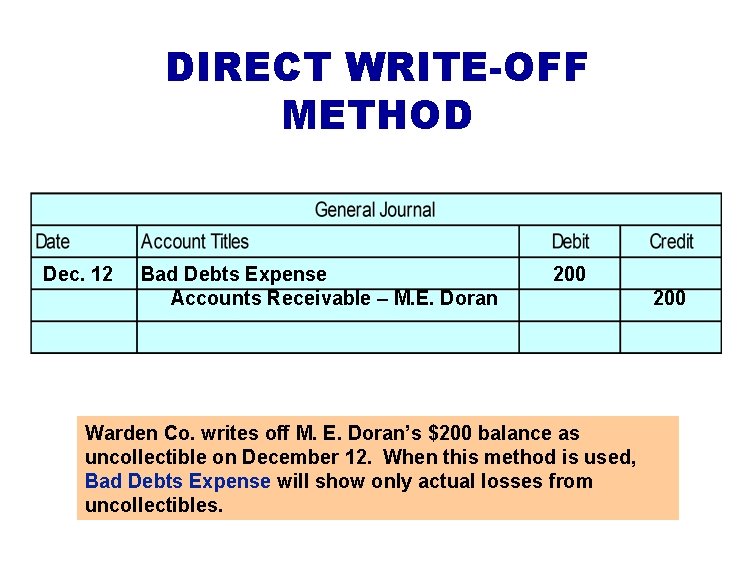
DIRECT WRITE-OFF METHOD Dec. 12 Bad Debts Expense Accounts Receivable – M. E. Doran 200 Warden Co. writes off M. E. Doran’s $200 balance as uncollectible on December 12. When this method is used, Bad Debts Expense will show only actual losses from uncollectibles. 200
THE ALLOWANCE METHOD • Allowance method – required when bad debts are deemed to be material in amount. • Uncollectible accounts are estimated – expense for the uncollectible accounts is matched against sales in the same accounting period in which the sales occurred.
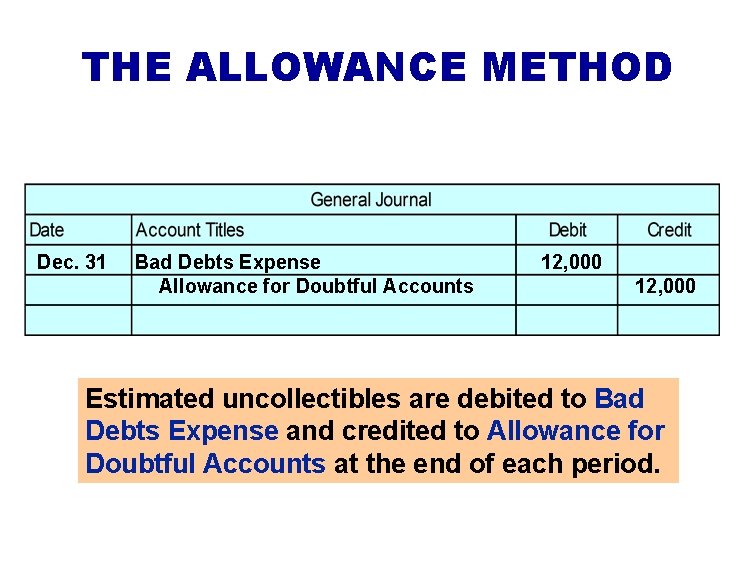
THE ALLOWANCE METHOD Dec. 31 Bad Debts Expense Allowance for Doubtful Accounts 12, 000 Estimated uncollectibles are debited to Bad Debts Expense and credited to Allowance for Doubtful Accounts at the end of each period.
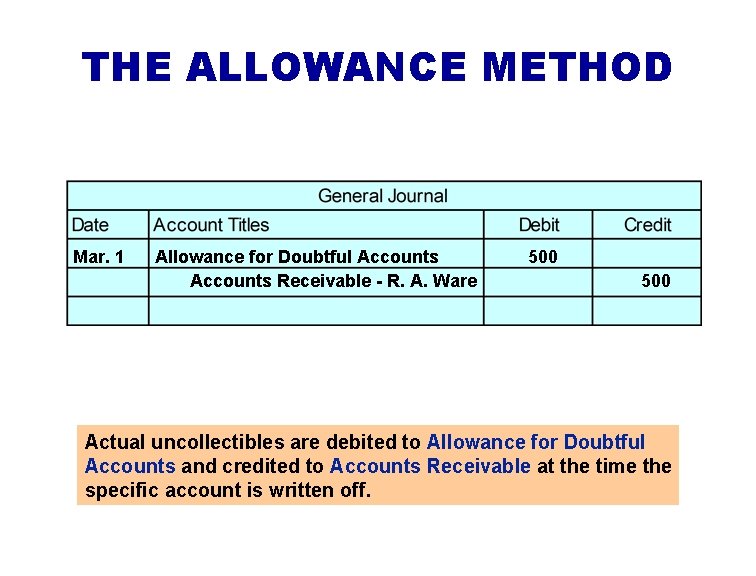
THE ALLOWANCE METHOD Mar. 1 Allowance for Doubtful Accounts Receivable - R. A. Ware 500 Actual uncollectibles are debited to Allowance for Doubtful Accounts and credited to Accounts Receivable at the time the specific account is written off.
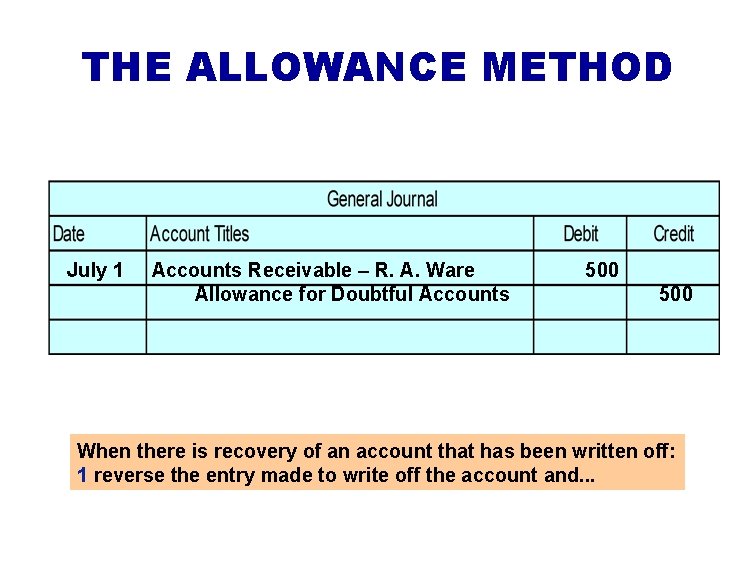
THE ALLOWANCE METHOD July 1 Accounts Receivable – R. A. Ware Allowance for Doubtful Accounts 500 When there is recovery of an account that has been written off: 1 reverse the entry made to write off the account and. . .
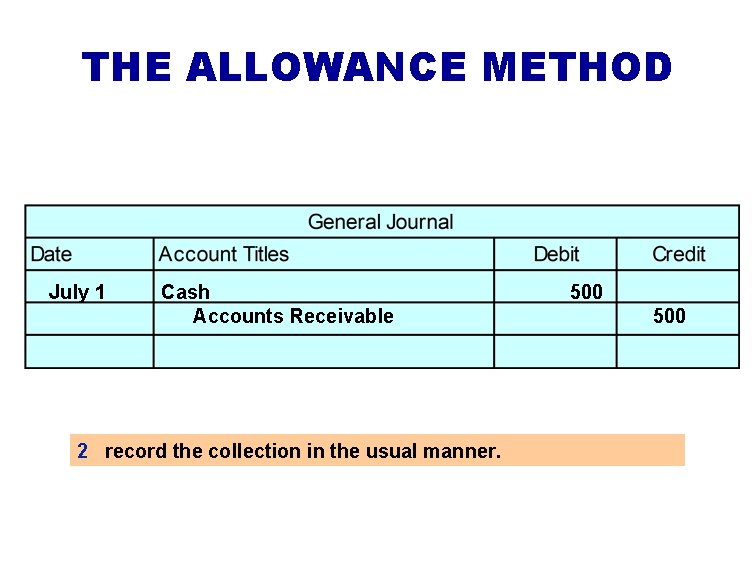
THE ALLOWANCE METHOD July 1 Cash Accounts Receivable 2 record the collection in the usual manner. 500
BASES USED FOR THE ALLOWANCE METHOD • Companies use one of two methods in the estimation of uncollectibles: 1 Percentage of sales 2 Percentage of receivables • Both bases are GAAP; the choice is a management decision.
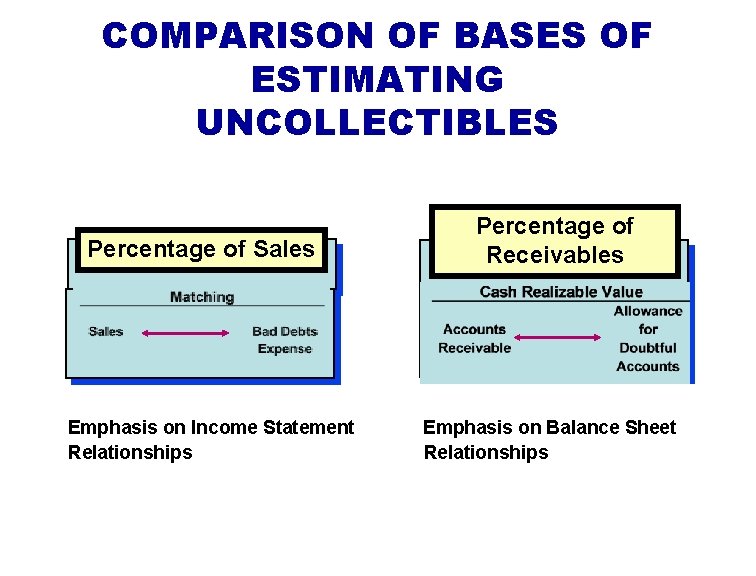
COMPARISON OF BASES OF ESTIMATING UNCOLLECTIBLES Percentage of Sales Emphasis on Income Statement Relationships Percentage of Receivables Emphasis on Balance Sheet Relationships
PERCENTAGE OF SALES BASIS • Management estimates what percentage of credit sales will be uncollectible. • Expected bad debt losses are determined by applying the percentage to the sales base of the current period. • Better match – Expenses with revenues
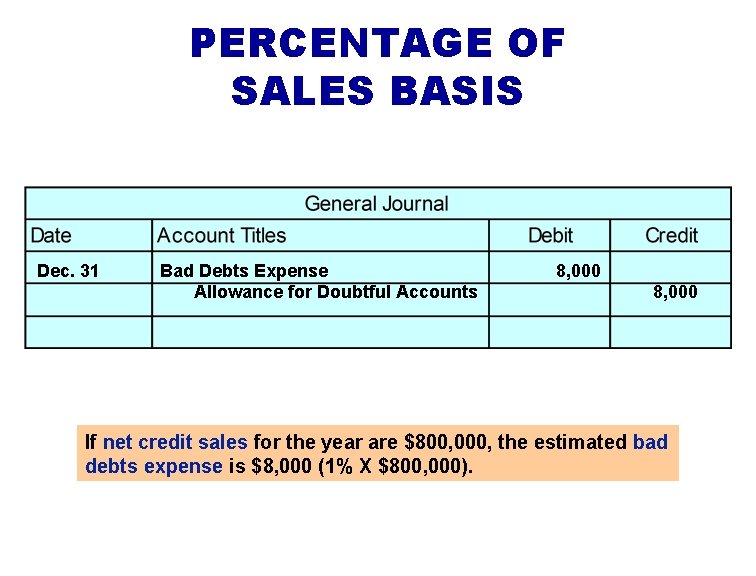
PERCENTAGE OF SALES BASIS Dec. 31 Bad Debts Expense Allowance for Doubtful Accounts 8, 000 If net credit sales for the year are $800, 000, the estimated bad debts expense is $8, 000 (1% X $800, 000).
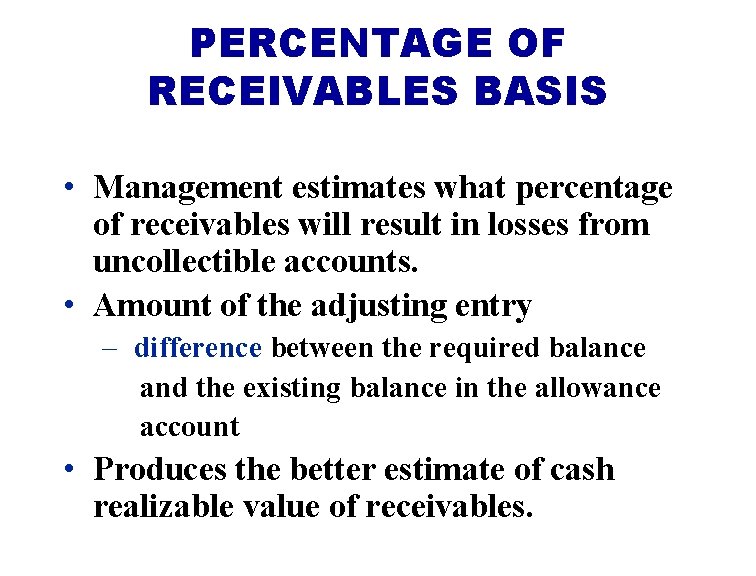
PERCENTAGE OF RECEIVABLES BASIS • Management estimates what percentage of receivables will result in losses from uncollectible accounts. • Amount of the adjusting entry – difference between the required balance and the existing balance in the allowance account • Produces the better estimate of cash realizable value of receivables.
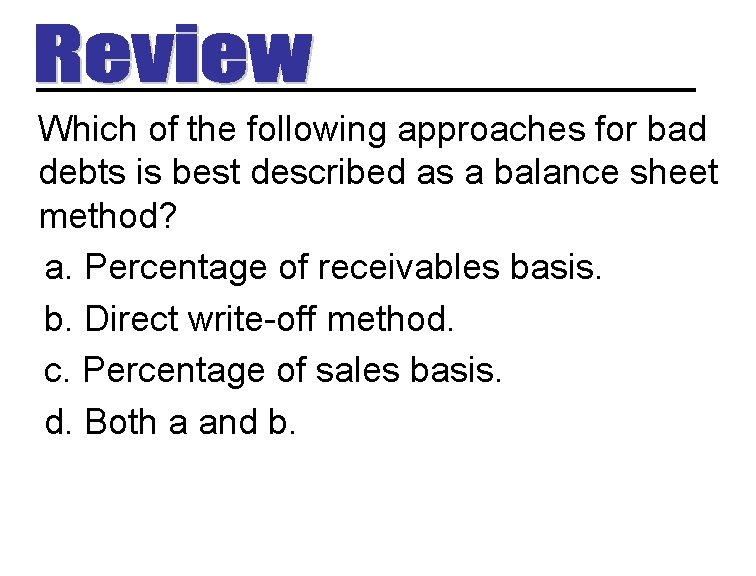
Which of the following approaches for bad debts is best described as a balance sheet method? a. Percentage of receivables basis. b. Direct write-off method. c. Percentage of sales basis. d. Both a and b.
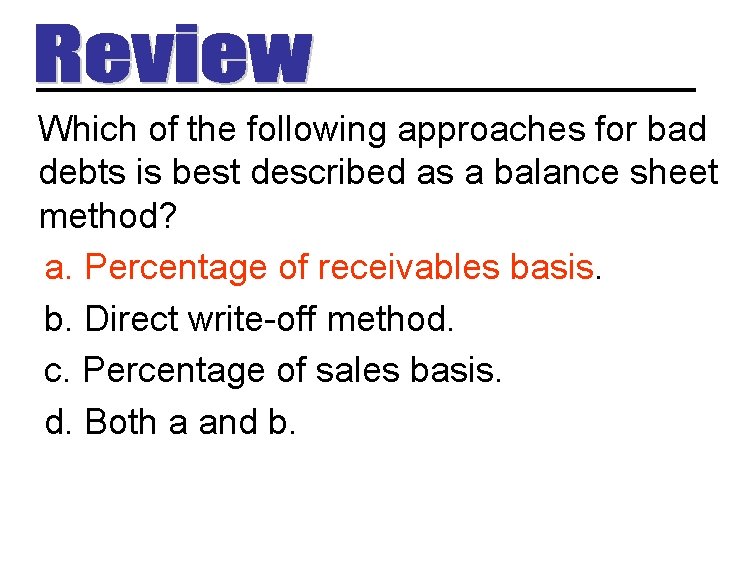
Which of the following approaches for bad debts is best described as a balance sheet method? a. Percentage of receivables basis. b. Direct write-off method. c. Percentage of sales basis. d. Both a and b.
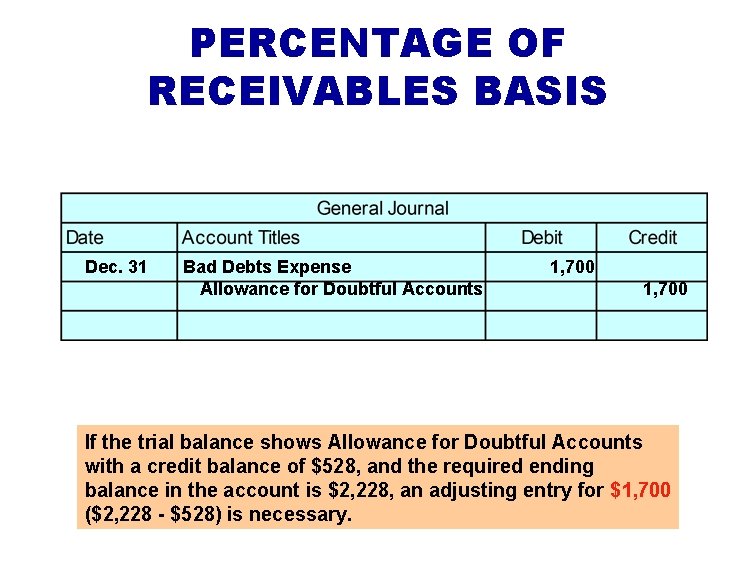
PERCENTAGE OF RECEIVABLES BASIS Dec. 31 Bad Debts Expense Allowance for Doubtful Accounts 1, 700 If the trial balance shows Allowance for Doubtful Accounts with a credit balance of $528, and the required ending balance in the account is $2, 228, an adjusting entry for $1, 700 ($2, 228 - $528) is necessary.
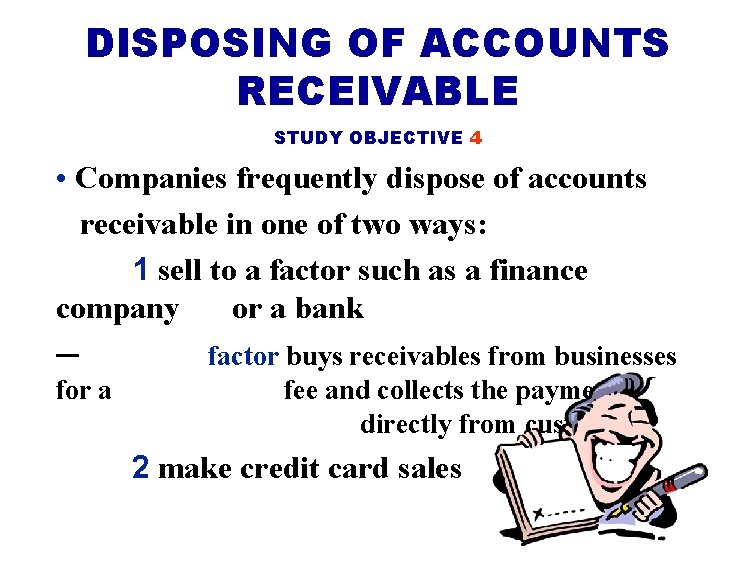
DISPOSING OF ACCOUNTS RECEIVABLE STUDY OBJECTIVE 4 • Companies frequently dispose of accounts receivable in one of two ways: 1 sell to a factor such as a finance company or a bank ─ factor buys receivables from businesses for a fee and collects the payments directly from customers 2 make credit card sales
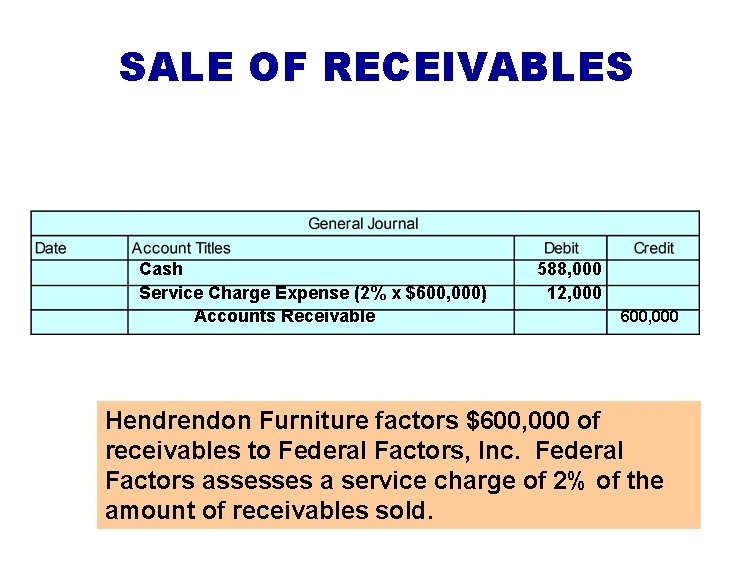
SALE OF RECEIVABLES Cash Service Charge Expense (2% x $600, 000) Accounts Receivable 588, 000 12, 000 600, 000 Hendrendon Furniture factors $600, 000 of receivables to Federal Factors, Inc. Federal Factors assesses a service charge of 2% of the amount of receivables sold.
CREDIT CARD SALES • Credit cards – used by retailers who wish to avoid the paperwork of issuing credit – cash is received quickly from the credit card issuer • National credit cards – Visa, Master. Card, Discover, and American Express
CREDIT CARD SALES • Three parties 1 credit card issuer 2 retailer 3 customer • Retailer pays the credit card issuer a fee of 2 -6% of the invoice price for its services. • From an accounting standpoint, sales from Visa, Master. Card, and Discover are treated differently than sales from American Express.
VISA, MASTERCARD, AND DISCOVER SALES • VISA, Master. Card, and Discover – cards issued by banks – considered cash sales by the retailer • Upon receipt of credit card sales slips from a retailer – the bank immediately adds the amount to the seller’s bank balance
VISA, MASTERCARD, AND DISCOVER SALES Cash Service Charge Expense Sales Anita Ferreri purchases a number of compact discs for her restaurant from Karen Kerr Music Co. for $1, 000 using her VISA First Bank Card. The service fee that First Bank charges is 3%. 970 30 1, 000
AMERICAN EXPRESS SALES • American Express cards – reported as credit sales, not cash sales • Conversion to cash does not occur until the American Express remits the net amount to the seller.
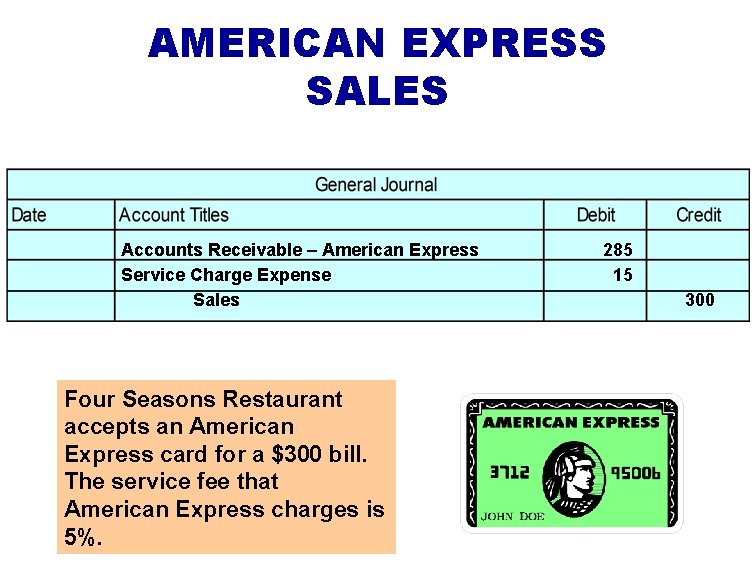
AMERICAN EXPRESS SALES Accounts Receivable – American Express Service Charge Expense Sales Four Seasons Restaurant accepts an American Express card for a $300 bill. The service fee that American Express charges is 5%. 285 15 300
NOTES RECEIVABLE • Promissory note – written promise to pay a specified amount of money on demand or at a definite time. • Maker – The party making the promise. • Payee – The party to whom payment is made.
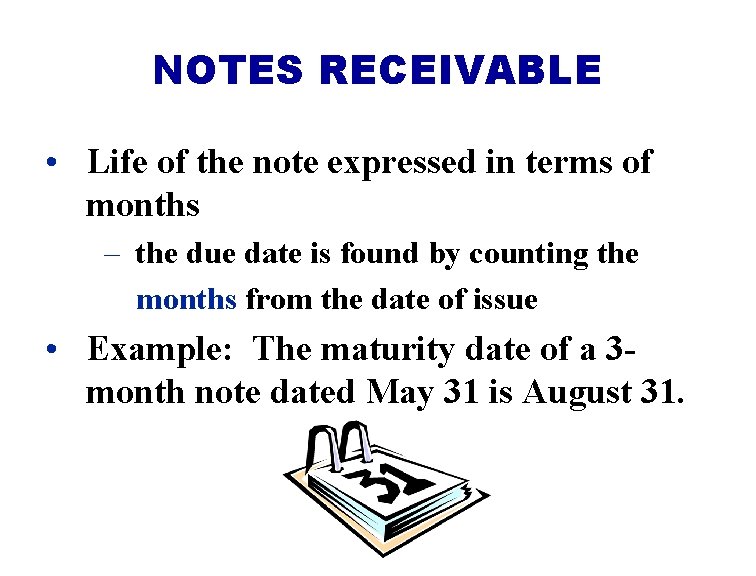
NOTES RECEIVABLE • Life of the note expressed in terms of months – the due date is found by counting the months from the date of issue • Example: The maturity date of a 3 month note dated May 31 is August 31.
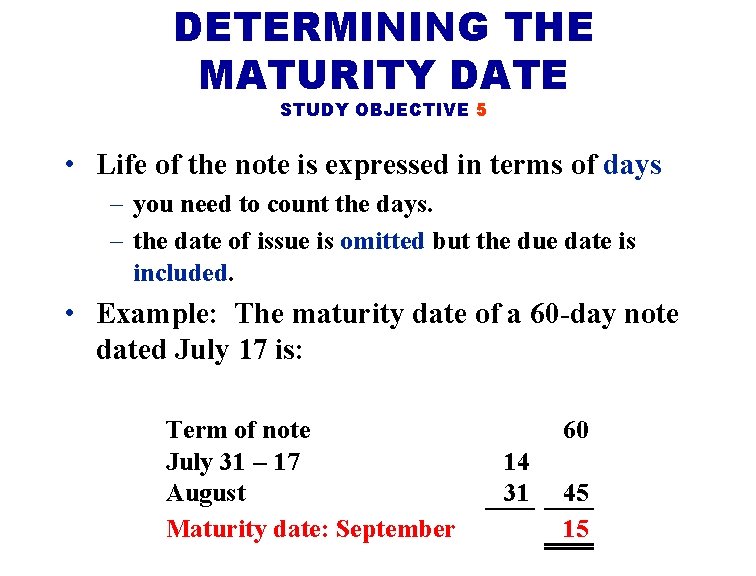
DETERMINING THE MATURITY DATE STUDY OBJECTIVE 5 • Life of the note is expressed in terms of days – you need to count the days. – the date of issue is omitted but the due date is included. • Example: The maturity date of a 60 -day note dated July 17 is: Term of note July 31 – 17 August Maturity date: September 60 14 31 45 15
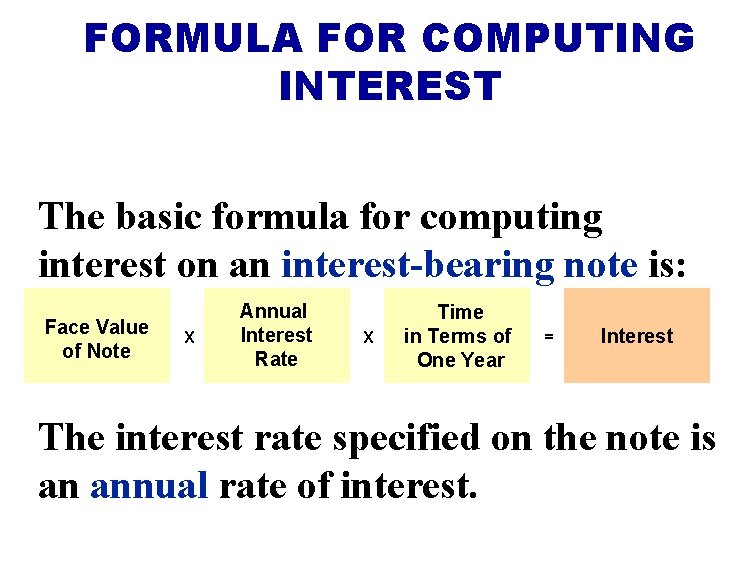
FORMULA FOR COMPUTING INTEREST The basic formula for computing interest on an interest-bearing note is: Face Value of Note X Annual Interest Rate X Time in Terms of One Year = Interest The interest rate specified on the note is an annual rate of interest.
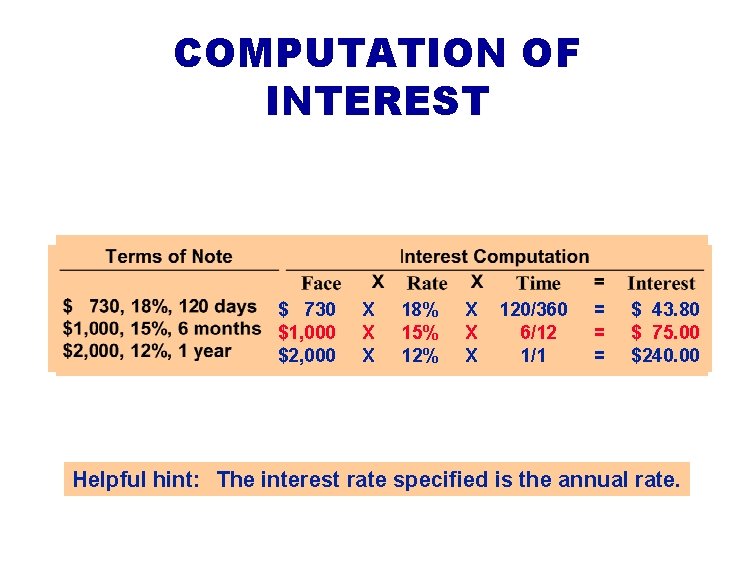
COMPUTATION OF INTEREST $ 730 $1, 000 $2, 000 X X X 18% 15% 12% X X X 120/360 6/12 1/1 = = = $ 43. 80 $ 75. 00 $240. 00 Helpful hint: The interest rate specified is the annual rate.
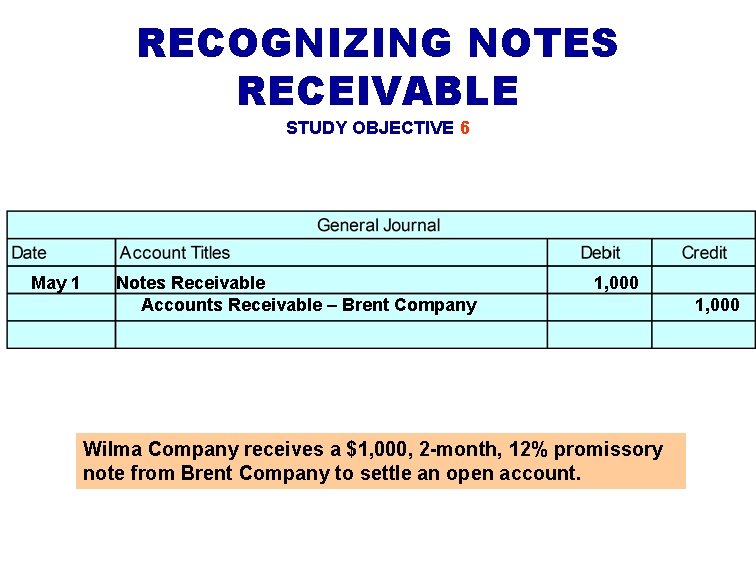
RECOGNIZING NOTES RECEIVABLE STUDY OBJECTIVE 6 May 1 Notes Receivable Accounts Receivable – Brent Company 1, 000 Wilma Company receives a $1, 000, 2 -month, 12% promissory note from Brent Company to settle an open account. 1, 000
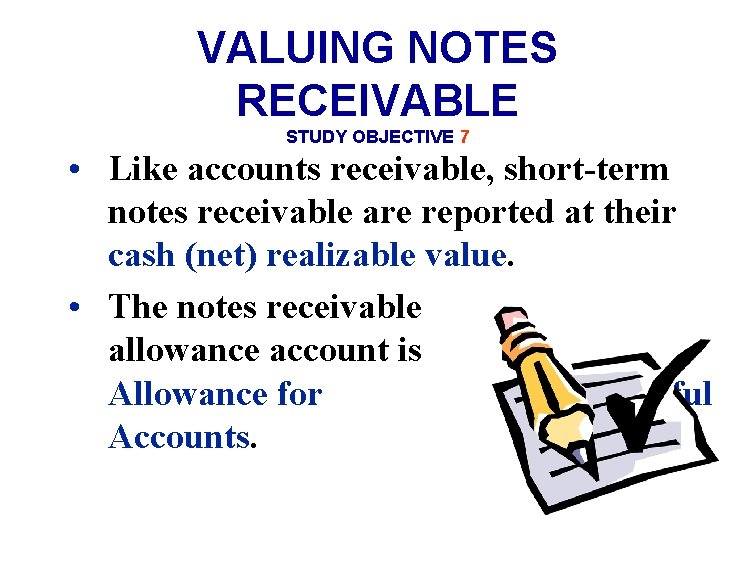
VALUING NOTES RECEIVABLE STUDY OBJECTIVE 7 • Like accounts receivable, short-term notes receivable are reported at their cash (net) realizable value. • The notes receivable allowance account is Allowance for Doubtful Accounts.
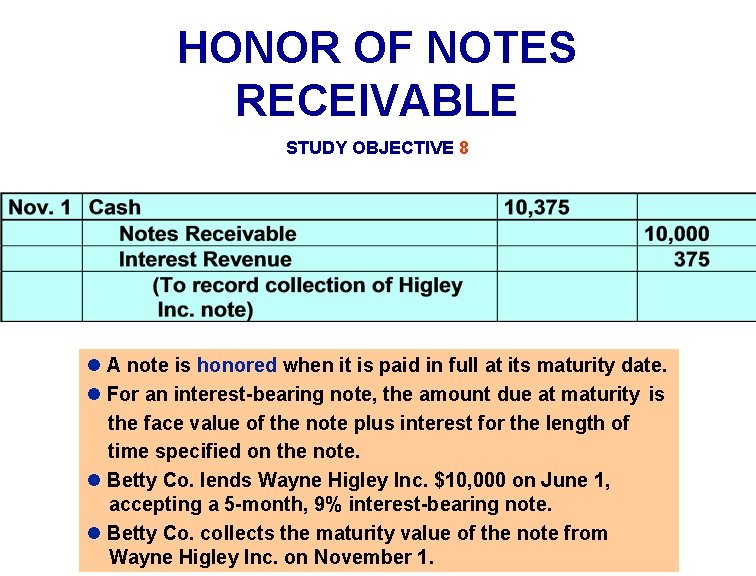
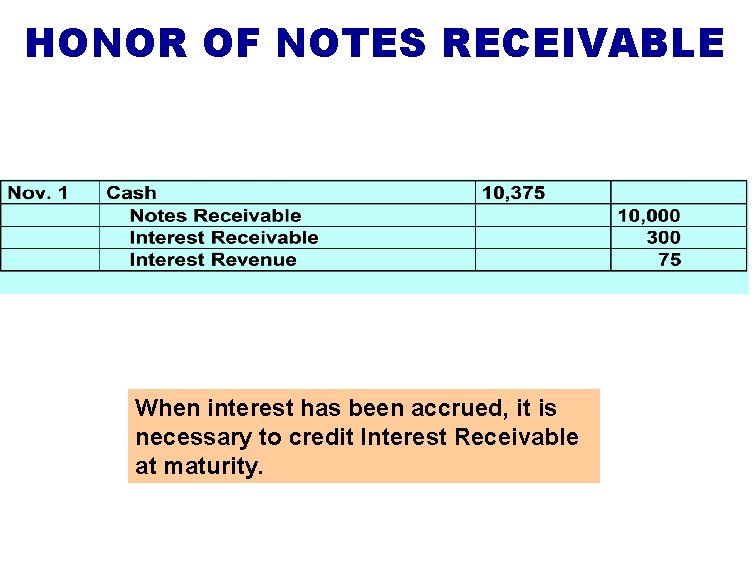
HONOR OF NOTES RECEIVABLE STUDY OBJECTIVE 8 l A note is honored when it is paid in full at its maturity date. l For an interest-bearing note, the amount due at maturity is the face value of the note plus interest for the length of time specified on the note. l Betty Co. lends Wayne Higley Inc. $10, 000 on June 1, accepting a 5 -month, 9% interest-bearing note. l Betty Co. collects the maturity value of the note from Wayne Higley Inc. on November 1.
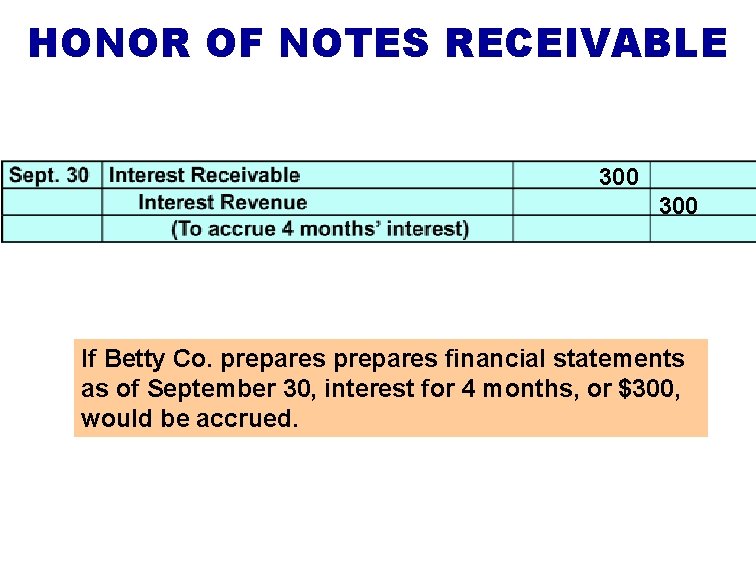
HONOR OF NOTES RECEIVABLE 300 If Betty Co. prepares financial statements as of September 30, interest for 4 months, or $300, would be accrued.
HONOR OF NOTES RECEIVABLE When interest has been accrued, it is necessary to credit Interest Receivable at maturity.
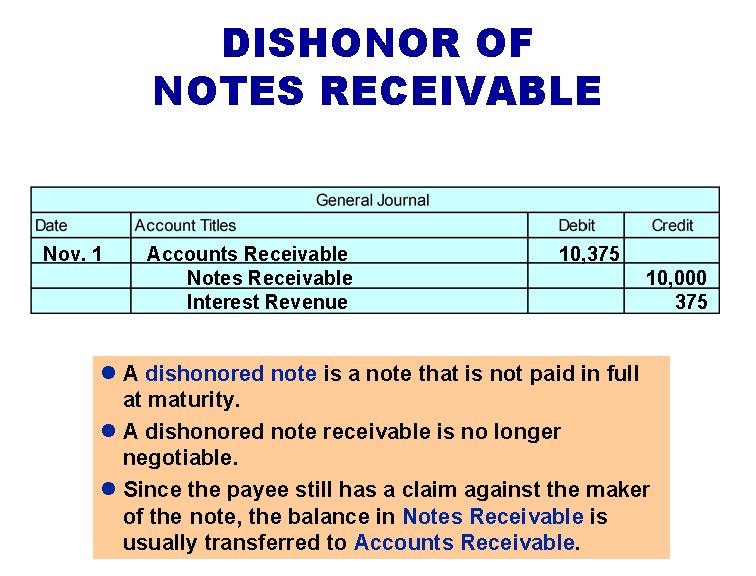
DISHONOR OF NOTES RECEIVABLE Nov. 1 Accounts Receivable Notes Receivable Interest Revenue 10, 375 10, 000 375 l A dishonored note is a note that is not paid in full at maturity. l A dishonored note receivable is no longer negotiable. l Since the payee still has a claim against the maker of the note, the balance in Notes Receivable is usually transferred to Accounts Receivable.
BALANCE SHEET PRESENTATION OF RECEIVABLES STUDY OBJECTIVE 9 • In the balance sheet, short-term receivables are reported in the current assets section below shortterm investments. • Report both the gross amount of receivables and the allowance for doubtful accounts.
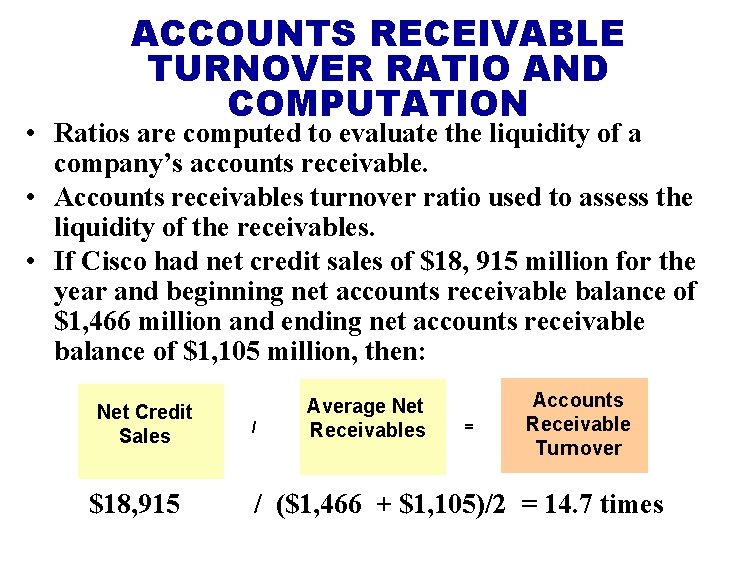
ACCOUNTS RECEIVABLE TURNOVER RATIO AND COMPUTATION • Ratios are computed to evaluate the liquidity of a company’s accounts receivable. • Accounts receivables turnover ratio used to assess the liquidity of the receivables. • If Cisco had net credit sales of $18, 915 million for the year and beginning net accounts receivable balance of $1, 466 million and ending net accounts receivable balance of $1, 105 million, then: Net Credit Sales $18, 915 / Average Net Receivables = Accounts Receivable Turnover / ($1, 466 + $1, 105)/2 = 14. 7 times
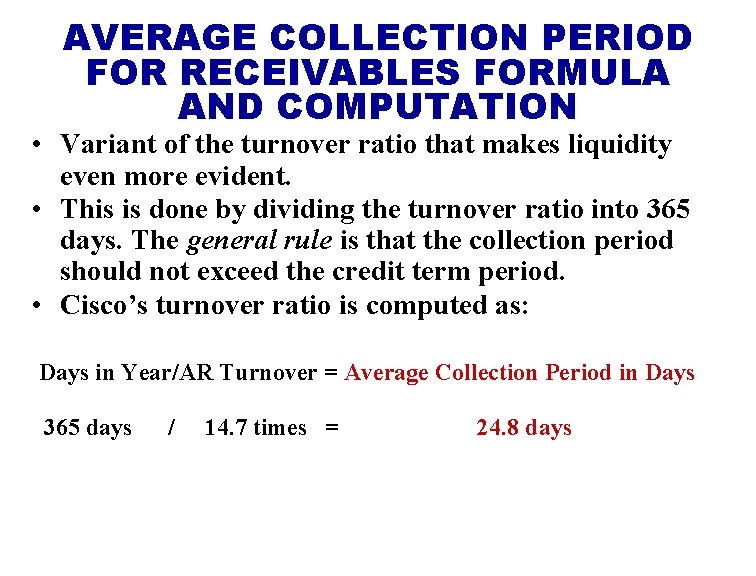
AVERAGE COLLECTION PERIOD FOR RECEIVABLES FORMULA AND COMPUTATION • Variant of the turnover ratio that makes liquidity even more evident. • This is done by dividing the turnover ratio into 365 days. The general rule is that the collection period should not exceed the credit term period. • Cisco’s turnover ratio is computed as: Days in Year/AR Turnover = Average Collection Period in Days 365 days / 14. 7 times = 24. 8 days
Which of the following statements about VISA credit card sales is incorrect? a. The credit card issuer makes the credit investigation of the customer. b. The retailer is not involved in the collection process. c. Two parties are involved.
Which of the following statements about VISA credit card sales is incorrect? a. The credit card issuer makes the credit investigation of the customer. b. The retailer is not involved in the collection process. c. Two parties are involved.
COPYRIGHT Copyright © 2005 John Wiley & Sons, Inc. All rights reserved. Reproduction or translation of this work beyond that permitted in Section 117 of the 1976 United States Copyright Act without the express written consent of the copyright owner is unlawful. Request for further information should be addressed to the Permissions Department, John Wiley & Sons, Inc. The purchaser may make back-up copies for his/her own use only and not for distribution or resale. The Publisher assumes no responsibility for errors, omissions, or damages, caused by the use of these programs or from the use of the information contained herein.