
Accounting Principles 7 th Edition Weygandt Kieso Kimmel
- Slides: 49
Accounting Principles, 7 th Edition Weygandt • Kieso • Kimmel Chapter 8 Internal Control and Cash Prepared by Naomi Karolinski Monroe Community College and Marianne Bradford Bryant College John Wiley & Sons, Inc. © 2005
CHAPTER 8 INTERNAL CONTROL AND CASH After studying this chapter, you should be able to: 1 Define internal control. 2 Identify the principles of internal control. 3 Explain the applications of internal control principles to cash receipts. 4 Explain the applications of internal control principles to cash disbursements. 5 Describe the operation of a petty cash fund. 6 Indicate the control features of a bank account. 7 Prepare a bank reconciliation. 8 Explain the reporting of cash.
INTERNAL CONTROL STUDY OBJECTIVE 1 Internal Control 1. Safeguards an organization’s assets 2. Enhances the accuracy and reliability of accounting records
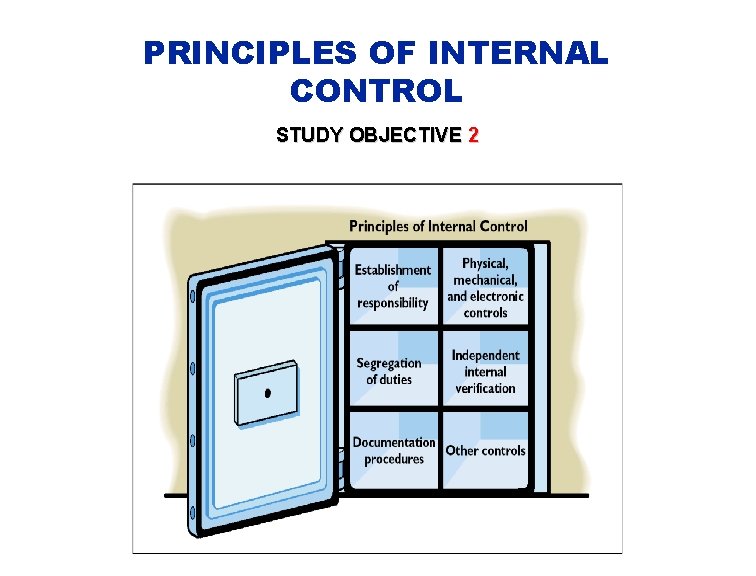
PRINCIPLES OF INTERNAL CONTROL STUDY OBJECTIVE 2
PRINCIPLES OF INTERNAL CONTROL • Establishment of responsibility: • most effective when only one person is responsible for a given task • Segregation of duties: • the work of one employee should provide a reliable basis for evaluating the work of another employee • Documentation procedures: • documents provide evidence that transactions and events have occurred
PRINCIPLES OF INTERNAL CONTROL • Physical, mechanical, and electronic controls: safeguarding of assets and enhancing accuracy and reliability of the accounting records. • Independent internal verification: the review, comparison, and reconciliation of information from two sources. • Other controls: bonding of employees who handle cash, rotating employee’s duties, and requiring employees to take vacations.
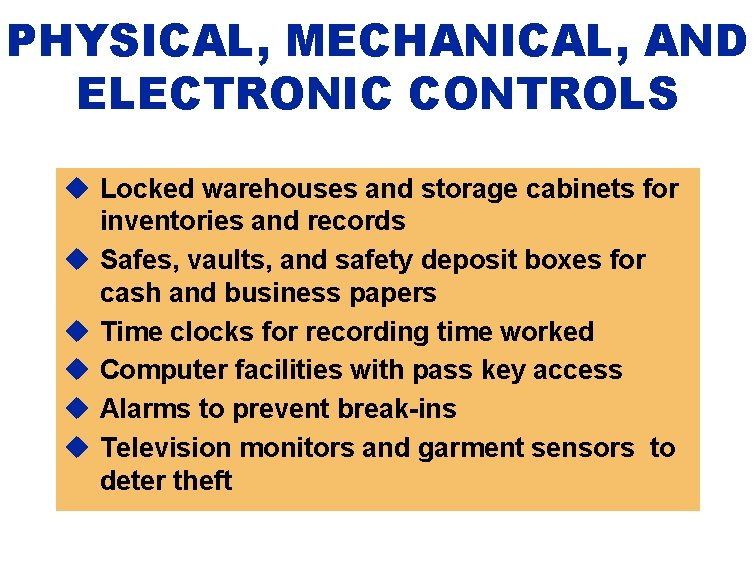
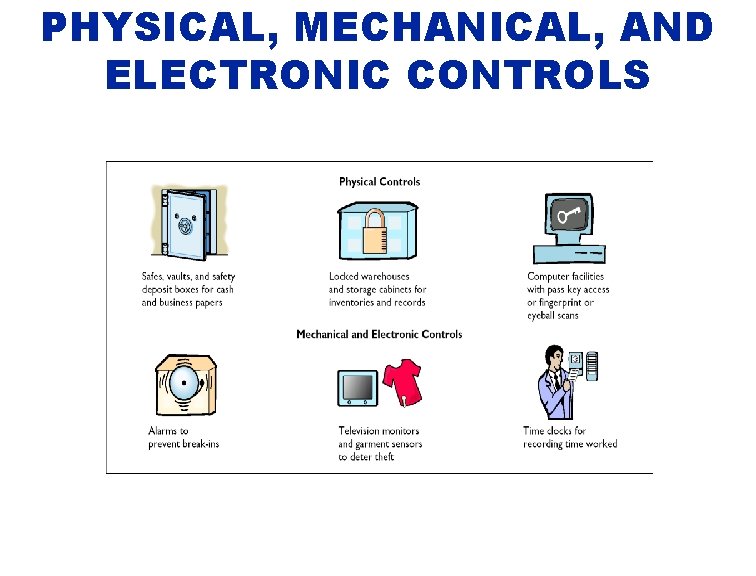
PHYSICAL, MECHANICAL, AND ELECTRONIC CONTROLS u Locked warehouses and storage cabinets for inventories and records u Safes, vaults, and safety deposit boxes for cash and business papers u Time clocks for recording time worked u Computer facilities with pass key access u Alarms to prevent break-ins u Television monitors and garment sensors to deter theft
PHYSICAL, MECHANICAL, AND ELECTRONIC CONTROLS
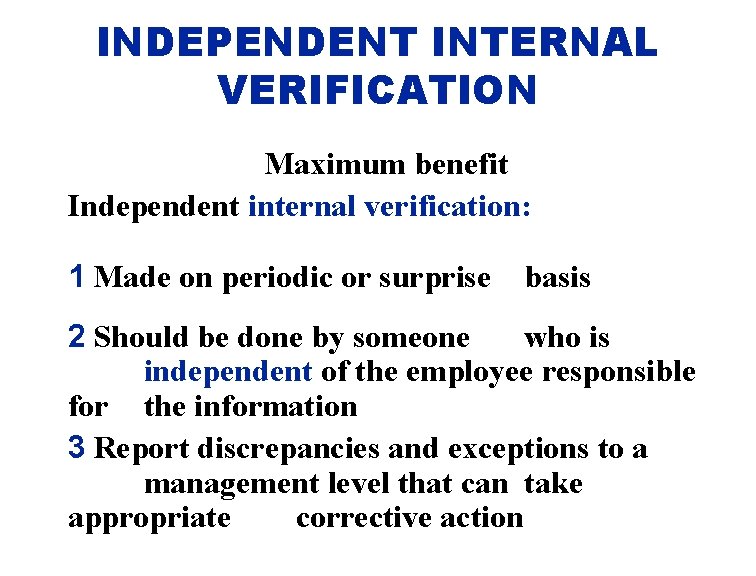
INDEPENDENT INTERNAL VERIFICATION Maximum benefit Independent internal verification: 1 Made on periodic or surprise basis 2 Should be done by someone who is independent of the employee responsible for the information 3 Report discrepancies and exceptions to a management level that can take appropriate corrective action
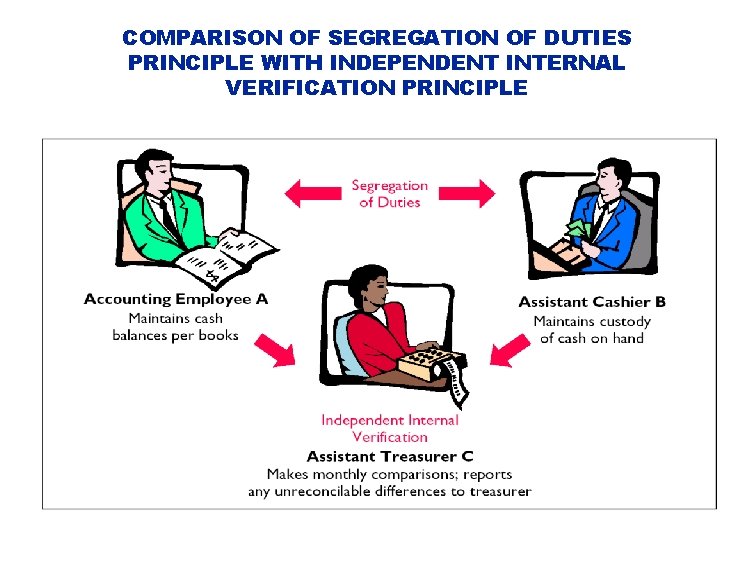
COMPARISON OF SEGREGATION OF DUTIES PRINCIPLE WITH INDEPENDENT INTERNAL VERIFICATION PRINCIPLE
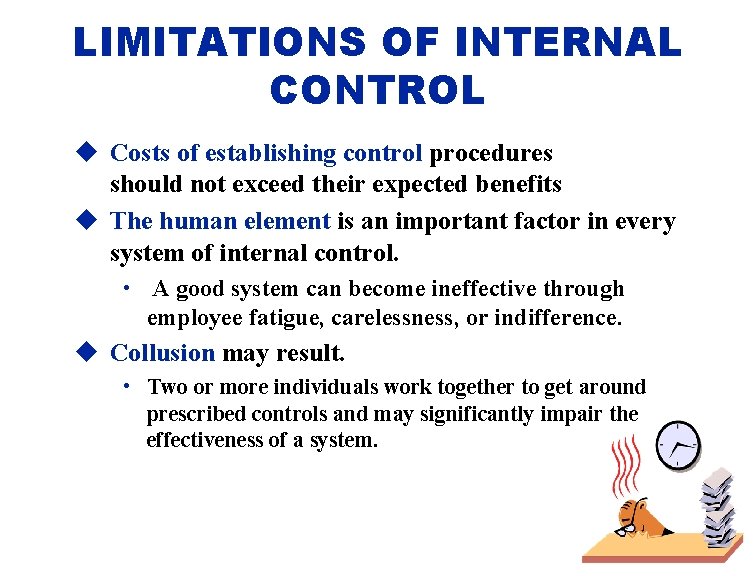
LIMITATIONS OF INTERNAL CONTROL u Costs of establishing control procedures should not exceed their expected benefits u The human element is an important factor in every system of internal control. • A good system can become ineffective through employee fatigue, carelessness, or indifference. u Collusion may result. • Two or more individuals work together to get around prescribed controls and may significantly impair the effectiveness of a system.
CASH u Cash • Coins, currency, checks, money orders, and money on hand or on deposit at a bank or similar depository u Internal control over cash is imperative • Safeguards cash and assure the accuracy of the accounting records for cash
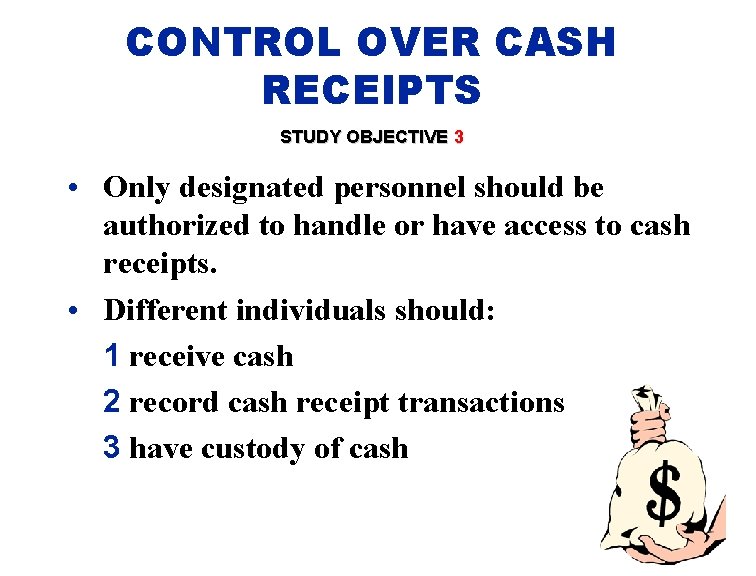
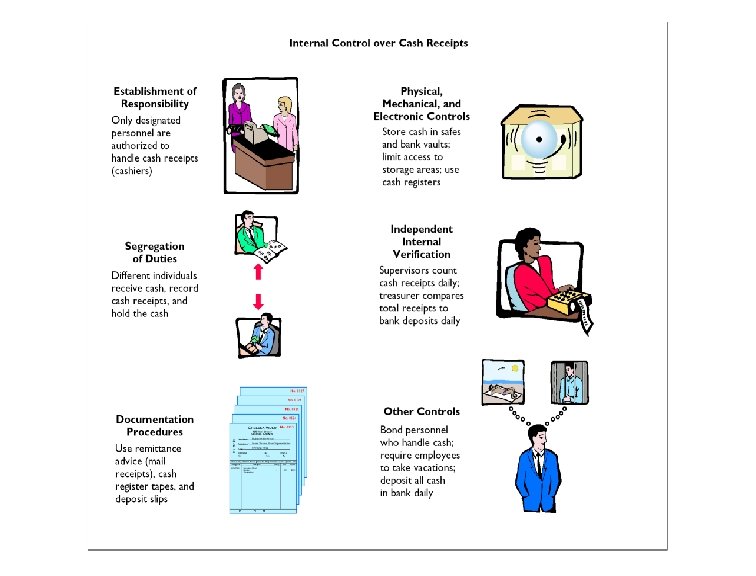
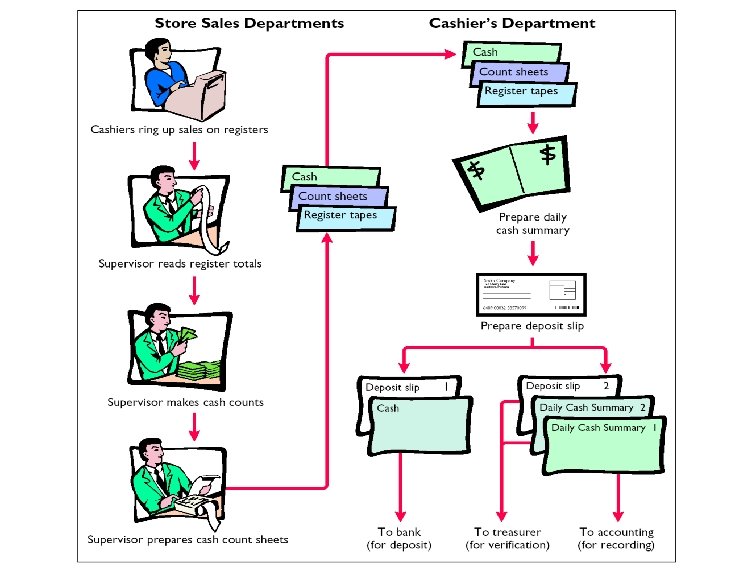
CONTROL OVER CASH RECEIPTS STUDY OBJECTIVE 3 • Only designated personnel should be authorized to handle or have access to cash receipts. • Different individuals should: 1 receive cash 2 record cash receipt transactions 3 have custody of cash
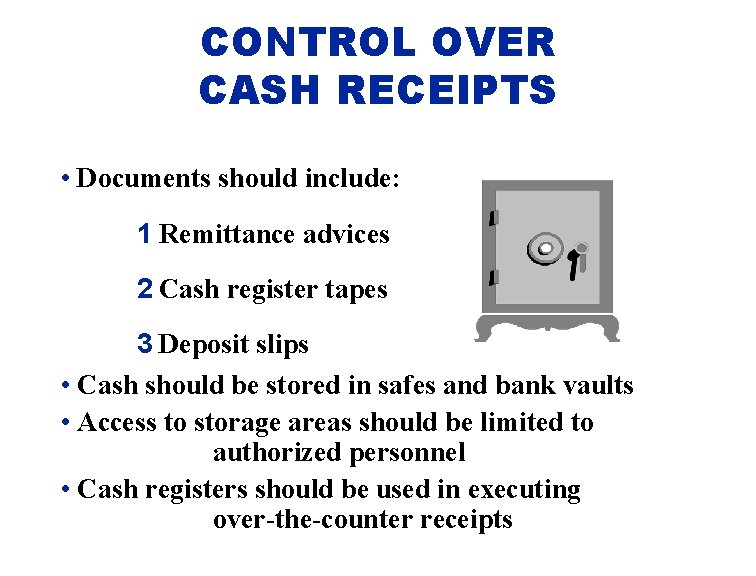
CONTROL OVER CASH RECEIPTS • Documents should include: 1 Remittance advices 2 Cash register tapes 3 Deposit slips • Cash should be stored in safes and bank vaults • Access to storage areas should be limited to authorized personnel • Cash registers should be used in executing over-the-counter receipts
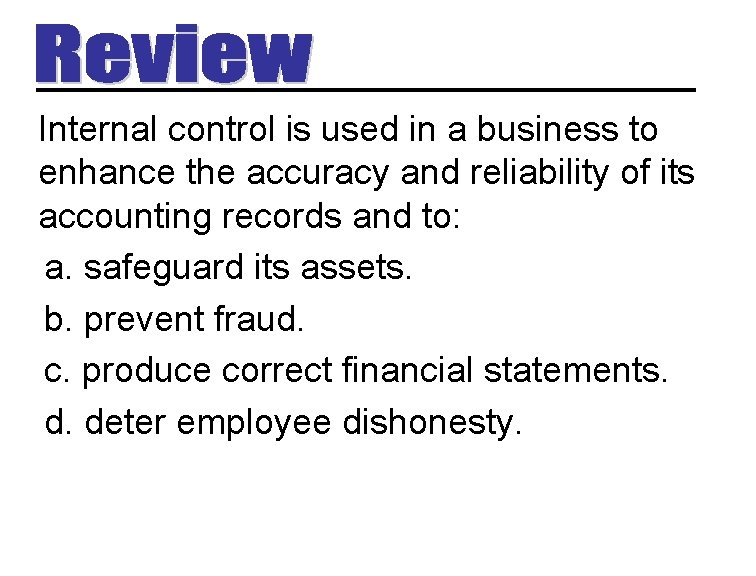
Internal control is used in a business to enhance the accuracy and reliability of its accounting records and to: a. safeguard its assets. b. prevent fraud. c. produce correct financial statements. d. deter employee dishonesty.
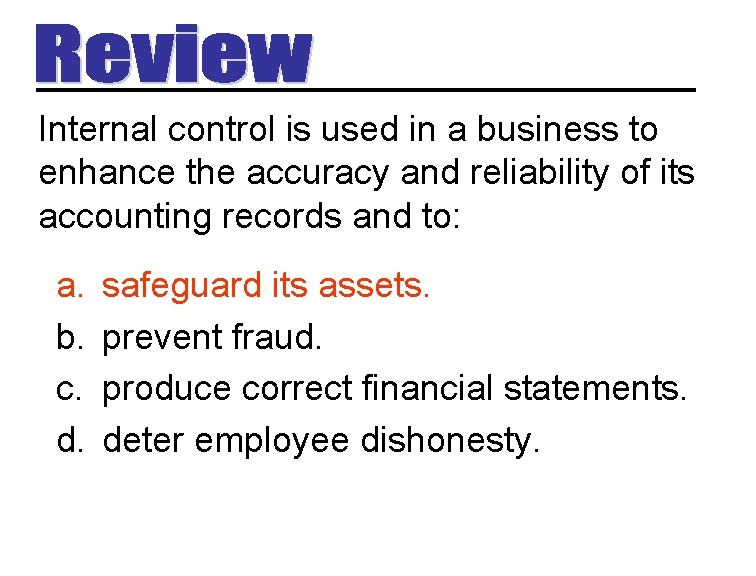
Internal control is used in a business to enhance the accuracy and reliability of its accounting records and to: a. b. c. d. safeguard its assets. prevent fraud. produce correct financial statements. deter employee dishonesty.
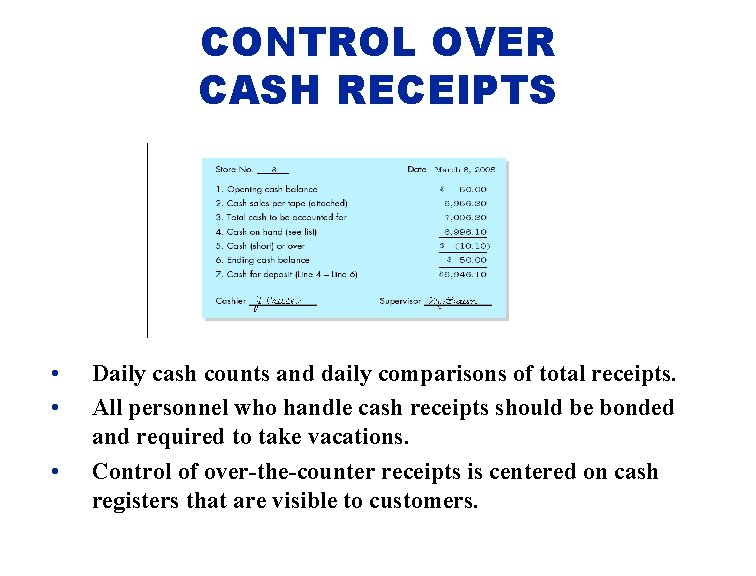
CONTROL OVER CASH RECEIPTS • • • Daily cash counts and daily comparisons of total receipts. All personnel who handle cash receipts should be bonded and required to take vacations. Control of over-the-counter receipts is centered on cash registers that are visible to customers.
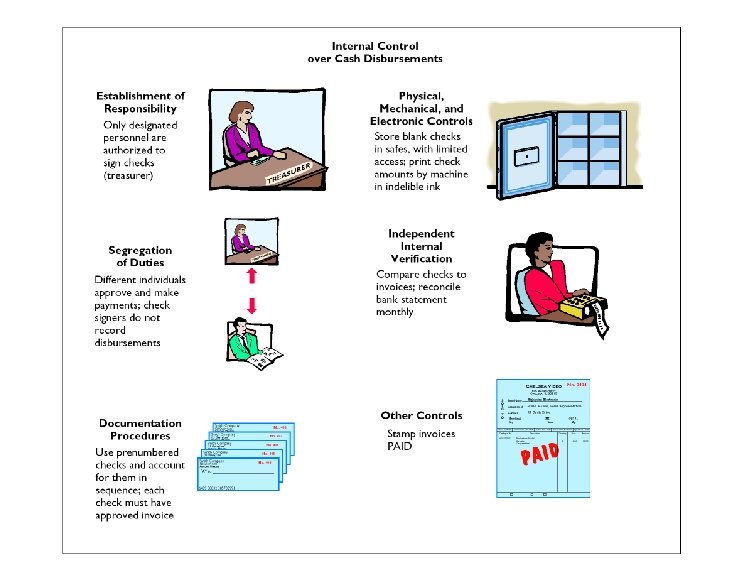
CONTROL OVER CASH DISBURSEMENTS STUDY OBJECTIVE 4 • Payments are made by check rather than by cash, except for petty cash transactions. • Only specified individuals should be authorized to sign checks. • Different departments or individuals should be assigned the duties of approving an item for payment and paying it.
CONTROL OVER CASH DISBURSEMENTS u Prenumbered checks should be used and each check should be supported by an approved invoice or other document. u Blank checks should be stored in a safe. 1 Access should be restricted to authorized personnel. 2 A check writer machine should be used to imprint the amount on the check in indelible ink.
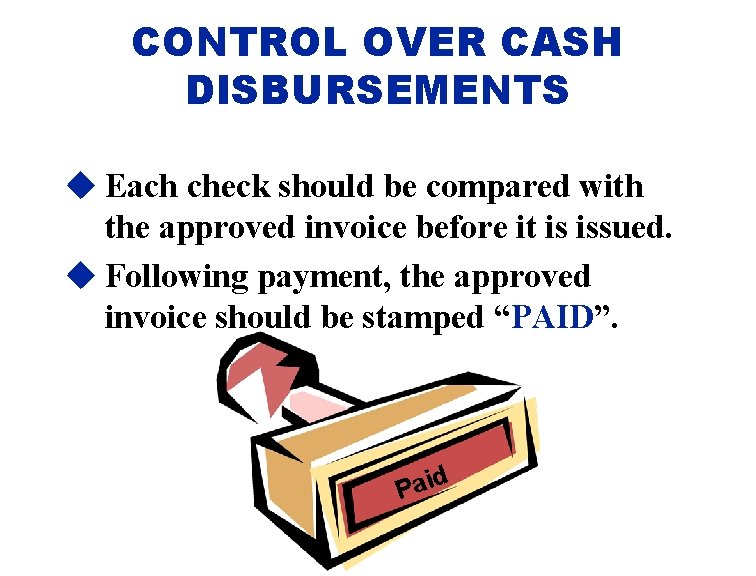
CONTROL OVER CASH DISBURSEMENTS u Each check should be compared with the approved invoice before it is issued. u Following payment, the approved invoice should be stamped “PAID”. d Pai
VOUCHER SYSTEM u The voucher system u Is often used to enhance the internal control over cash disbursements. u. Is an extensive network of approvals by authorized individuals acting independently to ensure that all disbursements by check are proper. u A voucher is an authorization form prepared for each expenditure. u Vouchers are recorded in a journal called the voucher register.
ELECTRONIC FUNDS TRANSFER SYSTEM • Checks processing is expensive • New methods are being developed to transfer funds among parties without the use of paper • Electronic Funds Transfer (EFT) System A disbursement system that uses wire, telephone, telegraph, or computer to transfer cash from one location to another
PETTY CASH FUND STUDY OBJECTIVE 5 u A petty cash fund is used to pay relatively small amounts u Operation of the fund, often called an imprest system, involves: 1 Establishing the fund 2 Making payments from the fund 3 Replenishing the fund u Accounting entries are required when: 1 The fund is established 2 The fund is replenished 3 The amount of the fund is changed
ESTABLISHING THE FUND • Two essential steps in establishing a petty cash fund are: 1 appointing a petty cash custodian who will be responsible for the fund and 2 determining the size of the fund. • Ordinarily, the amount is expected to cover anticipated disbursements for a 3 to 4 week period.
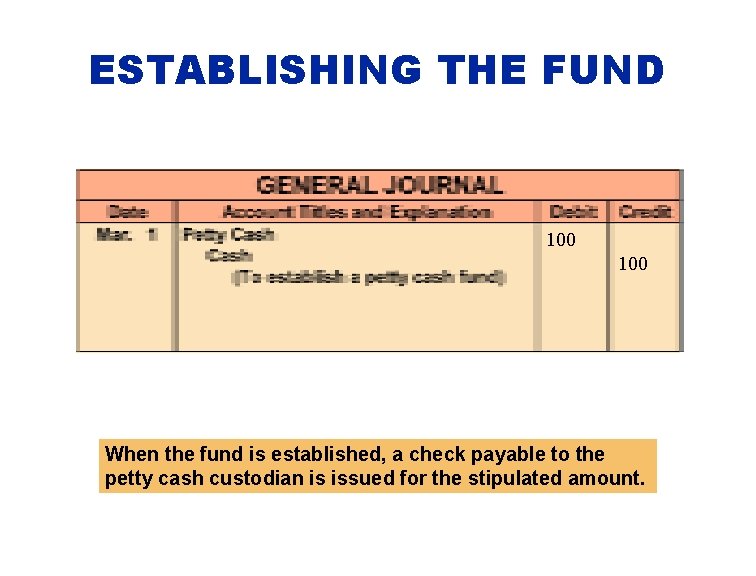
ESTABLISHING THE FUND 100 When the fund is established, a check payable to the petty cash custodian is issued for the stipulated amount.
REPLENISHING THE FUND u When the money in the petty cash fund reaches a minimum level, the fund is replenished. u The request for reimbursement is initiated by the petty cash custodian. u The petty cash custodian prepares a schedule of the payments that have been made and sends the schedule, with supporting documentation, to the treasurer’s office.
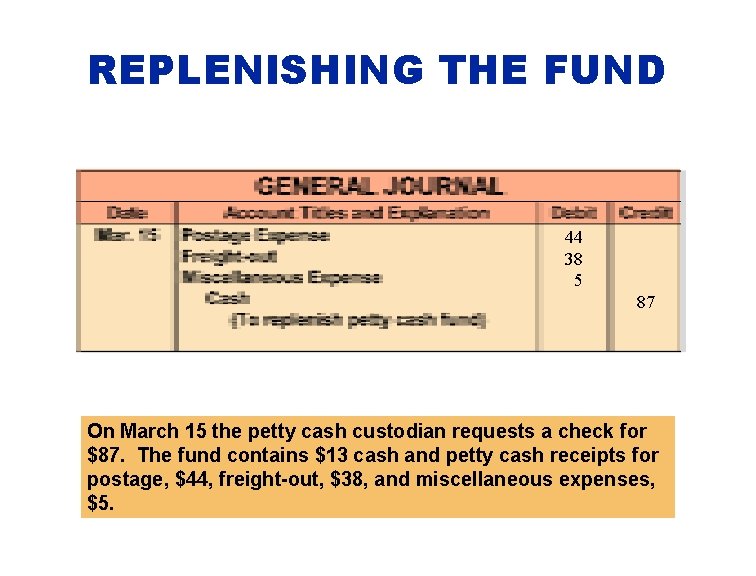
REPLENISHING THE FUND 44 38 5 87 On March 15 the petty cash custodian requests a check for $87. The fund contains $13 cash and petty cash receipts for postage, $44, freight-out, $38, and miscellaneous expenses, $5.
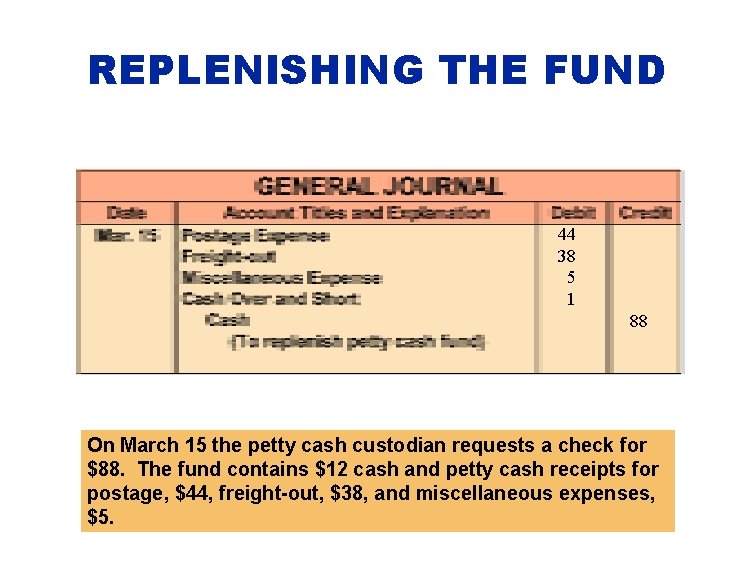
REPLENISHING THE FUND 44 38 5 1 88 On March 15 the petty cash custodian requests a check for $88. The fund contains $12 cash and petty cash receipts for postage, $44, freight-out, $38, and miscellaneous expenses, $5.
USE OF A BANK STUDY OBJECTIVE 6 u The use of a bank minimizes the amount of currency that must be kept on hand contributes significantly to good internal control over cash. u A company can safeguard its cash by using a bank as a depository and as a clearing house for checks received and checks written.
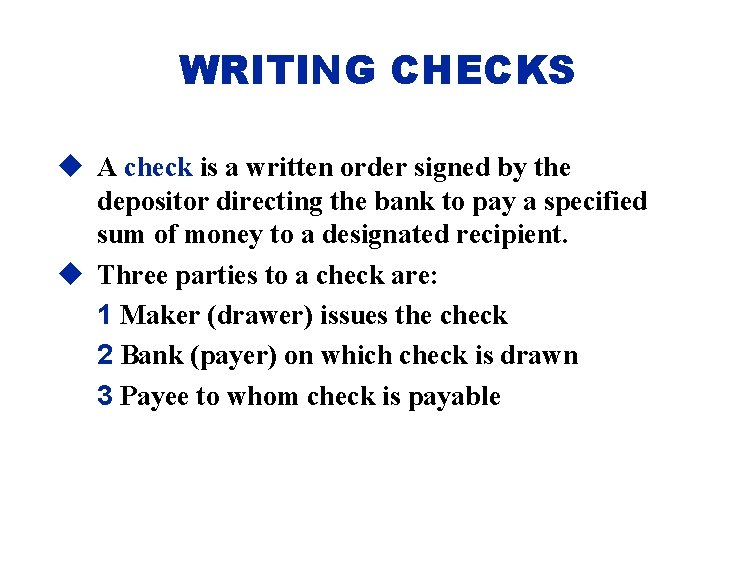
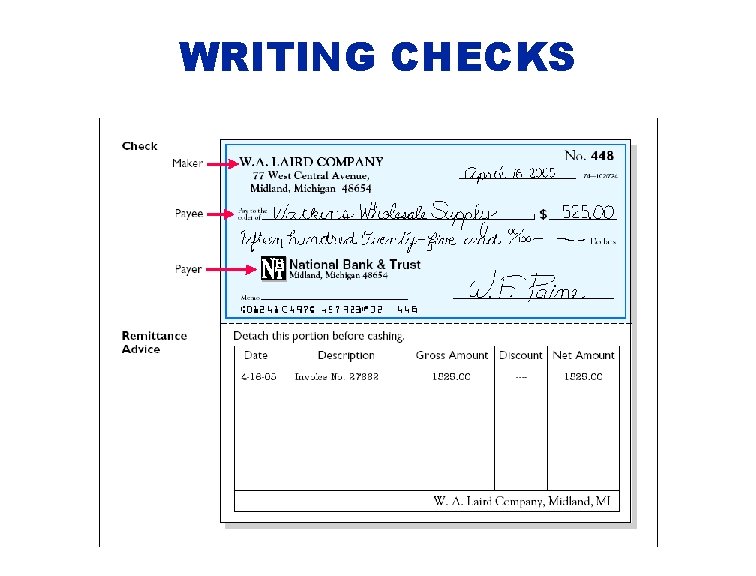
WRITING CHECKS u A check is a written order signed by the depositor directing the bank to pay a specified sum of money to a designated recipient. u Three parties to a check are: 1 Maker (drawer) issues the check 2 Bank (payer) on which check is drawn 3 Payee to whom check is payable
WRITING CHECKS
BANK STATEMENTS A bank statement shows: 1 Checks paid and other debits charged against the account 2 Deposits and other credits made to the account 3 Account balance after each day’s transactions
MEMORANDA u Bank debit memoranda • Indicate charges against the depositor’s account. Example: ATM service charges u Bank credit memoranda • Indicate amounts that will increase the depositor’s account. Example: interest income on account balance
RECONCILING THE BANK ACCOUNT STUDY OBJECTIVE 7 u Reconciliation • Necessary as the balance per bank and balance per books are seldom in agreement due to time lags and errors. u A bank reconciliation • Should be prepared by an employee who has no other responsibilities pertaining to cash.
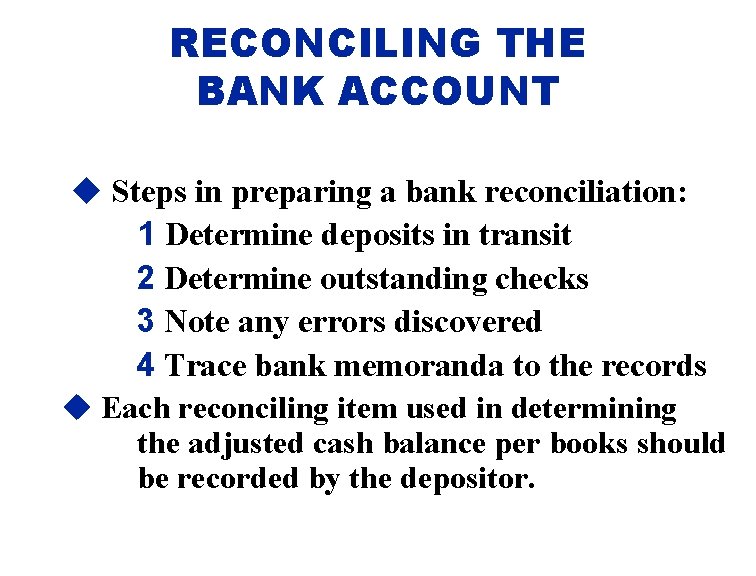
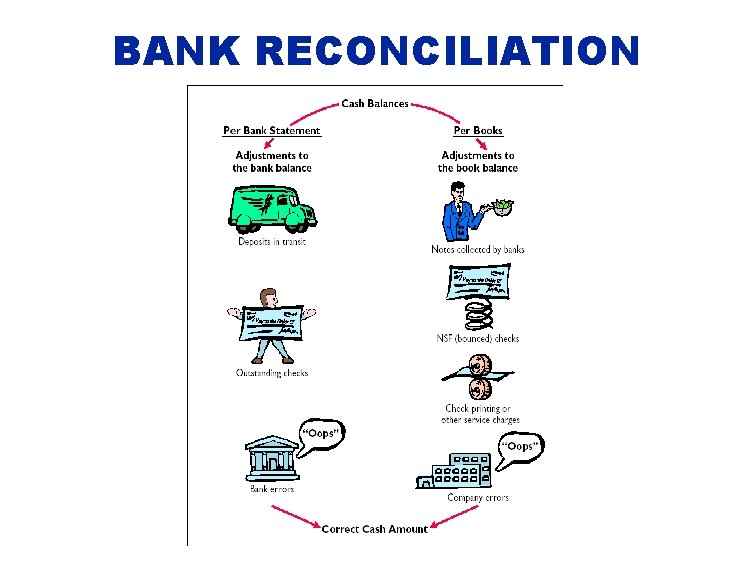
RECONCILING THE BANK ACCOUNT u Steps in preparing a bank reconciliation: 1 Determine deposits in transit 2 Determine outstanding checks 3 Note any errors discovered 4 Trace bank memoranda to the records u Each reconciling item used in determining the adjusted cash balance per books should be recorded by the depositor.
BANK RECONCILIATION
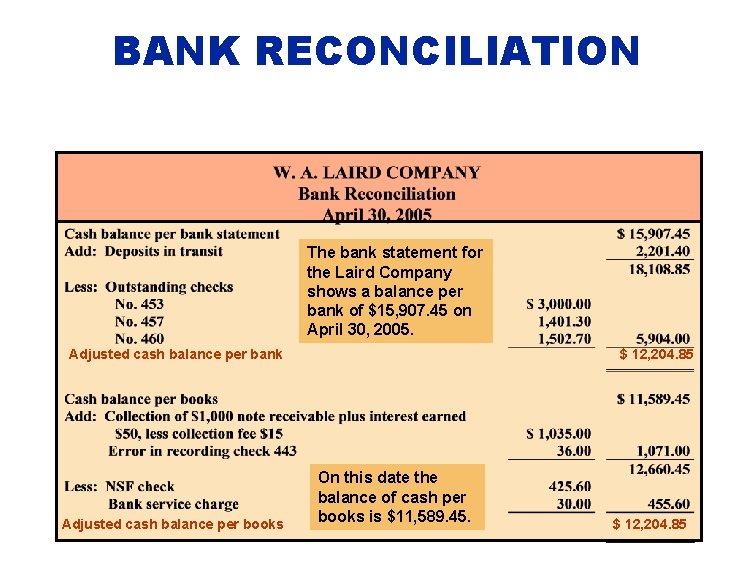
BANK RECONCILIATION The bank statement for the Laird Company shows a balance per bank of $15, 907. 45 on April 30, 2005. Adjusted cash balance per bank Adjusted cash balance per books $ 12, 204. 85 On this date the balance of cash per books is $11, 589. 45. $ 12, 204. 85
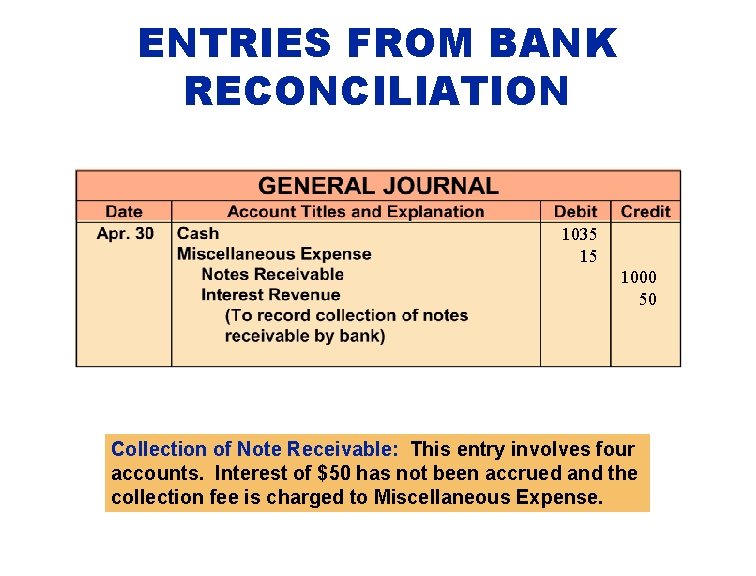
ENTRIES FROM BANK RECONCILIATION 1035 15 1000 50 Collection of Note Receivable: This entry involves four accounts. Interest of $50 has not been accrued and the collection fee is charged to Miscellaneous Expense.
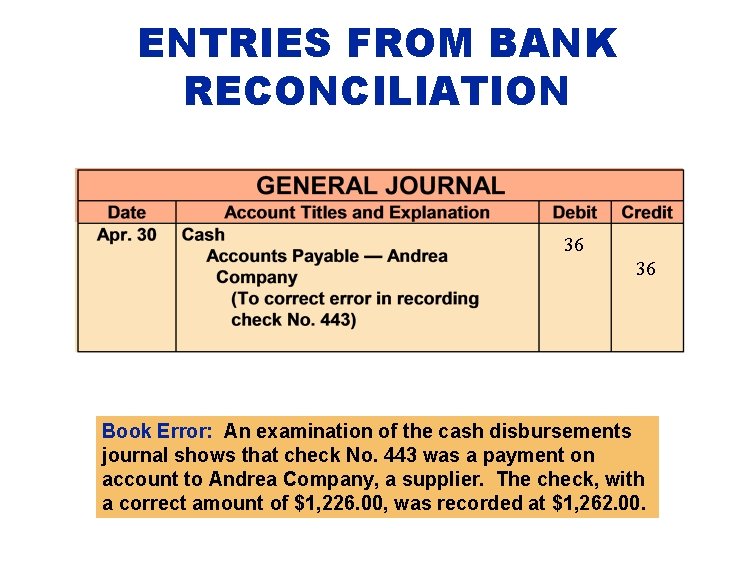
ENTRIES FROM BANK RECONCILIATION 36 36 Book Error: An examination of the cash disbursements journal shows that check No. 443 was a payment on account to Andrea Company, a supplier. The check, with a correct amount of $1, 226. 00, was recorded at $1, 262. 00.
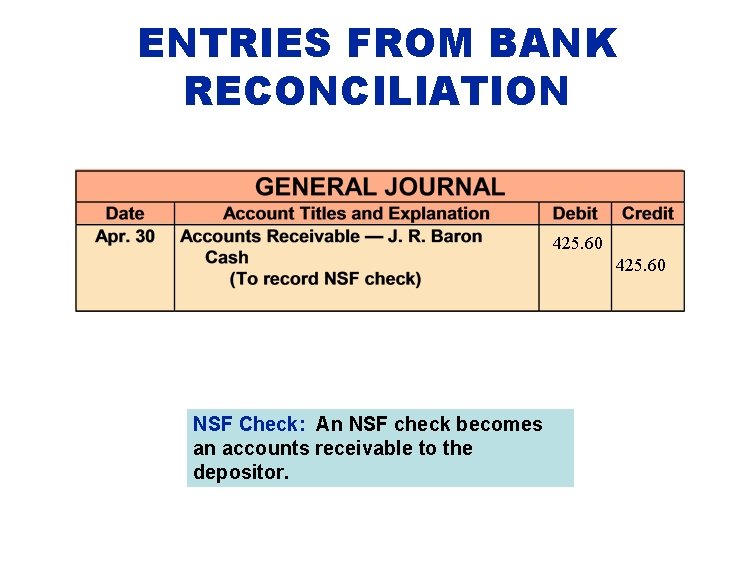
ENTRIES FROM BANK RECONCILIATION 425. 60 NSF Check: An NSF check becomes an accounts receivable to the depositor.
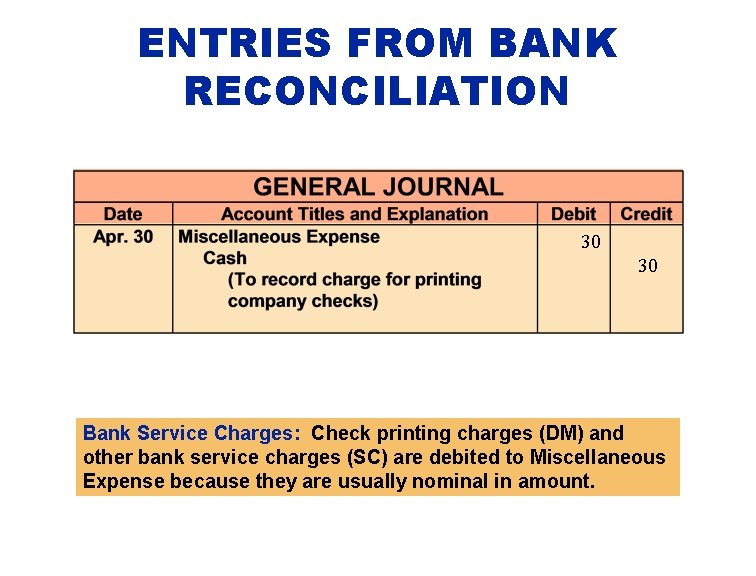
ENTRIES FROM BANK RECONCILIATION 30 30 Bank Service Charges: Check printing charges (DM) and other bank service charges (SC) are debited to Miscellaneous Expense because they are usually nominal in amount.
REPORTING CASH STUDY OBJECTIVE 8 u Cash reported on the Balance Sheet includes: 1 Cash on hand 2 Cash in banks 3 Petty cash u Cash is listed first in the balance sheet under the title cash and cash equivalents because it is the most liquid asset.
CASH EQUIVALENTS u Cash equivalents • Are highly liquid investments that can be converted into a specific amount of cash • Typically have maturities of 3 months or less when purchased Examples: Money market funds, bank certificates of deposit, and U. S. Treasury bills and notes
The statement that correctly describes the reporting of cash is: a. Cash cannot be combined with cash equivelants b. Restricted cash funds may be combined with Cash. c. Cash is listed first in the current assets. d. Restricted cash funds cannot be reported as a current asset.
The statement that correctly describes the reporting of cash is: a. Cash cannot be combined with cash equivelants. b. Restricted cash funds may be combined with Cash. c. Cash is listed first in the current assets. d. Restricted cash funds cannot be reported as a current asset.
COPYRIGHT Copyright © 2005 John Wiley & Sons, Inc. All rights reserved. Reproduction or translation of this work beyond that permitted in Section 117 of the 1976 United States Copyright Act without the express written consent of the copyright owner is unlawful. Request for further information should be addressed to the Permissions Department, John Wiley & Sons, Inc. The purchaser may make back-up copies for his/her own use only and not for distribution or resale. The Publisher assumes no responsibility for errors, omissions, or damages, caused by the use of these programs or from the use of the information contained herein.