
Accounting Principles 7 th Edition Weygandt Kieso Kimmel









- Slides: 69
Accounting Principles, 7 th Edition Weygandt • Kieso • Kimmel Chapter 2 The Recording Process Prepared by Naomi Karolinski Monroe Community College and Marianne Bradford Bryant College John Wiley & Sons, Inc. © 2005
CHAPTER 2 THE RECORDING PROCESS After studying this chapter, you should be able to: 1 Explain what an account is and how it helps in the recording process 2 Define debits and credits and explain how they are used to record business transactions 3 Identify the basic steps in the recording process 4 Explain what a journal is and how it helps in the recording process
CHAPTER 2 THE RECORDING PROCESS After studying this chapter, you should be able to: 5 Explain what a ledger is and how it helps in the recording process 6 Explain what posting is and how it helps in the recording process 7 Prepare a trial balance and explain its purpose
THE ACCOUNT STUDY OBJECTIVE 1 • An account is an individual accounting record of increases and decreases in a specific asset, liability, or owner’s equity item. • There are separate accounts for the items we used in transactions such as cash, salaries expense, accounts payable, etc.
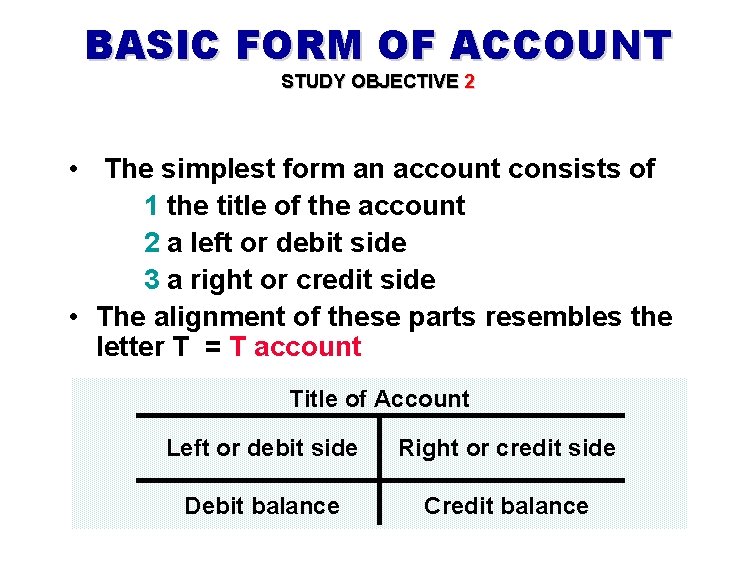
BASIC FORM OF ACCOUNT STUDY OBJECTIVE 2 • The simplest form an account consists of 1 the title of the account 2 a left or debit side 3 a right or credit side • The alignment of these parts resembles the letter T = T account Title of Account Left or debit side Right or credit side Debit balance Credit balance
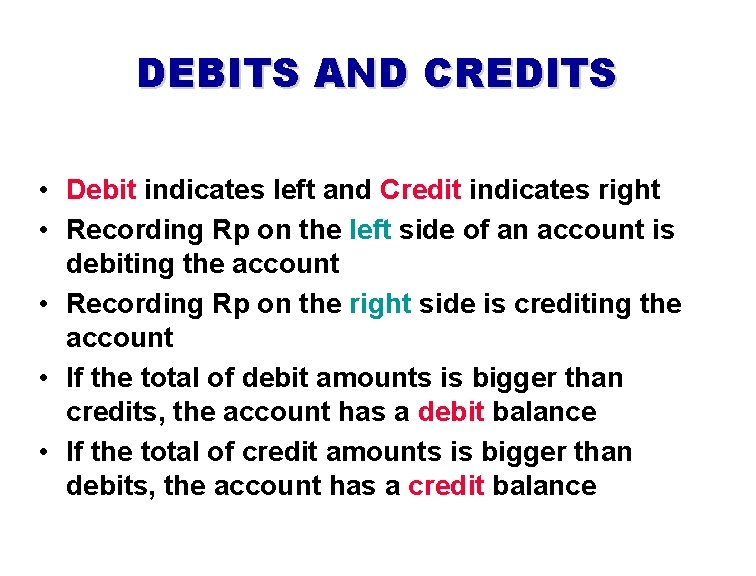
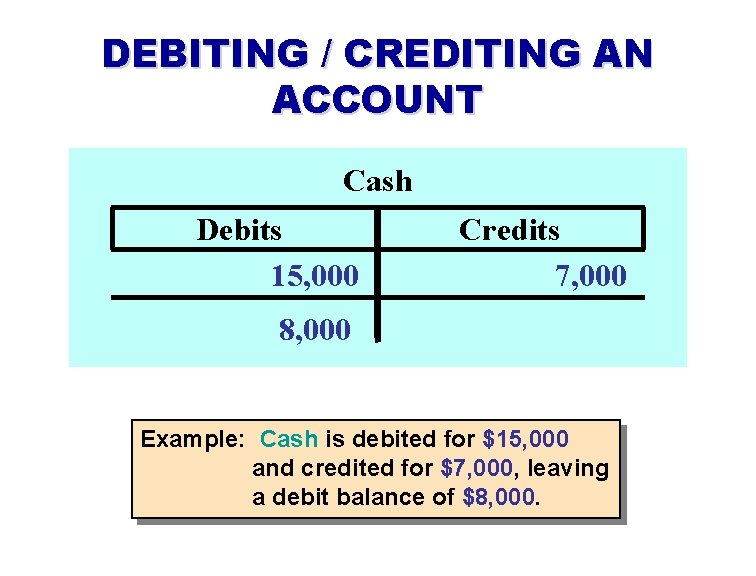
DEBITS AND CREDITS • Debit indicates left and Credit indicates right • Recording Rp on the left side of an account is debiting the account • Recording Rp on the right side is crediting the account • If the total of debit amounts is bigger than credits, the account has a debit balance • If the total of credit amounts is bigger than debits, the account has a credit balance
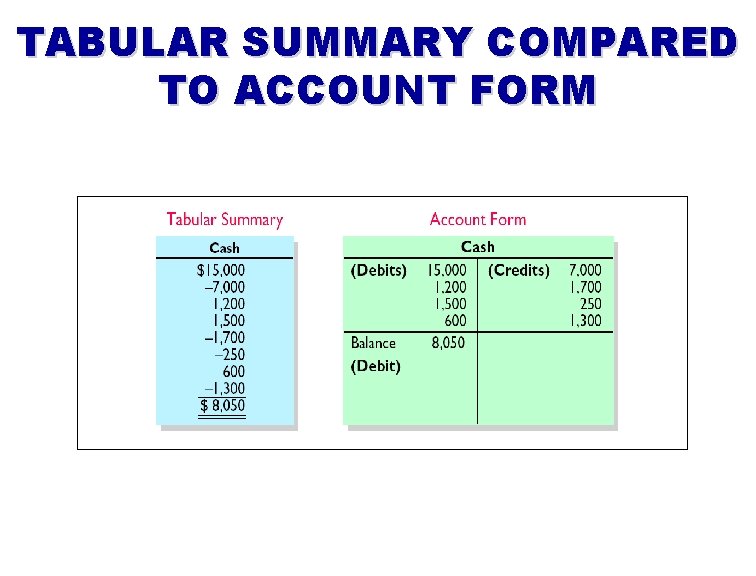
TABULAR SUMMARY COMPARED TO ACCOUNT FORM
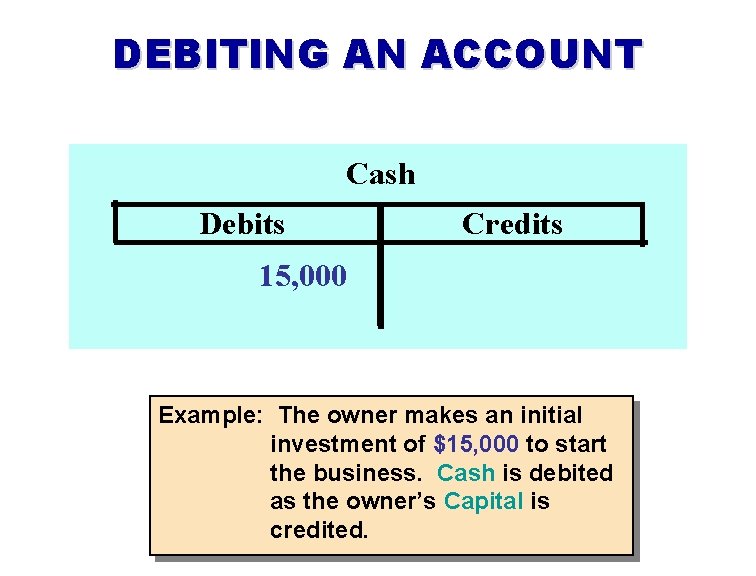
DEBITING AN ACCOUNT Cash Debits Credits 15, 000 Example: The owner makes an initial investment of $15, 000 to start the business. Cash is debited as the owner’s Capital is credited.
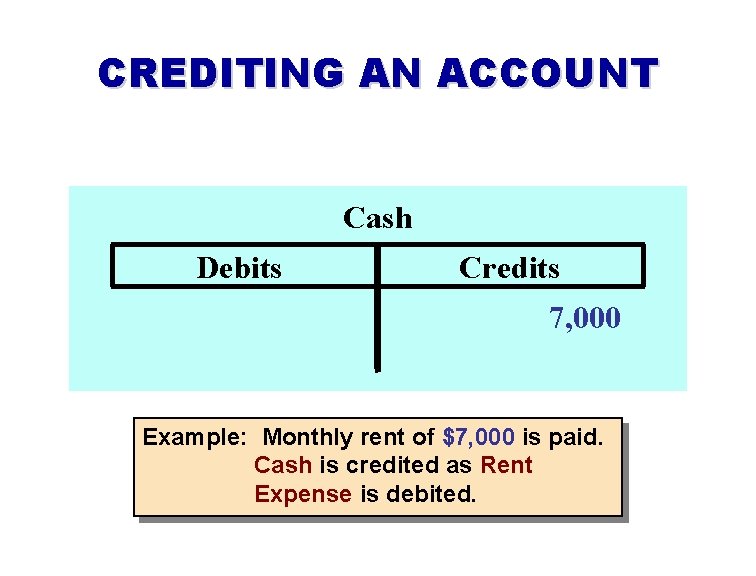
CREDITING AN ACCOUNT Cash Debits Credits 7, 000 Example: Monthly rent of $7, 000 is paid. Cash is credited as Rent Expense is debited.
DEBITING / CREDITING AN ACCOUNT Cash Debits 15, 000 Credits 7, 000 8, 000 Example: Cash is debited for $15, 000 and credited for $7, 000, leaving a debit balance of $8, 000.
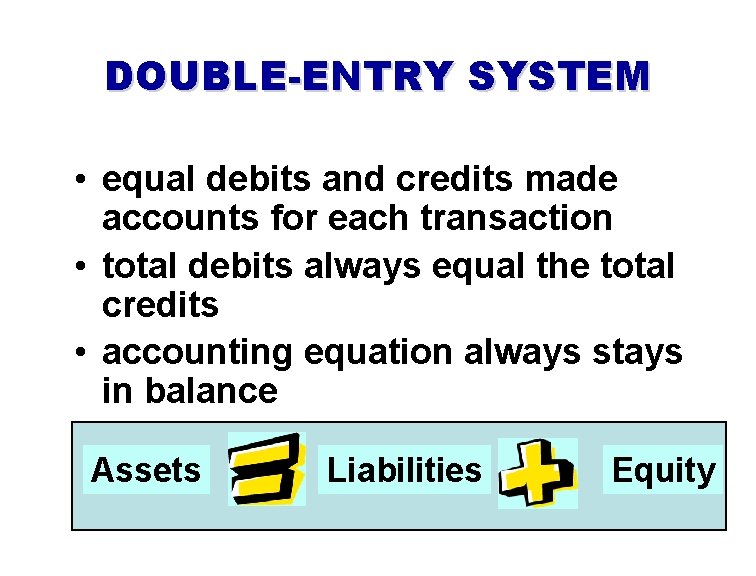
DOUBLE-ENTRY SYSTEM • equal debits and credits made accounts for each transaction • total debits always equal the total credits • accounting equation always stays in balance Assets Liabilities Equity
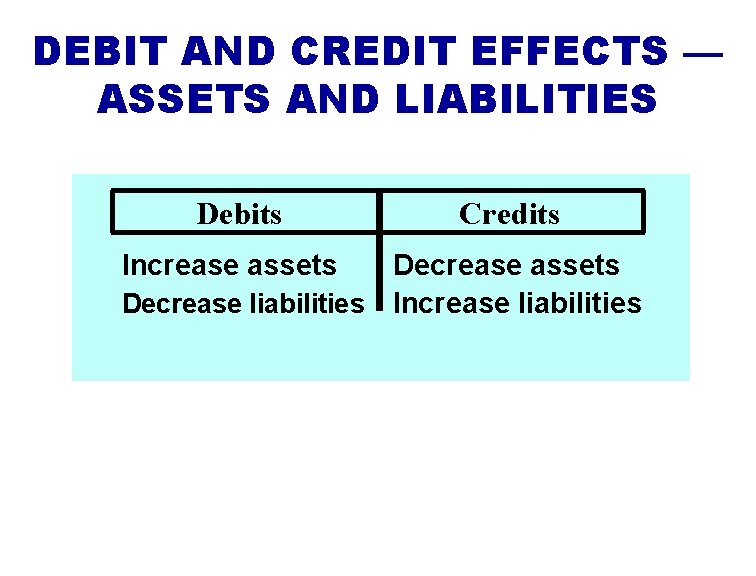
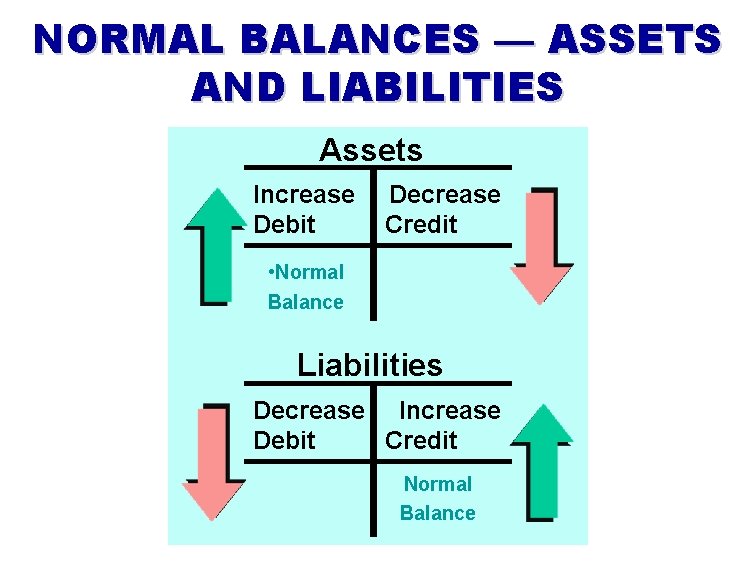
DEBIT AND CREDIT EFFECTS — ASSETS AND LIABILITIES Debits Increase assets Credits Decrease assets Decrease liabilities Increase liabilities
NORMAL BALANCE • every account has a designated normal balance. – It is either a debit or credit. • accounts rarely have an abnormal balance.
NORMAL BALANCES — ASSETS AND LIABILITIES Assets Increase Debit Decrease Credit • Normal Balance Liabilities Decrease Increase Debit Credit Normal Balance
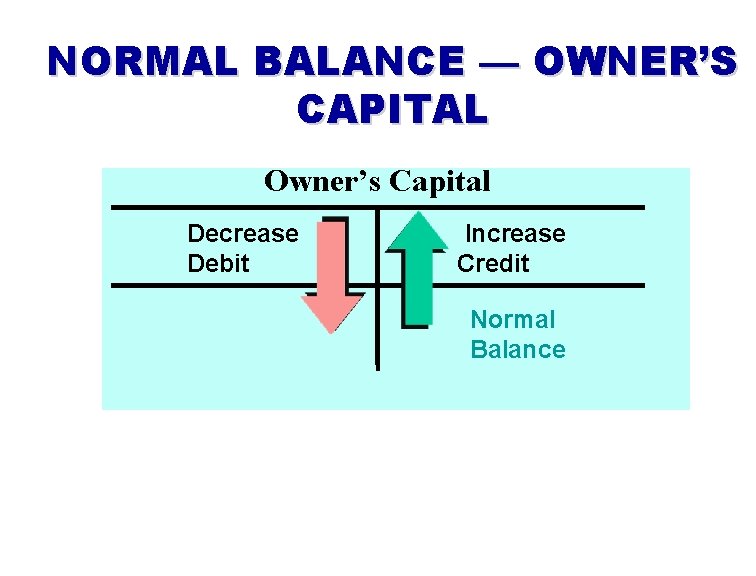
DEBIT AND CREDIT EFFECTS — OWNER’S CAPITAL Debits Decrease owner’s capital Credits Increase owner’s capital
NORMAL BALANCE — OWNER’S CAPITAL Owner’s Capital Decrease Debit Increase Credit Normal Balance
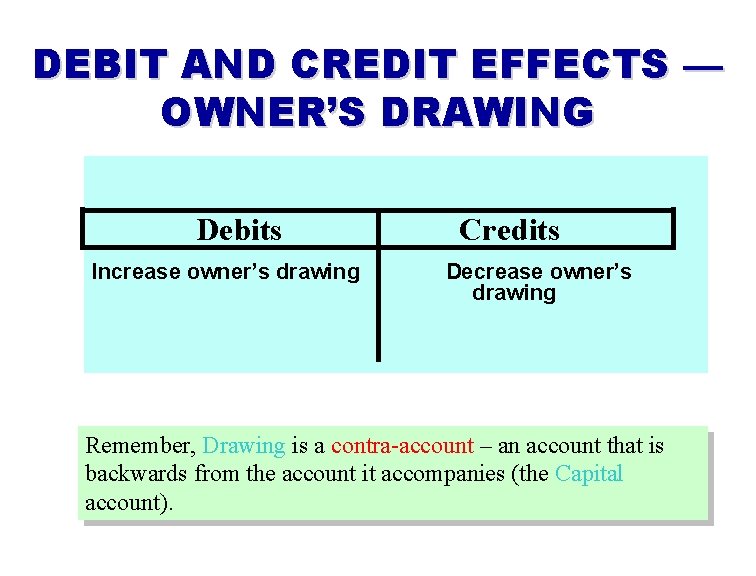
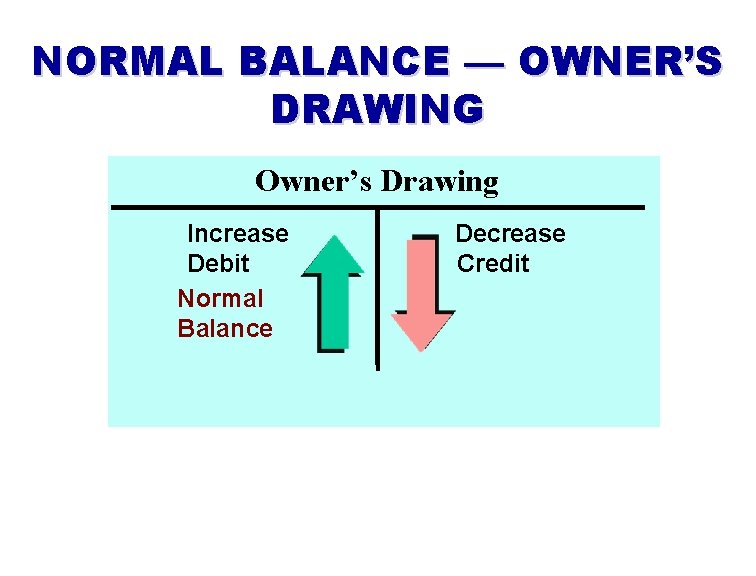
DEBIT AND CREDIT EFFECTS — OWNER’S DRAWING Debits Increase owner’s drawing Credits Decrease owner’s drawing Remember, Drawing is a contra-account – an account that is backwards from the account it accompanies (the Capital account).
NORMAL BALANCE — OWNER’S DRAWING Owner’s Drawing Increase Debit Normal Balance Decrease Credit
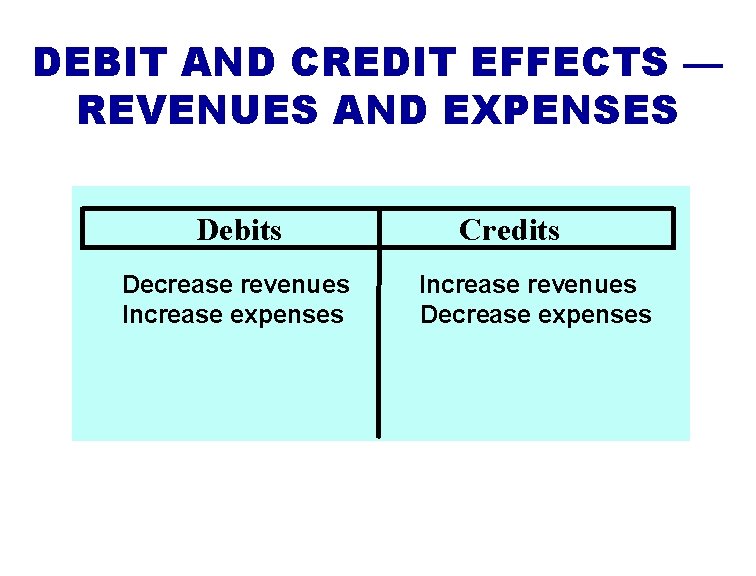
DEBIT AND CREDIT EFFECTS — REVENUES AND EXPENSES Debits Decrease revenues Increase expenses Credits Increase revenues Decrease expenses
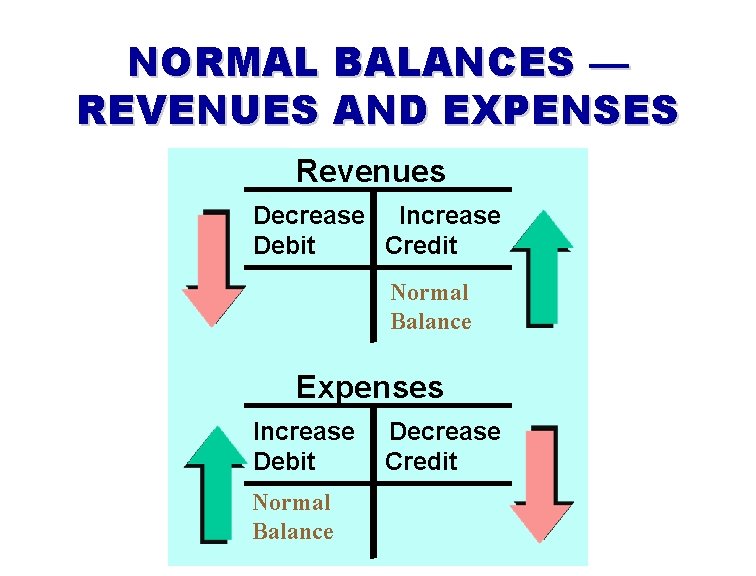
NORMAL BALANCES — REVENUES AND EXPENSES Revenues Decrease Increase Debit Credit Normal Balance Expenses Increase Debit Normal Balance Decrease Credit
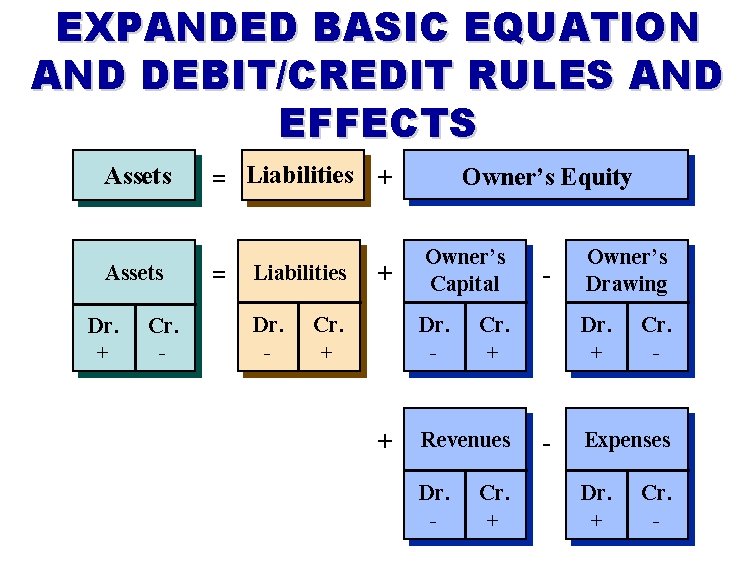
EXPANDED BASIC EQUATION AND DEBIT/CREDIT RULES AND EFFECTS Assets = Liabilities Assets = Dr. + Cr. - Liabilities Dr. - Owner’s Equity + + Cr. + Owner’s Capital Dr. - + Dr. + Cr. + Revenues Dr. - - Cr. + Owner’s Drawing - Cr. - Expenses Dr. + Cr. -
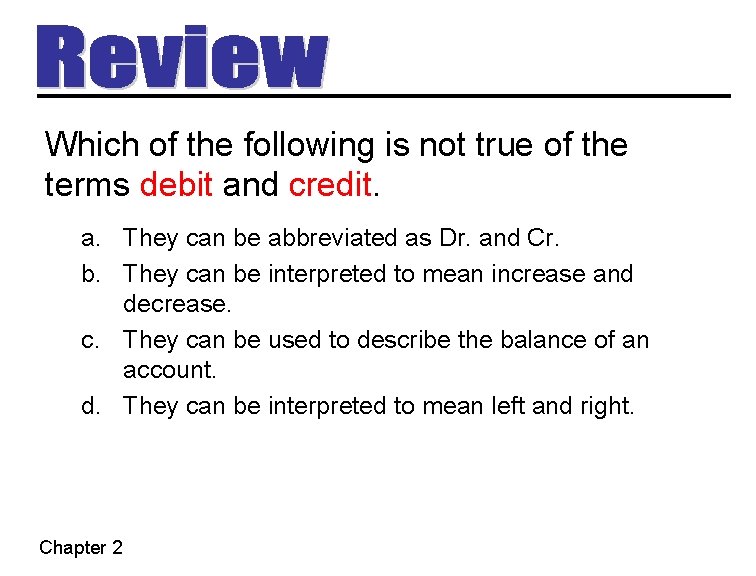
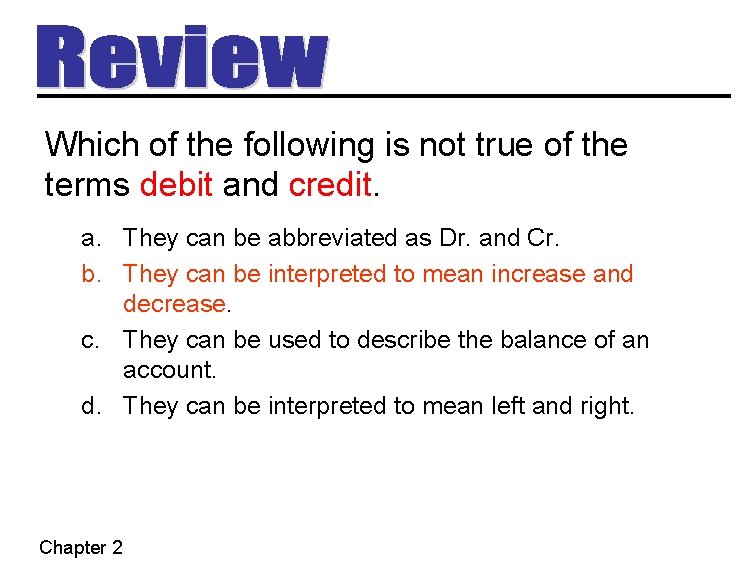
Which of the following is not true of the terms debit and credit. a. They can be abbreviated as Dr. and Cr. b. They can be interpreted to mean increase and decrease. c. They can be used to describe the balance of an account. d. They can be interpreted to mean left and right. Chapter 2
Which of the following is not true of the terms debit and credit. a. They can be abbreviated as Dr. and Cr. b. They can be interpreted to mean increase and decrease. c. They can be used to describe the balance of an account. d. They can be interpreted to mean left and right. Chapter 2
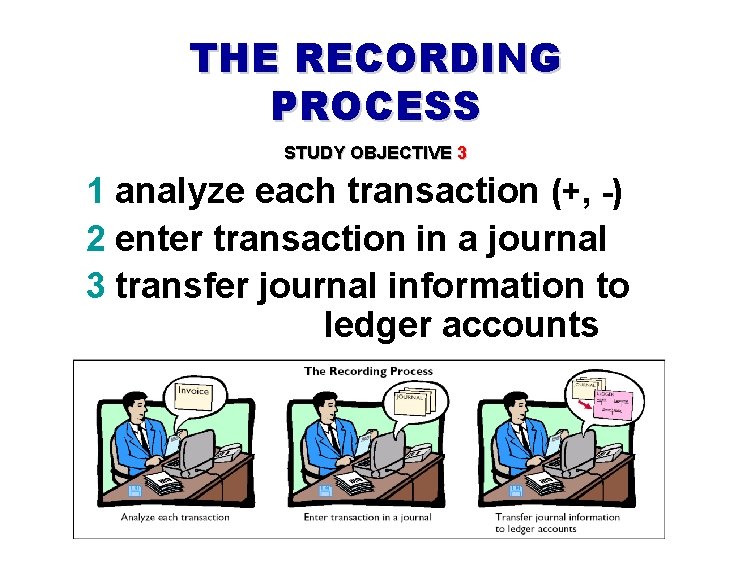
THE RECORDING PROCESS STUDY OBJECTIVE 3 1 analyze each transaction (+, -) 2 enter transaction in a journal 3 transfer journal information to ledger accounts
THE JOURNAL STUDY OBJECTIVE 4 • Transactions – Are initially recorded in chronological order before they are transferred to the ledger accounts. • A general journal has 1 spaces for dates 2 account titles and explanations 3 references 4 two amount columns
THE JOURNAL A journal makes several contributions to recording process: 1 discloses in one place the complete effect of a transaction 2 provides a chronological record of transactions 3 helps to prevent or locate errors as debit and credit amounts for each entry can be compared
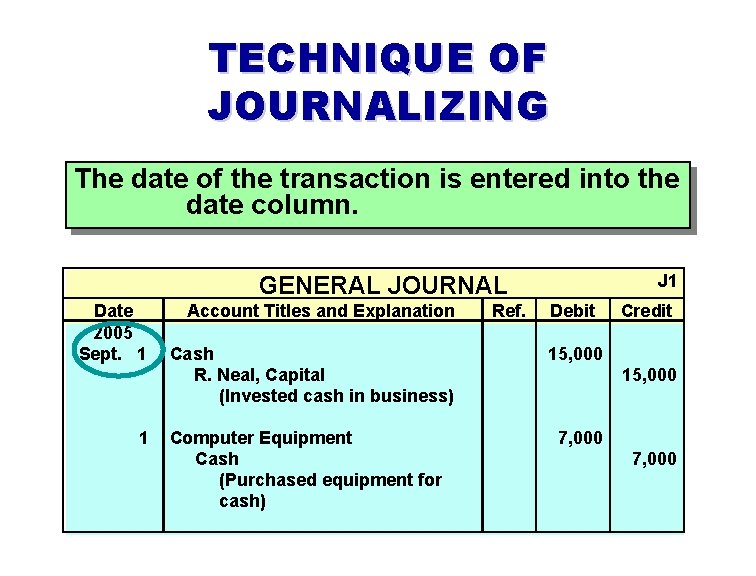
JOURNALIZING • Entering transaction data in the journal is known as journalizing. • Separate journal entries are made for each transaction. • A complete entry consists of: 1 the date of the transaction, 2 the accounts and amounts to be debited and credited, 3 a brief explanation of transaction.
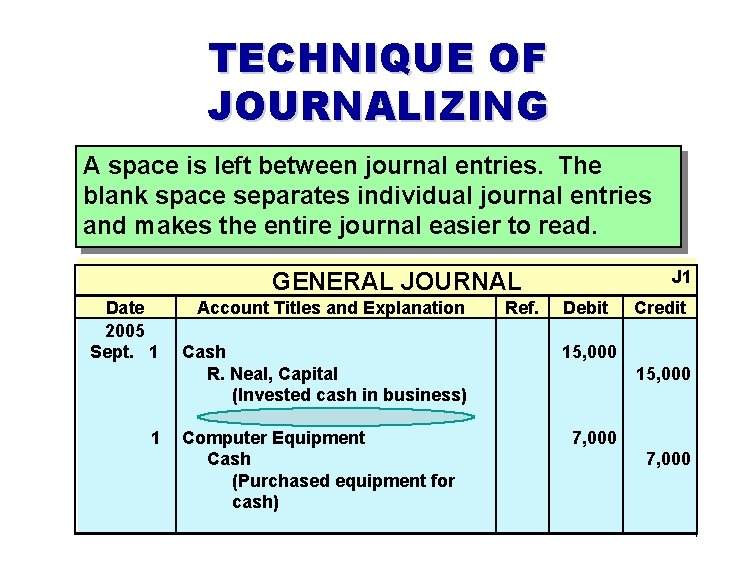
TECHNIQUE OF JOURNALIZING The date of the transaction is entered into the date column. J 1 GENERAL JOURNAL Date 2005 Sept. 1 1 Account Titles and Explanation Cash R. Neal, Capital (Invested cash in business) Computer Equipment Cash (Purchased equipment for cash) Ref. Debit Credit 15, 000 7, 000
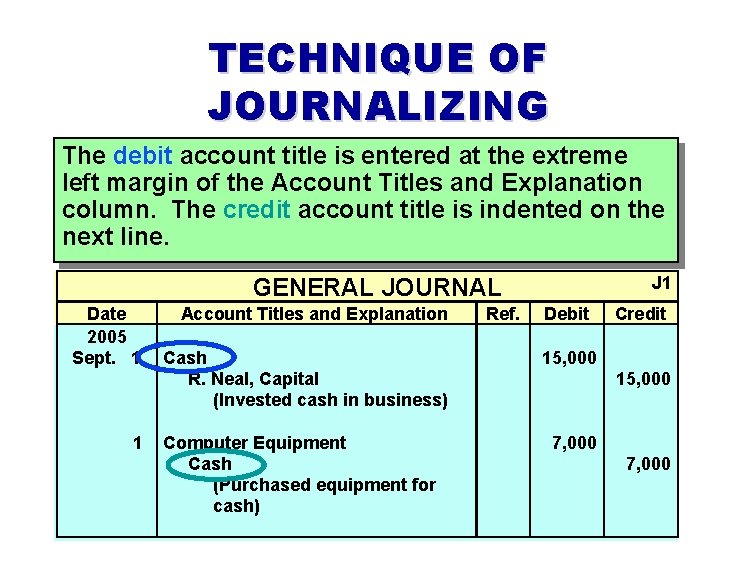
TECHNIQUE OF JOURNALIZING The debit account title is entered at the extreme left margin of the Account Titles and Explanation column. The credit account title is indented on the next line. J 1 GENERAL JOURNAL Date 2005 Sept. 1 1 Account Titles and Explanation Cash R. Neal, Capital (Invested cash in business) Computer Equipment Cash (Purchased equipment for cash) Ref. Debit Credit 15, 000 7, 000
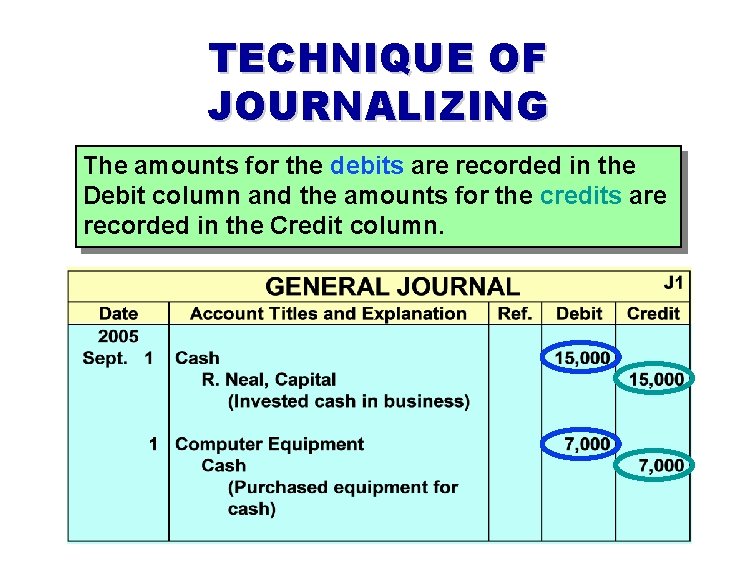
TECHNIQUE OF JOURNALIZING The amounts for the debits are recorded in the Debit column and the amounts for the credits are recorded in the Credit column.
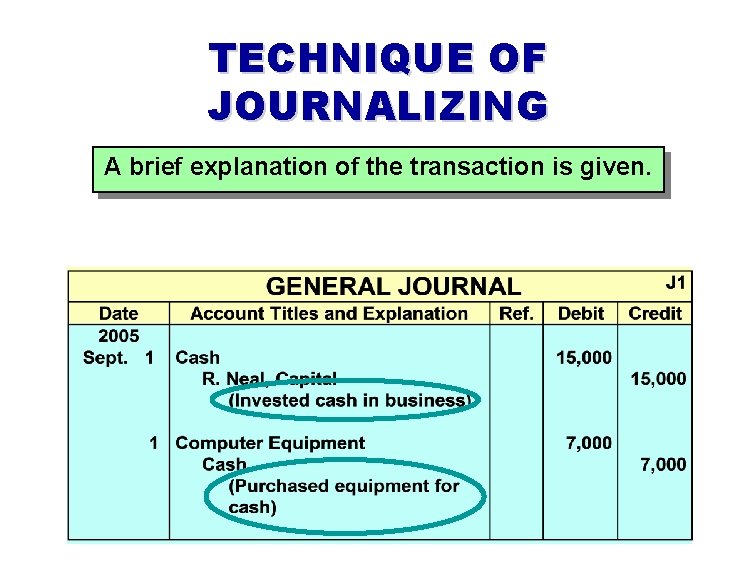
TECHNIQUE OF JOURNALIZING A brief explanation of the transaction is given.
TECHNIQUE OF JOURNALIZING A space is left between journal entries. The blank space separates individual journal entries and makes the entire journal easier to read. J 1 GENERAL JOURNAL Date 2005 Sept. 1 1 Account Titles and Explanation Cash R. Neal, Capital (Invested cash in business) Computer Equipment Cash (Purchased equipment for cash) Ref. Debit Credit 15, 000 7, 000
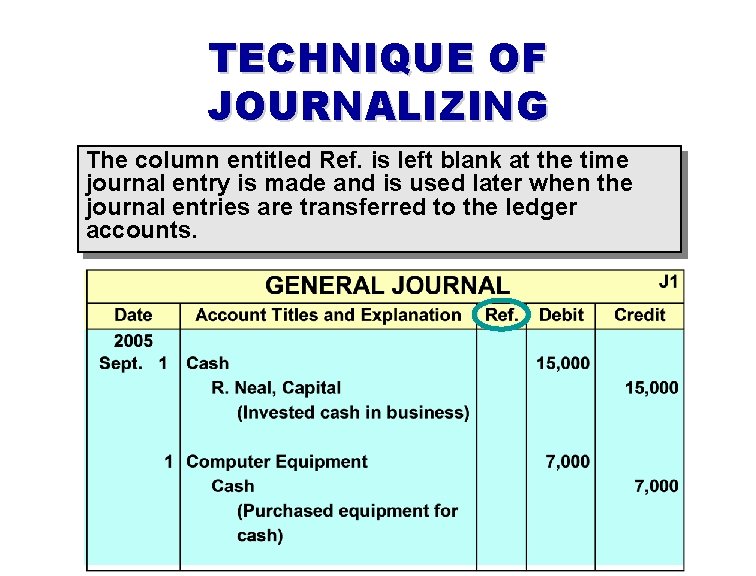
TECHNIQUE OF JOURNALIZING The column entitled Ref. is left blank at the time journal entry is made and is used later when the journal entries are transferred to the ledger accounts.
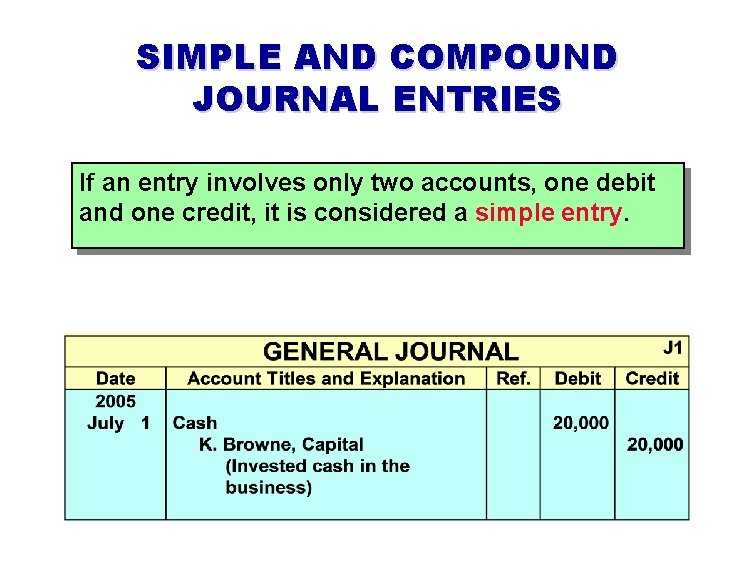
SIMPLE AND COMPOUND JOURNAL ENTRIES If an entry involves only two accounts, one debit and one credit, it is considered a simple entry.
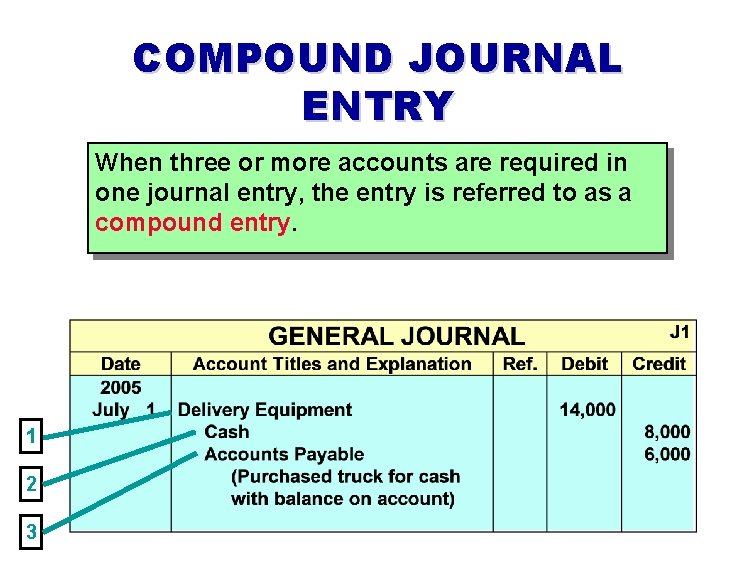
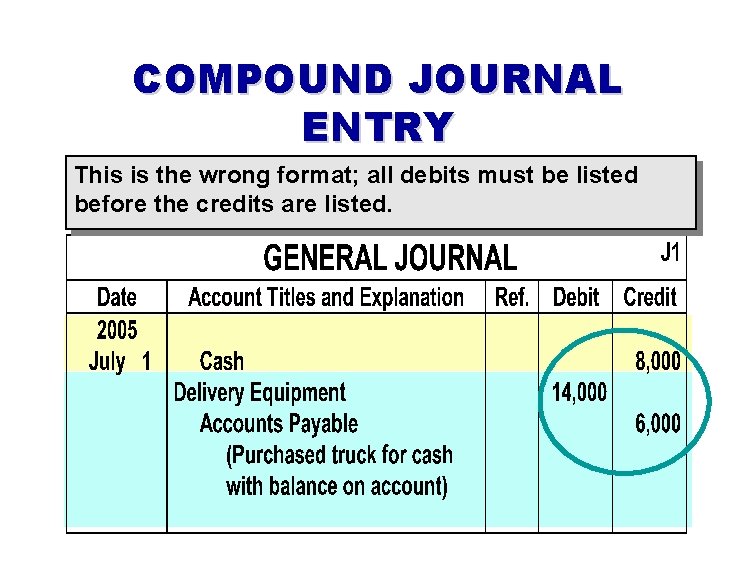
COMPOUND JOURNAL ENTRY When three or more accounts are required in one journal entry, the entry is referred to as a compound entry. 1 2 3
COMPOUND JOURNAL ENTRY This is the wrong format; all debits must be listed before the credits are listed.
THE LEDGER STUDY OBJECTIVE 5 A Group of accounts maintained by a company is called the ledger. A general ledger contains all the assets, liabilities, and owner’s equity accounts
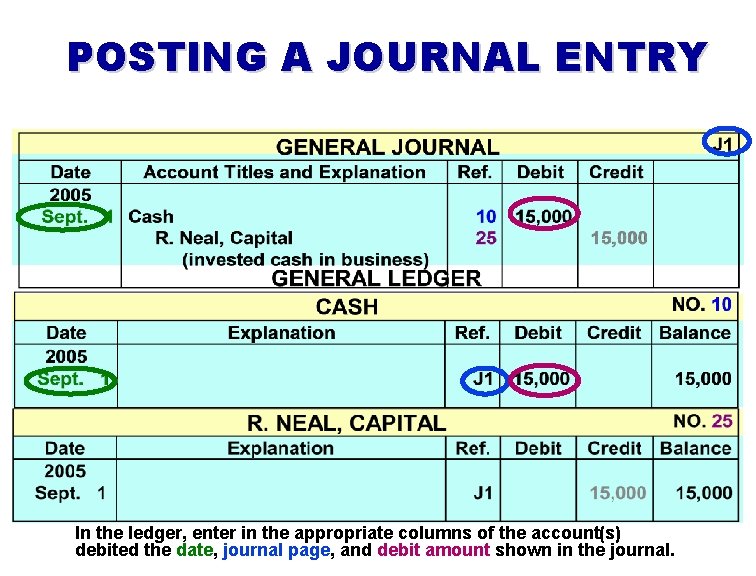
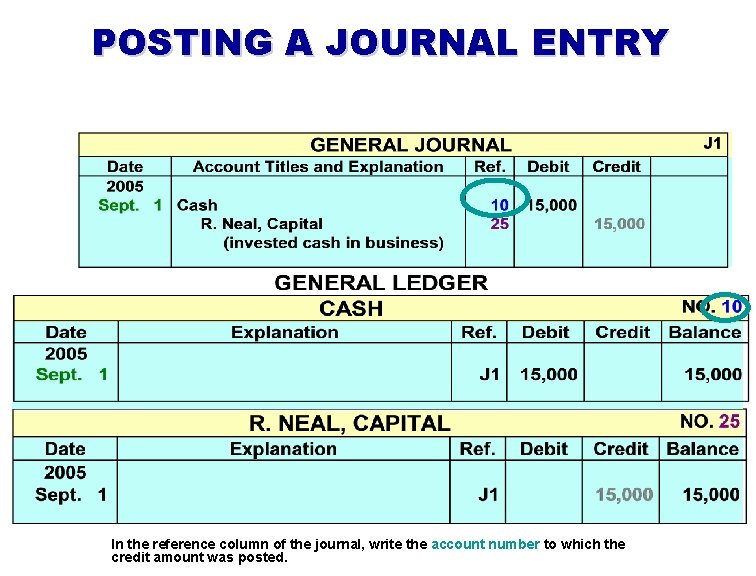
POSTING A JOURNAL ENTRY In the ledger, enter in the appropriate columns of the account(s) debited the date, journal page, and debit amount shown in the journal.
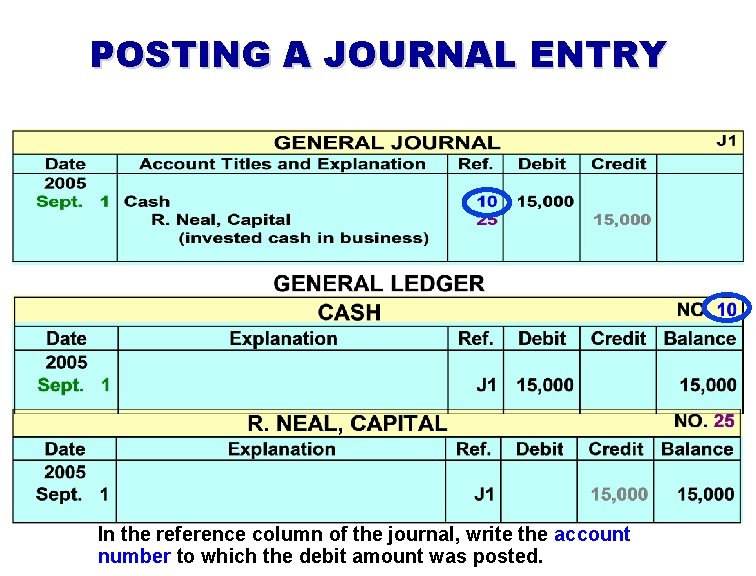
POSTING A JOURNAL ENTRY In the reference column of the journal, write the account number to which the debit amount was posted.
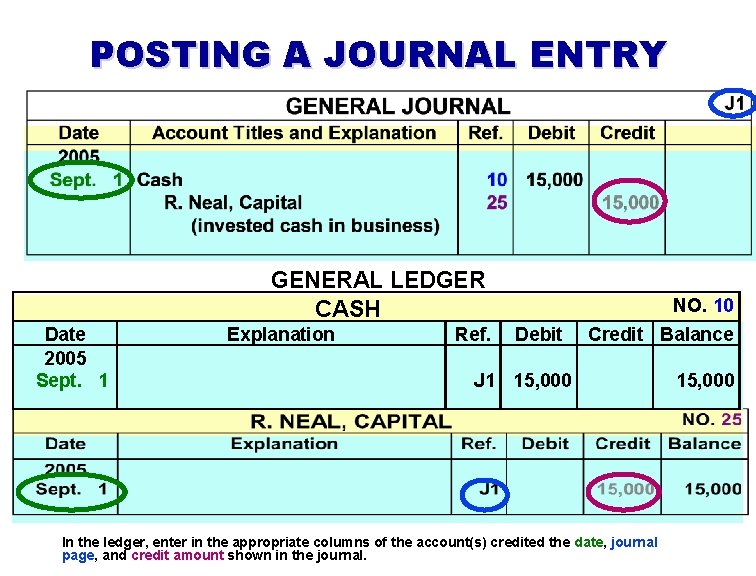
POSTING A JOURNAL ENTRY GENERAL LEDGER CASH Date 2005 Sept. 1 Explanation Ref. NO. 10 Debit Credit Balance J 1 15, 000 In the ledger, enter in the appropriate columns of the account(s) credited the date, journal page, and credit amount shown in the journal. 15, 000
POSTING A JOURNAL ENTRY In the reference column of the journal, write the account number to which the credit amount was posted.
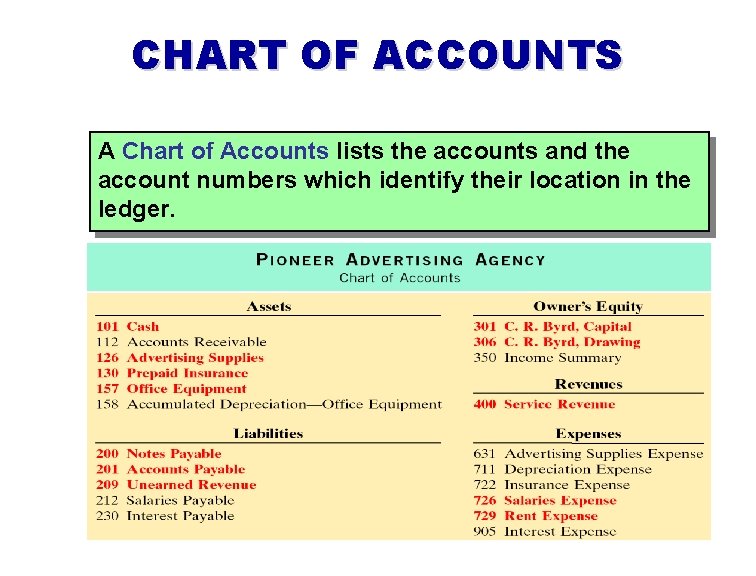
CHART OF ACCOUNTS A Chart of Accounts lists the accounts and the account numbers which identify their location in the ledger.
INVESTMENT OF CASH BY OWNER Transaction Basic Analysis Debit-Credit Analysis October 1, C. R. Byrd invests $10, 000 cash in an advertising business known as: The Pioneer Advertising Agency. • The asset Cash is increased $10, 000 • Owner’s equity, C. R. Byrd, Capital is increased $10, 000. Debits increase assets: debit Cash $10, 000. Credits increase owner’s equity: credit C. R. Byrd, Capital $10, 000.
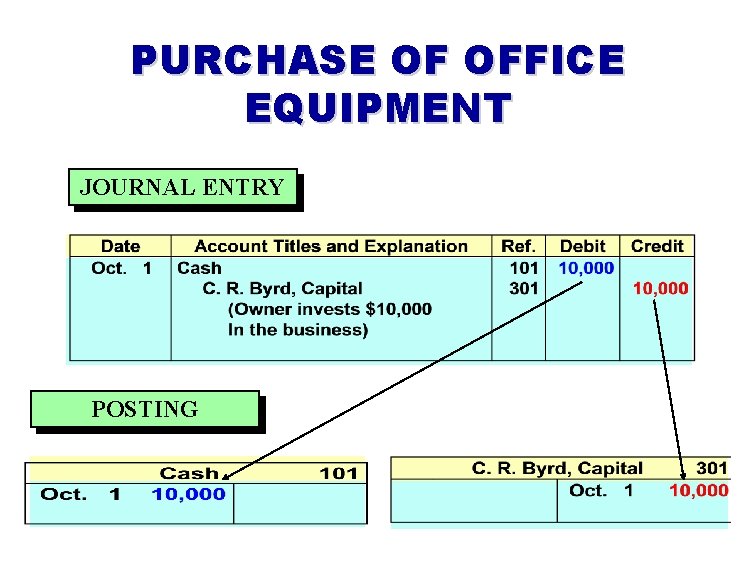
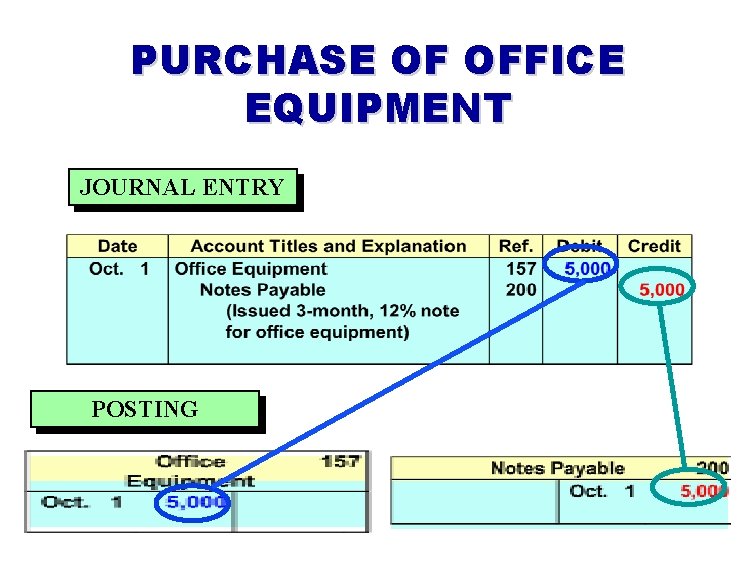
PURCHASE OF OFFICE EQUIPMENT JOURNAL ENTRY POSTING
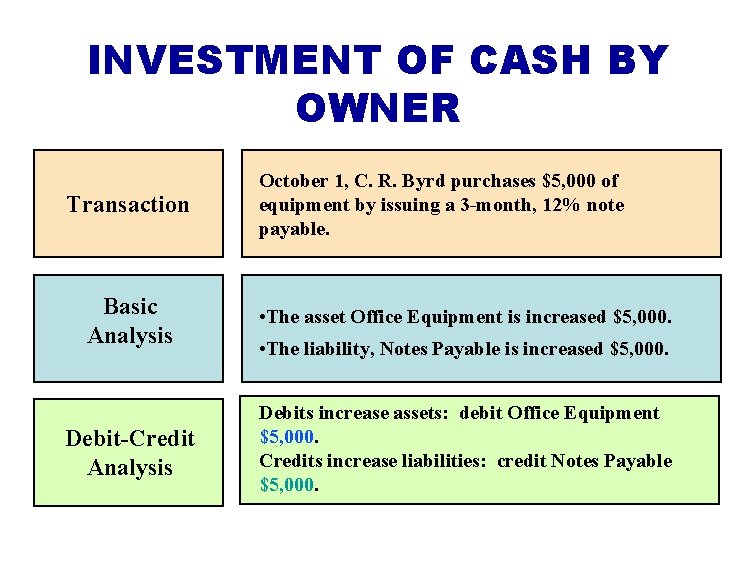
INVESTMENT OF CASH BY OWNER Transaction October 1, C. R. Byrd purchases $5, 000 of equipment by issuing a 3 -month, 12% note payable. Basic Analysis • The asset Office Equipment is increased $5, 000. Debit-Credit Analysis Debits increase assets: debit Office Equipment $5, 000. Credits increase liabilities: credit Notes Payable $5, 000. • The liability, Notes Payable is increased $5, 000.
PURCHASE OF OFFICE EQUIPMENT JOURNAL ENTRY POSTING
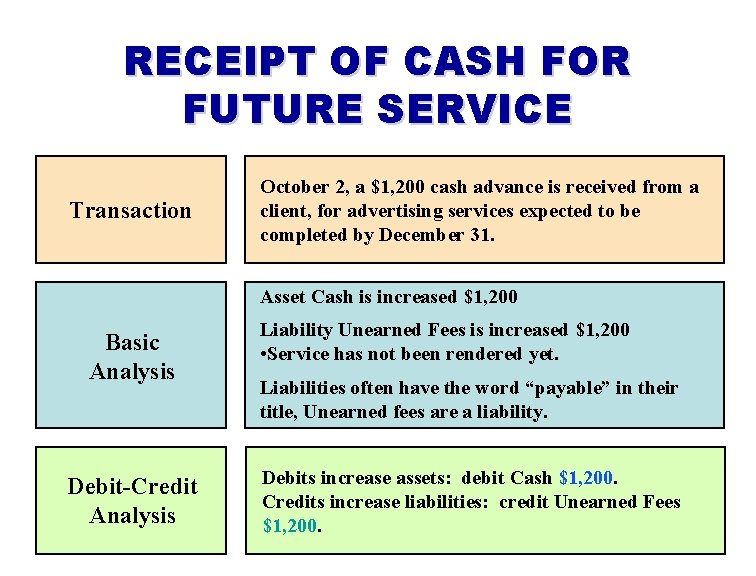
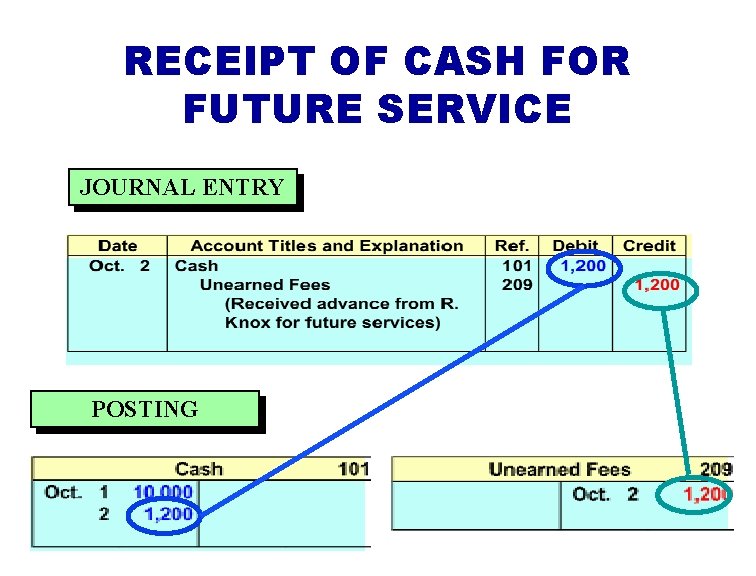
RECEIPT OF CASH FOR FUTURE SERVICE Transaction October 2, a $1, 200 cash advance is received from a client, for advertising services expected to be completed by December 31. Asset Cash is increased $1, 200 Basic Analysis Debit-Credit Analysis Liability Unearned Fees is increased $1, 200 • Service has not been rendered yet. Liabilities often have the word “payable” in their title, Unearned fees are a liability. Debits increase assets: debit Cash $1, 200. Credits increase liabilities: credit Unearned Fees $1, 200.
RECEIPT OF CASH FOR FUTURE SERVICE JOURNAL ENTRY POSTING
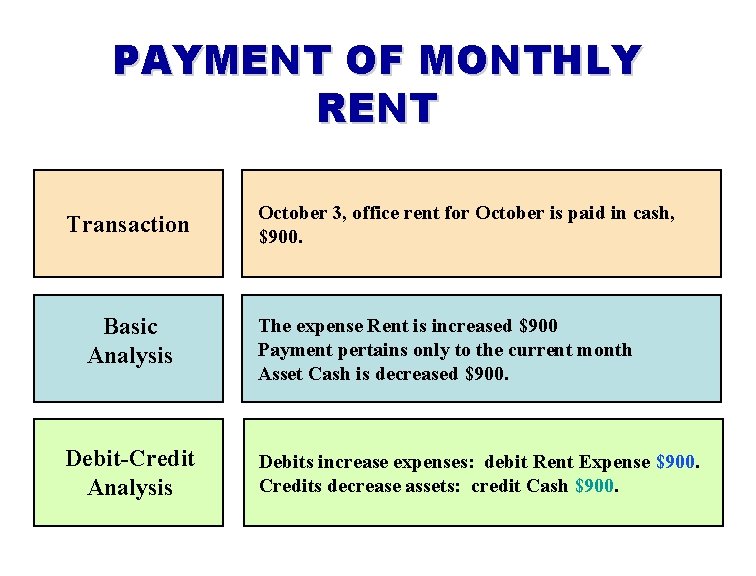
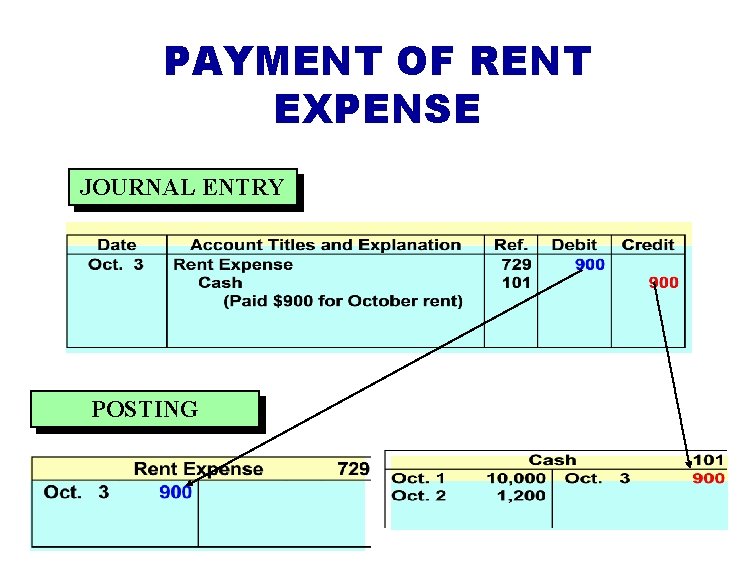
PAYMENT OF MONTHLY RENT Transaction Basic Analysis Debit-Credit Analysis October 3, office rent for October is paid in cash, $900. The expense Rent is increased $900 Payment pertains only to the current month Asset Cash is decreased $900. Debits increase expenses: debit Rent Expense $900. Credits decrease assets: credit Cash $900.
PAYMENT OF RENT EXPENSE JOURNAL ENTRY POSTING
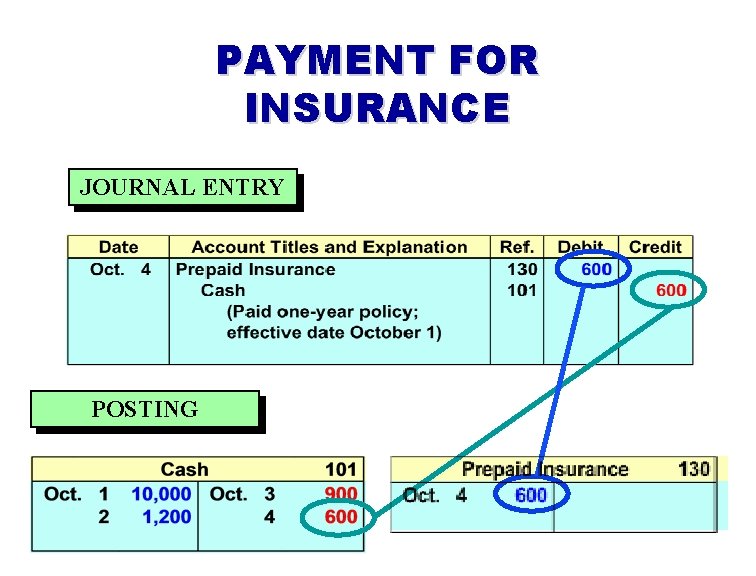
PAYMENT FOR INSURANCE Transaction October 4, $600 Paid one-year insurance policyexpires next year on September 30. -Asset Prepaid Insurance increases $600 -Payment extends to more than the current month Basic Analysis Debit-Credit Analysis -Asset Cash is decreased $600. -Payments of expenses benefiting more than one period are prepaid expenses or prepayments. Debits increase assets: debit Prepaid Insurance $600. Credits decrease assets: credit Cash $600.
PAYMENT FOR INSURANCE JOURNAL ENTRY POSTING
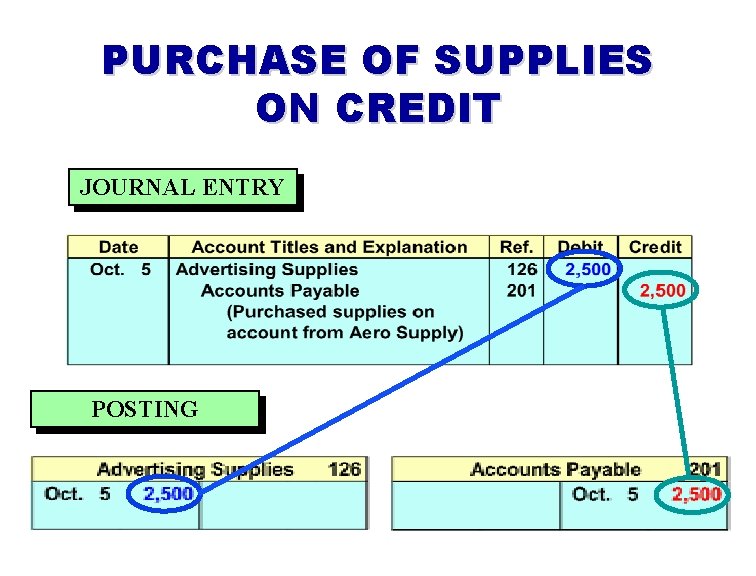
PURCHASE OF SUPPLIES ON CREDIT Transaction October 5, an estimated 3 -month supply of advertising materials is purchased on account from Aero Supply for $2, 500. Basic Analysis The asset Advertising Supplies is increased $2, 500; the liability Accounts Payable is increased $2, 500. Debit-Credit Analysis Debits increase assets: debit Advertising Supplies $2, 500. Credits increase liabilities: credit Accounts Payable $2, 500.
PURCHASE OF SUPPLIES ON CREDIT JOURNAL ENTRY POSTING
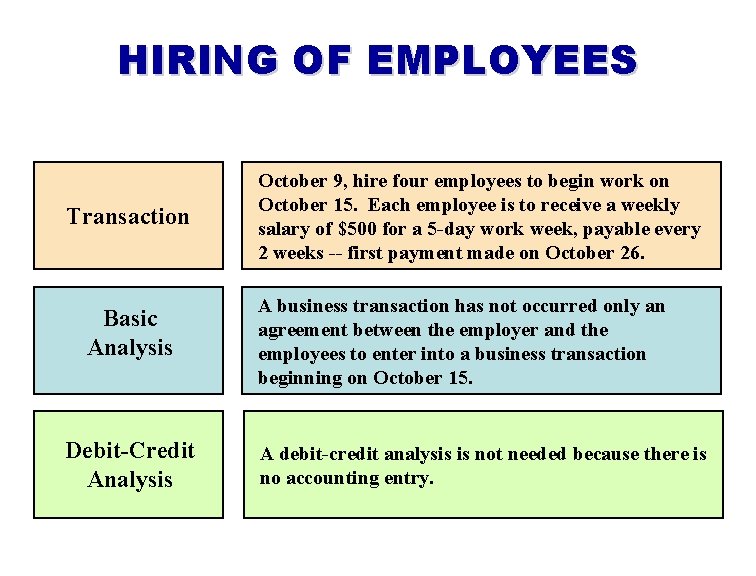
HIRING OF EMPLOYEES Transaction Basic Analysis Debit-Credit Analysis October 9, hire four employees to begin work on October 15. Each employee is to receive a weekly salary of $500 for a 5 -day work week, payable every 2 weeks -- first payment made on October 26. A business transaction has not occurred only an agreement between the employer and the employees to enter into a business transaction beginning on October 15. A debit-credit analysis is not needed because there is no accounting entry.
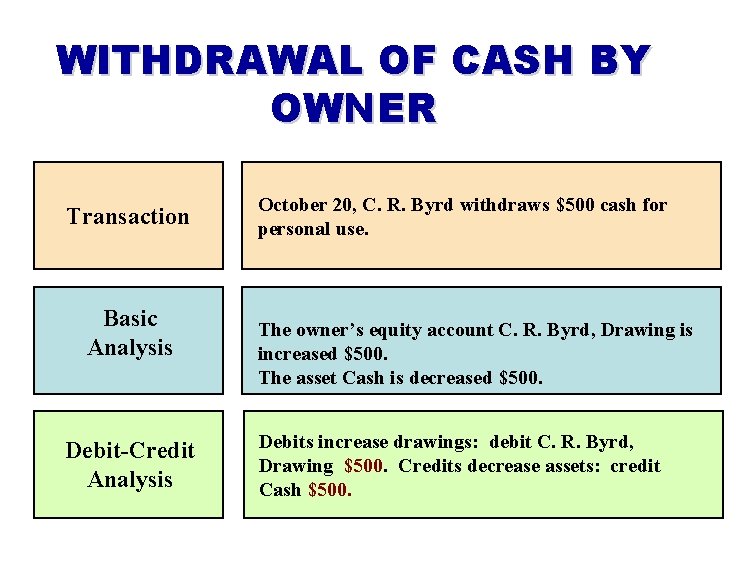
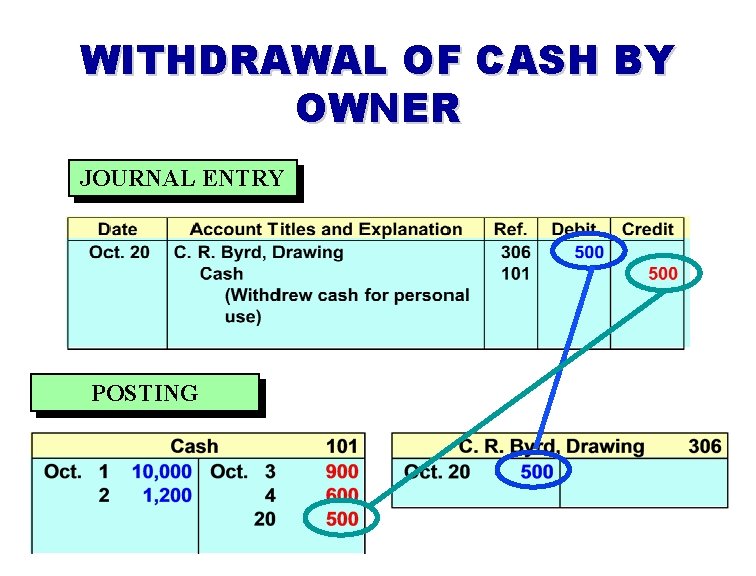
WITHDRAWAL OF CASH BY OWNER Transaction Basic Analysis Debit-Credit Analysis October 20, C. R. Byrd withdraws $500 cash for personal use. The owner’s equity account C. R. Byrd, Drawing is increased $500. The asset Cash is decreased $500. Debits increase drawings: debit C. R. Byrd, Drawing $500. Credits decrease assets: credit Cash $500.
WITHDRAWAL OF CASH BY OWNER JOURNAL ENTRY POSTING
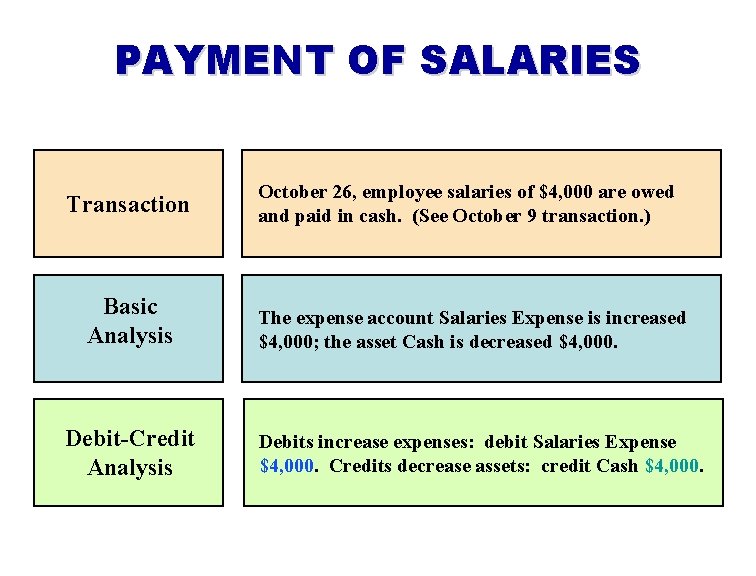
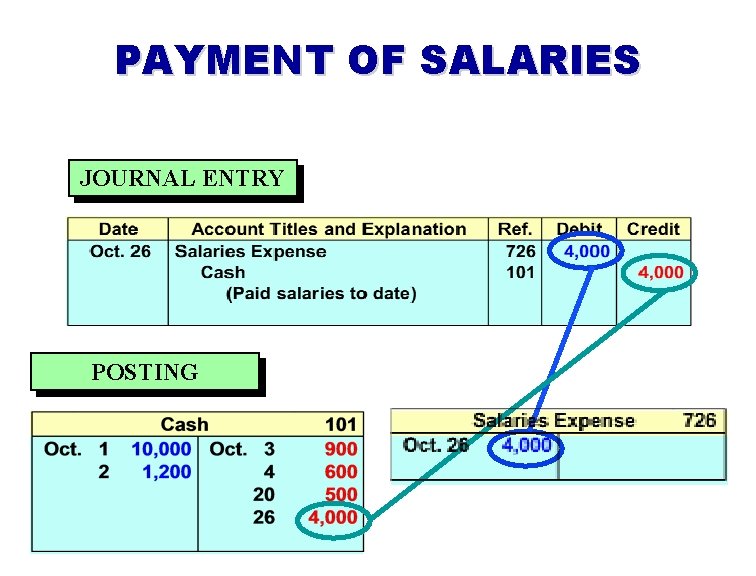
PAYMENT OF SALARIES Transaction October 26, employee salaries of $4, 000 are owed and paid in cash. (See October 9 transaction. ) Basic Analysis The expense account Salaries Expense is increased $4, 000; the asset Cash is decreased $4, 000. Debit-Credit Analysis Debits increase expenses: debit Salaries Expense $4, 000. Credits decrease assets: credit Cash $4, 000.
PAYMENT OF SALARIES JOURNAL ENTRY POSTING
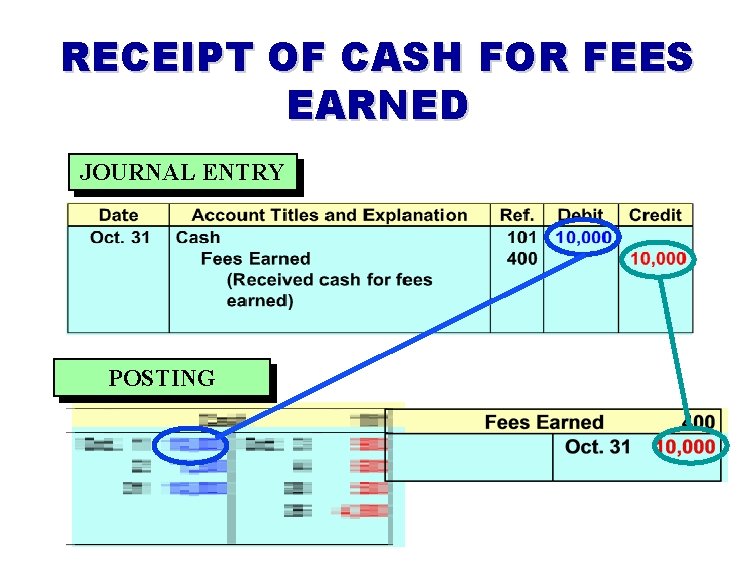
RECEIPT OF CASH FOR FEES EARNED Transaction October 31, received $10, 000 in cash from Copa Company for advertising services rendered in October. Basic Analysis The asset Cash is increased $10, 000; the revenue Fees Earned is increased $10, 000. Debit-Credit Analysis Debits increase assets: debit Cash $10, 000. Credits increase revenues: credit Fees Earned $10, 000.
RECEIPT OF CASH FOR FEES EARNED JOURNAL ENTRY POSTING
THE TRIAL BALANCE STUDY OBJECTIVE 7 • The trial balance is a list of accounts and their balances at a given time. • The primary purpose of a trial balance is to prove debits = credits after posting. • If debits and credits do not agree, the trial balance can be used to uncover errors in journalizing and posting.
THE TRIAL BALANCE The Steps in preparing the Trial Balance are: 1. List the account titles and balances 2. Total the debit and credit columns 3. Prove the equality of the two columns
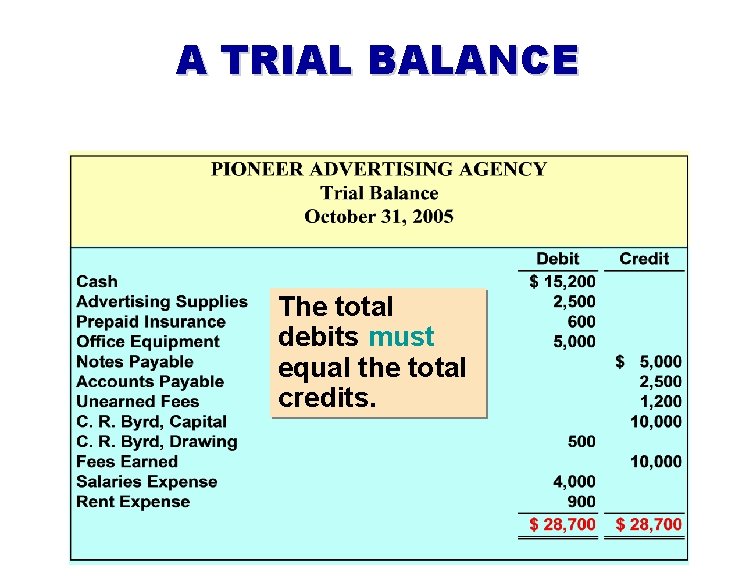
A TRIAL BALANCE The total debits must equal the total credits.
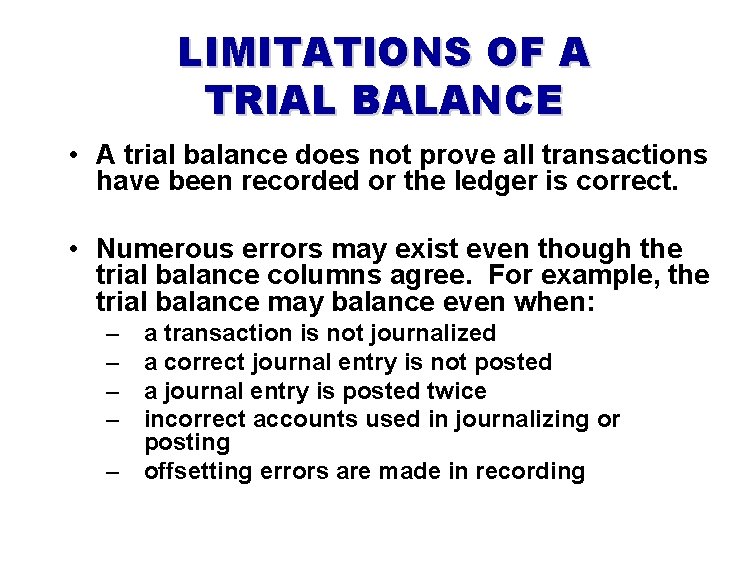
LIMITATIONS OF A TRIAL BALANCE • A trial balance does not prove all transactions have been recorded or the ledger is correct. • Numerous errors may exist even though the trial balance columns agree. For example, the trial balance may balance even when: – – – a transaction is not journalized a correct journal entry is not posted a journal entry is posted twice incorrect accounts used in journalizing or posting offsetting errors are made in recording
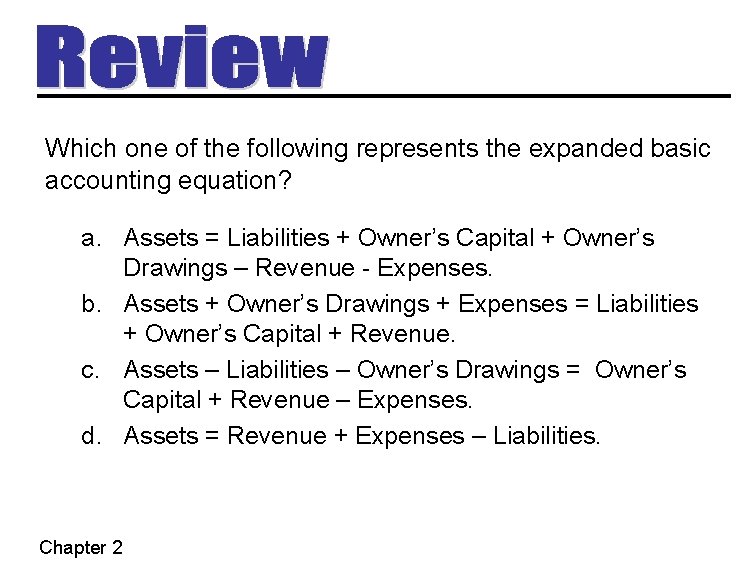
Which one of the following represents the expanded basic accounting equation? a. Assets = Liabilities + Owner’s Capital + Owner’s Drawings – Revenue - Expenses. b. Assets + Owner’s Drawings + Expenses = Liabilities + Owner’s Capital + Revenue. c. Assets – Liabilities – Owner’s Drawings = Owner’s Capital + Revenue – Expenses. d. Assets = Revenue + Expenses – Liabilities. Chapter 2
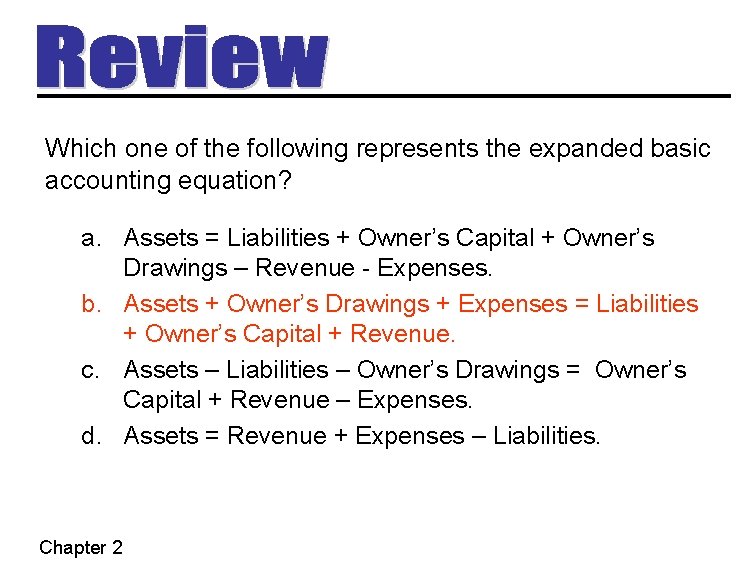
Which one of the following represents the expanded basic accounting equation? a. Assets = Liabilities + Owner’s Capital + Owner’s Drawings – Revenue - Expenses. b. Assets + Owner’s Drawings + Expenses = Liabilities + Owner’s Capital + Revenue. c. Assets – Liabilities – Owner’s Drawings = Owner’s Capital + Revenue – Expenses. d. Assets = Revenue + Expenses – Liabilities. Chapter 2
Chapter 2
COPYRIGHT Copyright © 2005 John Wiley & Sons, Inc. All rights reserved. Reproduction or translation of this work beyond that permitted in Section 117 of the 1976 United States Copyright Act without the express written consent of the copyright owner is unlawful. Request for further information should be addressed to the Permissions Department, John Wiley & Sons, Inc. The purchaser may make back-up copies for his/her own use only and not for distribution or resale. The Publisher assumes no responsibility for errors, omissions, or damages, caused by the use of these programs or from the use of the information contained herein.