
Accounting Practices in Nepal Concept Accounting Information System
![Process - (Principals) Principles v Joj; flos cl: t. Tjsf] l; 4 f. Gt](https://slidetodoc.com/presentation_image_h2/88851ebc4c19ed5b330db9d63e2c8daf/image-14.jpg "Process - (Principals) Principles v Joj; flos cl: t. Tjsf] l; 4 f. Gt")
![Accounting cycle != sf/f]af/ &= af; nft @= ef}r/ df}Hbft c. Nof ^= gfkmf](https://slidetodoc.com/presentation_image_h2/88851ebc4c19ed5b330db9d63e2c8daf/image-17.jpg "Accounting cycle != sf/f]af/ &= af; nft @= ef}r/ df}Hbft c. Nof ^= gfkmf")
![Accounting cycle: in government != sf/f]af/ &= k|fl. Kt tyf e'Stfg. Lsf] ljl. Qo](https://slidetodoc.com/presentation_image_h2/88851ebc4c19ed5b330db9d63e2c8daf/image-31.jpg "Accounting cycle: in government != sf/f]af/ &= k|fl. Kt tyf e'Stfg. Lsf] ljl. Qo")
![Accounting Process in the context of Nepal g]kfn ; /sf/sf] n]vf k 4 t.](https://slidetodoc.com/presentation_image_h2/88851ebc4c19ed5b330db9d63e2c8daf/image-32.jpg "Accounting Process in the context of Nepal g]kfn ; /sf/sf] n]vf k 4 t.")
![jflif{s k|ltj]bg -ltg} txsf] ; /sf/_ -@_ jflif{s v e'Qmfg. L lbg afs. L](https://slidetodoc.com/presentation_image_h2/88851ebc4c19ed5b330db9d63e2c8daf/image-33.jpg "jflif{s k|ltj]bg -ltg} txsf] ; /sf/_ -@_ jflif{s v e'Qmfg. L lbg afs. L")

- Slides: 43
Accounting Practices in Nepal Concept, Accounting Information System, Accounting Practices, recent development in Nepal Presented by: Sundar Shrestha Amrit Shrestha (CA, CPFA Affil. )
Contents of Course - Outline General Accounting concept Accounting information system � Accounting procedures � Types of accounting bases � Financial statements Accounting cycle Recent changes Development (Accounting standard)
Book Keeping Book keeping is the initial activity, It comprise of collecting information and recording the transaction Based on source documents
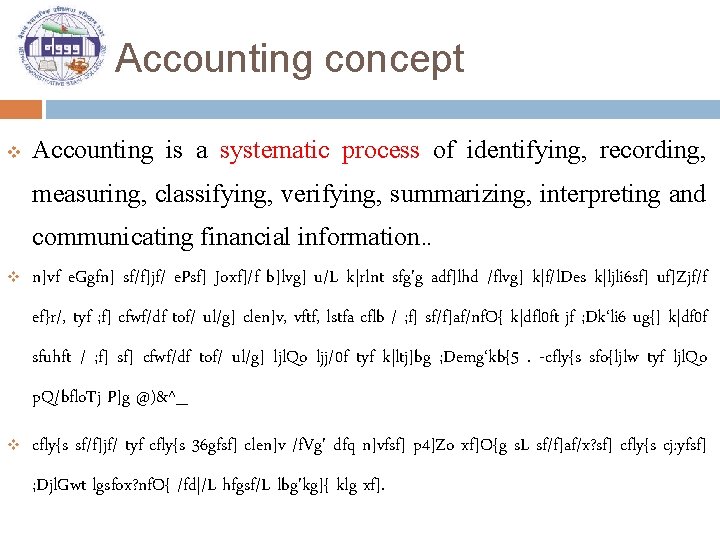
Accounting concept v Accounting is a systematic process of identifying, recording, measuring, classifying, verifying, summarizing, interpreting and communicating financial information. . v n]vf e. Ggfn] sf/f]jf/ e. Psf] Joxf]/f b]lvg] u/L k|rlnt sfg'g adf]lhd /flvg] k|f/l. Des k|ljli 6 sf] uf]Zjf/f ef}r/, tyf ; f] cfwf/df tof/ ul/g] clen]v, vftf, lstfa cflb / ; f] sf/f]af/nf. O{ k|dfl 0 ft jf ; Dk‘li 6 ug{] k|df 0 f sfuhft / ; f] sf] cfwf/df tof/ ul/g] ljl. Qo ljj/0 f tyf k|ltj]bg ; Demg‘kb{5. -cfly{s sfo{ljlw tyf ljl. Qo p. Q/bflo. Tj P]g @)&^_ v cfly{s sf/f]jf/ tyf cfly{s 36 gfsf] clen]v /f. Vg' dfq n]vfsf] p 4]Zo xf]O{g s. L sf/f]af/x? sf] cfly{s cj: yfsf] ; Djl. Gwt lgsfox? nf. O{ /fd|/L hfgsf/L lbg'kg]{ klg xf].
Book keeping Vs Accounting Book keeping is primary activity Accounting is based on book keeping
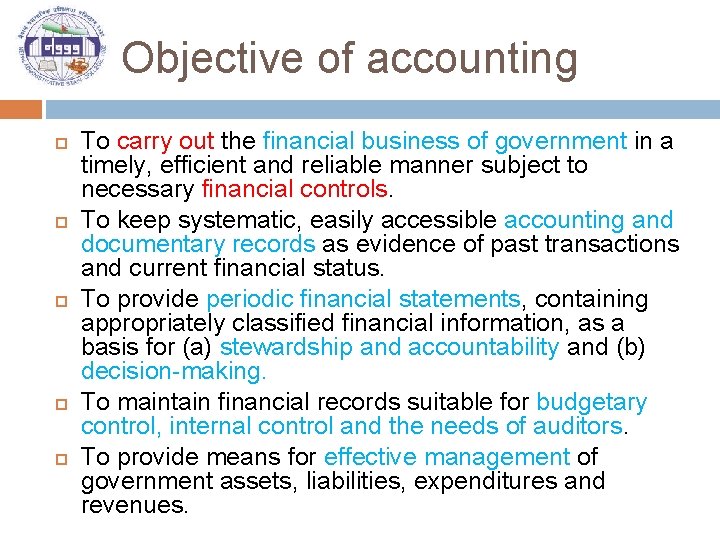
Objective of accounting To carry out the financial business of government in a timely, efficient and reliable manner subject to necessary financial controls. To keep systematic, easily accessible accounting and documentary records as evidence of past transactions and current financial status. To provide periodic financial statements, containing appropriately classified financial information, as a basis for (a) stewardship and accountability and (b) decision-making. To maintain financial records suitable for budgetary control, internal control and the needs of auditors. To provide means for effective management of government assets, liabilities, expenditures and revenues.
Need of Accounting Risk mitigation Consistency Accountability Institutional memory � Transparency � Evidence � Documentation Good Governance Accounting information is required to be accountable towards taxpayers, for being transparent to stakeholders and maintain good governance in organization.
Professional Judgement & Skepticism Professional Judgement: A Right that Comes with Responsibility Its Applying knowledge, skills and experience, in a way that is informed by professional standards, laws and ethical principles, to develop an opinion or decision about what should be done to best. Skepticism : questioning attitude or doubt towards one or more items knowledge or belief.
ASSUM E Re think on your actions
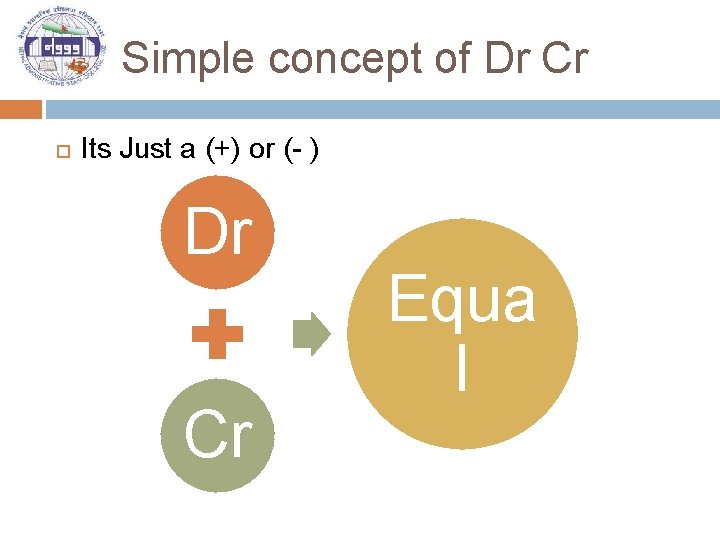
Simple concept of Dr Cr Its Just a (+) or (- ) Dr Cr Equa l
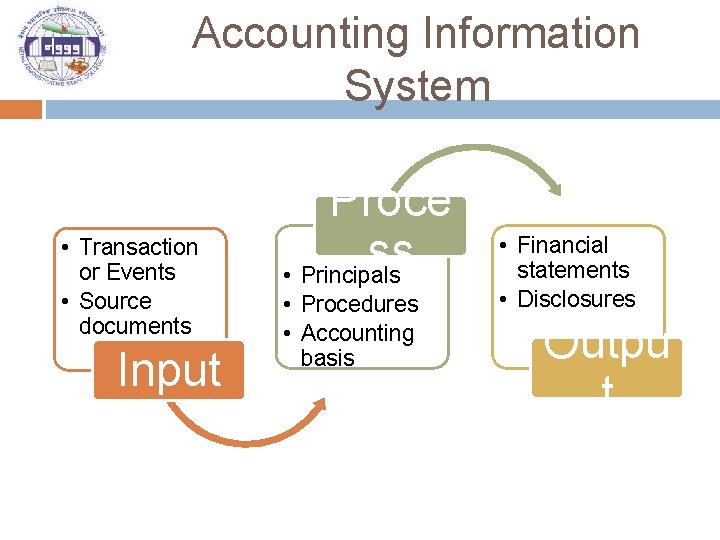
Accounting Information System • Transaction or Events • Source documents Input Proce ss • Principals • Procedures • Accounting basis • Financial statements • Disclosures Outpu t
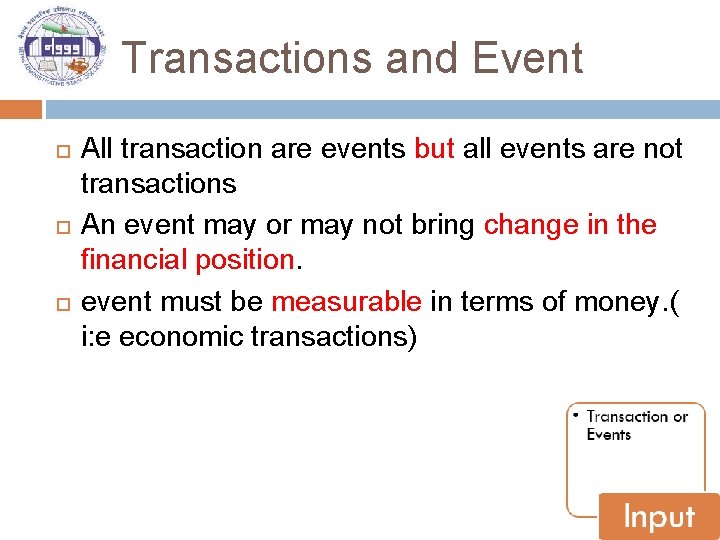
Transactions and Event All transaction are events but all events are not transactions An event may or may not bring change in the financial position. event must be measurable in terms of money. ( i: e economic transactions)
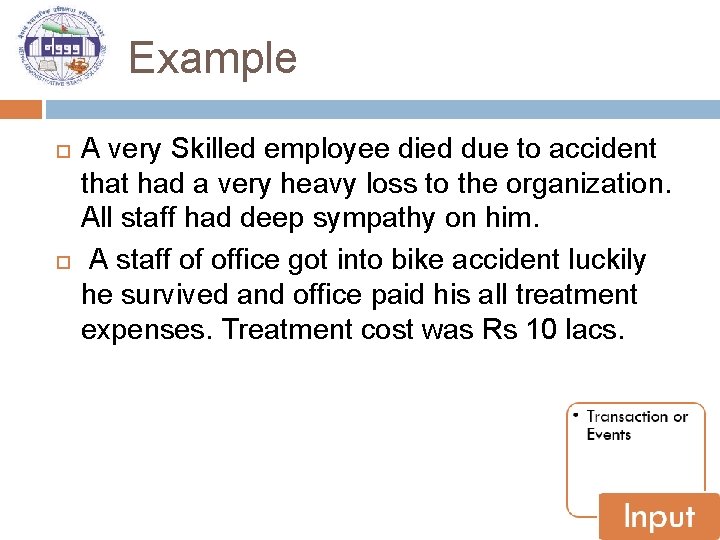
Example A very Skilled employee died due to accident that had a very heavy loss to the organization. All staff had deep sympathy on him. A staff of office got into bike accident luckily he survived and office paid his all treatment expenses. Treatment cost was Rs 10 lacs.
Process - (Principals) Principles v Joj; flos cl: t. Tjsf] l; 4 f. Gt (Business Entity Concept) v Df}flb|s dfkb 08 sf] l; 4 f. Gt (Money Measurement Concept) v g. L/Gt/tfsf] l; 4 f. Gt (Going Concern Concept) v k/n d'Nosf l; 4 f. Gt (Cost Concept) v cfly{s jif{sf] l; 4 f. Gt (Accounting Period Concept) v K|ff. Kt. Lsf] l; 4 f. Gt (Realization Concept) v lx; fj ldnfgsf] l; 4 f. Gt (Matching Concept) v bf]xf]/f] n]vfsf] l; 4 f. Gt (Double Entry System)
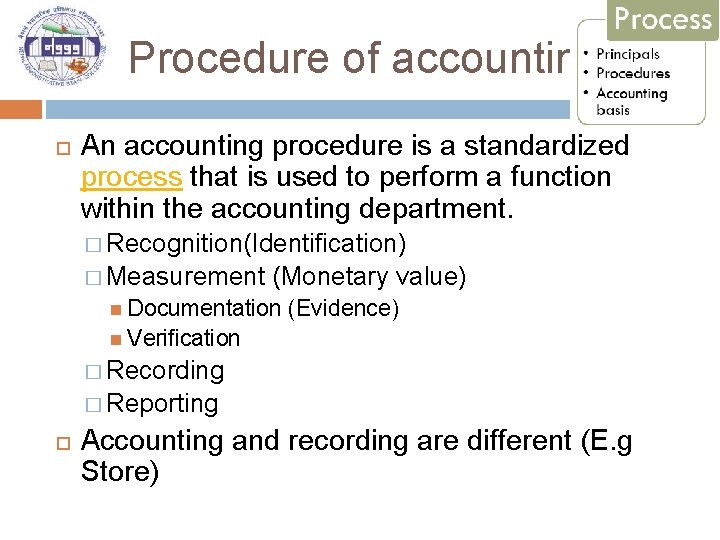
Procedure of accounting An accounting procedure is a standardized process that is used to perform a function within the accounting department. � Recognition(Identification) � Measurement (Monetary value) Documentation (Evidence) Verification � Recording � Reporting Accounting and recording are different (E. g Store)
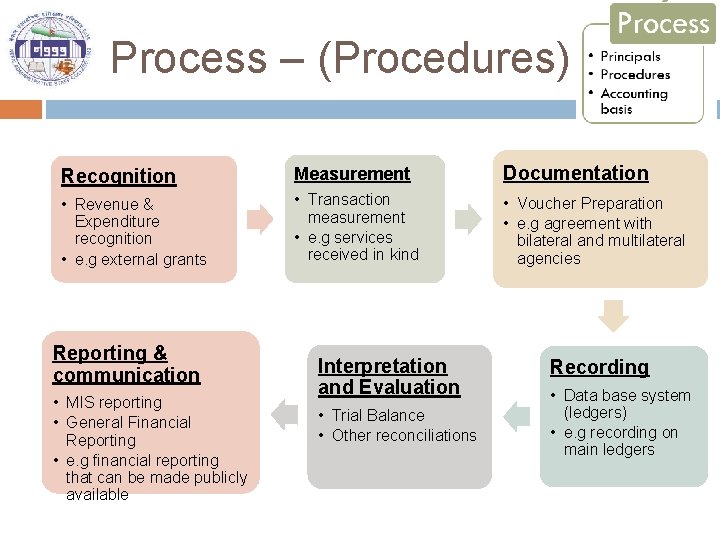
Process – (Procedures) Recognition Measurement Documentation • Revenue & Expenditure recognition • e. g external grants • Transaction measurement • e. g services received in kind • Voucher Preparation • e. g agreement with bilateral and multilateral agencies Reporting & communication • MIS reporting • General Financial Reporting • e. g financial reporting that can be made publicly available Interpretation and Evaluation • Trial Balance • Other reconciliations Recording • Data base system (ledgers) • e. g recording on main ledgers
Accounting cycle != sf/f]af/ &= af; nft @= ef}r/ df}Hbft c. Nof ^= gfkmf gf]S; fg lx; fa #= vftf %= Jokfl/ vftf $= ; Gt'ng kl/If 0 f
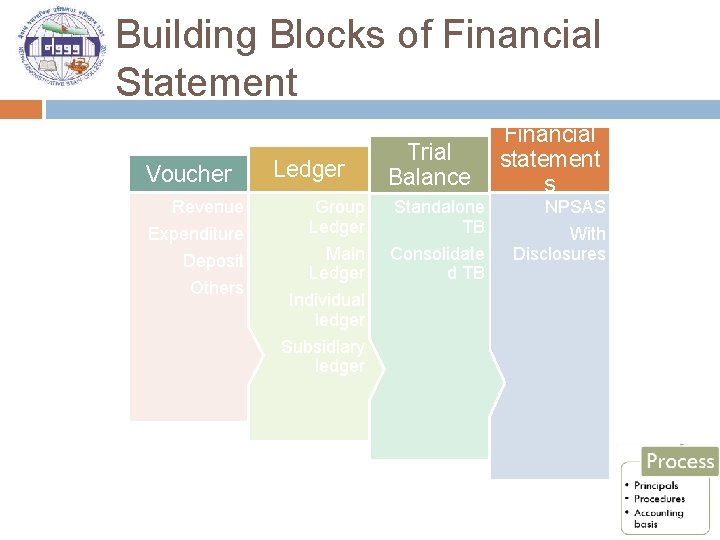
Building Blocks of Financial Statement Voucher Revenue Expenditure Deposit Others Ledger Group Ledger Main Ledger Individual ledger Subsidiary ledger Trial Balance Standalone TB Consolidate d TB Financial statement s NPSAS With Disclosures
Use of Ledger Group Ledger �Main Ledger Subsidiary ledgers (The proper use of ledger allows you to handle your accounts more properly. Aggregation or segregation of the accounts will be more easy. Eg handling project accounts and its components)
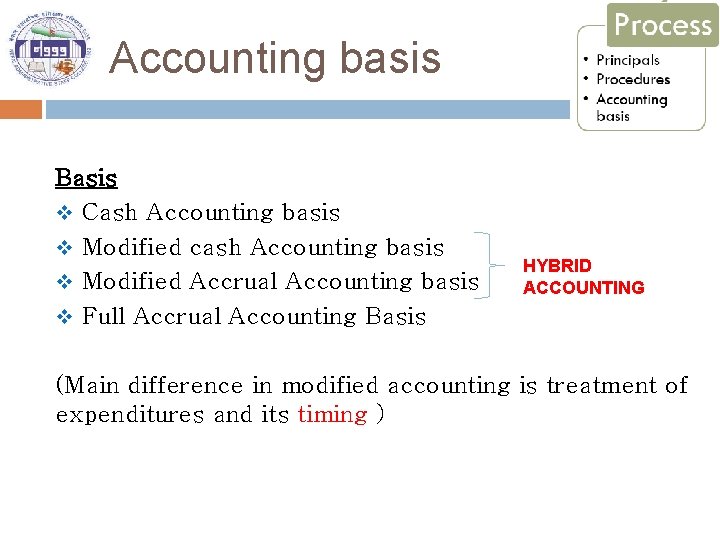
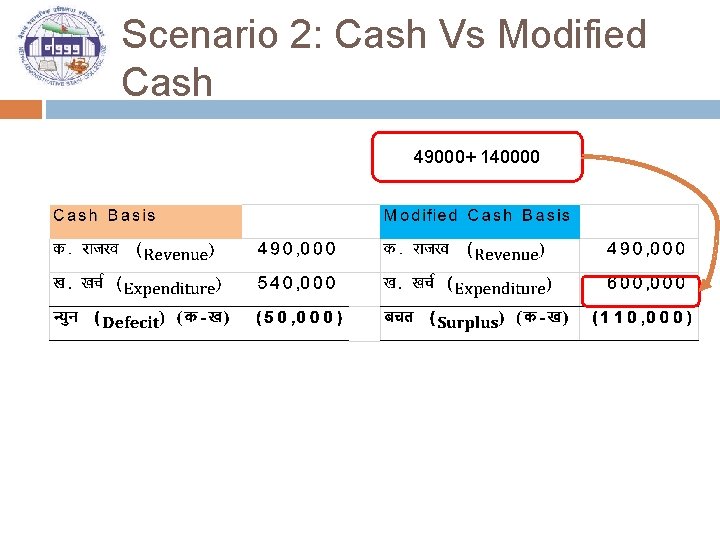
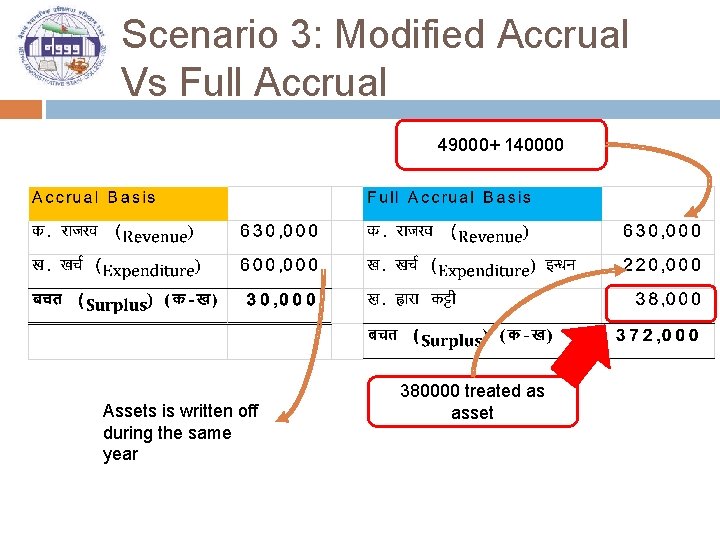
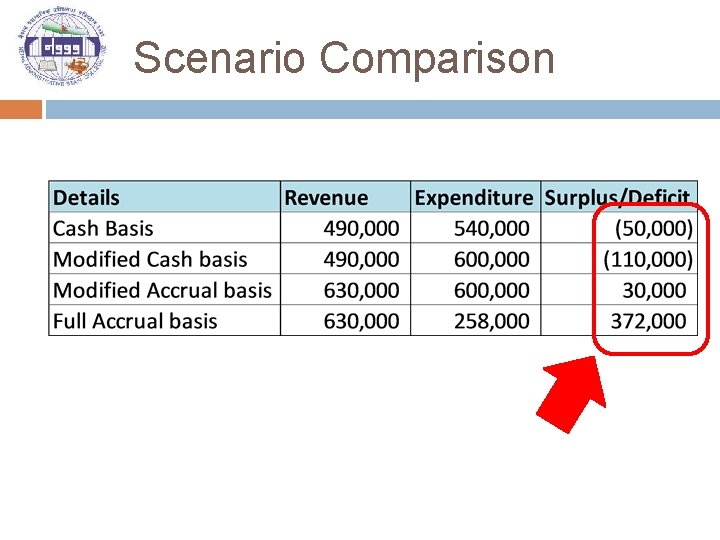
Accounting basis Basis v Cash Accounting basis v Modified cash Accounting basis v Modified Accrual Accounting basis v Full Accrual Accounting Basis HYBRID ACCOUNTING (Main difference in modified accounting is treatment of expenditures and its timing )
How wording differs Difference between income and expenditure Difference between revenue and expense
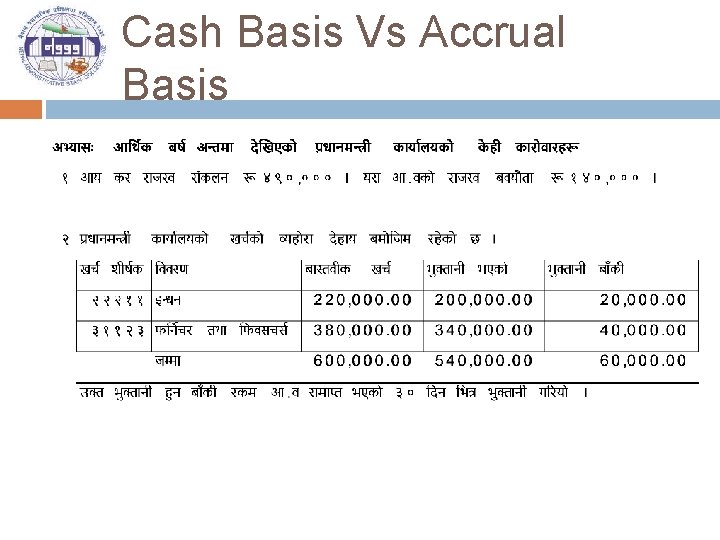
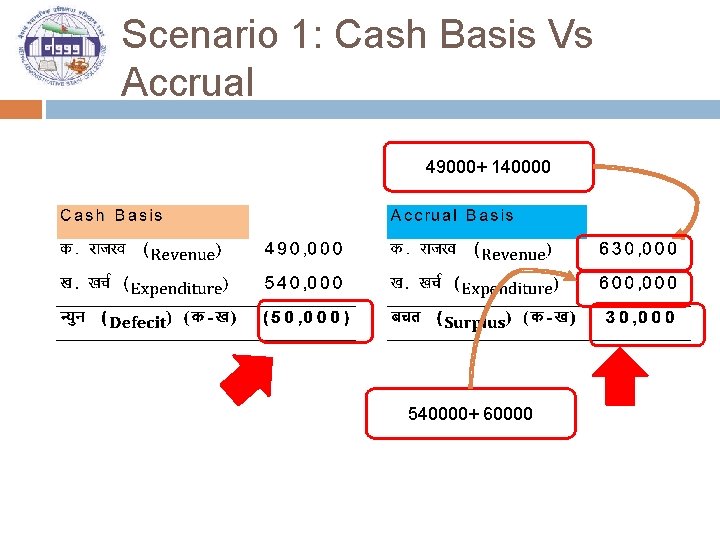
Cash Basis Vs Accrual Basis
Scenario 1: Cash Basis Vs Accrual 49000+ 140000 540000+ 60000
Scenario 2: Cash Vs Modified Cash 49000+ 140000
Scenario 3: Modified Accrual Vs Full Accrual 49000+ 140000 Assets is written off during the same year 380000 treated as asset
Scenario Comparison
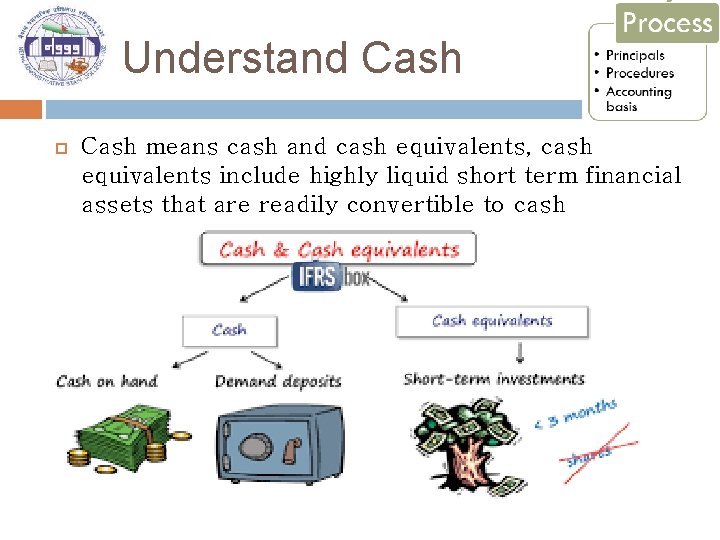
Understand Cash means cash and cash equivalents, cash equivalents include highly liquid short term financial assets that are readily convertible to cash
Concept of GPFS OAG formats are based on the Nepal Public Sector accounting standards-NPSAS General purpose Vs Specific Purpose General Purpose financial statements.
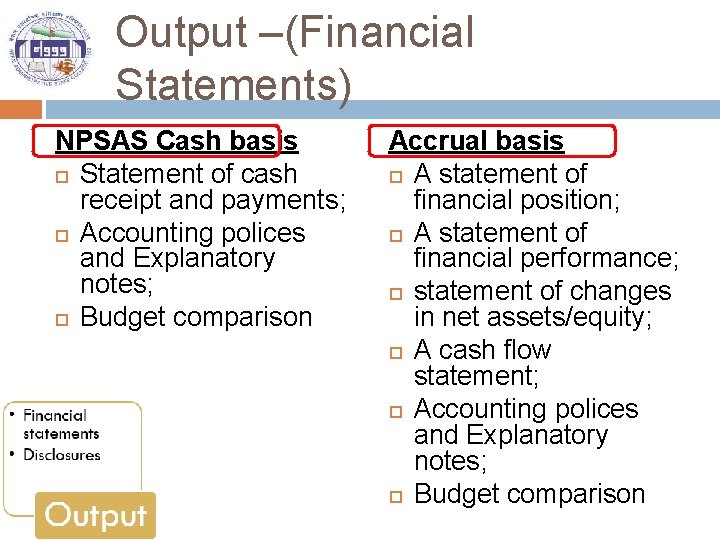
Output –(Financial Statements) NPSAS Cash basis Statement of cash receipt and payments; Accounting polices and Explanatory notes; Budget comparison Accrual basis A statement of financial position; A statement of financial performance; statement of changes in net assets/equity; A cash flow statement; Accounting polices and Explanatory notes; Budget comparison
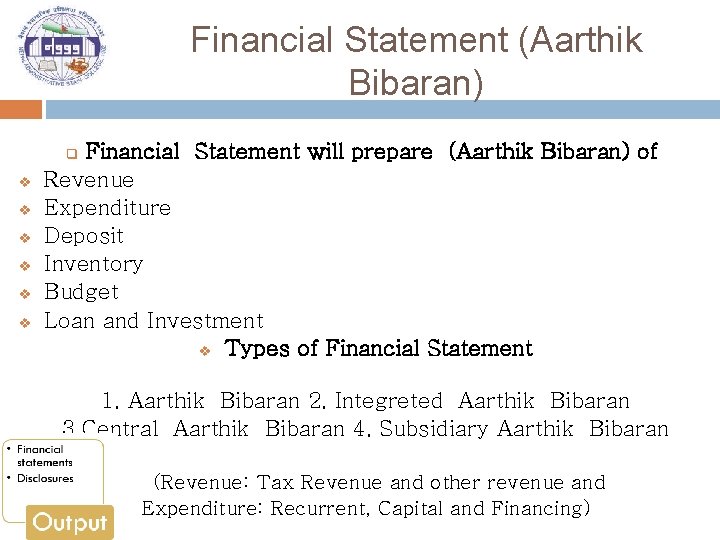
Financial Statement (Aarthik Bibaran) Financial Statement will prepare (Aarthik Bibaran) of Revenue Expenditure Deposit Inventory Budget Loan and Investment v Types of Financial Statement q v v v 1. Aarthik Bibaran 2. Integreted Aarthik Bibaran 3. Central Aarthik Bibaran 4. Subsidiary Aarthik Bibaran (Revenue: Tax Revenue and other revenue and Expenditure: Recurrent, Capital and Financing)
Accounting cycle: in government != sf/f]af/ &= k|fl. Kt tyf e'Stfg. Lsf] ljl. Qo ljj/0 f @= ef}r/ df}Hbft c. Nof ^= cfly{s ljj/0 f #= vftf %= kmf. F 6 af/L $= ; Gt'ng kl/If 0 f
Accounting Process in the context of Nepal g]kfn ; /sf/sf] n]vf k 4 t. L v uf]Zjf/f ef}r/ - ; flas d=n]=k= kmf/fd g+=!) _ / xfn @)# v vftfx? - ; flas d=n]=k= kmf/fd g+=@@ _ / xfn @)& v e'Qmfg. L cfb]zsf] - ; flas cg'; 'r. L !$ _ / xfn @)$ v a}+s gub. L lstfa - ; flas d=n]=k= kmf/fd g+=% _ / xfn @)( v ah]6 lx; fa - ; flas d=n]=k= kmf/fd g+= * _ / xfn @)* v j}s lx; fj ; dfof]hg ljj/0 f - ; flas d=n]=k= kmf/fd g+=!% _ / xfn @!@ v vr{sf] kmf. F 6 jf/L - ; flas d=n]=k= kmf/fd g+=!# _ / xfn @!) v km 5 of}{6 x'g afs. L k]Zs. L - ; flas d=n]=k=kmf= !$_ / xfn @!! v cfly{s ljj/0 f - ; flas d=n]=k= kmf/fd g+=!& _ / -Working Sheet) v ������� ; flas ) / xfn @@%
jflif{s k|ltj]bg -ltg} txsf] ; /sf/_ -@_ jflif{s v e'Qmfg. L lbg afs. L s. Rrfaf/L - ; flas d=n]=k=kmf= !* / xfn @@! v jflif{s cf=lj= - ; flas d=n]=k=kmf= !& / xfn @&@ NPSAS v km 5 of}{6 x'g afs. L k]Zs. L - ; flas d=n]=k=kmf= !$ / xfn @!! § ljlgof]hg , w/f}6 L, /fh. Zj, § lh. G; L / c. Go § ; /sf/L sf/f]af/sf] jflif{s cfly{s ljj/0 f tof/ ug{' kg]{ / o: tf] ljj/0 fdf n]vfk|0 ffn. Ldf ; dflji 6 gu/]sf] s]lx yk ljifodf hfgsf/L lbg'kg]{ Joj: yf 5, h: t}– e"Qmfg. Lx'g af. Fs. L ljj/0 f, c; "nx'g af. Fs. L /fh. Zjsf] nut / ut ljut jif{sf] k]Zs. L
Test your understanding Is मनतर लयक कनदर य व वरण a financial statement? आरथ क Answer: Nepal Public sector standards has defined FS R/P, Budget Comparison and No. A
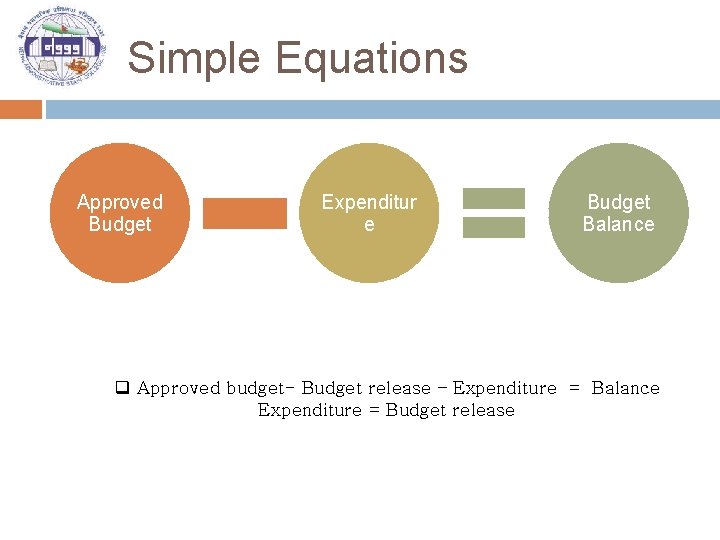
Simple Equations Approved Budget Expenditur e Budget Balance q Approved budget- Budget release – Expenditure = Balance Expenditure = Budget release
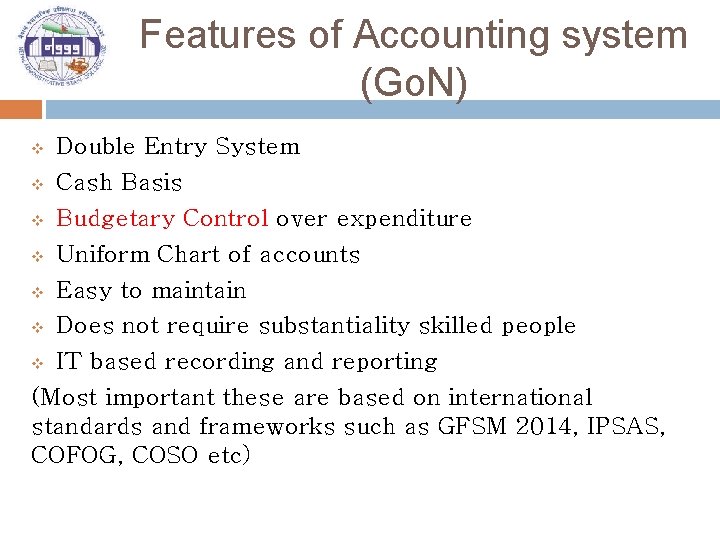
Features of Accounting system (Go. N) Double Entry System v Cash Basis v Budgetary Control over expenditure v Uniform Chart of accounts v Easy to maintain v Does not require substantiality skilled people v IT based recording and reporting (Most important these are based on international standards and frameworks such as GFSM 2014, IPSAS, COFOG, COSO etc) v
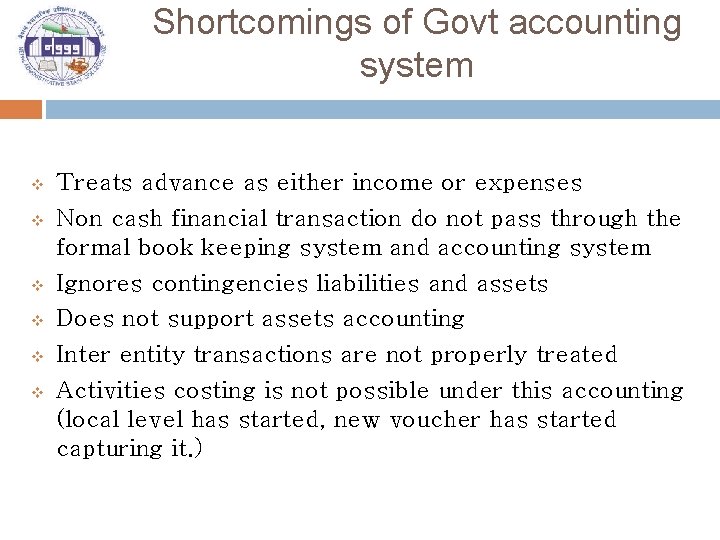
Shortcomings of Govt accounting system v v v Treats advance as either income or expenses Non cash financial transaction do not pass through the formal book keeping system and accounting system Ignores contingencies liabilities and assets Does not support assets accounting Inter entity transactions are not properly treated Activities costing is not possible under this accounting (local level has started, new voucher has started capturing it. )
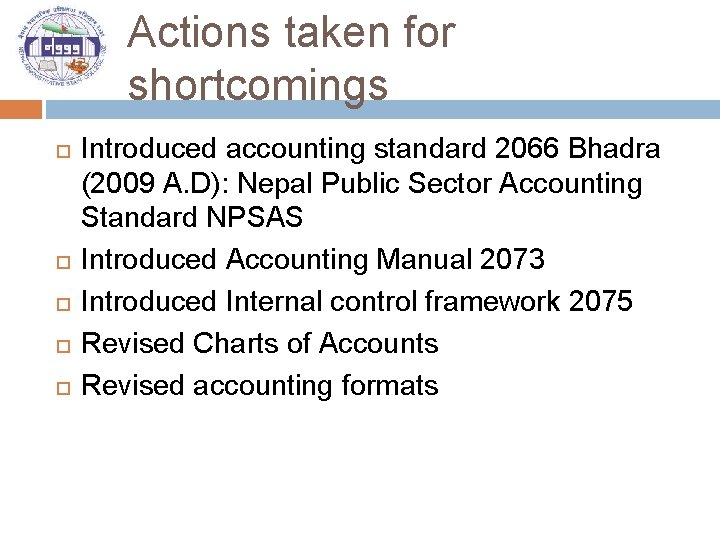
Actions taken for shortcomings Introduced accounting standard 2066 Bhadra (2009 A. D): Nepal Public Sector Accounting Standard NPSAS Introduced Accounting Manual 2073 Introduced Internal control framework 2075 Revised Charts of Accounts Revised accounting formats
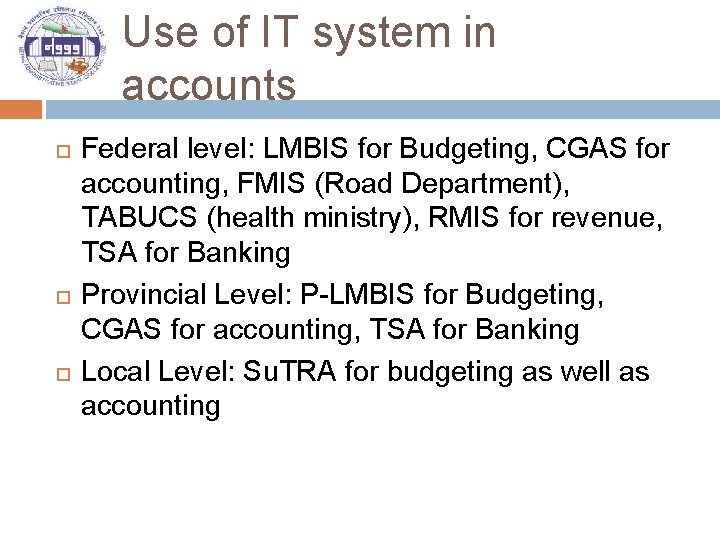
Use of IT system in accounts Federal level: LMBIS for Budgeting, CGAS for accounting, FMIS (Road Department), TABUCS (health ministry), RMIS for revenue, TSA for Banking Provincial Level: P-LMBIS for Budgeting, CGAS for accounting, TSA for Banking Local Level: Su. TRA for budgeting as well as accounting
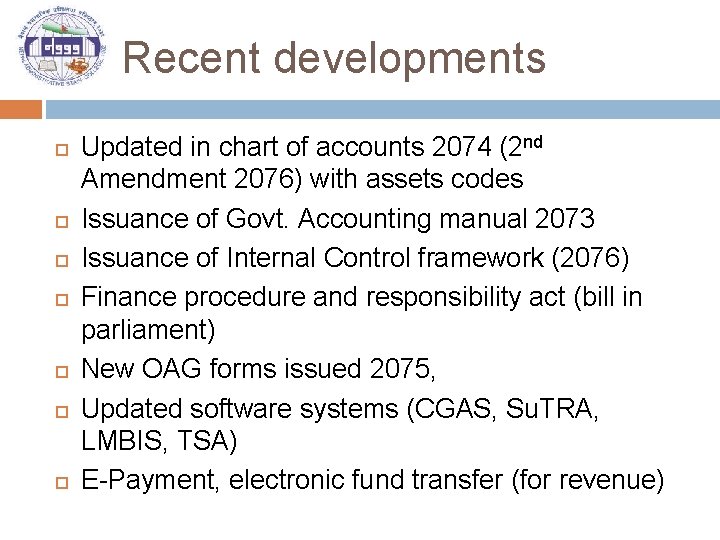
Recent developments Updated in chart of accounts 2074 (2 nd Amendment 2076) with assets codes Issuance of Govt. Accounting manual 2073 Issuance of Internal Control framework (2076) Finance procedure and responsibility act (bill in parliament) New OAG forms issued 2075, Updated software systems (CGAS, Su. TRA, LMBIS, TSA) E-Payment, electronic fund transfer (for revenue)
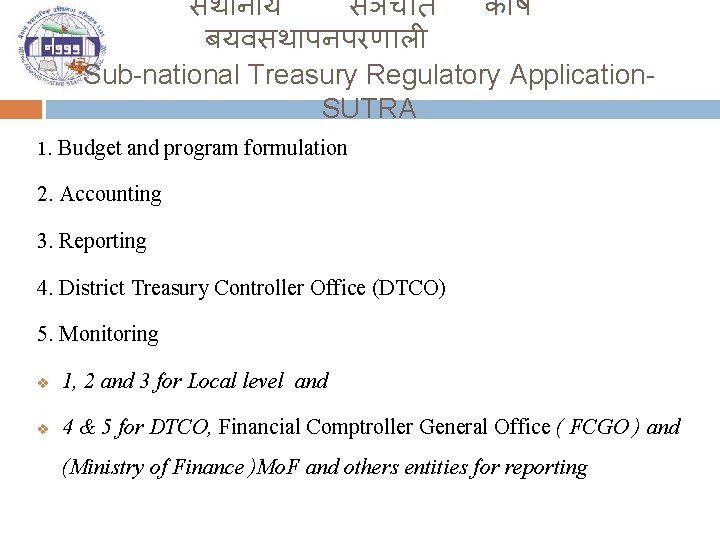
सथ न य सञच त क ष बयवसथ पनपरण ल Sub-national Treasury Regulatory Application. SUTRA 1. Budget and program formulation 2. Accounting 3. Reporting 4. District Treasury Controller Office (DTCO) 5. Monitoring v 1, 2 and 3 for Local level and v 4 & 5 for DTCO, Financial Comptroller General Office ( FCGO ) and (Ministry of Finance )Mo. F and others entities for reporting
Any Queries
THANK YOU