
Accounting Information Systems 9 th Edition Marshall B
Accounting Information Systems 9 th Edition Marshall B. Romney Paul John Steinbart © 2003 Prentice Hall Business Publishing, Accounting Information Systems, 9/e, Romney/Steinbart 18 -1
Systems Design, Implementation, and Operation Chapter 18 © 2003 Prentice Hall Business Publishing, Accounting Information Systems, 9/e, Romney/Steinbart 18 -2
Learning Objectives 1 2 3 Discuss the conceptual systems design process and the activities in this phase. Discuss the physical systems design process and the activities in this phase. Discuss the systems implementation and conversion process and the activities in this phase. © 2003 Prentice Hall Business Publishing, Accounting Information Systems, 9/e, Romney/Steinbart 3
Learning Objectives 4 Discuss the systems operation and maintenance process and the activities in this phase. © 2003 Prentice Hall Business Publishing, Accounting Information Systems, 9/e, Romney/Steinbart 4
Introduction ¢ Ann Christy, the controller at shoppers mart, scheduled a meeting with the head of systems development to discuss the following questions: l l What type of system will best meet shoppers mart’s needs? Should her team develop what they consider to be the best approach to meeting SM’s need? © 2003 Prentice Hall Business Publishing, Accounting Information Systems, 9/e, Romney/Steinbart 5
Introduction l l Should they develop several approaches? What can be done to ensure that system output will meet user needs? When and how should input, such as accounting transaction, be captured, and who should capture it? Where should AIS data be stored, and how should it be organized and accessed? How should SM convert to its new AIS? © 2003 Prentice Hall Business Publishing, Accounting Information Systems, 9/e, Romney/Steinbart 6
Introduction ¢ This chapter discusses the last four steps in the SDLC: conceptual systems design, physical systems design, systems implementation and conversion, and operation and maintenance. © 2003 Prentice Hall Business Publishing, Accounting Information Systems, 9/e, Romney/Steinbart 7
Learning Objective 1 Discuss the conceptual systems design process and the activities in this phase. © 2003 Prentice Hall Business Publishing, Accounting Information Systems, 9/e, Romney/Steinbart 8
Conceptual Systems Design ¢ ¢ In the conceptual systems design phase, a general framework is developed for implementing user requirements and solving problems identified in the analysis phase. What are three steps in conceptual design? 1. 2. 3. Evaluate design alternatives. Prepare design specifications. Prepare conceptual systems design report. © 2003 Prentice Hall Business Publishing, Accounting Information Systems, 9/e, Romney/Steinbart 9
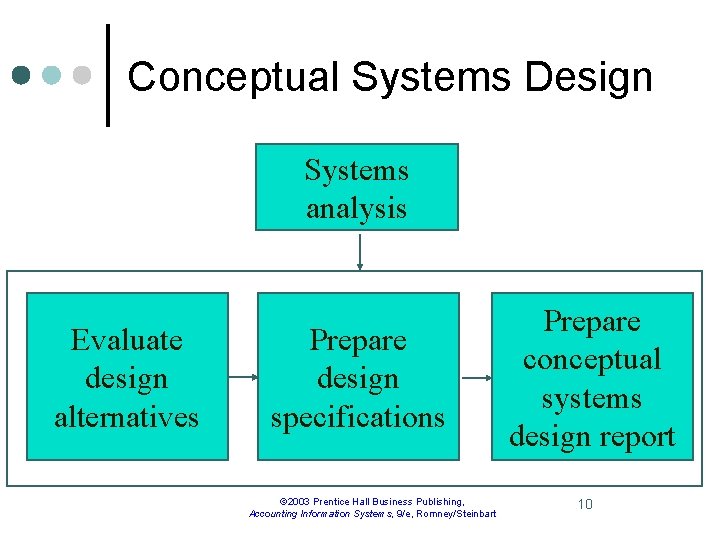
Conceptual Systems Design Systems analysis Evaluate design alternatives Prepare design specifications © 2003 Prentice Hall Business Publishing, Accounting Information Systems, 9/e, Romney/Steinbart Prepare conceptual systems design report 10
Conceptual Systems Design ¢ ¢ Evaluate design alternatives: The design team should identify and evaluate design alternatives using the following criteria: 1. How well it meets organizational and system objectives 2. How well it meets users’ needs 3. Whether it is economically feasible 4. Its advantages and disadvantages © 2003 Prentice Hall Business Publishing, Accounting Information Systems, 9/e, Romney/Steinbart 11
Conceptual Systems Design ¢ ¢ Prepare design specifications: Once a design alternative has been selected, the team develops the conceptual design specifications for the following elements: 1. 2. 3. 4. Output Data storage Input Processing procedures and operations © 2003 Prentice Hall Business Publishing, Accounting Information Systems, 9/e, Romney/Steinbart 12
Conceptual Systems Design ¢ ¢ Prepare conceptual systems design report: At the end of the conceptual design a conceptual systems design report is developed and submitted. To guide physical systems design activities 2. To communicate how management and user information needs will be met 3. To help assess systems’ feasibility 1. © 2003 Prentice Hall Business Publishing, Accounting Information Systems, 9/e, Romney/Steinbart 13
Learning Objective 2 Discuss the physical systems design processes and the activities in this phase. © 2003 Prentice Hall Business Publishing, Accounting Information Systems, 9/e, Romney/Steinbart 14
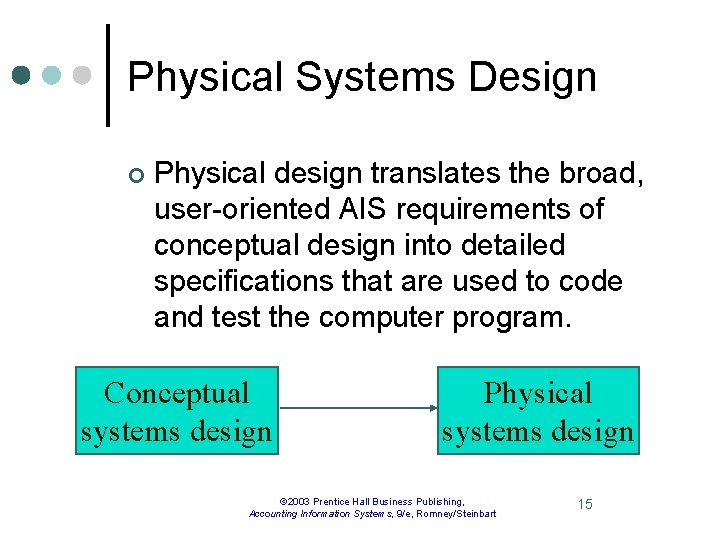
Physical Systems Design ¢ Physical design translates the broad, user-oriented AIS requirements of conceptual design into detailed specifications that are used to code and test the computer program. Conceptual systems design Physical systems design © 2003 Prentice Hall Business Publishing, Accounting Information Systems, 9/e, Romney/Steinbart 15
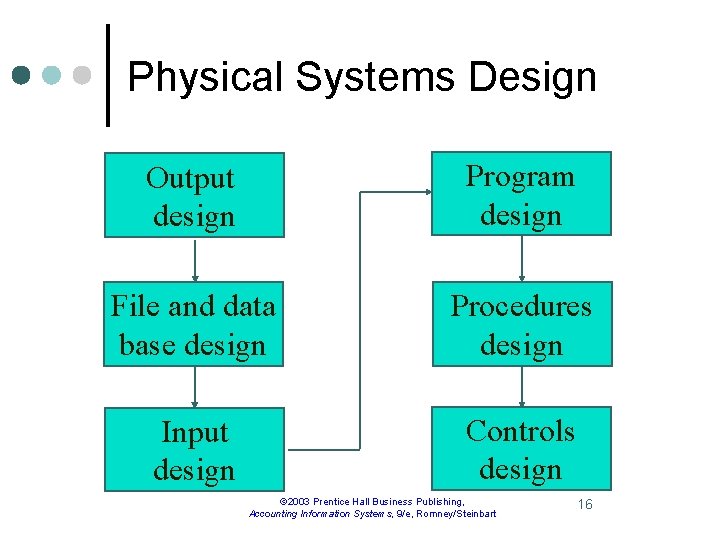
Physical Systems Design Output design Program design File and data base design Procedures design Input design Controls design © 2003 Prentice Hall Business Publishing, Accounting Information Systems, 9/e, Romney/Steinbart 16
Physical Systems Design: Output Design ¢ ¢ The objective of output design is to determine the characteristics of reports, documents, and screen displays. Output fits into one of four categories: 1. 2. 3. 4. Scheduled reports Special-purpose analysis Triggered exception reports Demand reports © 2003 Prentice Hall Business Publishing, Accounting Information Systems, 9/e, Romney/Steinbart 17
Physical Systems Design: File and Database Design ¢ What are some file and database design considerations? – – – medium of storage organization and access processing mode maintenance size and activity level © 2003 Prentice Hall Business Publishing, Accounting Information Systems, 9/e, Romney/Steinbart 18
Physical Systems Design: Input Design ¢ ¢ When evaluating input design, the design team must identify the different types of data input and optimal input method. What are the two principal types of data input? 1. Forms 2. Computer screens © 2003 Prentice Hall Business Publishing, Accounting Information Systems, 9/e, Romney/Steinbart 19
Physical Systems Design: Program Design ¢ ¢ ¢ Program design is one of the most timeconsuming activities in the entire SDLC. Programs should be subdivided into small, well-defined modules to reduce complexity. What is this referred to as? – ¢ structured programming Modules should interact with a control module rather than with each other. © 2003 Prentice Hall Business Publishing, Accounting Information Systems, 9/e, Romney/Steinbart 20
Physical Systems Design: Procedures Design Procedures design should answer the who, what, where, and how questions related to all AIS activities. ¢ What should procedures cover? ¢ t t input preparation transaction processing error detection and corrections controls © 2003 Prentice Hall Business Publishing, Accounting Information Systems, 9/e, Romney/Steinbart 21
Physical Systems Design: Procedures Design What should procedures cover? (continued) t reconciliation of balances t database access t output preparation and distribution t computer operator instructions © 2003 Prentice Hall Business Publishing, Accounting Information Systems, 9/e, Romney/Steinbart 22
Physical Systems Design: Control Design What are some control design considerations? üValidity üAuthorization üAccuracy üSecurity üNumerical Control üAvailability üMaintainability üIntegrity üAudit Control © 2003 Prentice Hall Business Publishing, Accounting Information Systems, 9/e, Romney/Steinbart 23
Physical Systems Design Report At the end of the physical design phase the team prepares a physical systems design report. ¢ This report becomes the basis for management’s decision whether to proceed to the implementation phase. ¢ © 2003 Prentice Hall Business Publishing, Accounting Information Systems, 9/e, Romney/Steinbart 24
Learning Objective 3 Discuss the systems implementation and conversion process and the activities in this phase. © 2003 Prentice Hall Business Publishing, Accounting Information Systems, 9/e, Romney/Steinbart 25
Systems Implementation ¢ Systems implementation is the process of installing hardware and software and getting the AIS up and running. © 2003 Prentice Hall Business Publishing, Accounting Information Systems, 9/e, Romney/Steinbart 26
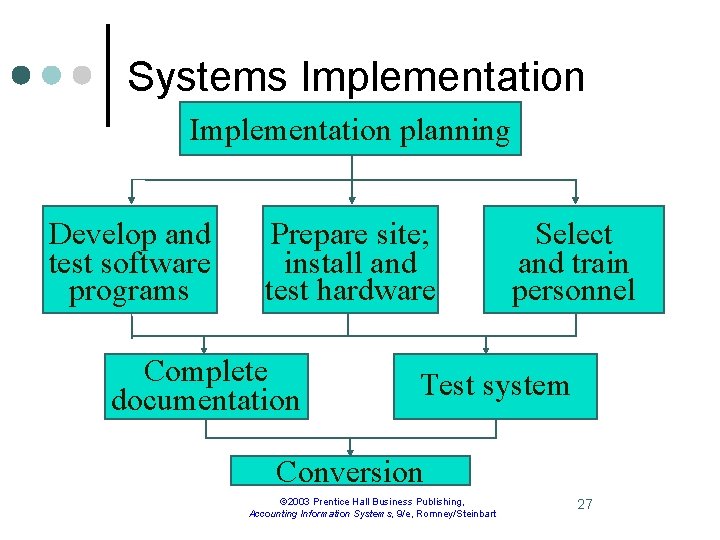
Systems Implementation planning Develop and test software programs Prepare site; install and test hardware Complete documentation Select and train personnel Test system Conversion © 2003 Prentice Hall Business Publishing, Accounting Information Systems, 9/e, Romney/Steinbart 27
Systems Implementation: Implementation Planning An implementation plan consists of implementation tasks, expected completion dates, cost estimates, and the person or persons responsible for each task. ¢ Planning should include adjustments to the company’s organizational structure. ¢ © 2003 Prentice Hall Business Publishing, Accounting Information Systems, 9/e, Romney/Steinbart 28
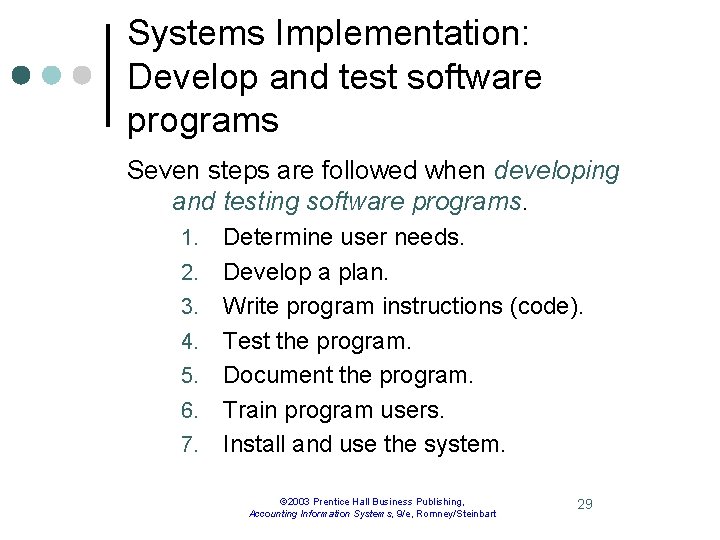
Systems Implementation: Develop and test software programs Seven steps are followed when developing and testing software programs. 1. 2. 3. 4. 5. 6. 7. Determine user needs. Develop a plan. Write program instructions (code). Test the program. Document the program. Train program users. Install and use the system. © 2003 Prentice Hall Business Publishing, Accounting Information Systems, 9/e, Romney/Steinbart 29
Systems Implementation: Site Preparation ¢ ¢ ¢ A PC requires little site preparation. A large system may require extensive changes, such as additional electrical outlets. Site preparation should begin well in advance of the installation date. © 2003 Prentice Hall Business Publishing, Accounting Information Systems, 9/e, Romney/Steinbart 30
Systems Implementation: Select and train personnel Employees can be hired from outside the company or transferred internally. ¢ Effective AIS training should include employees’ orientation to new policies and operations. ¢ Training should occur before systems testing and conversion. ¢ © 2003 Prentice Hall Business Publishing, Accounting Information Systems, 9/e, Romney/Steinbart 31
Systems Implementation: Complete Documentation ¢ Three types of documentation must be prepared for new systems. 1. 2. 3. Development documentation Operations documentation User documentation © 2003 Prentice Hall Business Publishing, Accounting Information Systems, 9/e, Romney/Steinbart 32
Systems Implementation: Test the System ¢ There are three common forms of testing. 1. 2. 3. Walk-through Processing of test transactions Acceptance tests © 2003 Prentice Hall Business Publishing, Accounting Information Systems, 9/e, Romney/Steinbart 33
Systems Implementation: Conversion ¢ There are four conversion approaches. 1. 2. 3. 4. Direct conversion Parallel conversion Phase-in conversion Pilot conversion © 2003 Prentice Hall Business Publishing, Accounting Information Systems, 9/e, Romney/Steinbart 34
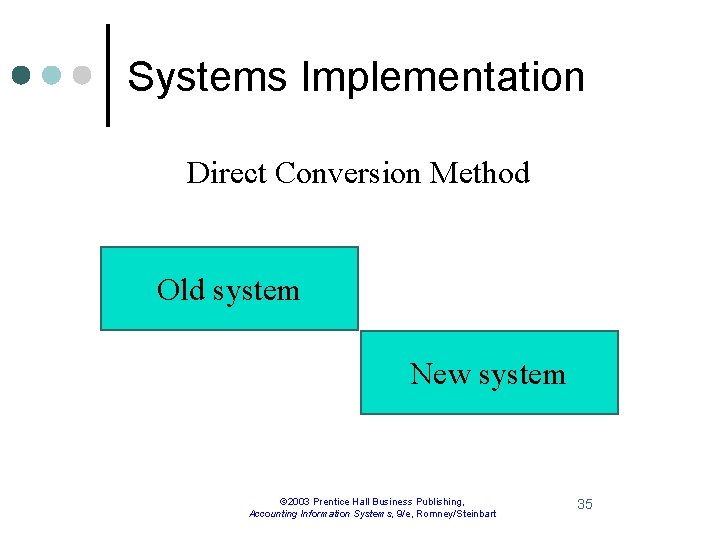
Systems Implementation Direct Conversion Method Old system New system © 2003 Prentice Hall Business Publishing, Accounting Information Systems, 9/e, Romney/Steinbart 35
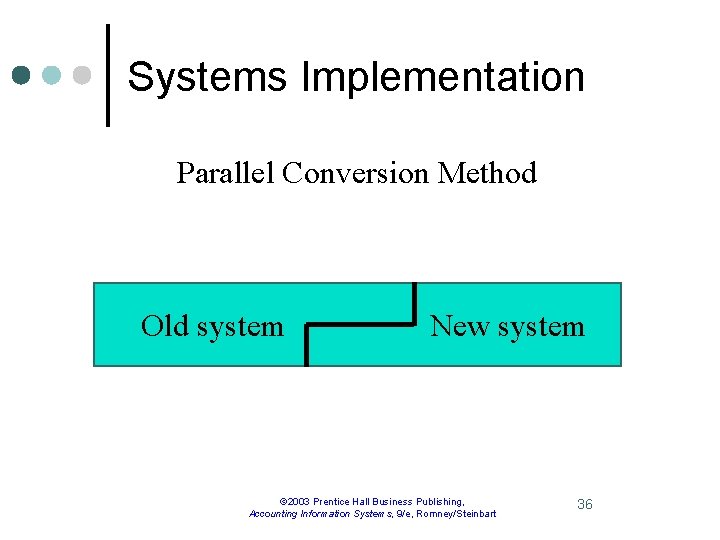
Systems Implementation Parallel Conversion Method Old system New system © 2003 Prentice Hall Business Publishing, Accounting Information Systems, 9/e, Romney/Steinbart 36
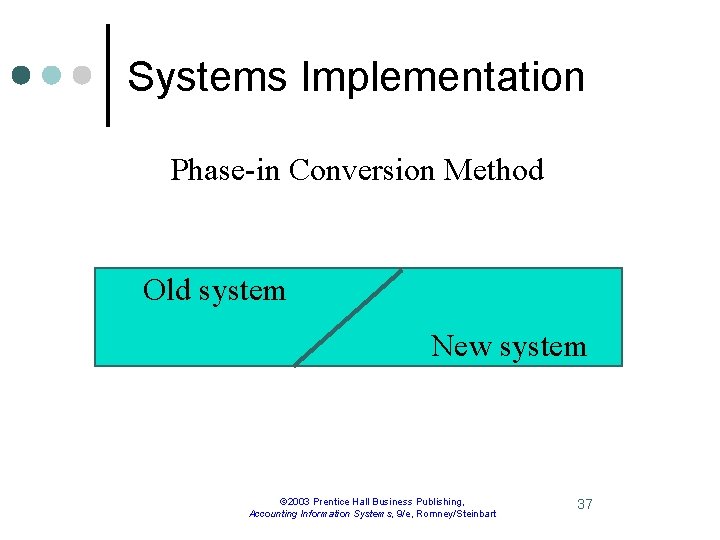
Systems Implementation Phase-in Conversion Method Old system New system © 2003 Prentice Hall Business Publishing, Accounting Information Systems, 9/e, Romney/Steinbart 37
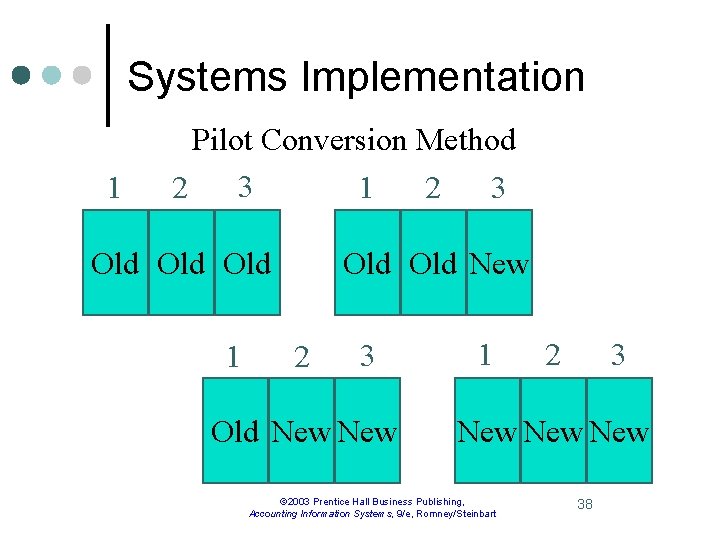
Systems Implementation 1 Pilot Conversion Method 3 2 1 2 3 Old Old 1 Old New 2 3 Old New 1 2 3 New New © 2003 Prentice Hall Business Publishing, Accounting Information Systems, 9/e, Romney/Steinbart 38
Systems Implementation: Data Conversion ¢ Data files may need to be modified in three ways: 1. 2. 3. Files may be moved to a different storage Data content may be changed File format may be changed © 2003 Prentice Hall Business Publishing, Accounting Information Systems, 9/e, Romney/Steinbart 39
Learning Objective 4 Discuss the systems operation and maintenance process and the activities in this phase. © 2003 Prentice Hall Business Publishing, Accounting Information Systems, 9/e, Romney/Steinbart 40
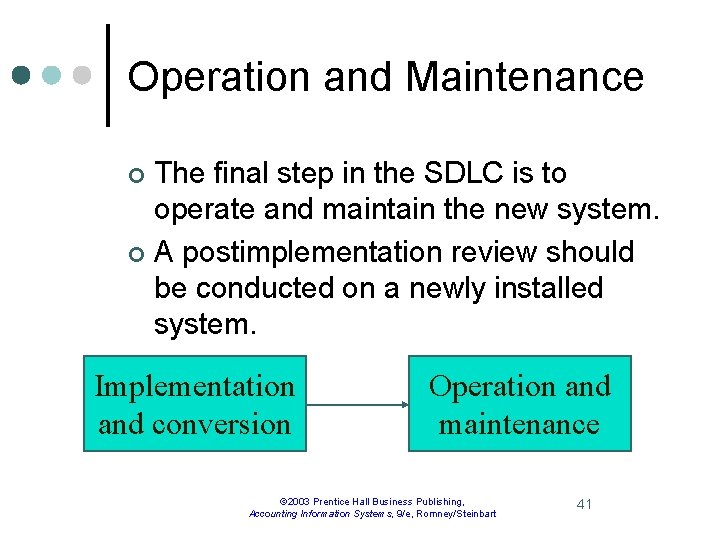
Operation and Maintenance The final step in the SDLC is to operate and maintain the new system. ¢ A postimplementation review should be conducted on a newly installed system. ¢ Implementation and conversion Operation and maintenance © 2003 Prentice Hall Business Publishing, Accounting Information Systems, 9/e, Romney/Steinbart 41
Operation and Maintenance What are some factors to consider during the postimplementation review? üGoals and objectives üControls and security üSatisfaction üErrors üBenefits üTraining üCosts üCommunications üReliability üOrganizational changes üDocumentation üAccuracy üTimeliness üCompatibility © 2003 Prentice Hall Business Publishing, Accounting Information Systems, 9/e, Romney/Steinbart 42
Case Conclusion ¢ Did Ann buy a software package? l l l No. The team developed conceptual design specifications for the output, input, processing, and data storage elements. The company decided to utilize screenbased output as much as possible and to capture data electronically. © 2003 Prentice Hall Business Publishing, Accounting Information Systems, 9/e, Romney/Steinbart 43
Case Conclusion ¢ ¢ During physical design, the development team designed each report identified during conceptual design. What format did they use? – – ¢ Screen Hard copy What conversion strategy did Ann use? – Parallel © 2003 Prentice Hall Business Publishing, Accounting Information Systems, 9/e, Romney/Steinbart 44
End of Chapter 18 © 2003 Prentice Hall Business Publishing, Accounting Information Systems, 9/e, Romney/Steinbart 45
- Slides: 45