
Accounting Information System Week 01 Introduction Business Processes
Accounting Information System Week 01 Introduction & Business Processes
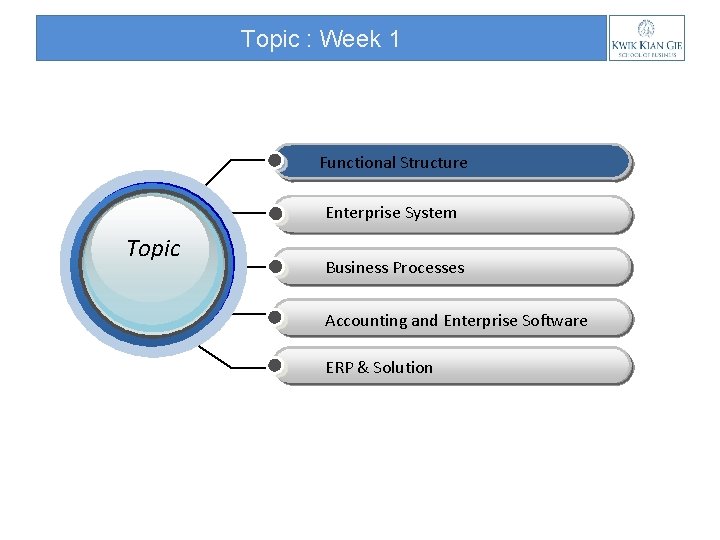
Topic : Week 1 Functional Structure Enterprise System Topic Business Processes Accounting and Enterprise Software ERP & Solution
Learning Objective After completing this session you will be able to: 1. Define the functional organizational structure, and explain why this structure creates problems for modern businesses. 2. Describe key business processes in an organization. 3. Identify the main integration points between and among processes. 4. Understand the cross-functional nature of processes and their relationship to organizational areas. 5. Adopt and apply an integrated perspective to business processes. 6. Describe organizational structure of Global Bike Incorporated. 7. Explain how the SAP® ERP system promotes an integrated approach to business processes.
Introduction to Business Processes The course for which you are using this textbook deals with integrated business processes and the enterprise systems (ES) that support them. The concepts and skills you will gain from this course are different from what you have experienced previously, and you will need to approach this course with a different perspective.
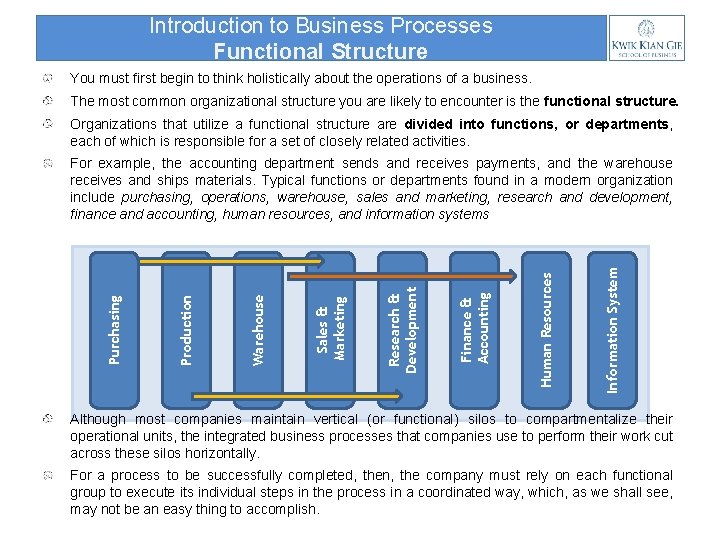
Introduction to Business Processes Functional Structure You must first begin to think holistically about the operations of a business. The most common organizational structure you are likely to encounter is the functional structure. Organizations that utilize a functional structure are divided into functions, or departments, each of which is responsible for a set of closely related activities. Information System Human Resources Finance & Accounting Research & Development Sales & Marketing Warehouse Production Purchasing For example, the accounting department sends and receives payments, and the warehouse receives and ships materials. Typical functions or departments found in a modern organization include purchasing, operations, warehouse, sales and marketing, research and development, finance and accounting, human resources, and information systems Although most companies maintain vertical (or functional) silos to compartmentalize their operational units, the integrated business processes that companies use to perform their work cut across these silos horizontally. For a process to be successfully completed, then, the company must rely on each functional group to execute its individual steps in the process in a coordinated way, which, as we shall see, may not be an easy thing to accomplish.
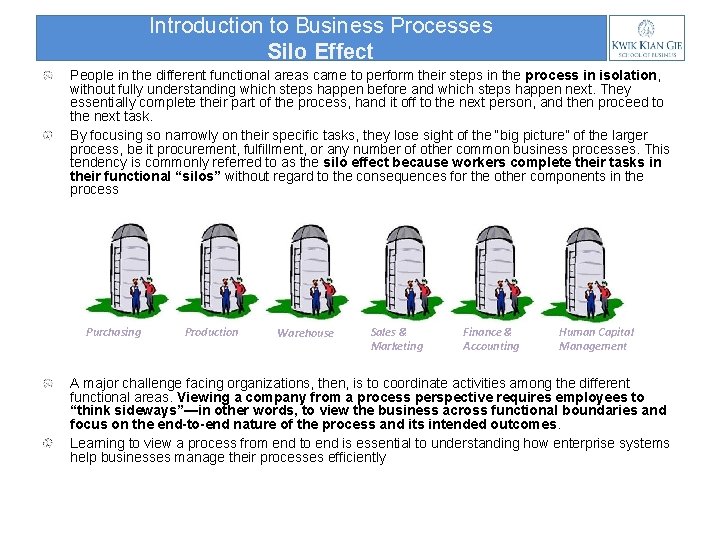
Introduction to Business Processes Silo Effect People in the different functional areas came to perform their steps in the process in isolation, without fully understanding which steps happen before and which steps happen next. They essentially complete their part of the process, hand it off to the next person, and then proceed to the next task. By focusing so narrowly on their specific tasks, they lose sight of the “big picture” of the larger process, be it procurement, fulfillment, or any number of other common business processes. This tendency is commonly referred to as the silo effect because workers complete their tasks in their functional “silos” without regard to the consequences for the other components in the process Purchasing Production Warehouse Sales & Marketing Finance & Accounting Human Capital Management A major challenge facing organizations, then, is to coordinate activities among the different functional areas. Viewing a company from a process perspective requires employees to “think sideways”—in other words, to view the business across functional boundaries and focus on the end-to-end nature of the process and its intended outcomes. Learning to view a process from end to end is essential to understanding how enterprise systems help businesses manage their processes efficiently
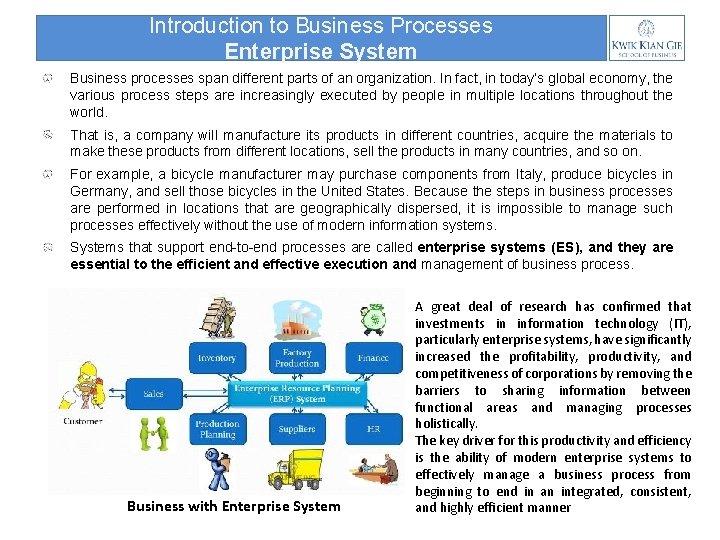
Introduction to Business Processes Enterprise System Business processes span different parts of an organization. In fact, in today’s global economy, the various process steps are increasingly executed by people in multiple locations throughout the world. That is, a company will manufacture its products in different countries, acquire the materials to make these products from different locations, sell the products in many countries, and so on. For example, a bicycle manufacturer may purchase components from Italy, produce bicycles in Germany, and sell those bicycles in the United States. Because the steps in business processes are performed in locations that are geographically dispersed, it is impossible to manage such processes effectively without the use of modern information systems. Systems that support end-to-end processes are called enterprise systems (ES), and they are essential to the efficient and effective execution and management of business process. Business with Enterprise System A great deal of research has confirmed that investments in information technology (IT), particularly enterprise systems, have significantly increased the profitability, productivity, and competitiveness of corporations by removing the barriers to sharing information between functional areas and managing processes holistically. The key driver for this productivity and efficiency is the ability of modern enterprise systems to effectively manage a business process from beginning to end in an integrated, consistent, and highly efficient manner
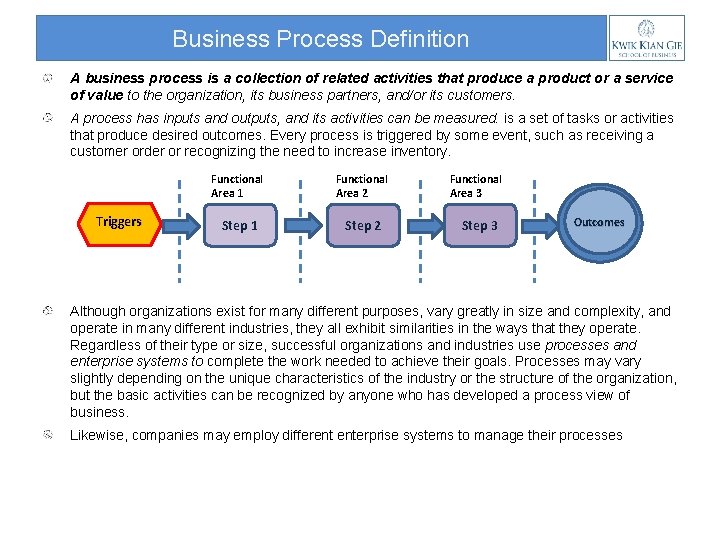
Business Process Definition A business process is a collection of related activities that produce a product or a service of value to the organization, its business partners, and/or its customers. A process has inputs and outputs, and its activities can be measured. is a set of tasks or activities that produce desired outcomes. Every process is triggered by some event, such as receiving a customer order or recognizing the need to increase inventory. Triggers Functional Area 1 Functional Area 2 Step 1 Step 2 Functional Area 3 Step 3 Outcomes Although organizations exist for many different purposes, vary greatly in size and complexity, and operate in many different industries, they all exhibit similarities in the ways that they operate. Regardless of their type or size, successful organizations and industries use processes and enterprise systems to complete the work needed to achieve their goals. Processes may vary slightly depending on the unique characteristics of the industry or the structure of the organization, but the basic activities can be recognized by anyone who has developed a process view of business. Likewise, companies may employ different enterprise systems to manage their processes
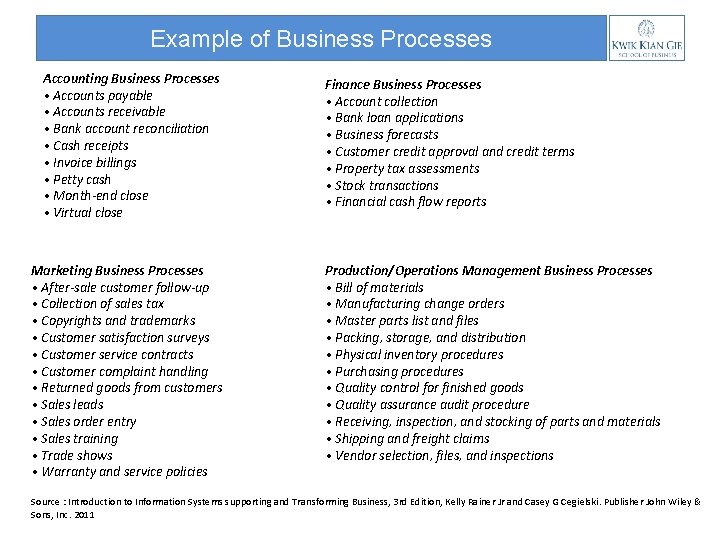
Example of Business Processes Accounting Business Processes • Accounts payable • Accounts receivable • Bank account reconciliation • Cash receipts • Invoice billings • Petty cash • Month-end close • Virtual close Marketing Business Processes • After-sale customer follow-up • Collection of sales tax • Copyrights and trademarks • Customer satisfaction surveys • Customer service contracts • Customer complaint handling • Returned goods from customers • Sales leads • Sales order entry • Sales training • Trade shows • Warranty and service policies Finance Business Processes • Account collection • Bank loan applications • Business forecasts • Customer credit approval and credit terms • Property tax assessments • Stock transactions • Financial cash flow reports Production/Operations Management Business Processes • Bill of materials • Manufacturing change orders • Master parts list and files • Packing, storage, and distribution • Physical inventory procedures • Purchasing procedures • Quality control for finished goods • Quality assurance audit procedure • Receiving, inspection, and stocking of parts and materials • Shipping and freight claims • Vendor selection, files, and inspections Source : Introduction to Information Systems supporting and Transforming Business, 3 rd Edition, Kelly Rainer Jr and Casey G Cegielski. Publisher John Wiley & Sons, Inc. 2011
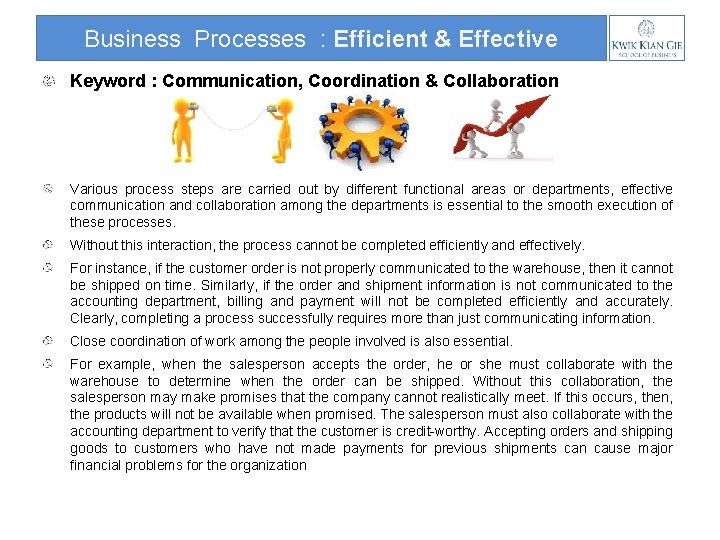
Business Processes : Efficient & Effective Keyword : Communication, Coordination & Collaboration Various process steps are carried out by different functional areas or departments, effective communication and collaboration among the departments is essential to the smooth execution of these processes. Without this interaction, the process cannot be completed efficiently and effectively. For instance, if the customer order is not properly communicated to the warehouse, then it cannot be shipped on time. Similarly, if the order and shipment information is not communicated to the accounting department, billing and payment will not be completed efficiently and accurately. Clearly, completing a process successfully requires more than just communicating information. Close coordination of work among the people involved is also essential. For example, when the salesperson accepts the order, he or she must collaborate with the warehouse to determine when the order can be shipped. Without this collaboration, the salesperson may make promises that the company cannot realistically meet. If this occurs, then, the products will not be available when promised. The salesperson must also collaborate with the accounting department to verify that the customer is credit-worthy. Accepting orders and shipping goods to customers who have not made payments for previous shipments can cause major financial problems for the organization
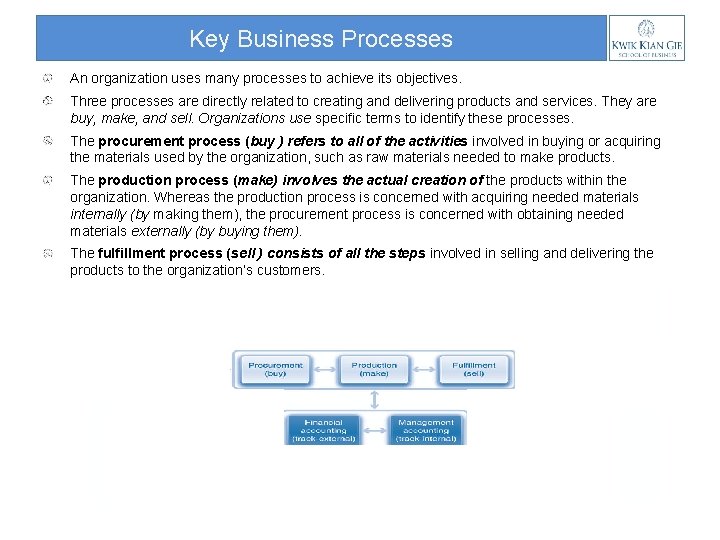
Key Business Processes An organization uses many processes to achieve its objectives. Three processes are directly related to creating and delivering products and services. They are buy, make, and sell. Organizations use specific terms to identify these processes. The procurement process (buy ) refers to all of the activities involved in buying or acquiring the materials used by the organization, such as raw materials needed to make products. The production process (make) involves the actual creation of the products within the organization. Whereas the production process is concerned with acquiring needed materials internally (by making them), the procurement process is concerned with obtaining needed materials externally (by buying them). The fulfillment process (sell ) consists of all the steps involved in selling and delivering the products to the organization’s customers.
Key Business Processes All these processes have an impact on an organization’s finance. This brings us to the last two processes, which track the financial impacts of processes. 1. Financial accounting (FI) processes (track–external ) track the financial impacts of process steps with the goal of meeting legal reporting requirements—for example, the Internal Revenue Service (IRS) or the Securities and Exchange Commission ( SEC). 2. Management accounting or controlling (CO) processes (track–internal ) focus on internal reporting to manage costs and revenues.
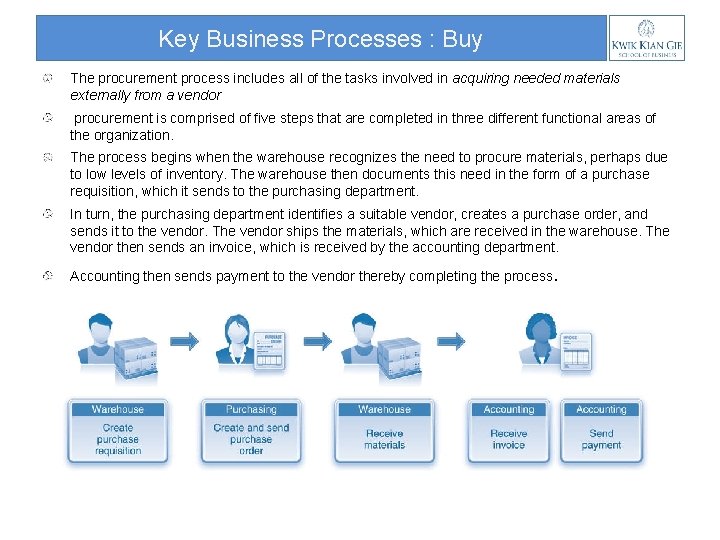
Key Business Processes : Buy The procurement process includes all of the tasks involved in acquiring needed materials externally from a vendor procurement is comprised of five steps that are completed in three different functional areas of the organization. The process begins when the warehouse recognizes the need to procure materials, perhaps due to low levels of inventory. The warehouse then documents this need in the form of a purchase requisition, which it sends to the purchasing department. In turn, the purchasing department identifies a suitable vendor, creates a purchase order, and sends it to the vendor. The vendor ships the materials, which are received in the warehouse. The vendor then sends an invoice, which is received by the accounting department. Accounting then sends payment to the vendor thereby completing the process.
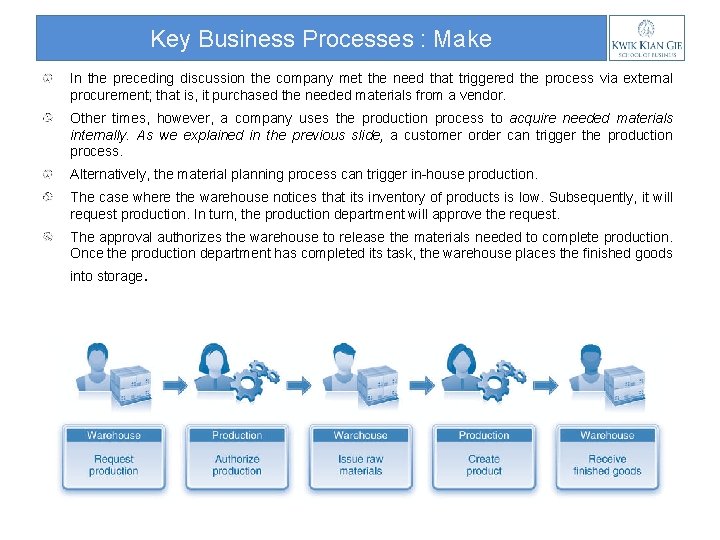
Key Business Processes : Make In the preceding discussion the company met the need that triggered the process via external procurement; that is, it purchased the needed materials from a vendor. Other times, however, a company uses the production process to acquire needed materials internally. As we explained in the previous slide, a customer order can trigger the production process. Alternatively, the material planning process can trigger in-house production. The case where the warehouse notices that its inventory of products is low. Subsequently, it will request production. In turn, the production department will approve the request. The approval authorizes the warehouse to release the materials needed to complete production. Once the production department has completed its task, the warehouse places the finished goods into storage.
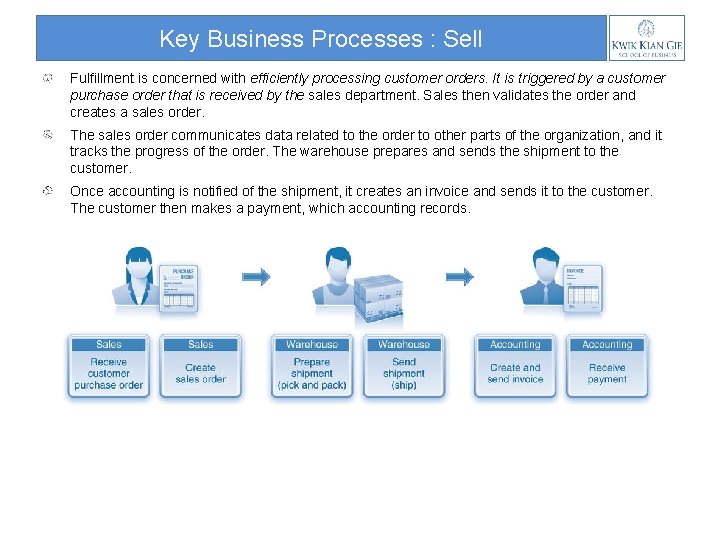
Key Business Processes : Sell Fulfillment is concerned with efficiently processing customer orders. It is triggered by a customer purchase order that is received by the sales department. Sales then validates the order and creates a sales order. The sales order communicates data related to the order to other parts of the organization, and it tracks the progress of the order. The warehouse prepares and sends the shipment to the customer. Once accounting is notified of the shipment, it creates an invoice and sends it to the customer. The customer then makes a payment, which accounting records.
Accounting and Enterprise Software Because of the repetitive nature of many tasks in accounting, it is not surprising that these tasks have been automated. With advances in hardware and software technology, accounting software has become increasingly sophisticated and customized for specificindustry needs. Initially, accounting software packages were very basic. Typically they simply processed bookkeeping transactions for businesses. Now, accounting and enterprise-wide software incredibly powerful, complex, and are capable of collecting a wide variety of data to support business decisions for multinational firms that operate globally and require information in various foreign languages and currencies. Today, accounting software is evolving into yet another phase as these business solutions become a part (module) of integrated enterprise software called enterprise resource planning (ERP) systems. Examples include financial functions interfaced with manufacturing, sales and distribution, human resources applications, and others. The argest enterprises today, realizing the benefits of integrating their information systems, extend their ERP systems up and down their supply chains. This chapter discusses various aspects of integrated accounting software and enterprise-wide systems in some detail, including their functionality, architecture, impact on business processes, and associated costs and benefits. Because the impact of enterprise-wide software packages is so important to accountants, we cover this software in depth. Source : Introduction to Information Systems supporting and Transforming Business, 3 rd Edition, Kelly Rainer Jr and Casey G Cegielski. Publisher John Wiley & Sons, Inc. 2011
Accounting and Enterprise Software An organization’s information system must do much more than process strictly financial data. The capabilities of accounting software programs to process enterprise-wide data expand with the price and complexity of the software. Examples of software in this category, known as enterprise resource planning (ERP) systems, enterprise software, and business application suites include Microsoft Dynamics AX, SAP All-in-One, Sage MAS 500, Net. Suite Enterprise Solution, Exact Synergy, Infor Enterprise Solutions, Epicor, and Oracle. Two important features of this type of technology are its integration and a central database. Typically, the software integrates the financial or accounting subsystem with customer relationship management (CRM), business services, human resources (HR), and supply chain management (SCM). Because SAP’s high-end products can cost millions of dollars to implement, they are mostly used by the world’s largest business organizations. Large-scale ERP software forces companies to reengineer or redesign their business processes for maximum efficiency. Such multinational corporations as Eastman Kodak Company, Owens-Corning Fiberglass Corporation, and Procter and Gamble have spent millions of dollars implementing SAP for its potential cost savings. Cost savings (discussed in detail later in the chapter) often come from streamlining, speeding, or consolidating processes. Source : Introduction to Information Systems supporting and Transforming Business, 3 rd Edition, Kelly Rainer Jr and Casey G Cegielski. Publisher John Wiley & Sons, Inc. 2011
Accounting and Enterprise Software Benefits of ERPs. Despite the high costs, there are many compelling reasons to implement an ERP system. These benefits can sometimes be difficult to quantify. For example, how can you estimate precisely what dollar benefit arises from improved decisionmaking or more satisfied customers? On the other hand, management might decide the business imperative to integrate an organization’s IT systems is to match competitors. Typically, most organizations make an attempt to identify the benefits they expect from the new ERP system. Many of the benefits are from cost reductions, such as reductions in inventory and employees. Spend management describes an approach to cutting expenses to their bare minimum. These include reducing employee travel expenses, procurement expenses, and even the costs associated with invoice processing. Source : Introduction to Information Systems supporting and Transforming Business, 3 rd Edition, Kelly Rainer Jr and Casey G Cegielski. Publisher John Wiley & Sons, Inc. 2011
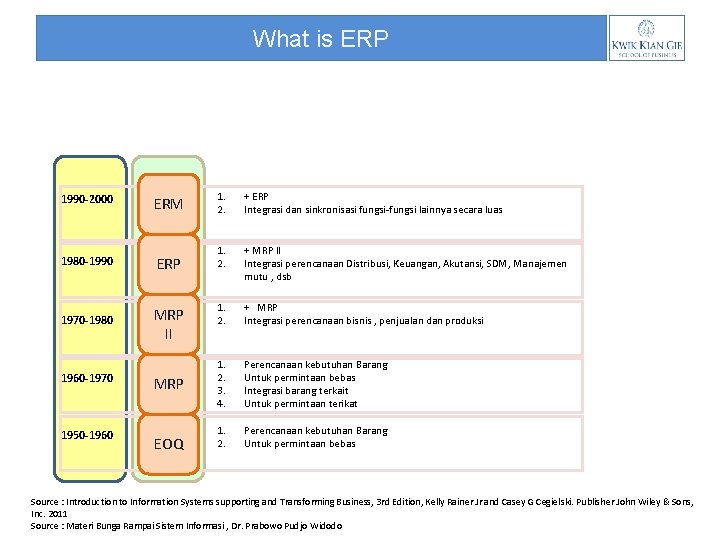
What is ERP ERM 1. 2. + ERP Integrasi dan sinkronisasi fungsi-fungsi lainnya secara luas 1980 -1990 ERP 1. 2. + MRP II Integrasi perencanaan Distribusi, Keuangan, Akutansi, SDM, Manajemen mutu , dsb 1970 -1980 MRP II 1. 2. + MRP Integrasi perencanaan bisnis , penjualan dan produksi 1. 2. 3. 4. Perencanaan kebutuhan Barang Untuk permintaan bebas Integrasi barang terkait Untuk permintaan terikat 1. 2. Perencanaan kebutuhan Barang Untuk permintaan bebas 1990 -2000 1960 -1970 1950 -1960 MRP EOQ Source : Introduction to Information Systems supporting and Transforming Business, 3 rd Edition, Kelly Rainer Jr and Casey G Cegielski. Publisher John Wiley & Sons, Inc. 2011 Source : Materi Bunga Rampai Sistem Informasi , Dr. Prabowo Pudjo Widodo
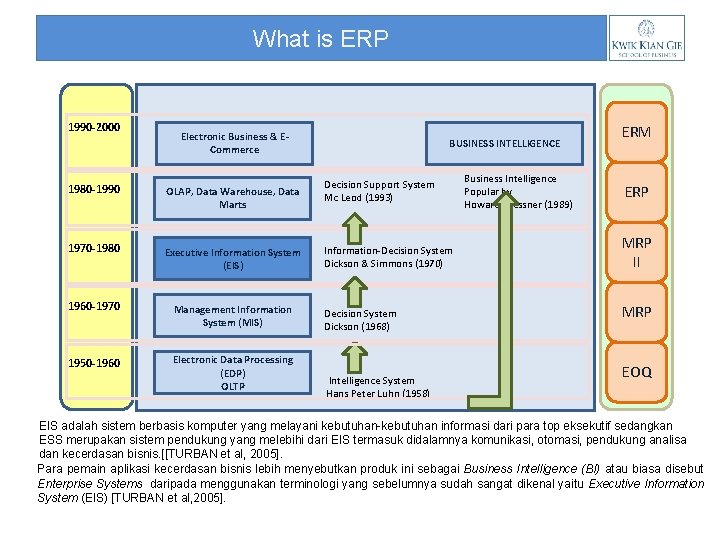
What is ERP 1990 -2000 Electronic Business & ECommerce 1980 -1990 OLAP, Data Warehouse, Data Marts 1970 -1980 Executive Information System (EIS) 1960 -1970 Management Information System (MIS) 1950 -1960 Electronic Data Processing (EDP) OLTP BUSINESS INTELLIGENCE Decision Support System Mc Leod (1993) Information-Decision System Dickson & Simmons (1970) Decision System Dickson (1968) Intelligence System Hans Peter Luhn (1958) Business Intelligence Popular by Howard Dressner (1989) ERM ERP MRP II MRP EOQ EIS adalah sistem berbasis komputer yang melayani kebutuhan-kebutuhan informasi dari para top eksekutif sedangkan ESS merupakan sistem pendukung yang melebihi dari EIS termasuk didalamnya komunikasi, otomasi, pendukung analisa dan kecerdasan bisnis. [[TURBAN et al, 2005]. Para pemain aplikasi kecerdasan bisnis lebih menyebutkan produk ini sebagai Business Intelligence (BI) atau biasa disebut Enterprise Systems daripada menggunakan terminologi yang sebelumnya sudah sangat dikenal yaitu Executive Information System (EIS) [TURBAN et al, 2005].
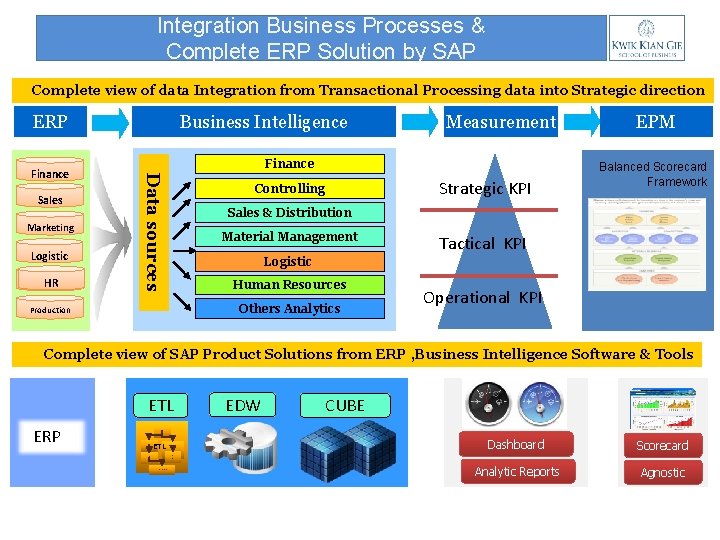
Integration Business Processes & Complete ERP Solution by SAP Complete view of data Integration from Transactional Processing data into Strategic direction ERP Sales Marketing Logistic HR Measurement Finance Data sources Finance Business Intelligence Controlling Strategic KPI EPM Balanced Scorecard Framework Sales & Distribution Material Management Tactical KPI Logistic Human Resources Others Analytics Production Operational KPI Complete view of SAP Product Solutions from ERP , Business Intelligence Software & Tools ETL ERP EDW CUBE タ ス ク ETL タ ス ク Dashboard Scorecard Analytic Reports Agnostic タ ス ク データ フロー タスク
- Slides: 21