
ACCOUNTING GRADE 10 FINAL ACCOUNTS At the end

![NEW EXPENSES [GAAP – Prudence] v Trading Stock Deficit – stock disappears from](https://slidetodoc.com/presentation_image_h2/a0403928d04fd587fb5f7b2d7282d0c4/image-7.jpg "NEW EXPENSES [GAAP – Prudence] v Trading Stock Deficit – stock disappears from")



- Slides: 28
ACCOUNTING GRADE 10 FINAL ACCOUNTS At the end of the accounting period or end of the financial year, the final accounts are prepared for the owner. REASON: To determine how much profit the business has made, so that he knows how much money he can take out as drawings and how much tax he personally will have to pay. To determine whether the business has been managed properly and has improved from the previous year, or whether changes must be made to improve profitability.
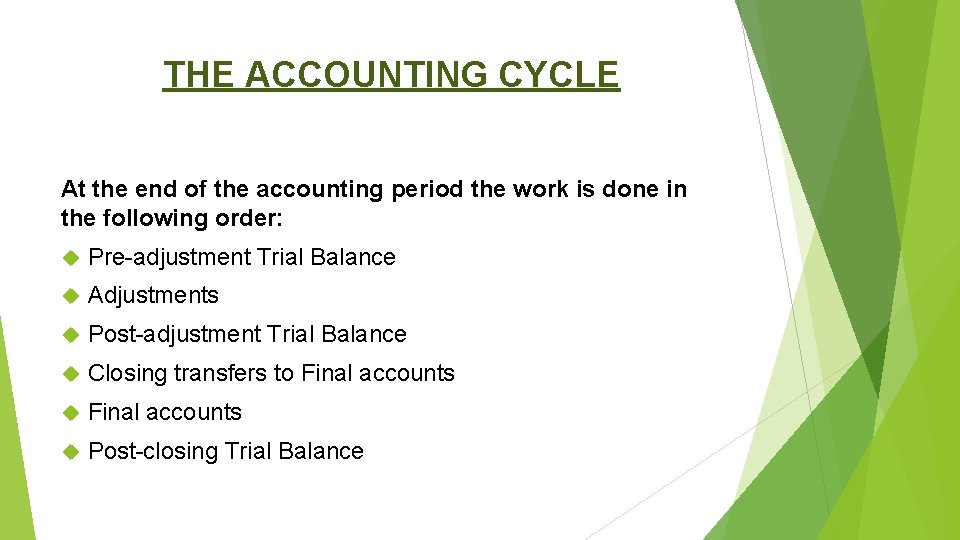
THE ACCOUNTING CYCLE At the end of the accounting period the work is done in the following order: Pre-adjustment Trial Balance Adjustments Post-adjustment Trial Balance Closing transfers to Final accounts Post-closing Trial Balance
PRE-ADJUSTMENT TRIAL BALANCE After all the journals have been posted to the accounts in the General Ledger, a Trial Balance is drawn up to make sure that the books balance. i. e. the debit total equals the credit total. This is a control measure to ensure that the books and the final results are accurate.
ADJUSTMENTS Journal entries are made to adjust the books so that they comply with all aspects of GAAP. They are done before the closing transfers. It is impossible for all the totals and balances of the accounts to be 100% correct on the last day of the accounting period because: v Consumables bought have not all been used, e. g. packing material, fuel, stationery. v Expenses have been paid for the next accounting period e. g. insurance.
v Income has been earned, but not yet received e. g. interest on fixed deposit. v Some expenses have not been paid by the year-end e. g. telephone. v Payment has been received for a service, but the service has not been provided yet e. g. rent income. v Trading stock account does not tally with actual stock available (physical stock-taking) i. e. there is a deficit, or there is surplus stock on hand. v Fixed assets must be depreciated.
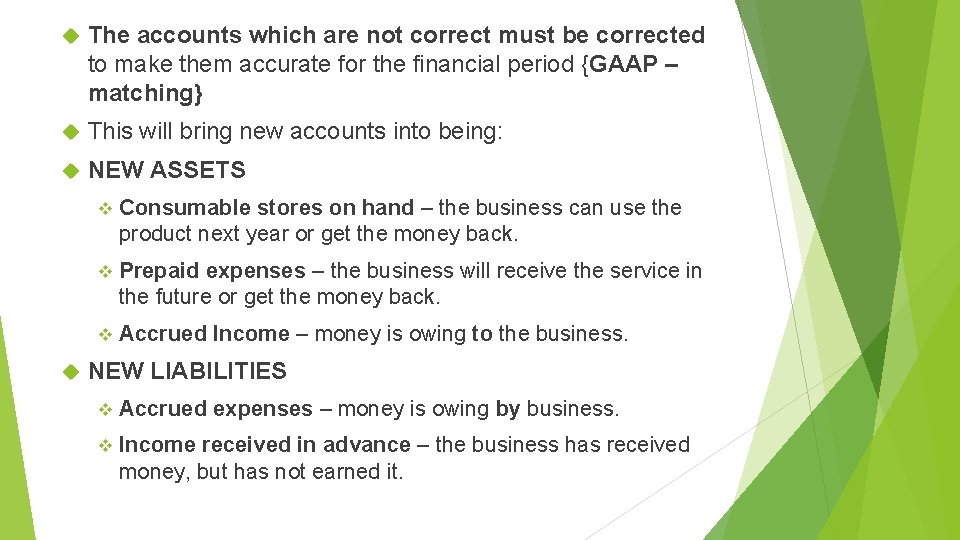
The accounts which are not correct must be corrected to make them accurate for the financial period {GAAP – matching} This will bring new accounts into being: NEW ASSETS v Consumable stores on hand – the business can use the product next year or get the money back. v Prepaid expenses – the business will receive the service in the future or get the money back. v Accrued Income – money is owing to the business. NEW LIABILITIES v Accrued expenses – money is owing by business. v Income received in advance – the business has received money, but has not earned it.
NEW EXPENSES [GAAP – Prudence] v Trading Stock Deficit – stock disappears from the shelves, but as there was no break-in, the business cannot claim insurance. v Depreciation – reduction of the value of fixed assets because of normal ‘wear and tear’. NEW INCOME v Trading Stock Surplus – there would be more stock on the shelves than there should be. It would mean that maybe someone bought and paid for goods, but forgot to take them.
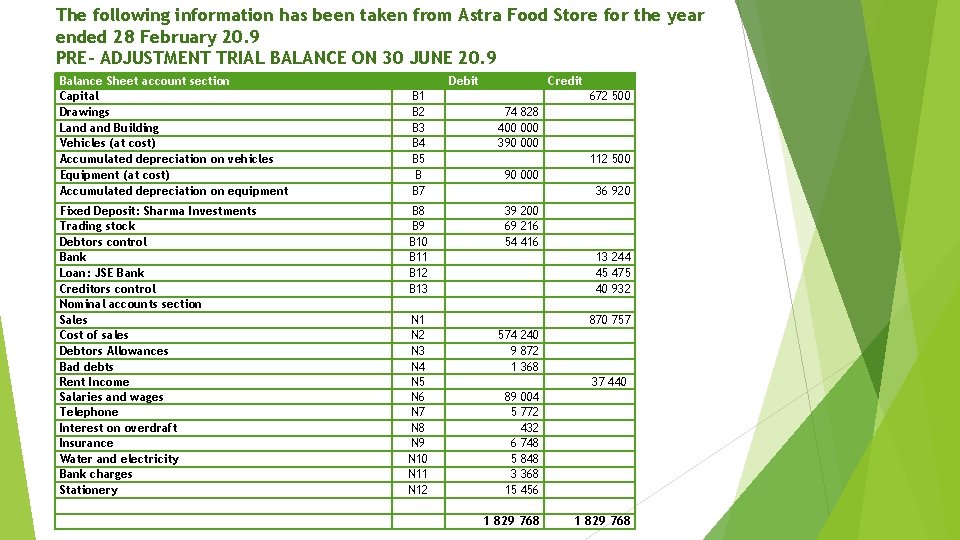
The following information has been taken from Astra Food Store for the year ended 28 February 20. 9 PRE- ADJUSTMENT TRIAL BALANCE ON 30 JUNE 20. 9 Balance Sheet account section Capital Drawings Land Building Vehicles (at cost) Accumulated depreciation on vehicles Equipment (at cost) Accumulated depreciation on equipment Fixed Deposit: Sharma Investments Trading stock Debtors control Bank Loan: JSE Bank Creditors control Nominal accounts section Sales Cost of sales Debtors Allowances Bad debts Rent Income Salaries and wages Telephone Interest on overdraft Insurance Water and electricity Bank charges Stationery Debit B 1 B 2 B 3 B 4 B 5 B B 7 B 8 B 9 B 10 B 11 B 12 B 13 N 1 N 2 N 3 N 4 N 5 N 6 N 7 N 8 N 9 N 10 N 11 N 12 Credit 672 500 74 828 400 000 390 000 112 500 90 000 36 920 39 200 69 216 54 416 13 244 45 475 40 932 870 757 574 240 9 872 1 368 37 440 89 004 5 772 432 6 748 5 848 3 368 15 456 1 829 768
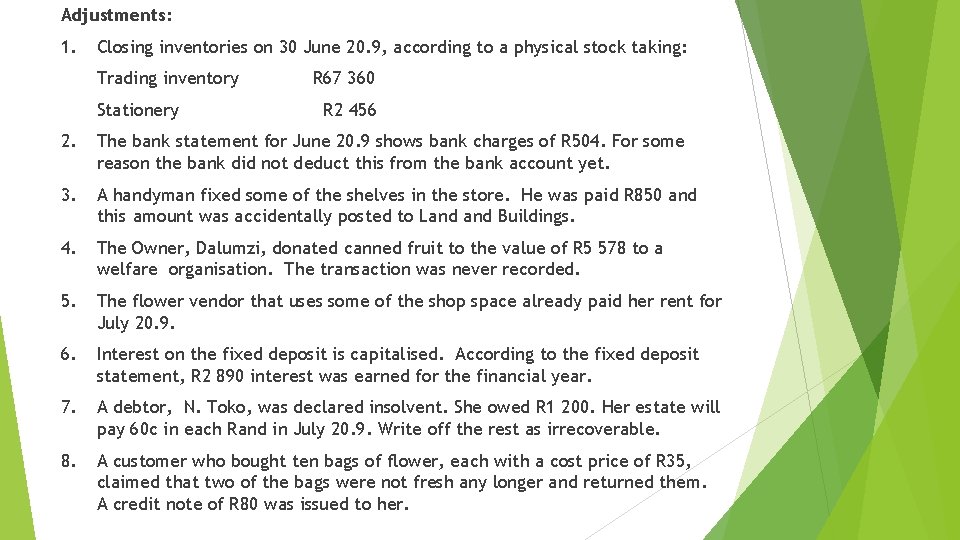
Adjustments: 1. Closing inventories on 30 June 20. 9, according to a physical stock taking: Trading inventory Stationery R 67 360 R 2 456 2. The bank statement for June 20. 9 shows bank charges of R 504. For some reason the bank did not deduct this from the bank account yet. 3. A handyman fixed some of the shelves in the store. He was paid R 850 and this amount was accidentally posted to Land Buildings. 4. The Owner, Dalumzi, donated canned fruit to the value of R 5 578 to a welfare organisation. The transaction was never recorded. 5. The flower vendor that uses some of the shop space already paid her rent for July 20. 9. 6. Interest on the fixed deposit is capitalised. According to the fixed deposit statement, R 2 890 interest was earned for the financial year. 7. A debtor, N. Toko, was declared insolvent. She owed R 1 200. Her estate will pay 60 c in each Rand in July 20. 9. Write off the rest as irrecoverable. 8. A customer who bought ten bags of flower, each with a cost price of R 35, claimed that two of the bags were not fresh any longer and returned them. A credit note of R 80 was issued to her.
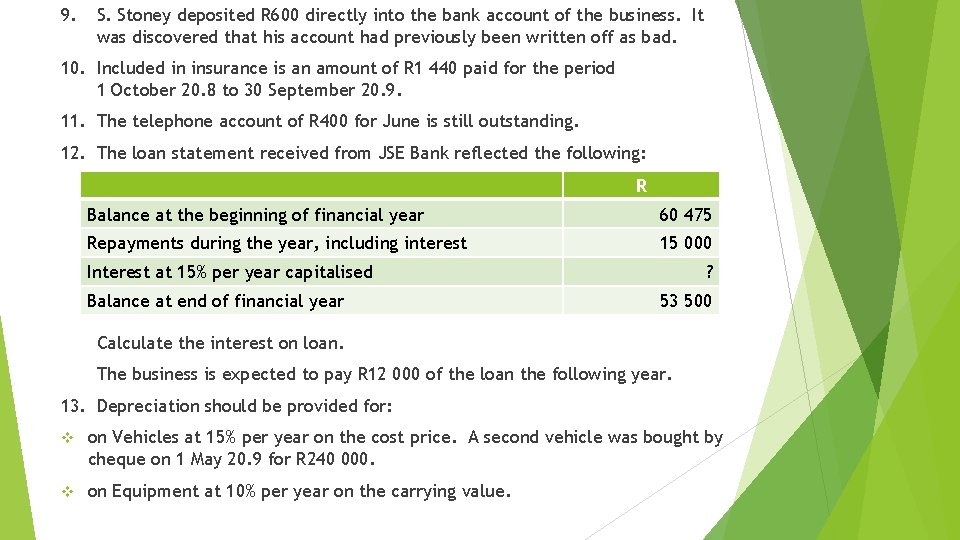
9. S. Stoney deposited R 600 directly into the bank account of the business. It was discovered that his account had previously been written off as bad. 10. Included in insurance is an amount of R 1 440 paid for the period 1 October 20. 8 to 30 September 20. 9. 11. The telephone account of R 400 for June is still outstanding. 12. The loan statement received from JSE Bank reflected the following: R Balance at the beginning of financial year 60 475 Repayments during the year, including interest 15 000 Interest at 15% per year capitalised Balance at end of financial year ? 53 500 Calculate the interest on loan. The business is expected to pay R 12 000 of the loan the following year. 13. Depreciation should be provided for: v on Vehicles at 15% per year on the cost price. A second vehicle was bought by cheque on 1 May 20. 9 for R 240 000. v on Equipment at 10% per year on the carrying value.
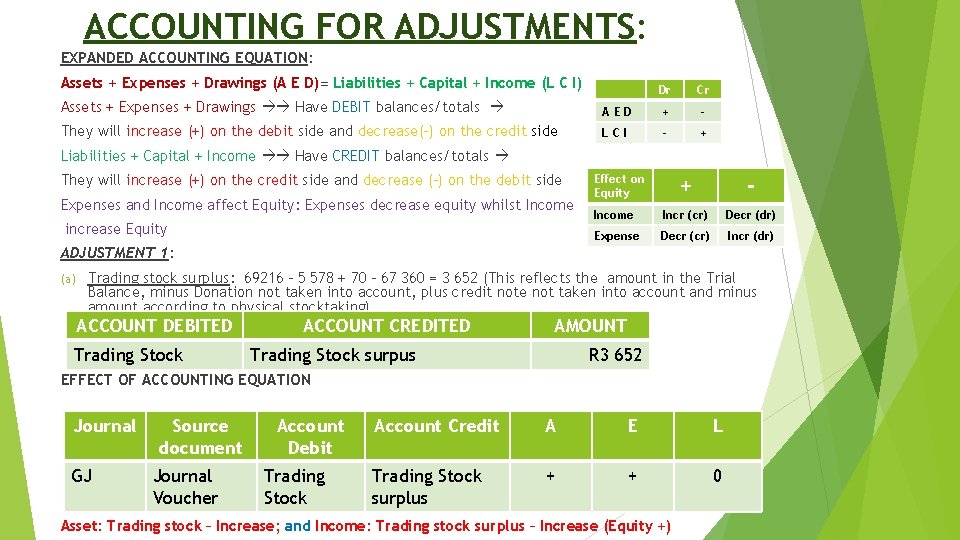
ACCOUNTING FOR ADJUSTMENTS: EXPANDED ACCOUNTING EQUATION: Assets + Expenses + Drawings (A E D)= Liabilities + Capital + Income (L C I) Dr Cr Assets + Expenses + Drawings Have DEBIT balances/totals AED + - They will increase (+) on the debit side and decrease(-) on the credit side LCI - + Liabilities + Capital + Income Have CREDIT balances/totals They will increase (+) on the credit side and decrease (-) on the debit side Expenses and Income affect Equity: Expenses decrease equity whilst Income increase Equity Effect on Equity + - Income Incr (cr) Decr (dr) Expense Decr (cr) Incr (dr) ADJUSTMENT 1: (a) Trading stock surplus: 69216 – 5 578 + 70 – 67 360 = 3 652 (This reflects the amount in the Trial Balance, minus Donation not taken into account, plus credit note not taken into account and minus amount according to physical stocktaking) ACCOUNT DEBITED Trading Stock ACCOUNT CREDITED AMOUNT Trading Stock surpus R 3 652 EFFECT OF ACCOUNTING EQUATION Journal GJ Source document Journal Voucher Account Debit Trading Stock Account Credit A E L Trading Stock surplus + + 0 Asset: Trading stock – Increase; and Income: Trading stock surplus – Increase (Equity +)
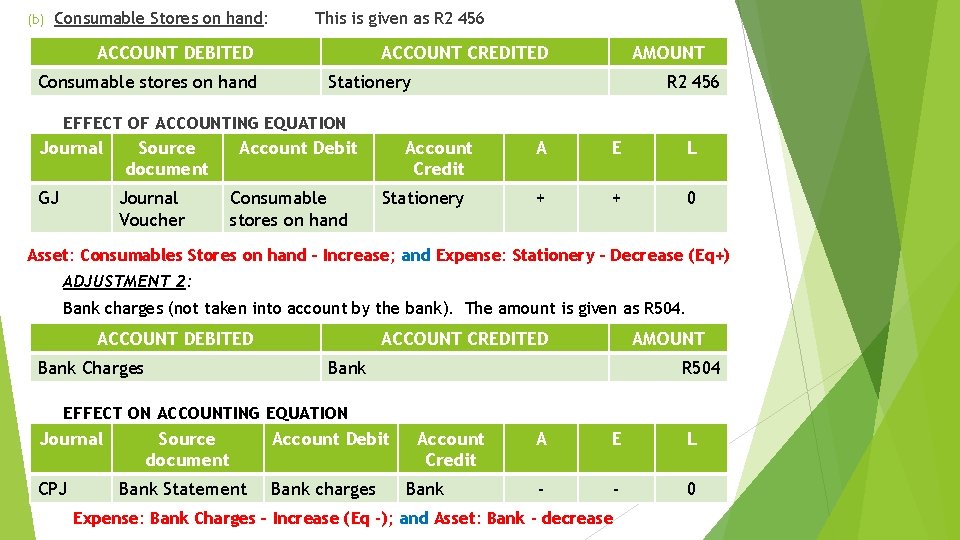
(b) Consumable Stores on hand: This is given as R 2 456 ACCOUNT DEBITED Consumable stores on hand ACCOUNT CREDITED AMOUNT Stationery R 2 456 EFFECT OF ACCOUNTING EQUATION Journal GJ Source document Journal Voucher Account Debit Consumable stores on hand Account Credit Stationery A E L + + 0 Asset: Consumables Stores on hand – Increase; and Expense: Stationery – Decrease (Eq+) ADJUSTMENT 2: Bank charges (not taken into account by the bank). The amount is given as R 504. ACCOUNT DEBITED Bank Charges ACCOUNT CREDITED AMOUNT Bank R 504 EFFECT ON ACCOUNTING EQUATION Journal CPJ Source document Bank Statement Account Debit Bank charges Account Credit Bank A E L - - 0 Expense: Bank Charges – Increase (Eq -); and Asset: Bank - decrease
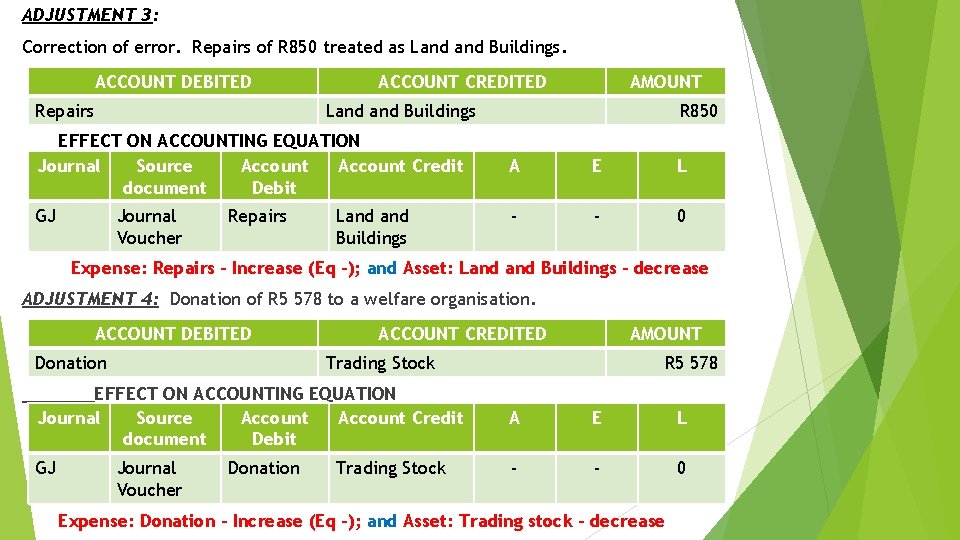
ADJUSTMENT 3: Correction of error. Repairs of R 850 treated as Land Buildings. ACCOUNT DEBITED Repairs ACCOUNT CREDITED AMOUNT Land Buildings R 850 EFFECT ON ACCOUNTING EQUATION Journal Source Account Credit document Debit A E L GJ - - 0 Journal Voucher Repairs Land Buildings Expense: Repairs – Increase (Eq -); and Asset: Land Buildings - decrease ADJUSTMENT 4: Donation of R 5 578 to a welfare organisation. ACCOUNT DEBITED Donation ACCOUNT CREDITED AMOUNT Trading Stock R 5 578 EFFECT ON ACCOUNTING EQUATION Journal Source Account Credit document Debit A E L GJ - - 0 Journal Voucher Donation Trading Stock Expense: Donation – Increase (Eq -); and Asset: Trading stock - decrease
ADJUSTMENT 5: Rent for July 20. 9 prepaid. R 37 440 paid for 13 months. This equals R 2 880 per month. ACCOUNT DEBITED Rent Income ACCOUNT CREDITED AMOUNT Income received in advance R 2 880 EFFECT ON ACCOUNTING EQUATION Journal Source Account Credit document Debit A E L GJ 0 - + Journal Voucher Rent Income received in adv Income: Rent Income – Decrease (Eq -); and Liability: Income Rec in Adv - increase ADJUSTMENT 6: Interest on fixed deposit of R 2 890 earned. ACCOUNT DEBITED Fixed deposit ACCOUNT CREDITED AMOUNT Interest on fixed deposit R 2 890 EFFECT ON ACCOUNTING EQUATION Journal Source Account Credit document Debit A E L GJ + + 0 Journal Voucher Fixed deposit Interest on Fixed deposit Asset: Fixed deposit – Increase ; and Income: Interest on Fix dep – increase (Eq +)
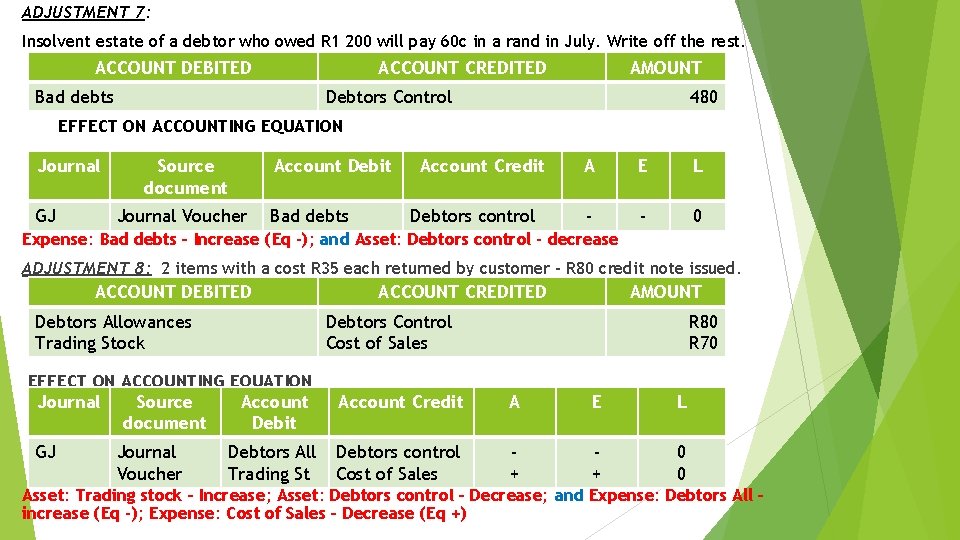
ADJUSTMENT 7: Insolvent estate of a debtor who owed R 1 200 will pay 60 c in a rand in July. Write off the rest. ACCOUNT DEBITED ACCOUNT CREDITED Bad debts AMOUNT Debtors Control 480 EFFECT ON ACCOUNTING EQUATION Journal GJ Source document Account Debit Journal Voucher Bad debts Account Credit Debtors control A E L - - 0 Expense: Bad debts – Increase (Eq -); and Asset: Debtors control - decrease ADJUSTMENT 8: 2 items with a cost R 35 each returned by customer – R 80 credit note issued. ACCOUNT DEBITED Debtors Allowances Trading Stock ACCOUNT CREDITED AMOUNT Debtors Control Cost of Sales R 80 R 70 EFFECT ON ACCOUNTING EQUATION Journal GJ Source document Journal Voucher Account Debit Account Credit A E L Debtors All Trading St Debtors control Cost of Sales + + 0 0 Asset: Trading stock – Increase; Asset: Debtors control – Decrease; and Expense: Debtors All – increase (Eq -); Expense: Cost of Sales – Decrease (Eq +)
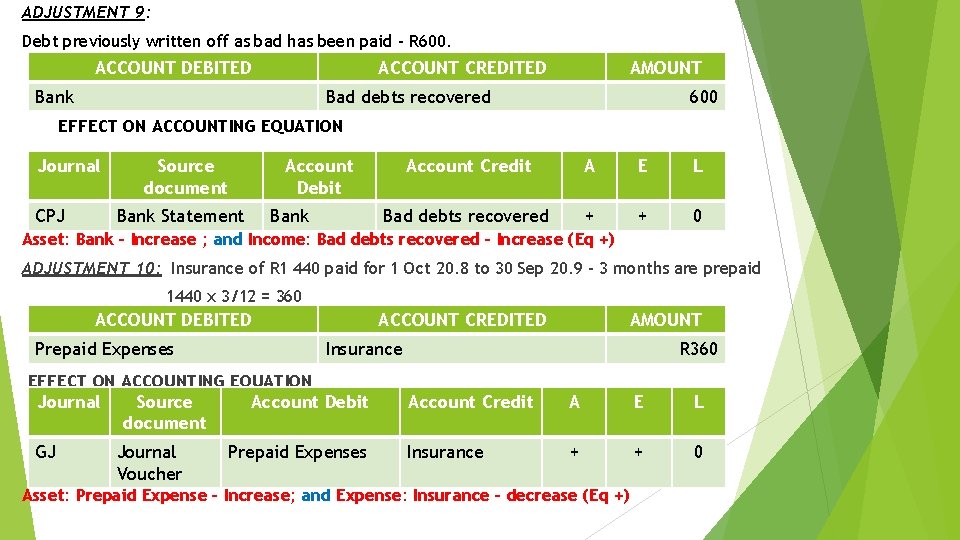
ADJUSTMENT 9: Debt previously written off as bad has been paid - R 600. ACCOUNT DEBITED ACCOUNT CREDITED Bank AMOUNT Bad debts recovered 600 EFFECT ON ACCOUNTING EQUATION Journal CPJ Source document Account Debit Bank Statement Bank Account Credit A E L Bad debts recovered + + 0 Asset: Bank – Increase ; and Income: Bad debts recovered – Increase (Eq +) ADJUSTMENT 10: Insurance of R 1 440 paid for 1 Oct 20. 8 to 30 Sep 20. 9 – 3 months are prepaid 1440 x 3/12 = 360 ACCOUNT DEBITED Prepaid Expenses ACCOUNT CREDITED AMOUNT Insurance R 360 EFFECT ON ACCOUNTING EQUATION Journal GJ Source document Journal Voucher Account Debit Prepaid Expenses Account Credit A E L Insurance + + 0 Asset: Prepaid Expense – Increase; and Expense: Insurance – decrease (Eq +)
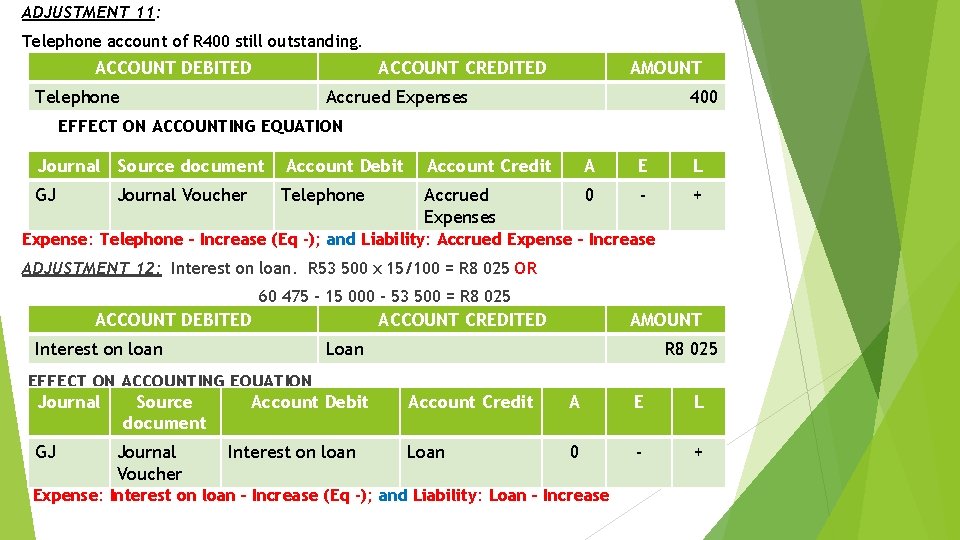
ADJUSTMENT 11: Telephone account of R 400 still outstanding. ACCOUNT DEBITED ACCOUNT CREDITED Telephone AMOUNT Accrued Expenses 400 EFFECT ON ACCOUNTING EQUATION Journal Source document Account Debit Account Credit A E L GJ Telephone Accrued Expenses 0 - + Journal Voucher Expense: Telephone – Increase (Eq -); and Liability: Accrued Expense – Increase ADJUSTMENT 12: Interest on loan. R 53 500 x 15/100 = R 8 025 OR 60 475 – 15 000 – 53 500 = R 8 025 ACCOUNT DEBITED Interest on loan ACCOUNT CREDITED AMOUNT Loan R 8 025 EFFECT ON ACCOUNTING EQUATION Journal GJ Source document Journal Voucher Account Debit Interest on loan Account Credit A E L Loan 0 - + Expense: Interest on loan – Increase (Eq -); and Liability: Loan – Increase
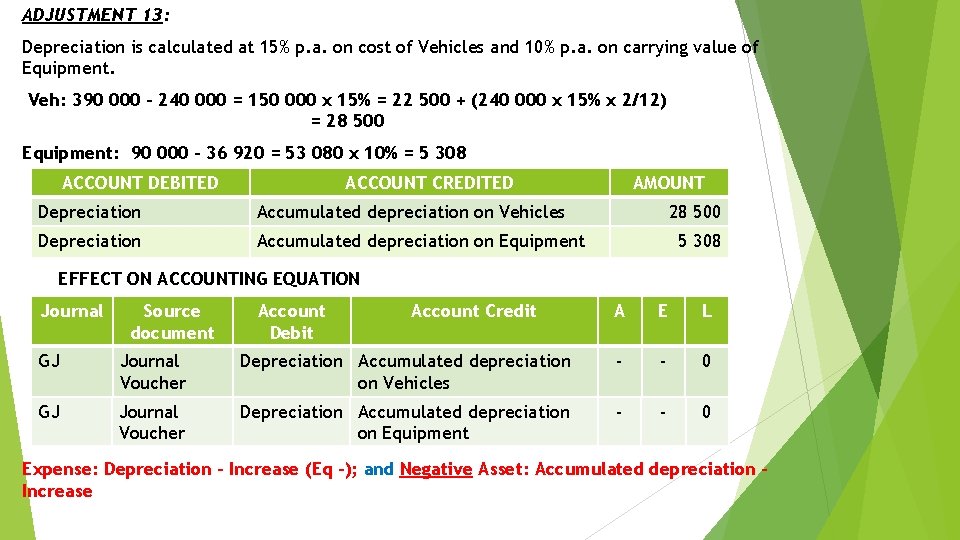
ADJUSTMENT 13: Depreciation is calculated at 15% p. a. on cost of Vehicles and 10% p. a. on carrying value of Equipment. Veh: 390 000 – 240 000 = 150 000 x 15% = 22 500 + (240 000 x 15% x 2/12) = 28 500 Equipment: 90 000 – 36 920 = 53 080 x 10% = 5 308 ACCOUNT DEBITED ACCOUNT CREDITED Depreciation Accumulated depreciation on Vehicles Depreciation Accumulated depreciation on Equipment AMOUNT 28 500 5 308 EFFECT ON ACCOUNTING EQUATION Journal Source document Account Debit Account Credit A E L GJ Journal Voucher Depreciation Accumulated depreciation on Vehicles - - 0 GJ Journal Voucher Depreciation Accumulated depreciation on Equipment - - 0 Expense: Depreciation – Increase (Eq -); and Negative Asset: Accumulated depreciation – Increase
POST-ADJUSTMENT TRIAL BALANCE After the adjustments have been completed, a Post adjustment Trial Balance is drawn up to make sure that the books still balance. This Trial Balance will have all the accounts in it. i. e. the Balance Sheet Accounts section including the new assets and liabilities for prepaid and accrued amounts, and the Nominal Accounts section including the new accounts for depreciation, trading stock deficit and trading stock surplus.
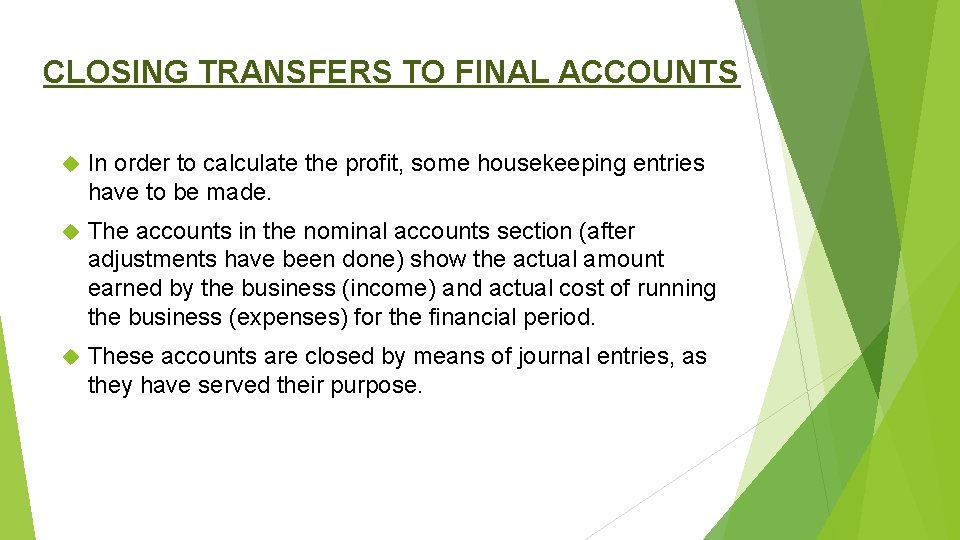
CLOSING TRANSFERS TO FINAL ACCOUNTS In order to calculate the profit, some housekeeping entries have to be made. The accounts in the nominal accounts section (after adjustments have been done) show the actual amount earned by the business (income) and actual cost of running the business (expenses) for the financial period. These accounts are closed by means of journal entries, as they have served their purpose.
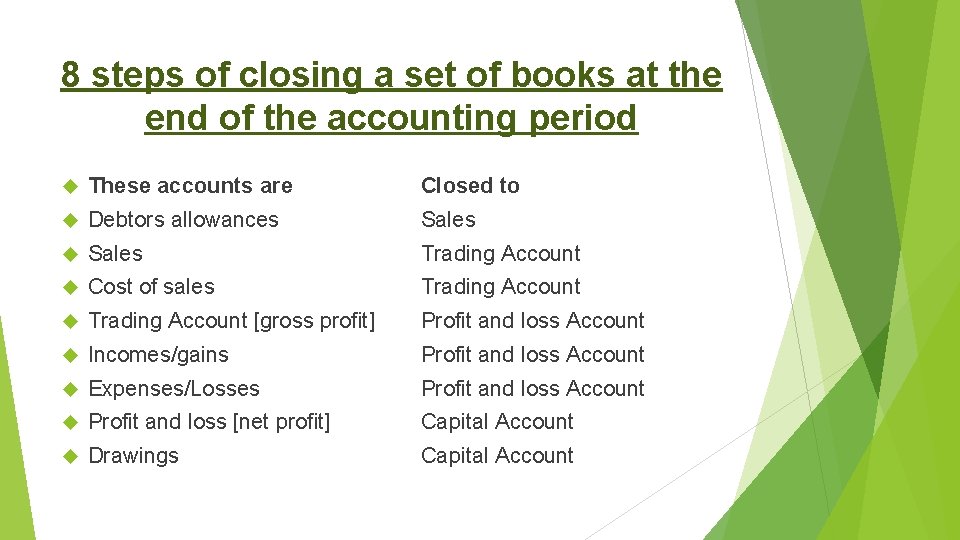
8 steps of closing a set of books at the end of the accounting period These accounts are Closed to Debtors allowances Sales Trading Account Cost of sales Trading Account [gross profit] Profit and loss Account Incomes/gains Profit and loss Account Expenses/Losses Profit and loss Account Profit and loss [net profit] Capital Account Drawings Capital Account
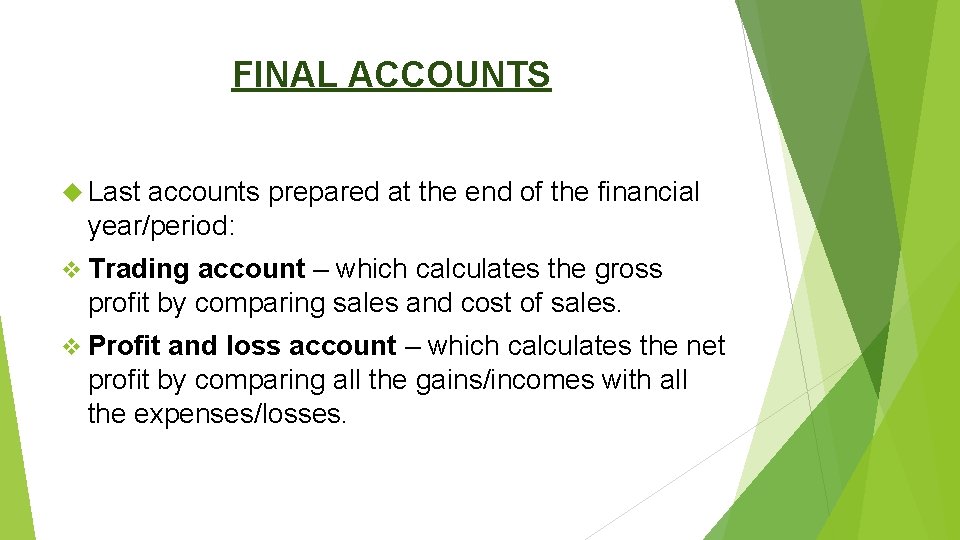
FINAL ACCOUNTS Last accounts prepared at the end of the financial year/period: v Trading account – which calculates the gross profit by comparing sales and cost of sales. v Profit and loss account – which calculates the net profit by comparing all the gains/incomes with all the expenses/losses.
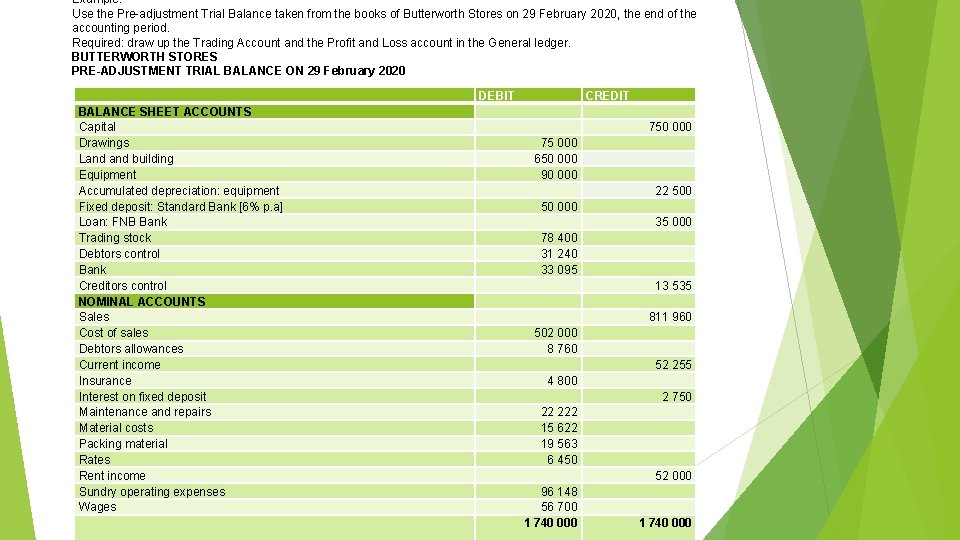
Example: Use the Pre-adjustment Trial Balance taken from the books of Butterworth Stores on 29 February 2020, the end of the accounting period. Required: draw up the Trading Account and the Profit and Loss account in the General ledger. BUTTERWORTH STORES PRE-ADJUSTMENT TRIAL BALANCE ON 29 February 2020 DEBIT BALANCE SHEET ACCOUNTS Capital Drawings Land building Equipment Accumulated depreciation: equipment Fixed deposit: Standard Bank [6% p. a] Loan: FNB Bank Trading stock Debtors control Bank Creditors control NOMINAL ACCOUNTS Sales Cost of sales Debtors allowances Current income Insurance Interest on fixed deposit Maintenance and repairs Material costs Packing material Rates Rent income Sundry operating expenses Wages CREDIT 750 000 75 000 650 000 90 000 22 500 50 000 35 000 78 400 31 240 33 095 13 535 811 960 502 000 8 760 52 255 4 800 2 750 22 222 15 622 19 563 6 450 52 000 96 148 56 700 1 740 000
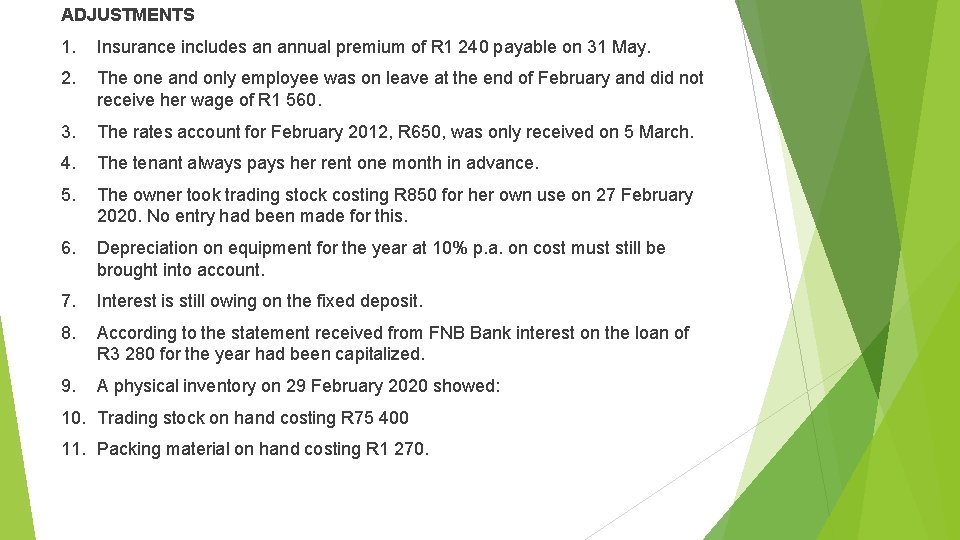
ADJUSTMENTS 1. Insurance includes an annual premium of R 1 240 payable on 31 May. 2. The one and only employee was on leave at the end of February and did not receive her wage of R 1 560. 3. The rates account for February 2012, R 650, was only received on 5 March. 4. The tenant always pays her rent one month in advance. 5. The owner took trading stock costing R 850 for her own use on 27 February 2020. No entry had been made for this. 6. Depreciation on equipment for the year at 10% p. a. on cost must still be brought into account. 7. Interest is still owing on the fixed deposit. 8. According to the statement received from FNB Bank interest on the loan of R 3 280 for the year had been capitalized. 9. A physical inventory on 29 February 2020 showed: 10. Trading stock on hand costing R 75 400 11. Packing material on hand costing R 1 270.
SOLUTION: • Insurance 1 240 x 3 / 12 = R 310 • Rent income 52 000/13 = R 4 000 • Interest on fixed deposit 50 000 x 6/100 = 3 000. TRADING ACCOUNT Cost of sales 502 000 Profit and loss (gross profit) 301 200 Sales [811 960 – 8 760] 803 200 PROFIT AND LOSS Insurance [4 800 -310] 4 490 Trading Account 301 200 22 222 Current income 52 255 Material costs 15 622 Interest on fixed deposit [2 750 + 250] Packing Material [19 563 – 1 270] 18 293 Rent income [52 000 – 4000] Sundry operating expenses 96 148 Wages [56 700 + 1 560] 58260 Depreciation 9 000 Trading stock deficit [78 400 – 850 – 75 400] 2 150 Interest on loan 3 280 Maintenance and repairs Capital [net profit] 167 890 404 455 3 000 48 000 404 455
POST-CLOSING TRIAL BALANCE The last step in the accounting cycle is to prepare a postclosing trial balance. A post-closing trial balance is prepared after closing entries are made and posted to the ledger. It is the third (and last) trial balance prepared in the accounting cycle. It’s purpose is to test the equality between debits and credits after closing entries are prepared and posted. The post-closing trial balance contains real accounts only since all nominal accounts have already been closed at this stage.
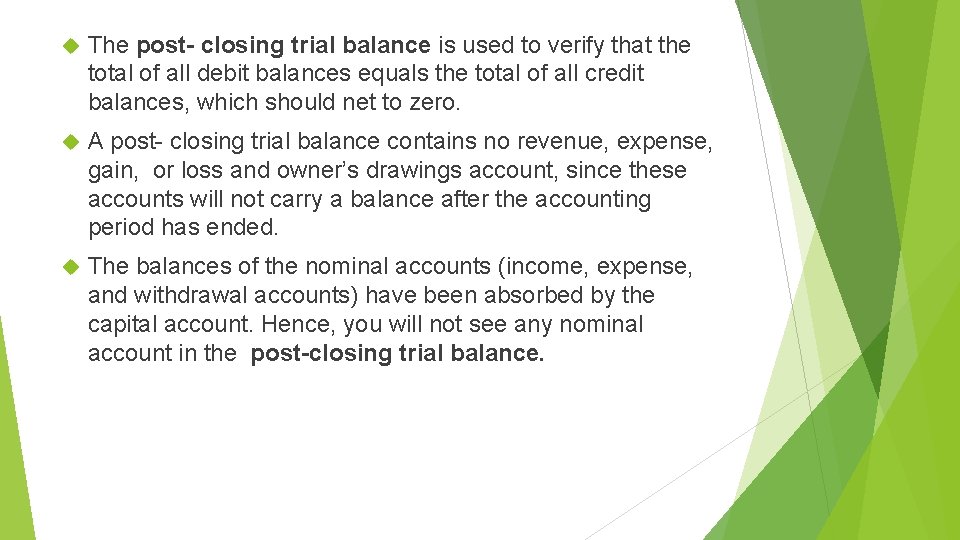
The post- closing trial balance is used to verify that the total of all debit balances equals the total of all credit balances, which should net to zero. A post- closing trial balance contains no revenue, expense, gain, or loss and owner’s drawings account, since these accounts will not carry a balance after the accounting period has ended. The balances of the nominal accounts (income, expense, and withdrawal accounts) have been absorbed by the capital account. Hence, you will not see any nominal account in the post-closing trial balance.
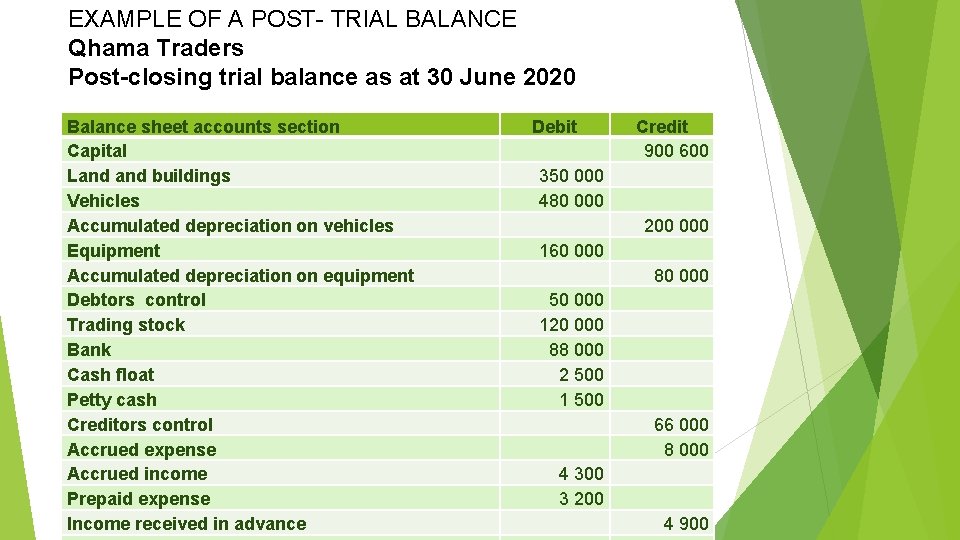
EXAMPLE OF A POST- TRIAL BALANCE Qhama Traders Post-closing trial balance as at 30 June 2020 Balance sheet accounts section Capital Land buildings Vehicles Accumulated depreciation on vehicles Equipment Accumulated depreciation on equipment Debtors control Trading stock Bank Cash float Petty cash Creditors control Accrued expense Accrued income Prepaid expense Income received in advance Debit Credit 900 600 350 000 480 000 200 000 160 000 80 000 50 000 120 000 88 000 2 500 1 500 66 000 8 000 4 300 3 200 4 900