
Accounting for Ordinary Share Issues Issuing Par Value






- Slides: 58
Accounting for Ordinary Share Issues Issuing Par Value Ordinary Shares for Cash Illustration: Assume that Hydro-Slide, Inc. issues 2, 000 shares of $1 par value ordinary shares. Prepare Hydro-Slide’s journal entry if (a) 1, 000 shares are issued for $1 per share, and (b) 1, 000 shares are issued for $5 per share. a. Cash 1, 000 Share capital - ordinary (1, 000 x $1) b. Slide 11 -1 Cash 1, 000 5, 000 Share capital - ordinary (1, 000 x $1) 1, 000 Share premium - ordinary 4, 000 SO 2 Record the issuance of ordinary shares.
Accounting for Ordinary Share Issues Illustration 11 -7 Slide 11 -2 SO 2 Record the issuance of ordinary shares.
Accounting for Ordinary Share Issues Issuing No-Par Ordinary Shares for Cash Illustration: Assume that Hydro-Slide, Inc. issues 5, 000 shares of $5 stated value no-par shares for $8 per share. The entry is: Cash 40, 000 Share capital - ordinary (5, 000 x $5) 25, 000 Share premium - ordinary 15, 000 Prepare the entry assuming there is no stated value. Cash 40, 000 Share capital - ordinary Slide 11 -3 40, 000 SO 2 Record the issuance of ordinary shares.
Accounting for Ordinary Share Issues Issuing Ordinary Shares for Services or Noncash Assets Corporations also may issue shares for: Services (attorneys or consultants). Noncash assets (land, buildings, and equipment). Cost is either the fair market value of the consideration given up, or the fair market value of the consideration received, whichever is more clearly determinable. Slide 11 -4 SO 2 Record the issuance of ordinary shares.
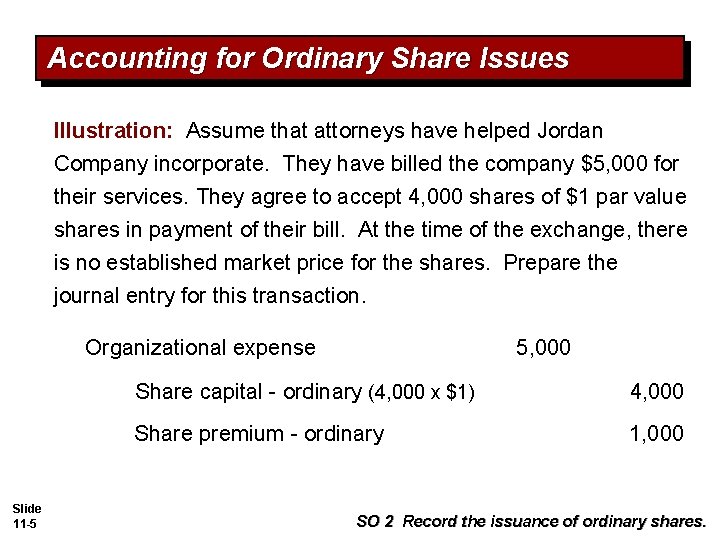
Accounting for Ordinary Share Issues Illustration: Assume that attorneys have helped Jordan Company incorporate. They have billed the company $5, 000 for their services. They agree to accept 4, 000 shares of $1 par value shares in payment of their bill. At the time of the exchange, there is no established market price for the shares. Prepare the journal entry for this transaction. Organizational expense Slide 11 -5 5, 000 Share capital - ordinary (4, 000 x $1) 4, 000 Share premium - ordinary 1, 000 SO 2 Record the issuance of ordinary shares.
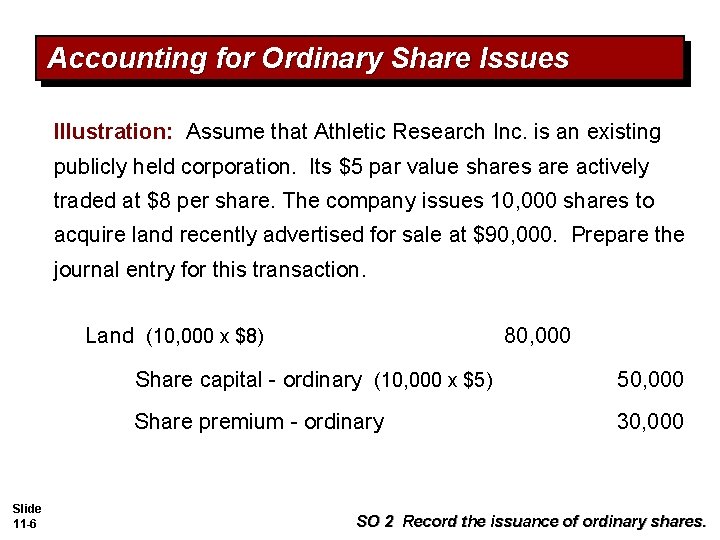
Accounting for Ordinary Share Issues Illustration: Assume that Athletic Research Inc. is an existing publicly held corporation. Its $5 par value shares are actively traded at $8 per share. The company issues 10, 000 shares to acquire land recently advertised for sale at $90, 000. Prepare the journal entry for this transaction. Land (10, 000 x $8) Slide 11 -6 80, 000 Share capital - ordinary (10, 000 x $5) 50, 000 Share premium - ordinary 30, 000 SO 2 Record the issuance of ordinary shares.
Accounting for Treasury Shares - corporation’s own shares that it has reacquired from shareholders, but not retired. Corporations purchase their outstanding share to: 1. Reissue the shares to officers and employees under bonus and share compensation plans. 2. Enhance the share’s market value. 3. Have additional shares available for use in the acquisition of other companies. 4. Increase earnings per share. 5. Rid the company of disgruntled investors, perhaps to avoid a takeover. Slide 11 -7 SO 3 Explain the accounting for treasury shares.
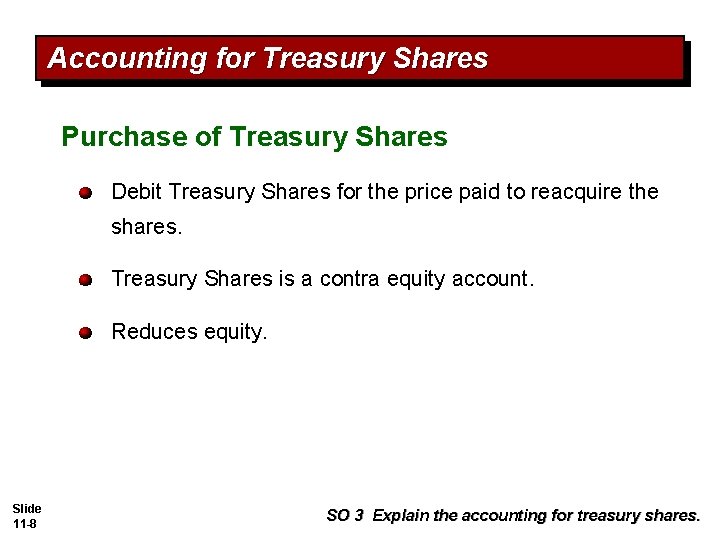
Accounting for Treasury Shares Purchase of Treasury Shares Debit Treasury Shares for the price paid to reacquire the shares. Treasury Shares is a contra equity account. Reduces equity. Slide 11 -8 SO 3 Explain the accounting for treasury shares.
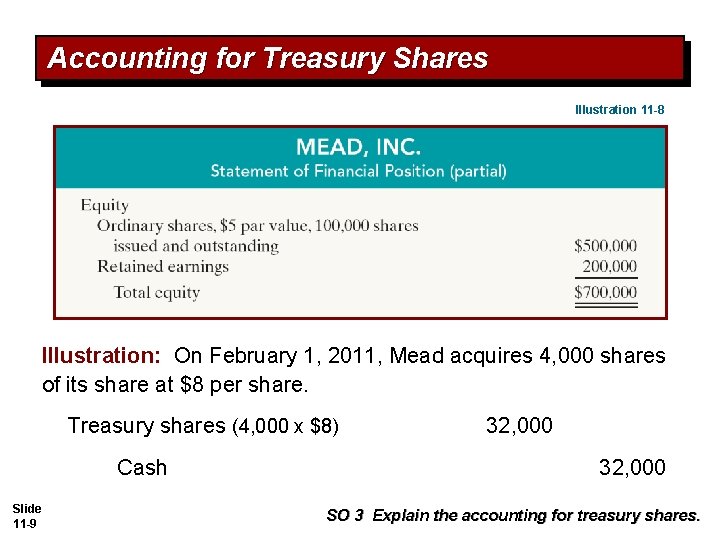
Accounting for Treasury Shares Illustration 11 -8 Illustration: On February 1, 2011, Mead acquires 4, 000 shares of its share at $8 per share. Treasury shares (4, 000 x $8) Cash Slide 11 -9 32, 000 SO 3 Explain the accounting for treasury shares.
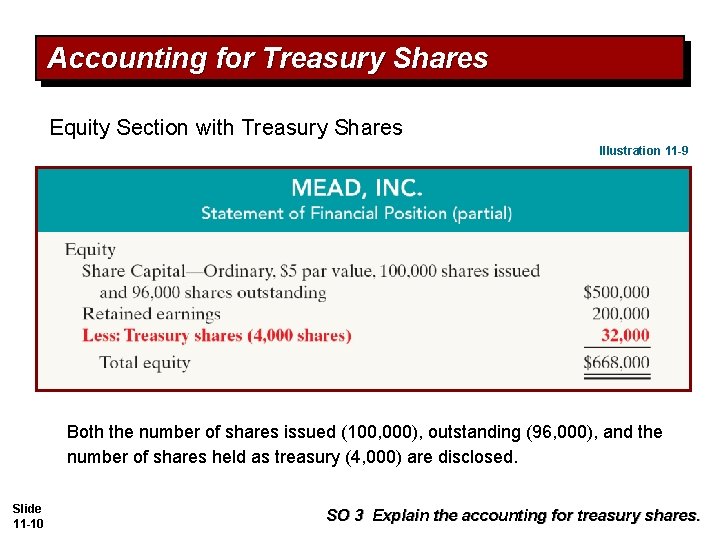
Accounting for Treasury Shares Equity Section with Treasury Shares Illustration 11 -9 Both the number of shares issued (100, 000), outstanding (96, 000), and the number of shares held as treasury (4, 000) are disclosed. Slide 11 -10 SO 3 Explain the accounting for treasury shares.
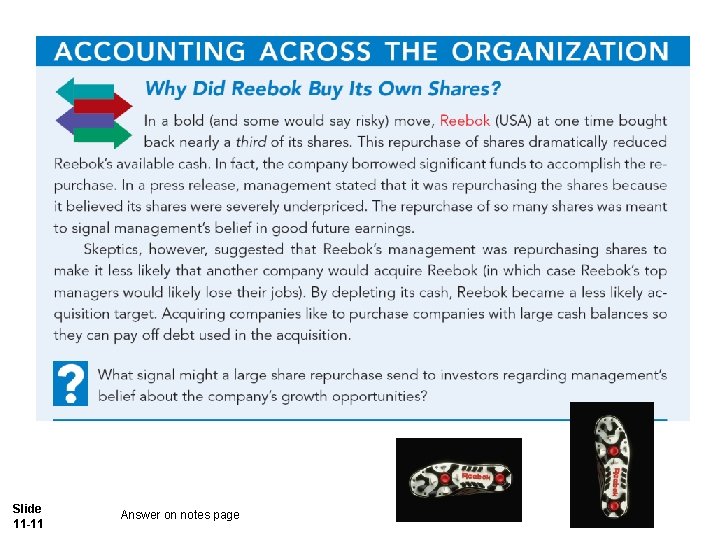
Slide 11 -11 Answer on notes page
Accounting for Treasury Shares Disposal of Treasury Shares Above Cost Below Cost Both increase total assets and equity. Slide 11 -12 SO 3 Explain the accounting for treasury shares.
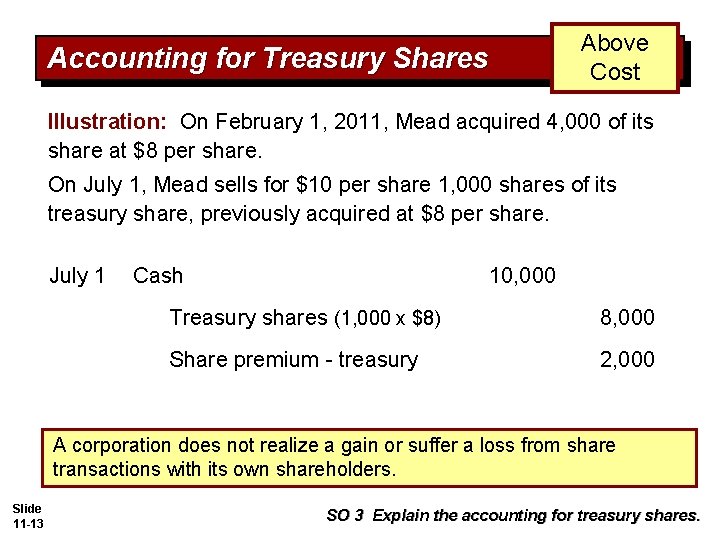
Accounting for Treasury Shares Above Cost Illustration: On February 1, 2011, Mead acquired 4, 000 of its share at $8 per share. On July 1, Mead sells for $10 per share 1, 000 shares of its treasury share, previously acquired at $8 per share. July 1 Cash 10, 000 Treasury shares (1, 000 x $8) 8, 000 Share premium - treasury 2, 000 A corporation does not realize a gain or suffer a loss from share transactions with its own shareholders. Slide 11 -13 SO 3 Explain the accounting for treasury shares.
Below Cost Accounting for Treasury Shares Illustration: On February 1, 2011, Mead acquired 4, 000 of its share at $8 per share. On Oct. 1, Mead sells an additional 800 treasury shares at $7 per share. Oct. 1 Cash 5, 600 Share premium - treasury Treasury shares (800 x $8) Slide 11 -14 800 6, 400 SO 3 Explain the accounting for treasury shares.
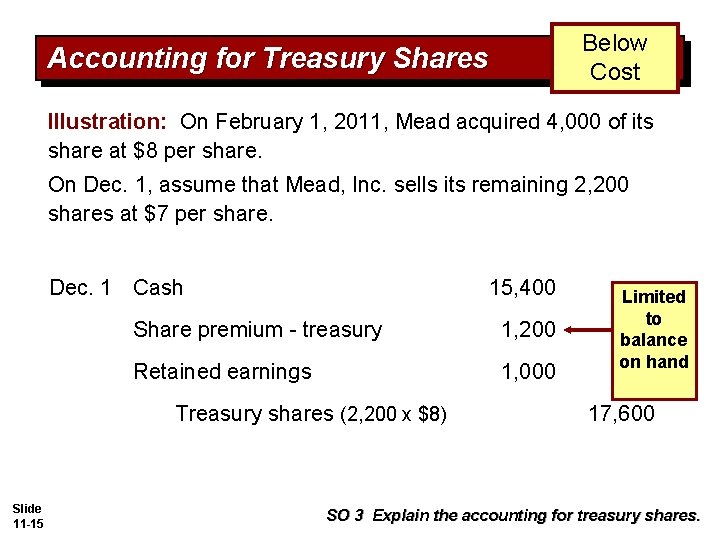
Below Cost Accounting for Treasury Shares Illustration: On February 1, 2011, Mead acquired 4, 000 of its share at $8 per share. On Dec. 1, assume that Mead, Inc. sells its remaining 2, 200 shares at $7 per share. Dec. 1 Cash 15, 400 Share premium - treasury 1, 200 Retained earnings 1, 000 Treasury shares (2, 200 x $8) Slide 11 -15 Limited to balance on hand 17, 600 SO 3 Explain the accounting for treasury shares.
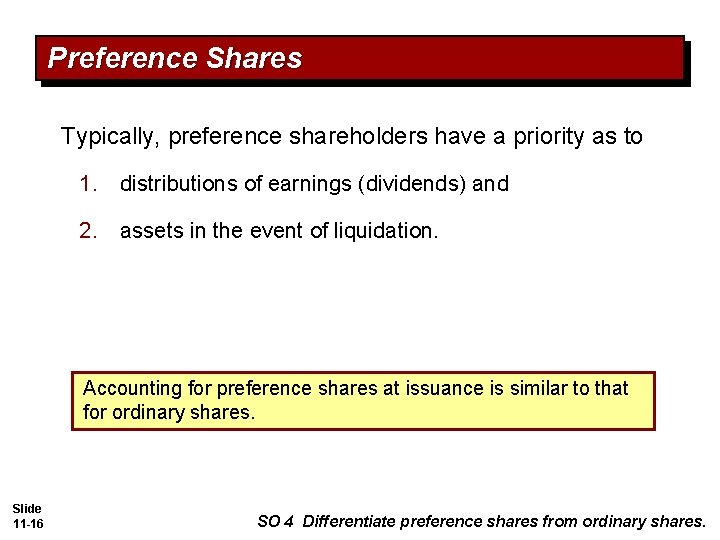
Preference Shares Typically, preference shareholders have a priority as to 1. distributions of earnings (dividends) and 2. assets in the event of liquidation. Accounting for preference shares at issuance is similar to that for ordinary shares. Slide 11 -16 SO 4 Differentiate preference shares from ordinary shares.
Preference Shares Illustration: Stine Corporation issues 10, 000 shares of $10 par value preference shares for $12 cash per share. Journalize the issuance of the preference share. Cash 120, 000 Share capital - preference (10, 000 x $10) Share premium – preference 100, 000 20, 000 Preference shares may have a par value or no-par value. Slide 11 -17 SO 4 Differentiate preference shares from ordinary shares.
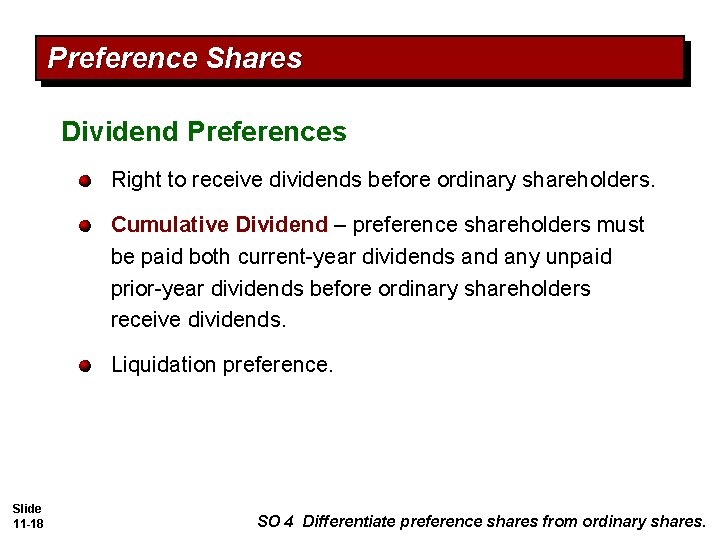
Preference Shares Dividend Preferences Right to receive dividends before ordinary shareholders. Cumulative Dividend – preference shareholders must be paid both current-year dividends and any unpaid prior-year dividends before ordinary shareholders receive dividends. Liquidation preference. Slide 11 -18 SO 4 Differentiate preference shares from ordinary shares.
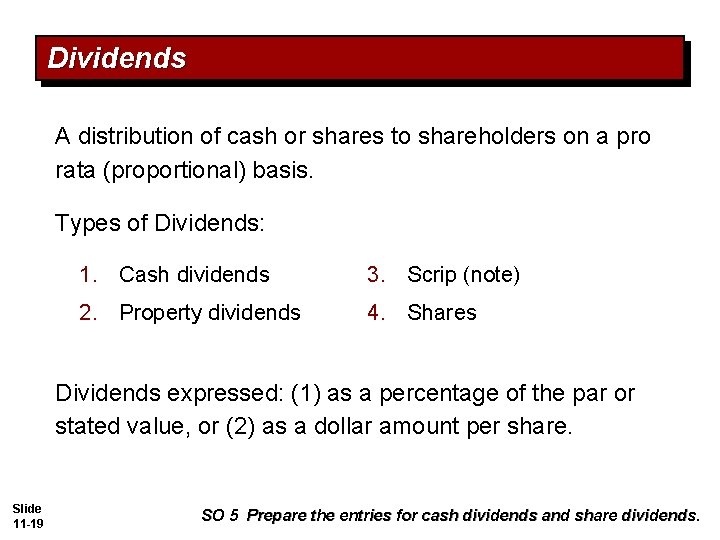
Dividends A distribution of cash or shares to shareholders on a pro rata (proportional) basis. Types of Dividends: 1. Cash dividends 3. Scrip (note) 2. Property dividends 4. Shares Dividends expressed: (1) as a percentage of the par or stated value, or (2) as a dollar amount per share. Slide 11 -19 SO 5 Prepare the entries for cash dividends and share dividends.
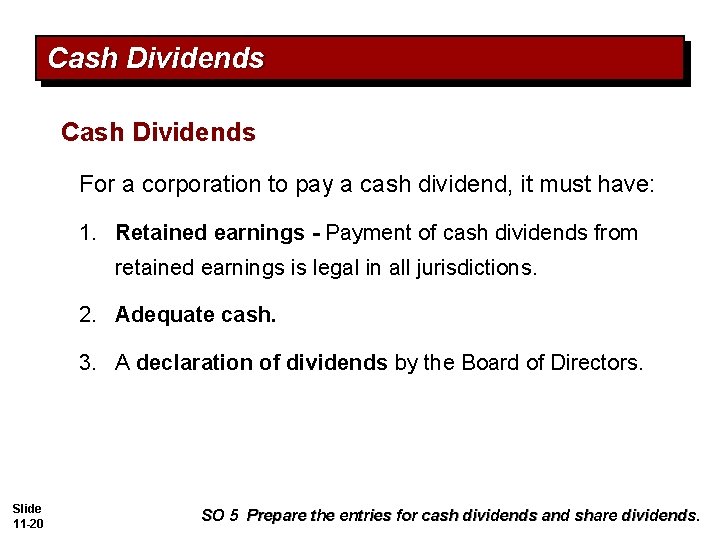
Cash Dividends For a corporation to pay a cash dividend, it must have: 1. Retained earnings - Payment of cash dividends from retained earnings is legal in all jurisdictions. 2. Adequate cash. 3. A declaration of dividends by the Board of Directors. Slide 11 -20 SO 5 Prepare the entries for cash dividends and share dividends.
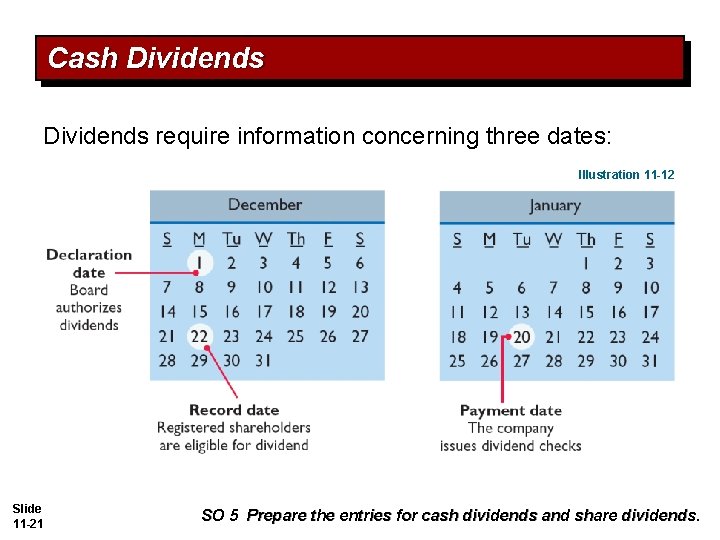
Cash Dividends require information concerning three dates: Illustration 11 -12 Slide 11 -21 SO 5 Prepare the entries for cash dividends and share dividends.
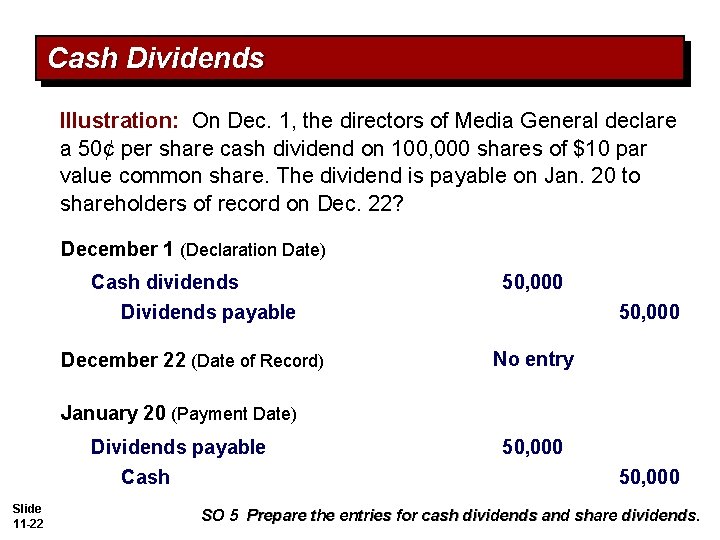
Cash Dividends Illustration: On Dec. 1, the directors of Media General declare a 50¢ per share cash dividend on 100, 000 shares of $10 par value common share. The dividend is payable on Jan. 20 to shareholders of record on Dec. 22? December 1 (Declaration Date) Cash dividends Dividends payable 50, 000 December 22 (Date of Record) No entry 50, 000 January 20 (Payment Date) Dividends payable Cash Slide 11 -22 50, 000 SO 5 Prepare the entries for cash dividends and share dividends.
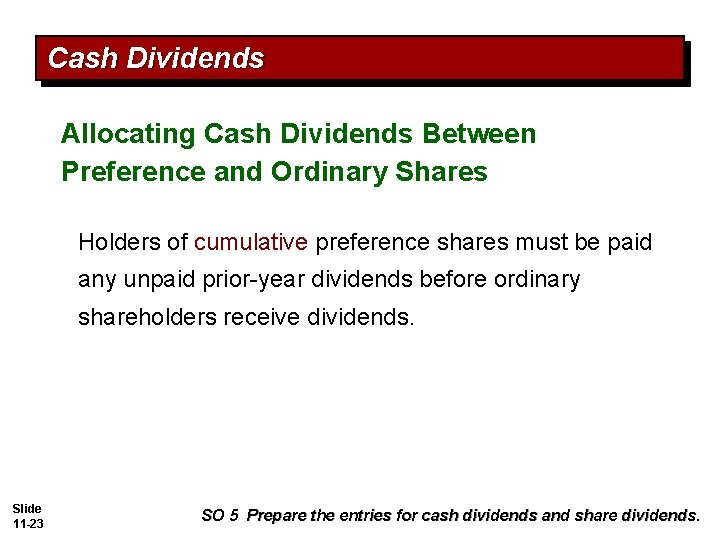
Cash Dividends Allocating Cash Dividends Between Preference and Ordinary Shares Holders of cumulative preference shares must be paid any unpaid prior-year dividends before ordinary shareholders receive dividends. Slide 11 -23 SO 5 Prepare the entries for cash dividends and share dividends.
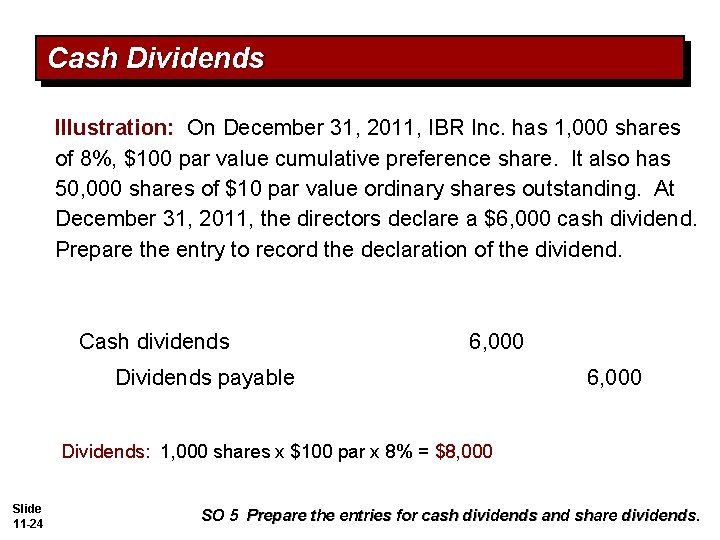
Cash Dividends Illustration: On December 31, 2011, IBR Inc. has 1, 000 shares of 8%, $100 par value cumulative preference share. It also has 50, 000 shares of $10 par value ordinary shares outstanding. At December 31, 2011, the directors declare a $6, 000 cash dividend. Prepare the entry to record the declaration of the dividend. Cash dividends 6, 000 Dividends payable 6, 000 Dividends: 1, 000 shares x $100 par x 8% = $8, 000 Slide 11 -24 SO 5 Prepare the entries for cash dividends and share dividends.
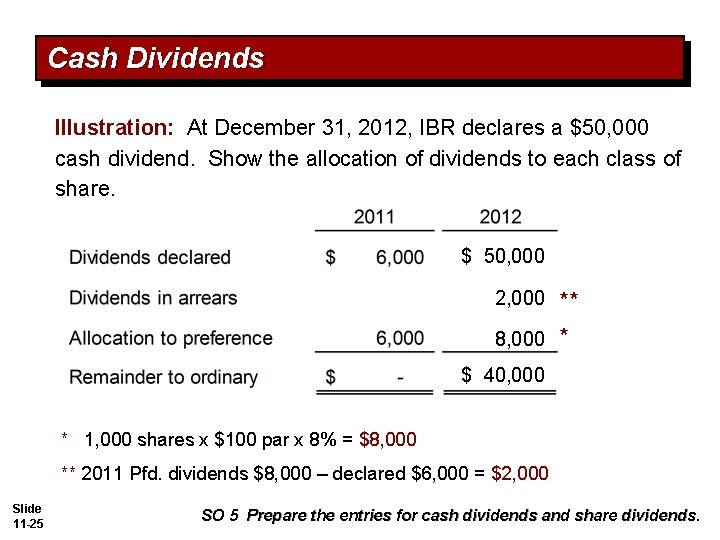
Cash Dividends Illustration: At December 31, 2012, IBR declares a $50, 000 cash dividend. Show the allocation of dividends to each class of share. $ 50, 000 2, 000 ** 8, 000 * $ 40, 000 * 1, 000 shares x $100 par x 8% = $8, 000 ** 2011 Pfd. dividends $8, 000 – declared $6, 000 = $2, 000 Slide 11 -25 SO 5 Prepare the entries for cash dividends and share dividends.
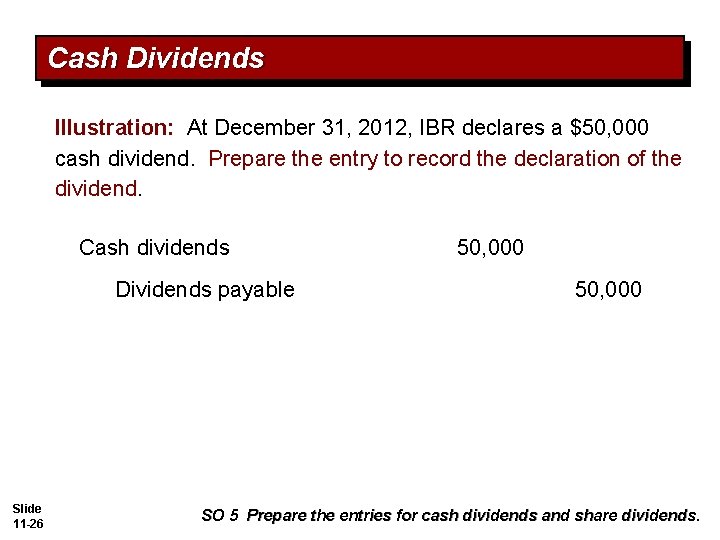
Cash Dividends Illustration: At December 31, 2012, IBR declares a $50, 000 cash dividend. Prepare the entry to record the declaration of the dividend. Cash dividends Dividends payable Slide 11 -26 50, 000 SO 5 Prepare the entries for cash dividends and share dividends.
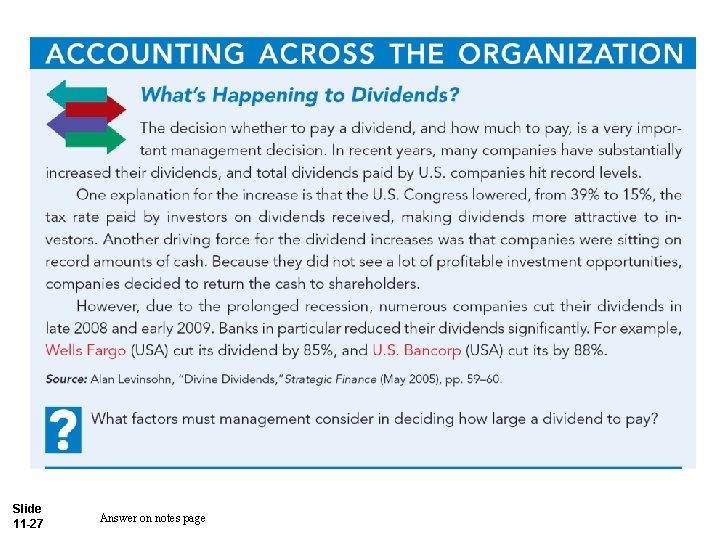
Slide 11 -27 Answer on notes page
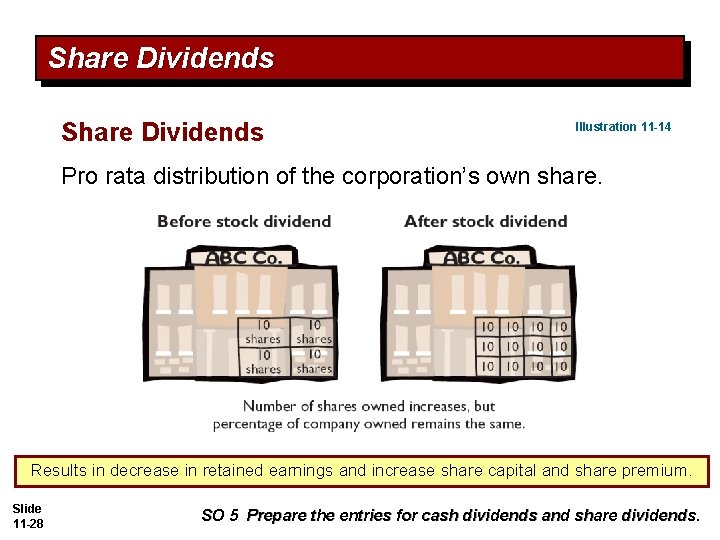
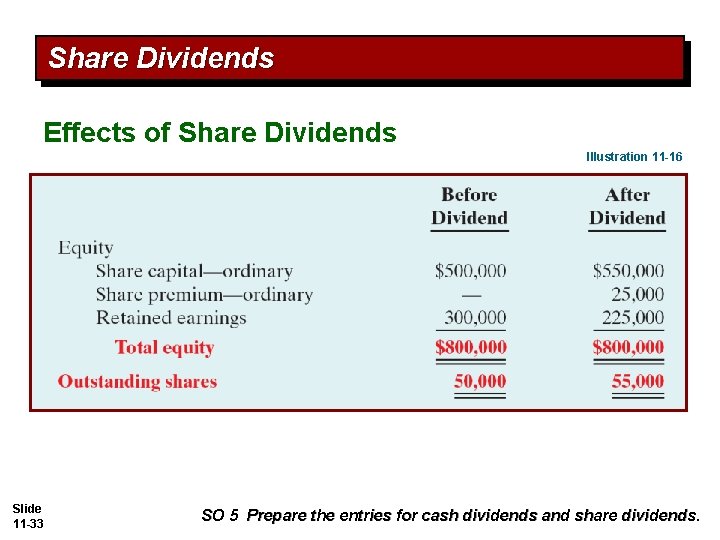
Share Dividends Illustration 11 -14 Pro rata distribution of the corporation’s own share. Results in decrease in retained earnings and increase share capital and share premium. Slide 11 -28 SO 5 Prepare the entries for cash dividends and share dividends.
Share Dividends Reasons why corporations issue share dividends: 1. To satisfy shareholders’ dividend expectations without spending cash. 2. To increase the marketability of the corporation’s shares. 3. To emphasize that a portion of shareholders’ equity has been permanently reinvested in the business. Slide 11 -29 SO 5 Prepare the entries for cash dividends and share dividends.
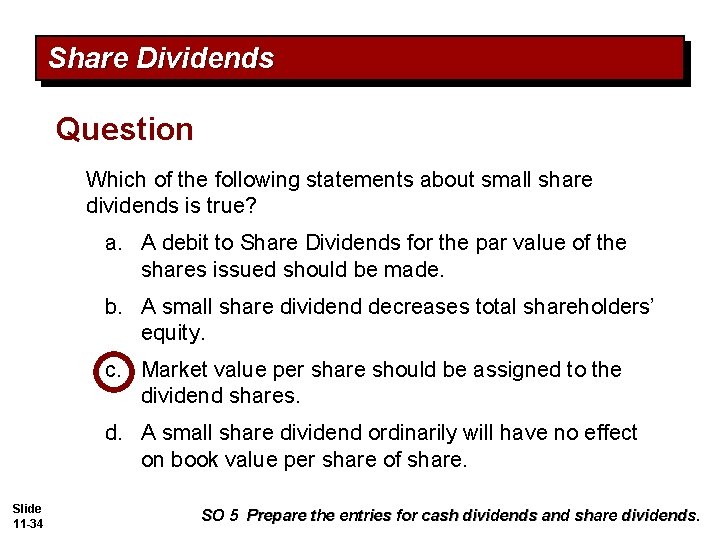
Share Dividends Size of share Dividends Small share dividend (less than 20– 25% of the corporation’s issued shares, recorded at fair market value) * Large share dividend (greater than 20– 25% of issued shares, recorded at par value) * This accounting is based on the assumption that a small share dividend will have little effect on the market price of the outstanding shares. Slide 11 -30 SO 5 Prepare the entries for cash dividends and share dividends.
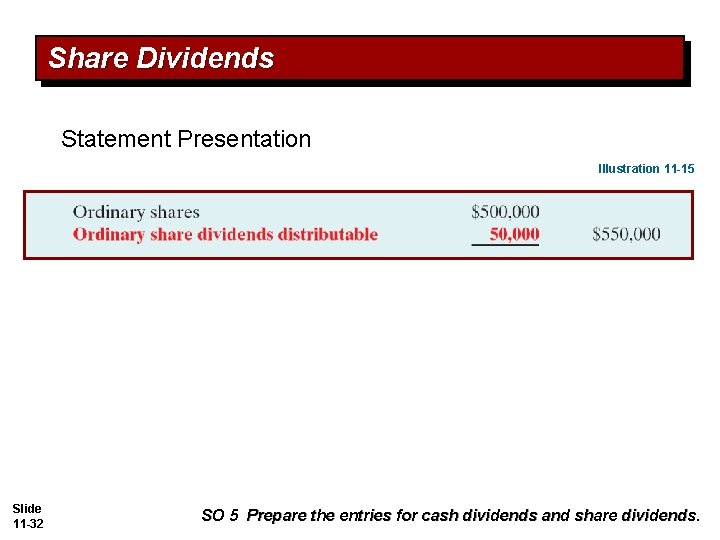
Share Dividends Illustration: Medland Corp. has 50, 000 shares issued and outstanding. The par value is $10 per share and market value is $15 per share. 10% share dividend is declared Share dividends (50, 000 x 10% x $15) Ordinary share dividends distributable Share premium - ordinary 75, 000 50, 000 25, 000 Shares issued Ordinary share dividends distributable Share capital - ordinary Slide 11 -31 50, 000 SO 5 Prepare the entries for cash dividends and share dividends.
Share Dividends Statement Presentation Illustration 11 -15 Slide 11 -32 SO 5 Prepare the entries for cash dividends and share dividends.
Share Dividends Effects of Share Dividends Illustration 11 -16 Slide 11 -33 SO 5 Prepare the entries for cash dividends and share dividends.
Share Dividends Question Which of the following statements about small share dividends is true? a. A debit to Share Dividends for the par value of the shares issued should be made. b. A small share dividend decreases total shareholders’ equity. c. Market value per share should be assigned to the dividend shares. d. A small share dividend ordinarily will have no effect on book value per share of share. Slide 11 -34 SO 5 Prepare the entries for cash dividends and share dividends.
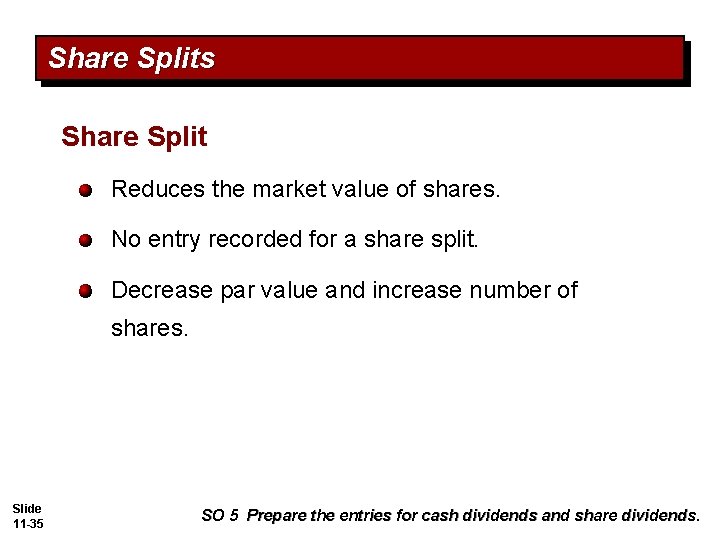
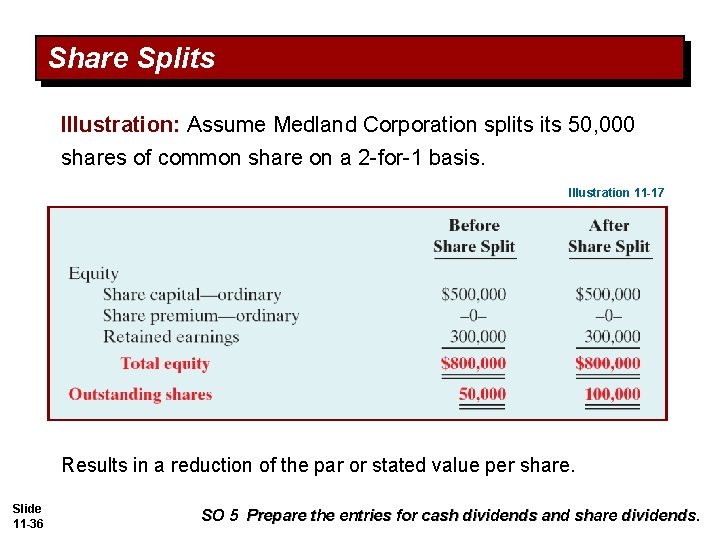
Share Splits Share Split Reduces the market value of shares. No entry recorded for a share split. Decrease par value and increase number of shares. Slide 11 -35 SO 5 Prepare the entries for cash dividends and share dividends.
Share Splits Illustration: Assume Medland Corporation splits 50, 000 shares of common share on a 2 -for-1 basis. Illustration 11 -17 Results in a reduction of the par or stated value per share. Slide 11 -36 SO 5 Prepare the entries for cash dividends and share dividends.
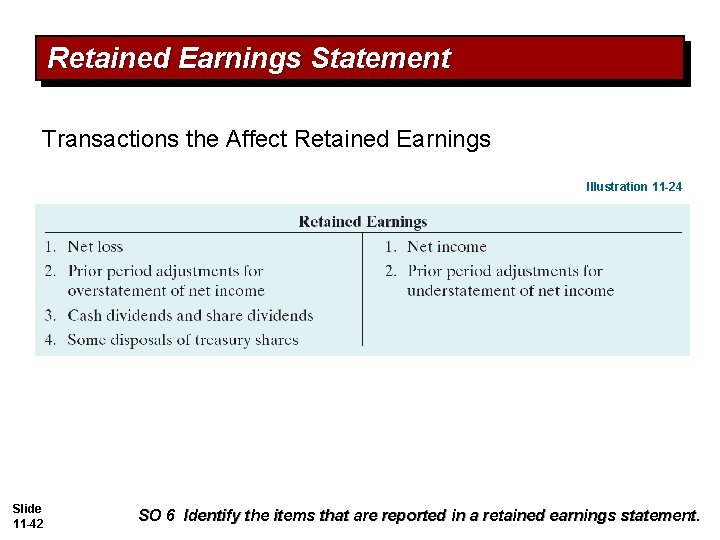
Retained Earnings Retained earnings is net income that a company retains for use in the business. Net income increases retained earnings and a net loss decreases retained earnings. Retained earnings is part of the shareholders’ claim on the total assets of the corporation. A debit balance in retained earnings is identified as a deficit. Slide 11 -37 SO 6 Identify the items that are reported in a retained earnings statement.
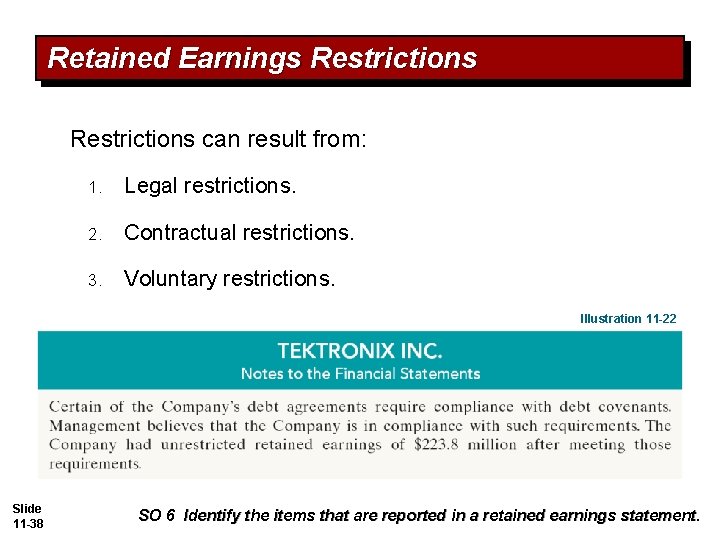
Retained Earnings Restrictions can result from: 1. Legal restrictions. 2. Contractual restrictions. 3. Voluntary restrictions. Illustration 11 -22 Slide 11 -38 SO 6 Identify the items that are reported in a retained earnings statement.
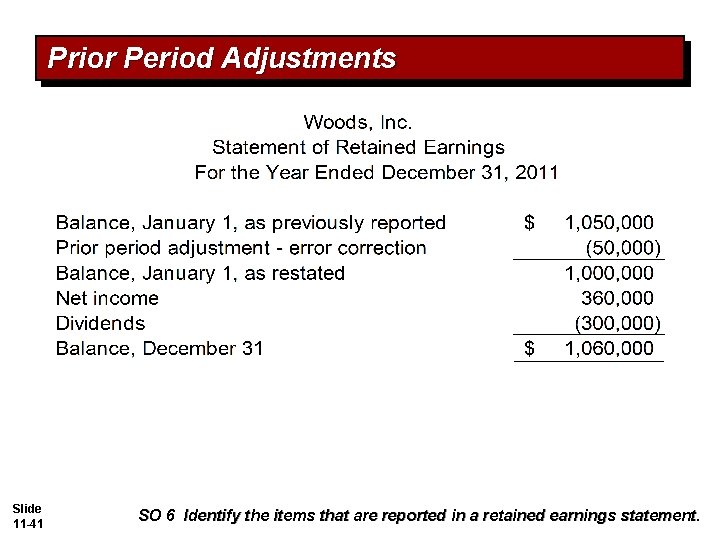
Prior Period Adjustments Corrections of Errors Result from: Ø mathematical mistakes Ø mistakes in application of accounting principles Ø oversight or misuse of facts Corrections treated as prior period adjustments Adjustment made to the beginning balance of retained earnings Slide 11 -39 SO 6 Identify the items that are reported in a retained earnings statement.
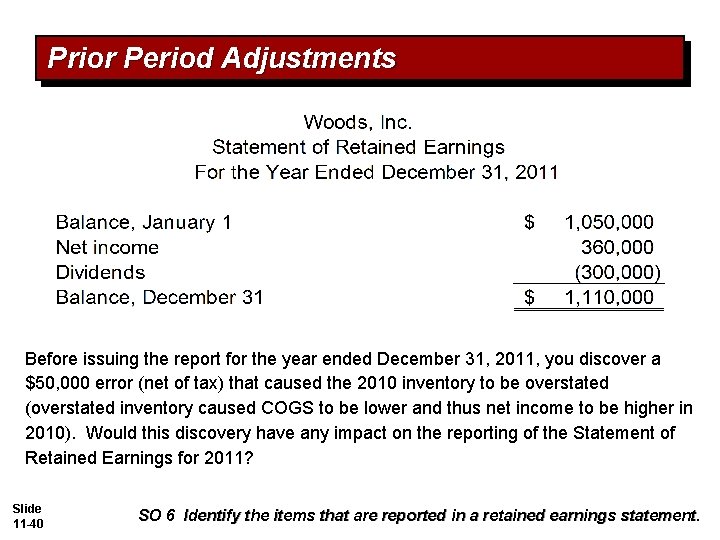
Prior Period Adjustments Before issuing the report for the year ended December 31, 2011, you discover a $50, 000 error (net of tax) that caused the 2010 inventory to be overstated (overstated inventory caused COGS to be lower and thus net income to be higher in 2010). Would this discovery have any impact on the reporting of the Statement of Retained Earnings for 2011? Slide 11 -40 SO 6 Identify the items that are reported in a retained earnings statement.
Prior Period Adjustments Slide 11 -41 SO 6 Identify the items that are reported in a retained earnings statement.
Retained Earnings Statement Transactions the Affect Retained Earnings Illustration 11 -24 Slide 11 -42 SO 6 Identify the items that are reported in a retained earnings statement.
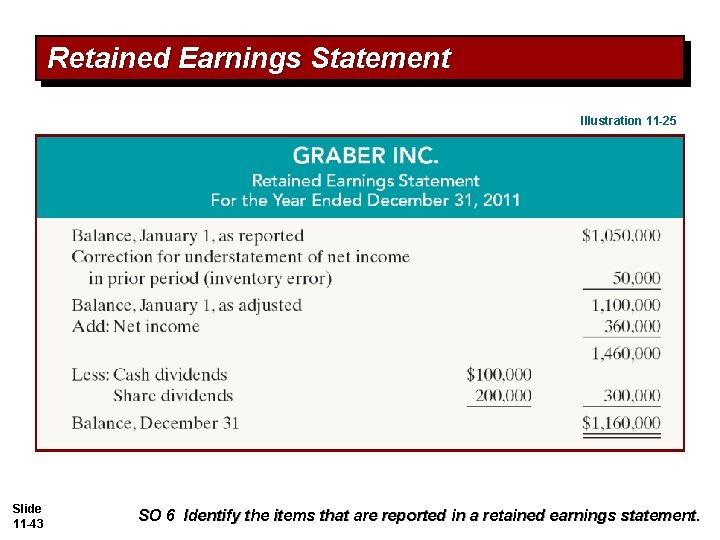
Retained Earnings Statement Illustration 11 -25 Slide 11 -43 SO 6 Identify the items that are reported in a retained earnings statement.
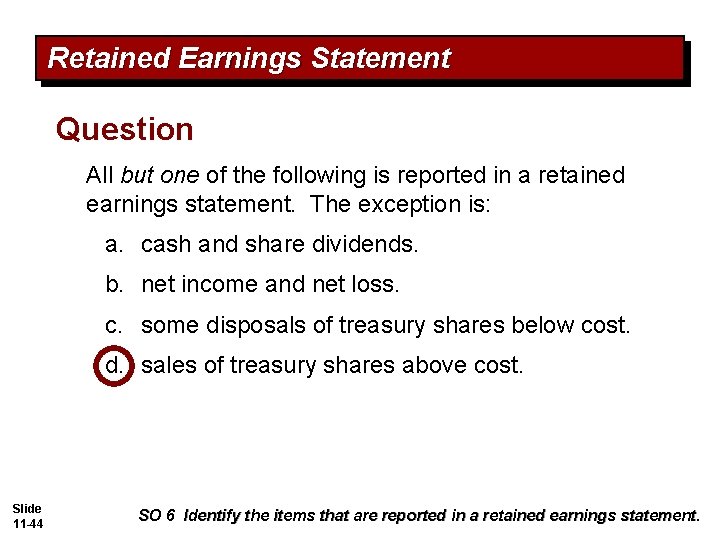
Retained Earnings Statement Question All but one of the following is reported in a retained earnings statement. The exception is: a. cash and share dividends. b. net income and net loss. c. some disposals of treasury shares below cost. d. sales of treasury shares above cost. Slide 11 -44 SO 6 Identify the items that are reported in a retained earnings statement.
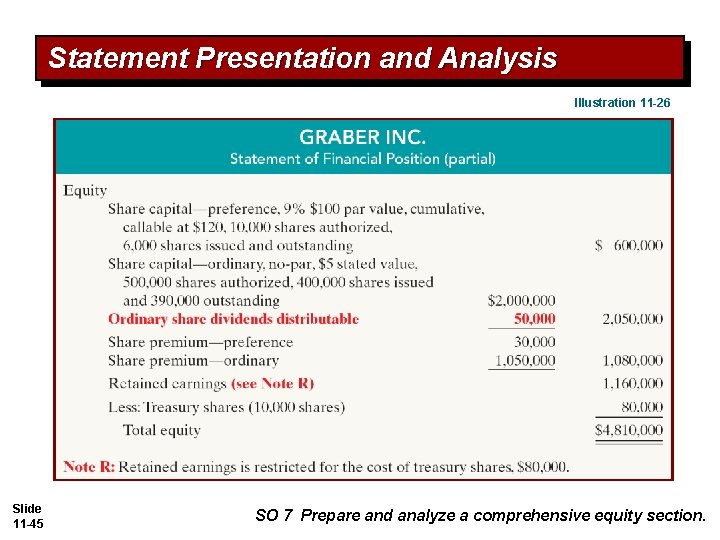
Statement Presentation and Analysis Illustration 11 -26 Slide 11 -45 SO 7 Prepare and analyze a comprehensive equity section.
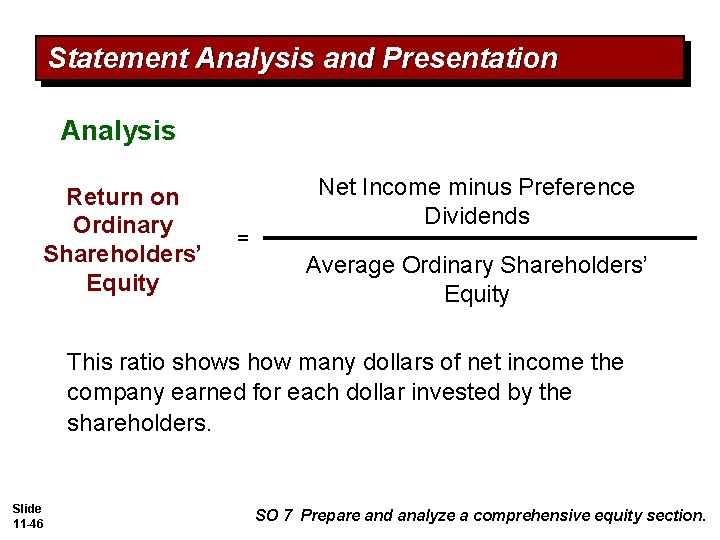
Statement Analysis and Presentation Analysis Return on Ordinary Shareholders’ Equity = Net Income minus Preference Dividends Average Ordinary Shareholders’ Equity This ratio shows how many dollars of net income the company earned for each dollar invested by the shareholders. Slide 11 -46 SO 7 Prepare and analyze a comprehensive equity section.
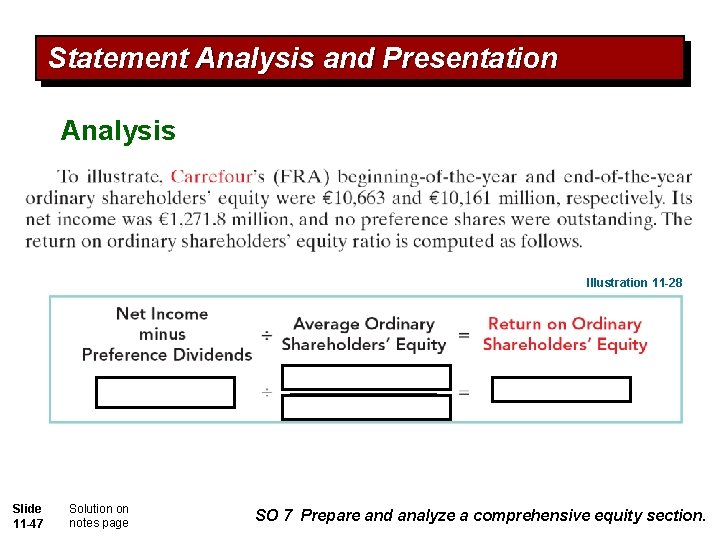
Statement Analysis and Presentation Analysis Illustration 11 -28 Slide 11 -47 Solution on notes page SO 7 Prepare and analyze a comprehensive equity section.
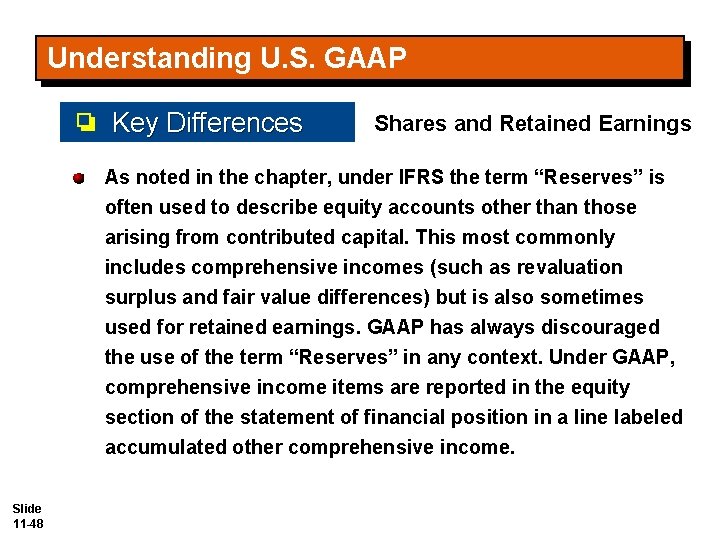
Understanding U. S. GAAP Key Differences Shares and Retained Earnings As noted in the chapter, under IFRS the term “Reserves” is often used to describe equity accounts other than those arising from contributed capital. This most commonly includes comprehensive incomes (such as revaluation surplus and fair value differences) but is also sometimes used for retained earnings. GAAP has always discouraged the use of the term “Reserves” in any context. Under GAAP, comprehensive income items are reported in the equity section of the statement of financial position in a line labeled accumulated other comprehensive income. Slide 11 -48
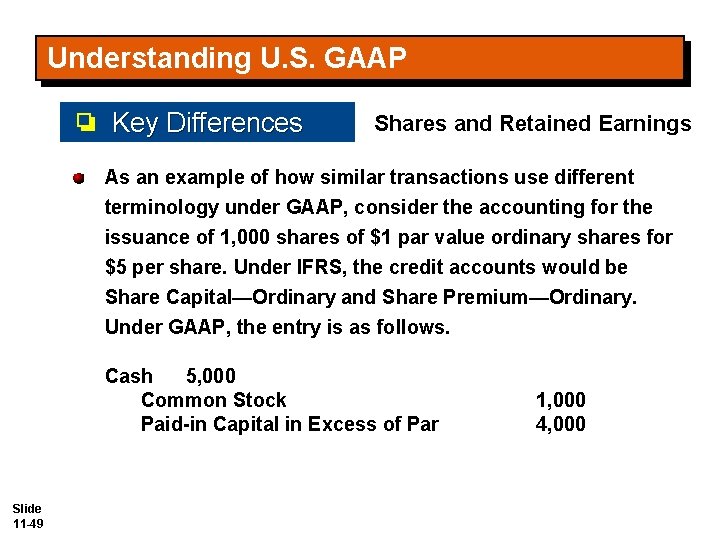
Understanding U. S. GAAP Key Differences Shares and Retained Earnings As an example of how similar transactions use different terminology under GAAP, consider the accounting for the issuance of 1, 000 shares of $1 par value ordinary shares for $5 per share. Under IFRS, the credit accounts would be Share Capital—Ordinary and Share Premium—Ordinary. Under GAAP, the entry is as follows. Cash 5, 000 Common Stock Paid-in Capital in Excess of Par Slide 11 -49 1, 000 4, 000
Understanding U. S. GAAP Key Differences Shares and Retained Earnings A major difference between IFRS and GAAP relates to the account Revaluation Surplus arises under IFRS because companies are permitted to revalue their property, plant, and equipment to fair value under certain circumstances. This account is part of general reserves under IFRS and is not considered contributed capital. IFRS sometimes uses terms such as retained profits or accumulated profit or loss to describe retained earnings. The term retained earnings is also often used, as is the custom, under GAAP. Slide 11 -50
Understanding U. S. GAAP Looking to the Future Shares and Retained Earnings The IASB and the FASB are currently working on a project related to financial statement presentation. An important part of this study is to determine whether certain line items, subtotals, and totals should be clearly defined and required to be displayed in the financial statements. For example, it is likely that the statement of shareholders’ equity and its presentation will be examined closely. It is interesting to note that, in a presentation of a proposed statement of financial position that was published as a result of this project, the term “Reserves, ” which as noted is commonly used under IFRS, was replaced by the phrase “Accumulated other comprehensive income, ” which is the title used under GAAP. Slide 11 -51
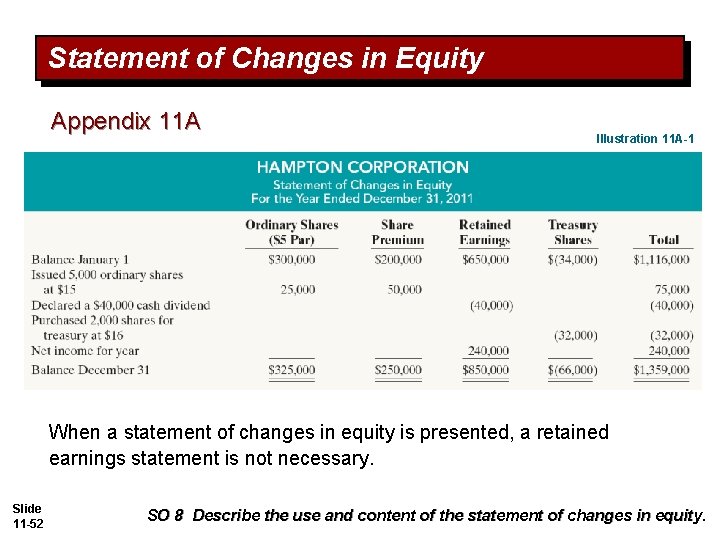
Statement of Changes in Equity Appendix 11 A Illustration 11 A-1 When a statement of changes in equity is presented, a retained earnings statement is not necessary. Slide 11 -52 SO 8 Describe the use and content of the statement of changes in equity.
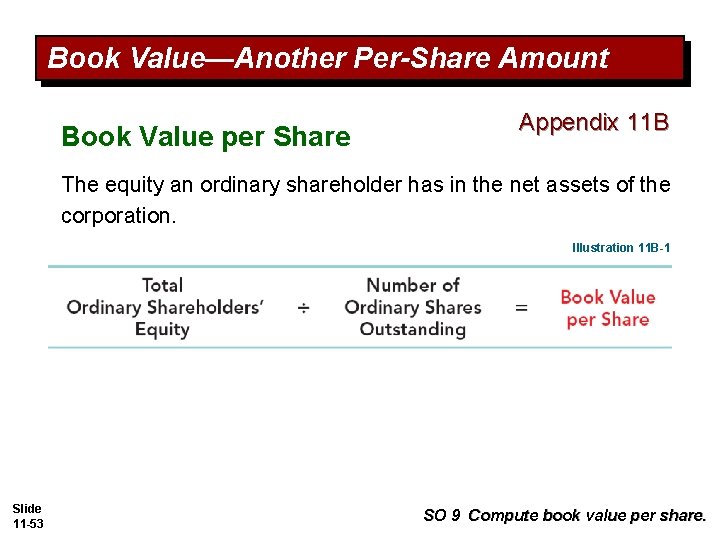
Book Value—Another Per-Share Amount Book Value per Share Appendix 11 B The equity an ordinary shareholder has in the net assets of the corporation. Illustration 11 B-1 Slide 11 -53 SO 9 Compute book value per share.
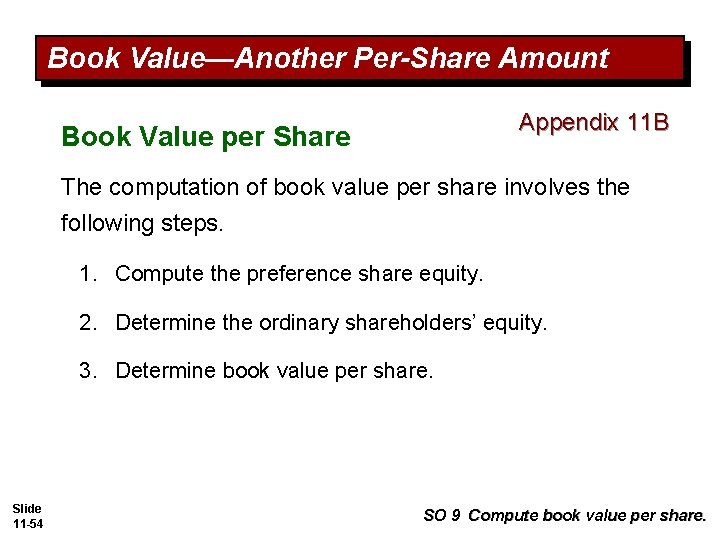
Book Value—Another Per-Share Amount Appendix 11 B Book Value per Share The computation of book value per share involves the following steps. 1. Compute the preference share equity. 2. Determine the ordinary shareholders’ equity. 3. Determine book value per share. Slide 11 -54 SO 9 Compute book value per share.
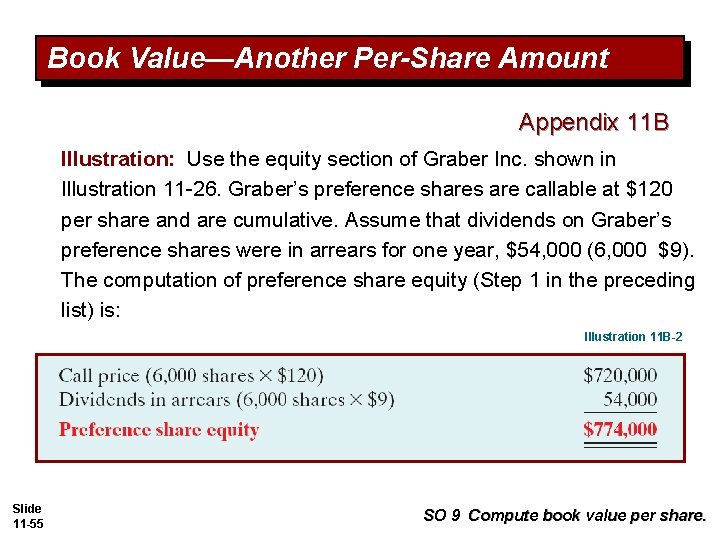
Book Value—Another Per-Share Amount Appendix 11 B Illustration: Use the equity section of Graber Inc. shown in Illustration 11 -26. Graber’s preference shares are callable at $120 per share and are cumulative. Assume that dividends on Graber’s preference shares were in arrears for one year, $54, 000 (6, 000 $9). The computation of preference share equity (Step 1 in the preceding list) is: Illustration 11 B-2 Slide 11 -55 SO 9 Compute book value per share.
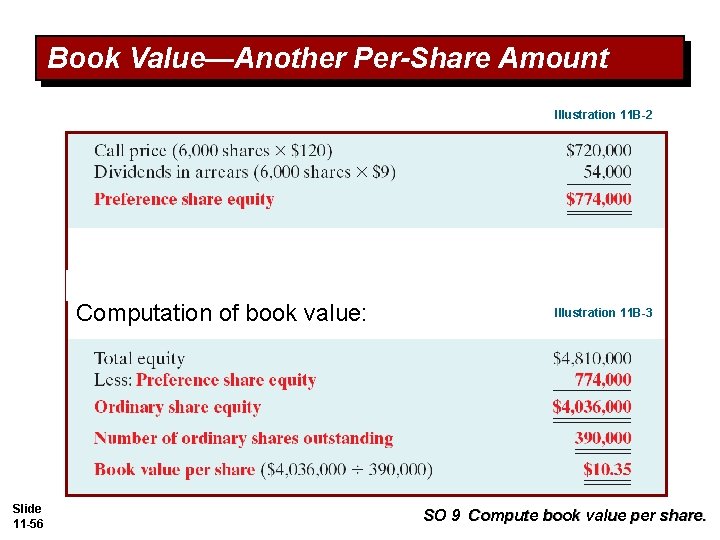
Book Value—Another Per-Share Amount Illustration 11 B-2 Computation of book value: Slide 11 -56 Illustration 11 B-3 SO 9 Compute book value per share.
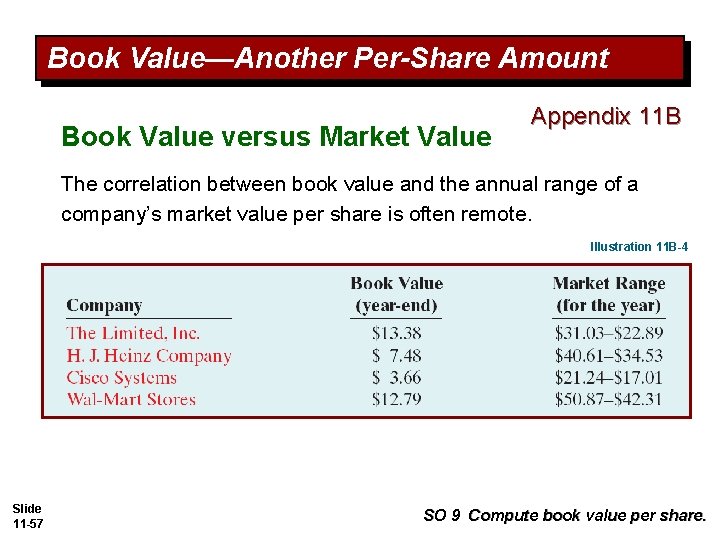
Book Value—Another Per-Share Amount Book Value versus Market Value Appendix 11 B The correlation between book value and the annual range of a company’s market value per share is often remote. Illustration 11 B-4 Slide 11 -57 SO 9 Compute book value per share.
Copyright “Copyright © 2011 John Wiley & Sons, Inc. All rights reserved. Reproduction or translation of this work beyond that permitted in Section 117 of the 1976 United States Copyright Act without the express written permission of the copyright owner is unlawful. Request for further information should be addressed to the Permissions Department, John Wiley & Sons, Inc. The purchaser may make back-up copies for his/her own use only and not for distribution or resale. The Publisher assumes no responsibility for errors, omissions, or damages, caused by the use of these programs or from the use of the information contained herein. ” Slide 11 -58