
Accounting for merchandising operation Learning Objectives 1 Identify
Accounting for merchandising operation
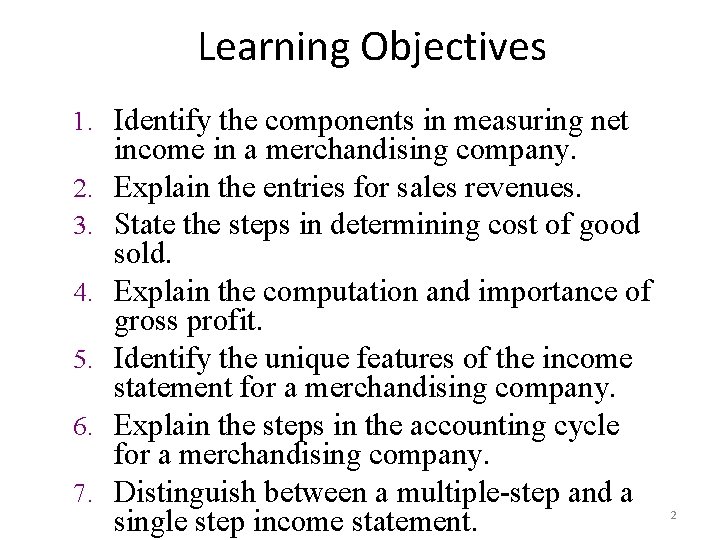
Learning Objectives 1. Identify the components in measuring net 2. 3. 4. 5. 6. 7. income in a merchandising company. Explain the entries for sales revenues. State the steps in determining cost of good sold. Explain the computation and importance of gross profit. Identify the unique features of the income statement for a merchandising company. Explain the steps in the accounting cycle for a merchandising company. Distinguish between a multiple-step and a single step income statement. 2
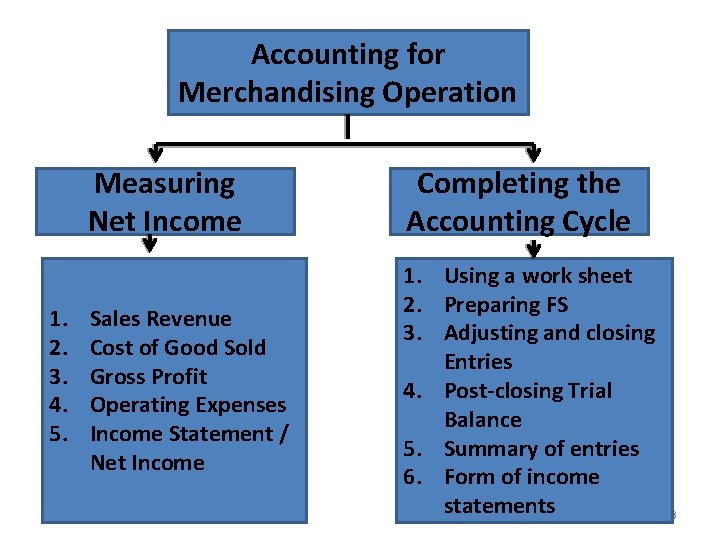
Accounting for Merchandising Operation 1. 2. 3. 4. 5. Measuring Net Income Completing the Accounting Cycle Sales Revenue Cost of Good Sold Gross Profit Operating Expenses Income Statement / Net Income 1. Using a work sheet 2. Preparing FS 3. Adjusting and closing Entries 4. Post-closing Trial Balance 5. Summary of entries 6. Form of income statements 3
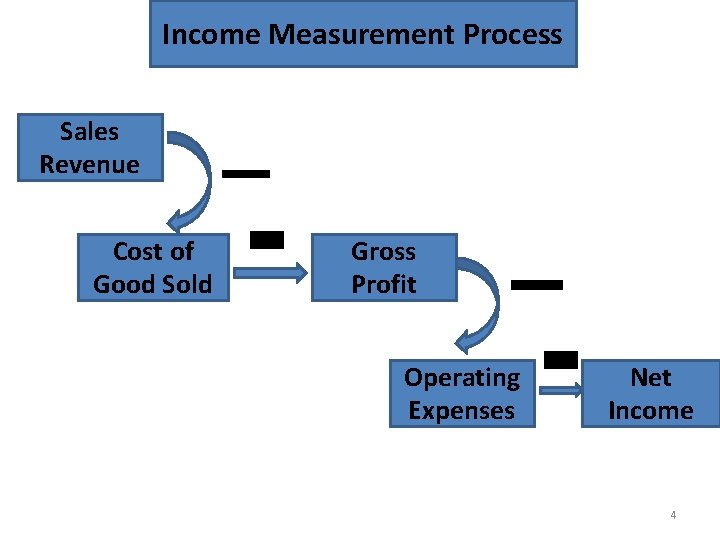
Income Measurement Process Sales Revenue Cost of Good Sold Gross Profit Operating Expenses Net Income 4
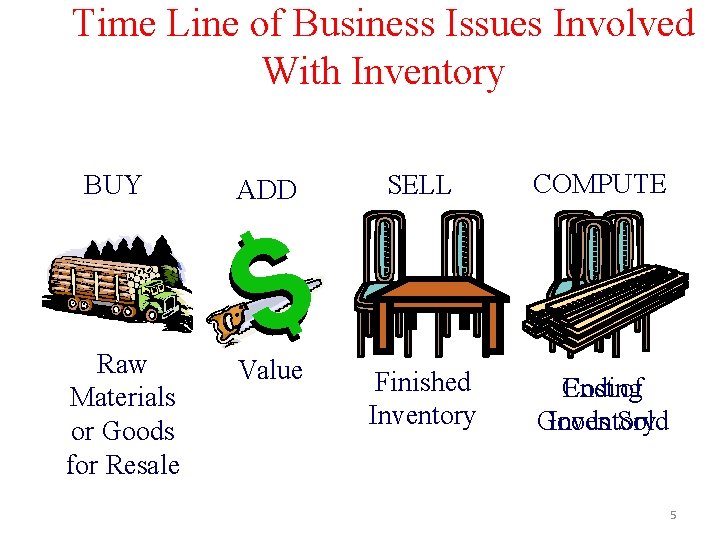
Time Line of Business Issues Involved With Inventory BUY Raw Materials or Goods for Resale ADD SELL COMPUTE Value Finished Inventory Cost Ending of Goods Inventory Sold 5
What Is Inventory? Inventory designates goods held for sale in the normal course of business and, in the case of a manufacturer, goods in production or to be placed in production. 6
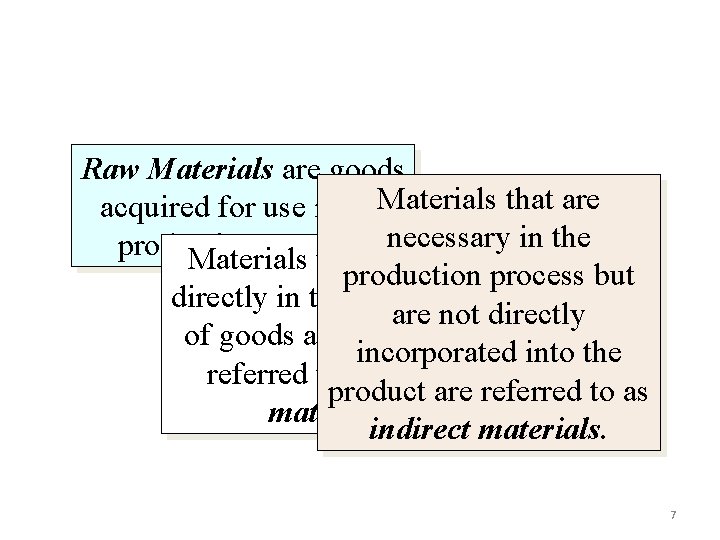
Raw Materials are goods acquired for use in the. Materials that are necessary in the production process. Materials that are used production process but directly in the production are not directly of goods are frequently incorporated into the referred to as direct product are referred to as materials. indirect materials. 7
Work in Process Work in process consists of materials partly processed and requiring further work before they can be sold. This inventory includes three cost elements. 1. Direct materials 2. Direct labor 3. Manufacturing overhead 8
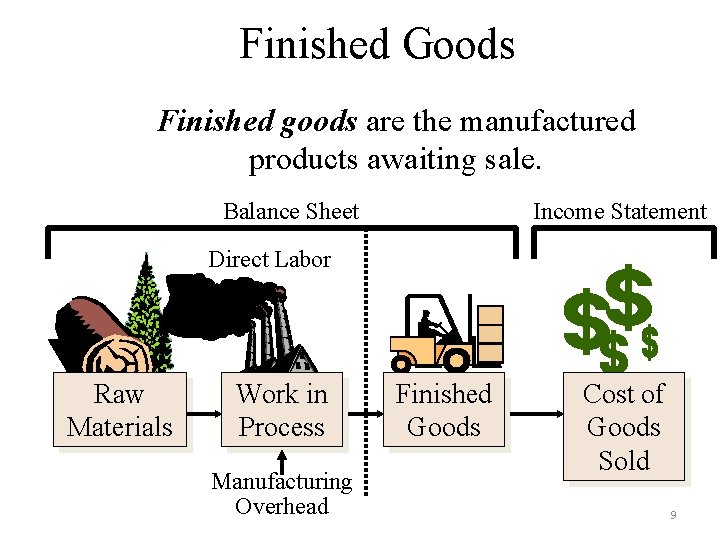
Finished Goods Finished goods are the manufactured products awaiting sale. Income Statement Balance Sheet Direct Labor Raw Materials Work in Process Manufacturing Overhead Finished Goods Cost of Goods Sold 9
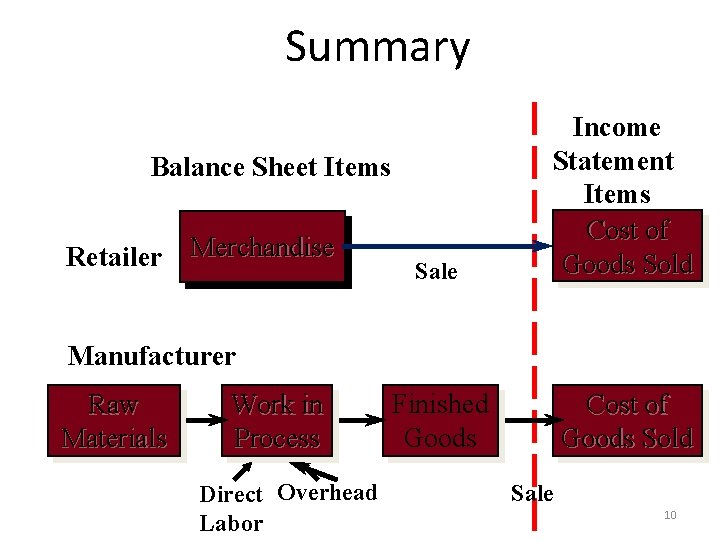
Summary Sale Income Statement Items Cost of Goods Sold Finished Goods Cost of Goods Sold Balance Sheet Items Retailer Merchandise Manufacturer Raw Materials Work in Process Direct Overhead Labor Sale 10
Periodic Inventory Systems ü Cost of Goods Sold is determined and Inventory is adjusted to proper balance at period end. ü All purchases of inventoriable merchandise are recorded in the Purchases account. ü Ending inventory is determined by physical count of merchandise on hand. 11
Perpetual Inventory Systems 12 ü Cost of Goods Sold is determined and Inventory is adjusted to proper balance each time inventory is purchased or sold. ü All purchases of inventoriable goods are recorded in the Inventory account. 12
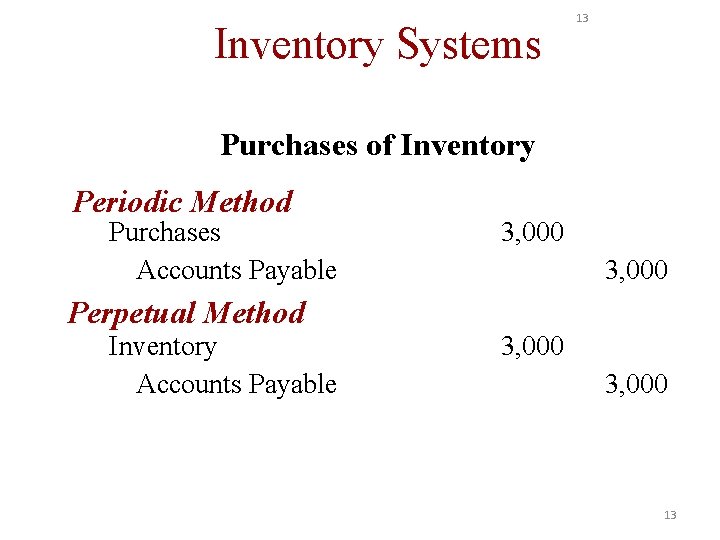
Inventory Systems 13 Purchases of Inventory Periodic Method Purchases Accounts Payable 3, 000 Perpetual Method Inventory Accounts Payable 3, 000 13
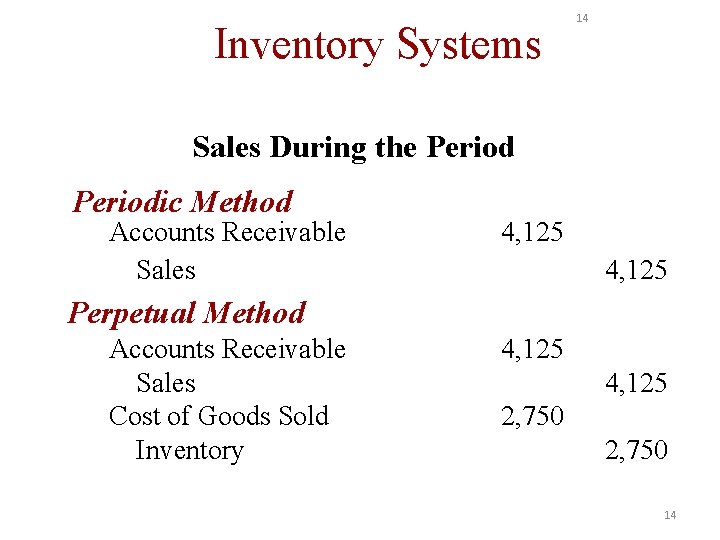
Inventory Systems 14 Sales During the Periodic Method Accounts Receivable Sales 4, 125 Perpetual Method Accounts Receivable Sales Cost of Goods Sold Inventory 4, 125 2, 750 14
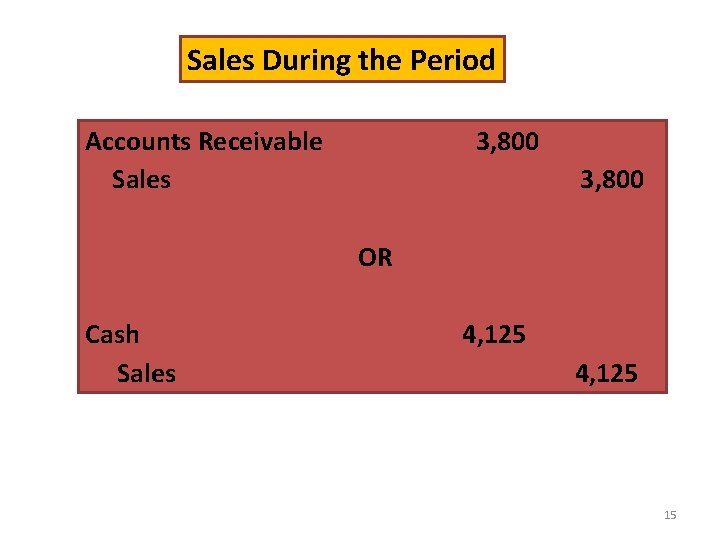
Sales During the Period Accounts Receivable Sales 3, 800 OR Cash Sales 4, 125 15
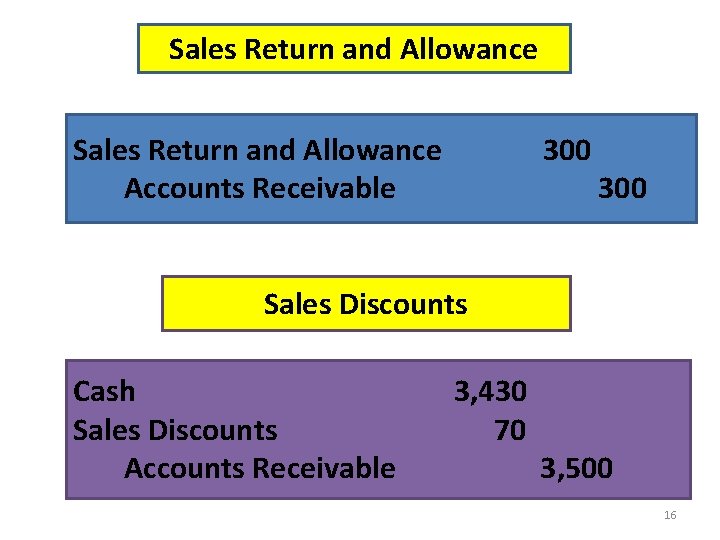
Sales Return and Allowance Accounts Receivable 300 Sales Discounts Cash Sales Discounts Accounts Receivable 3, 430 70 3, 500 16
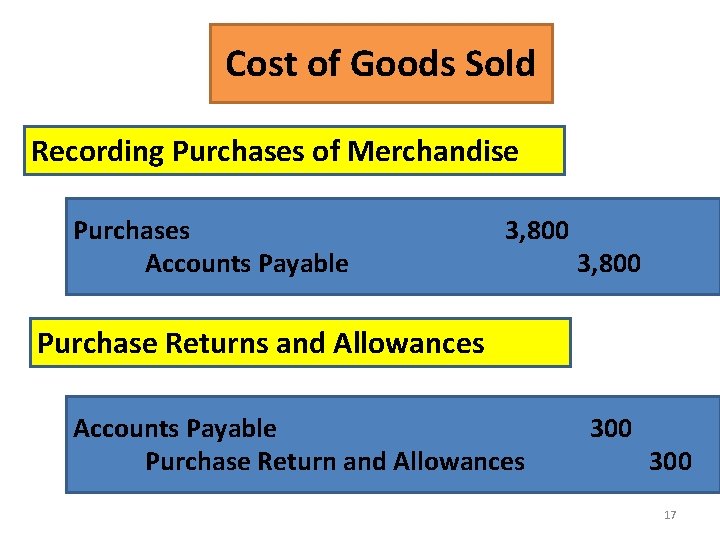
Cost of Goods Sold Recording Purchases of Merchandise Purchases Accounts Payable 3, 800 Purchase Returns and Allowances Accounts Payable Purchase Return and Allowances 300 17
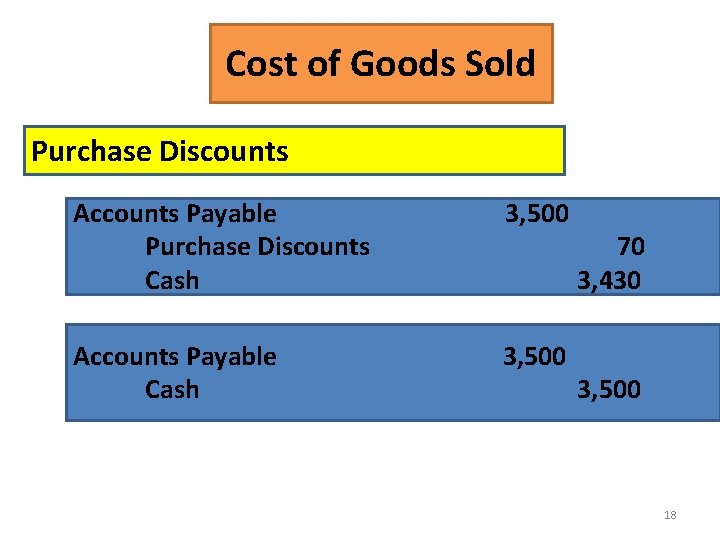
Cost of Goods Sold Purchase Discounts Accounts Payable Purchase Discounts Cash 3, 500 Accounts Payable Cash 3, 500 70 3, 430 3, 500 18
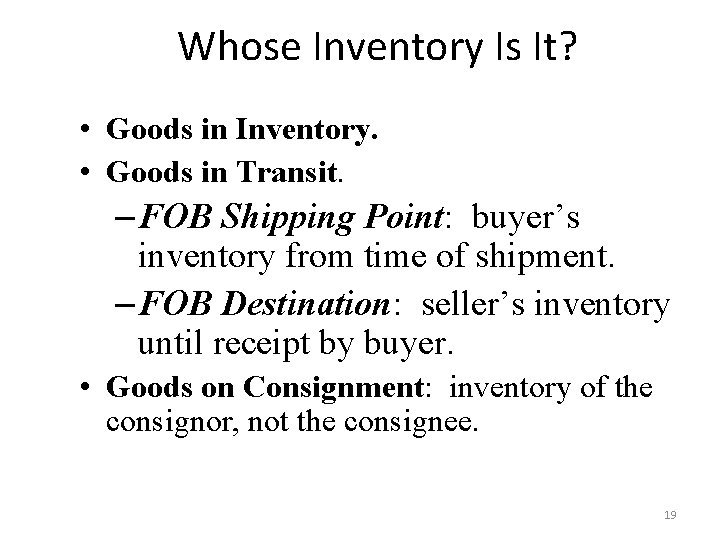
Whose Inventory Is It? • Goods in Inventory. • Goods in Transit. – FOB Shipping Point: buyer’s inventory from time of shipment. – FOB Destination: seller’s inventory until receipt by buyer. • Goods on Consignment: inventory of the consignor, not the consignee. 19
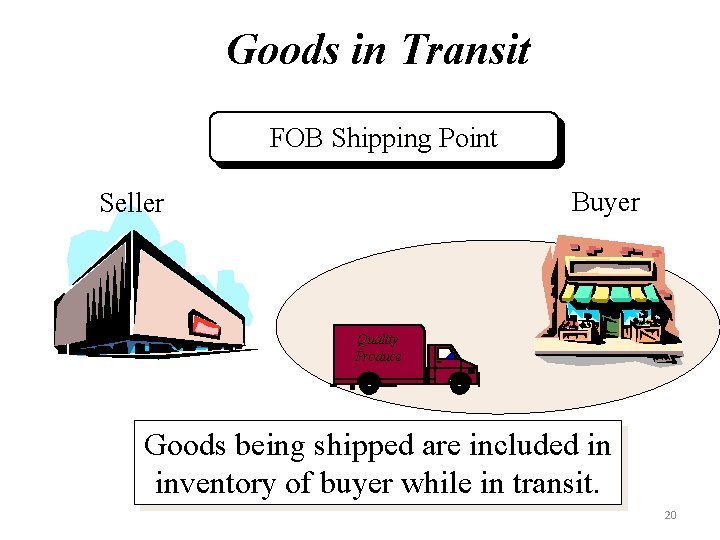
Goods in Transit FOB Shipping Point Buyer Seller Quality Produce Goods being shipped are included in inventory of buyer while in transit. 20
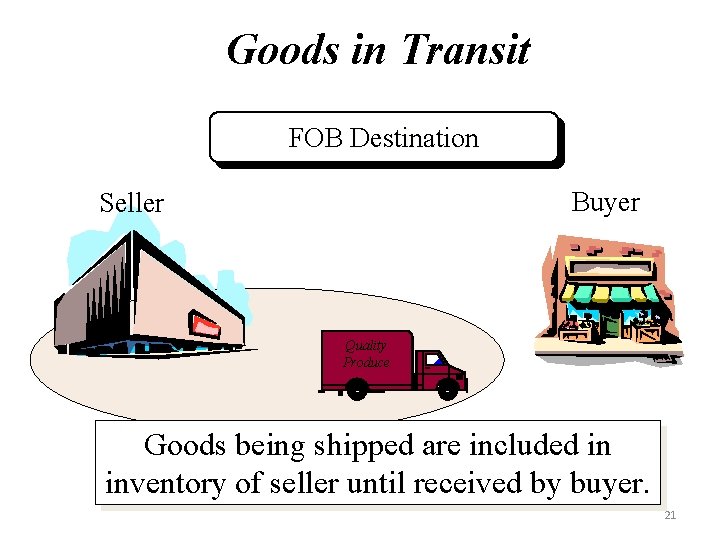
Goods in Transit FOB Destination Buyer Seller Quality Produce Goods being shipped are included in inventory of seller until received by buyer. 21
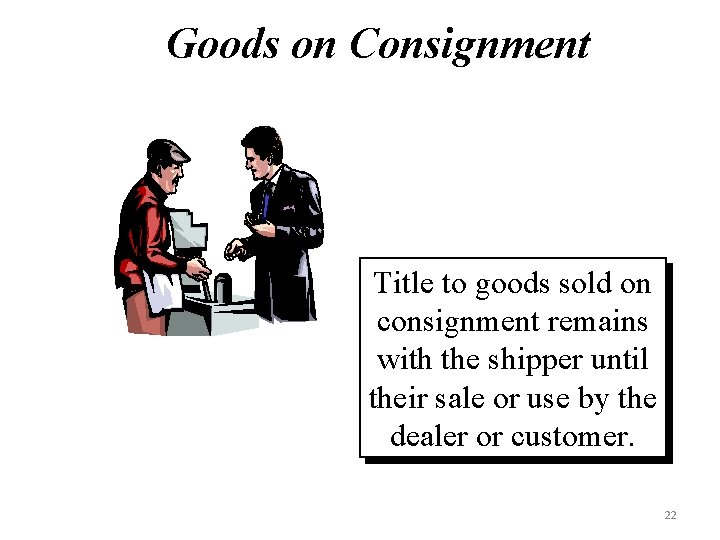
Goods on Consignment Title to goods sold on consignment remains with the shipper until their sale or use by the dealer or customer. 22
What Is Inventory Cost? • Inventory Cost is all expenditures related to inventory acquisition, preparation, and placement for sale. • Trade Discounts – Convert the catalog price to the actual price. – Record inventory at discounted price. • Cash Discounts – Granted for payment of invoices within a limited time period. – Record inventory using the net method or gross method. 23
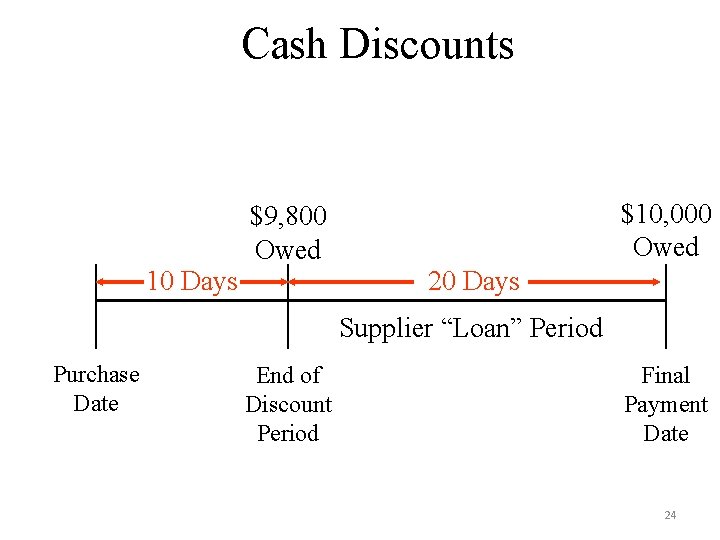
Cash Discounts $10, 000 Owed $9, 800 Owed 10 Days 20 Days Supplier “Loan” Period Purchase Date End of Discount Period Final Payment Date 24
Determining Cost of Goods on Hand • Computing the units on hand for each item of inventory. • Applying unit costs to the total units on hand for each item of inventory. • Aggregating the costs for each item of inventory to determine the total cost of goods on hand. 25
Computing Cost of Goods Sold • Add the cost of goods purchased to the cost of goods on hand at the beginning of the period (beginning inventory) to obtain the cost of goods available for sale. • Subtract the cost of goods on hand at the end of the period (ending inventory) from the cost of goods available for sale to arrive at the cost of goods sold. 26
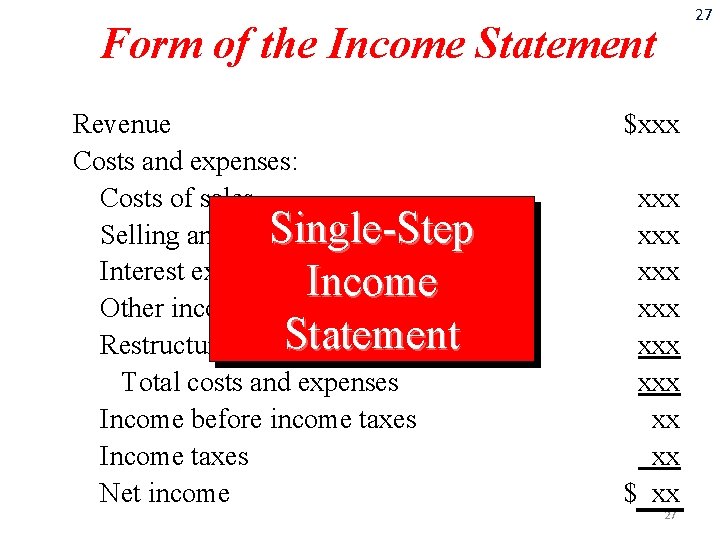
27 Form of the Income Statement Revenue Costs and expenses: Costs of sales Single-Step Selling and administrative Interest expense Income Other income/expense, net Statement Restructuring charge Total costs and expenses Income before income taxes Income taxes Net income $xxx xxx xx xx $ xx 27
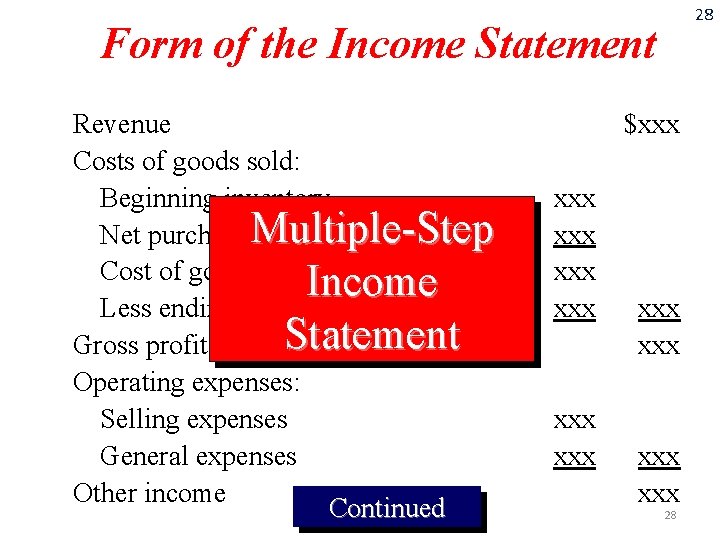
28 Form of the Income Statement Revenue Costs of goods sold: Beginning inventory Net purchases. Multiple-Step Cost of goods available for sale Income Less ending inventory Statement Gross profit on sales Operating expenses: Selling expenses General expenses Other income Continued $xxx xxx xxx 28
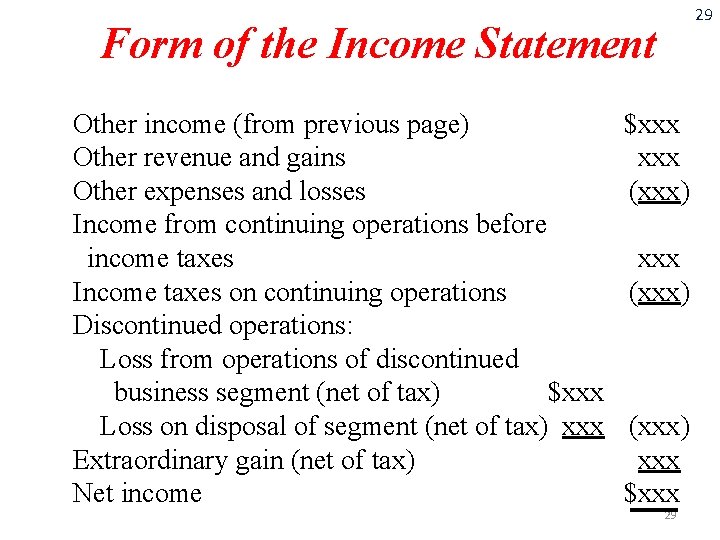
29 Form of the Income Statement Other income (from previous page) Other revenue and gains Other expenses and losses Income from continuing operations before income taxes Income taxes on continuing operations Discontinued operations: Loss from operations of discontinued business segment (net of tax) $xxx Loss on disposal of segment (net of tax) xxx Extraordinary gain (net of tax) Net income $xxx (xxx) xxx $xxx 29
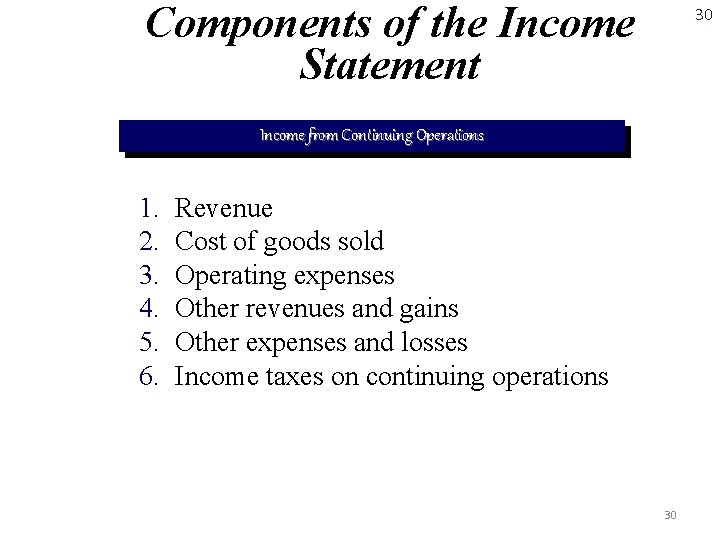
Components of the Income Statement 30 Income from Continuing Operations 1. 2. 3. 4. 5. 6. Revenue Cost of goods sold Operating expenses Other revenues and gains Other expenses and losses Income taxes on continuing operations 30
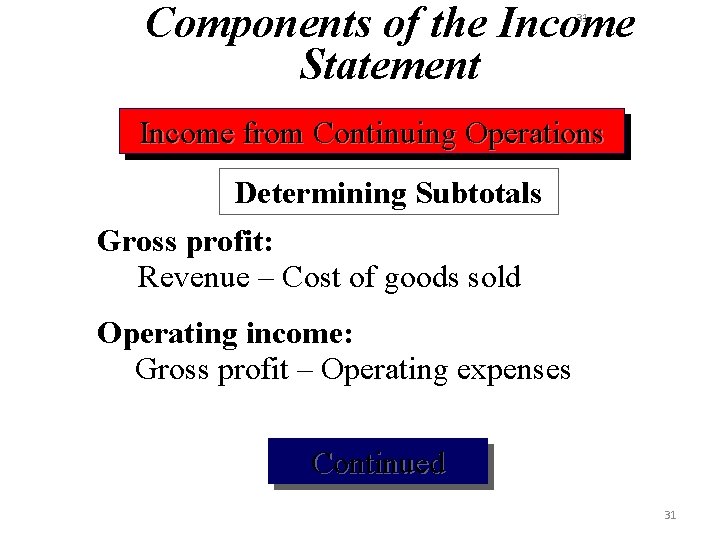
Components of the Income Statement 31 Income from Continuing Operations Determining Subtotals Gross profit: Revenue – Cost of goods sold Operating income: Gross profit – Operating expenses Continued 31
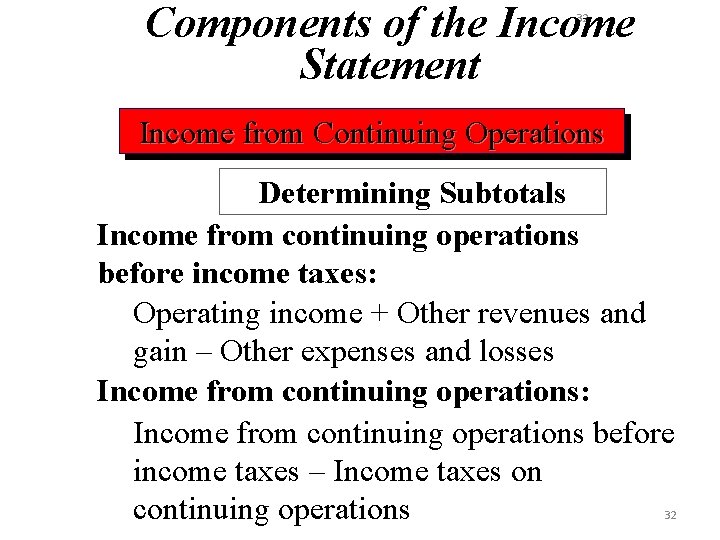
Components of the Income Statement 32 Income from Continuing Operations Determining Subtotals Income from continuing operations before income taxes: Operating income + Other revenues and gain – Other expenses and losses Income from continuing operations: Income from continuing operations before income taxes – Income taxes on continuing operations 32
Components of the Income Statement 33 Revenue reports the total sales to customers for the period less any sales returns and allowances or discounts. 33
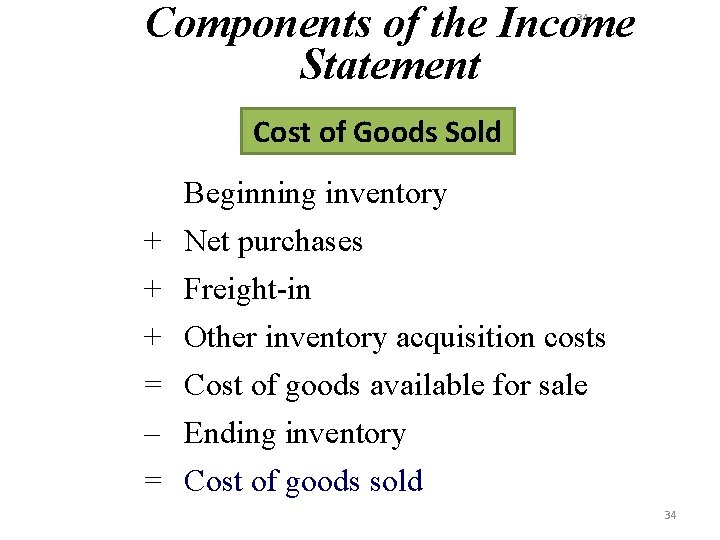
Components of the Income Statement 34 Cost of Goods Sold Beginning inventory + Net purchases + Freight-in + Other inventory acquisition costs = Cost of goods available for sale – Ending inventory = Cost of goods sold 34
Components of the Income Statement 35 Cost of Goods Sold Cost of goods sold is a significant item on merchandising and manufacturing companies’ income statement. 35
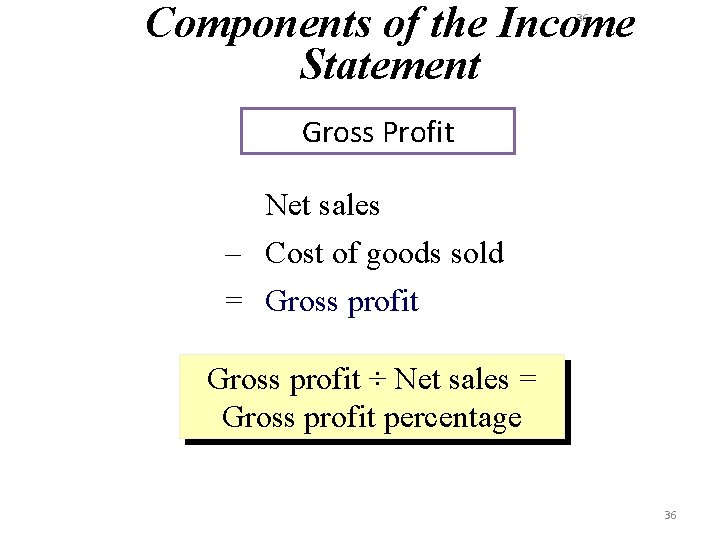
Components of the Income Statement 36 Gross Profit Net sales – Cost of goods sold = Gross profit ÷ Net sales = Gross profit percentage 36
Components of the Income Statement 37 Operating Expenses Operating expenses may be reported in two parts: 1) Selling expenses 2) General and administrative expenses 37
Components of the Income Statement 38 Operating Income Operating income measures the performance of the fundamental business operations conducted by a company. Gross profit – Operating expenses = Operating income 38
Components of the Income Statement 39 Other Revenues and Gains This section usually includes items identified with the peripheral activities of the company. 1) Rent revenue 2) Interest revenue 3) Dividend revenue 4) Gains from the sale of assets 39
Components of the Income Statement 40 Other Expenses and Losses This section parallels “Other Revenues and Gains” except the items result in deductions from operating income. 1) Interest expense 2) Losses from the sale of assets 40
41 Discontinued Operations Why would management decide to dispose of a component of a business? § The component may be unprofitable. § The component may not fit into the longrange plans for the company. § Management may need funds to reduce long-term debit or to expand into other areas. § Management may be fearful of a corporate takeover. 41
Discontinued Operations 42 • Income statement section consists of two parts: – Income (loss) from operations--disclosed only if decision to discontinue operations is made after beginning of the year. – Gain (loss) on disposal of operations-consisting of income (loss) during phase out and gain (loss) from disposal of segment assets. 42
Discontinued Operations 43 According to FASB Statement No. 144, if on the balance sheet date assets and liabilities associated with discontinued components have not been completely disposed, they are to be listed separately in the asset and liability sections of the balance sheet. 43
44 Discontinued Operations In addition to the summary income or loss number reported in the income statement, the total revenue associated with the discontinued operations should be disclosed in the financial statement notes. 44
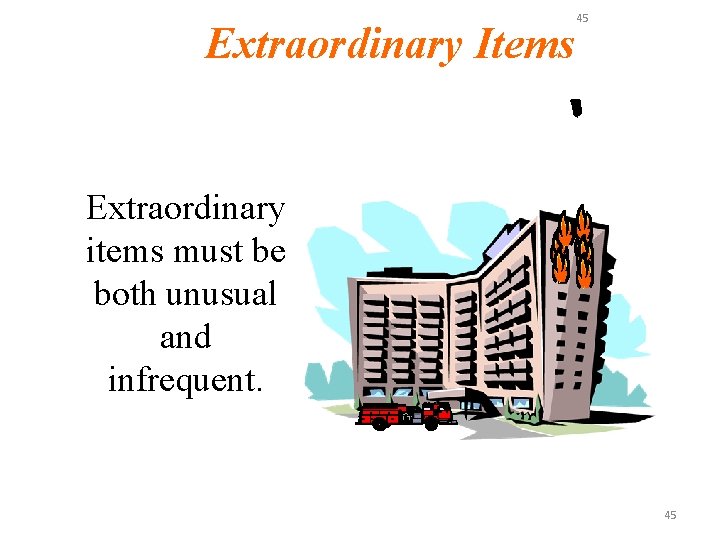
Extraordinary Items 45 Extraordinary items must be both unusual and infrequent. 45
Never Extraordinary u u u 46 Write-down or write-off of receivables, inventory, etc. Gains or losses from exchange or remeasurement of foreign currencies. Gains or losses on disposal of business segment. Gains or losses from sale or abandonment of productive assets. Effects of a strike. Adjustment of accruals on long-term contracts. 46
Completing the Accounting Cycle 47
- Slides: 47