
Accounting for Merchandising Business ACG 2021 Chapter 5
Accounting for Merchandising Business ACG 2021: Chapter 5
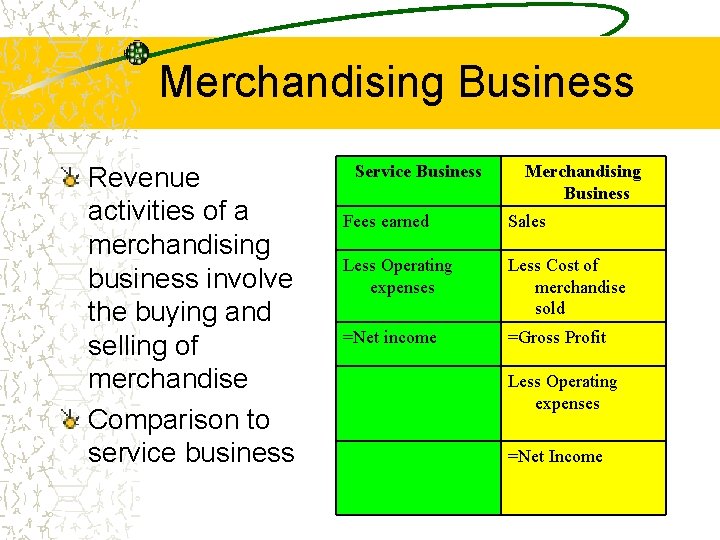
Merchandising Business Revenue activities of a merchandising business involve the buying and selling of merchandise Comparison to service business Service Business Merchandising Business Fees earned Sales Less Operating expenses Less Cost of merchandise sold =Net income =Gross Profit Less Operating expenses =Net Income
New Accounts on the Income Statement – SALES – revenues collected from the sale of merchandise – COST OF MERCHANDISE SOLD – the purchase price plus incidentals of merchandise available for resale – GROSS PROFIT – Sales – Cost of merchandise sold
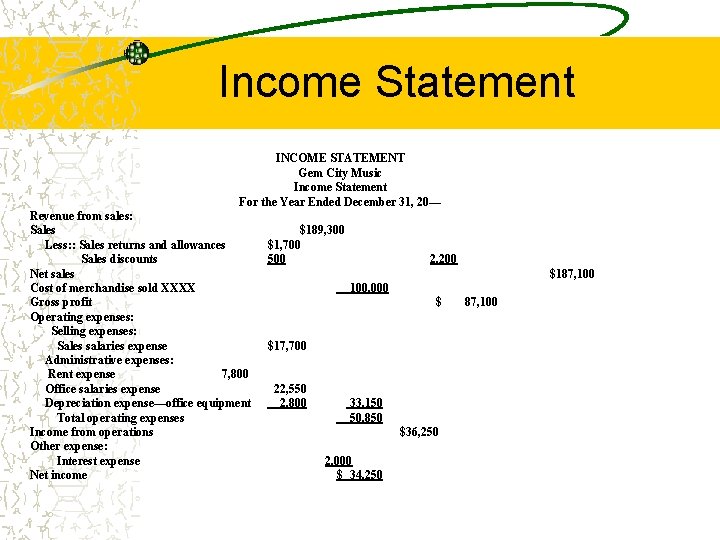
Income Statement INCOME STATEMENT Gem City Music Income Statement For the Year Ended December 31, 20— Revenue from sales: Sales Less: : Sales returns and allowances Sales discounts Net sales Cost of merchandise sold XXXX Gross profit Operating expenses: Selling expenses: Sales salaries expense Administrative expenses: Rent expense 7, 800 Office salaries expense Depreciation expense—office equipment Total operating expenses Income from operations Other expense: Interest expense Net income $189, 300 $1, 700 500 2, 200 $187, 100, 000 $ $17, 700 22, 550 2, 800 33, 150 50, 850 $36, 250 2, 000 $ 34, 250 87, 100
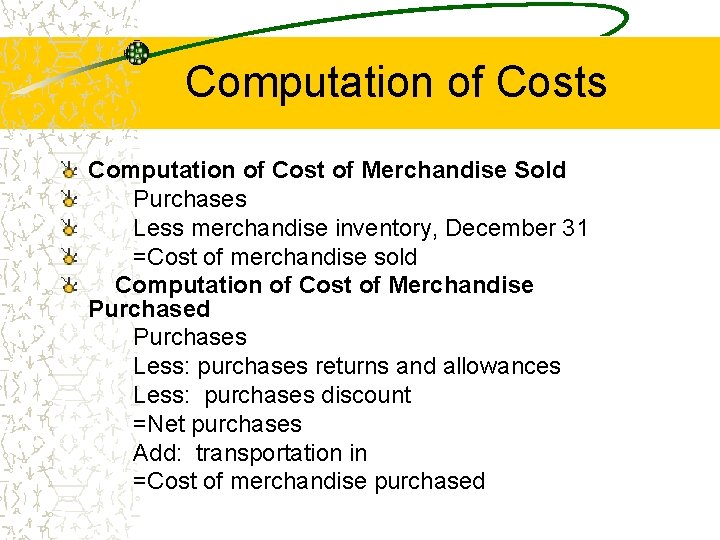
Computation of Costs Computation of Cost of Merchandise Sold Purchases Less merchandise inventory, December 31 =Cost of merchandise sold Computation of Cost of Merchandise Purchased Purchases Less: purchases returns and allowances Less: purchases discount =Net purchases Add: transportation in =Cost of merchandise purchased

Balance Sheet Accounts Merchandise inventory – merchandise on hand at the end of an accounting period.
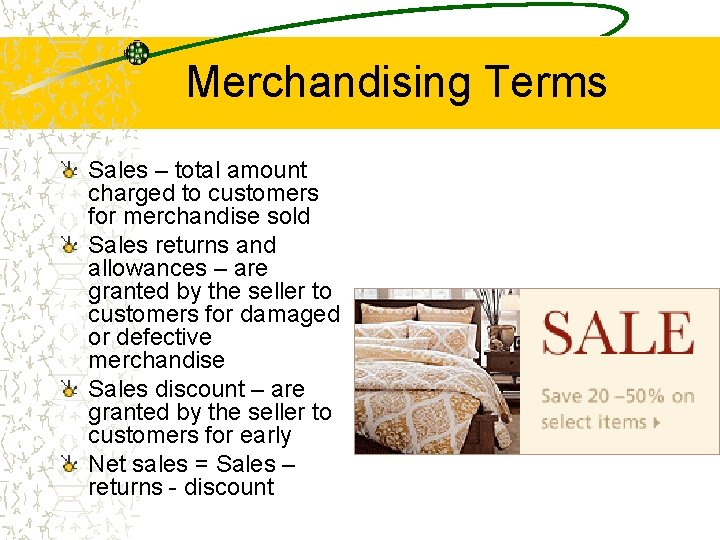
Merchandising Terms Sales – total amount charged to customers for merchandise sold Sales returns and allowances – are granted by the seller to customers for damaged or defective merchandise Sales discount – are granted by the seller to customers for early Net sales = Sales – returns - discount
Merchandising Terms Cost of goods sold – Cost of merchandise sold to customers Purchases discounts – Offered by the seller to buyer – For early payment Purchases allowances and returns – Buyer may receive a reduction in the intial price at which the merchandise is purchased.
Merchandising Terms Merchandise available for sale = – Beginning merchandise inventory + net purchases Net purchases = – Purchases minus discounts – returns and allowances
Accounting for Sales Under the perpetual inventory system, all sales require the reporting of the removal of inventory from the books at the same time.
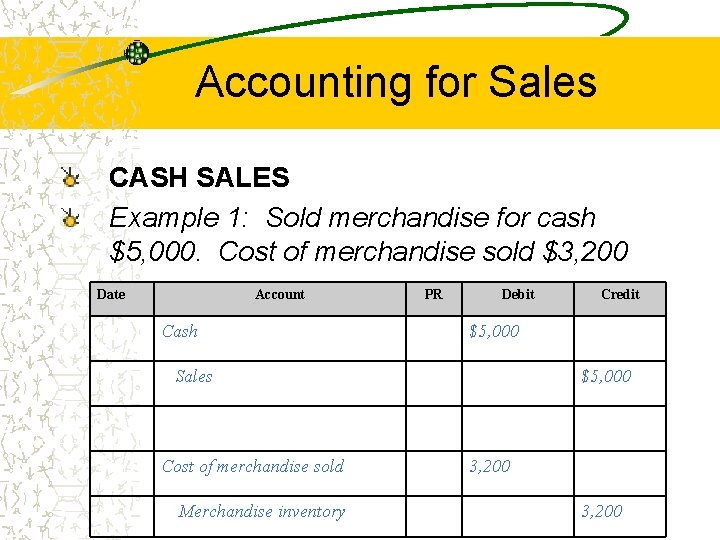
Accounting for Sales CASH SALES Example 1: Sold merchandise for cash $5, 000. Cost of merchandise sold $3, 200 Date Account Cash PR Debit $5, 000 Sales Cost of merchandise sold Merchandise inventory Credit $5, 000 3, 200
Credit sales Bank cards – Master card – Visa – Monies directly deposited in business account – Requires a debit to CASH Service charge must be later recorded as expense
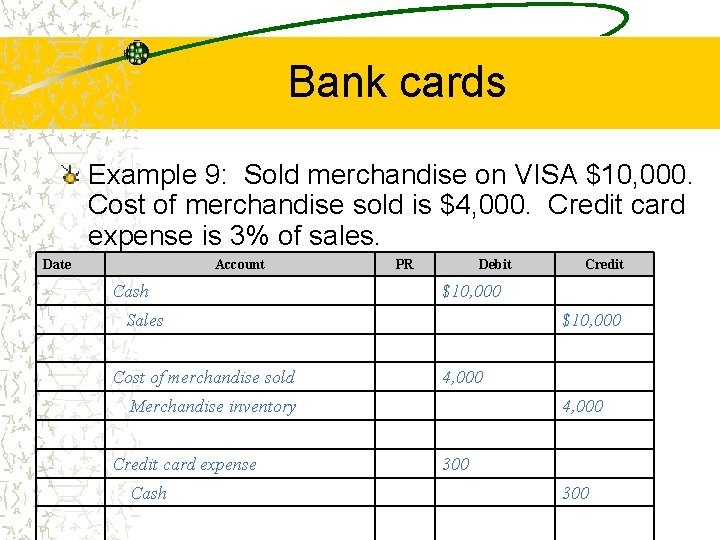
Bank cards Example 9: Sold merchandise on VISA $10, 000. Cost of merchandise sold is $4, 000. Credit card expense is 3% of sales. Date Account Cash PR Debit $10, 000 Sales Cost of merchandise sold $10, 000 4, 000 Merchandise inventory Credit card expense Cash Credit 4, 000 300
Bank cards Example 3: Sold merchandise on VISA $6, 000. Cost of merchandise sold is $3, 000. Credit card expense is 3% of sales.
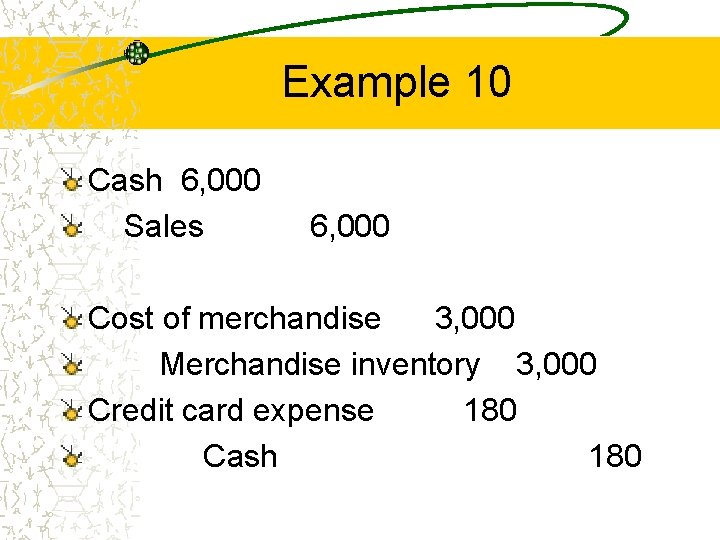
Example 10 Cash 6, 000 Sales 6, 000 Cost of merchandise 3, 000 Merchandise inventory 3, 000 Credit card expense 180 Cash 180
Credit sales Two types: – American express – On account Results in debit to ACCOUNTS RECEIVABLE
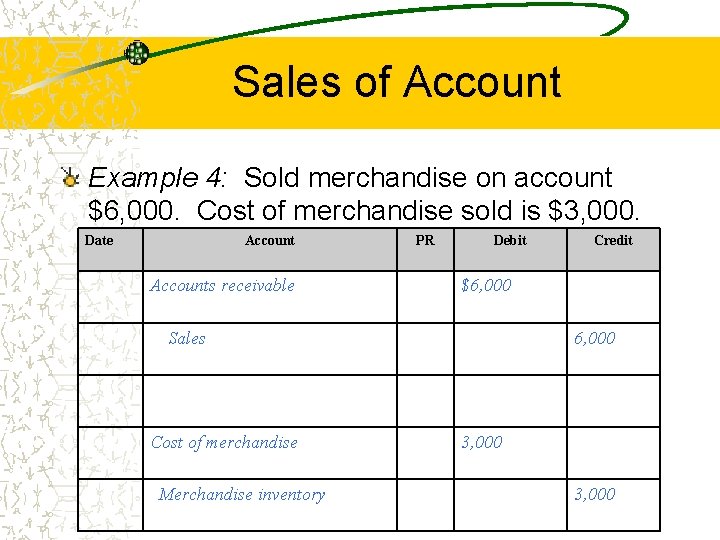
Sales of Account Example 4: Sold merchandise on account $6, 000. Cost of merchandise sold is $3, 000. Date Accounts receivable PR Debit $6, 000 Sales Cost of merchandise Merchandise inventory Credit 6, 000 3, 000
Recap Under the perpetual inventory system, all sales transactions consist of at least two entries. The first entry records the sale at the selling price with a debit to how it will be paid and credit to sales. The second entry records the merchandise leaving the business with a debit to cost of merchandise sold and credit to merchandise inventory for the cost of the merchandise.
Sales discounts A reduction in the price of the good for early payment. This account is a contra – SALES Upon payment of the account receivable, if the payment is within the discount period, we record the discount. Credit terms – terms of when payments for merchandise are to be made. – Net 30 days – full amount due in 30 days – 2/10 – 2% discount if paid within 10 days
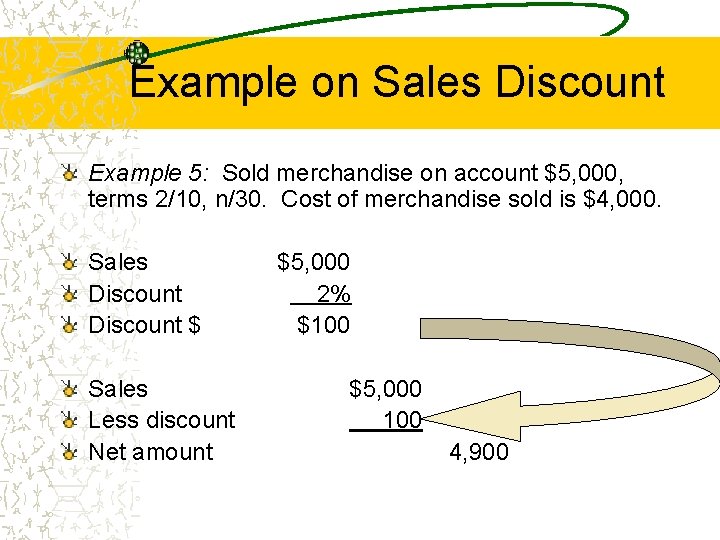
Example on Sales Discount Example 5: Sold merchandise on account $5, 000, terms 2/10, n/30. Cost of merchandise sold is $4, 000. Sales Discount $ Sales Less discount Net amount $5, 000 2% $100 $5, 000 100 4, 900
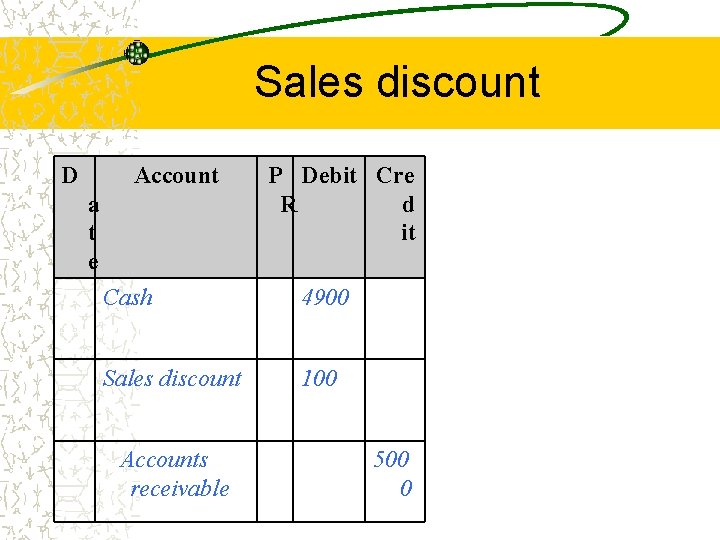
Sales discount D Account a t e P Debit Cre R d it Cash 4900 Sales discount 100 Accounts receivable 500 0
Sales Returns and Allowances Merchandise sold may be returned to the seller Merchandise sold may be reduced in price due to defects This account is CONTRA – sales Increases with a debit
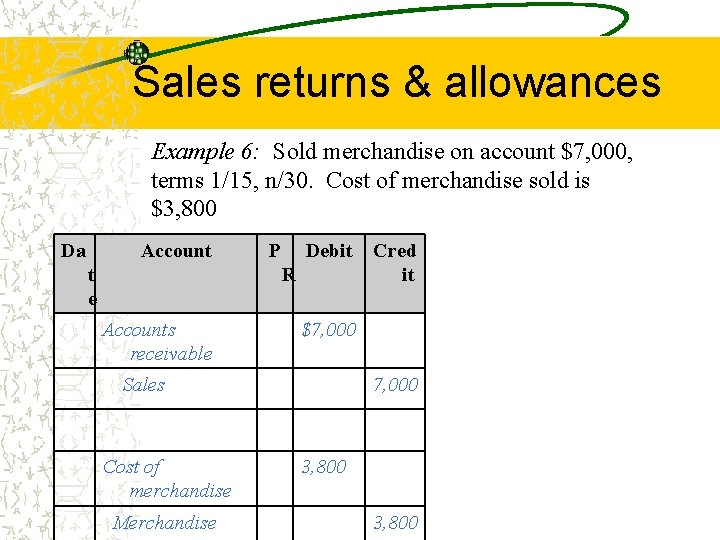
Sales returns & allowances Example 6: Sold merchandise on account $7, 000, terms 1/15, n/30. Cost of merchandise sold is $3, 800 Da Account t e P Debit R Accounts receivable $7, 000 Sales Cost of merchandise Merchandise Cred it 7, 000 3, 800
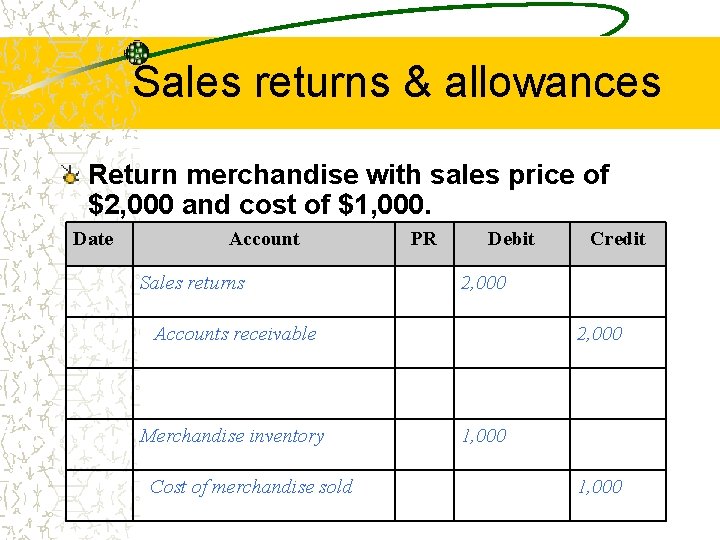
Sales returns & allowances Return merchandise with sales price of $2, 000 and cost of $1, 000. Date Account Sales returns PR Debit 2, 000 Accounts receivable Merchandise inventory Cost of merchandise sold Credit 2, 000 1, 000
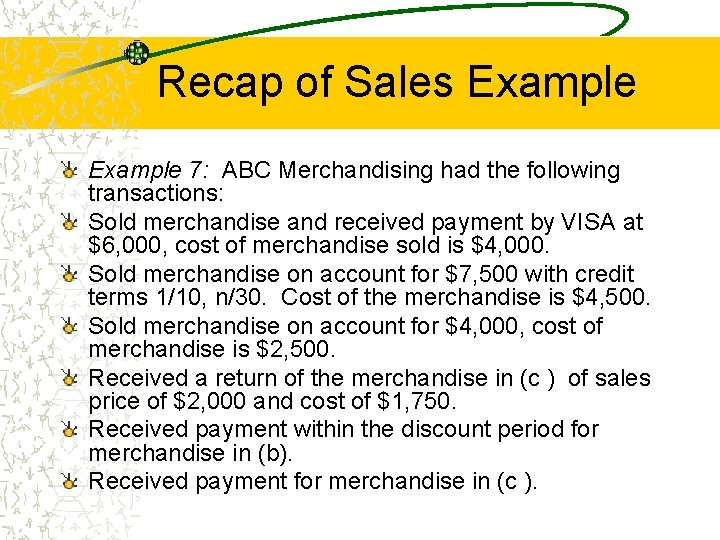
Recap of Sales Example 7: ABC Merchandising had the following transactions: Sold merchandise and received payment by VISA at $6, 000, cost of merchandise sold is $4, 000. Sold merchandise on account for $7, 500 with credit terms 1/10, n/30. Cost of the merchandise is $4, 500. Sold merchandise on account for $4, 000, cost of merchandise is $2, 500. Received a return of the merchandise in (c ) of sales price of $2, 000 and cost of $1, 750. Received payment within the discount period for merchandise in (b). Received payment for merchandise in (c ).
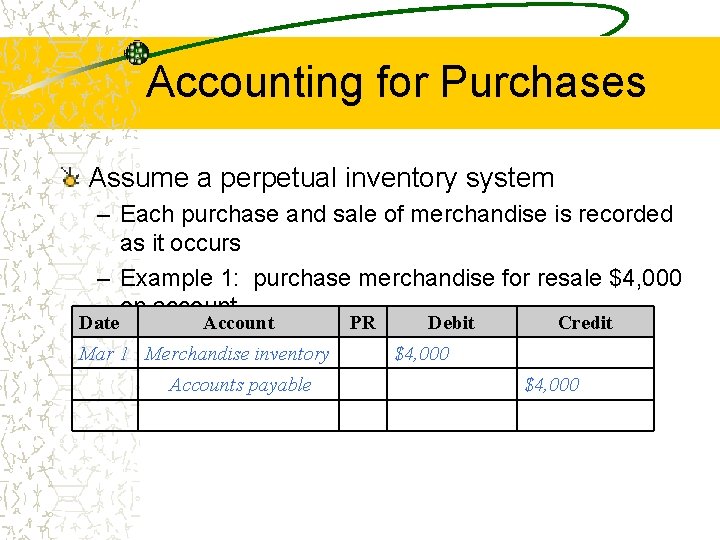
Accounting for Purchases Assume a perpetual inventory system – Each purchase and sale of merchandise is recorded as it occurs – Example 1: purchase merchandise for resale $4, 000 on account Date Account Mar 1 Merchandise inventory Accounts payable PR Debit Credit $4, 000
Purchases Discount Credit terms – Purchases discounts are discounts taken by the buyer for early payment of an invoice. – These discounts reduce the cost of the merchandise purchased. – Should be taken when offered if not it is a LOSS to
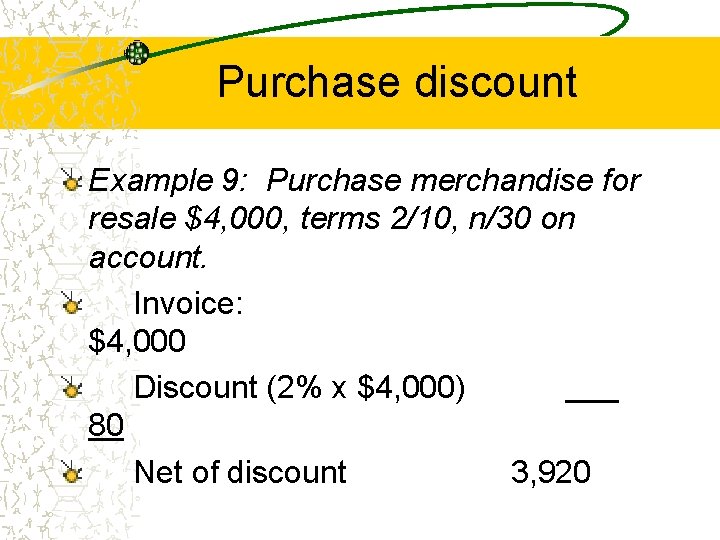
Purchase discount Example 9: Purchase merchandise for resale $4, 000, terms 2/10, n/30 on account. Invoice: $4, 000 Discount (2% x $4, 000) 80 Net of discount 3, 920
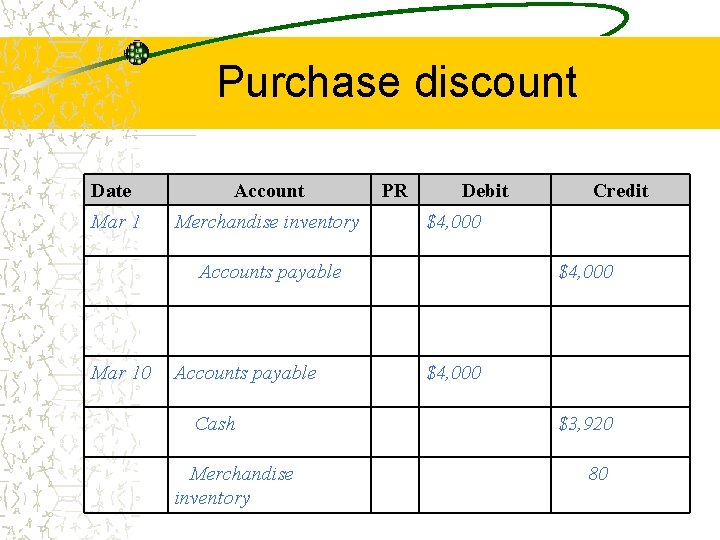
Purchase discount Date Account Mar 1 Merchandise inventory PR Debit $4, 000 Accounts payable Mar 10 Accounts payable Cash Merchandise inventory Credit $4, 000 $3, 920 80
Purchase Discount Reduction of the cost of the merchandise is reflected in the merchandise inventory account. Example 10: Purchase merchandise for resale $6, 000, terms 1/15, n/30 on account.
Purchases Returns and Allowances Purchase returns – merchandise is returned to the seller Purchase allowances – price adjustment Debit memorandum – notification of the return or allowance by seller
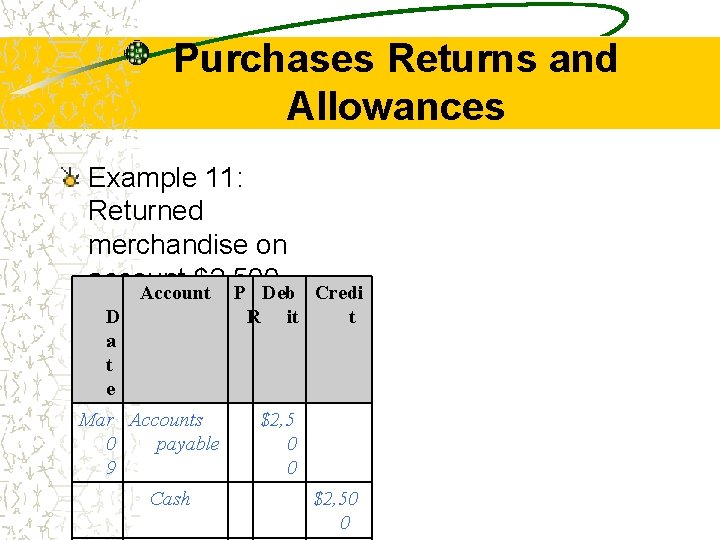
Purchases Returns and Allowances Example 11: Returned merchandise on account $2, 500. Account P Deb D a t e R Mar Accounts 0 payable 9 Cash Credi it t $2, 5 0 0 $2, 50 0
Example 12: Purchased merchandise of $8, 000 on terms 2/10, n/30. Ennis pays the original invoice less a return of $2, 500 within the discount period. Record the above entries
Recap of Purchases Example 7: ABC Merchandising had the following transactions: Purchased merchandise and received payment by VISA at $6, 000. Purchased merchandise on account for $7, 500 with credit terms 1/10, n/30. Purchased merchandise on account for $4, 000. Return of the merchandise in (c ) of sales price of $2, 000. Paid within the discount period for merchandise in (b). Paid for merchandise in (c ).
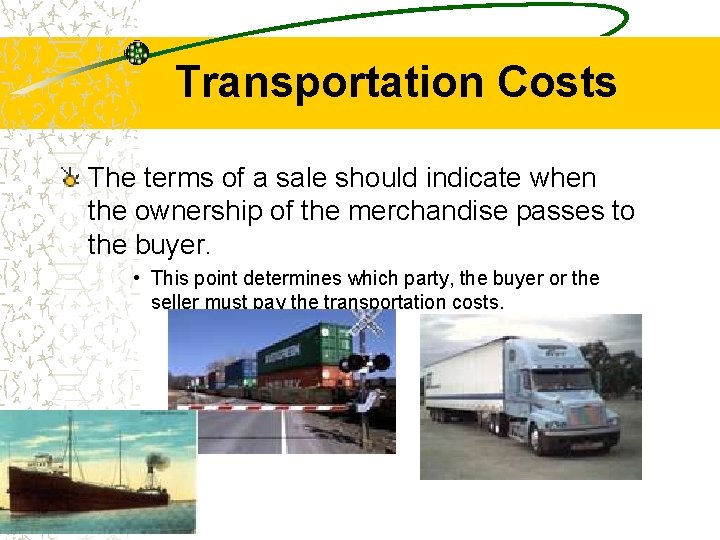
Transportation Costs The terms of a sale should indicate when the ownership of the merchandise passes to the buyer. • This point determines which party, the buyer or the seller must pay the transportation costs.
Transportation Costs – FOB – shipping point • The ownership of the merchandise passes to the buyer when the seller delivers the merchandise to the transportation company. • Buyer pays the transportation costs Example 13: Purchased merchandise for $4, 000 with shipping costs of $50 FOB shipping point.
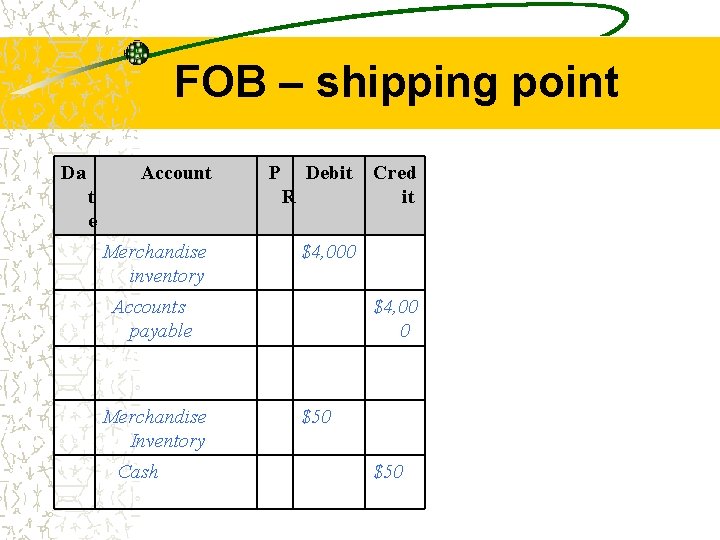
FOB – shipping point Da Account t e P Debit R Merchandise inventory $4, 000 Accounts payable Merchandise Inventory Cash Cred it $4, 00 0 $50
Transportation Costs – FOB – destination point • The ownership of the merchandise passes to the buyer when the seller delivers the merchandise to the buyer. • Seller pays the transportation costs Example 14: Sold merchandise for $4, 000 with shipping costs of $50 FOB destination. Cost of merchandise sold is $2, 000.
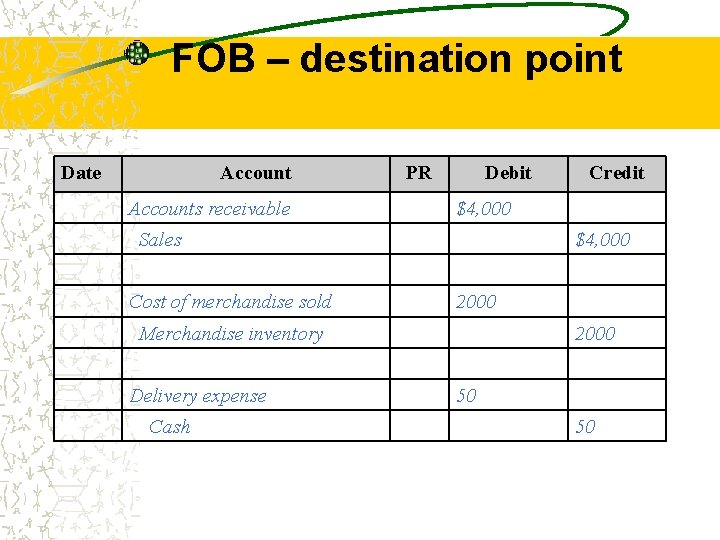
FOB – destination point Date Accounts receivable PR Debit $4, 000 Sales Cost of merchandise sold $4, 000 2000 Merchandise inventory Delivery expense Cash Credit 2000 50 50
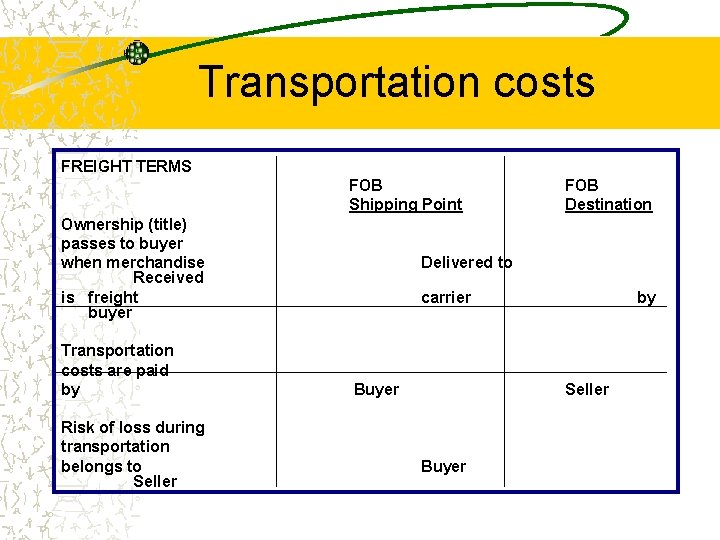
Transportation costs FREIGHT TERMS FOB Shipping Point Ownership (title) passes to buyer when merchandise Received is freight buyer Transportation costs are paid by Risk of loss during transportation belongs to Seller FOB Destination Delivered to carrier Buyer by Seller Buyer
Sales Taxes Liability to the business Create a SALES TAX PAYABLE account Example 15: Sold merchandise on account $7, 000, plus 5% sales tax. Cost of merchandise sold is $3, 800.
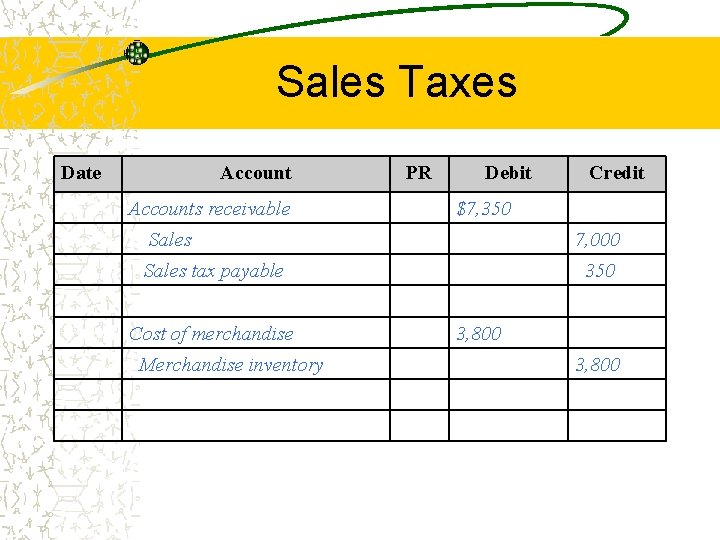
Sales Taxes Date Accounts receivable PR Debit $7, 350 Sales 7, 000 Sales tax payable Cost of merchandise Merchandise inventory Credit 350 3, 800
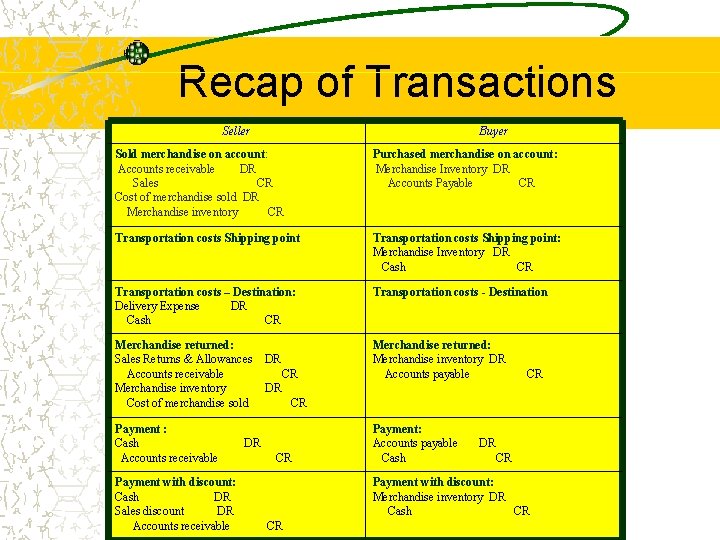
Recap of Transactions Seller Buyer Sold merchandise on account: Accounts receivable DR Sales CR Cost of merchandise sold DR Merchandise inventory CR Purchased merchandise on account: Merchandise Inventory DR Accounts Payable CR Transportation costs Shipping point: Merchandise Inventory DR Cash CR Transportation costs – Destination: Delivery Expense DR Cash CR Transportation costs - Destination Merchandise returned: Sales Returns & Allowances Accounts receivable Merchandise inventory Cost of merchandise sold Merchandise returned: Merchandise inventory DR Accounts payable Payment : Cash Accounts receivable Payment with discount: Cash DR Sales discount DR Accounts receivable DR CR Payment: Accounts payable Cash CR DR CR Payment with discount: Merchandise inventory DR Cash CR CR
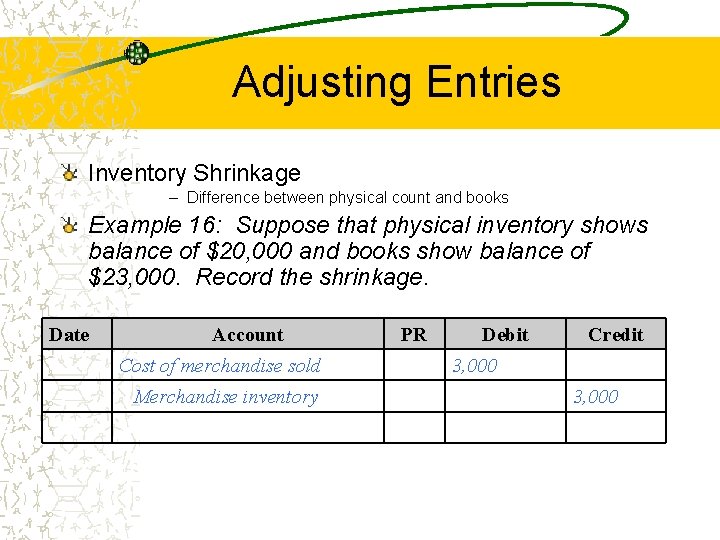
Adjusting Entries Inventory Shrinkage – Difference between physical count and books Example 16: Suppose that physical inventory shows balance of $20, 000 and books show balance of $23, 000. Record the shrinkage. Date Account Cost of merchandise sold Merchandise inventory PR Debit Credit 3, 000
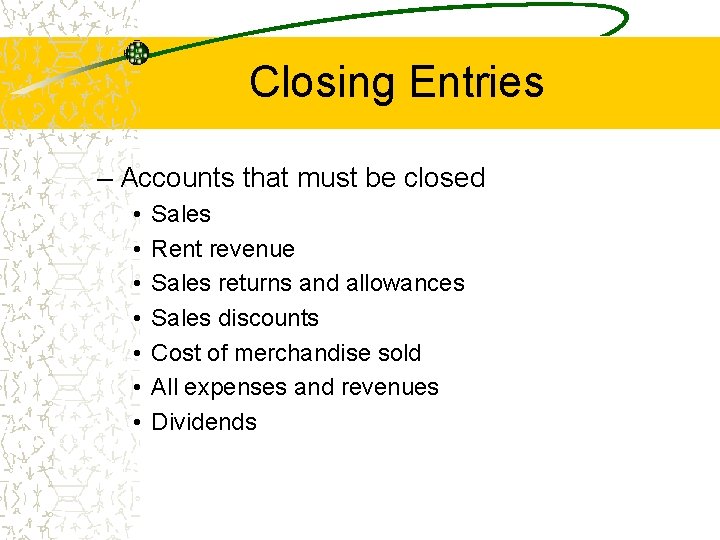
Closing Entries – Accounts that must be closed • • Sales Rent revenue Sales returns and allowances Sales discounts Cost of merchandise sold All expenses and revenues Dividends
- Slides: 45