
Accounting Control and Controlling Accounting Interdisciplinary and Critical
- Slides: 30
Accounting Control and Controlling Accounting Interdisciplinary and Critical Perspectives Jane Broadbent Royal Holloway, University of London Richard Laughlin King’s College London, University of London
Introduction (1) Ø This presentation overviews key insights into a book with the same title published by Emerald Publishing – see http: //www. emeraldinsight. com/products/books/notable/page. htm? id=9781781907627 Ø The Book attempts to do three things: Ø To explore something of the nature and history of the Interdisciplinary and Critical Perspectives on Accounting (ICPA) Project. Ø To demonstrate the power of a particular ICPA Research Approach to critically analyse what we refer to as Accounting Control and Controlling Accounting which involves a range of counterproductive and destructive relationships between society and (particularly) public sector organisations driven by different forms of accounting. . Ø To provide an alternative way forward involving policy prescriptions to overcome the problems analysed.
Introduction (2) Ø Presentation Outline with links to Chapters in the Book: Ø Nature and History of the ICPA Project (Parts of Chapters 1 and 2) Ø An ICPA Conceptual and Theoretical Framework for Critically Analysing Accounting Control and Controlling Accounting (Parts of Chapters 1 and 2 and Chapter 3) Ø The Nature of Accounting Control (Chapters 4 and 5) Ø The Nature of Controlling Accounting (Chapters 6 and 7) Ø An Alternative Way Forward: Reflections and Policy Proposals (Chapter 8) Ø We will provide a brief overview into the key insights of the book under each of these headings. Please read the Book for more details!
History and Nature of the ICPA Project (1) Ø The nature of the ICPA Project can be found in its history but unfortunately the history is only partially available. Ø Robin Roslender, Jesse Dillard and Richard Baker have provided some important pieces in the historical jigsaw but there are still many gaps to fill. Ø In the Book we provide our own take on this history and consequent clarification of the nature of the ICPA Project.
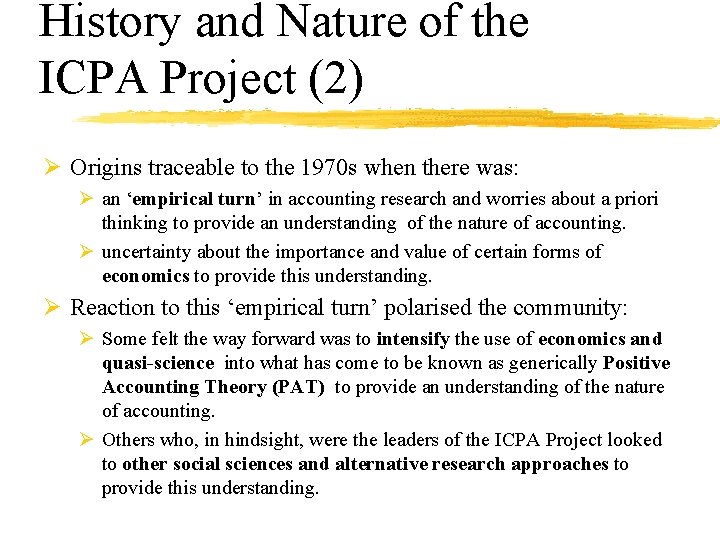
History and Nature of the ICPA Project (2) Ø Origins traceable to the 1970 s when there was: Ø an ‘empirical turn’ in accounting research and worries about a priori thinking to provide an understanding of the nature of accounting. Ø uncertainty about the importance and value of certain forms of economics to provide this understanding. Ø Reaction to this ‘empirical turn’ polarised the community: Ø Some felt the way forward was to intensify the use of economics and quasi-science into what has come to be known as generically Positive Accounting Theory (PAT) to provide an understanding of the nature of accounting. Ø Others who, in hindsight, were the leaders of the ICPA Project looked to other social sciences and alternative research approaches to provide this understanding.
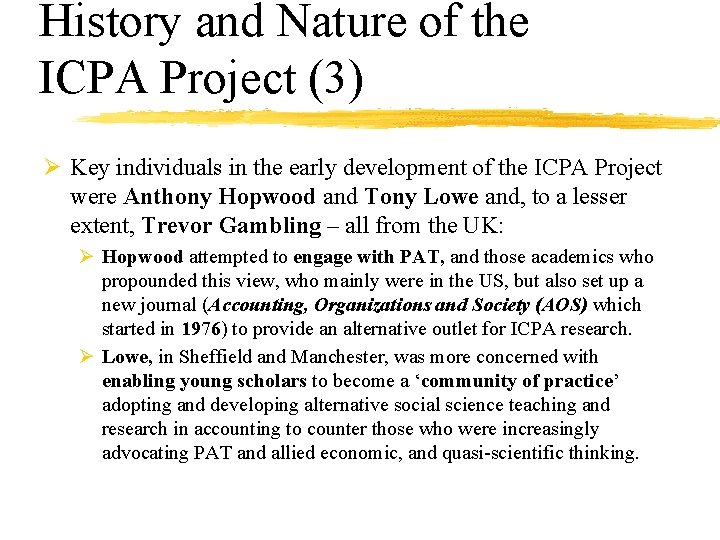
History and Nature of the ICPA Project (3) Ø Key individuals in the early development of the ICPA Project were Anthony Hopwood and Tony Lowe and, to a lesser extent, Trevor Gambling – all from the UK: Ø Hopwood attempted to engage with PAT, and those academics who propounded this view, who mainly were in the US, but also set up a new journal (Accounting, Organizations and Society (AOS) which started in 1976) to provide an alternative outlet for ICPA research. Ø Lowe, in Sheffield and Manchester, was more concerned with enabling young scholars to become a ‘community of practice’ adopting and developing alternative social science teaching and research in accounting to counter those who were increasingly advocating PAT and allied economic, and quasi-scientific thinking.
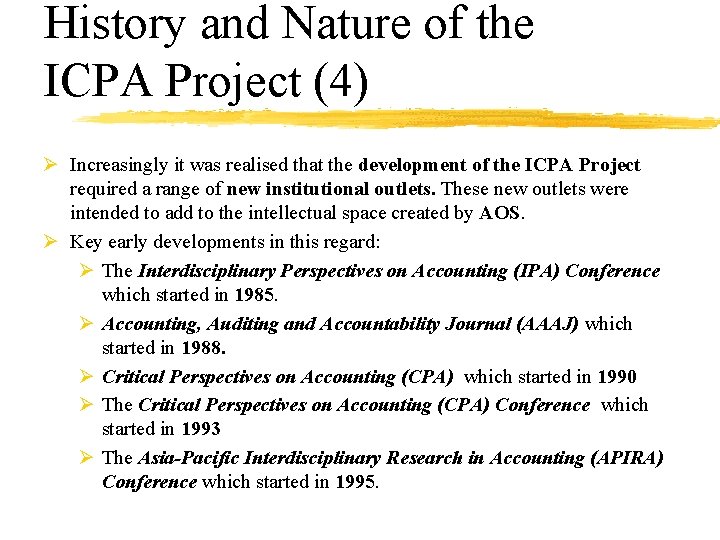
History and Nature of the ICPA Project (4) Ø Increasingly it was realised that the development of the ICPA Project required a range of new institutional outlets. These new outlets were intended to add to the intellectual space created by AOS. Ø Key early developments in this regard: Ø The Interdisciplinary Perspectives on Accounting (IPA) Conference which started in 1985. Ø Accounting, Auditing and Accountability Journal (AAAJ) which started in 1988. Ø Critical Perspectives on Accounting (CPA) which started in 1990 Ø The Critical Perspectives on Accounting (CPA) Conference which started in 1993 Ø The Asia-Pacific Interdisciplinary Research in Accounting (APIRA) Conference which started in 1995.
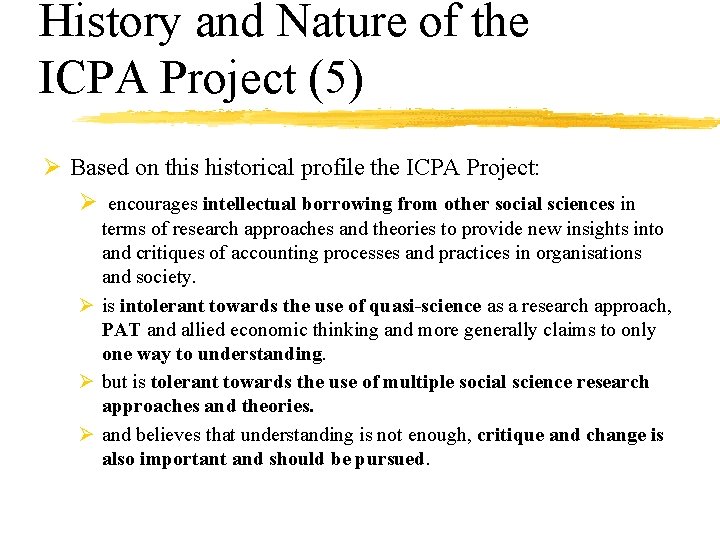
History and Nature of the ICPA Project (5) Ø Based on this historical profile the ICPA Project: Ø encourages intellectual borrowing from other social sciences in terms of research approaches and theories to provide new insights into and critiques of accounting processes and practices in organisations and society. Ø is intolerant towards the use of quasi-science as a research approach, PAT and allied economic thinking and more generally claims to only one way to understanding. Ø but is tolerant towards the use of multiple social science research approaches and theories. Ø and believes that understanding is not enough, critique and change is also important and should be pursued.
A Conceptual Overview (1) Ø Our central argument is that Public Sector Organisations, using the UK as an example of a more general change across many countries: Ø Are subject to extensive and intrusive forms of certain forms of Accounting Control; Ø These are, in turn, resisted by Public Sector Organisations, through Controlling Accounting strategies. Ø These forces and counterforces are a waste of effort and energy, create long term damage to the delivery of Public Services and need to be fundamentally changed.
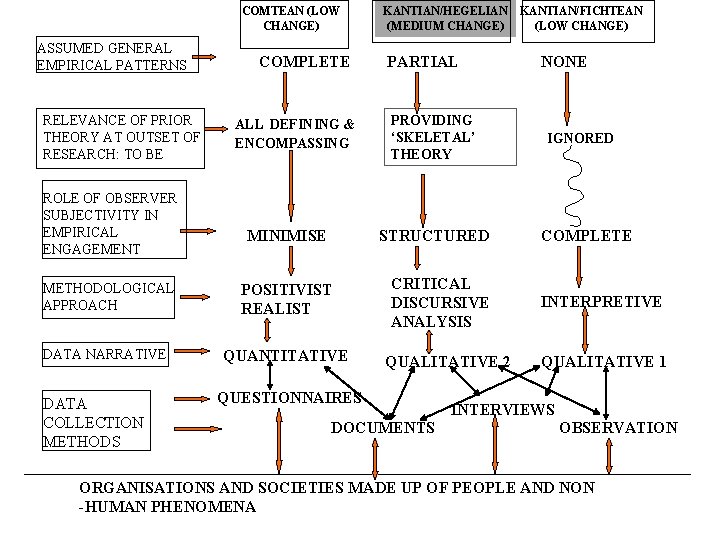
A Conceptual Overview (2) Ø The RESEARCH APPROACH that we use to explore Accounting Control and Controlling Accounting is what we call ‘Middle-Range Thinking’ Ø A ‘Middle-Range Thinking’ Research Approach is a Kantian/Hegelian approach to looking at the empirical world which can be compared and contrasted with Kantian/Fichtean and Comtean research approaches. Ø It is the Comtean range of research approaches that the ICPA Project stands against. Any Kantian/Hegelian and Kantian/Fichtean research approaches are both tolerated and welcomed by the ICPA Project and community.
COMTEAN (LOW CHANGE) ASSUMED GENERAL EMPIRICAL PATTERNS RELEVANCE OF PRIOR THEORY AT OUTSET OF RESEARCH: TO BE ROLE OF OBSERVER SUBJECTIVITY IN EMPIRICAL ENGAGEMENT COMPLETE ALL DEFINING & ENCOMPASSING MINIMISE PARTIAL PROVIDING ‘SKELETAL’ THEORY STRUCTURED METHODOLOGICAL APPROACH POSITIVIST REALIST DATA NARRATIVE QUANTITATIVE DATA COLLECTION METHODS KANTIAN/HEGELIAN KANTIAN/FICHTEAN (MEDIUM CHANGE) (LOW CHANGE) CRITICAL DISCURSIVE ANALYSIS QUALITATIVE 2 QUESTIONNAIRES DOCUMENTS NONE IGNORED COMPLETE INTERPRETIVE QUALITATIVE 1 INTERVIEWS OBSERVATION ORGANISATIONS AND SOCIETIES MADE UP OF PEOPLE AND NON -HUMAN PHENOMENA
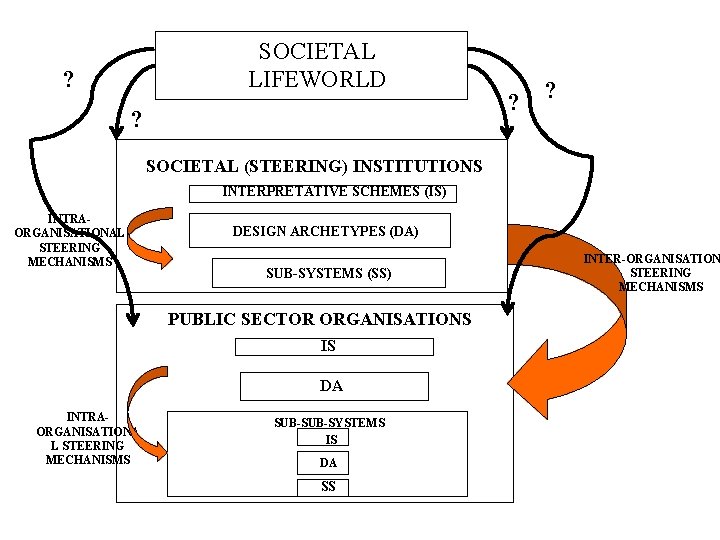
SOCIETAL LIFEWORLD ? ? ? ? SOCIETAL (STEERING) INSTITUTIONS INTERPRETATIVE SCHEMES (IS) INTRAORGANISATIONAL STEERING MECHANISMS DESIGN ARCHETYPES (DA) SUB-SYSTEMS (SS) PUBLIC SECTOR ORGANISATIONS IS DA INTRAORGANISATIONA L STEERING MECHANISMS SUB-SYSTEMS IS DA SS INTER-ORGANISATION STEERING MECHANISMS
A Conceptual Overview (3) Ø Our focus in this presentation and the Book is to use an analysis of the UK’s public sector to explore the nature of the: Ø Current Accounting Control Inter-Organisational Steering Mechanisms between Societal Steering Institutions and Public Sector Organisations. Ø Current Controlling Accounting Intra-Organisational Steering Mechanisms that Public Sector Organisations use in relation to these Accounting Controls. Ø Alternatives to these Accounting Control and Controlling Accounting strategies.
A Conceptual Overview (4) Ø Money is the key inter and intra organisational steering mechanism. Ø Money is a ‘pure instrument’ (Simmel, 1978: 211) but when combined with primarily ‘accounting’ information it forms a ‘…code by means of which information can be transmitted from a sender to a receiver. ’ (Habermas, 1987: 264). Ø These accounting information codes are ex ante – clarifying expectations for the use of money transferred - and ex post – providing directly and indirectly an account as to whether these ex ante expectations have been achieved.
A Conceptual Overview (5) Ø Accounting can be defined as: Ø ‘The ex ante and ex post information codes accompanying direct and indirect money transfers which collectively constitute the key steering mechanisms of societal institutions and organisations. ’ Ø Accounting in this sense does not have to be called accounting as such! Ø We call codes that are normally referred to as accounting Traditional Accounting in the Book. Ø We also talk about Accountability which is an outgrowth of Traditional Accounting. Ø But we also refer to Accounting Logic which is not driven by or is referred to as accounting but is imbued with Traditional Accounting thinking. Ø Accounting Logic is where all the problems are as we will see. Ø This definition is, in effect, a call for new forms of Accounting and certainly alternatives to Accounting Logic.
A Conceptual Overview (6) Ø Accounting Control : Ø Is concerned with the construction and subsequent use of systems of accounting that attempt to ensure that the outcomes expected when money is transferred are achieved. Ø Controlling Accounting: Ø Is embedded in the handling and processing of accounting and accounting control to ensure these practices fit with and further the ethos, values and concerns of institutions and organisations. Ø These are generic definitions. Ø The main focus of the Book is with the nature of the Accounting Control over Public Sector Organisations and the resulting Controlling Accounting strategies pursued in these organisations to deal with these controls.
A Conceptual Overview (7) Ø The nature of Accounting Control will be driven by a particular Performance Management System (PMS) which can be TRANSACTIONAL or RELATIONAL in nature. Ø A TRANSACTIONAL PMS: Ø has high levels of measurement specificity in the ends to achieve; Ø has clear specification of means needed to achieve these ends; Ø and is often project-based linked to short to medium term contracts. Ø A RELATIONAL PMS: Ø can be less specific on ends to achieve and the means to achieve these but this depends on the key criteria of agreement between stakeholders and ownership of the requirements; Ø are often less project-based and more concerned with long term sustainability.
A Conceptual Overview (8) Ø The Controlling Accounting we are concerned with in this Book involves handling and processing of the inter-organisational forms of Accounting Control to ensure that these practices fit with and further the ethos, values and concerns of Public Sector Organisations. Ø These Accounting Controls are a form of organisational disturbance that can track their way through four different Controlling Accounting organisational pathways: Ø Rebuttal involving minimal first order change. Ø Reorientation involving more substantive first order change. Ø Colonisation involving substantive and disruptive second order change. Ø Evolution involving substantive but deliberately chosen second order change
Accounting Control (1) Ø Based on our analysis the EX ANTE (primarily) but also the EX POST elements of Accounting Control over Public Sector Organisations in the UK are driven by ACCOUNTING LOGIC: Ø Namely ‘…. that it is possible to evaluate each and every financial flow in terms of the outputs and preferably outcomes achieved’ (Laughlin, 2007: 280) Ø It is the underlying ‘something for something’ logic that makes a TRANSACTIONAL PMS meaningful. Ø It is a logic that originates from Traditional Accounting and double entry book-keeping but has permeated the thinking of not just accountants but many others as well, notably politicians, managers and those governing public sector organisations.
Accounting Control (2) Ø The current EX POST part of the Accounting Control requirements over Public Sector Organisations in the UK requires information that is contained in TRADITIONAL ACCOUNTING and ACCOUNTABILITY reports: Ø TRADITIONAL ACCOUNTING constitutes the information that is normally called accounting – notably Financial Accounting Statements and Management Accounting Reports. Ø ACCOUNTABILITY reports include the extensions of Traditional Accounting often referred to as Narrative Reporting but goes beyond this to all manner of Accounts that provide information as to what has been achieved with any money transfers.
Accounting Control (3) Ø The current EX POST reporting requirements over Public Sector Organisations in the UK both in terms of Traditional Accounting as well as Narrative Reporting largely replicate those required of Private Sector Organisations. Ø The overall emphasis of this replication is changing only slightly nationally (as in the UK) and internationally (with the International Public Sector Accounting Standards Board (IPSASB) as some standards manage (at last) to be different from the IFRS of the IASB. Ø There are some additional supplementary EX POST accountability report requirements related to EX ANTE expectations where Traditional Accounting and Narrative Reports are not seen as adequate to provide this information.
Accounting Control (4) Ø These EX ANTE expectations and EX POST reporting requirements for Public Sector Organisations in the UK have been increasing and intensifying over the last few years. Ø Our view is that these changes are driven by the increasing TRANSACTIONAL PMS nature of the NEW PUBLIC FINANCIAL MANAGEMENT (NPFM) Public Sector reforms in countries such as the UK. Ø Whilst the UK experience of this is unique, the UK is one of a number of countries (Hood (1995) adds Sweden, Canada, New Zealand, Australia to the UK) that are advocates and enthusiastic high adopters of NPFM reforms.
Controlling Accounting (1) Ø CONTROLLING ACCOUNTING involves ACCOUNTING PROCESSES at the organisational level to meet the EX POST reporting requirements of ACCOUNTING CONTROL. Ø CONTROLLING ACCOUNTING involves BEHAVIOURAL, ORGANISATIONAL (RATHER THAN ACCOUNTING) PROCESSES and PRACTICES when addressing the EX ANTE elements of ACCOUNTING CONTROL. Ø From an organisational perspective the EX POST reporting requirements are LESS THREATENING than the EX ANTE expectations.
Controlling Accounting (2) Ø These current EX ANTE expectations invariably are RESENTED. They are very rarely seen as a source for organisational EVOLUTION and development. Ø RESISTANCE to them is normal yet this is: Ø DIFFICULT where the EX ANTE expectations are tightly defined as in an extreme TRANSACTIONAL form of ACCOUNTING CONTROL. Ø STILL ATTEMPTED, despite this difficulty, such is the level of resentment created by these EX ANTE expectations. Ø Involve the formation, processes and practices of ‘SPECIALIST WORK GROUPS’ (De Board, 1978: 43) to ‘handle’ both these EX ANTE expectations and EX POST reporting requirements.
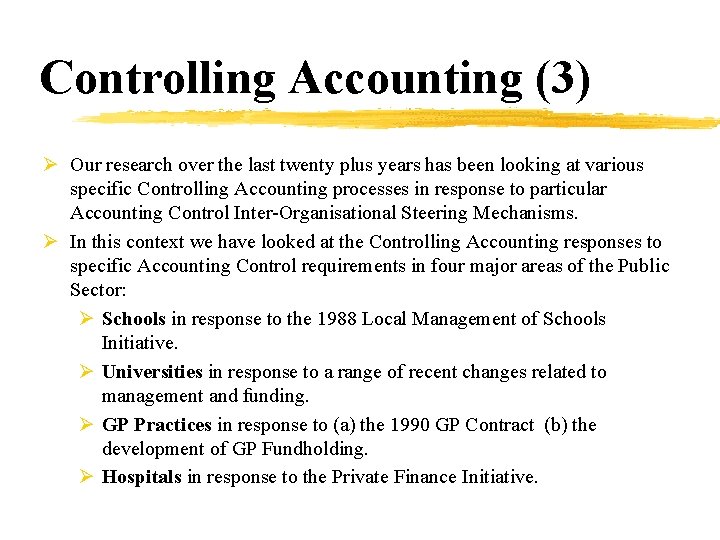
Controlling Accounting (3) Ø Our research over the last twenty plus years has been looking at various specific Controlling Accounting processes in response to particular Accounting Control Inter-Organisational Steering Mechanisms. Ø In this context we have looked at the Controlling Accounting responses to specific Accounting Control requirements in four major areas of the Public Sector: Ø Schools in response to the 1988 Local Management of Schools Initiative. Ø Universities in response to a range of recent changes related to management and funding. Ø GP Practices in response to (a) the 1990 GP Contract (b) the development of GP Fundholding. Ø Hospitals in response to the Private Finance Initiative.
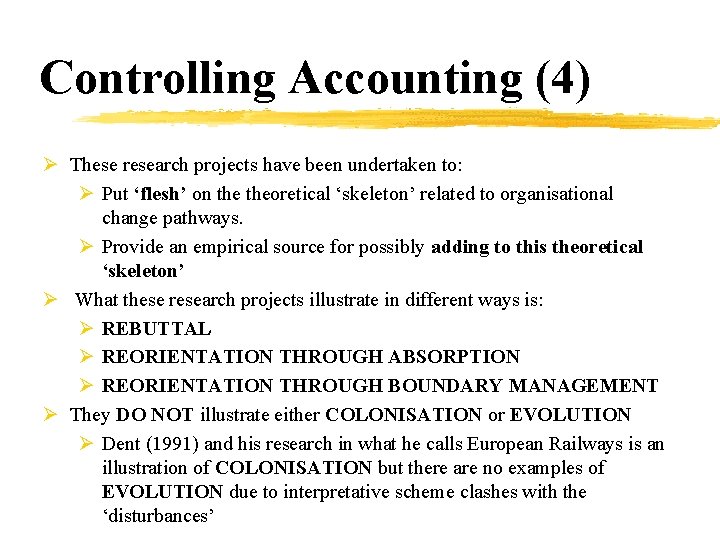
Controlling Accounting (4) Ø These research projects have been undertaken to: Ø Put ‘flesh’ on theoretical ‘skeleton’ related to organisational change pathways. Ø Provide an empirical source for possibly adding to this theoretical ‘skeleton’ Ø What these research projects illustrate in different ways is: Ø REBUTTAL Ø REORIENTATION THROUGH ABSORPTION Ø REORIENTATION THROUGH BOUNDARY MANAGEMENT Ø They DO NOT illustrate either COLONISATION or EVOLUTION Ø Dent (1991) and his research in what he calls European Railways is an illustration of COLONISATION but there are no examples of EVOLUTION due to interpretative scheme clashes with the ‘disturbances’
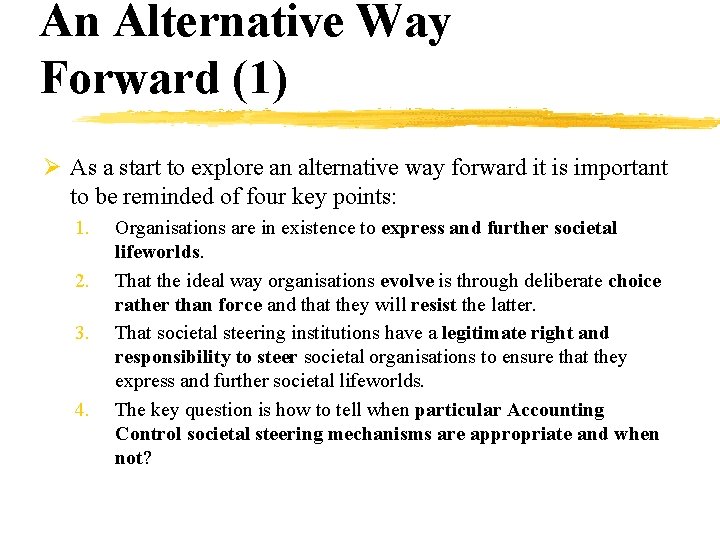
An Alternative Way Forward (1) Ø As a start to explore an alternative way forward it is important to be reminded of four key points: 1. 2. 3. 4. Organisations are in existence to express and further societal lifeworlds. That the ideal way organisations evolve is through deliberate choice rather than force and that they will resist the latter. That societal steering institutions have a legitimate right and responsibility to steer societal organisations to ensure that they express and further societal lifeworlds. The key question is how to tell when particular Accounting Control societal steering mechanisms are appropriate and when not?
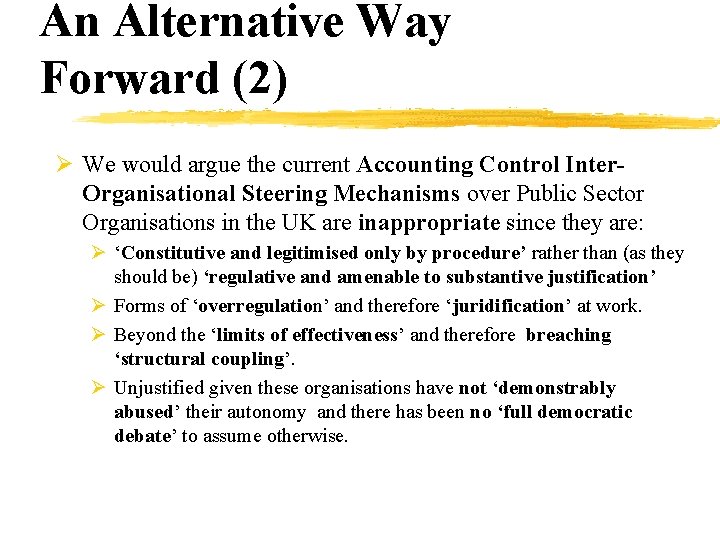
An Alternative Way Forward (2) Ø We would argue the current Accounting Control Inter. Organisational Steering Mechanisms over Public Sector Organisations in the UK are inappropriate since they are: Ø ‘Constitutive and legitimised only by procedure’ rather than (as they should be) ‘regulative and amenable to substantive justification’ Ø Forms of ‘overregulation’ and therefore ‘juridification’ at work. Ø Beyond the ‘limits of effectiveness’ and therefore breaching ‘structural coupling’. Ø Unjustified given these organisations have not ‘demonstrably abused’ their autonomy and there has been no ‘full democratic debate’ to assume otherwise.
An Alternative Way Forward (3) Ø Change is needed in the nature of the societal steering mechanisms over public sector organisations. They need to: Ø Be ‘regulative and amenable to substantive justification’ and not ‘constitutive and legitimised only by procedure’ Ø No longer based on the belief that every form of steering in relation to money has to be Transactional in nature and driven by Accounting Logic. Ø Move to become a form of Reflexive Law which will: ‘…. . neither authoritively determine the social functions of other sub-systems nor regulate their input and output performances, but will foster mechanisms that systematically further the reflexion structures within social systems. ’ (Teubner, 1983: 275)
An Alternative Way Forward (4) Ø Reflexive Law would also open up a new role for Accounting and Accounting Control without the necessity for this wasteful Controlling Accounting behaviour: Ø Accounting defined as ‘the ex ante and ex post information codes accompanying direct and indirect money transfers’ and its role in being the ‘key steering mechanisms of societal institutions and organisations’ remains relevant and needed. Ø What is needed is a revolution in the nature of these information codes to be driven by relational rather than transactional thinking. This provides a very different approach and understanding to Controlling Accounting behaviour. Ø This will lead to an entirely different understanding of Accounting Control in relation to both Inter-Organisational and Intra. Organisational Steering Mechanisms.