
Accounting Basics Lecture 5 INVENTORY ACCOUNTING METHODS ITS
Accounting (Basics) - Lecture 5 INVENTORY ACCOUNTING METHODS, ITS VALUATION, INVENTORYING AND ANALYTICAL EVIDENCE. SPECIFIC ACOCUNTING TECHNIQUES CONCERNING INTERNALLY PRODUCED INVENTORY. STRANGE CASES OF INVENTORY ACCOUNTING AT THE END OF ACCOUNTING PERIOD.

Content n Inventory accounting methods, its valuation, inventorying and analytical evidence n Specific accounting techniques concerning internally produced inventory Strange cases of inventory accounting at the end of accounting period n 2

Inventory accounting methods n n n According to list of accounts, inventories can be divided into several accounting groups - material, own inventories (products, intermediate products, incomplete products, etc. ), merchandise (goods) and animals (used for trade, animals held for breeding are charged as fixed assets). There are two ways of charging about inventories – way A and way B. The concrete way of charging depends on company’s decision. 3
Inventory accounting methods n n It is even possible to use both ways simultaneously (for example for charging about material and goods can be used way A and for charging about own inventories (products, incomplete products, etc. ) can be used way B. The chosen way of charging should be defined in internal accounting regulation issued by company. 4
The way A n n This way A of charging means that inventories are charged during the accounting period on accounts Acquisition of material and Material on stock (or Goods on stock, Acquisition of goods, etc. ). As cost (expense) they are charged in the moment of their consumption (in case of material) or their sale (in case of goods (merchandise)). 5
The way A n n Special procedures are used for charging about own inventories. The own inventories are charged on asset accounts used for concrete type of ownproduced inventories (products, incomplete products or intermediate products) and the change of the balance of these inventories is charged as a capitalization of expenses (costs) influencing the profit of the company. 6
The way A n n Accounting transactions connected with inventories: A) Acquisition of inventories by purchase Inventories bought are valued by acquisition costs. It is suitable to use some special account for calculation of these acquisition costs (it is purchase price and all costs connected with the acquisition (especially transportation costs, assembling costs, etc. )). 7
The way A n n This account is usually called Acquisition of material or Acquisition of goods. In the moment when total amount of acquisition costs is known, this value is recharged from these accounts on concrete asset accounts used for material or goods (Material at stock and Goods at stock). 8
The way A n n Example: Company buys material on invoice bill in value 10 000 CZK. This material was transported by other company. The value of transportation is 1 000 CZK (invoice bill). Charge all necessary transactions. 9
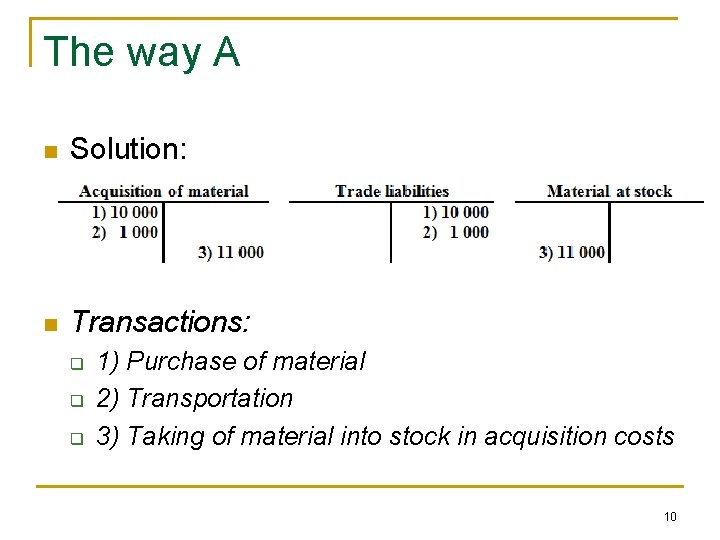
The way A n Solution: n Transactions: q q q 1) Purchase of material 2) Transportation 3) Taking of material into stock in acquisition costs 10
The way A n n B) Consumption (decrease) of inventories Costs (expenses) connected with inventories are charged in the moment of consumption of material or decrease of goods sold. Example: Company consumed material in value 11 000 CZK. Charge this operation. 11
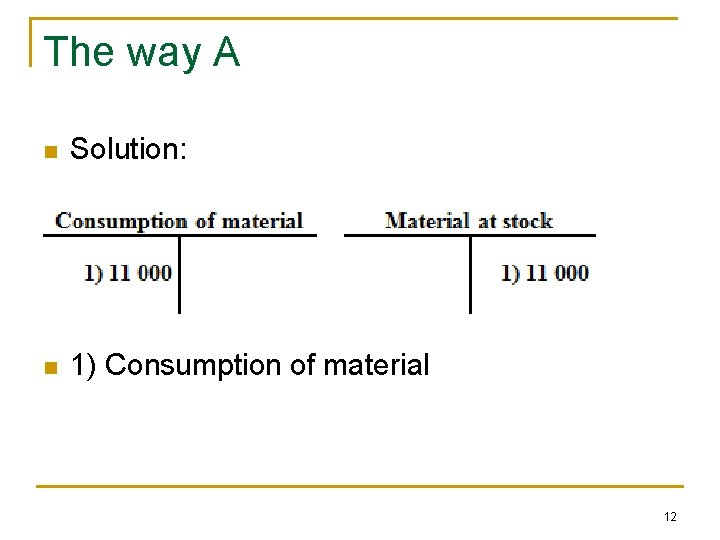
The way A n Solution: n 1) Consumption of material 12
The way A n n C) Charging about own inventories Own inventories are charged on accounts which contains following accounts: Incomplete products, Intermediate products, Products, Animals. Correlated accounts are cost (expense) accounts Changes of incomplete products, Changes of intermediate products and Changes of products). Inventories of own production are valued by own costs (direct (and partly indirect) costs spent for production of these inventories – wages, consumed material, consumed energy, etc. ). 13
They way A n n Example: Company consumed material in value 1 000 and wages in value 500. On this base the new incomplete products have been produced. Charge creation and value the incomplete products. 14
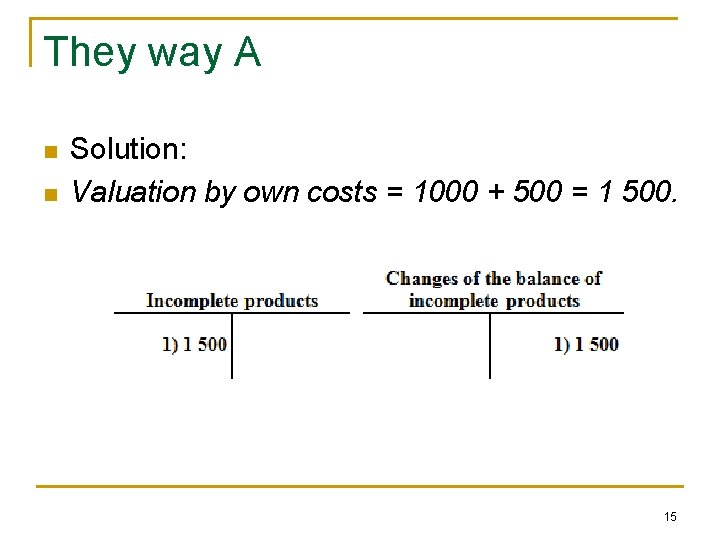
They way A n n Solution: Valuation by own costs = 1000 + 500 = 1 500. 15

They way A n n n D) Deficits and surpluses of inventories Accounting units have a duty to make stocktaking (minimally to the date of financial statements compilation) in case of inventories. Stocktaking controls accounting balances of inventories with real balances. If there are differences between these two balances, they must be charged. If the accounting balance is higher than real balance, it is called deficit (charged as operating expense). 16
They way A n n If the accounting balance is lower than real balance, it is called surplus (charged as operating revenue). In case of inventories there are two types of deficits caused by different reasons. Some deficit can happen because of a nature decrease of the inventories (for example because of steaming of inventories). This kind of deficit is charged as consumption of inventories (account Consumed material in case of material and account Goods sold in case of goods) (socalled deficit in norm). 17
They way A n n n Deficits caused by employees or third persons (for example steals, destructions, etc. ) are charged on special cost (expense) account named Deficits and damages. Example: Stocktaking at stock found out surplus in case of material in value 10 000 CZK (valuation by executant acquisition costs) and deficit in case of goods in value 15 000 CZK (valuation by value in accounting files). The deficit in value 10 000 CZK was caused by drying-up of dyes (deficit in norm), the deficit in value 5 000 CZK was caused by employees (steal) (deficit above norm). Charge all necessary transactions: 18
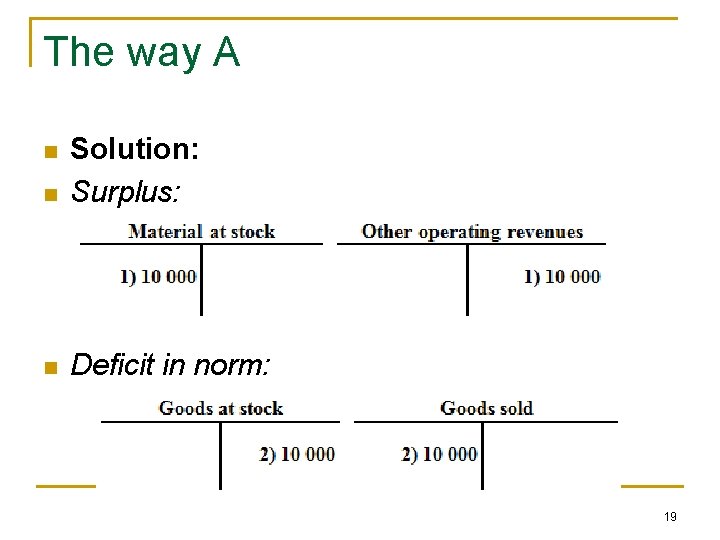
The way A n Solution: Surplus: n Deficit in norm: n 19

The way A n Deficit above norm: 20
The way A n n n E) Adjusting items connected with inventories In case when stocktaking finds out temporary! (not permanent) decrease of value of inventories, it is necessary to charge the difference between accounting value and newly found value. In this moment so-called adjusting item to inventories must be charged (also called as impairments). 21

The way A n n n In the moment when future stocktaking finds out that the value is back on original amount, this adjusting item (AI) must be cancelled. Special accounting group for adjusting items to inventories is created in list of accounts. Creation of adjusting items is charged as operating cost (expense), cancelling as decrease of operating cost (expense). 22
The way A n n Example: Stocktaking found out that accounting value of material had temporarily decreased from value 10 000 to 6 000 CZK. Next stocktaking found out that the value of inventories had returned on original amount. Charge all transactions necessary to be charged. 23
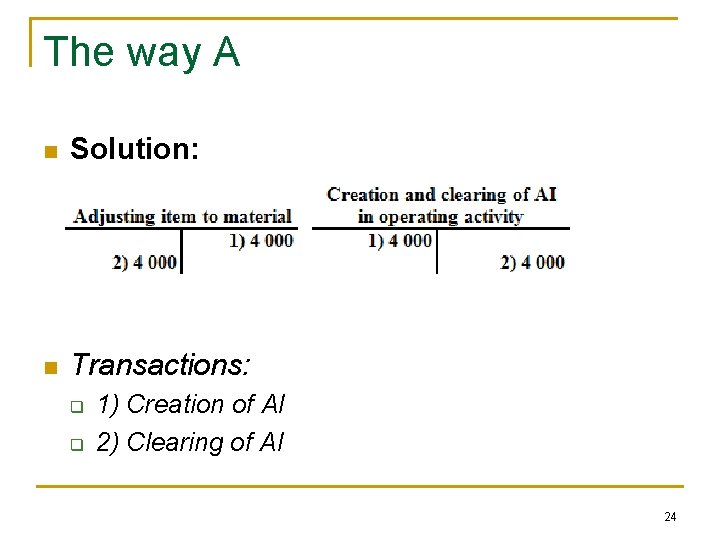
The way A n Solution: n Transactions: q q 1) Creation of AI 2) Clearing of AI 24
Way B n n n This way of charging about inventories means that asset accounts as Material at stock or Goods at stock are used only at the beginning (opening balances are charged on them) or at the end of accounting period). Purchases of material or goods during the accounting period are charged immediately into costs (expenses) (Consumed material, Goods sold). Own inventories are not charged during the accounting period. 25
Way B n n At the end of accounting period the opening balances from accounts Material at stock or Goods at stock are recharged into costs too. Then stocktaking compares real consumption or other real decreases with accounting balance and unrealized consumption of inventories or other unrealized decreases (real) must be recharged from cost accounts to asset accounts (Material at stock, Goods at stock, etc. ). 26
Way B n n Example: At the beginning of accounting period the company had material in value 20 000 CZK. Company bought material on invoice bill in value 10 000 CZK. This material was transported by other company. The value of transportation is 1 000 CZK (invoice bill). Material in value 7 000 CZK was consumed during the accounting period. Charge all necessary transactions. 27
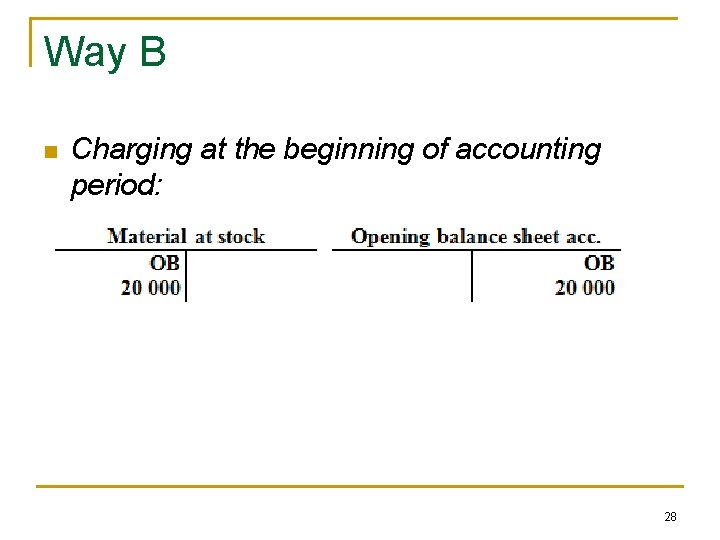
Way B n Charging at the beginning of accounting period: 28
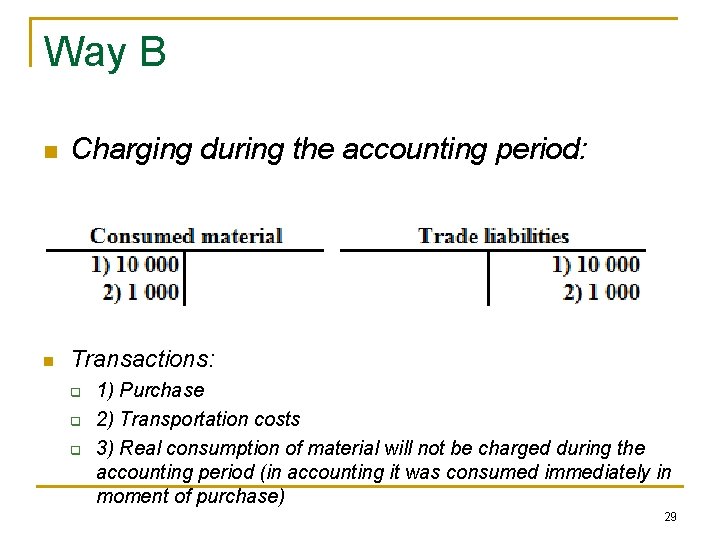
Way B n Charging during the accounting period: n Transactions: q q q 1) Purchase 2) Transportation costs 3) Real consumption of material will not be charged during the accounting period (in accounting it was consumed immediately in moment of purchase) 29

Way B n Charging at the end of accounting period: q q 4) Recharging of OB on cost account 5) Recharging of unconsumed material back to asset account (in this case the value 24 000 is calculated as the difference between total amount of costs charged on DS of Consumed material and amount 7 000 which is the value of real consumption. The final balance of account Consumed material must be 7 000 CZK which is the value of real consumption, the final balance of account Material at stock will be 24 000, which is unconsumed material. Final balances of accounts Consumed material and Material at stock must be equal to situation in charging by way A). 30
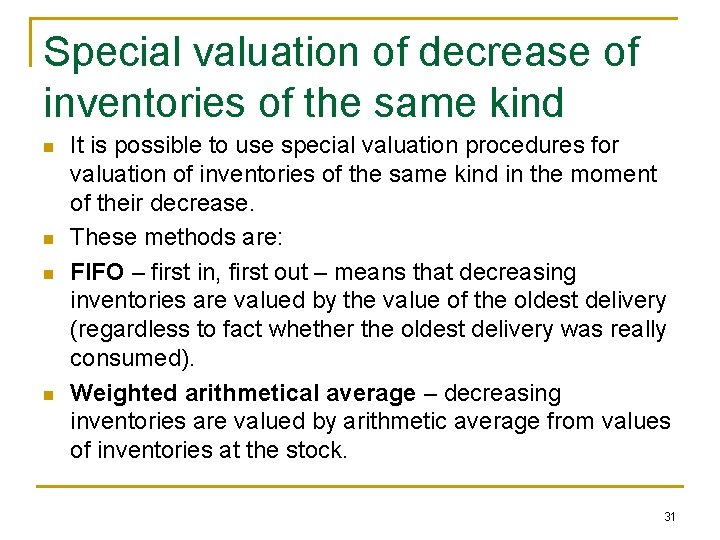
Special valuation of decrease of inventories of the same kind n n It is possible to use special valuation procedures for valuation of inventories of the same kind in the moment of their decrease. These methods are: FIFO – first in, first out – means that decreasing inventories are valued by the value of the oldest delivery (regardless to fact whether the oldest delivery was really consumed). Weighted arithmetical average – decreasing inventories are valued by arithmetic average from values of inventories at the stock. 31
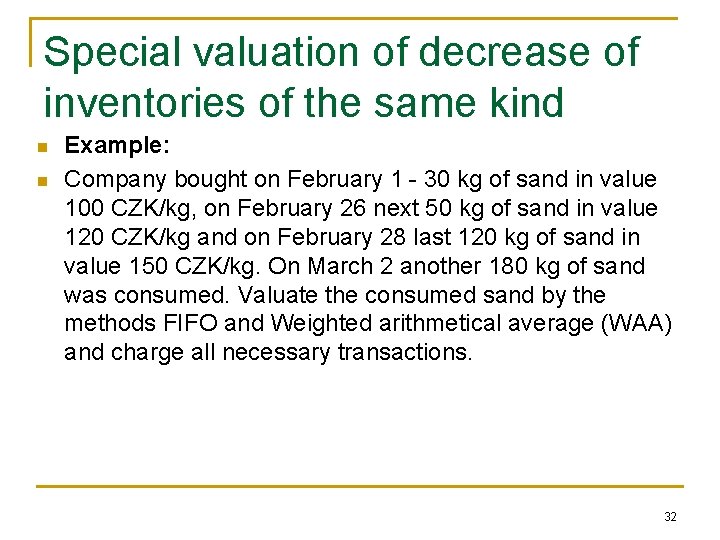
Special valuation of decrease of inventories of the same kind n n Example: Company bought on February 1 - 30 kg of sand in value 100 CZK/kg, on February 26 next 50 kg of sand in value 120 CZK/kg and on February 28 last 120 kg of sand in value 150 CZK/kg. On March 2 another 180 kg of sand was consumed. Valuate the consumed sand by the methods FIFO and Weighted arithmetical average (WAA) and charge all necessary transactions. 32
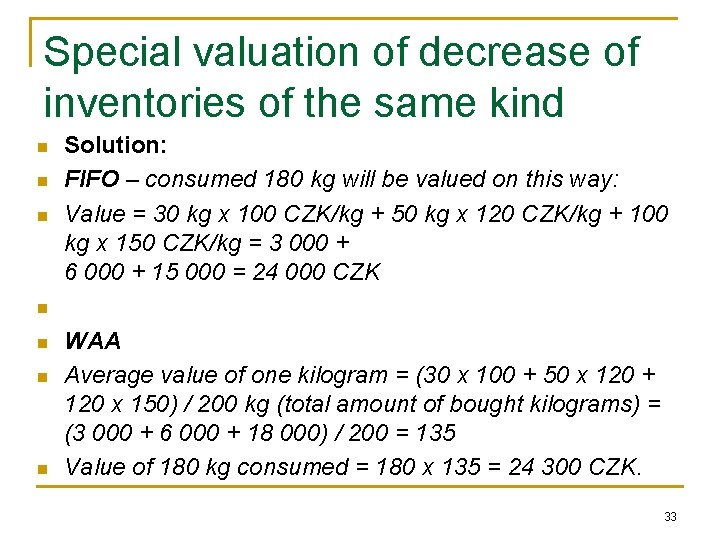
Special valuation of decrease of inventories of the same kind n n n Solution: FIFO – consumed 180 kg will be valued on this way: Value = 30 kg x 100 CZK/kg + 50 kg x 120 CZK/kg + 100 kg x 150 CZK/kg = 3 000 + 6 000 + 15 000 = 24 000 CZK n n WAA Average value of one kilogram = (30 x 100 + 50 x 120 + 120 x 150) / 200 kg (total amount of bought kilograms) = (3 000 + 6 000 + 18 000) / 200 = 135 Value of 180 kg consumed = 180 x 135 = 24 300 CZK. 33

Special valuation of decrease of inventories of the same kind 34
- Slides: 34