
Accounting and the Business Environment Chapter 1 1
Accounting and the Business Environment Chapter 1 1 Copyright © 2012 Pearson Education, Inc. Publishing as Prentice Hall.
Learning Objectives Define accounting vocabulary Define the users of financial information Describe the accounting profession and the organizations that govern it Identify the different types of business organizations Delineate the distinguishing characteristics and organization of a proprietorship 2 Copyright © 2012 Pearson Education, Inc. Publishing as Prentice Hall.
Learning Objectives Apply accounting concepts and principles Describe the accounting equation, and define assets, liabilities, and equity Use the accounting equation to analyze transactions Prepare financial statements Use financial statements to evaluate business performance 3 Copyright © 2012 Pearson Education, Inc. Publishing as Prentice Hall.
1 Define accounting vocabulary 4 Copyright © 2012 Pearson Education, Inc. Publishing as Prentice Hall.
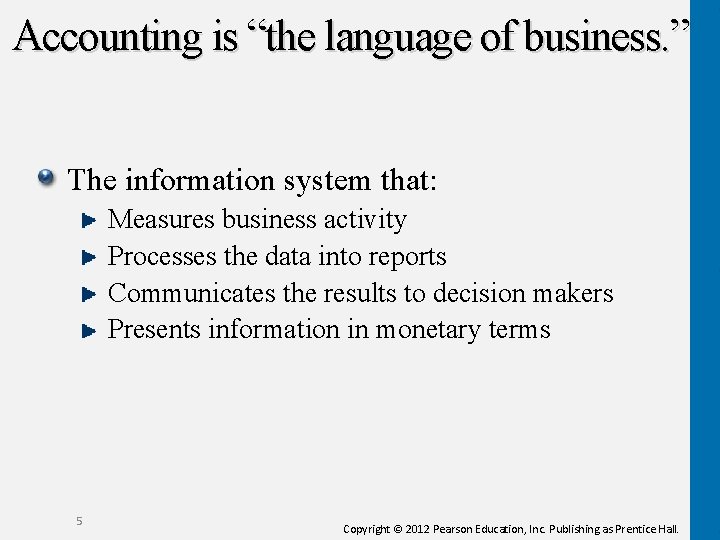
Accounting is “the language of business. ” The information system that: Measures business activity Processes the data into reports Communicates the results to decision makers Presents information in monetary terms 5 Copyright © 2012 Pearson Education, Inc. Publishing as Prentice Hall.
2 Define the users of financial information 6 Copyright © 2012 Pearson Education, Inc. Publishing as Prentice Hall.
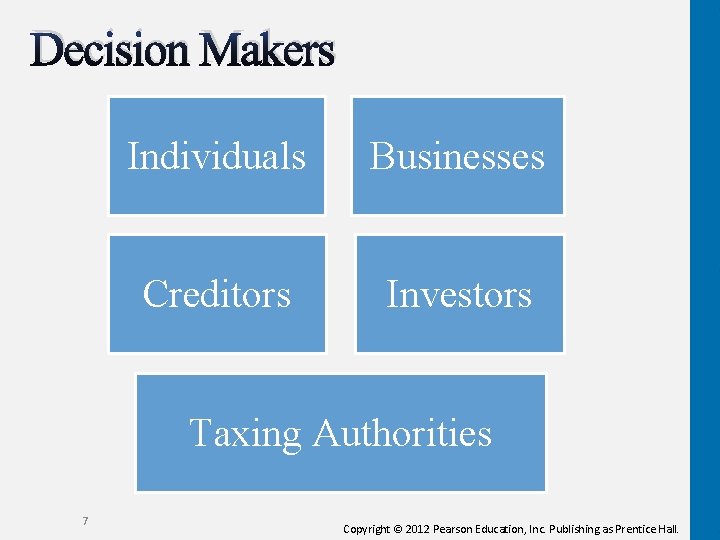
Decision Makers Individuals Businesses Creditors Investors Taxing Authorities 7 Copyright © 2012 Pearson Education, Inc. Publishing as Prentice Hall.
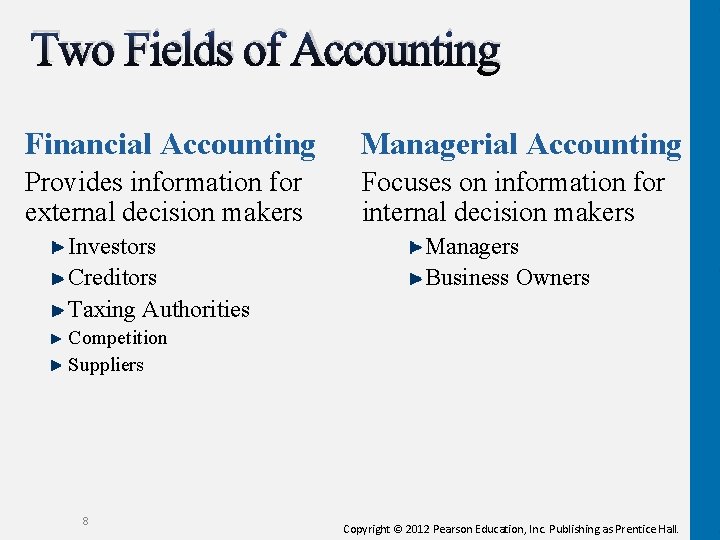
Two Fields of Accounting Financial Accounting Managerial Accounting Provides information for external decision makers Focuses on information for internal decision makers Investors Creditors Taxing Authorities Managers Business Owners Competition Suppliers 8 Copyright © 2012 Pearson Education, Inc. Publishing as Prentice Hall.
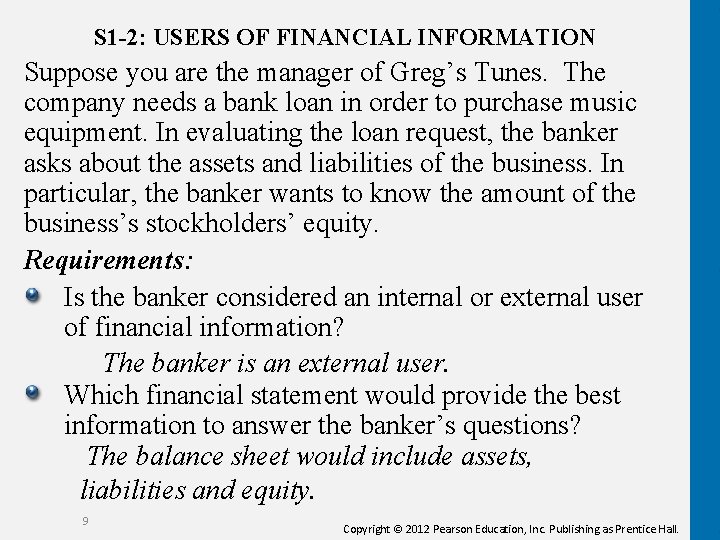
S 1 -2: USERS OF FINANCIAL INFORMATION Suppose you are the manager of Greg’s Tunes. The company needs a bank loan in order to purchase music equipment. In evaluating the loan request, the banker asks about the assets and liabilities of the business. In particular, the banker wants to know the amount of the business’s stockholders’ equity. Requirements: Is the banker considered an internal or external user of financial information? The banker is an external user. Which financial statement would provide the best information to answer the banker’s questions? The balance sheet would include assets, liabilities and equity. 9 Copyright © 2012 Pearson Education, Inc. Publishing as Prentice Hall.
3 Describe the accounting profession and the organizations that govern it 10 Copyright © 2012 Pearson Education, Inc. Publishing as Prentice Hall.
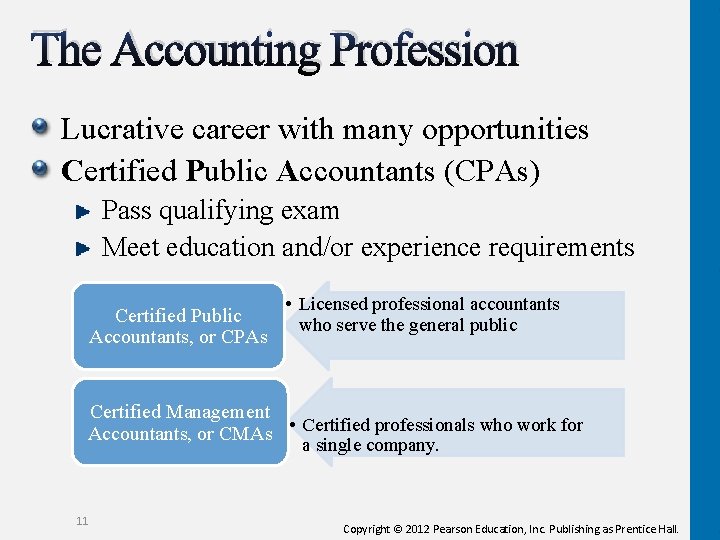
The Accounting Profession Lucrative career with many opportunities Certified Public Accountants (CPAs) Pass qualifying exam Meet education and/or experience requirements Certified Public Accountants, or CPAs • Licensed professional accountants who serve the general public Certified Management Accountants, or CMAs • Certified professionals who work for a single company. 11 Copyright © 2012 Pearson Education, Inc. Publishing as Prentice Hall.
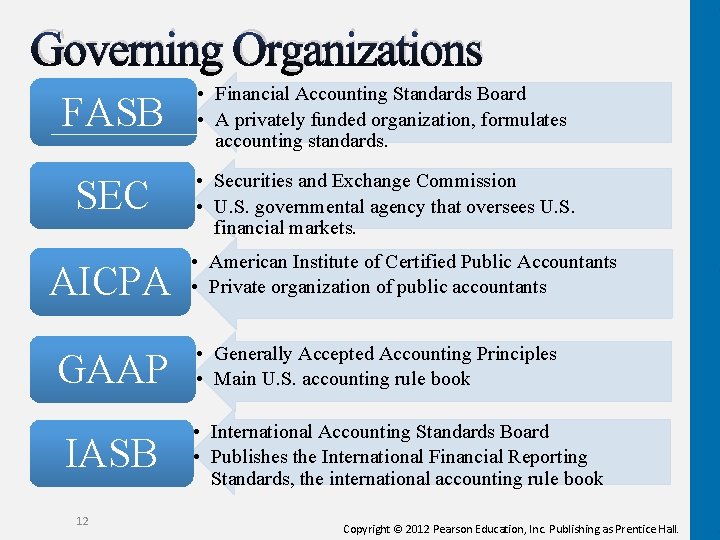
Governing Organizations FASB • Financial Accounting Standards Board • A privately funded organization, formulates accounting standards. SEC • Securities and Exchange Commission • U. S. governmental agency that oversees U. S. financial markets. AICPA GAAP IASB 12 • American Institute of Certified Public Accountants • Private organization of public accountants • Generally Accepted Accounting Principles • Main U. S. accounting rule book • International Accounting Standards Board • Publishes the International Financial Reporting Standards, the international accounting rule book Copyright © 2012 Pearson Education, Inc. Publishing as Prentice Hall.
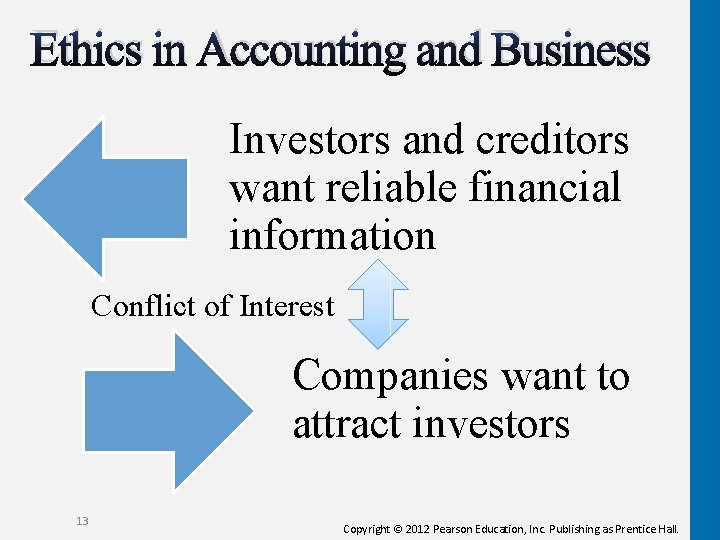
Ethics in Accounting and Business Investors and creditors want reliable financial information Conflict of Interest Companies want to attract investors 13 Copyright © 2012 Pearson Education, Inc. Publishing as Prentice Hall.
Audit SEC requires companies to have financial statements examined by independent accountants Auditors will provide an opinion on financial statements, if possible Recent accounting scandals hurt investor confidence U. S. Government passed the Sarbanes-Oxley Act (SOX) Criminal offense to falsify financial statements Also created the Public Companies Accounting Oversight Board (PCAOB) Watchdog of accounting profession 14 Copyright © 2012 Pearson Education, Inc. Publishing as Prentice Hall.
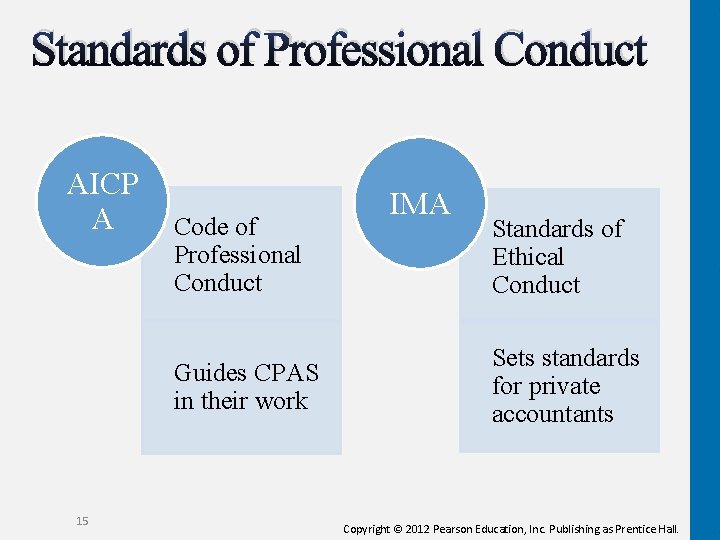
Standards of Professional Conduct AICP A Code of Professional Conduct Guides CPAS in their work 15 IMA Standards of Ethical Conduct Sets standards for private accountants Copyright © 2012 Pearson Education, Inc. Publishing as Prentice Hall.
4 Identify the different types of business organizations 16 Copyright © 2012 Pearson Education, Inc. Publishing as Prentice Hall.
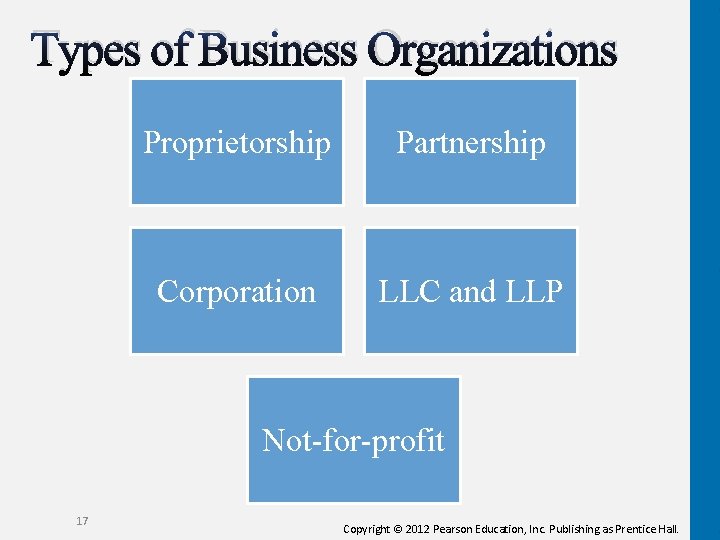
Types of Business Organizations Proprietorship Partnership Corporation LLC and LLP Not-for-profit 17 Copyright © 2012 Pearson Education, Inc. Publishing as Prentice Hall.
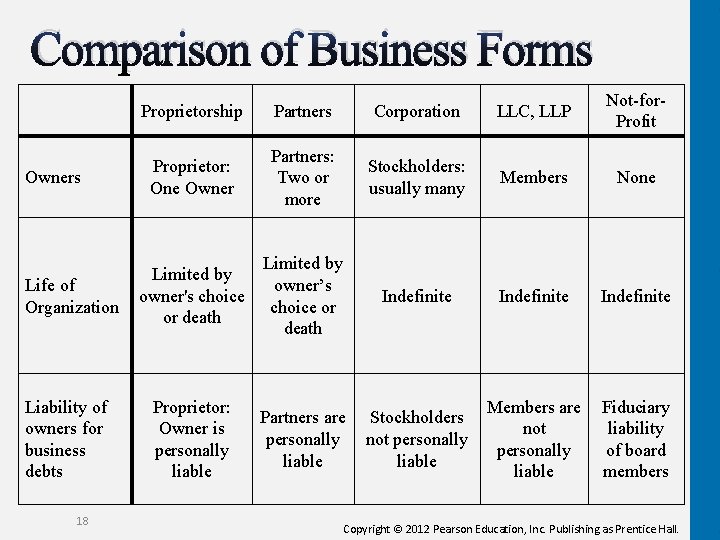
Comparison of Business Forms Owners Life of Organization Liability of owners for business debts 18 Proprietorship Partners Corporation LLC, LLP Not-for. Profit Proprietor: One Owner Partners: Two or more Stockholders: usually many Members None Limited by owner's choice or death Limited by owner’s choice or death Indefinite Proprietor: Owner is personally liable Partners are personally liable Stockholders not personally liable Members are not personally liable Fiduciary liability of board members Copyright © 2012 Pearson Education, Inc. Publishing as Prentice Hall.
5 Delineate the distinguishing characteristics and organization of a proprietorship 19 Copyright © 2012 Pearson Education, Inc. Publishing as Prentice Hall.
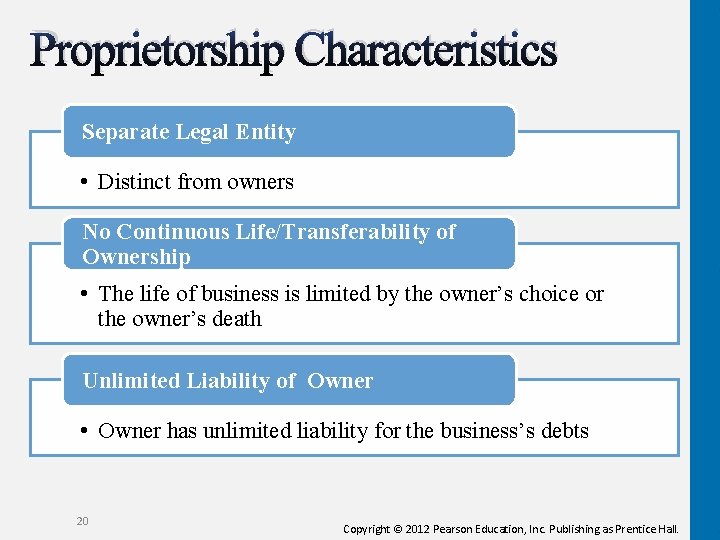
Proprietorship Characteristics Separate Legal Entity • Distinct from owners No Continuous Life/Transferability of Ownership • The life of business is limited by the owner’s choice or the owner’s death Unlimited Liability of Owner • Owner has unlimited liability for the business’s debts 20 Copyright © 2012 Pearson Education, Inc. Publishing as Prentice Hall.
Proprietorship Characteristics (continued) Unification of Ownership and Management • Owners manage the business Business Taxation • Not a separate taxable entity • Income flows directly to the sole owner’s tax return, where he or she pays self-employment and income tax Government Regulation • Minimal regulation is an advantages 21 Copyright © 2012 Pearson Education, Inc. Publishing as Prentice Hall.
Organization of a Corporation Incorporators obtain charter from the state Charter authorizes corporation to: Issue stock Conduct business in accordance with state law Incorporators agreed to a set of bylaws Bylaws are the rule book that guides the corporation. Corporations begins to exist when stock is issued Stockholders vote on who will serve on Board of Directors 22 Copyright © 2012 Pearson Education, Inc. Publishing as Prentice Hall.
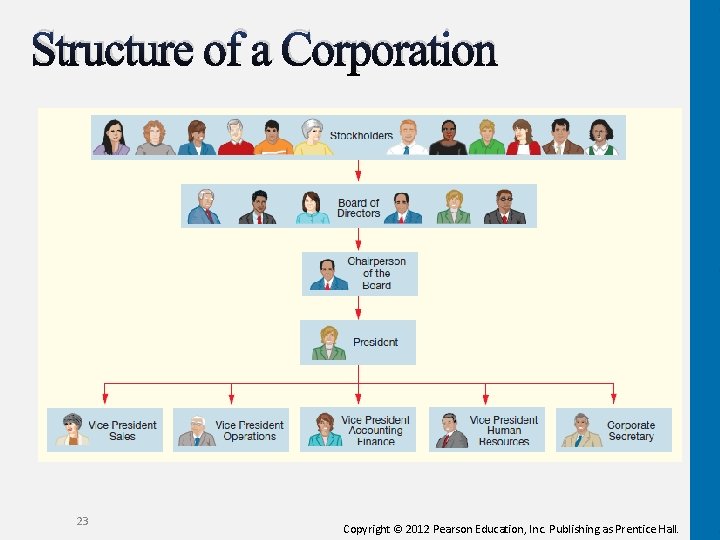
Structure of a Corporation 23 Copyright © 2012 Pearson Education, Inc. Publishing as Prentice Hall.
S 1 -4: TYPES OF BUSINESS ORGANIZATION Chloe Michaels plans on opening Chloe Michaels’ Floral Designs. She is considering the various types of business organizations and wishes to organize her business with unlimited life and limited liability features. Additionally, Chloe wants the option to raise additional equity easily in the future. Which type of business organization will meet Chloe’s needs best? A corporation has all the requirements of Chloe’s request. A corporation has an unlimited life, shareholders have limited liability and additional stock can be sold to raise additional equity. 24 Copyright © 2012 Pearson Education, Inc. Publishing as Prentice Hall.
6 Apply accounting concepts and principles 25 Copyright © 2012 Pearson Education, Inc. Publishing as Prentice Hall.
GAAP Generally Accepted Accounting Principles Guidelines that govern accounting Based on a conceptual framework Goals include: Provide useful information for investment and lending decisions Must be relevant, reliable, and comparable 26 Copyright © 2012 Pearson Education, Inc. Publishing as Prentice Hall.
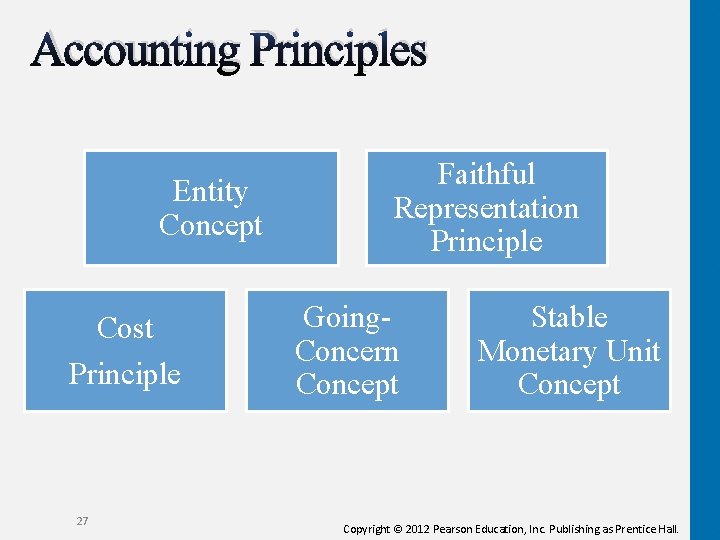
Accounting Principles Entity Concept Cost Principle 27 Faithful Representation Principle Going. Concern Concept Stable Monetary Unit Concept Copyright © 2012 Pearson Education, Inc. Publishing as Prentice Hall.
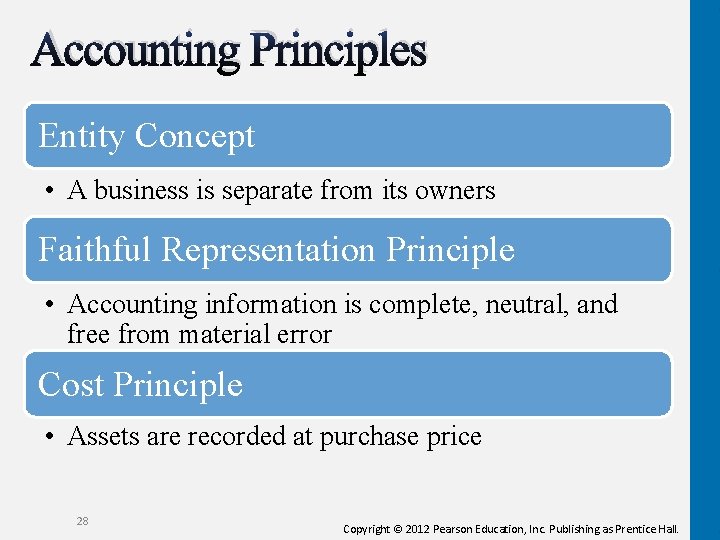
Accounting Principles Entity Concept • A business is separate from its owners Faithful Representation Principle • Accounting information is complete, neutral, and free from material error Cost Principle • Assets are recorded at purchase price 28 Copyright © 2012 Pearson Education, Inc. Publishing as Prentice Hall.
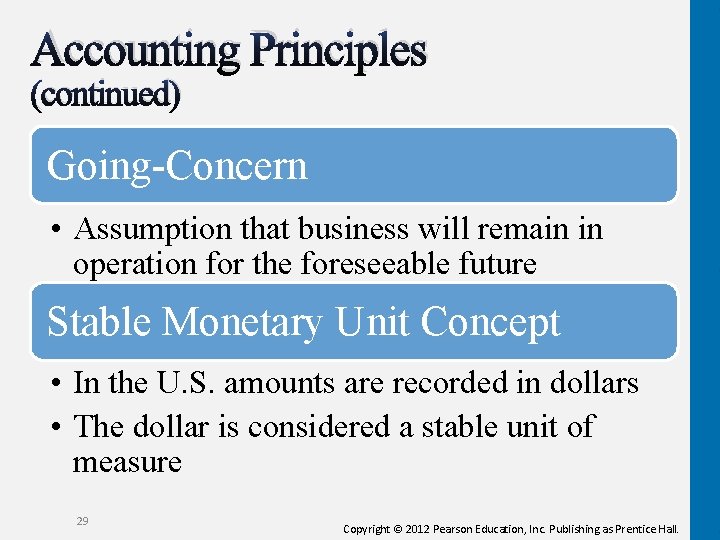
Accounting Principles (continued) Going-Concern • Assumption that business will remain in operation for the foreseeable future Stable Monetary Unit Concept • In the U. S. amounts are recorded in dollars • The dollar is considered a stable unit of measure 29 Copyright © 2012 Pearson Education, Inc. Publishing as Prentice Hall.
7 Describe the accounting equation, and define assets, liabilities, and equity 30 Copyright © 2012 Pearson Education, Inc. Publishing as Prentice Hall.
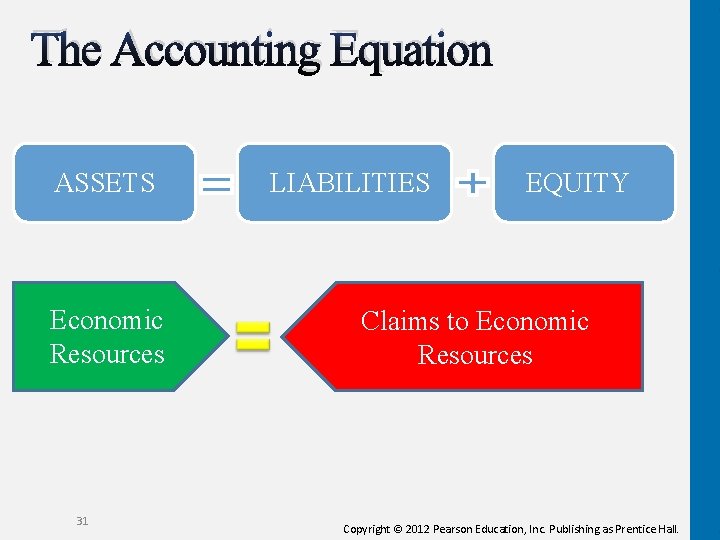
The Accounting Equation ASSETS Economic Resources 31 LIABILITIES EQUITY Claims to Economic Resources Copyright © 2012 Pearson Education, Inc. Publishing as Prentice Hall.
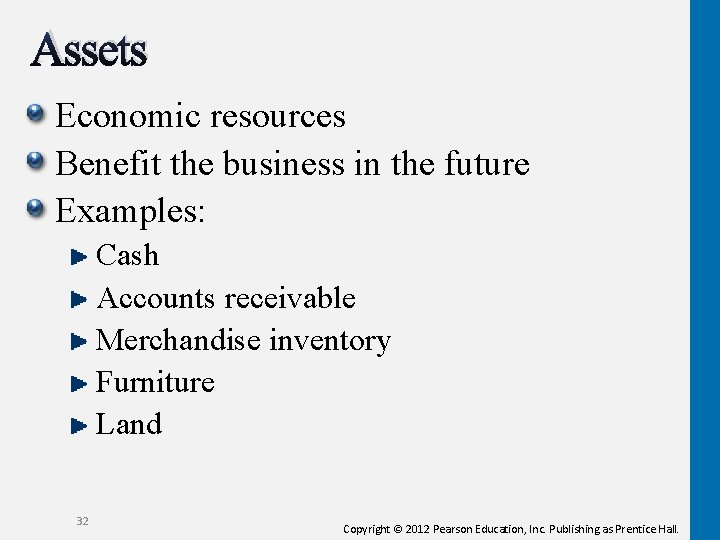
Assets Economic resources Benefit the business in the future Examples: Cash Accounts receivable Merchandise inventory Furniture Land 32 Copyright © 2012 Pearson Education, Inc. Publishing as Prentice Hall.
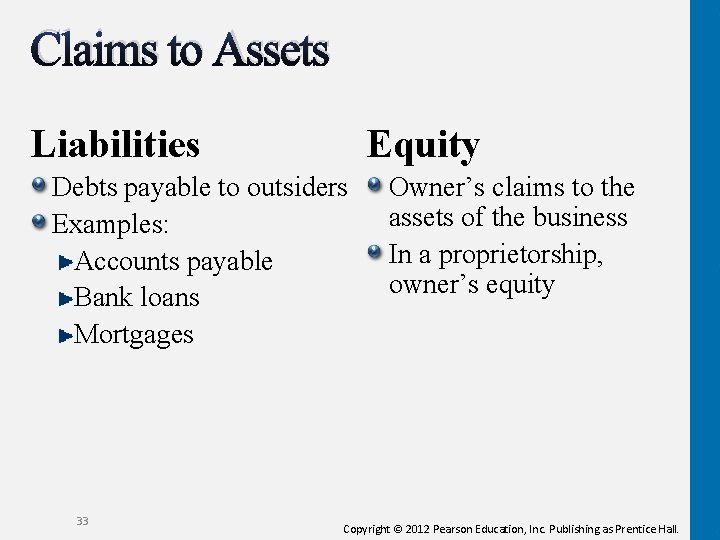
Claims to Assets Liabilities Equity Debts payable to outsiders Examples: Accounts payable Bank loans Mortgages 33 Owner’s claims to the assets of the business In a proprietorship, owner’s equity Copyright © 2012 Pearson Education, Inc. Publishing as Prentice Hall.
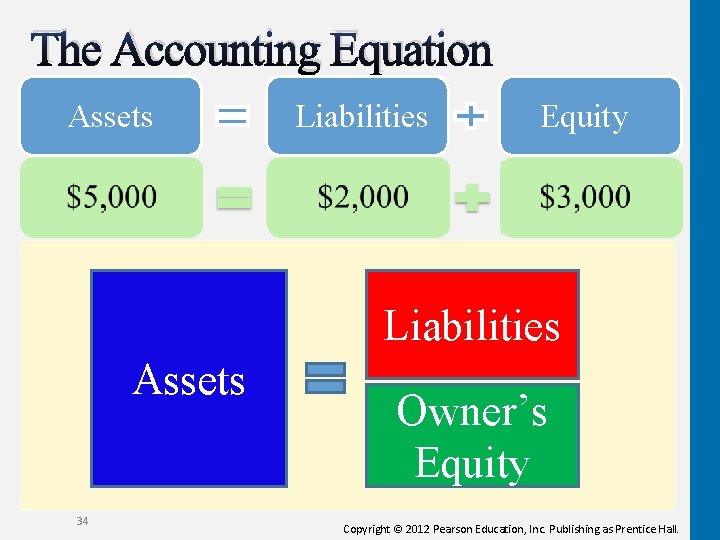
The Accounting Equation Assets Liabilities Equity Liabilities Assets 34 Owner’s Equity Copyright © 2012 Pearson Education, Inc. Publishing as Prentice Hall.
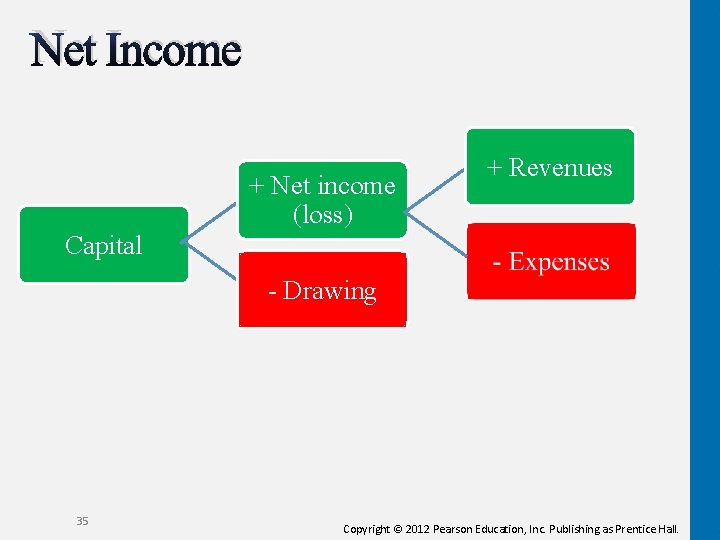
Net Income + Net income (loss) + Revenues Capital - Drawing 35 Copyright © 2012 Pearson Education, Inc. Publishing as Prentice Hall.
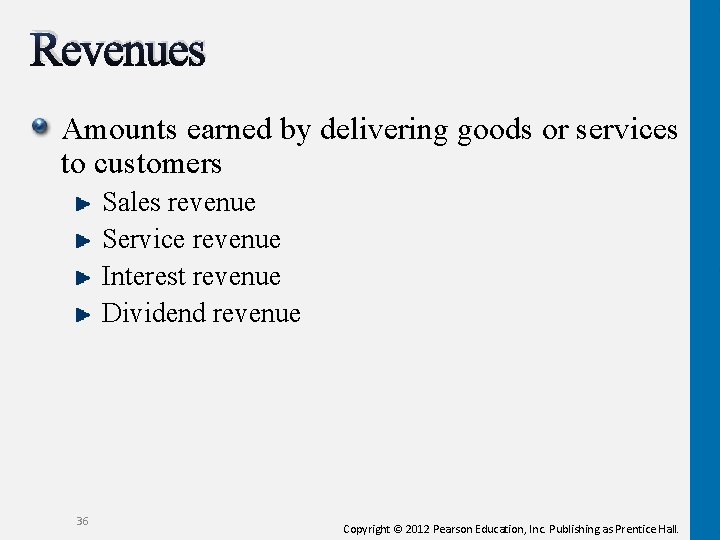
Revenues Amounts earned by delivering goods or services to customers Sales revenue Service revenue Interest revenue Dividend revenue 36 Copyright © 2012 Pearson Education, Inc. Publishing as Prentice Hall.
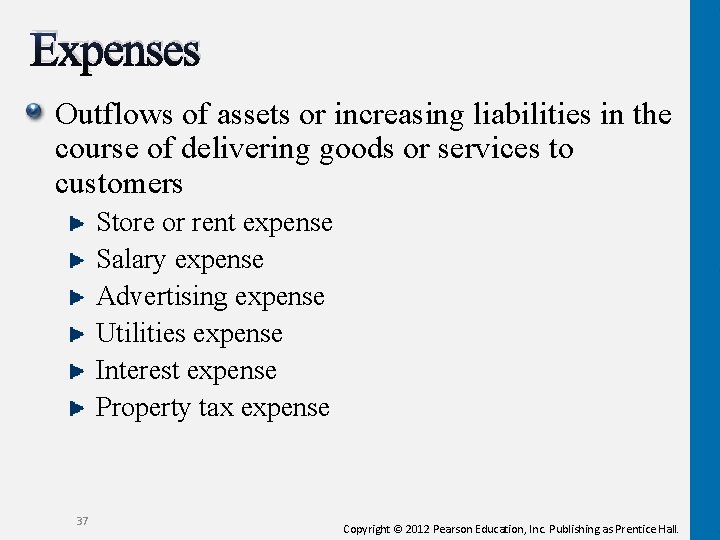
Expenses Outflows of assets or increasing liabilities in the course of delivering goods or services to customers Store or rent expense Salary expense Advertising expense Utilities expense Interest expense Property tax expense 37 Copyright © 2012 Pearson Education, Inc. Publishing as Prentice Hall.
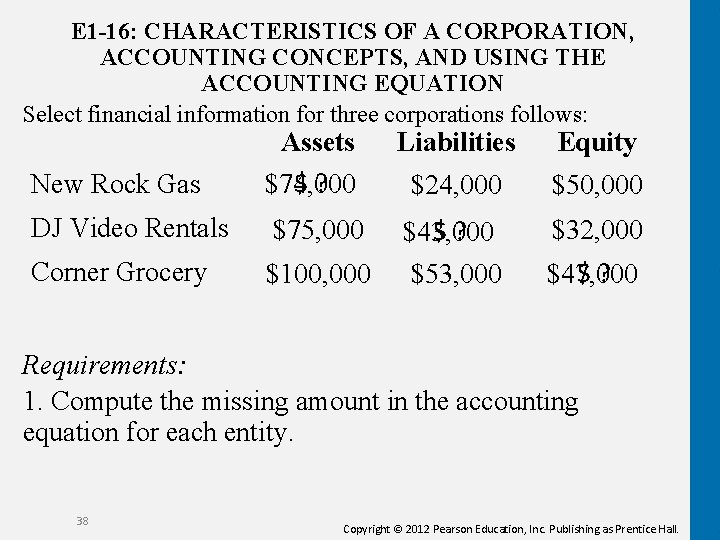
E 1 -16: CHARACTERISTICS OF A CORPORATION, ACCOUNTING CONCEPTS, AND USING THE ACCOUNTING EQUATION Select financial information for three corporations follows: Liabilities Equity New Rock Gas Assets $? $74, 000 $24, 000 $50, 000 DJ Video Rentals $75, 000 $? $43, 000 $32, 000 Corner Grocery $100, 000 $53, 000 $? $47, 000 Requirements: 1. Compute the missing amount in the accounting equation for each entity. 38 Copyright © 2012 Pearson Education, Inc. Publishing as Prentice Hall.
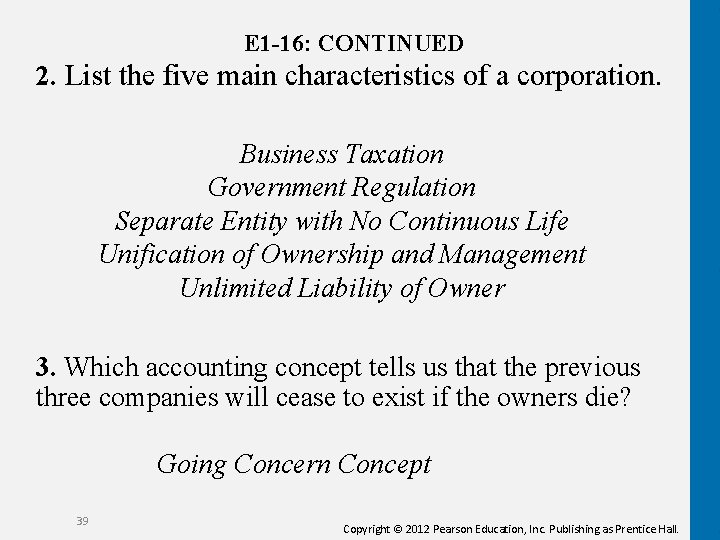
E 1 -16: CONTINUED 2. List the five main characteristics of a corporation. Business Taxation Government Regulation Separate Entity with No Continuous Life Unification of Ownership and Management Unlimited Liability of Owner 3. Which accounting concept tells us that the previous three companies will cease to exist if the owners die? Going Concern Concept 39 Copyright © 2012 Pearson Education, Inc. Publishing as Prentice Hall.
8 Use the accounting equation to analyze transactions 40 Copyright © 2012 Pearson Education, Inc. Publishing as Prentice Hall.
Transaction An event that affects the financial position of the business Can be measured reliably Every transaction impacts at least two items The accounting equation balances before and after each transaction 41 Copyright © 2012 Pearson Education, Inc. Publishing as Prentice Hall.
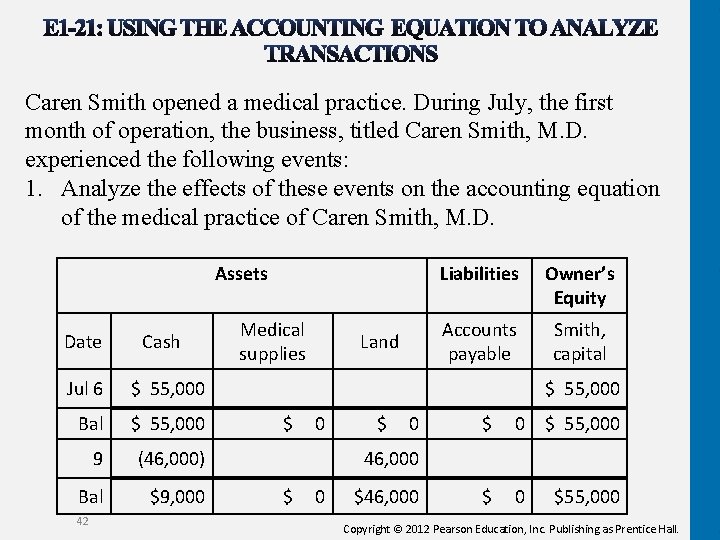
Caren Smith opened a medical practice. During July, the first month of operation, the business, titled Caren Smith, M. D. experienced the following events: 1. Analyze the effects of these events on the accounting equation of the medical practice of Caren Smith, M. D. Assets Date Cash Jul 6 $ 55, 000 Bal $ 55, 000 9 (46, 000) Bal $9, 000 42 Medical supplies Land Liabilities Owner’s Equity Accounts payable Smith, capital $ 55, 000 $ 0 $55, 000 46, 000 $ 0 $46, 000 Copyright © 2012 Pearson Education, Inc. Publishing as Prentice Hall.
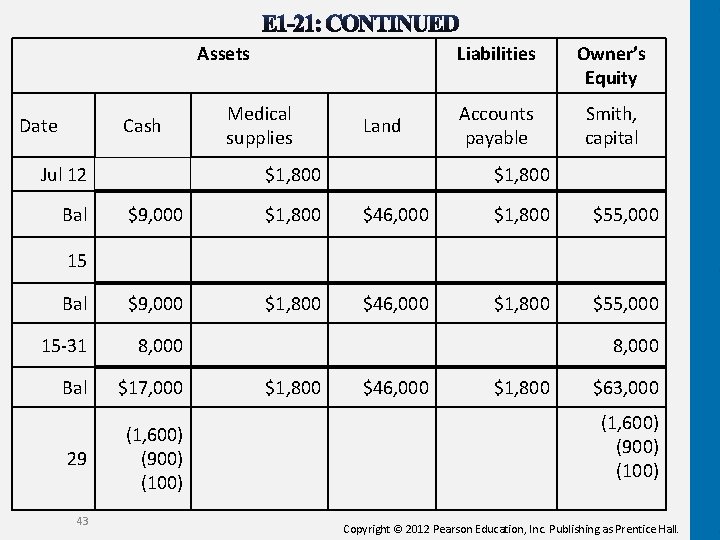
Assets Date Cash Jul 12 Bal Medical supplies Land $1, 800 Liabilities Owner’s Equity Accounts payable Smith, capital $1, 800 $9, 000 $1, 800 $46, 000 $1, 800 $55, 000 Bal $9, 000 $1, 800 $46, 000 $1, 800 $55, 000 15 -31 8, 000 Bal $17, 000 29 (1, 600) (900) (100) 15 43 8, 000 $1, 800 $46, 000 $1, 800 $63, 000 (1, 600) (900) (100) Copyright © 2012 Pearson Education, Inc. Publishing as Prentice Hall.
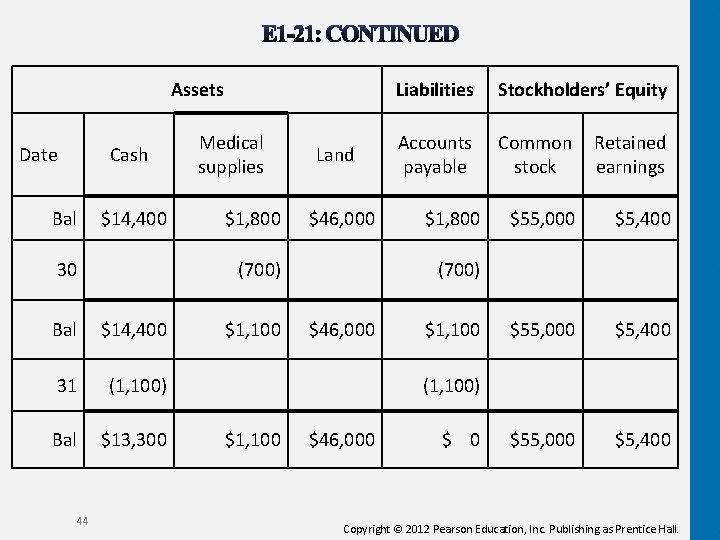
Assets Date Cash Bal $14, 400 30 $1, 800 Land $46, 000 (700) Bal $14, 400 31 (1, 100) Bal $13, 300 44 Medical supplies $1, 100 Liabilities Stockholders’ Equity Accounts payable Common stock Retained earnings $55, 000 $5, 400 $1, 800 (700) $46, 000 $1, 100 (1, 100) $1, 100 $46, 000 $ 0 Copyright © 2012 Pearson Education, Inc. Publishing as Prentice Hall.
9 Prepare financial statements 45 Copyright © 2012 Pearson Education, Inc. Publishing as Prentice Hall.
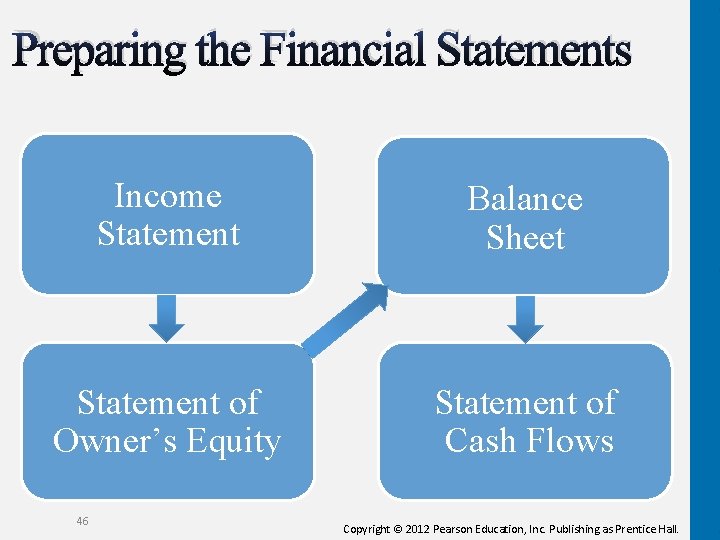
Preparing the Financial Statements Income Statement Balance Sheet Statement of Owner’s Equity Statement of Cash Flows 46 Copyright © 2012 Pearson Education, Inc. Publishing as Prentice Hall.
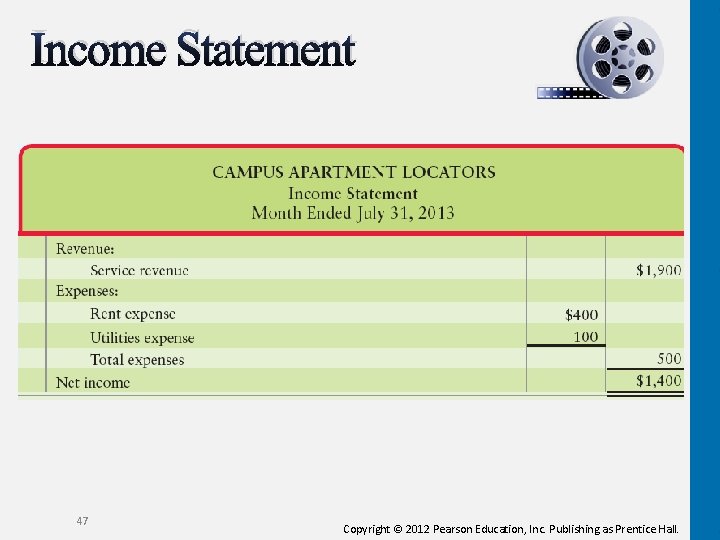
Income Statement 47 Copyright © 2012 Pearson Education, Inc. Publishing as Prentice Hall.
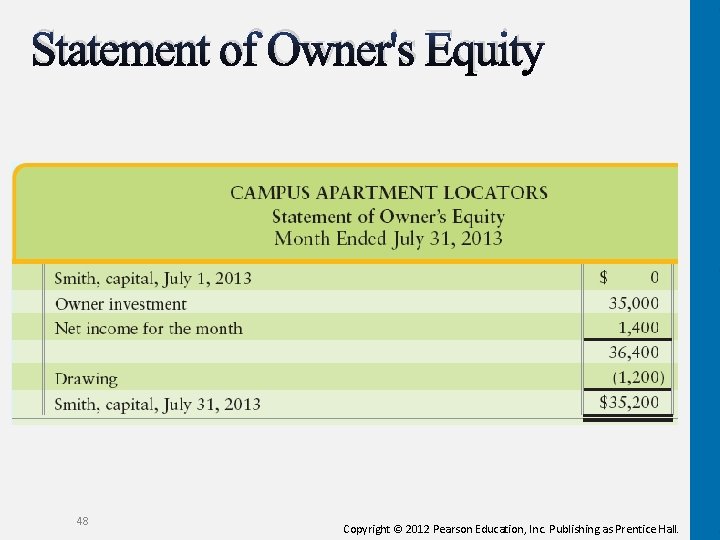
Statement of Owner's Equity 48 Copyright © 2012 Pearson Education, Inc. Publishing as Prentice Hall.
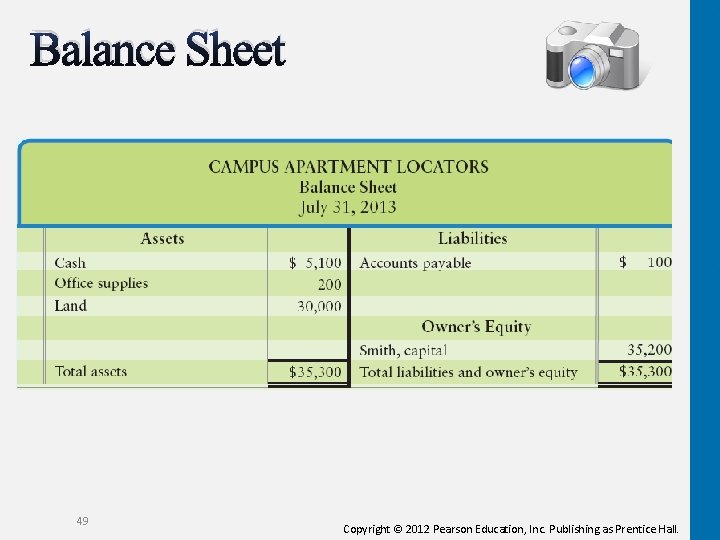
Balance Sheet 49 Copyright © 2012 Pearson Education, Inc. Publishing as Prentice Hall.
Statement of Cash Flows The statement of cash flows reports the cash coming in (positive amounts) and the cash going out (negative amounts) during a period. Business activities result in a net cash inflow or a net cash outflow. The statement of cash flows reports the net increase or decrease in cash during the period and the ending cash balance 50 Copyright © 2012 Pearson Education, Inc. Publishing as Prentice Hall.

Studio Photography works weddings and prom-type parties. The balance of Ansel, capital was $16, 000 at December 31, 2011. At December 31, 2012, the business’s accounting records show these balances: Insurance expense $ 8, 000 Accounts receivable $ 8, 000 Cash 37, 000 Note payable 12, 000 Accounts payable 7, 000 Ansel, capital, Dec 31, 2012 Advertising expense 3, 000 Salary expense ? 25, 000 Service revenue 80, 000 Equipment 50, 000 Ansel, drawing 13, 000 Owner’s investment, 2012 29, 000 Prepare the following financial statements for Studio Photography, Inc. for the year ended December 31, 2012: a. Income statement b. Statement of owner’s equity c. Balance sheet 51 Copyright © 2012 Pearson Education, Inc. Publishing as Prentice Hall.
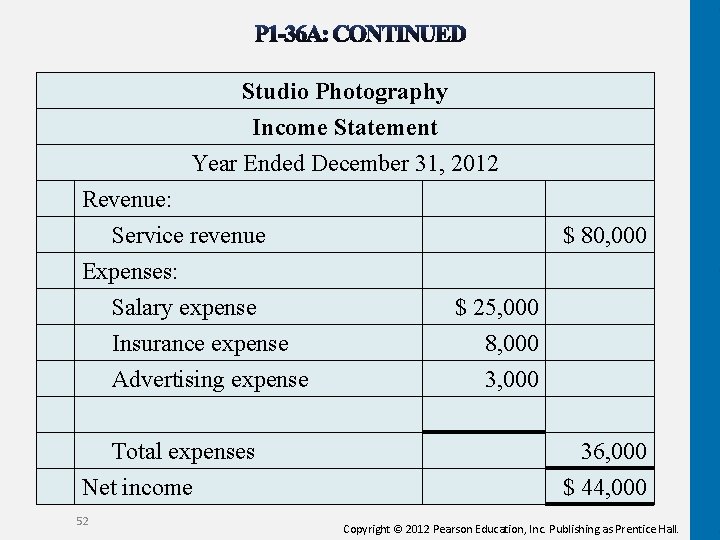
Studio Photography Income Statement Year Ended December 31, 2012 Revenue: Service revenue Expenses: Salary expense Insurance expense Advertising expense Total expenses Net income 52 $ 80, 000 $ 25, 000 8, 000 36, 000 $ 44, 000 Copyright © 2012 Pearson Education, Inc. Publishing as Prentice Hall.
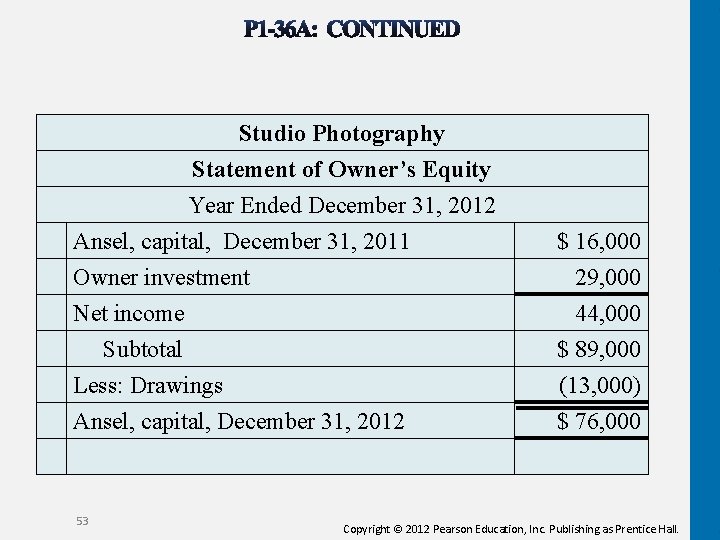
Studio Photography Statement of Owner’s Equity Year Ended December 31, 2012 Ansel, capital, December 31, 2011 Owner investment Net income Subtotal $ 16, 000 29, 000 44, 000 $ 89, 000 Less: Drawings Ansel, capital, December 31, 2012 (13, 000) $ 76, 000 53 Copyright © 2012 Pearson Education, Inc. Publishing as Prentice Hall.
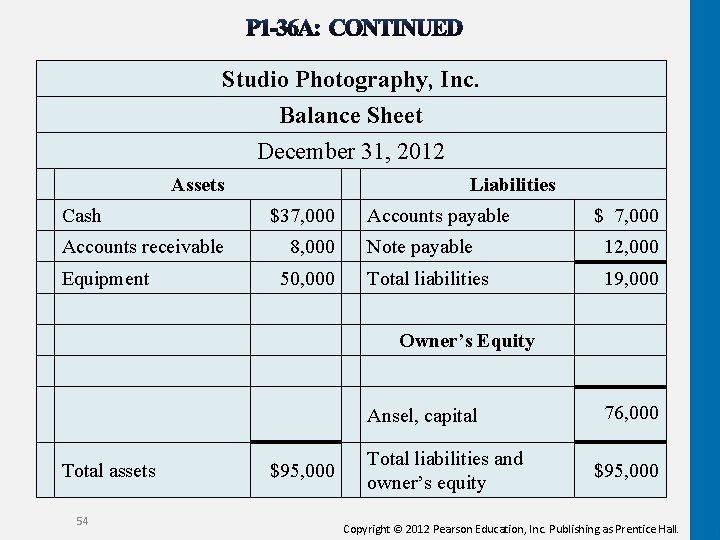
Studio Photography, Inc. Balance Sheet December 31, 2012 Assets Cash Accounts receivable Equipment Liabilities $37, 000 8, 000 50, 000 Accounts payable $ 7, 000 Note payable 12, 000 Total liabilities 19, 000 Owner’s Equity Ansel, capital Total assets 54 $95, 000 Total liabilities and owner’s equity 76, 000 $95, 000 Copyright © 2012 Pearson Education, Inc. Publishing as Prentice Hall.
10 Use financial statements to evaluate business performance 55 Copyright © 2012 Pearson Education, Inc. Publishing as Prentice Hall.
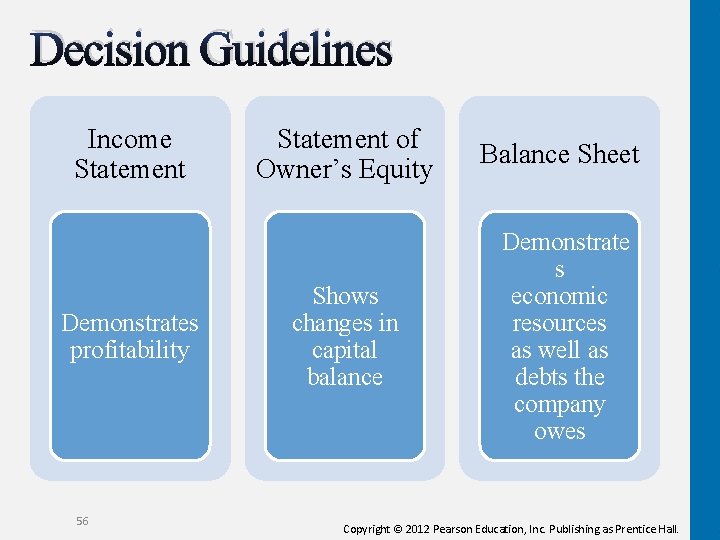
Decision Guidelines Income Statement Demonstrates profitability 56 Statement of Owner’s Equity Balance Sheet Shows changes in capital balance Demonstrate s economic resources as well as debts the company owes Copyright © 2012 Pearson Education, Inc. Publishing as Prentice Hall.
Chapter 1 Summary Accounting is the language of business. Financial statements report a company’s activities in monetary terms. Different users—including individuals, business owners, managers, investors, creditors, and tax authorities—review a company’s financial statements for different reasons. Each user’s goal will determine which pieces of the financial statements he or she will find most useful. 57 Copyright © 2012 Pearson Education, Inc. Publishing as Prentice Hall.
Chapter 1 Summary Most U. S. businesses follow generally accepted accounting principles (GAAP). If the company is publicly traded, then it must also follow SEC guidelines. If the company operates internationally, then international financial reporting standards (IFRS) will apply. The goal is that, eventually, all public U. S. companies will report using IFRS rules. There are five main forms of business organizations: proprietorships, partnerships, corporations, LLPs/LLCs, and not-for-profits. Each is unique in its formation, ownership, life, and liability exposure. 58 Copyright © 2012 Pearson Education, Inc. Publishing as Prentice Hall.
Chapter 1 Summary Proprietorships are formed when one person creates a business. One person owns the proprietorship. Although the proprietorship is a separate entity, it has no continuous life, and the owner has unlimited liability for the business’s debts. Proprietorships have a more difficult time raising capital, but have the advantage of reduced regulation and less taxes than the corporate form of business. The accounting concepts are the underlying assumptions used when recording financial information for a business. Think of the concepts like rules of a game. You have to play by the rules. 59 Copyright © 2012 Pearson Education, Inc. Publishing as Prentice Hall.
Chapter 1 Summary The accounting equation must always equal. That is, Assets (what you own) must equal Liabilities (what you owe) + Equity (net worth). The accounting equation is Assets = Liabilities + Equity. Every business transaction affects various parts of the equation, but after each transaction is recorded, the equation must ALWAYS balance (equal). Financial statements are prepared from the ending balances of each account. Each financial statement shows a different view of the company’s overall results 60 Copyright © 2012 Pearson Education, Inc. Publishing as Prentice Hall.
Chapter 1 Summary Financial statements are prepared from the transaction analyses (summary of events) reported in each account (Exhibit 1 -6) in the order shown in Exhibit 1 -7. No one financial statement shows everything about a company. It is the financial statements AND the relationships the statements show that give users the overall picture for a specific company. 61 Copyright © 2012 Pearson Education, Inc. Publishing as Prentice Hall.

62 Copyright © 2012 Pearson Education, Inc. Publishing as Prentice Hall.
Copyright All rights reserved. No part of this publication may be reproduced, stored in a retrieval system, or transmitted, in any form or by any means, electronic, mechanical, photocopying, recording, or otherwise, without the prior written permission of the publisher. Printed in the United States of America. 63 Copyright © 2012 Pearson Education, Inc. Publishing as Prentice Hall.
- Slides: 63