
Accountability in the School System an illustrative example
Accountability in the School System – an illustrative example from England. A Workshop Presentation 10 th OECD - Japan International Seminar Tokyo, 24 th June 2005 Professor David Hopkins HSBC i. NET Chair of International Leadership
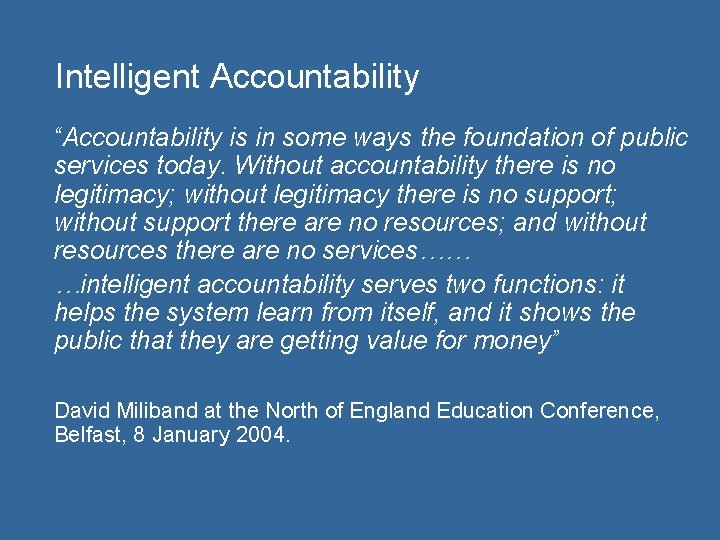
Intelligent Accountability “Accountability is in some ways the foundation of public services today. Without accountability there is no legitimacy; without legitimacy there is no support; without support there are no resources; and without resources there are no services…… …intelligent accountability serves two functions: it helps the system learn from itself, and it shows the public that they are getting value for money” David Miliband at the North of England Education Conference, Belfast, 8 January 2004.
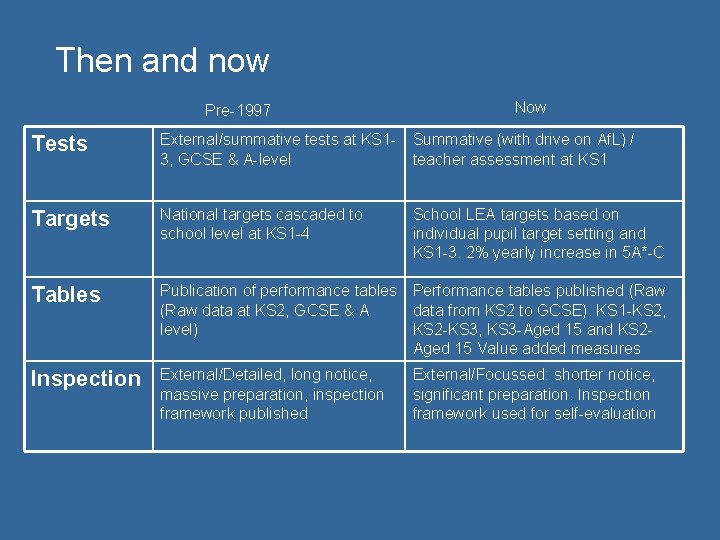
Then and now Pre-1997 Now Tests External/summative tests at KS 13, GCSE & A-level Summative (with drive on Af. L) / teacher assessment at KS 1 Targets National targets cascaded to school level at KS 1 -4 School LEA targets based on individual pupil target setting and KS 1 -3. 2% yearly increase in 5 A*-C Tables Publication of performance tables Performance tables published (Raw data at KS 2, GCSE & A data from KS 2 to GCSE). KS 1 -KS 2, level) KS 2 -KS 3, KS 3 -Aged 15 and KS 2 Aged 15 Value added measures Inspection External/Detailed, long notice, massive preparation, inspection framework published External/Focussed: shorter notice, significant preparation. Inspection framework used for self-evaluation
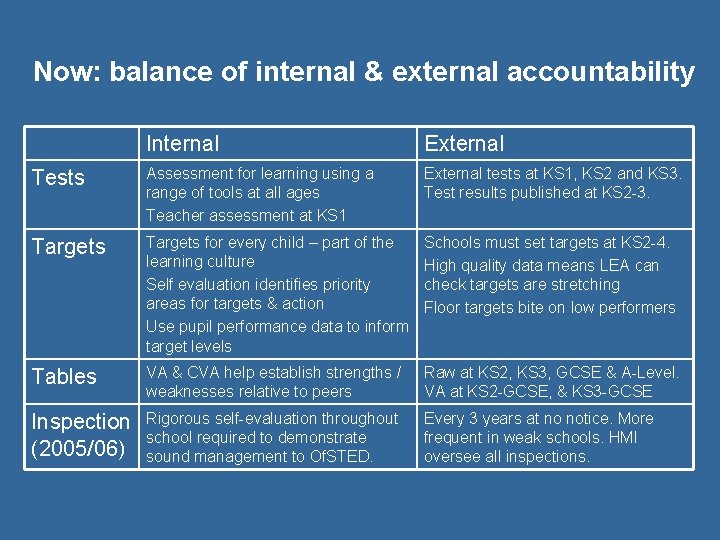
Now: balance of internal & external accountability Internal External Tests Assessment for learning using a range of tools at all ages Teacher assessment at KS 1 External tests at KS 1, KS 2 and KS 3. Test results published at KS 2 -3. Targets for every child – part of the learning culture Self evaluation identifies priority areas for targets & action Use pupil performance data to inform target levels Schools must set targets at KS 2 -4. High quality data means LEA can check targets are stretching Floor targets bite on low performers Tables VA & CVA help establish strengths / weaknesses relative to peers Raw at KS 2, KS 3, GCSE & A-Level. VA at KS 2 -GCSE, & KS 3 -GCSE Inspection (2005/06) Rigorous self-evaluation throughout school required to demonstrate sound management to Of. STED. Every 3 years at no notice. More frequent in weak schools. HMI oversee all inspections.
Advantages of this approach • Encourages ownership of targets & improvement • Self evaluation focuses attention on weak spots • Differentiates better between different schools e. g. • Firm floor targets for poor performers • Continued stretch for high performers (>50% 5 A*-C) • Promotes assessment for learning & personalisation But there’s a danger of drift – need to retain wholesystem view
What’s changed? • Pressure eased on our blunt levers • OFSTED inspections focusing on core issues, not • • observing every lesson Increased precision using VA data A more sophisticated, but more complex system, with more options at every step, but greater reliance on local judgements Better incentives for success, designed to encourage system-wide improvement Better solutions to failure: academies, fast-track to closure But this needs to bite on different types of schools
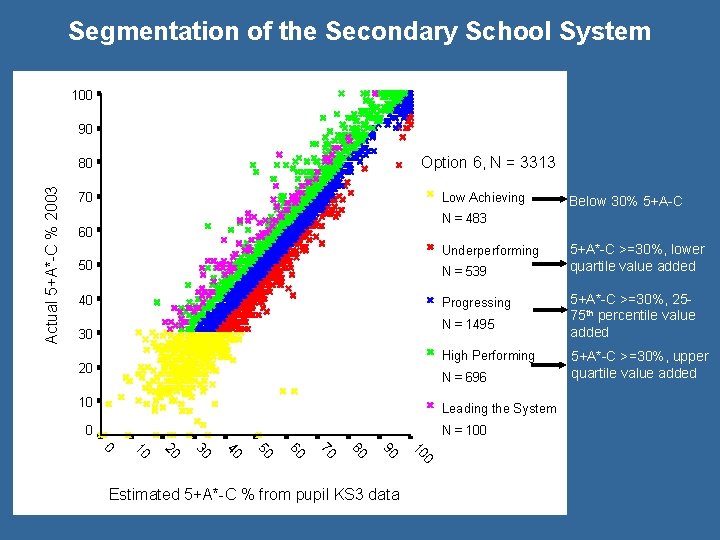
Segmentation of the Secondary School System 100 90 Option 6, N = 3313 Actual 5+A*-C % 2003 80 70 Low Achieving Below 30% 5+A-C N = 483 60 Underperforming 50 N = 539 40 Progressing N = 1495 30 High Performing 20 N = 696 10 Leading the System 0 N = 100 0 10 90 80 70 60 50 40 30 20 10 0 Estimated 5+A*-C % from pupil KS 3 data 5+A*-C >=30%, lower quartile value added 5+A*-C >=30%, 2575 th percentile value added 5+A*-C >=30%, upper quartile value added
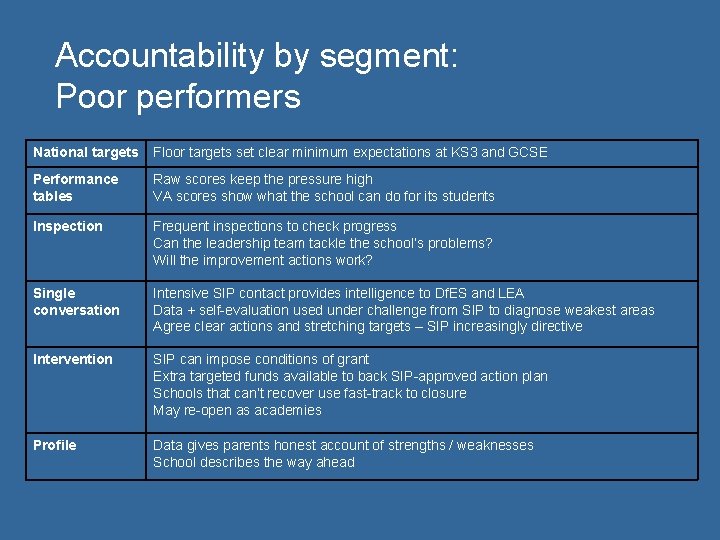
Accountability by segment: Poor performers National targets Floor targets set clear minimum expectations at KS 3 and GCSE Performance tables Raw scores keep the pressure high VA scores show what the school can do for its students Inspection Frequent inspections to check progress Can the leadership team tackle the school’s problems? Will the improvement actions work? Single conversation Intensive SIP contact provides intelligence to Df. ES and LEA Data + self-evaluation used under challenge from SIP to diagnose weakest areas Agree clear actions and stretching targets – SIP increasingly directive Intervention SIP can impose conditions of grant Extra targeted funds available to back SIP-approved action plan Schools that can’t recover use fast-track to closure May re-open as academies Profile Data gives parents honest account of strengths / weaknesses School describes the way ahead
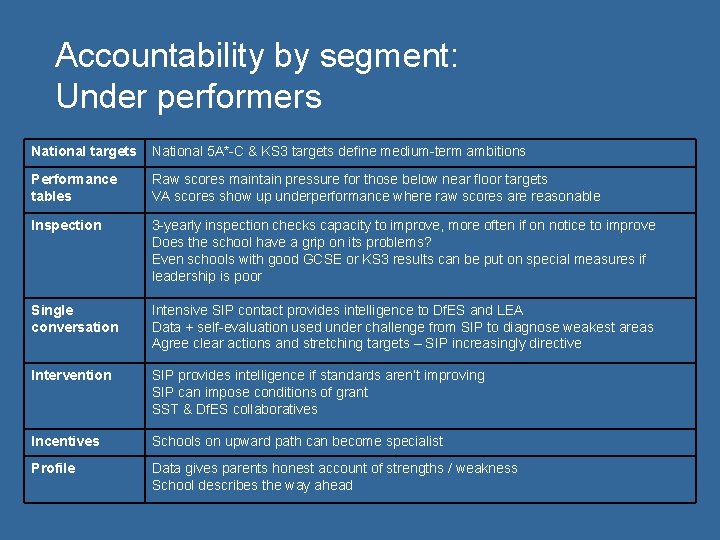
Accountability by segment: Under performers National targets National 5 A*-C & KS 3 targets define medium-term ambitions Performance tables Raw scores maintain pressure for those below near floor targets VA scores show up underperformance where raw scores are reasonable Inspection 3 -yearly inspection checks capacity to improve, more often if on notice to improve Does the school have a grip on its problems? Even schools with good GCSE or KS 3 results can be put on special measures if leadership is poor Single conversation Intensive SIP contact provides intelligence to Df. ES and LEA Data + self-evaluation used under challenge from SIP to diagnose weakest areas Agree clear actions and stretching targets – SIP increasingly directive Intervention SIP provides intelligence if standards aren’t improving SIP can impose conditions of grant SST & Df. ES collaboratives Incentives Schools on upward path can become specialist Profile Data gives parents honest account of strengths / weakness School describes the way ahead
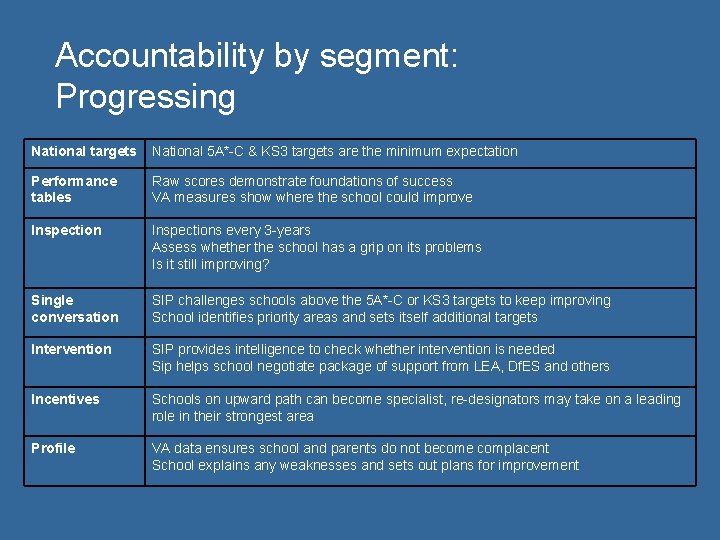
Accountability by segment: Progressing National targets National 5 A*-C & KS 3 targets are the minimum expectation Performance tables Raw scores demonstrate foundations of success VA measures show where the school could improve Inspections every 3 -years Assess whether the school has a grip on its problems Is it still improving? Single conversation SIP challenges schools above the 5 A*-C or KS 3 targets to keep improving School identifies priority areas and sets itself additional targets Intervention SIP provides intelligence to check whether intervention is needed Sip helps school negotiate package of support from LEA, Df. ES and others Incentives Schools on upward path can become specialist, re-designators may take on a leading role in their strongest area Profile VA data ensures school and parents do not become complacent School explains any weaknesses and sets out plans for improvement
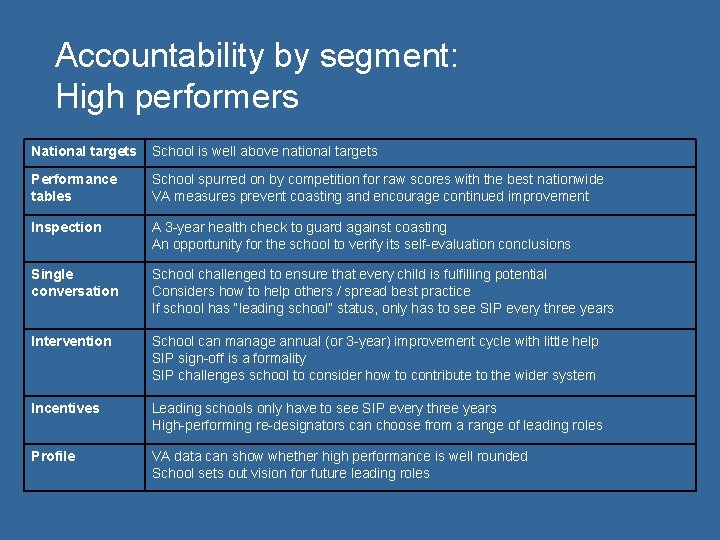
Accountability by segment: High performers National targets School is well above national targets Performance tables School spurred on by competition for raw scores with the best nationwide VA measures prevent coasting and encourage continued improvement Inspection A 3 -year health check to guard against coasting An opportunity for the school to verify its self-evaluation conclusions Single conversation School challenged to ensure that every child is fulfilling potential Considers how to help others / spread best practice If school has “leading school” status, only has to see SIP every three years Intervention School can manage annual (or 3 -year) improvement cycle with little help SIP sign-off is a formality SIP challenges school to consider how to contribute to the wider system Incentives Leading schools only have to see SIP every three years High-performing re-designators can choose from a range of leading roles Profile VA data can show whether high performance is well rounded School sets out vision for future leading roles
Conclusions • The new system is better at driving improvements in the top half of the • • • market • better stimuli from VA data • better incentives to perform and help the whole system • but we need something similar for primary schools We have better solutions at the bottom end • Better intelligence about the problems: SIP & OFSTED • More options for dealing with failure quickly But communications need to strike a balance between encouragement and tough messages that failure is unacceptable CVA allows sharp focus on underperformance that is being tackled directly through SST and Df. ES networks But we need some clear triggers for ratcheting up (or down) our approach to a school – SIPs must know what problems to look for and how to tackle them & we need access to that information How will the accountability system need to adapt in the future?
- Slides: 12