
Accident Prevention Principles Introduction Accidents result from breakdowns

Accident Prevention Principles

Introduction • Accidents result from breakdowns in the safety system & represent a management problem • Many safety professionals attack accidents by identifying, evaluating, & controlling hazards

Objectives • Understand accident prevention & loss control terms • Explain causes of accidents • Describe methods used in an accident prevention program strategy

Injury Stats • Unintentional injuries are the 5 th leading cause of death - exceeded by heart disease, cancer, stroke, & chronic pulmonary diseases • Between ages 1 - 34, unintentional injuries are leading cause of death
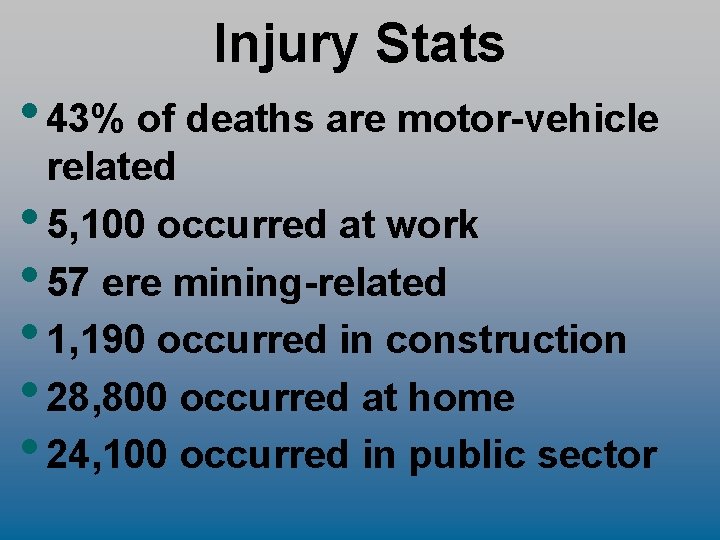
Injury Stats • 43% of deaths are motor-vehicle related • 5, 100 occurred at work • 57 ere mining-related • 1, 190 occurred in construction • 28, 800 occurred at home • 24, 100 occurred in public sector

Consequences • Loss of life • Permanent or temporary disability • Minor injury • Property damage • Loss of production • Loss of wages
Consequences • Increase in insurance costs • Loss of profit • Loss of recreation/hobby • Pain & suffering (physical & psychological) • Litigation settlements
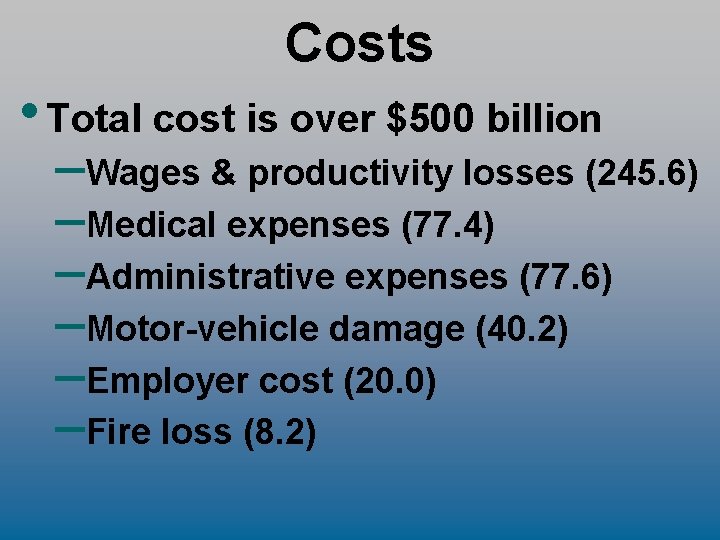
Costs • Total cost is over $500 billion –Wages & productivity losses (245. 6) –Medical expenses (77. 4) –Administrative expenses (77. 6) –Motor-vehicle damage (40. 2) –Employer cost (20. 0) –Fire loss (8. 2)
Definitions
Safety • An acceptable level of risk • Freedom from hazards • Science/activity directed at controlling hazards & preventing accidents
Hazard • Condition or situation that can cause/contribute to an accident • Common hazards include: fall to a lower lever, struck-by, caught in, under, or between, contact with, etc
Accident • Unplanned release of energy that results in injury or property damage • Usually when force of energy released exceeds threshold limit value of affected body or object
Risk • Measure of both probability & severity of all hazards associated with a given activity or condition
Incident • Unplanned event that may or may not cause loss • All accidents are incidents, but not all incidents are accidents • Incidents that do not result in loss indicate a breakdown in the safety system, & investigated
Safety Management • Planning, organizing, directing, monitoring/controlling those activities necessary to achieve an organization’s loss prevention & loss control objectives
Loss Control • Program whose purpose is to minimize accident-based financial losses • Analysis of property damage is considered to be a highly desirable, worthwhile activity
Loss Prevention • Describes a before-the-loss (proactive) program designed to identify & correct potential accident problems

Causes Of Accidents • Accident cause complex • Failure of people, equipment, materials, or environment to behave or react as expected • Man • Machines • Materials • Environment
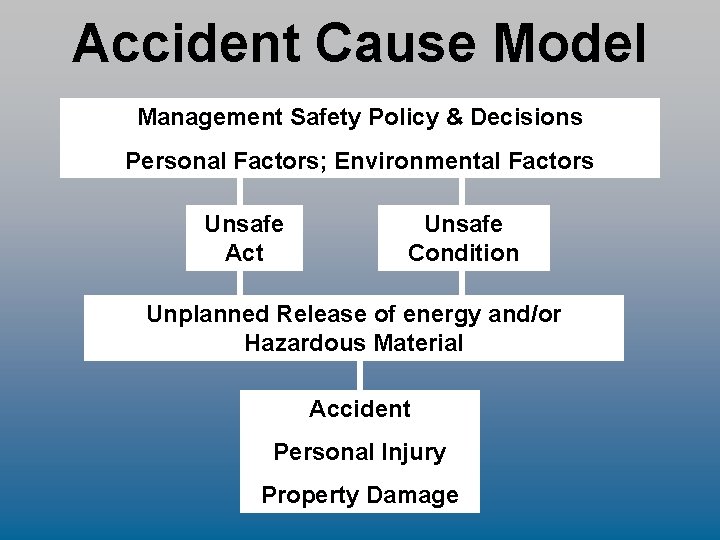
Accident Cause Model Management Safety Policy & Decisions Personal Factors; Environmental Factors Unsafe Act Unsafe Condition Unplanned Release of energy and/or Hazardous Material Accident Personal Injury Property Damage
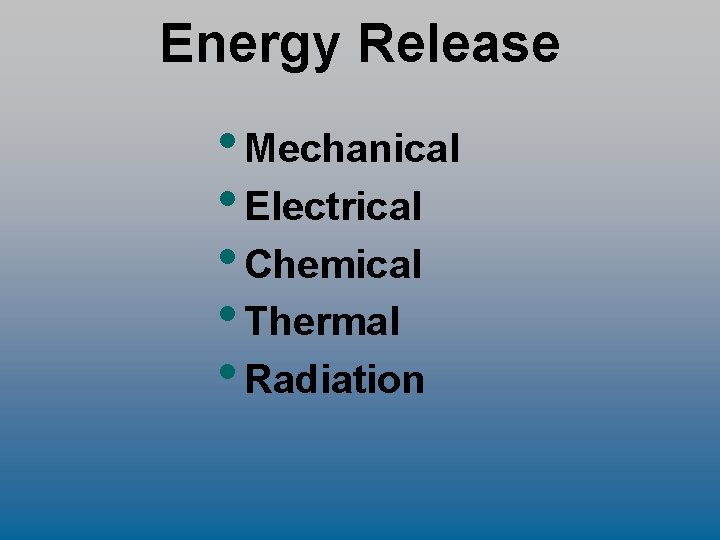
Energy Release • Mechanical • Electrical • Chemical • Thermal • Radiation
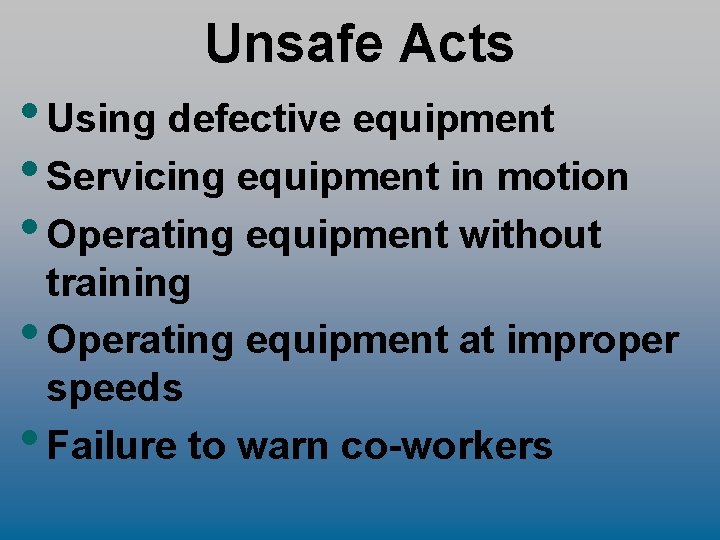
Unsafe Acts • Using defective equipment • Servicing equipment in motion • Operating equipment without training • Operating equipment at improper speeds • Failure to warn co-workers
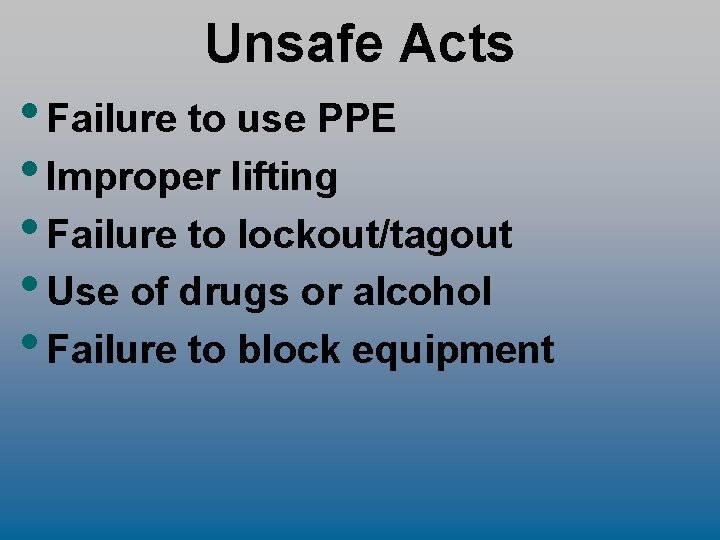
Unsafe Acts • Failure to use PPE • Improper lifting • Failure to lockout/tagout • Use of drugs or alcohol • Failure to block equipment
Unsafe Conditions • Defective tools & equipment • Excessive dust/noise • Inadequate guards/supports • Poorly designed or maintained haul roads • Poor lighting • Accumulations of combustibles
Personal Factors • Inadequate capability (physical & mental aspects) • Lack of knowledge • Lack of skill • Stress • Improper motivation
Job Factors • Inadequate leadership or supervision • Inadequate engineering • Inadequate design, layout • Inadequate purchasing
Job Factors • Inadequate maintenance • Inadequate tools, equipment, materials • Inadequate work standards • Abuse, misuse, wear & tear
Lack of Control • Management policies/decisions & failure to insure compliance for: –leadership & administration –management training –planned inspections –task analysis & procedures –Task observation

Lack of Control • Organizational rules • Emergency preparedness • Accident/incident analysis • Accident/incident investigation • PPE • Engineering controls • Purchasing control
Lack of Control • Hiring placement • Employee training • General promotion • Personal communication • Group meetings • Health control • Off-the-job safety
Analyzing The Causes Of Accidents • Management’s commitment to safety must be transparent through its actions
Accident Prevention Program Strategy • Injuries can be prevented when management fully supports the prevention program & everyone lives up to their responsibilities • ACCOUNTABILITY
Total Safety Work Culture • Strong management commitment to safety is essential • Safety is a value, not a priority –Priorities get rearranged in reaction to schedules, resources, orders, etc. –Values endure & represent a foundation we base our decisions & actions –Safety is more than compliance
Total Safety Work Culture • Balanced attention given equally to environment, behavior & person • Program must be positive, i. e. , focusing on implementing safe practices, not avoidance of mistakes or unsafe acts
Total Safety Work Culture • Essential that supervisors consistently promote safe performance by words & actions • Authority is a powerful force in determining behavior of others
Total Safety Work Culture • We should be our brother’s keeper • Assuming that no accidents or good incidence rate (IR) means a safe operation is misleading • At-risk behavior may have reached or may be reaching critical levels
Role of Management • Establish standards/policies • Hiring & selection • New employee training • Skills/task training • Adequate job instruction • PPE
Role of Management • Job analysis procedures • Supervisory training • Annual refresher safety training • Engineering controls • Purchasing controls
Role of Management • Planned inspections • Maintenance • Accident investigations • Group communications
Role of Management • Emergency/evacuation plan • First aid care • Safety coaching program • Performance reinforcing procedures
Role of Management • Implement policies & enforce procedures • Continuous monitoring & control –Plan –Do –Check –Act
Summary The intent of this presentation was to take a proactive approach to accident prevention by systemically identifying, evaluating, and controlling hazards in the workplace
- Slides: 41