
Accident Investigation Training How to Conduct a Workplace
- Slides: 23
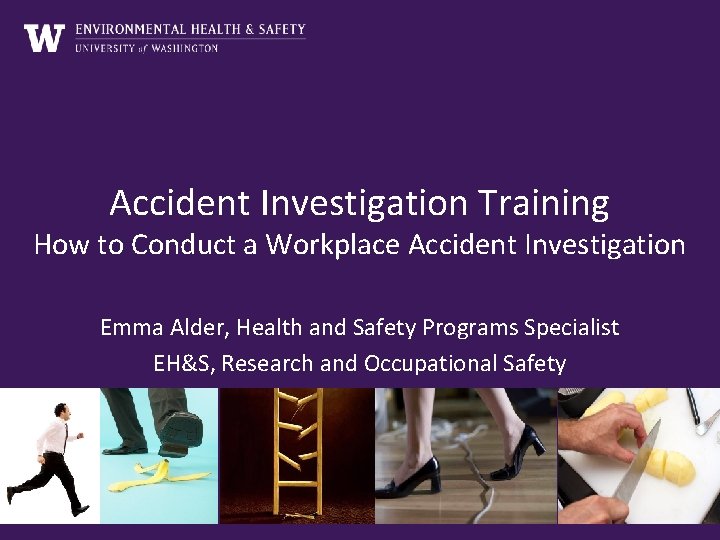
Accident Investigation Training How to Conduct a Workplace Accident Investigation Emma Alder, Health and Safety Programs Specialist EH&S, Research and Occupational Safety
Goals for this Training • Learn simple tools that can be used to investigate simple and complex accidents. • Learn the importance of root cause analysis. • Walk away with resources that can help minimize the occurrence of accidents in your department. 10/30/2020 2
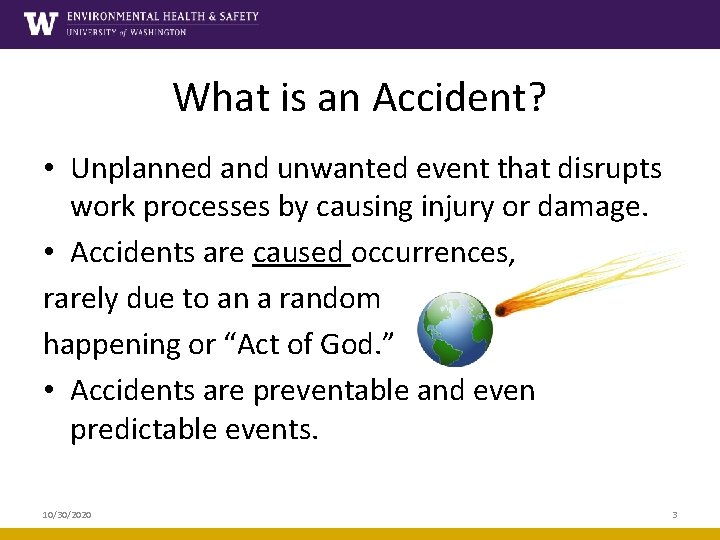
What is an Accident? • Unplanned and unwanted event that disrupts work processes by causing injury or damage. • Accidents are caused occurrences, rarely due to an a random happening or “Act of God. ” • Accidents are preventable and even predictable events. 10/30/2020 3
Why Investigate? • Investigations can uncover deficiencies in procedures and training or draw attention to needed repairs/maintenance. • Investigations lead to corrective actions that prevent reoccurrence of accidents. • Investigations are required by law for serious accidents (WAC 296 -800 -32020). 10/30/2020 4
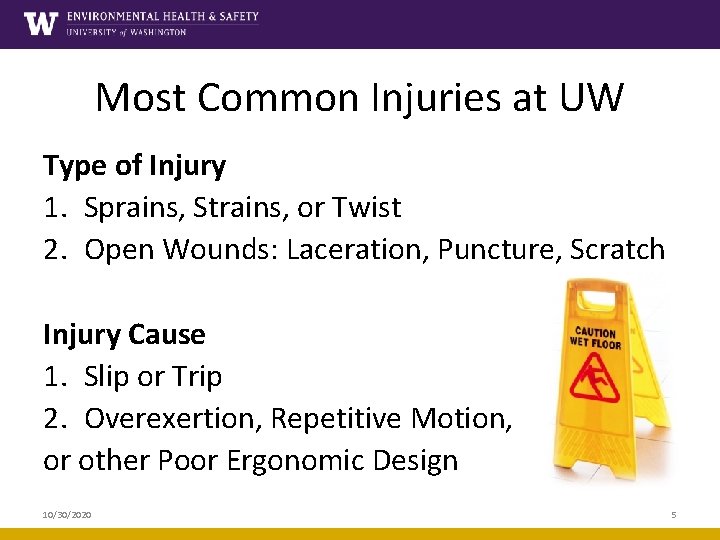
Most Common Injuries at UW Type of Injury 1. Sprains, Strains, or Twist 2. Open Wounds: Laceration, Puncture, Scratch Injury Cause 1. Slip or Trip 2. Overexertion, Repetitive Motion, or other Poor Ergonomic Design 10/30/2020 5
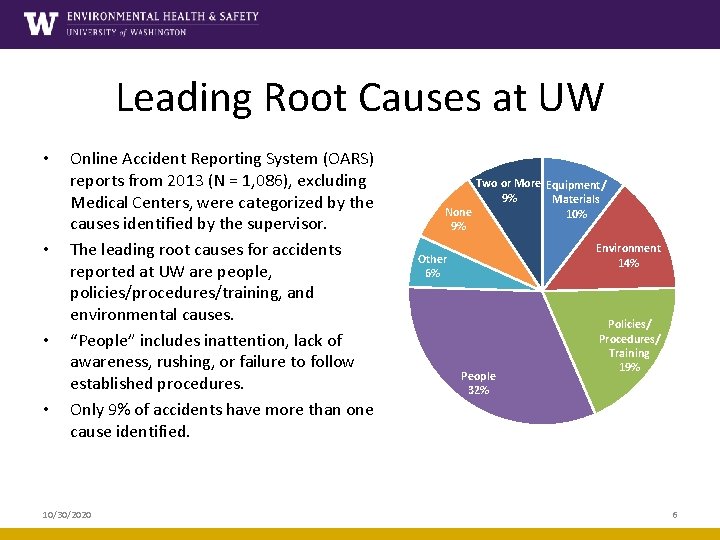
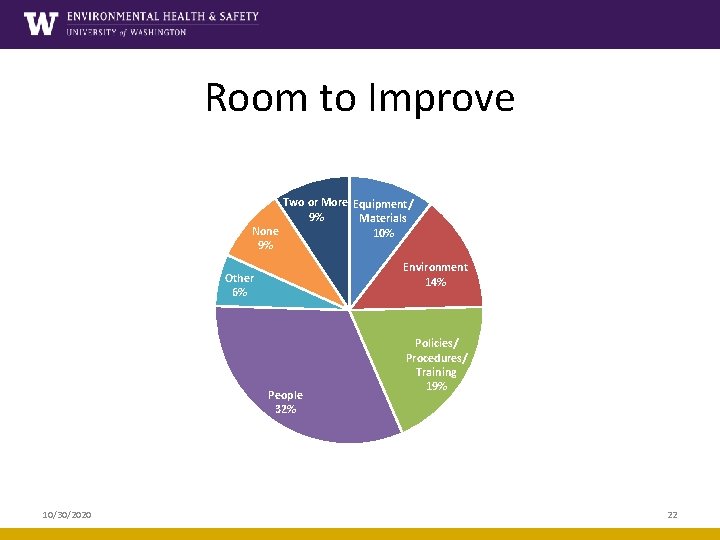
Leading Root Causes at UW • • Online Accident Reporting System (OARS) reports from 2013 (N = 1, 086), excluding Medical Centers, were categorized by the causes identified by the supervisor. The leading root causes for accidents reported at UW are people, policies/procedures/training, and environmental causes. “People” includes inattention, lack of awareness, rushing, or failure to follow established procedures. Only 9% of accidents have more than one cause identified. 10/30/2020 Two or More Two 9% or More Equipment/ 9% Materials None 10% 9% Environment 14% Other 6% People 32% Policies/ Procedures/ Training 19% 6
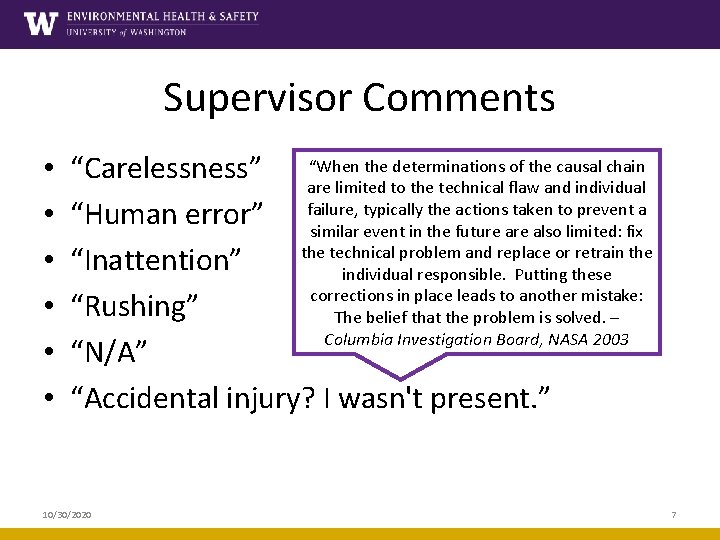
Supervisor Comments • • • “When the determinations of the causal chain “Carelessness” are limited to the technical flaw and individual typically the actions taken to prevent a “Human error” failure, similar event in the future also limited: fix the technical problem and replace or retrain the “Inattention” individual responsible. Putting these corrections in place leads to another mistake: “Rushing” The belief that the problem is solved. – Columbia Investigation Board, NASA 2003 “N/A” “Accidental injury? I wasn't present. ” 10/30/2020 7
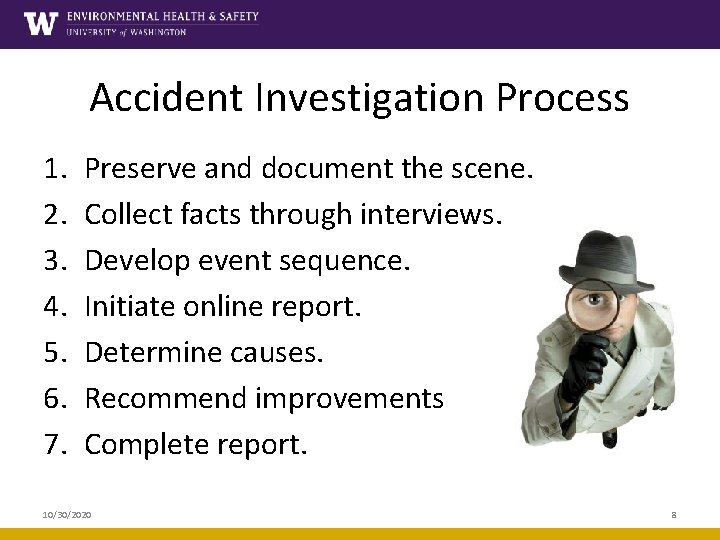
Accident Investigation Process 1. 2. 3. 4. 5. 6. 7. Preserve and document the scene. Collect facts through interviews. Develop event sequence. Initiate online report. Determine causes. Recommend improvements Complete report. 10/30/2020 8
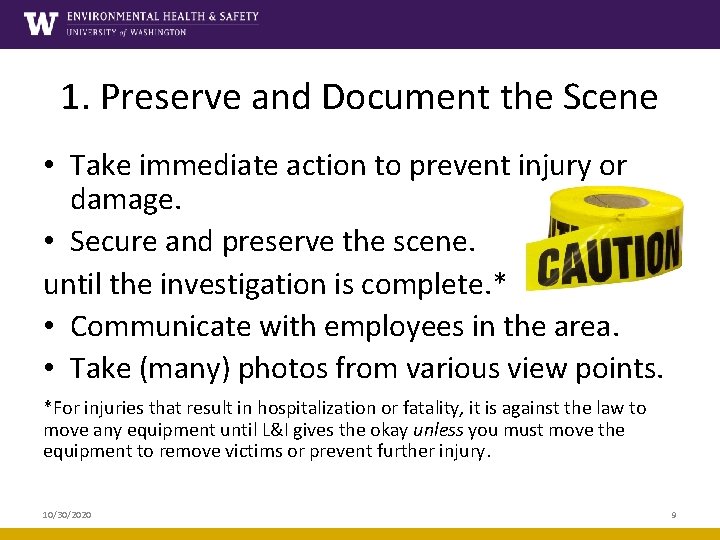
1. Preserve and Document the Scene • Take immediate action to prevent injury or damage. • Secure and preserve the scene. until the investigation is complete. * • Communicate with employees in the area. • Take (many) photos from various view points. *For injuries that result in hospitalization or fatality, it is against the law to move any equipment until L&I gives the okay unless you must move the equipment to remove victims or prevent further injury. 10/30/2020 9
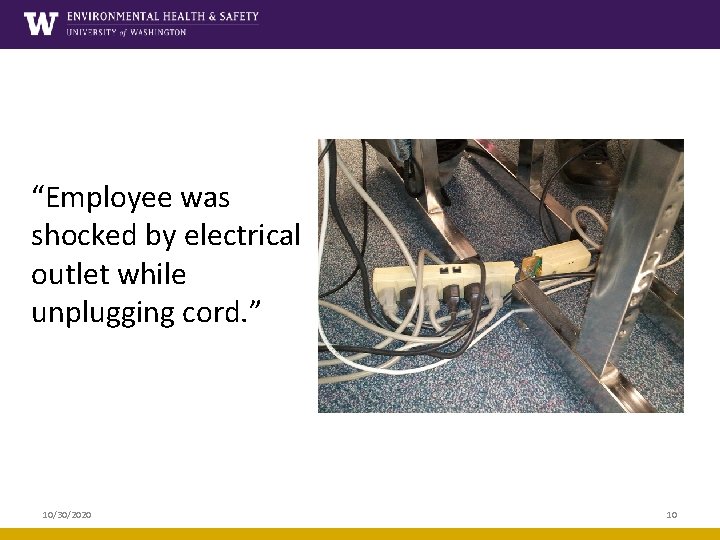
“Employee was shocked by electrical outlet while unplugging cord. ” 10/30/2020 10
2. Collect Facts Through Interviews • Interview affected employee(s) and witnesses as soon as possible. • Interview at the accident scene, if possible. • Keep the purpose of the investigation in mind. Make sure the interviewee understands as well. • Ask for the interviewee’s suggestions. 10/30/2020 11
3. Develop the Sequence of Events • Analyze the accident by breaking down – Events prior to accident – Events during – Events immediately after • Identify gaps in your timeline and gather additional facts and information as needed. 10/30/2020 12
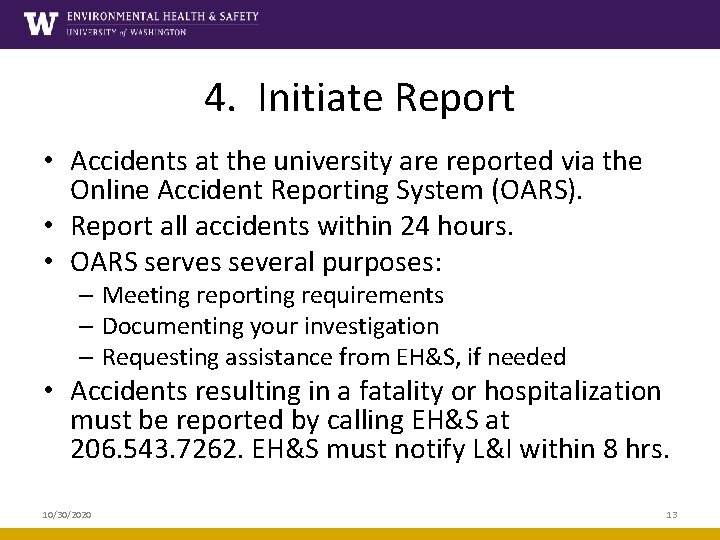
4. Initiate Report • Accidents at the university are reported via the Online Accident Reporting System (OARS). • Report all accidents within 24 hours. • OARS serves several purposes: – Meeting reporting requirements – Documenting your investigation – Requesting assistance from EH&S, if needed • Accidents resulting in a fatality or hospitalization must be reported by calling EH&S at 206. 543. 7262. EH&S must notify L&I within 8 hrs. 10/30/2020 13
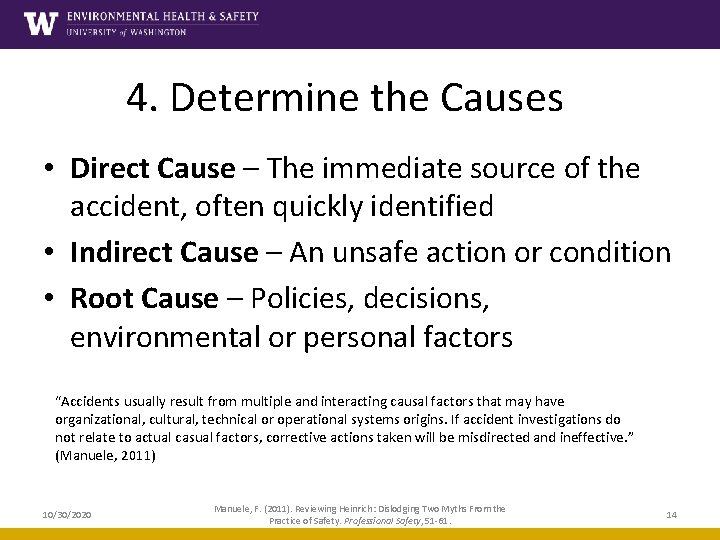
4. Determine the Causes • Direct Cause – The immediate source of the accident, often quickly identified • Indirect Cause – An unsafe action or condition • Root Cause – Policies, decisions, environmental or personal factors “Accidents usually result from multiple and interacting causal factors that may have organizational, cultural, technical or operational systems origins. If accident investigations do not relate to actual casual factors, corrective actions taken will be misdirected and ineffective. ” (Manuele, 2011) 10/30/2020 Manuele, F. (2011). Reviewing Heinrich: Dislodging Two Myths From the Practice of Safety. Professional Safety, 51 -61. 14
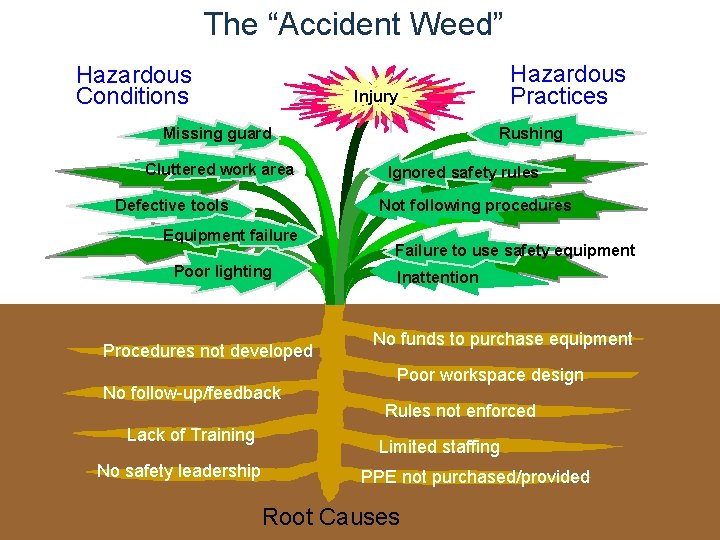
The “Accident Weed” Hazardous Conditions Injury Missing guard Cluttered work area Defective tools Poor lighting Procedures not developed No follow-up/feedback No safety leadership 10/30/2020 Rushing Ignored safety rules Not following procedures Equipment failure Lack of Training Hazardous Practices Failure to use safety equipment Inattention No funds to purchase equipment Poor workspace design Rules not enforced Limited staffing PPE not purchased/provided Root Causes 15
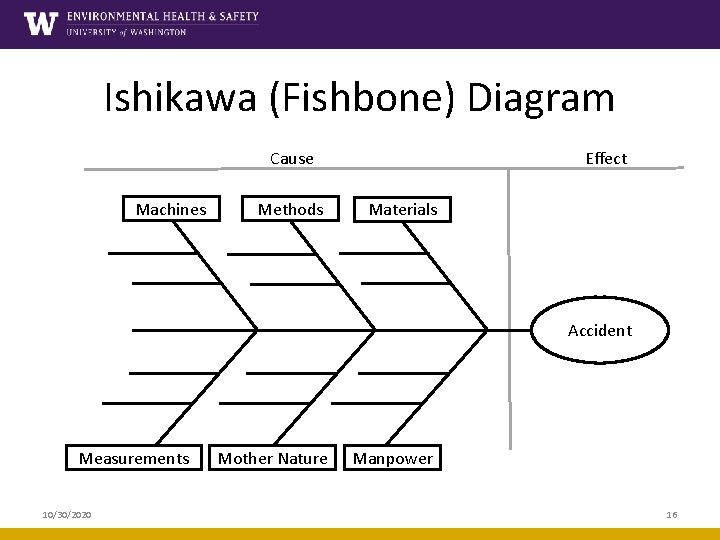
Ishikawa (Fishbone) Diagram Cause Machines Methods Effect Materials Accident Measurements 10/30/2020 Mother Nature Manpower 16
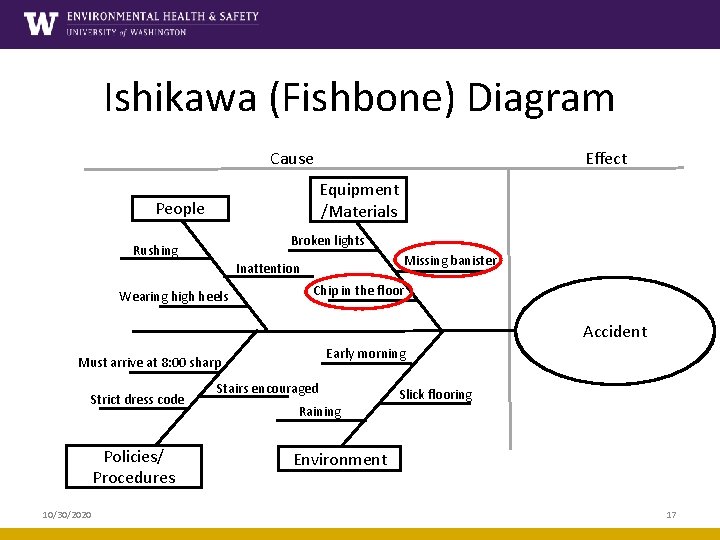
Ishikawa (Fishbone) Diagram Cause Effect Equipment /Materials People Broken lights Rushing Missing banister Inattention Wearing high heels Chip in the floor Early morning Must arrive at 8: 00 sharp Strict dress code Policies/ Procedures 10/30/2020 Stairs encouraged Raining Slipped and fell while walking up Accident stairs, spraining ankle Slick flooring Environment 17
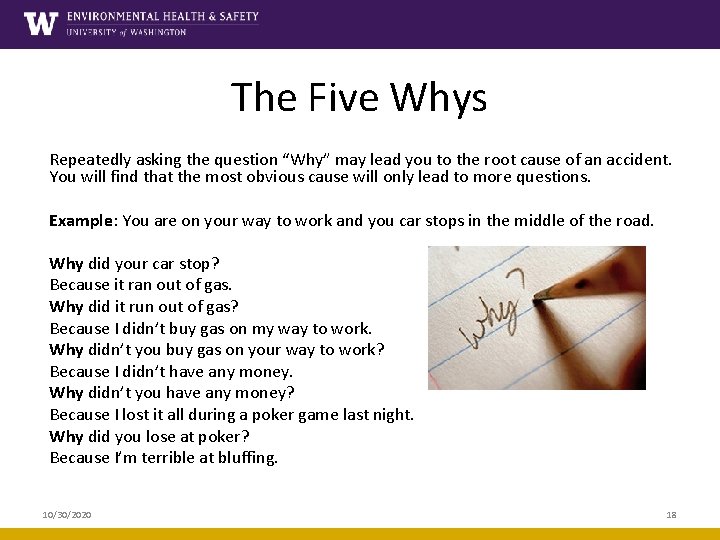
The Five Whys Repeatedly asking the question “Why” may lead you to the root cause of an accident. You will find that the most obvious cause will only lead to more questions. Example: You are on your way to work and you car stops in the middle of the road. Why did your car stop? Because it ran out of gas. Why did it run out of gas? Because I didn’t buy gas on my way to work. Why didn’t you buy gas on your way to work? Because I didn’t have any money. Why didn’t you have any money? Because I lost it all during a poker game last night. Why did you lose at poker? Because I’m terrible at bluffing. 10/30/2020 18
5. Recommend Improvements • Using your root cause analysis, look ahead to see how the risk of similar incidents can be reduced. • Identify solutions that are practical, specific, effective, and based on consultation. • Rank your solutions in order of priority. • Make a plan and take the first step. • Follow-up. 10/30/2020 19
6. Complete the Report • Document your findings in the OARS report. • Set a target date to complete your suggested corrective actions. • Once you complete the corrective actions or take the first step to completing the corrections, the report can be closed. • Continue to follow-up and make steps towards improvement. 10/30/2020 20
EH&S and Investigations • EH&S may assist with the investigation when an accident involves a: – – – Hospitalization or fatality Chemical spill and/or exposure Bloodborne pathogen exposure Recombinant/synthetic DNA exposure or spill. Fires Physical hazard such as a damaged sidewalk EH&S is available to assist with an investigation upon request. 10/30/2020 21
Room to Improve Two or More Equipment/ 9% Materials None 10% 9% Environment 14% Other 6% People 32% 10/30/2020 Policies/ Procedures/ Training 19% 22
Resources • EH&S website: http: //ehs. washington. edu/ – Online Accident Reporting System (OARS) http: //ehs. washington. edu/ohsoars/index. shtm – Safety Manuals and Publications http: //ehs. washington. edu/manuals/index. shtm – Safety Committees http: //www. ehs. washington. edu/ohssafcom/index. shtm 10/30/2020 23