
Accident Investigation Basic How to do Investigate workplace
Accident Investigation Basic § How to do Investigate workplace accidents for managers and supervisors
What you will learn § What is an accident or incident? § Why should you investigate both? § How do you find the true cause? § How should you investigate? § What should be the results of the investigation?

What Is An Accident? An unplanned, unwanted, but controllable event which disrupts the work process and causes injury to people.

What is an “Accident”? Definition: “an unforeseen event”, “chance”, “unexpected happening”, formerly “Act of God” • From experience and analysis: they are “caused occurrences” – Predictable - the logical outcome of hazards – Preventable and avoidable - hazards do not have to exist. They are caused by things people do -- or fail to do. Fatalities Severe Injuries Minor injuries Close calls Hazardous conditions

What Is An Incident? An incident may disrupt the work process, but does not result in injury or damage. It should be looked as a “wake up call”. It can be thought of as the first of a series of events which could lead to a situation in which harm or damage does occur. Example of an incident: A 50 lb carton falls off the top shelf of a 12’ high rack and lands near a worker. This event is unplanned, unwanted, and has the potential for injury.
Accidents Don’t Just Happen § An accident is not “just one of those things”. § Accidents are predictable and preventable events. § They don’t have to happen.
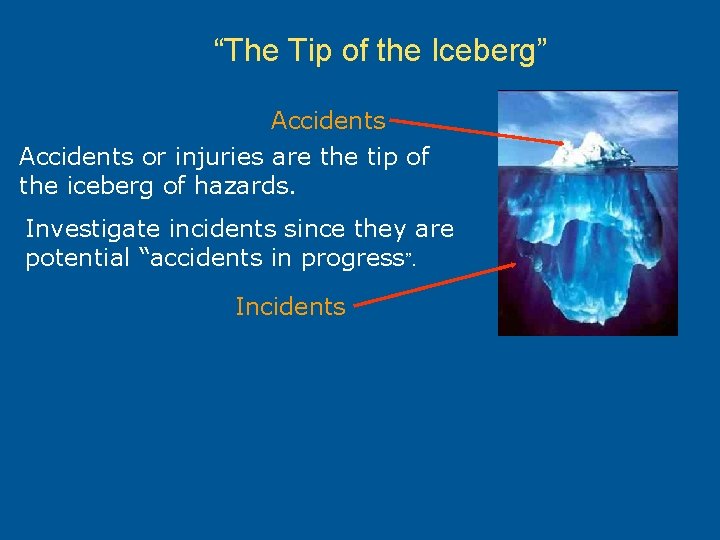
“The Tip of the Iceberg” Accidents or injuries are the tip of the iceberg of hazards. Investigate incidents since they are potential “accidents in progress”. Incidents
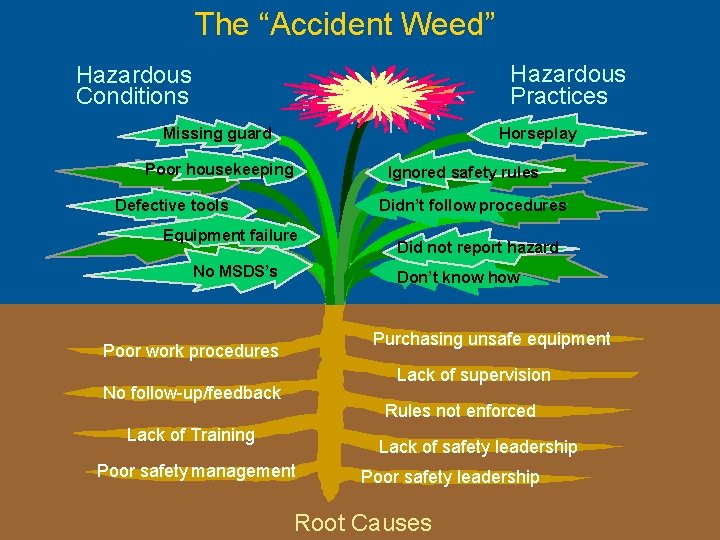
The “Accident Weed” Hazardous Practices Hazardous Conditions Missing guard Horseplay Poor housekeeping Ignored safety rules Defective tools Didn’t follow procedures Equipment failure No MSDS’s Did not report hazard Don’t know how Purchasing unsafe equipment Poor work procedures Lack of supervision No follow-up/feedback Rules not enforced Lack of Training Lack of safety leadership Poor safety management Poor safety leadership Root Causes

The Five Whys § Basic Question - Keeping asking “What caused or allowed this condition/practice to occur? ” until you get to root causes. My car will not start. (the problem) 1) Why? - The battery is dead. (first why) 2) Why? - The alternator is not functioning. (second why) 3) Why? - The alternator belt has broken. (third why) 4) Why? - The alternator belt was well beyond its useful service life and has never been replaced. (fourth why) 5) Why? - I have not been maintaining my car according to the recommended service schedule. (fifth why and the root cause) §

Why Investigate? § Prevent future incidents (leading to accidents). § Identify and eliminate hazards. § Expose deficiencies in process and/or equipment. § Reduce injury and worker compensation costs. § Maintain worker morale. § Meet regulatory standards.

Investigate All Incidents and Accidents § Conduct and document an investigation that answers: – – – Who was present? What activities were occurring? What happened? Where and what time? Why did it happen?

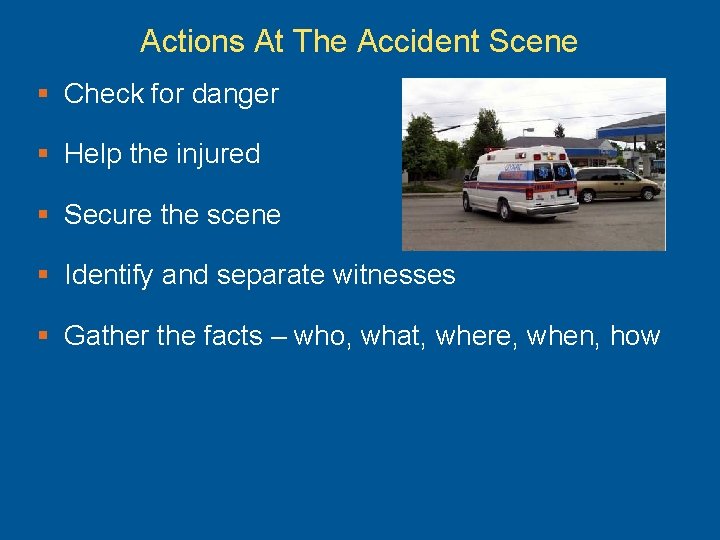
Actions At The Accident Scene § Check for danger § Help the injured § Secure the scene § Identify and separate witnesses § Gather the facts – who, what, where, when, how

Help the Injured § Provide First Aid – from the first aid kit § Call family member to take them home, DR. office, walk-in clinic or ER § Call on-campus EMT squad – 911 § Clean up bodily fluids § Pay the employee for the rest of the shift, if they seek medical treatment

Begin Investigation Immediately § It’s crucial to collect evidence and interview witnesses as soon as possible because evidence will disappear and people will forget.

Fact Finding § Witnesses and physical evidence § Position of tools and equipment § Equipment operation logs, charts, records

Document § Complete and online report § Take photographs or diagram § Preserve evidence if serious injury occurs

Online System § Accidents or work injury/illness (no incidents) § Complaints of personal injuries that could later be claimed as work related § Timely § Completely filled out SAP
Confidentiality § § All medical is confidential Do not keep copies of reports If printed must be shredded Do not discuss with those who have no need to know

Suspicious § Em’ee asks to leave work to go to the doctor about a sore wrist. They show up next day with a ace bandage on wrist. 3 rd day claims (witnessed) they hurt their wrist at work. They subsequently lie to the WC investigator that they had not seen a doctor or had an ace bandage on prior to the claimed date of injury.
Notify HR ASAP § Lost time § Medical treatment – Work-related at any time – Personal illness/injury and left work not by themselves § Death § More than 2 sent to hospital
MOST IMPORTANT § HOW CAN WE PREVENT THIS FROM HAPPENING AGAIN? ?
TAKE ACTION – Tuition already paid § Root Causes – enforcement, training, hurrying/horse play § Hazards – broken equipment, leaking floor, wrong chemical § 5 Whys – maybe a combination of causes
ACTIONS § § § Maintenance Work Order Retrain Signage Arrange space differently Remove or label clearly broken equipment Discipline employees

Lack Common Sense ? ? ?
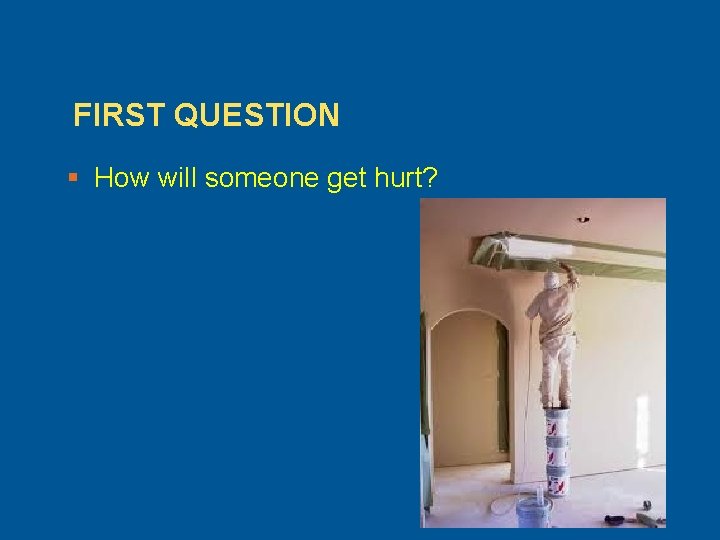
FIRST QUESTION § How will someone get hurt?
Beginning of the Semester § New employees and students § Existing employees not physically use to working/routine/lifting/standing § New equipment/New units – new hazards § Busy and lack student employees
New Employees § § § New to ASC or new to you Do not leave training up to co-workers Training is not “baptism under fire” How might this employee be injured? Take them on a tour of the unit and point out hazards
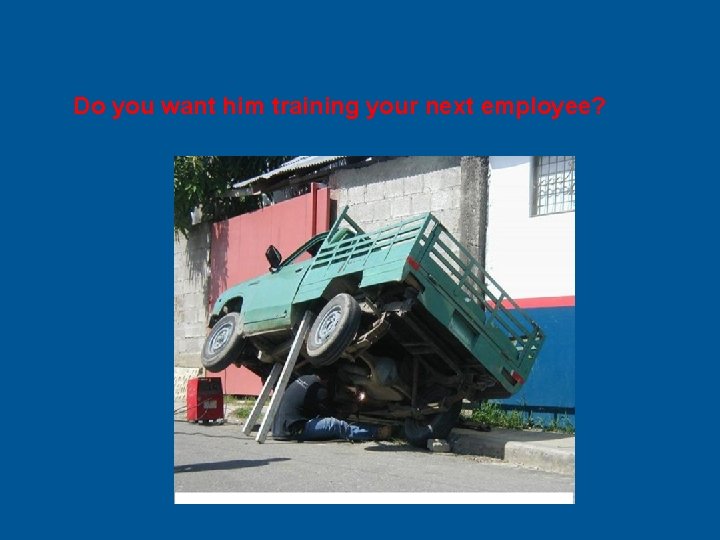
Do you want him training your next employee?
RECAP § § Take care of the injured Document accidents – Gather all facts Properly investigate accidents and incidences How can we prevent this from happening again? § ASK yourself: how will someone get hurt?
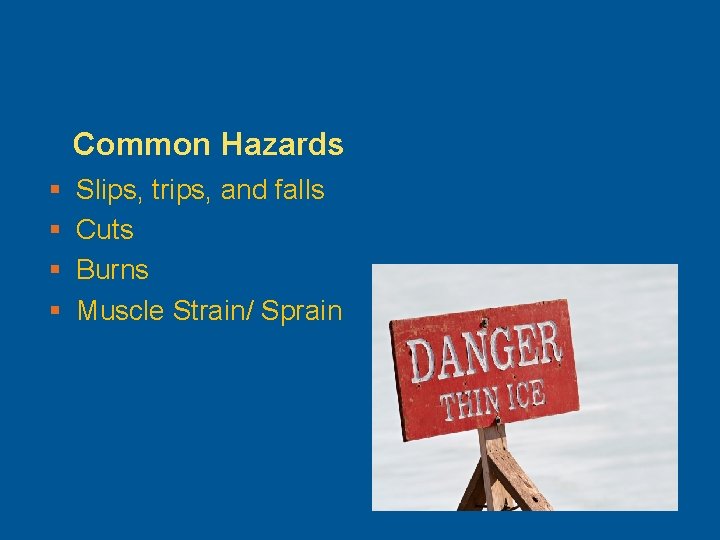
Common Hazards § § Slips, trips, and falls Cuts Burns Muscle Strain/ Sprain
Why is the rate of slips and falls higher in December than October?
What type of burns do you get in food service?
How will a cashier get a shoulder strain?
Most common way to get a cut at ASC?
- Slides: 36