
ACCIDENT CAUSATION Protect the Force Through Risk Management


- Slides: 34
ACCIDENT CAUSATION Protect the Force Through Risk Management 1
Early Man Protect the Force Through Risk Management 2
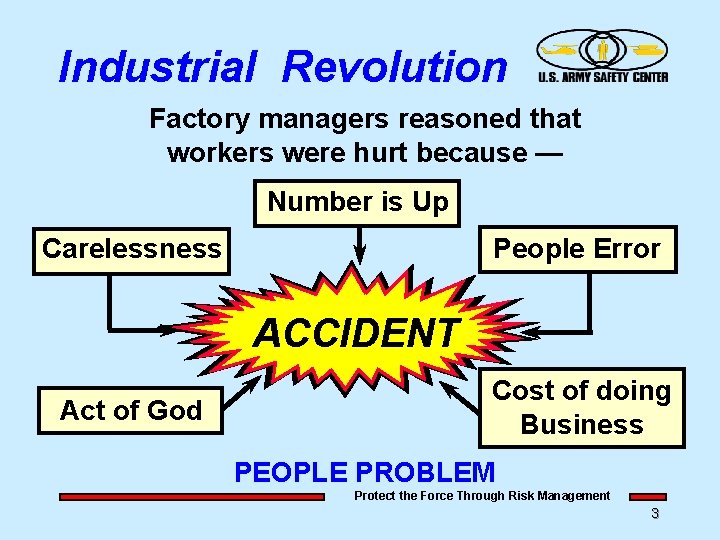
Industrial Revolution Factory managers reasoned that workers were hurt because — Number is Up Carelessness People Error ACCIDENT Act of God Cost of doing Business PEOPLE PROBLEM Protect the Force Through Risk Management 3
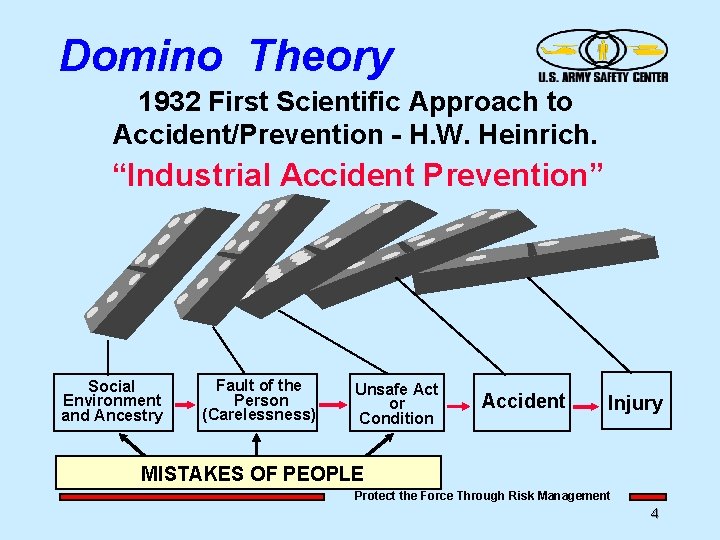
Domino Theory 1932 First Scientific Approach to Accident/Prevention - H. W. Heinrich. “Industrial Accident Prevention” Social Environment and Ancestry Fault of the Person (Carelessness) Unsafe Act or Condition Accident Injury MISTAKES OF PEOPLE Protect the Force Through Risk Management 4
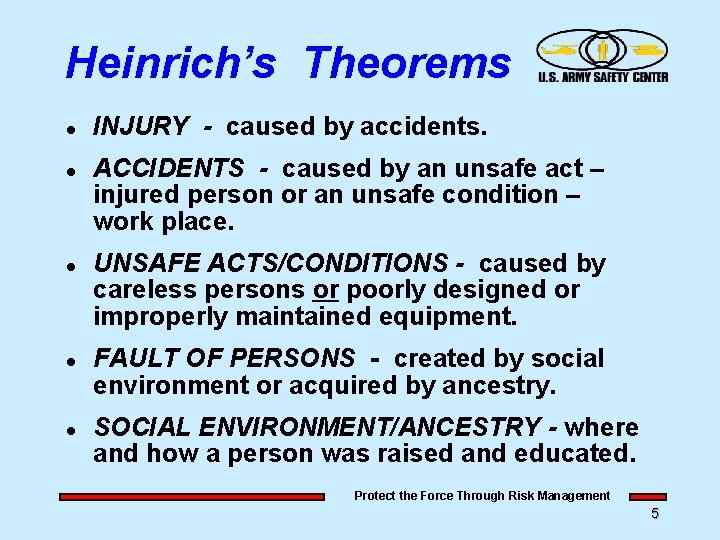
Heinrich’s Theorems l l l INJURY - caused by accidents. ACCIDENTS - caused by an unsafe act – injured person or an unsafe condition – work place. UNSAFE ACTS/CONDITIONS - caused by careless persons or poorly designed or improperly maintained equipment. FAULT OF PERSONS - created by social environment or acquired by ancestry. SOCIAL ENVIRONMENT/ANCESTRY - where and how a person was raised and educated. Protect the Force Through Risk Management 5
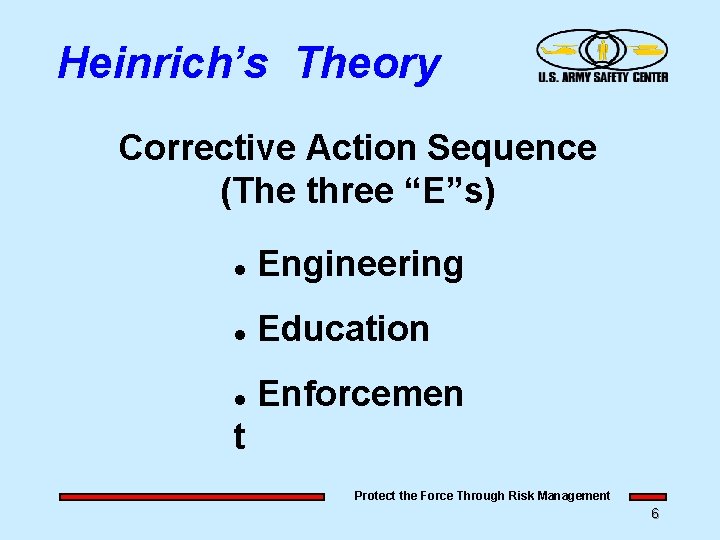
Heinrich’s Theory Corrective Action Sequence (The three “E”s) l Engineering l Education l Enforcemen t Protect the Force Through Risk Management 6
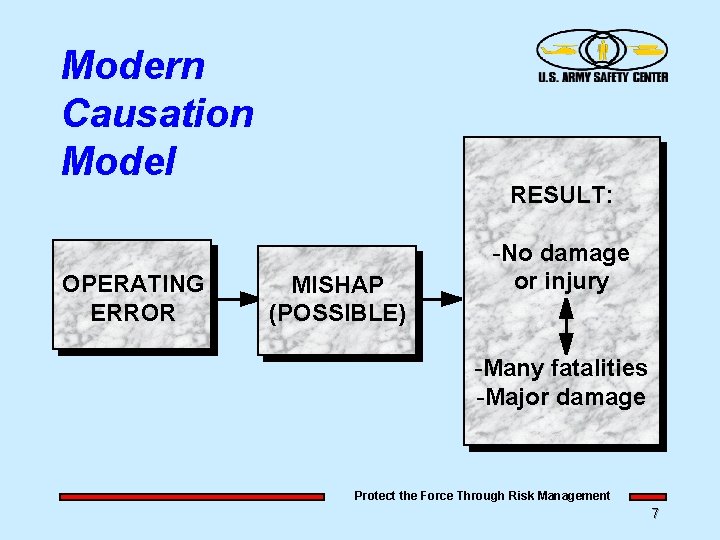
Modern Causation Model OPERATING ERROR RESULT: MISHAP (POSSIBLE) -No damage or injury -Many fatalities -Major damage Protect the Force Through Risk Management 7
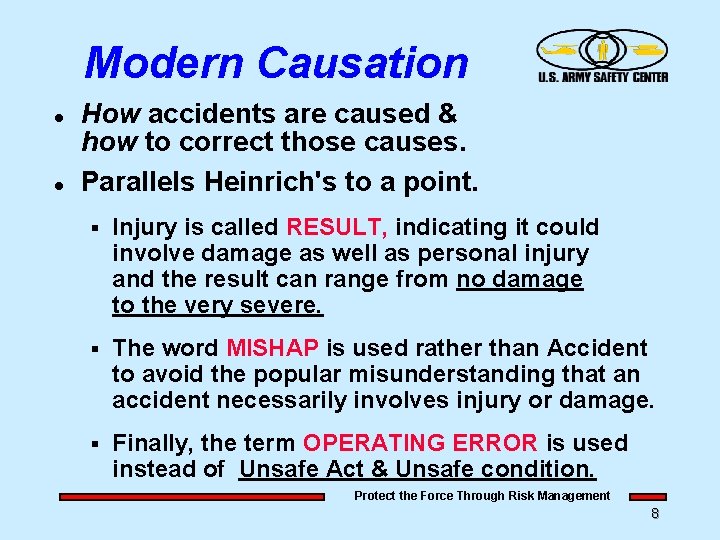
Modern Causation l l How accidents are caused & how to correct those causes. Parallels Heinrich's to a point. § Injury is called RESULT, indicating it could involve damage as well as personal injury and the result can range from no damage to the very severe. § The word MISHAP is used rather than Accident to avoid the popular misunderstanding that an accident necessarily involves injury or damage. § Finally, the term OPERATING ERROR is used instead of Unsafe Act & Unsafe condition. Protect the Force Through Risk Management 8
Examples Operating Errors: § Being in an unsafe position § Stacking supplies in unstable stacks § Poor housekeeping § Removing a guard Protect the Force Through Risk Management 9
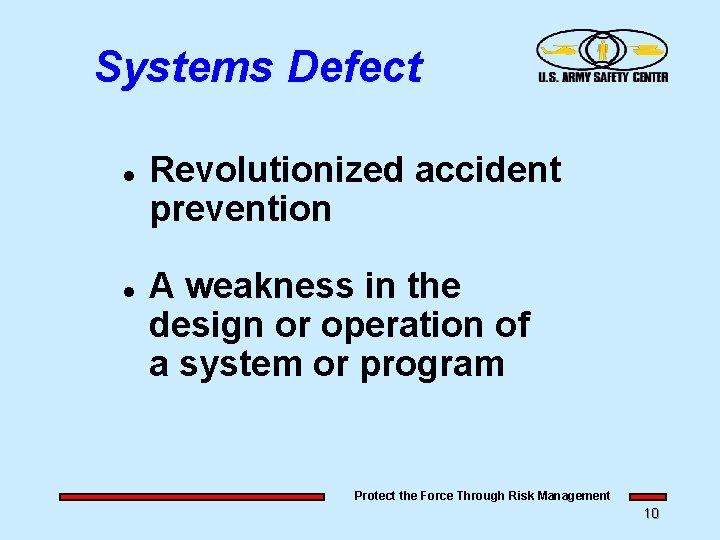
Systems Defect l l Revolutionized accident prevention A weakness in the design or operation of a system or program Protect the Force Through Risk Management 10
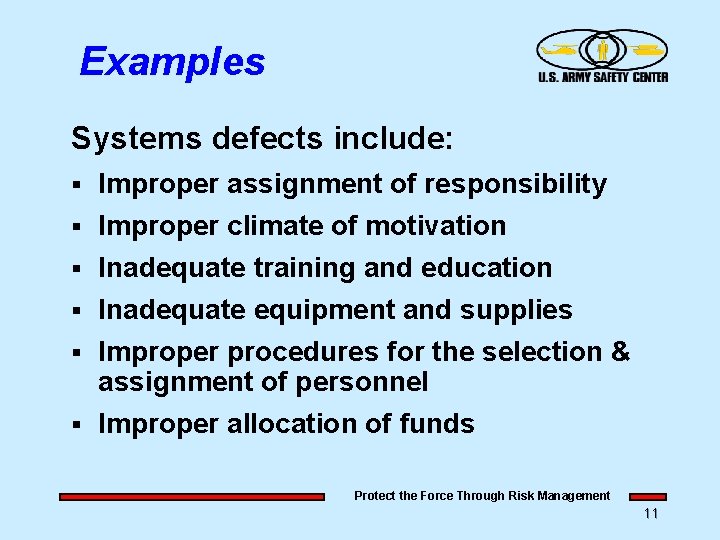
Examples Systems defects include: § Improper assignment of responsibility § Improper climate of motivation Inadequate training and education Inadequate equipment and supplies Improper procedures for the selection & assignment of personnel Improper allocation of funds § § Protect the Force Through Risk Management 11
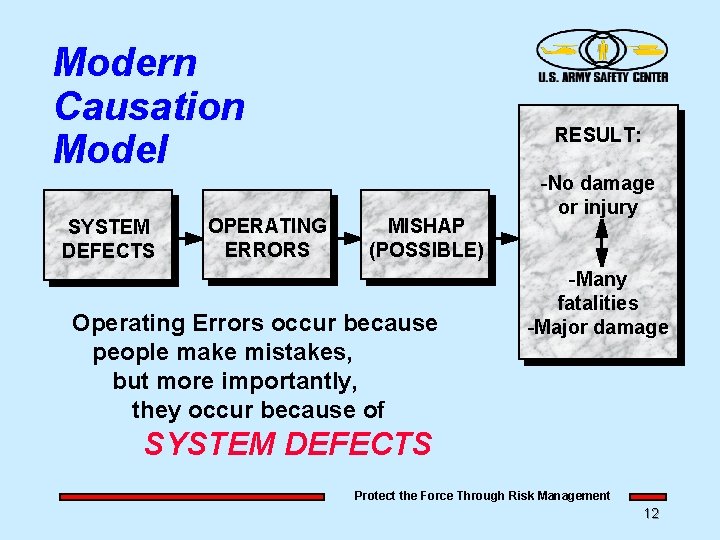
Modern Causation Model SYSTEM DEFECTS OPERATING ERRORS RESULT: MISHAP (POSSIBLE) Operating Errors occur because people make mistakes, but more importantly, they occur because of -No damage or injury -Many fatalities -Major damage SYSTEM DEFECTS Protect the Force Through Risk Management 12
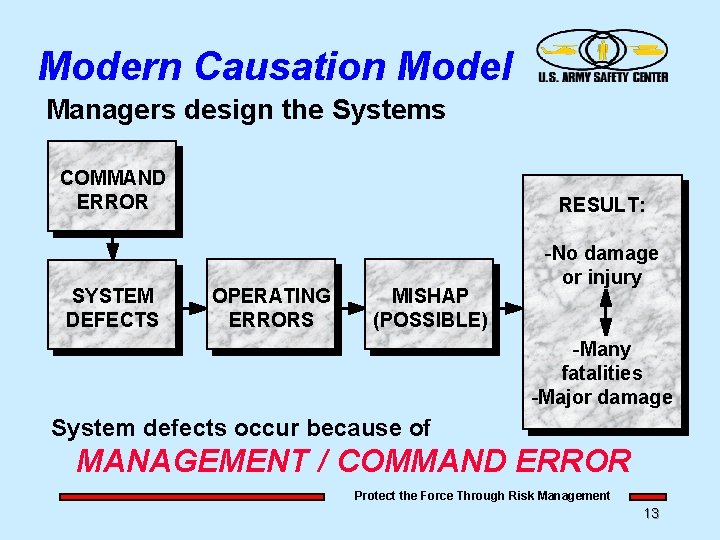
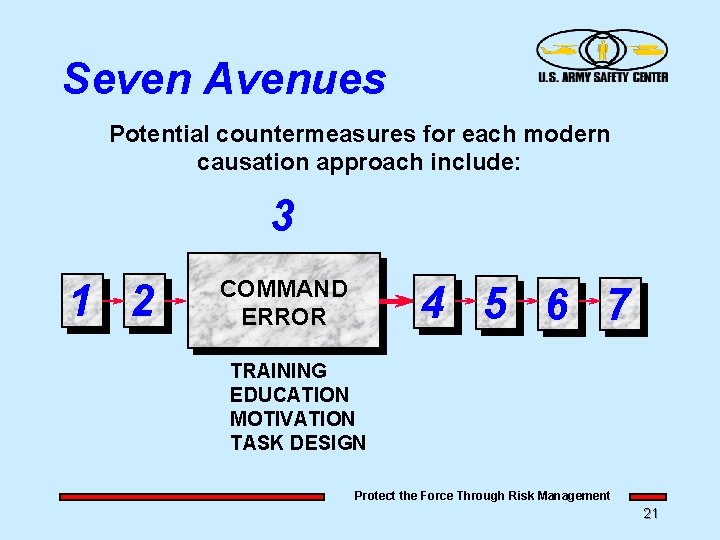
Modern Causation Model Managers design the Systems COMMAND ERROR SYSTEM DEFECTS RESULT: OPERATING ERRORS MISHAP (POSSIBLE) -No damage or injury -Many fatalities -Major damage System defects occur because of MANAGEMENT / COMMAND ERROR Protect the Force Through Risk Management 13
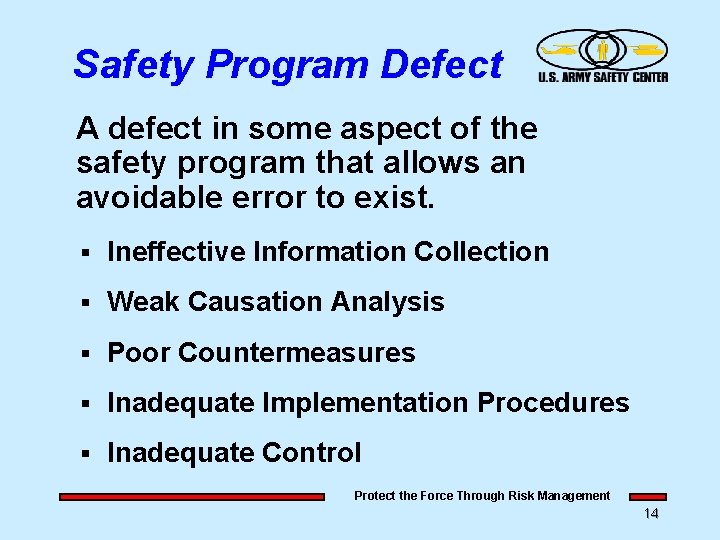
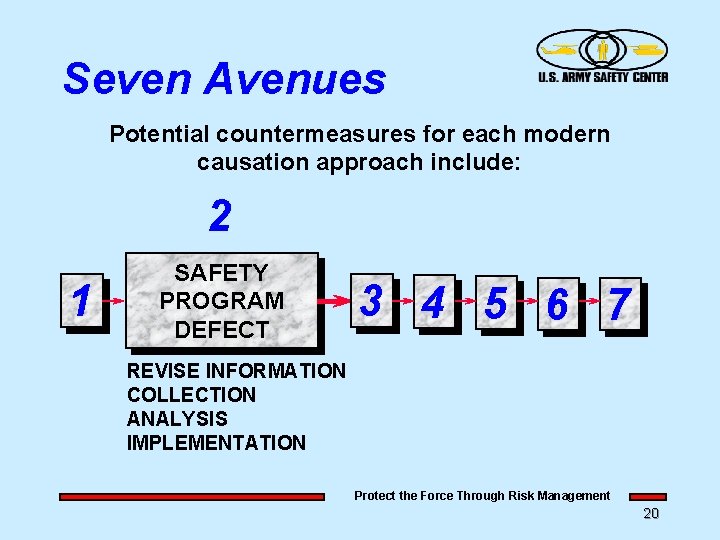
Safety Program Defect A defect in some aspect of the safety program that allows an avoidable error to exist. § Ineffective Information Collection § Weak Causation Analysis § Poor Countermeasures § Inadequate Implementation Procedures § Inadequate Control Protect the Force Through Risk Management 14
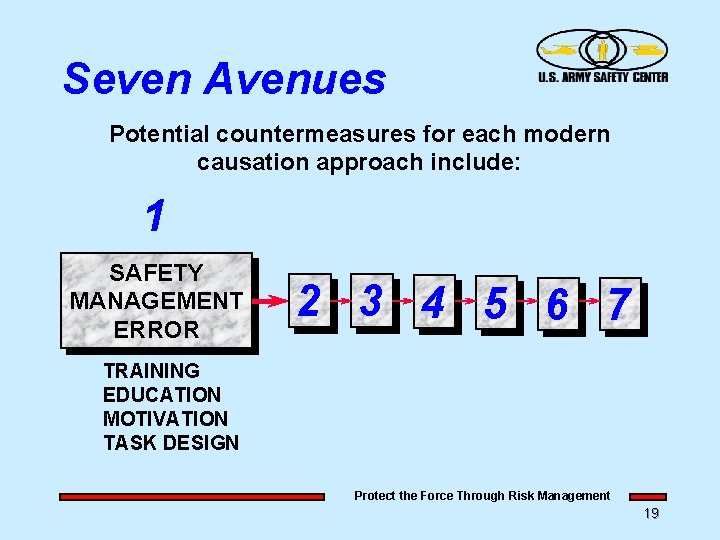
Safety Management Error A weakness in the knowledge or motivation of the safety manager that permits a preventable defect in the safety program to exist. SAFETY MANAGEMENT ERROR Protect the Force Through Risk Management 15
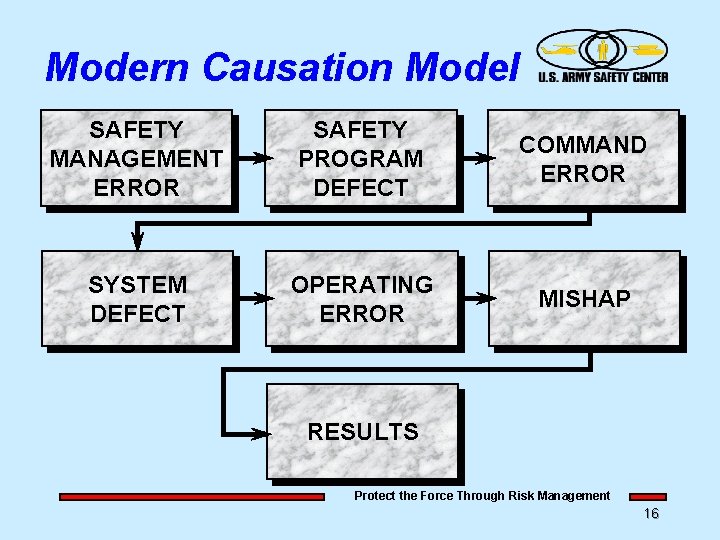
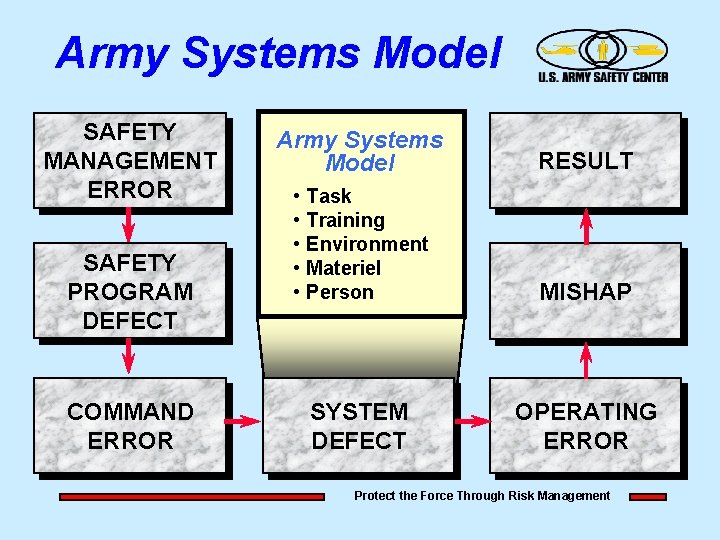
Modern Causation Model SAFETY MANAGEMENT ERROR SAFETY PROGRAM DEFECT COMMAND ERROR SYSTEM DEFECT OPERATING ERROR MISHAP RESULTS Protect the Force Through Risk Management 16
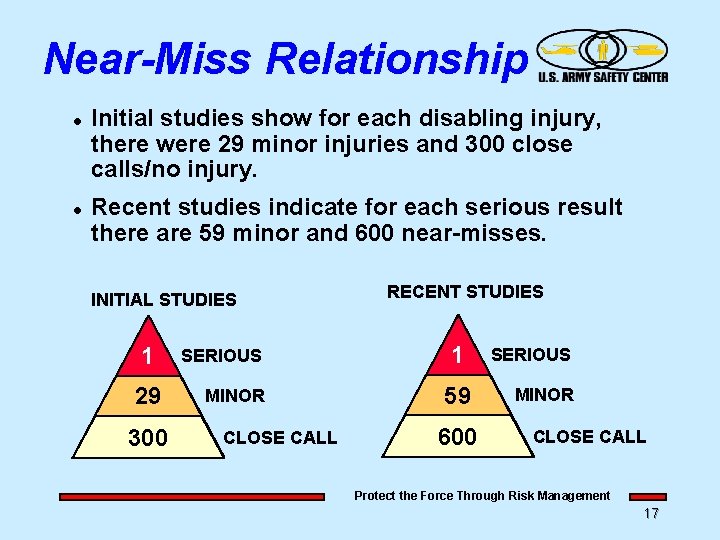
Near-Miss Relationship l l Initial studies show for each disabling injury, there were 29 minor injuries and 300 close calls/no injury. Recent studies indicate for each serious result there are 59 minor and 600 near-misses. INITIAL STUDIES 1 29 300 SERIOUS MINOR CLOSE CALL RECENT STUDIES 1 59 600 SERIOUS MINOR CLOSE CALL Protect the Force Through Risk Management 17
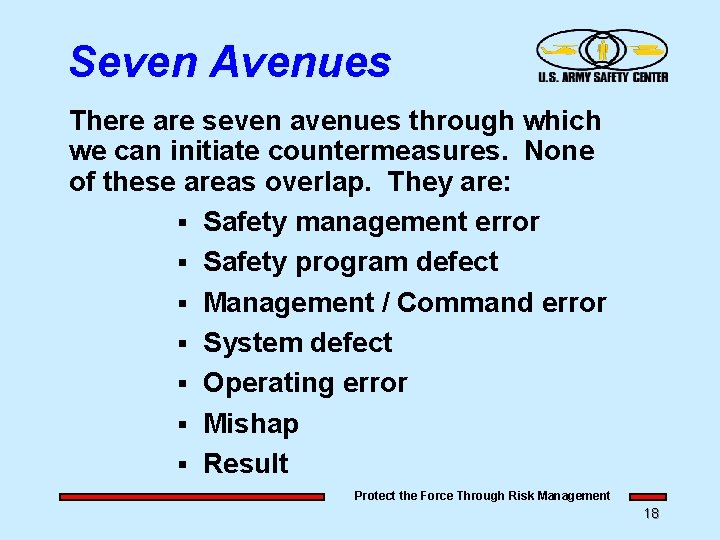
Seven Avenues There are seven avenues through which we can initiate countermeasures. None of these areas overlap. They are: § Safety management error § Safety program defect § Management / Command error § System defect § Operating error § Mishap § Result Protect the Force Through Risk Management 18
Seven Avenues Potential countermeasures for each modern causation approach include: 1 SAFETY MANAGEMENT ERROR 2 3 4 5 6 7 TRAINING EDUCATION MOTIVATION TASK DESIGN Protect the Force Through Risk Management 19
Seven Avenues Potential countermeasures for each modern causation approach include: 2 1 SAFETY PROGRAM DEFECT 3 4 5 6 7 REVISE INFORMATION COLLECTION ANALYSIS IMPLEMENTATION Protect the Force Through Risk Management 20
Seven Avenues Potential countermeasures for each modern causation approach include: 3 1 2 COMMAND ERROR 4 5 6 7 TRAINING EDUCATION MOTIVATION TASK DESIGN Protect the Force Through Risk Management 21
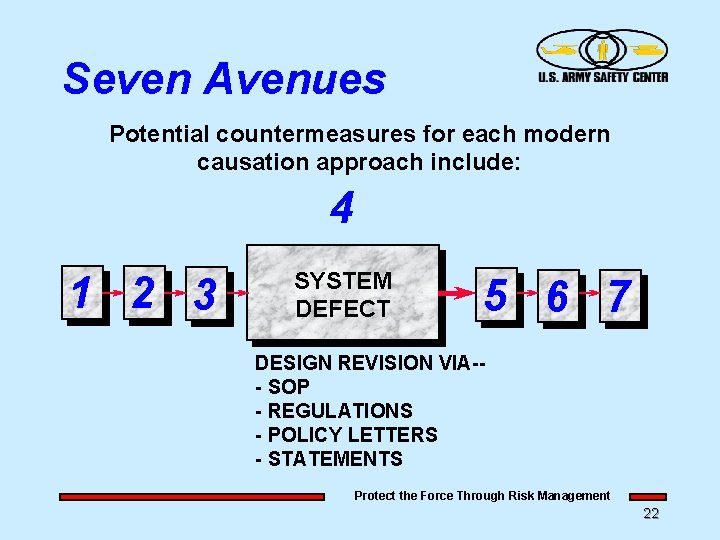
Seven Avenues Potential countermeasures for each modern causation approach include: 4 1 2 3 SYSTEM DEFECT 5 6 7 DESIGN REVISION VIA-- SOP - REGULATIONS - POLICY LETTERS - STATEMENTS Protect the Force Through Risk Management 22
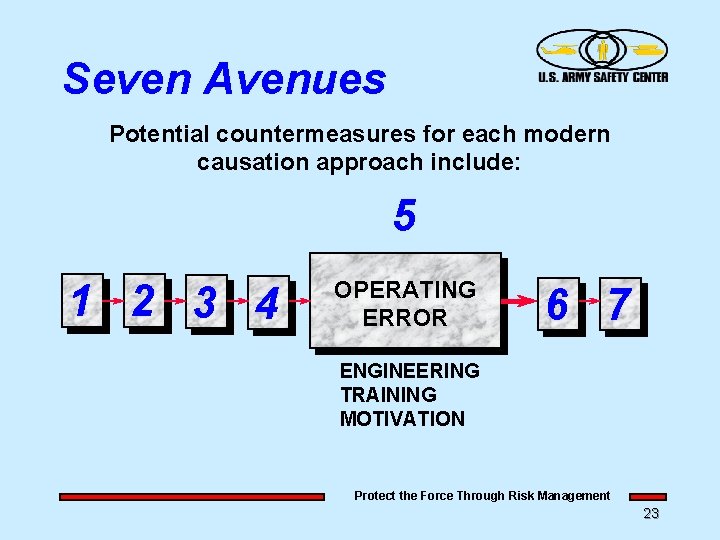
Seven Avenues Potential countermeasures for each modern causation approach include: 5 1 2 3 4 OPERATING ERROR 6 7 ENGINEERING TRAINING MOTIVATION Protect the Force Through Risk Management 23
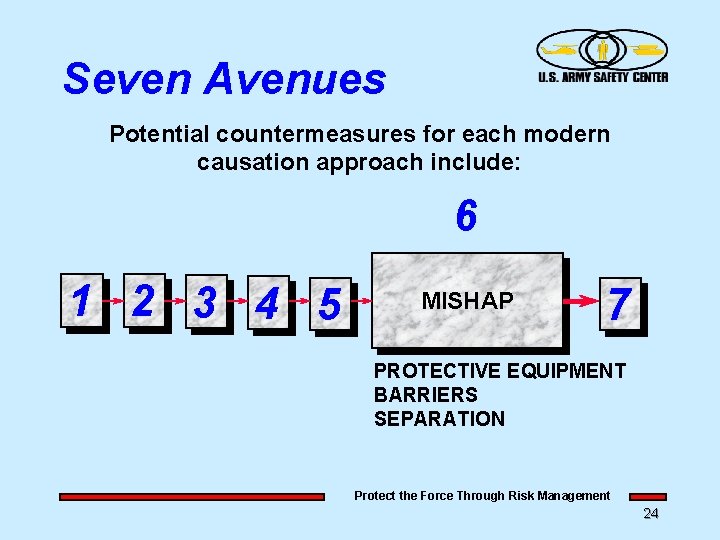
Seven Avenues Potential countermeasures for each modern causation approach include: 6 1 2 3 4 5 MISHAP 7 PROTECTIVE EQUIPMENT BARRIERS SEPARATION Protect the Force Through Risk Management 24
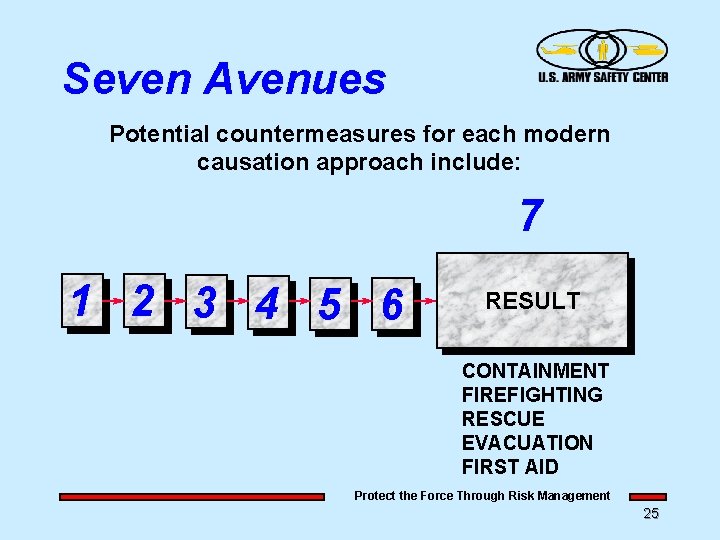
Seven Avenues Potential countermeasures for each modern causation approach include: 7 1 2 3 4 5 6 RESULT CONTAINMENT FIREFIGHTING RESCUE EVACUATION FIRST AID Protect the Force Through Risk Management 25
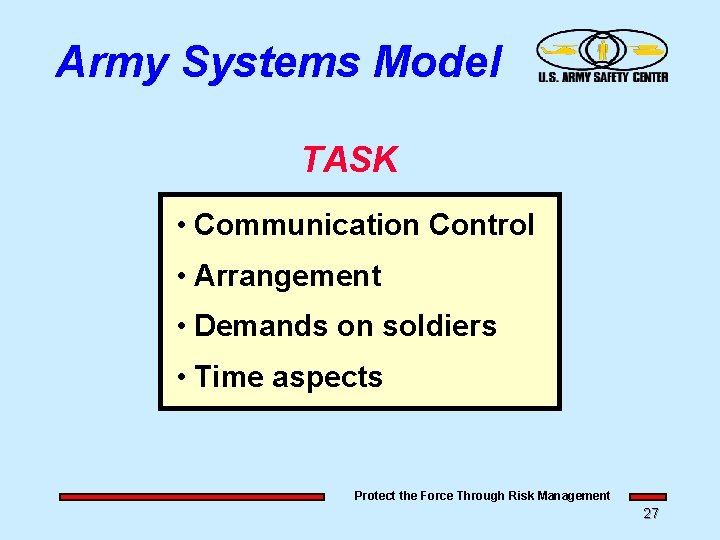
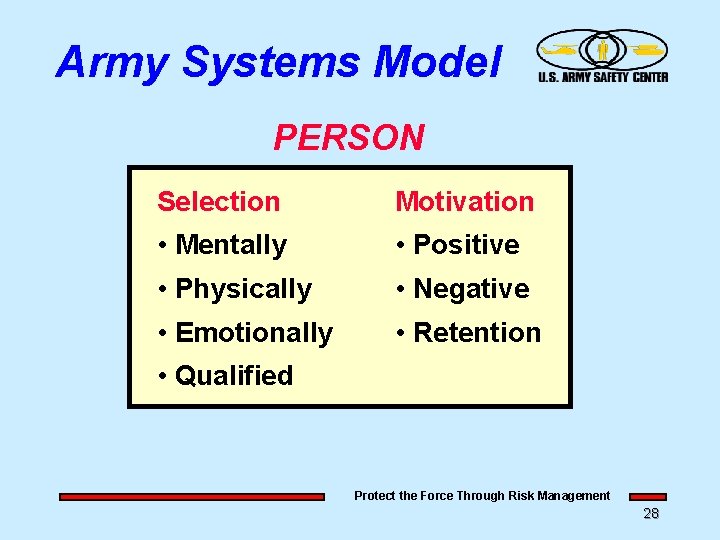
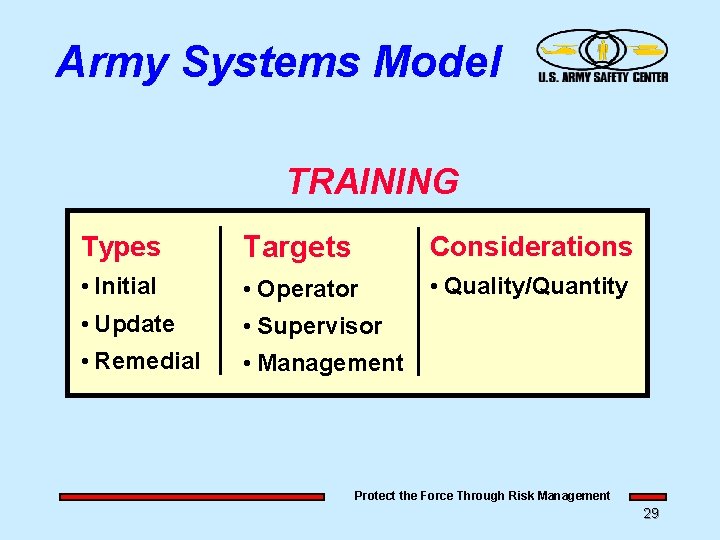
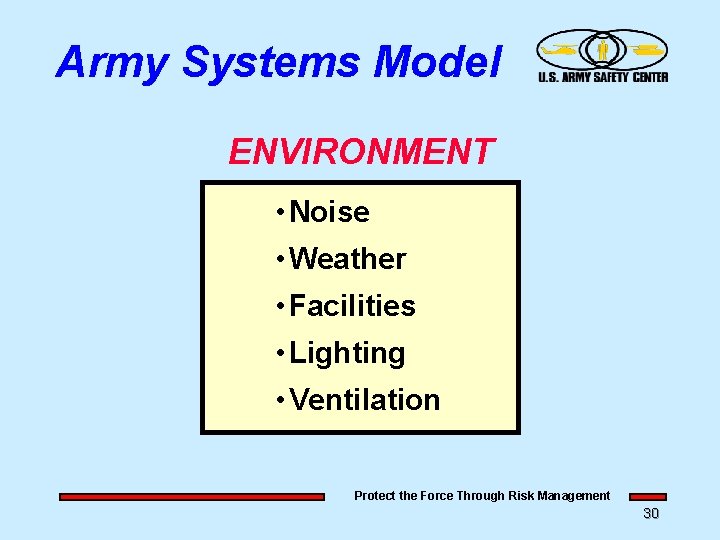
Army Systems Model A system is simply a group of interrelated parts which, when working together as they were designed to do, accomplish a goal. Using this analogy, an installation or organization can be viewed as a system. The elements of the Army Systems Model are: § Task § Person § Training § Environment § Materiel Protect the Force Through Risk Management 26
Army Systems Model TASK • Communication Control • Arrangement • Demands on soldiers • Time aspects Protect the Force Through Risk Management 27
Army Systems Model PERSON Selection Motivation • Mentally • Positive • Physically • Negative • Emotionally • Retention • Qualified Protect the Force Through Risk Management 28
Army Systems Model TRAINING Types Targets Considerations • Initial • Operator • Quality/Quantity • Update • Supervisor • Remedial • Management Protect the Force Through Risk Management 29
Army Systems Model ENVIRONMENT • Noise • Weather • Facilities • Lighting • Ventilation Protect the Force Through Risk Management 30
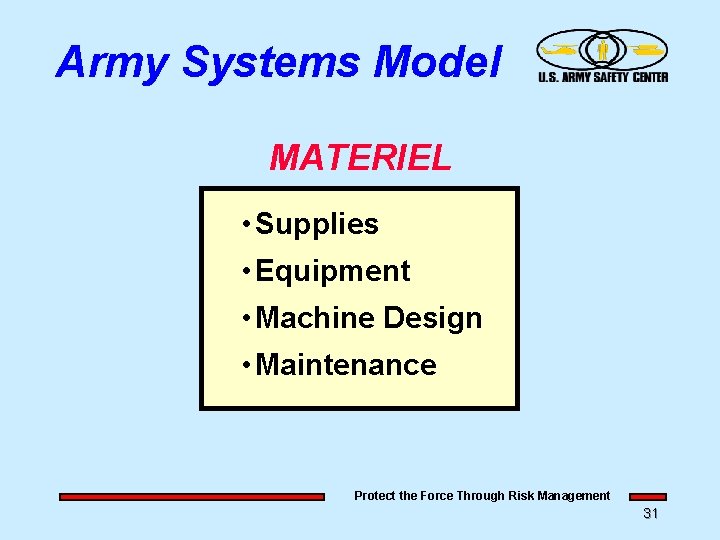
Army Systems Model MATERIEL • Supplies • Equipment • Machine Design • Maintenance Protect the Force Through Risk Management 31
Army Systems Model SAFETY MANAGEMENT ERROR SAFETY PROGRAM DEFECT COMMAND ERROR Army Systems Model • • • Task Training Environment Materiel Person SYSTEM DEFECT RESULT MISHAP OPERATING ERROR Protect the Force Through Risk Management
Protect the Force Through Risk Management 33
Protect the Force Through Risk Management 34